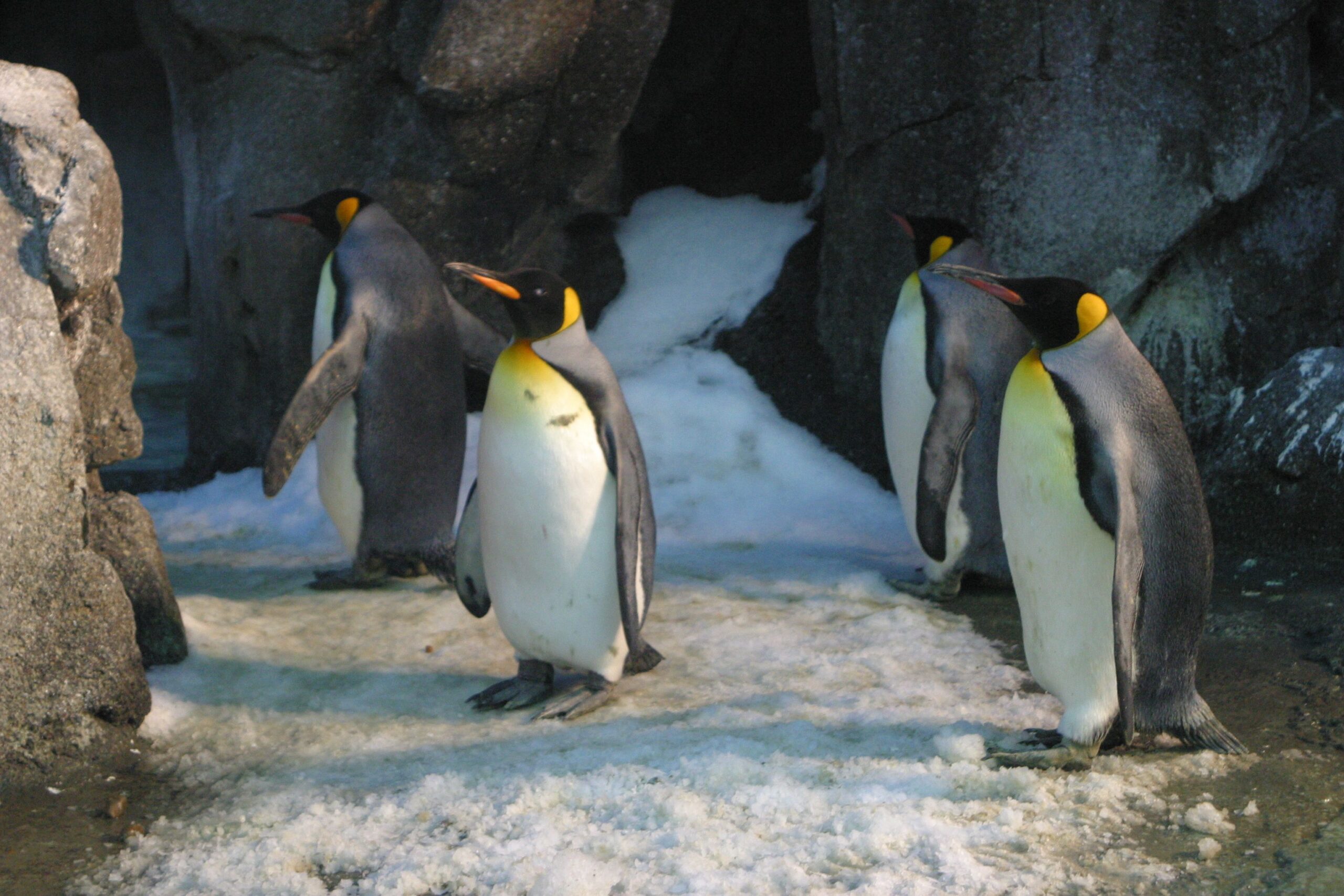
We will explain the characteristics, ecology, and habitat of king penguins. It is the next largest penguin after the emperor penguin and is very large, and its chicks can also be quite large. Their breeding grounds are a little far from Antarctica, so there are not many opportunities to meet people.



- Basic information about King Penguin
- What are the roots and origins of the King Penguin?
- What’s going on in taxonomy?
- About the king penguin habitat
- feature is? What kind of creature is it?
- What will your personality look like?
- What is the ecology of king penguins?
- King Penguin Molting
- King Penguin Diving
- King Penguin Calls
- Seasonal Activities of King Penguins
- About King Penguin Chicks
- Are king penguins an endangered species?
- Is it possible to keep king penguins?
- Zoos where they are kept (Japan and around the world)
- Fellow members of the same group
Basic information about King Penguin
King penguin is also known as king penguin. The second largest type of penguin, the body length is about 85-95 cm and the weight is 10-16 kg. It is a bird classified in the genus King Penguin of the order Penguinidae and is the same species as the emperor penguin.
| Japanese(和名) | キングペンギン、オウサマペンギン |
| English(英名) | King Penguin |
| scientific name(学名) | Aptenodytes patagonicus |
| classification(分類) | Sphenisciformes, Spheniscidae, Aptenodytes ペンギン目ペンギン科オウサマペンギン属 |
| IUCN Status(保全状況) | LEAST CONCERN |
| Height(身長) | 85-95cm |
| Weight(体重) | 10-16kg |
What are the roots and origins of the King Penguin?
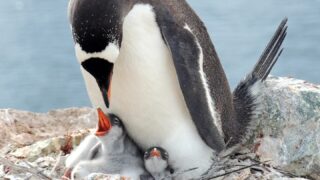
The roots of the King Penguin lie in ancient penguins shared with the Emperor Penguin.
Penguin Ancestors
The origin of penguins dates back approximately 60 million years.
The Waimanu, known as one of the oldest penguin species, lived in New Zealand approximately 61 million years ago.
It is believed that the ancestors of the King Penguin at that time had already largely lost their ability to fly and were beginning to specialize in swimming.
King Penguin Lineage
King penguins belong to the genus Aptenodytes.
This genus contains only two extant species:
King Penguin
Emperor Penguin
Genetic studies suggest that these two species are the most closely related penguins and diverged from a common ancestor millions of years ago.
Where did they evolve?
King penguins are thought to have evolved not on the Antarctic continent itself, but in sub-Antarctic regions such as:
South Georgia Island
Crozet Islands
Kerguelen Islands
Macquarie Island
What’s going on in taxonomy?
In 1778, British illustrator John Frederick Miller published a hand-colored print of a king penguin. As a result, this species gained attention and became known as the largest penguin, earning it the nickname “King.” However, an even larger emperor penguin was discovered and was given the name “Emperor”.
| 名前 : Name | 属名 : genus name | 生息地 : Habitat |
| コウテイペンギン(Emperor Penguin) | Aptenodytes コウテイペンギン属 | Antarctica |
| キングペンギン(King Penguin) | Aptenodytes コウテイペンギン属 | South Atlantic, Indian Ocean |
King Penguin Classification
Kingdom: Animalia
Phylum: Chordata
Class: Aves
Order: Sphenisciformes
Family: Spheniscidae
Genus: Aptenodytes
Species: King Penguin (Aptenodytes patagonicus)
About the king penguin habitat
King penguins mainly live on South Georgia Island and the Falkland Islands, but can also be found on Kergren Island, Heard Island, Macquarie Island, Crozet Islands, and Prince Edward Islands, near the South American continent but not in Antarctica. Records show that they live close to the habitats of Gentoo and Adelie penguins, and can be seen on icy islands. On land, their large yellow and orange walking forms can be photographed and viewed online.
- Geographic Distribution
Mainly found on sub-Antarctic islands
South Georgia, Falkland Islands, South Sandwich Islands, Crozet Islands
Distributed in cool island regions around South America and Antarctica
Rarely found off the coast of Antarctica
- Habitat Characteristics
On land
Nests on rocks, gravel, and grassland
Forms colonies and lives in groups during the breeding season
In the ocean
Feeds on fish, krill, and squid in cold coastal waters
May travel long distances at sea to forage
- Breeding Sites
Breeding occurs mainly along the coasts of sub-Antarctic islands
Forms large colonies of tens of thousands of birds on some islands
Lays eggs in burrows or on gravel in island environments with little sea ice
- Environmental Adaptations
Thick feathers and blubber allow them to withstand cold waters and winds
Huddles together in groups for protection and cold weather
Can swim long distances depending on ocean currents and the distribution of food
feature is? What kind of creature is it?
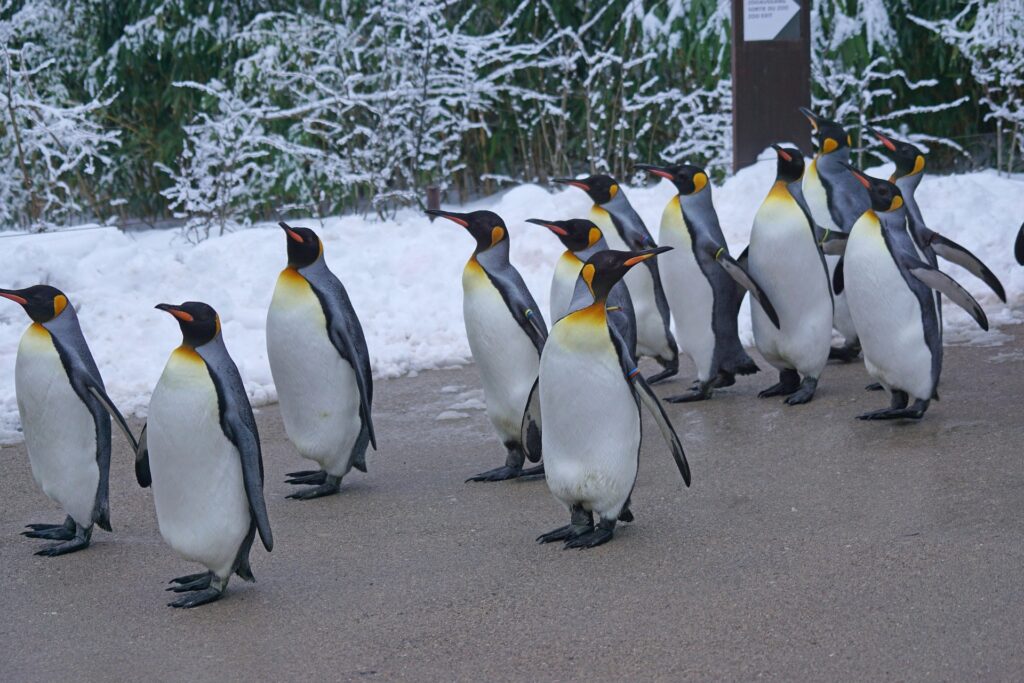
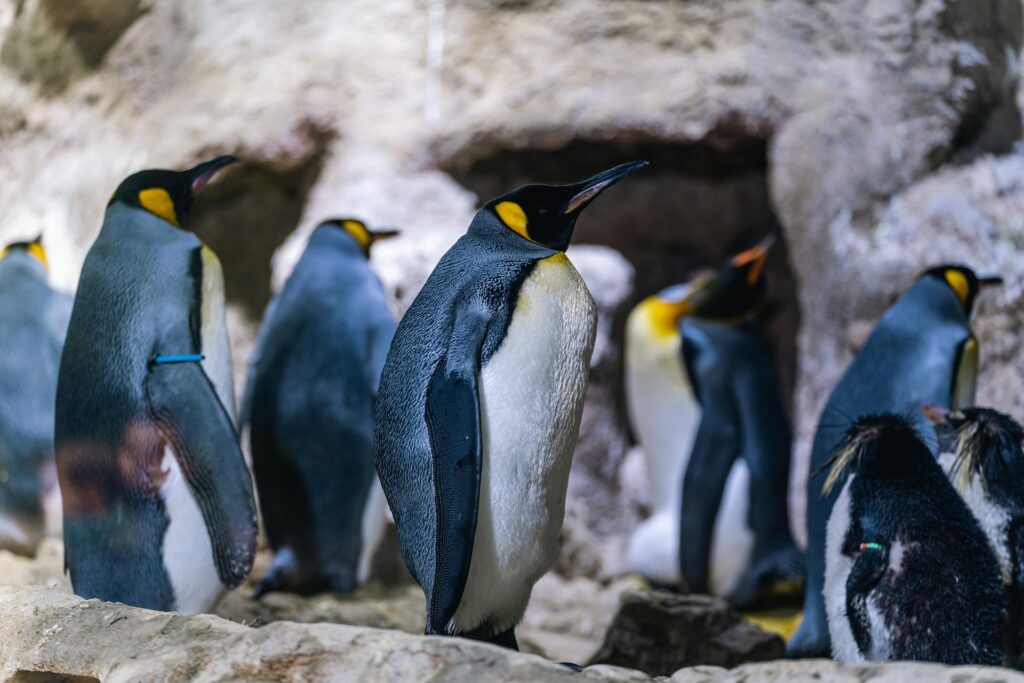
King penguins have black feathers on the outside of their heads and flippers, and look quite similar to emperor penguins. Their backs are gray, and the sides of their heads around their ears are orange. Their beaks are large, slender, and slightly curved, making them the longest of all penguins. In the sea, penguins’ legs extend from their bodies and act as rudders. The parents use their large bodies and beaks to get food for their chicks in the nest.
- Body Shape and Size
Body Length: Approximately 90-100 cm
Weight: 11-16 kg (varies depending on the individual and the season)
Although not as large as emperor penguins, they are large among sub-Antarctic penguins.
Their streamlined bodies are well-suited for swimming.
- Feather Color
Back: Blue-gray
Belly: White
Bright orange pattern from neck to chest
Black and orange gradation from the sides of the face to the chest
This coloring is important for individual identification and courtship behavior.
- Behavior and Habits
Excellent swimmers: They feed on fish, squid, and krill in the ocean.
They can travel long distances at sea to search for food.
They form colonies during the breeding season and are highly social.
- Breeding
Breeding season is the subantarctic summer (November to March)
Eggs are laid on rocks or gravel, and each egg is incubated.
Parents take turns incubating the egg until it hatches.
Compared to emperor penguins, the breeding season is longer, taking approximately 54 days from egg to hatch.
- Sociality
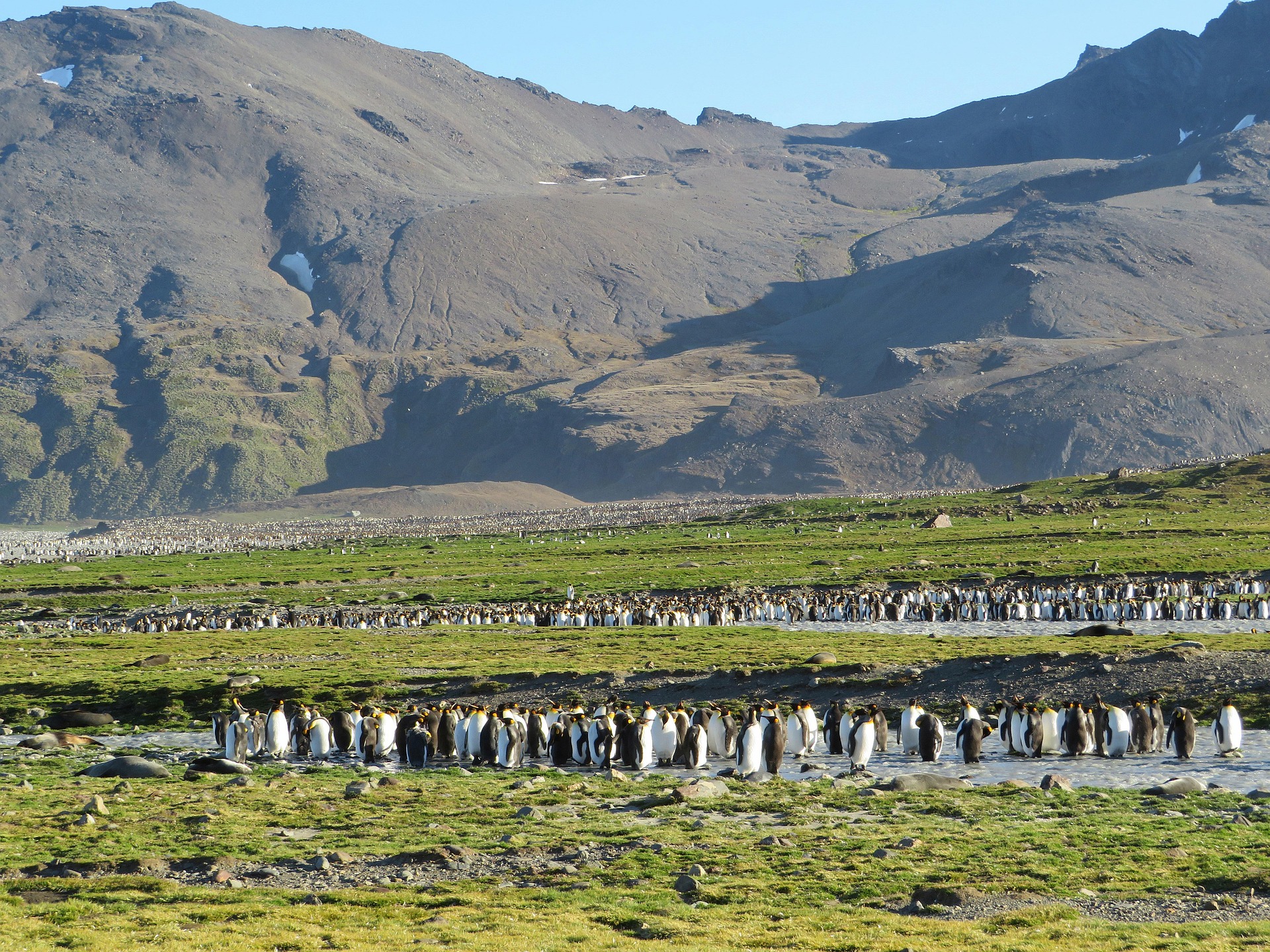
Live in large colonies.
Parents and offspring recognize each other by their calls and color patterns.
They cooperate to protect eggs and chicks, and huddle together to keep warm.
- Ecological Characteristics
Adapted to the cool subantarctic islands.
They tolerate the cold with thick feathers and blubber.
They swim long distances to find food sources and forage efficiently.
What will your personality look like?
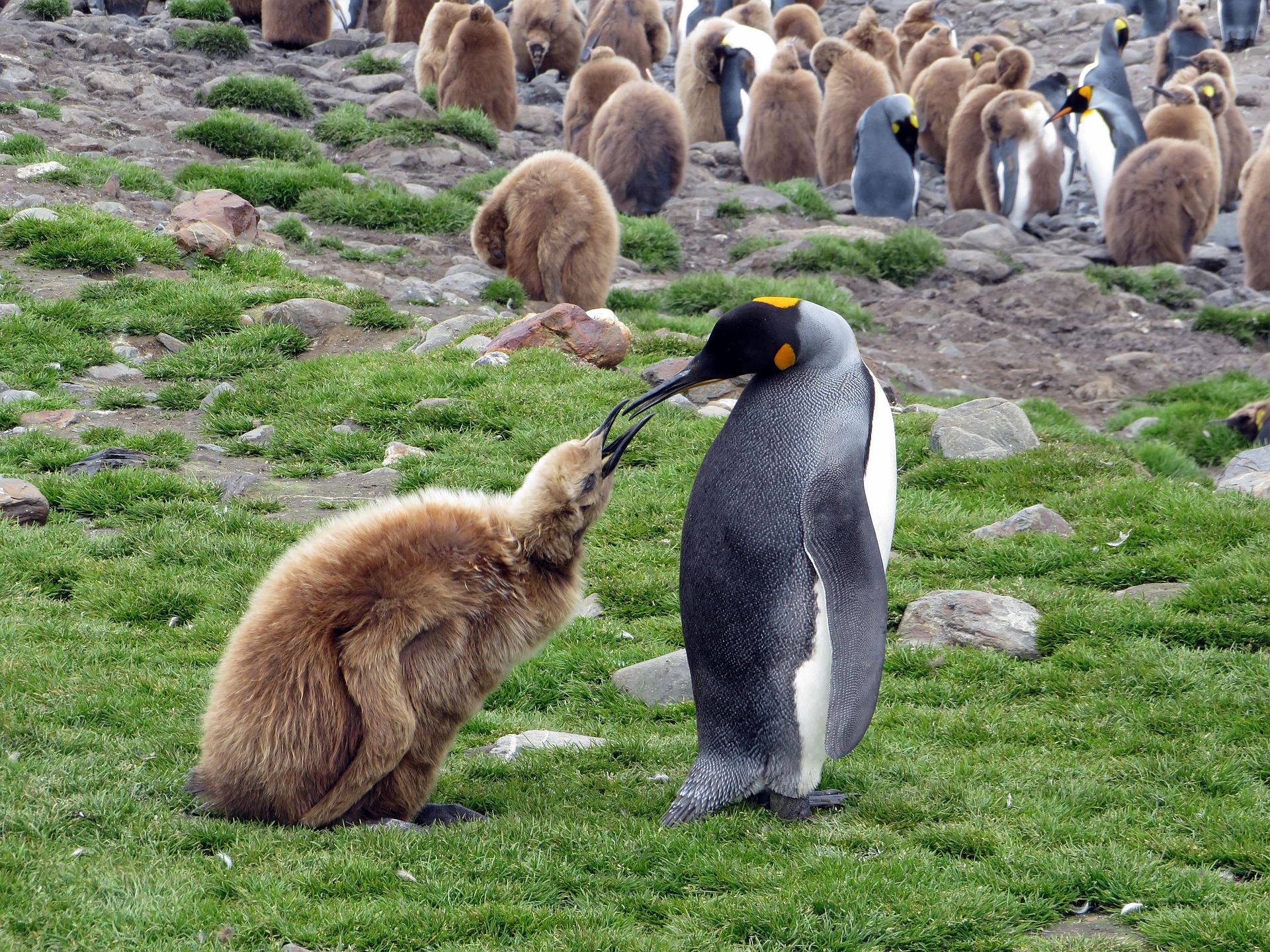
King penguins are calm and non-aggressive. King penguins have a habit of moving in groups, are said to be a species that is less prone to conflicts, and have a weak sense of territory. They are said to be cooperative animals because they act in groups to get food. They are also very courageous and will not run away even if a human approaches them.
- Highly Social
During the breeding season, they form colonies of thousands to tens of thousands of birds.
They work together as a group to protect their eggs and chicks.
Huddling behavior (collaborating together to protect from the cold) and other interactions with other birds are essential.
- Cooperative and Responsible
Monogamous and have strong pair bonds.
Parents take turns in incubating eggs and raising the chicks.
Sometimes pair pairs remain together for long periods of time.
- Alert
Sensitive to predators (birds and introduced predators) and environmental changes.
During the breeding season, they are alert to their surroundings in order to protect their nests and chicks.
- Gentle and Patient
Due to their adaptation to harsh environments, they have a calm and patient personality.
They are relatively calm in captivity and rarely aggressive towards humans.
- Curiosity
In captivity or under observation, they may show interest in their surroundings.
In the wild, their vigilance takes priority, and they often flee when approached.
In summary, king penguins are highly social and cooperative creatures, patient, gentle, and loyal. They are cautious, but also curious when necessary.
What is the ecology of king penguins?
King penguins are territorial and form colonies. When chicks are born, they form a “creche,” a group of the same size as in the wild. This is to survive the cold and to protect themselves from predators. Research has shown that they can swim at an average speed of 8.4 km per hour and dive to depths of more than 220 meters. They eat sardines, squid, and crustaceans. During the breeding season, they store 3.2 to 3.6 kg of food per day, including food for maintaining and recovering weight and feeding the chicks. Egg-laying peaks in early summer, from mid-December to January. Males and females take turns incubating the eggs, which hatch in about 54 days. They are said to live for about 20 years.
- Ecology
Habitat
Live along the coasts of sub-Antarctic islands
South Georgia, the Falkland Islands, the South Sandwich Islands, etc.
Breed on island rocks and gravel, forage at sea
Behavior/Feeding
Excellent swimmers: Prey on fish, squid, krill, etc.
Capable of traveling long distances at sea to find food
Forages mainly in cool coastal waters
Breeding
Breeding season is the sub-Antarctic summer (November to March)
Eggs are laid, and both parents take turns incubating them
Hatching takes approximately 54 days, and both parents take turns caring for the chicks until they leave the nest
Live in colonies, collectively protecting their chicks
Sociality
Highly social species that live in colonies
Huddling behavior maintains body temperature
Parents and offspring identify each other through calls and patterns
- Lifespan
Average lifespan in the wild: 15-20 years
Captive: Individuals have been reported to live for over 25 years.
Lifespan varies depending on individual characteristics, reproductive success, and food resource availability.
- Distinctive Ecological Features
Adapted to the cool sub-Antarctic environment (feathers and blubber provide protection from the cold)
Efficiently capture prey by swimming long distances
Sociality and cooperation are directly linked to reproductive success
Natural predators at sea
Killer whales (Orcinus orca)
Attack king penguins swimming at sea
Seals (especially leopard seals)
Prey from the sea
Large seabirds (occasionally attack chicks)
Fulmars and skyrock gulls sometimes target chicks
Natural predators on land
Introduced predators: Cats, dogs, rats, etc.
Eggs and chicks are affected by predators introduced by humans
Intracolony conflict
Pecks at eggs and chicks are sometimes observed among members of the same species.
King Penguin Molting
Molting is an important event for king penguins, where old feathers are replaced with new ones.
Characteristics of Molting
Like emperor penguins, king penguins undergo a catastrophic molt, a simultaneous molting of the entire body.
The entire body’s feathers are replaced in a short period of time.
They cannot enter the sea because they lose their water resistance.
They cannot eat and fast during molting.
Therefore, they accumulate sufficient nutrients in the sea before molting.
When does it happen?
King penguins have a long breeding cycle, and while it varies slightly from individual to individual,
mainly from summer to autumn
molting occurs as a transition between parenting and breeding activities.
Because the climate is relatively mild on the sub-Antarctic islands, they do not molt in the extreme cold that emperor penguins experience.
How long does it last?
Approximately 3-4 weeks
During this period, they spend time on land.
They experience significant weight loss.
In some cases, they may lose nearly a third of their body weight.
Appearance during molting
During molting, king penguins:
Their feathers become mottled.
Old feathers fall out in clumps.
They appear shaggy.
Therefore, they look quite different from their usual beautiful appearance.
King Penguin Diving
King penguins are penguins with excellent diving abilities, second only to emperor penguins.
How deep can they dive?
Normal foraging: 50-300m
Deep dives: Over 500m
Maximum recorded dive depth: Approximately 340m-400m+
Most foraging takes place at around 100-250m, but they may dive even deeper in pursuit of prey.
How long can they stay underwater?
Normal: 3-7 minutes
Long dives: Around 10 minutes
Longest recorded dive: Approximately 10-12 minutes
While not quite at the level of emperor penguins, this is still a very impressive ability for a bird.
King Penguin Calls
King penguins have a distinctive, resonant call that is sometimes compared to a trumpet or a donkey’s bleating.
What does it sound like?
In written form, it sounds like:
“Ooo-ah”
“Quoo-quawk, quawk”
“Ah-oh, ah-oh”
It’s a low, drawn-out sound.
In breeding grounds, thousands to hundreds of thousands of king penguins gather, creating a very lively environment.
Why do they call?
① Communication with mates
During the breeding season, males and females call to each other,
using it for:
Courtship
Pair formation
Reunion
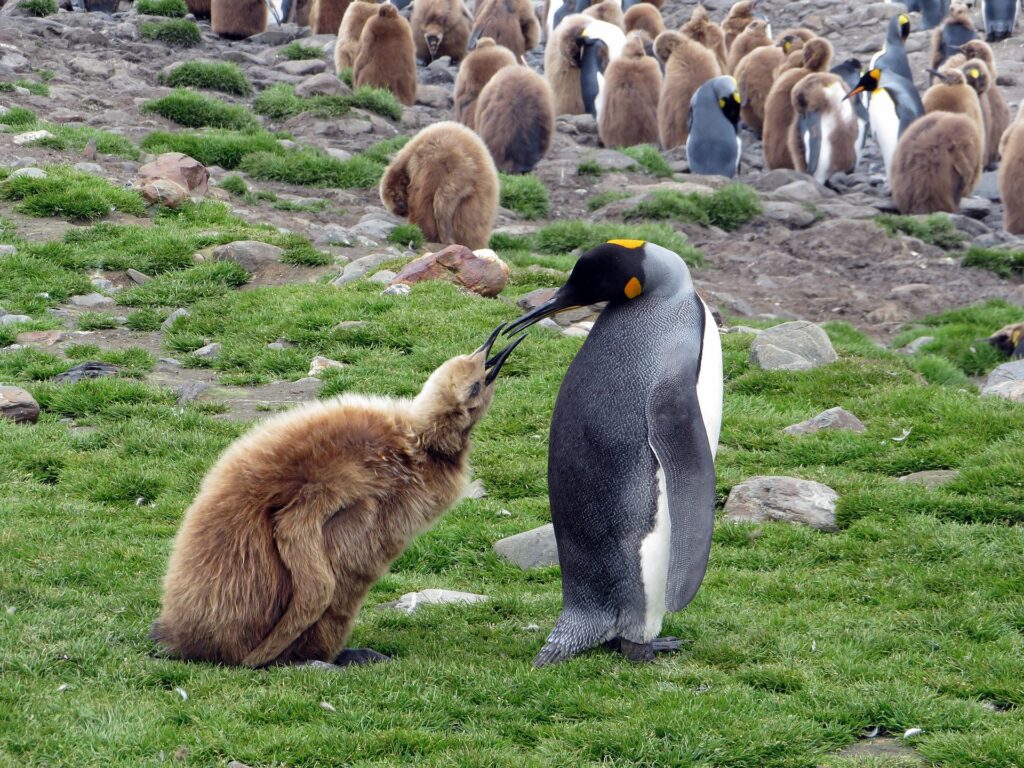
② Parent-child reunion
King penguin chicks live in large groups (crèches).
When parent birds return from the sea,
the parent calls
the chick responds
This exchange helps them find each other.
Individual Identification by Voice
King penguins belong to the same genus, Aptenodytes, as emperor penguins.
Therefore,
they use unique voice combinations
each individual has a different frequency combination
to identify others.
Even in colonies of tens of thousands of penguins, they can find their own families.
The Mechanism of “Dual Voice”
King penguins
by independently vibrating their left and right bronchi
they can simultaneously emit two different frequencies.
This characteristic offers several advantages:
Easier to hear from long distances
Easier individual identification
Easier transmission even in strong winds
This is due to the advantages of their voices.
Seasonal Activities of King Penguins
King penguins, unlike emperor penguins, have a long breeding cycle that lasts for more than two years.
Spring (September-November):
Courtship and Egg Laying
Pair Formation
Courtship Display
Egg Laying
These activities take place.
King penguins do not build nests; like emperor penguins, they incubate their eggs on their feet.
Summer (December-February):
Chick Birth and Rearing
Eggs Hatch
Parents Take Turns Foraging at Sea
They Regurgitate Fish and Squid to Feed the Chicks
Chicks Grow Rapidly in Summer Due to the Abundance of Food.
Autumn (March-May):
Chick Preparation for Winter
Chicks Grow While Covered in Brown Downy Feathers
They Accumulate Fat
They Live in Groups
Unable to Fly or Swim Yet, they Prepare for Winter by Receiving Food from Their Parents.
Winter (around June to August)
A harsh winter.
Adult birds forage at sea.
Chicks stay in the colony.
Feeding frequency decreases.
During this period, many chicks experience near-starvation.
They use their stored fat to survive, becoming so plump that they are called “orc monsters” (giant brown chicks).
About King Penguin Chicks
This article provides detailed information about King Penguin (Aptenodytes patagonicus) chicks.
- Eggs and Hatching
Number of Eggs: Usually 1
Egg Size: Approximately 10 cm x 6.5 cm
Days to Hatching: Approximately 54 days
Parent birds take turns incubating and incubating the eggs.
The eggs are primarily kept warm in the parent’s chest pocket.
- Chick Appearance
Immediately after hatching, the chicks are covered in fluffy gray or brown down.
Their down is not waterproof and they need to be protected by their parents in the nest.
Body Length: Approximately 20-25 cm, Weight: Approximately 200-300 g
- Development
After Incubation: The parents bring food to the chicks.
Chickling Stage: Over the course of approximately 2-3 months, the down matures and transforms into waterproof feathers.
Fledgeling: Approximately 10 months after hatching, the chicks enter the sea on their own and begin foraging.
Chicks may live in groups with other chicks within the breeding colony.
- Behavior and Sociality
Their parent-offspring bond is very strong, and they recognize their parents by their voices and patterns.
When they sense danger, they hide in the nest or under their parents.
They huddle together within the colony to protect themselves from the cold.
- Threats
Predation of eggs and chicks by introduced predators (such as rats and cats) (limited to islands)
Food shortages due to climate change
Nest destruction due to human activities and tourism
Are king penguins an endangered species?
King penguins are a species of least concern by the IUCN. However, the outlook for the future is quite pessimistic, and the possibility of extinction is extremely high. The reason is as follows. The estimated population is stable at 1,638,000, but the future is quite bleak.
- IUCN Conservation Status
Rating: Least Concern (LC)
The population is relatively stable, estimated at over 2 million birds worldwide.
Major colonies are found in South Georgia, the Falkland Islands, and the South Sandwich Islands.
- Current Threats
Climate Change
Rising sea temperatures are changing the distribution of food resources (small fish and krill).
Possible impact on breeding success.
Human Activities
Decrease in food resources due to fishing.
Impact of tourism and coastal development on colonies.
Invasive predators (limited to islands).
Rats and cats attack chicks and eggs.
- Conservation Status
Major breeding areas are designated as nature reserves, and conservation efforts are underway.
Food resource management and environmental monitoring are ongoing.
Is it possible to keep king penguins?
This article summarizes information about keeping king penguins (Aptenodytes patagonicus). The bottom line is that they cannot be kept in an ordinary household and can only be kept in specialized facilities such as zoos and aquariums.
- Breeding Environment
Water and Land
Large Pool/Aquarium: Requires ample space and depth for swimming (ideally at least 10m long and at least 3m deep).
Land Environment: Recreates a rocky and gravelly land area for resting, breeding, and huddling.
Temperature Control: Maintain a temperature similar to the cool sub-Antarctic environment (air temperature should be around 0-10°C, and water temperature should also be kept low).
Environmental Facilities
Seawater salinity and water quality control
Water filtration system and humidity control
Providing suitable burrows and environments for the breeding season
- Diet
Main Food: Fish (sardines, anchovies, herring), krill, squid
Food once or twice a day; adjust the amount depending on the individual and the season.
Vitamins and supplements may be provided as nutritional supplements.
- Breeding Management
Encourage breeding behavior during the winter and other seasons.
Parent assistance and artificial feeding are required for egg incubation and chick rearing.
Health management of parent birds and chicks is essential to maintain breeding success.
- Health Management
Regularly check weight, feathers, feeding status, and digestive system.
Prevent infectious diseases and parasites.
Proper environmental management is important because they are susceptible to environmental stress.
- Legal and Ethical Considerations
Although not an endangered species, breeding requires specialized facilities and experienced caretakers.
Very few facilities worldwide offer breeding services for these birds.
Zoos where they are kept (Japan and around the world)
King penguins are easier to keep than emperor penguins, so they can be seen in many zoos and aquariums in Japan and around the world.
Main facilities in Japan where you can see King Penguins
- Nagoya Port Aquarium
One of Japan’s leading penguin exhibits
Keeps King Penguins and Emperor Penguins
Has a wealth of breeding experience
- Adventure World
One of the largest penguin collections in Japan
Exhibits multiple penguin species
Famous for its penguin parade
- Asahiyama Zoo, Asahikawa
World-famous for its “behavioral exhibits”
Visitors can observe penguins swimming as if flying underwater
- Kasai Rinkai Aquarium
One of Japan’s largest penguin exhibit areas
Visitors can observe penguins living in groups
- Nagasaki Penguin Aquarium
A penguin-specialized aquarium
Boasts one of the world’s largest collections of penguin species
A world-renowned breeding facility
- Edinburgh Zoo
A leading European penguin breeding facility
Has a wealth of King Penguin breeding experience
- Detroit Zoo
One of the world’s largest polar exhibits
Recreates a large-scale penguin habitat
- SeaWorld San Diego
Famous for its Antarctic and sub-Antarctic penguin exhibit
Observe colonies of king penguins
- Antarctica Experience at Sea World Gold Coast
One of the leading penguin exhibits in the Southern Hemisphere
Recreates a low-temperature environment
Fellow members of the same group
コメント