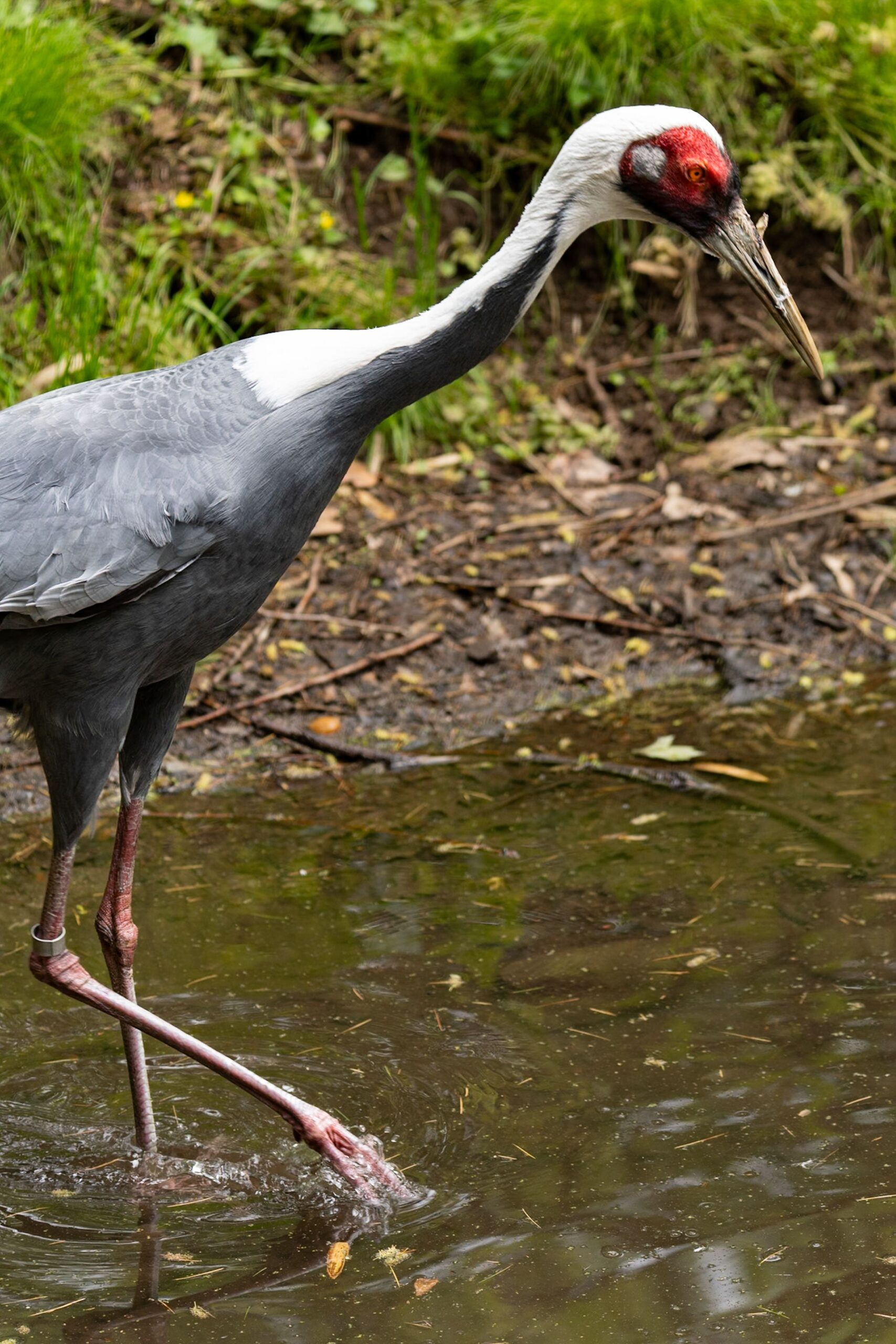
What kind of bird is the Mane-naped Crane? We will explain its characteristics, ecology, and habitat. Mane-naped cranes are a type of bird that live in Siberia and China. They have a fairly large and strong appearance, but in fact they are a critically endangered species.








- What is a The White-necked Crane? Basic Stats
- What are the roots and origins of the White-naped Crane?
- Habitat
- What are its characteristics? What kind of creature is it?
- What is their ecology?
- About Molting
- Vocalizations
- Seasonal Activities
- Flight Speed
- About White-naped Crane Chicks
- Are White-naped Cranes Endangered?
- Can White-naped Cranes be kept as pets?
- Zoos Housing White-naped Cranes (Japan & Worldwide)
- Introducing other animals
What is a The White-necked Crane? Basic Stats
The White-necked Crane is a bird that belongs to the Gruidae family. Its scientific name is Grus vipio, and its English name is White-necked Crane. Its total length is 120-150cm and its weight is 5-6kg. The list of information is as follows.
| Japanese(和名) | マナヅル |
| English(英名) | White-necked crane |
| scientific name(学名) | Grus vipio |
| classification(分類) | Aves、 Gruiformes、 Gruidae、Grus 鳥綱、ツル目、ツル科、ツル属 |
| IUCN Status(保全状況) | VULNERABLE |
| Length(体長) | 120-150cm |
| Weight(体重) | 5-6kg |
What are the roots and origins of the White-naped Crane?
The White-naped Crane (scientific name: Grus vipio) is a large crane species that evolved in the wetland environments of East Asia. Based on its current distribution, it is believed to have originated in the Far East, specifically in the region spanning southeastern Siberia and northeastern China.
Evolutionary Origins
The White-naped Crane belongs to:
Order: Gruiformes
Family: Gruidae
Genus: Grus
The ancestors of the crane family (Gruidae) are thought to have diversified approximately 50 million years ago or later, evolving into large birds characterized by long legs, long necks, and a wetland-dwelling lifestyle.
Within this family, the lineage of the White-naped Crane is a group that adapted to the vast wetlands and riverine areas of East Asia.
Region of Origin (Ancestral Range)
Its current breeding grounds are located in:
Southeastern Russia (Amur River basin)
Northeastern China
The area around northeastern Mongolia
These regions are believed to largely overlap with the area where the species originally evolved.
In particular, the wetlands of the Amur and Ussuri River basins
serve as crucial breeding grounds; the birds breed there from spring through summer and migrate to Japan, the Korean Peninsula, and southern China for the winter.
Origin of the Name “Manazuru”
In archaic Japanese, the prefix “Mana” carries meanings such as:
Ma (meaning “true” or “beautiful”)
Mana (meaning “high-quality” or “genuine”)
Thus, it is believed the bird was named to signify:
“A beautiful crane” or “A quintessential crane”
Its English name, “White-naped Crane,” is derived from the distinctive white plumage extending from the back of the neck to the back of the head (the nape).
Relationship with the Red-crowned Crane
While the White-naped Crane and the Red-crowned Crane are closely related, they belong to distinct lineages. Red-crowned Crane
Hokkaido and the Russian Far East
Better suited to colder regions
Black-and-white plumage
White-naped Crane
Southern parts of East Asia
Adapted to wetlands and agricultural lands
Grayish-black body
They are believed to have diverged from a common ancestor and adapted to their respective environments.
Biological classification (taxonomy)
| 階級 | 分類 |
|---|---|
| 界 | 動物界 Animalia |
| 門 | 脊索動物門 Chordata |
| 綱 | 鳥綱 Aves |
| 目 | ツル目 Gruiformes |
| 科 | ツル科 Gruidae |
| 属 | アネイゴネ属 Antigone |
| 種 | マナヅル Antigone vipio |
Habitat
White-naped cranes are found in Japan, northeastern Mongolia, the Amur River area in Russia, northeastern China, and the Korean Peninsula.
- Overview of Habitat
White-naped Cranes are migratory birds found throughout East Asia,
which change their habitat significantly depending on the season.
Summer: Breeding in the north
Winter: Wintering in the south
This lifestyle follows this pattern.
- Breeding Grounds (Summer Habitat)
Main Breeding Areas
Northeastern China
Mongolia
Russian Far East (Amur River Basin, etc.)
Environmental Characteristics
Vast wetlands
Grasslands along rivers
Around lakes and ponds
Open areas with little human disturbance
They prefer wetlands with good visibility, allowing them to quickly spot predators.
- Wintering Grounds (Winter Habitat)
Main Wintering Grounds
Southern China
Korean Peninsula
Japan (especially the Izumo Plain, Kagoshima Prefecture)
In Japan,
Japan is known as a globally important wintering ground.
Environmental Characteristics
Rice paddies
Riverbeds
Wetlands
Tidal flats
*In Japan, artificial feeding areas are also used due to conservation efforts.
- Habitat in Japan
Areas Found in Japan
Izumi City, Kagoshima Prefecture (Izumi Plain)
One of the world’s largest wintering grounds for White-naped Cranes and Hooded Cranes
Rarely
Yamaguchi Prefecture
Shimane Prefecture
Various locations in Kyushu
Arrives in Japan as a winter bird.
- Migration (Migratory Route)
Migrates between breeding grounds and wintering grounds every year
Travels several thousand kilometers
Uses rivers
lakes
wetlands
as stopovers during migration
The entire migration route is important for survival.
What are its characteristics? What kind of creature is it?
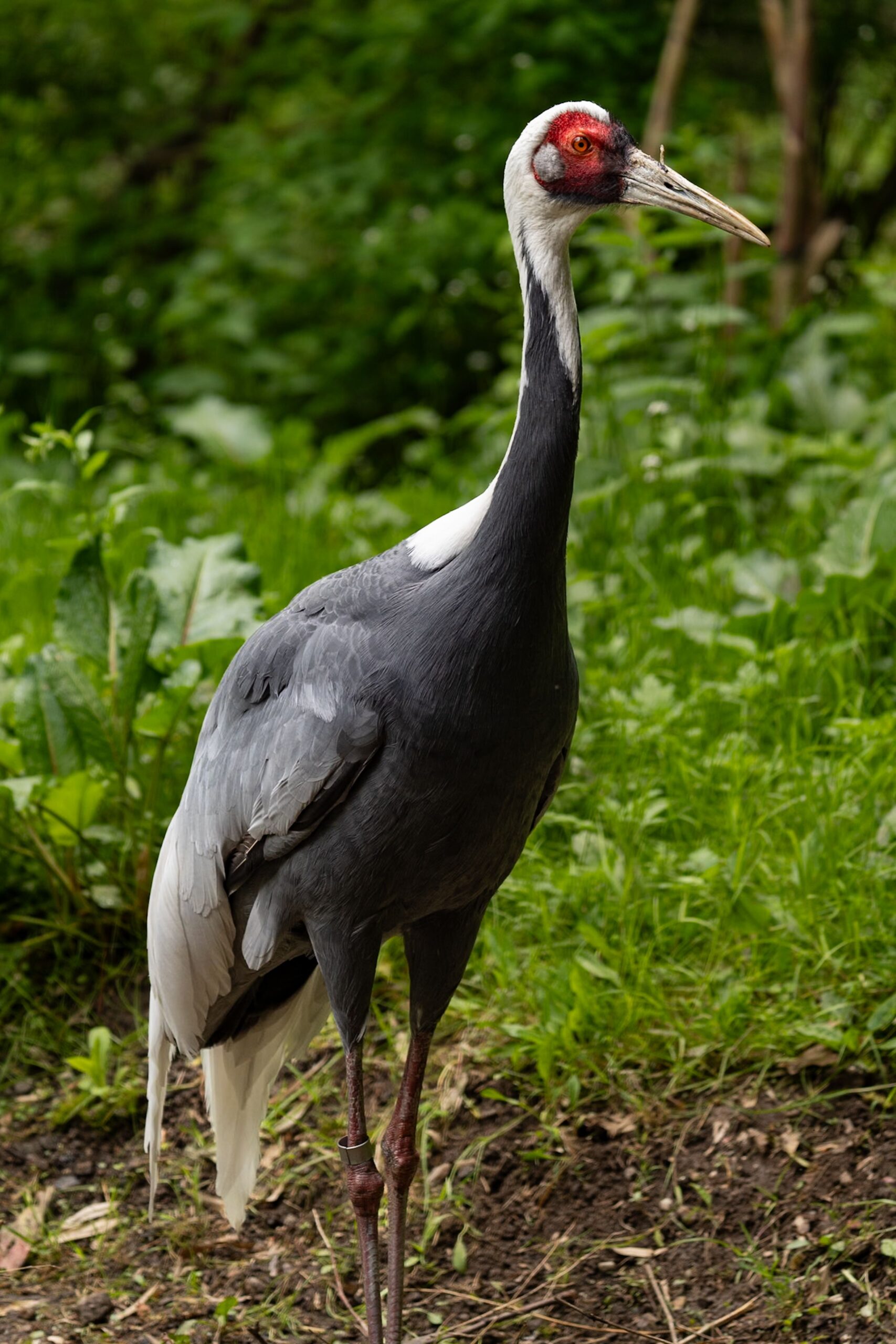
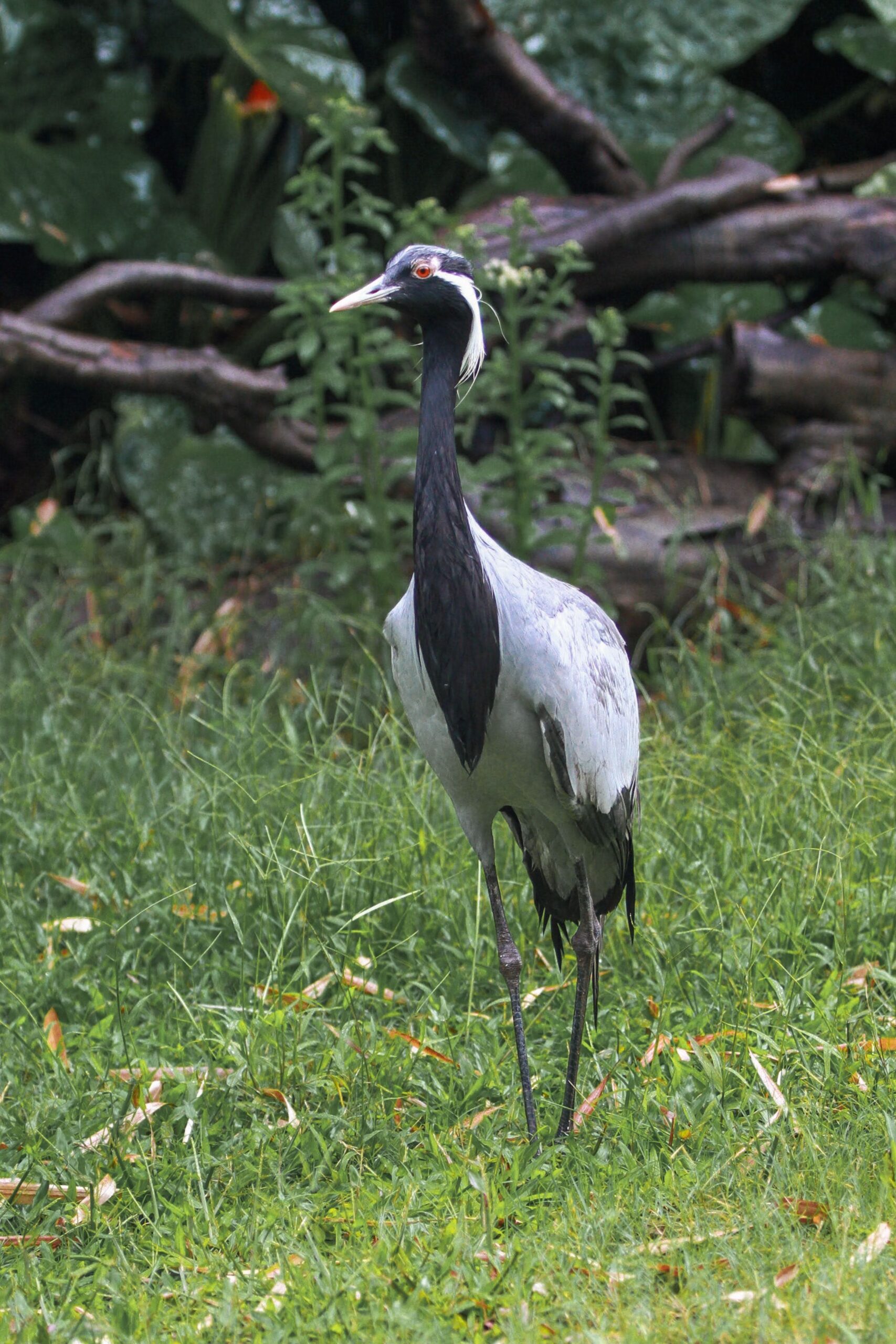
The white-naped crane is gray or dark gray all over its body, with white from the top of its head to the back of its neck and the base of its neck. The feathers covering its ear holes (ear feathers) are dark gray. Its legs are pink or dark red, and its coverts are bluish gray. White-naped cranes breed in northern Mongolia and other places, and fly to Japan as winter birds to spend the winter, so they are migratory birds. They live in marshes in river basins, and in their wintering areas, they prefer riverbanks, tidal flats, marshes, and farmland. They move in groups like small animals.
- Physical Characteristics (Very Easy to Identify)
Physical Characteristics
Body Length: Approximately 120-130cm
Wingspan: Approximately 220-250cm
Weight: 5-7kg
Appearance Features
White neck (hence the name)
Bare red skin on top of head
Gray body
Long, dark legs
Slightly larger than the Hooded Crane, with a brighter appearance.
- Overall Appearance
Slow movements
Straight, dignified posture
Accommodates calmly even in a flock
In Japan, they are strongly associated with “elegant and dignified cranes.”
- Personality
Basic Personality
Gentle
Wary, but not excessively so
Avoids unnecessary conflict
Sociality
Live in groups
Strong bond with mates
Typically spends time with the same partner year after year
Family-oriented and stability-oriented.
- Behavioral Characteristics
Ground Behavior
Walking slowly while foraging
Pecking grass and soil with their beaks
Flight
Powerful, large flapping wings
Often flying in V formation
Calls
High-pitched, clear “kururu” call
Often calling to each other in pairs
- Diet (What do they eat?)
Omnivorous
Plant roots and shoots
Cereal crops (rice)
Insects
Small fish and amphibians
Able to utilize both natural environments and farmland.
What is their ecology?
White-naped cranes live mainly on fish, insects, frogs, plant stems, leaves, and seeds. They are oviparous. They build nests in marshes made of sedges and reeds, and lay eggs every May. Males and females take turns incubating the eggs, and in captivity, they incubate them for one month. They reach sexual maturity in about 2-3 years. The lifespan of a white-naped crane is 45 years.
- Daily Rhythm
Activity
Diurnal
Daytime: Forage, move, and rest in groups
Night: Rest near water or open areas
At night, they choose places with good visibility to avoid predators.
- Diet (What they eat)
Omnivorous (predominantly plant-based)
Plant roots and rhizomes
Grass shoots
Cereal crops (rice and wheat)
Insects
Earthworms
Small fish and amphibians
They are characterized by their flexible diet, changing depending on the season and location.
- Foraging Behavior
Slow walking while pecking the ground with their beak
Stretching their neck to explore shallow waters
Often foraging simultaneously in groups
Prioritizing safety over efficiency.
- Social Structure (Flocks and Families)
Basic Structure
Wintering Season: Large Flocks
Breeding Season: Pair-bonded Units
Pair-bonding Relationships
Monogamy
Very Strong Bonds
Typically Breed with the Same Partner Year After Year
They have the strongest family bond among cranes.
- Breeding Habits
Breeding Season
Spring to Summer
Nest Building
Simple nests on the ground in marshes
Made from collected grasses and reeds
Egg Laying
Around 2 eggs
Both parents incubate (about 30 days)
Brooding
Chicks can walk immediately after hatching (precocial)
Strong parental protection
It takes about 2-3 months for them to be able to fly
Often, only one chick reaches adulthood.
- Young Bird Growth and Family Behavior
Young birds migrate with their parents
Sometimes stay with their parents until the following year
Even within the flock, they behave as family units
They have a long learning period for social skills.
- Migratory Biology (Very Important)
Long-distance migratory birds travel thousands of kilometers.
Fly in V formation.
Use wetlands and rivers as stopovers along the way.
The entire migratory route is directly related to survival.
Do they have any natural enemies?
White-naped cranes have no significant natural enemies.
About Molting
As large birds that undertake long-distance migrations, White-naped Cranes (Grus vipio) possess a mechanism for efficiently renewing their feathers while maintaining their ability to fly.
Types of Molting
Molting in Adults
White-naped Cranes primarily undergo:
A complete molt once a year
Sequential renewal of wing, tail, and body feathers
However, they do not lose a large number of flight feathers (remiges) all at once. Because large migratory birds must maintain flight capability, they replace their feathers gradually over an extended period.
Molting Season
Summer (Post-breeding: approximately June to September)
This is the primary molting period.
Once the breeding season concludes, the following processes take place:
Renewal of body feathers
Replacement of wing flight feathers
Renewal of tail feathers
During this time, they undergo molting while remaining in the wetlands of their breeding grounds.
Wing Molting
As large birds, wing molting is crucial for White-naped Cranes.
Characteristics:
Sequential replacement of primary flight feathers (at the wingtips)
Renewal with new feathers over the course of several months
Process occurs while maintaining flight capability
Acquiring a completely new set of wings leads to:
Improved efficiency for long-distance migration
Restored gliding performance
Maintenance of flapping power
Molting in Juveniles
Ages 0–1 year
Immediately after hatching: Pale brown down feathers
Growth: Transition to brown juvenile plumage
Winter: Migration with parent birds
Subsequent years: Gradual transition to the gray and white plumage of adults
It takes approximately 2 to 3 years to acquire full adult plumage.
Vocalizations
The White-naped Crane (Grus vipio) is characterized by a low, clear call that carries over great distances—typical of large crane species. They possess powerful communication abilities that evolved to help them maintain spacing between individuals in wetlands and vast agricultural fields.
Typical Calls
① Pair “Duet” (Cooperative Calling)
This is the most well-known call of the White-naped Crane.
Auditory impression:
“Kurururu…”
“Kwoh, kwoh”
“Koh, koh”
The male and female call in synchronization.
Characteristics:
Performed in a posture where they:
Extend their necks
Point their beaks upward
Spread their wings slightly
This exchange of calls serves to:
Reaffirm the pair bond
Declare territory
Reinforce reproductive behavior
Breeding Season Calls
Vocal activity intensifies in their breeding grounds during spring and summer.
Functions:
Territorial claims (“This is our territory”)
Courtship
Coordination between the pair
In wetlands, the White-naped Crane’s call can carry for several kilometers.
Migration Calls
They frequently call while in flight.
Characteristics:
Sounds such as “Kurururu,” “Gwah,” and “Kaka”
Used to:
Locate the flock
Maintain flight formation
Signal to other members of the group
Calls are exchanged—particularly when flying in a V-formation—to allow individuals at the rear to keep track of those in front.
Alarm Calls
When sensing danger, they emit:
Short, sharp sounds
Low-pitched alarm notes
Rapid, continuous calls
Targets:
Used to signal alertness regarding:
Foxes
Dogs
Birds of prey
Humans
Seasonal Activities
The activities of the White-naped Crane (Grus vipio) revolve around its seasonal migration between breeding grounds (Russian Far East and Northeast China) and wintering grounds (Japan, the Korean Peninsula, and Southern China). They follow a distinct annual cycle comprising migration, breeding, molting, and overwintering.
Spring (March–May)
Migration North to Breeding Grounds
After spending the winter in places like Japan, White-naped Cranes migrate north in the spring.
Key activities:
Migrating north in flocks
Traveling to breeding grounds
Pair formation and territory establishment
In breeding grounds, they select open areas such as:
Wetlands
Riverbanks
Grasslands
Breeding preparations
Males and females strengthen their pair bond through:
Courtship dances
Duets (calling back and forth)
Wing-spreading displays
Summer (May–August)
Breeding and Rearing Season
This is the most critical period for the White-naped Crane.
Nest building
Constructing nests by piling up vegetation in shallow wetland areas
Living while remaining vigilant of their surroundings
Rearing young
Usually about two eggs
Incubation shared by both parents
Cooperative rearing of hatched chicks
Chicks are precocial, meaning they can:
Walk immediately after hatching
Follow their parents to forage for food
Late Summer (July–September)
Molting and Migration Preparation
After the breeding season ends, adults undergo molting.
Activities:
Feather renewal
Nutrient replenishment
Restoration of flight capabilities
During this period, they tend to:
Limit flight distances
Spend time in safe wetlands
Increase food intake
Autumn (September–November)
Migration South
They move south as temperatures drop.
Route:
Russian Far East / Northeast China
↓
Korean Peninsula
↓
Japan (mainly Kyushu)
Activities:
Flock formation
Long-distance flight
Resting and foraging at stopover sites
They fly in V-shaped formations to reduce wind resistance.
Winter (November–March)
Overwintering
The Izumi Plain in Kagoshima Prefecture is one of the largest overwintering sites in Japan.
Main activities:
Foraging
They feed on items such as:
Fallen rice stalks (gleanings)
Grains
Grass seeds
Insects
Small animals
Flocking behavior
In winter, they may gather in flocks ranging from hundreds to thousands of birds.
Daily routine:
Morning: Move to foraging grounds
Midday: Rest
Evening: Return to roosting sites
Flight Speed
The flight speed of the White-naped Crane (Grus vipio) is moderate for a large crane that undertakes long-distance migrations; their flight style prioritizes endurance and efficiency over sheer speed.
Flight Speed (Estimates)
| Flight Situation | Speed |
|---|---|
| Normal cruising flight | Approx. 40–60 km/h |
| Migratory flight | Approx. 50–70 km/h |
| With tailwind or gliding | Can exceed 70 km/h |
| Immediately after takeoff | Accelerates from approx. 20–40 km/h |
Note: Data based solely on wild White-naped Cranes is limited; these estimates incorporate measurements from closely related crane species.
① Flight Suited for Long Distances
The White-naped Crane is an energy-efficient flyer rather than a “high-speed” flyer.
Characteristics:
Slow wingbeats using large wings
Gliding by utilizing thermal updrafts
Flying in V-formations within the flock
These behaviors enable them to travel distances ranging from hundreds to thousands of kilometers.
② Migratory Flight Capabilities
White-naped Cranes undertake seasonal migrations along the following route:
Russian Far East / Northeast China
↓
Korean Peninsula
↓
Japan (e.g., Kyushu)
While the daily distance covered depends on conditions, they may travel hundreds of kilometers during migration.
③ Wing Performance
Characteristics supporting the White-naped Crane’s flight capabilities:
Wingspan: Approximately 200 cm
Large, broad wings
Lightweight skeletal structure
Gliding ability provided by long wings
These features allow them to fly for extended periods with minimal wing-flapping.
④ Takeoff Characteristics
The sequence for taking off from the ground is as follows:
Extend the neck
Push off strongly with the legs
Flap wings vigorously
Rise by catching the wind
Due to their large body size, they prioritize gaining lift over speed immediately after takeoff.
About White-naped Crane Chicks
This article provides a comprehensive overview of White-naped Crane chicks, from birth to growth, behavior, and relationship with their parents.
- Birth
Breeding Season: Spring to Early Summer
Nest: A simple nest made of grass gathered on the marshland ground
Number of Eggs: Approximately 2
Incubation Period: Approximately 30 days
Chicks immediately after hatching
Yellow-brown to brown down covering the entire body
Eyes are open
Able to walk immediately after hatching (precocial)
A bird that can move independently from the moment it is born.
- Appearance (Chick-like Characteristics)
Fluffy down
Small body but very long legs
Lacks the white neck or red head of adult birds
Overall dull coloring (protective coloration)
Camouflage coloring that blends in with the marshland
- Behavior and Personality
Behavior
Follow closely behind their parents
Imitate foraging near water or grasslands
Crouch and stay still when in danger
Personality
Curious but cautious
Acts in family units rather than in groups
Learns by observing their parents’ behavior
- Relationship with Parents (Very Important)
Both parents always provide protection
When predators approach
Parents will threaten them
Chicks hide
Food
Eat what their parents dig up
(No regurgitation)
Characterized by strong family behavior
- Growth Process
A few weeks after birth
Movement distance increases
Increased food variety
2-3 months after birth
Rapid physical growth
Full feather growth
Able to fly
After six months of age
Appears to be a juvenile
First migration with parents
- Characteristics of sibling relationships
Even if two chicks hatch,
Often only one chick survives
This is due to food shortages and differences in physical strength
Survival strategies in harsh natural environments
- Natural Enemies and Hazards
Natural predators
Foxes
Hawks and eagles
Anthropogenic hazards
Wetland decline
Human access and disturbance
Livestock and agricultural machinery
The chick stage has the highest mortality rate.
Are White-naped Cranes Endangered?
White-naped cranes are designated as an endangered species (Red List). They are also listed in Appendix I of the Convention on International Trade in Endangered Species of Wild Fauna and Flora (CITES), and international trade is strictly restricted. In Russia and China, where they breed, their habitats have become dry due to development and destruction, making them unable to adapt to the environment. In addition, they have been killed in accidents caused by power lines and have been over-hunted due to poaching, causing their population to plummet. In Japan, the Ministry of the Environment designated the Izumi Plain in Kagoshima Prefecture, where White-naped Cranes live, as a Special Natural Monument of Japan in 1952, and as a national nature reserve as the Izumi-Takao Wildlife Sanctuary in 1987.
International Assessment (IUCN Red List)
IUCN (International Union for Conservation of Nature) Red List Assessment:
Vulnerable (VU)
→ This species is rated as being at “high risk of extinction in the future.”
This assessment is based on the estimated global population of only a few thousand birds, which is declining.
Japan’s Assessment
The Ministry of the Environment’s Red List also lists this species as “Vulnerable (VU).”
This assessment reflects the limited population and habitat within Japan.
Reasons for Decline (Why is it Endangered?)
The following are cited as the main causes:
✔ Habitat loss
Habitat loss due to development and reclamation of wetlands and grasslands
Drying of wetlands due to climate change, etc.
➡ It has been reported that nesting and feeding sites for White-naped Cranes are decreasing.
✔ Small Population
The global population is estimated at only a few thousand birds (approximately 7,000 to 1,000),
and its distribution is limited.
✔ Other Threats
Collisions with power lines, etc.
Anthropogenic impacts such as poaching
➡ Continued declines in areas where habitat conservation is insufficient.
Protection Measures and Legal Status
Listed in Appendix I of the Convention on International Trade in Endangered Species of Wild Fauna and Flora (CITES)
→ International trade is strictly restricted.
Law for the Conservation of Species (Japan)
→ Protected as an internationally endangered species of wild fauna and flora.
Law for the Protection of Cultural Properties (Japan)
→ Cranes and their migration habitats are designated as special natural monuments.
These measures aim to curb population declines and promote recovery.
Can White-naped Cranes be kept as pets?
White-naped Cranes are migratory birds and tend not to settle, so it is extremely difficult to keep them as pets. As they are endangered, international trade is strictly restricted, making them difficult to obtain. At the zoo, you can see Hooded Cranes, Japanese Cranes, and Sandhill Cranes, so try visiting the site map on the website.
- Is it legal to keep them as pets?
In Japan
Keeping them as pets is prohibited in principle.
White-naped cranes fall under the following categories:
Ministry of the Environment Red List: Endangered
Species Conservation Act
→ “Internationally Endangered Species”
Convention on International Trade in Endangered Species (CITES) Appendix I
Special Natural Monument (Cranes, Migratory Area)
✔ Capture, breeding, transfer, and sale are generally illegal.
✔ Exceptions are only made to facilities with strict government approval, such as
Zoos
Research Institutes
Protection and Breeding Programs
- Even if there were no laws, keeping them as pets would be nearly impossible.
① Extremely wild nature
Not tame
Highly wary
Extremely sensitive to stress
A domestic environment will definitely damage their physical and mental health.
② Their range of activity is too wide.
They normally roam in wetlands, rice paddies, and vast grasslands.
They are migratory birds that fly long distances.
Cages, gardens, and private facilities cannot satisfy their behavioral needs.
③ Their social and pair-bonding habits are unique.
Monogamy.
Strong pair bonds.
They live in family units.
Being kept alone causes severe stress.
④ Diet and environmental management are too difficult.
In the wild, they forage for their own food.
Rhizomes.
Small animals.
Seasonal plants.
Artificial diets alone are insufficient.
Zoos Housing White-naped Cranes (Japan & Worldwide)
The White-naped Crane (Grus vipio) is an endangered species kept in zoos and conservation facilities around the world. While there are relatively many examples of them being kept in Japan, overseas populations are maintained primarily for breeding and conservation purposes.
🇯🇵 Zoos in Japan
Tama Zoological Park (Tokyo)
One of the prominent facilities housing White-naped Cranes.
Conducts exhibits and research on crane breeding.
Provides information on the ecology and breeding habits of the White-naped Crane.
Ikeda Zoo
Has a record of keeping White-naped Cranes.
Features long-term resident individuals, allowing visitors to observe traits such as their lifespan and temperament in captivity.
Kagoshima City Hirakawa Zoological Park
One of the Japanese facilities that exhibits White-naped Cranes.
Provides explanations regarding their natural habitat, migration patterns, and breeding.
🌎 Major Facilities Worldwide
🇺🇸 Smithsonian’s National Zoo
A leading facility dedicated to the conservation breeding of White-naped Cranes.
Maintains the population for lineage preservation and research into breeding techniques.
Engages in activities such as artificial insemination and the maintenance of genetic diversity.
🇺🇸 Central Park Zoo
Has a record of successful White-naped Crane breeding.
Keeps the species as part of the Species Survival Plan, a cooperative program among North American zoos.
🇺🇸 Bronx Zoo
Like Central Park Zoo, it participates in the Wildlife Conservation Society (WCS) crane conservation initiatives.
Has a record of successful captive breeding.
Introducing other animals


コメント