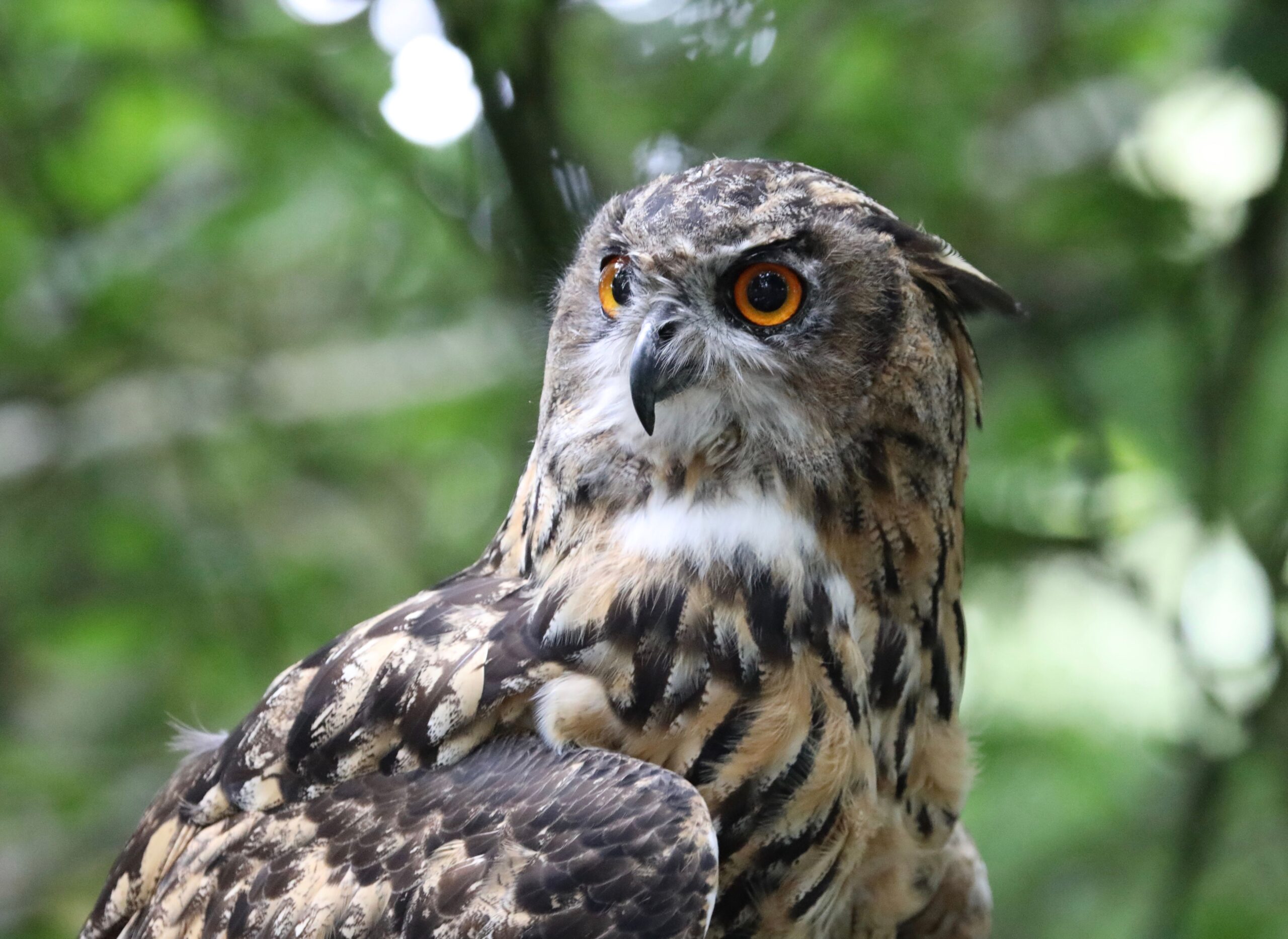
What kind of bird is the eagle owl (owl)? We will explain the characteristics, ecology, and habitat of animals. This horned owl, also known as the Eurasian eagle owl, is widely distributed across the Eurasian continent, with large numbers living mainly in Asia. In this article, I will explain what kind of characteristics it has.










- What is a eagle owl? About basic status
- What are the roots and origins of the Eurasian Eagle-Owl?
- About habitat
- feature is? What kind of creature is it?
- What is your personality like?
- What is the ecology like?
- About Molting
- About Their Calls
- Seasonal Activities
- Regarding Flight Speed
- About baby eagle owls
- Is the eagle owl an endangered species?
- Can eagle owls be kept as pets?
- Facilities Housing Eurasian Eagle-Owls (Japan & Worldwide)
- Introducing other animals
What is a eagle owl? About basic status
The eagle owl is a bird classified in the genus Owlidae of the order Owlidae. The body length is 58 – 71cm and the weight is 1,500 – 1,800g. The British name is owl, the scientific name is Bubo bubo, and the kanji is Washiki 菟. It has another name: Eurasian eagle owl. The list of information is as follows:
| Japanese(和名) | ワシミミズク |
| English(英名) | Eurasian eagle owl |
| scientific name(学名) | Bubo bubo |
| classification(分類) | Ave、Strigiformes、 Strigidae、Bubo 鳥綱、フクロウ目、フクロウ科、ワシミミズク属 |
| IUCN Status(保全状況) | LEAST CONCERN |
| Length(体長) | 58 – 71cm |
| Weight(体重) | 1,500 – 1,800g |
What are the roots and origins of the Eurasian Eagle-Owl?
The roots of the Eurasian Eagle-Owl (Bubo bubo) lie in the lineage of owls that evolved tens of millions of years ago. Modern Eurasian Eagle-Owls are large, nocturnal birds of prey that evolved primarily across the Eurasian continent.
Origins: The evolution of owls
The order Strigiformes (owls), to which the Eurasian Eagle-Owl belongs, is believed to have existed as early as 60 to 50 million years ago (during the early Cenozoic era).
Evolutionary path:
Ancient birds
↓
Birds adapted for nocturnal life
↓
Primitive owls
↓
Eagle-owls (Genus Bubo)
↓
Eurasian Eagle-Owl (Bubo bubo)
Origin of the name “Mimizuku” (Eagle-Owl)
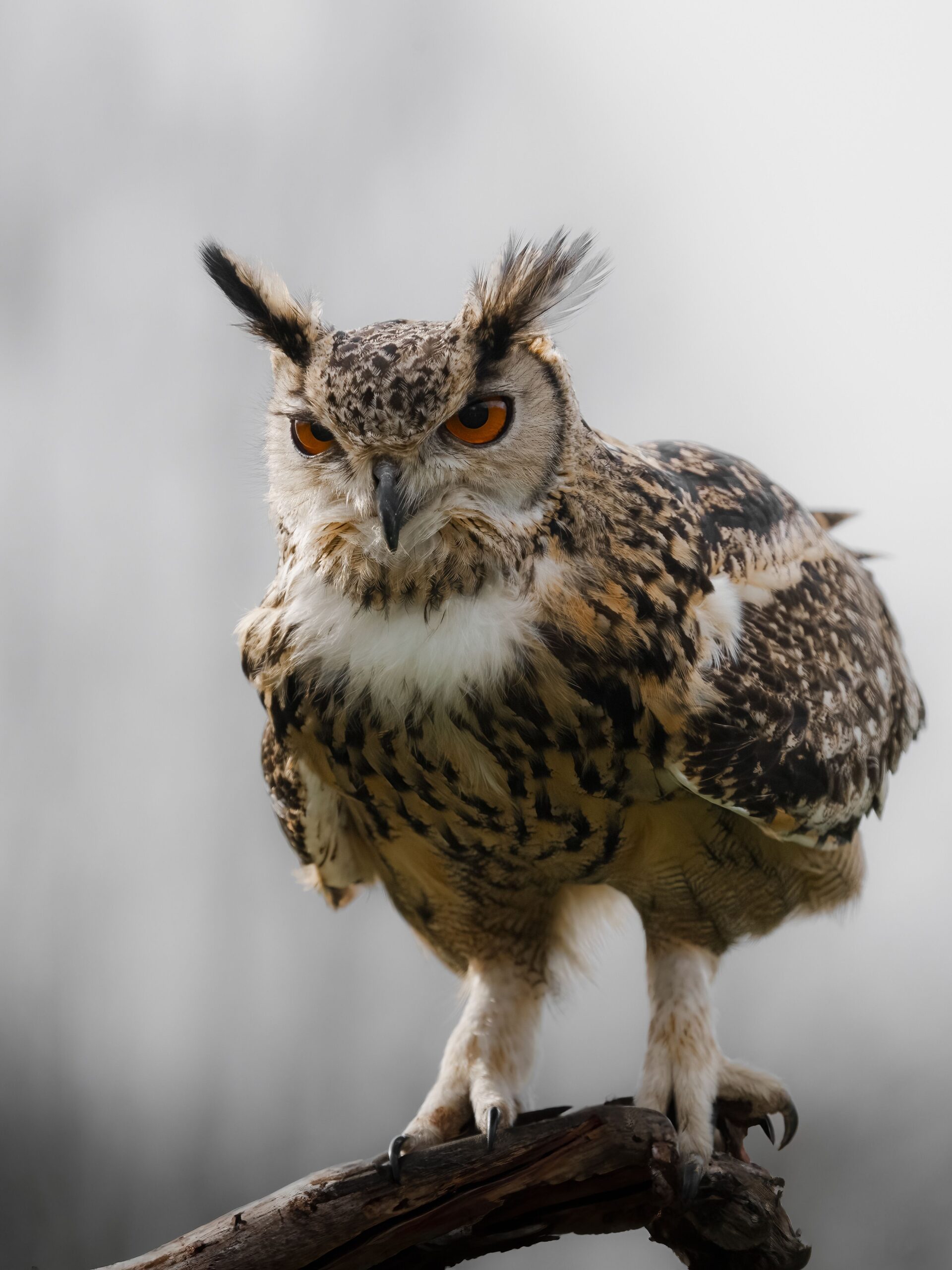
The most distinctive feature of the Eurasian Eagle-Owl is the pair of feather tufts on its head, which resemble ears.
However, it is important to note:
Those “ears” are not actually for hearing.
Functions:
Body language for communicating with others
Postural changes for intimidation
Camouflage within the environment
Their actual ears are small holes located beside their eyes.
Where did they originate?
The ancestors of the Eurasian Eagle-Owl are believed to have evolved primarily in northern to central Eurasia.
Current distribution:
Europe
Russia
Central Asia
China
Japan (e.g., Hokkaido)
…and beyond; their range is extremely wide.
Why did they grow so large?
The Eurasian Eagle-Owl is one of the largest owls in the world.
Body length:
Approx. 60–75 cm
Wingspan:
Approx. 150–180 cm
Reasons for their large size:
① To become a large-scale nocturnal hunter
Prey:
Rodents
Rabbits
Birds
Snakes
Small mammals
…they hunt a wide variety of creatures.
② Adaptation to cold regions
In the cold regions of Eurasia,
a large body offers the advantages of
retaining heat more effectively and
being able to lie in wait for extended periods.
About classification
The eagle owl is classified as a member of the genus Eagle Owl, but there are many subspecies. The following is a quote from Wikipedia. Let’s look into it when you have time.
| Scientific name(学名) | Habit(生息地) |
| Bubo bubo bubo | Scandinavian Peninsula/Western Russia to France スカンジナビア半島・ロシア西部からフランス |
| Bubo bubo borissowi | Sakhalin, Kuril Islands サハリン、千島列島 |
| Bubo bubo hemachalanus | Western Tibet, Western Himalayas チベット西部、ヒマラヤ西部 |
| Bubo bubo hispanus | iberian peninsula イベリア半島 |
| Bubo bubo interpositus | Southern Ukraine, Bulgaria, Romania to Türkiye ウクライナ南部・ブルガリア・ルーマニアからトルコ |
| Bubo bubo jakutensis | From north-central Siberia to northeastern Siberia シベリア中北部からシベリア北東部 |
| Bubo bubo kiautschensis | East of the People’s Republic of China, Korean Peninsula. There are examples of them flying to Amami Oshima, Miyakejima, and the Goto Islands. 中華人民共和国東部、朝鮮半島。奄美大島、三宅島、五島列島に飛来した例がある |
| Bubo bubo nikolskii | From eastern Iraq to western Pakistan イラク東部からパキスタン西部にかけて |
| Bubo bubo omissus | From northeastern Iran to Turkmenistan and western China イラン北東部からトルクメニスタン・中華人民共和国西部にかけて |
| Bubo bubo ruthenus | Europe Central, southern and eastern Russia ヨーロッパロシア中部・南部および東部 |
| Bubo bubo sibiricus | From the Ural Mountains to western and southwestern Siberia ウラル山脈からシベリア西部および南西部 |
| Bubo bubo tarimensis | Western Republic of China 中華人民共和国西部 |
| Bubo bubo tibetanus | Tibetan Plateau チベット高原 |
| Bubo bubo turcomanus | From Kazakhstan to western China and western Mongolia カザフスタンから中華人民共和国西部・モンゴル西部 |
| Bubo bubo ussuriensis | From eastern Mongolia and southeastern Siberia to northeastern China and eastern Siberia モンゴル東部・シベリア南東部から中華人民共和国北東部・シベリア東部にかけて |
| Bubo bubo yenisseensis | Northern Mongolia, central Siberia モンゴル北部、シベリア中部 |
About habitat
Its habitat is distributed across the Eurasian continent, including central Asia.
- Distribution
A large owl with a wide distribution
Throughout Europe (southern Scandinavia to southern Europe)
Asia (Siberia, Mongolia, China, the Korean Peninsula, and parts of Japan)
Also found in the Middle East and North Africa
One of the most widely distributed owls in the world
- Habitat
Forests (coniferous and broadleaf forests)
Mountainous areas, rocky areas, and cliffs
Also found in open areas around grasslands and farmland
Prefers areas with an abundance of birds and small mammals
- Nests/Hiding Places
Nests in rock crevices, tree holes, and cliff depressions
More often nests on the ground or in rocky areas than in trees
In winter, they rest in tree holes or rocky shade to avoid snow and cold
- Climate/Environmental Adaptation
Adapted to a wide range of climates from temperate to subarctic
Can live in high altitudes and cold regions
Avoids tropical rainforests and extremely dry deserts
feature is? What kind of creature is it?
Eagle owls tend to live as resident birds in woodlands, large forests, rocky areas, and moors. They often rest during the day, but at night they move their bodies and begin hunting. In nature, they attack small animals by flapping their wide wings slowly and silently, so their prey does not notice. The plumage is reddish-tan or cream-colored, with irregular stripes and spots all over.
- Physical Characteristics
Body Shape/Size
One of the world’s largest owls
Body Length: Approximately 60-75cm, Wingspan: Approximately 160-188cm
Weight: Approximately 2-4kg (varies by individual)
Face/Ear Feathers
Distinct “ear feathers” (standing tufts on both sides of the head)
Round face, large eyes, and highly developed night vision
Feathers/Body Color
Brown or gray back with black spots
Light-colored underside with stripes
Camouflage coloring for nighttime hunting
- Personality/Behavior
Nocturnal and crepuscular, primarily active at night
Timid but highly territorial
Behaves cautiously when encountering humans or large predators
Highly skilled hunting ability and excellent predators
As a bird of prey, it has excellent flying ability, sharp claws, and a beak
- Biology & Abilities
Diet: Carnivorous
Also prey on birds, small mammals (rats, rabbits, squirrels, etc.), and reptiles
Flight
Flying silently, making it difficult for prey to detect them
Reproduction
They build nests in tree holes or rock crevices, laying 1-4 eggs
Chicks are often raised by both parents
- Special Abilities
Highly developed night vision and hearing
Can accurately capture prey even in the dark
Quiet flight noise
Their feather structure allows them to approach prey undetected
What is your personality like?
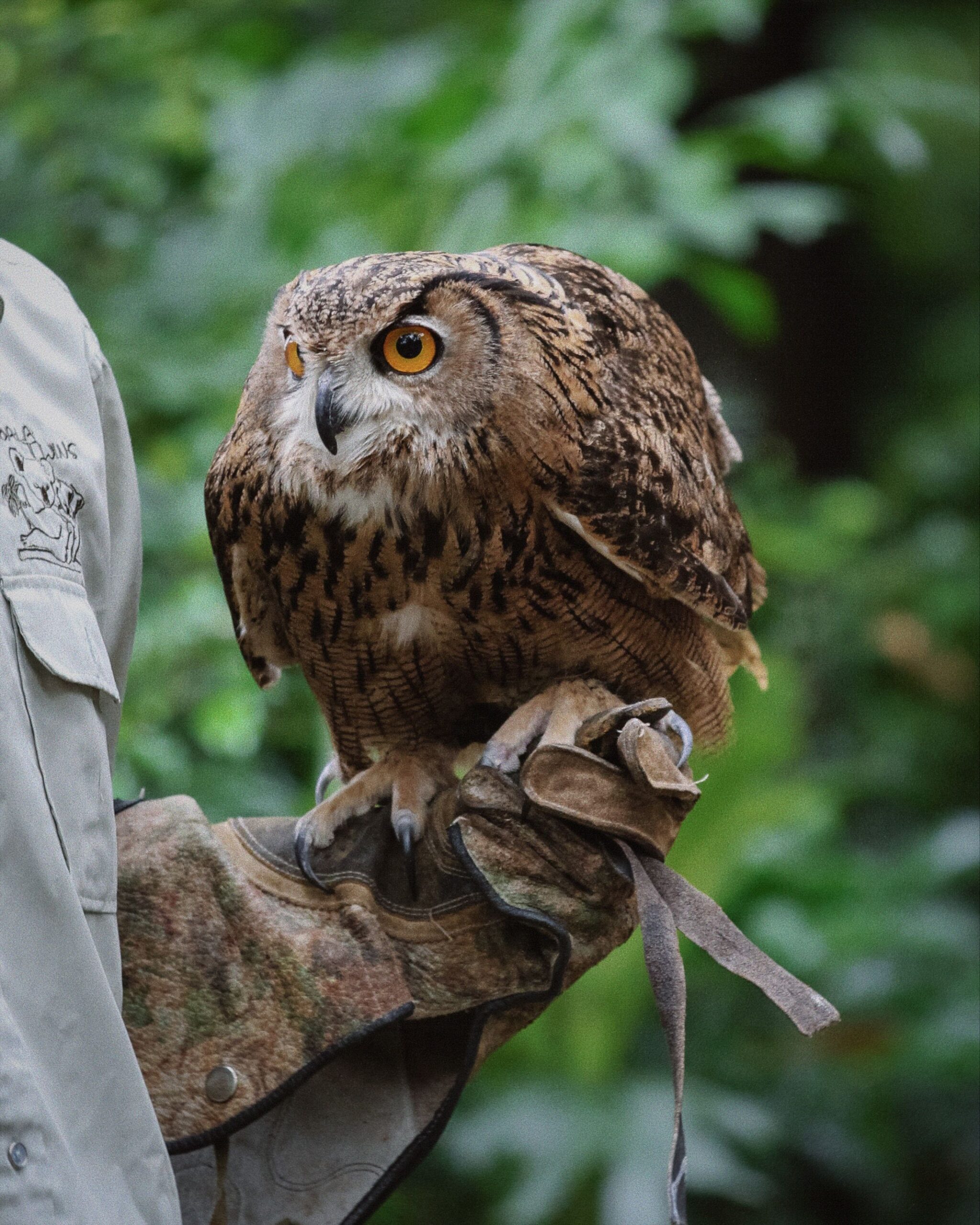
Eagle owls are very friendly birds, so some people actually keep them in captivity. However, he is not the type who will play with you, so he prefers to keep a reasonable distance from you.
Personality Traits of the Great Horned Owl
Timid and cautious
Very cautious around humans and large animals
If they sense danger, they will immediately flee or hide
Strongly territorial
Can be aggressive toward other individuals during breeding and hunting seasons
Uses their large bodies and powerful claws to defend their territory
Highly independent
Primarily solitary
Does not form groups except during breeding seasons, and lives mainly within its own hunting area
Excellent patience and observation skills
When hunting prey, they will wait and observe for long periods of time
Approach quietly and without making any noise when flying
Moderately curious
Observes their surroundings within limits that do not pose a threat to themselves
Wary of humans and new environments
What is the ecology like?
Eagle owls subsist on wild rodents, mammals, reptiles, and bird species such as herons, buzzards, and other owls. The form of coexistence is oviparous. They lay eggs from March to May. Lifespan is 15 to 30 years.
- Living Environment
Habitat: Forests, mountains, rocky areas, grasslands, etc. of Europe, Asia, and North Africa
Uses tree holes and rock depressions as nests and hideouts
Active not only in forests but also in open grasslands and around farmland
- Behavior
Nocturnal/Crepuscular
Mainly active from dusk to night
Rests in nests or in the shade of rocks during the day
Primarily solitary
Does not interact with others except during breeding season
Hunting Method
Approaches prey by quietly jumping down from tall trees or rocks
Waits quietly for long periods, observing its movements and then preying
- Diet
Carnivorous (predator)
Mainly preys on birds, small mammals (such as mice, rabbits, and squirrels), reptiles, and amphibians
Once caught, kills prey with its sharp claws and beak
Often captures prey near nests or in flight
- Breeding
Breeding Season: Spring (February–April depending on the region)
Eggs: 1–4
Nesting: Natural hideouts such as tree holes, rock crevices, and cliffs
Both parents often raise their chicks, and the young learn flight and hunting skills under their care.
Are there any natural enemies?
Eagle owls have no particular natural enemies. If I had to say it, it would be human.
About Molting
Molting (the shedding and replacement of feathers) in Eagle-Owls is a vital physiological process for maintaining their ability to fly and hunt, as well as for regulating body temperature. Unlike the shedding of fur in mammals, birds replace old feathers with new ones gradually.
Molting Season
Eagle-Owls generally molt during:
Spring through autumn (primarily May to October)
Reasons:
The breeding season has ended.
Food is easier to secure.
Survival is easier even if flight capability is temporarily reduced.
The Molting Process
Eagle-Owls do not lose all their feathers at once.
The process follows this sequence:
Old feathers fall out.
New feathers grow from the base.
Feathers are replaced while maintaining flight capability.
Of particular importance are the:
Flight feathers (wing feathers)
Tail feathers
Because these are directly linked to flight performance, they are replaced over an extended period.
Feather Changes from Juvenile to Adult
An Eagle-Owl’s plumage changes significantly as it grows.
Juvenile
Characteristics:
Fluffy, whitish down
Focus on insulation against the cold
Immature flight capability
↓
Young Bird
Brownish patterns gradually become more pronounced
Flight feathers develop
↓
Adult
Distinct striped patterns
Thick, durable feathers
Fully developed hunting capabilities
About Their Calls
The Eurasian Eagle-Owl is best known for its deep, resonant “hoo-hoo” call. Possessing the powerful vocal projection characteristic of large owls, the sound carries over long distances across forests and rocky terrain at night. These calls serve primarily to establish territory, facilitate breeding, and communicate with other owls.
Characteristic Call: “Hoo, hoo”
This is the typical call made by the male Eurasian Eagle-Owl.
Characteristics:
Deep, resonant voice
Rhythmic pattern of two or more notes
Audible from hundreds of meters away
Sound profile:
“Hoo… ho, hoo…”
A commanding, resonant call that echoes through the forest at night.
Territorial Calls
Eurasian Eagle-Owls are highly territorial.
Primary purposes:
Warning other males
Announcing their presence
Securing a breeding site
Vocal activity increases notably during the breeding season (winter to spring).
Males maintain distance from one another based on:
Volume
Frequency of calls
Positioning
Courtship Calls
Males and females call back and forth during the breeding season.
Male
Deep “hoo” sound
Territorial display
Female
Higher-pitched than the male
Calls in response
This vocal exchange facilitates:
Locating the partner
Pair formation
Preparation for breeding
Chick Calls
Young owls produce calls that differ from those of adults.
Characteristics:
High-pitched voice
Begging for food
Signaling the parent
The voice gradually deepens as they mature.
Seasonal Activities
The activity patterns of the Eurasian Eagle-Owl vary significantly by season. The most critical periods are the breeding season and the non-breeding season; territorial and courtship activities intensify from winter through spring, while life from summer onwards centers on rearing young and hunting.
🌸 Spring (approx. March–May)
The Start of Breeding and Rearing
Spring is the most important season for the Eurasian Eagle-Owl.
Key Activities
Pair formation
Nest site selection
Egg-laying
Incubation
Hatching of chicks
Characteristics:
Males call frequently at night
Strong defense of territory
Females incubate eggs in the nest
Nests are built in locations such as:
Rock ledges
Cliff recesses
Bases of large trees
Shallow depressions on the ground
☀️ Summer (approx. June–August)
Chick Growth and Hunting Season
Summer is the busiest time for the parent birds.
Key Activities
Feeding chicks
Securing prey
Flight training
Parent birds go out hunting at night.
Main prey:
Rodents
Rabbits
Hedgehogs
Birds
Reptiles
After fledging, young owls continue to receive food from their parents for a while as they learn hunting skills.
🍂 Autumn (approx. September–November)
Independence and Territory Seeking
Autumn is a season of growth for young owls.
Young owls
Separate from parents
Search for new habitats
Improve hunting skills
Adult owls
Build up physical strength for winter
Maintain territory
Complete molting
This period is relatively quiet, with fewer vocalizations compared to the breeding season.
❄️ Winter (approx. December–February)
Territory Defense and Breeding Preparation
Activity levels rise again during winter.
Key Activities
Courtship
Strengthening pair bonds
Territory assertion
Characteristics:
Increased nighttime vocalizations
Males call with low-pitched voices
Pairs are seen together more frequently
They remain active even in cold regions during winter. Reasons:
Heat retention provided by thick plumage
Adaptation for nocturnal hunting
High energy efficiency
Regarding Flight Speed
The flight style of the Eurasian Eagle-Owl is not one of high-speed pursuit; rather, it is specialized for a hunting method that involves “approaching silently and securing the kill in a single strike.” They possess exceptional flight capabilities, even among large owls.
Normal Flight Speed
The Eurasian Eagle-Owl’s normal flight speed is estimated to be:
Approximately 30–50 km/h
When patrolling its territory or traveling at night, it flies with slow, powerful wingbeats.
Characteristics:
Low wingbeat frequency
Frequent use of gliding
Energy conservation
Speed During a Dive or Hunt
When targeting prey, the owl accelerates rapidly.
Diving speed: Can reach approximately 60–80 km/h or more
The hunting sequence is as follows:
Wait at a high vantage point
Detect sound or movement
Approach silently (minimizing wing noise)
Dive
Capture with powerful legs
Why Can They Fly Fast?
① Large Wings
The Eurasian Eagle-Owl possesses large wings.
Wingspan:
Approximately 150–180 cm
These large wings allow for:
Staying airborne even at slow speeds
High gliding performance
Sharp, sudden turns
② Silent Flight
The Eurasian Eagle-Owl’s greatest asset is silence rather than raw speed.
Feather characteristics:
Comb-like feather tips
Disperses airflow
Reduces wing noise
This makes it difficult for prey to notice the owl’s approach.
③ Powerful Legs and Talons
Rather than focusing on flight speed itself, the Eurasian Eagle-Owl has evolved:
“The ability to approach and capture prey without being detected”
Legs:
Thick and strong
Powerful grip strength
Sharp talons
These features enable it to capture mammals and birds smaller than itself.
About baby eagle owls
This article provides detailed information about baby eagle owls (Bubo bubo).
- Appearance and Characteristics
Immediately after birth, they are covered in soft white to cream-colored down.
Their eyes are open, but their vision is not yet fully developed.
Their beaks and claws are small, and their flight feathers are underdeveloped.
They weigh approximately 80-120g, and their weight increases rapidly as they grow.
- Behavioral Ability
They are unable to leave the nest on their own immediately after birth and remain protected within the nest.
They begin practicing flapping and flight after a few weeks.
They observe their parents’ hunting habits and learn foraging techniques and vigilance behaviors.
- Diet and Growth
For the first few weeks after birth, they rely on their parents for food (captured small animals and birds).
At 2-3 weeks, they gradually begin to learn to catch food on their own.
At approximately 6-8 weeks, they develop flight ability and are able to leave the nest.
During their development, they acquire nocturnal hunting behaviors and hiding habits.
- Sociality
Young animals spend their time with their parents and siblings within the nest.
They have little contact with other individuals, so learning from their mother and father is key to their survival.
Light playful interactions between siblings also serve as practice for hunting and attacking.
- Defense and Safety
Hiding within the nest is essential to avoid predators.
Because their feathers are soft and they are unable to fly, parental protection is essential.
Is the eagle owl an endangered species?
Overall, the eagle owl is very stable. However, some subspecies are listed as endangered species. Environmental destruction caused by humans has become the greatest threat.
- IUCN Assessment
The International Union for Conservation of Nature (IUCN) Red List classifies the Great Horned Owl as “Least Concern (LC).”
This indicates that the species is currently at low risk of extinction and its population is relatively stable.
- Population Status
Widely distributed across Europe, Asia, and North Africa
Adapted to a variety of environments, including forests, rocky areas, mountains, and grasslands
While there are localized declines in some areas, the population is stable globally.
- Major Threats
Habitat Destruction
Deforestation, agricultural development, and urbanization
Human Persecution
May be exterminated as part of wildlife control measures
Traffic accidents and collisions with power lines
Food shortages
Decreases in the number of small mammals and birds that serve as prey
- Conservation Status
Hunting and capture are restricted in many countries.
Habitat conservation is important, and protection of nests and rocky areas, especially during the breeding season, is recommended.
Can eagle owls be kept as pets?
Eagle owls can be kept as pets. You can raise them if you have food, perches, cages, etc., but the problem is the price. If you keep a pet at a pet shop, the price can range from 400,000 yen to over 1,000,000 yen in Japanese yen, so it’s not cheap.
Food is a special food
As the staple food for eagle owls, we recommend special food that can be purchased at specialty stores. If you don’t hold it with a pin, it may think your hand is food and bite it.
Cages are made to order
We recommend that the cage be made to order. Eagle owls are very large and life can be quite stressful if they don’t have a decent amount of space. It’s best if you can also sunbathe.
Facilities Housing Eurasian Eagle-Owls (Japan & Worldwide)
The Eurasian Eagle-Owl (Bubo bubo) is one of the world’s largest owl species and is kept in zoos and facilities specializing in birds of prey across the globe, including in Japan. Due to their large size and long lifespans, they are frequently the subjects of educational exhibits and breeding research in zoos.
🇯🇵 Major Facilities in Japan Where You Can See Eurasian Eagle-Owls
🦉 Ueno Zoological Gardens (Tokyo)
One of Japan’s premier zoos, featuring exhibits of owls and birds of prey.
Features:
Exhibits of nocturnal birds
Observation of large owl species
Ecological commentary and educational displays
🦉 Tama Zoological Park (Tokyo)
Characterized by spacious exhibits that closely mimic natural environments.
Features:
Extensive exhibits of birds of prey
Opportunities to learn about avian flight capabilities and ecology
Active involvement in breeding research
🦉 Sapporo Maruyama Zoo (Hokkaido)
Located in Hokkaido, a region where the Eurasian Eagle-Owl is naturally distributed.
Features:
Many exhibits featuring animals from northern regions
Husbandry adapted to a cold climate
Excellent for observing owls
🦉 Asahiyama Zoo (Hokkaido)
Renowned for animal exhibits that leverage Hokkaido’s climate.
Features:
Housing environments that closely resemble Hokkaido’s natural landscape
Exhibits showcasing avian behavior
Ideal for observation during winter
🦉 Nasu Animal Kingdom (Tochigi Prefecture)
Famous for its bird-of-prey exhibits and bird flight demonstrations.
Features:
Exhibits of owls and birds of prey
Events showcasing flight capabilities
Exhibits allowing for close proximity to the birds
🦉 Kobe Animal Kingdom (Hyogo Prefecture)
A facility that places a strong emphasis on bird exhibits.
Features:
Exhibits of owl species
Indoor facility offering easy observation
Opportunities to see bird behavior up close
🌎 Major Facilities Worldwide
🇫🇮 Finland and the Nordic Region
Eurasian Eagle-Owls are naturally distributed across the Nordic region and are kept in zoos and wildlife rehabilitation centers there. Features:
Rescue for the purpose of reintroduction to the wild
Care for injured or sick individuals
Breeding research
🇩🇪 Berlin Zoo (Germany)
One of the most historic zoos in Europe.
Features:
Diverse bird exhibits
Raptor education
Conservation activities
🇬🇧 Chester Zoo (UK)
One of the largest zoos in Europe.
Features:
Bird conservation
Educational programs
Wildlife research
🇺🇸 Raptor conservation facilities in the USA
In the United States, Eurasian Eagle-Owls are cared for not only in zoos but also in raptor rehabilitation facilities.
Objectives:
Treatment of injured individuals
Reintroduction to the wild
Environmental education
Introducing other animals


コメント