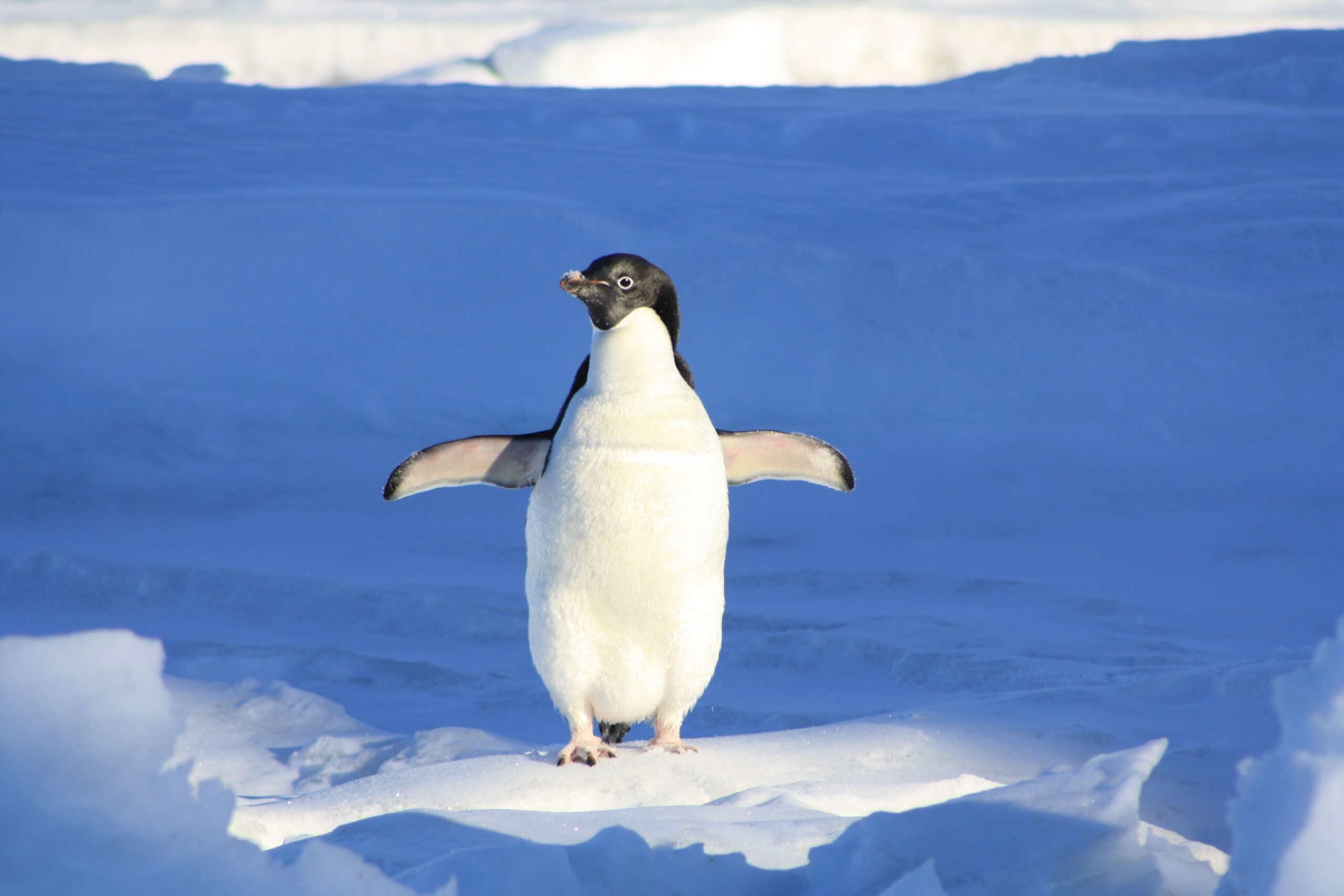
We will explain the characteristics, ecology, and habitat of Adélie penguins. Adélie penguins live in Antarctica, so we don’t have many chances to see them. However, many penguins are kept in zoos and aquariums, and there are many opportunities to see them.




- Basic information about Adélie penguins
- What are the roots and origins of the Adélie penguin?
- What will happen to the classification?
- About Adélie penguin habitat
- feature is? What kind of creature is it?
- What will your personality look like?
- What is the ecology of Adélie penguins?
- Adélie Penguin Molting
- Adélie Penguin Diving
- Adélie Penguin Calls
- Seasonal Activities of Adélie Penguins
- Adelie Penguin Chicks
- Are the rumors about pushing your friends down true?
- Are Adélie penguins an endangered species?
- Is it possible to keep Adélie penguins?
- Zoos where they are kept (Japan and around the world)
- Fellow penguins
Basic information about Adélie penguins
Adélie penguins are birds belonging to the Adélie penguin genus. The scientific name is Pygoscelis adeliae. This species and the emperor penguin are the only penguins that breed in Antarctica, with a body length of 60-70 cm and a weight of about 5 kg.
| Japanese(和名) | アデリーペンギン |
| English(英名) | Adelie penguin |
| scientific name(学名) | Pygoscelis adeliae |
| classification(分類) | Sphenisciformes, Spheniscidae, Pygoscelis ペンギン目ペンギン科アデリーペンギン属 |
| IUCN Status(保全状況) | LEAST CONCERN |
| Height(身長) | 60-70cm |
| Weight(体重) | 2-5kg |
What are the roots and origins of the Adélie penguin?
The Adélie penguin (Pygoscelis adeliae) is, broadly speaking, an “Antarctic-specialized penguin” that evolved over a long period of time around the Antarctic.
① Evolutionary Roots (When and Where Did They Come From?)
The Adélie penguin belongs to a fairly old group in the evolutionary history of penguins as a whole.
Penguins diverged from other seabird lineages around 40 million years ago.
They then continued to evolve in the seas around Antarctica.
The genus Pygoscelis is a further branch of that group.
Research suggests:
The genus Pygoscelis diverged after approximately 38 million years ago.
The Adélie penguin itself is estimated to have evolved around 19 million years ago.
In short,
It is a species that “evolved and solidified over a long period of time in Antarctica.”
② Place of Origin (Geographical Roots)
The “Adélie Land,” from which the Adélie penguin gets its name, is important.
Discovered during the French Antarctic expedition in 1840
Named by explorer Dumont d’Urville after his wife, “Adèle”
Penguins in that region came to be called “Adélie penguins”
However, what’s important is:
While the name originates from “Adélie Land”
The evolution of the species itself is much older and takes place in the vast Antarctic region
❄️ ③ Environment in which they evolved (Reasons for their characteristics)
All of the characteristics of the Adélie penguin are “Antarctic-specific”:
Swimming in icy seas (high-speed swimming)
Krill-centered diet
Colonial breeding in rocky areas (requires ice-free areas)
Rapid breeding during the short summer
In other words
“The perfected form resulting from adaptation to the extreme environment of Antarctica”
What will happen to the classification?
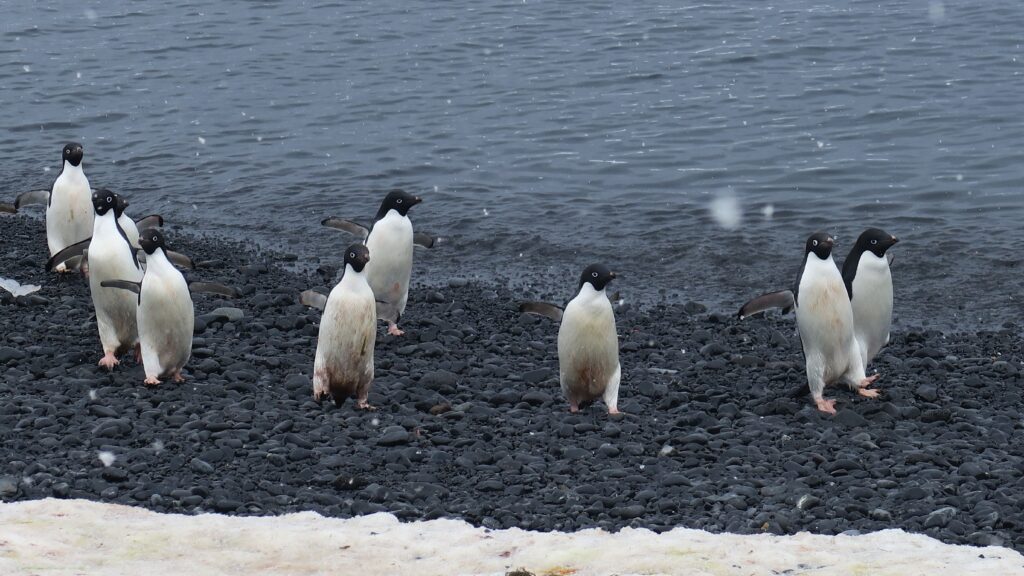
Adélie penguins belong to the Adélie penguin genus. Adélie His penguin specimens were collected by the crew of French explorer Jules du Mont d’Urville’s Antarctic expeditions in the 1830s and his 1840s. It was named the Adélie Penguin in honor of his wife, Adélie. In 1841 it received the scientific name Catarrhactesadeliæ, but now the Adelie penguin has been assigned to the genus Pygocelis. It is one of three types.
| 名前:Name | 属名:Group | 生息地:habit |
| アデリーペンギン(Adelie Penguin) | Pygoscelis アデリーペンギン属 | 南極大陸 Antarctica |
| ジェンツーペンギン(Gentoo Penguin) | Pygoscelis アデリーペンギン属 | 南極大陸 Antarctica |
| ヒゲペンギン(Chinstrap Penguin) | Pygoscelis アデリーペンギン属 | 南極大陸 Antarctica |
Classification
- 界 (Kingdom): Animalia(動物界)
- 門 (Phylum): Chordata(脊索動物門)
- 綱 (Class): Aves(鳥綱)
- 目 (Order): Sphenisciformes(ペンギン目)
- 科 (Family): Spheniscidae(ペンギン科)
- 属 (Genus): Pygoscelis(アデリーペンギン属)
- 種 (Species): Pygoscelis adeliae(アデリーペンギン)
About Adélie penguin habitat
Adélie penguins live in Antarctica, similar to emperor penguins.
- Geographic Distribution
Main Location: Coastal areas of Antarctica and surrounding small islands
Distributed widely along the coast of Antarctica, they colonize rocky areas and ice crevices in the ice margin.
Some species are also found on islands off the coast of the Antarctic Peninsula.
- Habitat
Land: They nest in reefs and ice crevices.
At sea: Their feeding grounds are along the coast of the Antarctic Ocean, primarily near the ice margin.
They choose areas with stable ice for their breeding grounds.
They are adapted to areas with heavy ice and snow, and are resistant to extreme cold.
- Ecological Characteristics
They feed on small crustaceans (krill) and small fish along the coastal areas of the Antarctic Ocean.
They live in groups, forming large colonies of several thousand birds during the breeding season.
They travel daily between their breeding and feeding grounds.
feature is? What kind of creature is it?
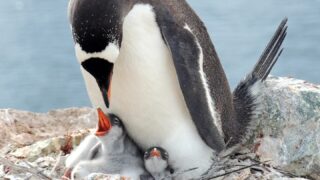
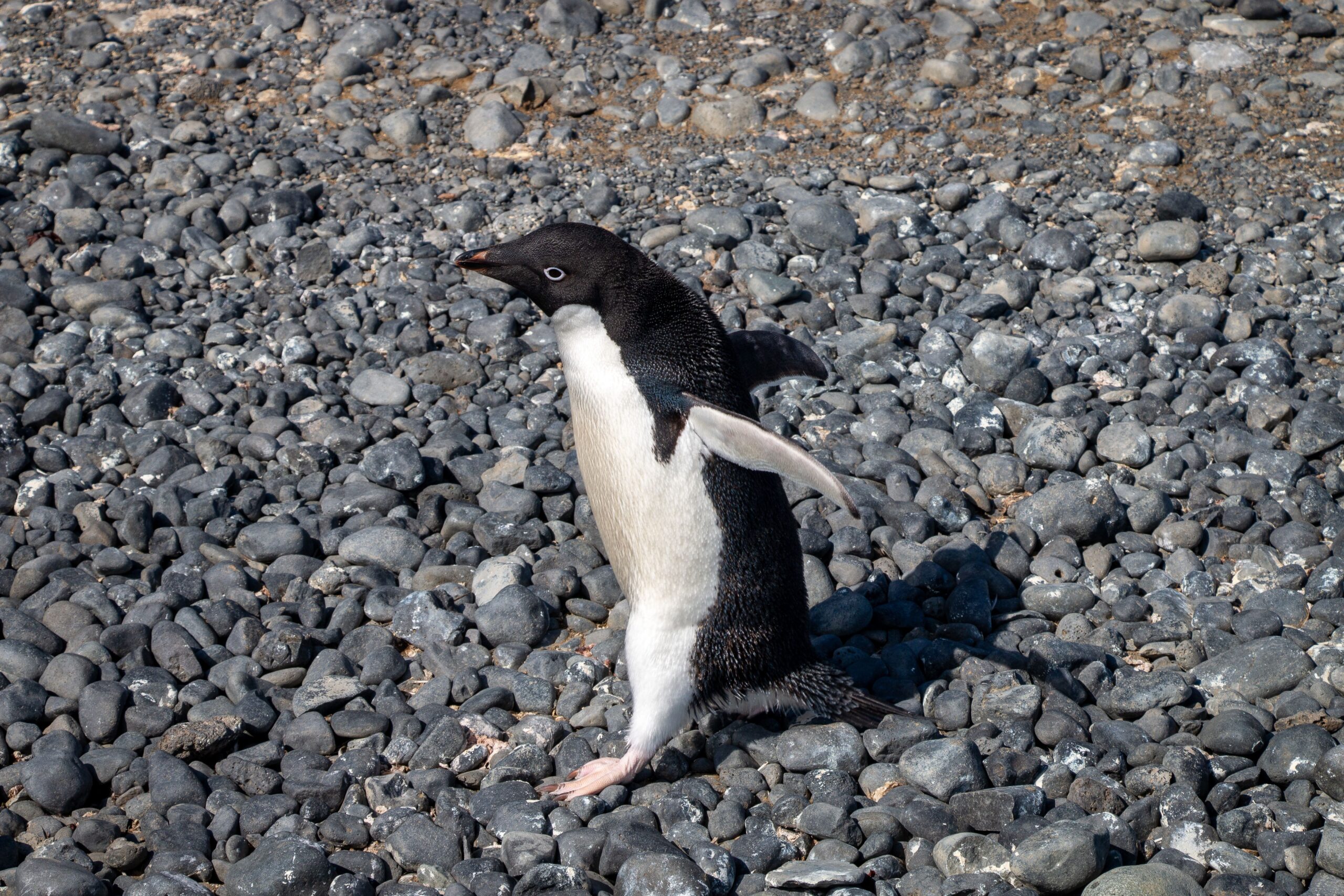
Adélie penguins are characterized by the white area around their eyes. The iris is brown and the feathers are white on the ventral side and black on the head and back. There is a white eye ring around the eyes, and the legs are pink. They usually live in groups in Antarctica, forming large colonies. As the chicks grow, they form “craches” where the chicks gather together.
- Physical Characteristics
Body Length: Approximately 46-71 cm
Weight: Approximately 3-6 kg
Body Type: Medium-sized and stocky
Plumage/Pattern:
Black back, white belly
White around the eyes, distinctive facial expression
Short, reddish beak
Coloration makes them highly visible even in the ice and snow of Antarctica
- Behavior/Movement
Very agile in the water, chasing fish and krill for prey
On land, they waddle, but in breeding grounds, they cooperate in groups to build nests
They are active colonists, living in groups of several thousand
- Diet
Main diet: krill, small fish, and crustaceans
Preys mainly off the coast of the Antarctic Ocean
Even in winter and during icy seasons, they forage in cracks in the ice and at sea
- Reproduction and Lifespan
Breeding season is summer (Antarctic summer is short)
They build nests in rocks or ice crevices, usually laying one to two eggs.
Both parents take turns incubating and raising the eggs.
Their lifespan in the wild is approximately 10 to 20 years.
- Personality and Behavioral Characteristics
Highly social, they cooperate in groups.
Agile and active in the water, but somewhat cautious on land.
During the breeding season, they exhibit territoriality to protect their nests and chicks.
What will your personality look like?
Adélie penguins have a mischievous nature, as if they would stand still and not run away even when approached by humans. Basically, they do not attack on their own, but they will mercilessly attack anyone who tries to approach their nest.
- Sociality
They often live in groups, cooperatively foraging for food.
During the breeding season, they form colonies and live in groups of several thousand birds.
- Vigilance
They are somewhat cautious on land and wary of humans and predators.
They are agile in the sea and will quickly flee if they sense danger.
- Activity
They are very active and agile in the water.
They are active when chasing fish or krill, and sometimes appear to play.
On land, they waddle and move somewhat slowly.
- Stubbornness/Independence
During the breeding season, they demonstrate territoriality to protect their nests and chicks.
Otherwise, they are cooperative and tend to follow the group.
- Impression from Humans
They have a cute, waddling gait on land.
They are agile and active in the sea.
They are curious but cautious.
What is the ecology of Adélie penguins?
Adélie penguins basically live on fish, squid, and crustaceans. In October, Adélie penguins gather at their breeding grounds, build nests made of pebbles, and the females lay eggs. Eggs take about 35 days to hatch. The lifespan is said to be about 15 years.
- Habitat
Location: Coastal areas of Antarctica and surrounding islands
Environmental Conditions:
Nests on reefs or ice crevices
Prefers locations close to the ocean for easy access to food
Tolerant of extreme cold, can survive on ice
- Diet
Main Food: Krill, small fish, and crustaceans
Hunting Method: Diving for food
The amount and type of food are affected by the season, ice conditions, and ocean currents
- Reproduction
Breeding season is the Antarctic summer (November to February)
Nests are built on rocks or ice crevices, usually laying one to two eggs
Both parents take turns incubating and raising the eggs
Chicks leave the nest after a few weeks and learn how to swim and feed from their parents
- Behavior
Live in groups and cooperate to forage for food
Waddle on land and swim agilely in water
During the breeding season, they exhibit territoriality to protect their nests and chicks
- Lifespan
Approximately 100 years in the wild 10–20 years
Survival rates vary depending on food availability, predators, and ice conditions.
What are the natural enemies of Adélie penguins?
Adélie penguins are predators of leopard seals, and skuas are the predators of their eggs and chicks. They have natural enemies both on land and in the sea.
Adélie Penguin Molting
Molting is a very significant and extreme event for Adélie penguins. In short, it’s a molting process that occurs once a year, where they completely replace all their feathers in a short period, often accompanied by fasting.
Molting Basics (When Does It Happen?)
Time: Late Antarctic summer to autumn (approximately February to March)
Frequency: Once a year
Duration: Approximately 2-3 weeks
During this period, almost all Adélie penguins come ashore and remain still in groups.
⚠️ Key Feature: Fasting During Molting
Adélie penguin molting is quite unique:
They cannot enter the sea (because their feathers lose their waterproofing function)
They cannot forage for food
In other words, it’s a complete fasting period
Therefore, before molting:
They prepare by:
Accumulating body fat
Foraging for a large amount of food in the sea one last time
Adélie Penguin Diving
Adélie penguins are characterized by a “short-duration, high-frequency, high-speed” hunting style. This style is specialized for efficiently catching krill and other prey in the Antarctic ocean.
Basic Diving Specifications
⏱ Dive Time: Mostly 1-3 minutes
Maximum 5-6 minutes
Dive Depth: Generally 20-70m
Deeper dives of around 100-150m
♂️ Number of Dives: Dozens to over 100 dives per day
They are more of a “many-dive-per-day” type than a “long-dive-per-day” type.
What are they doing (purpose)?
Main prey:
Krill (most important)
Small fish (silver-colored fish, etc.)
Small crustaceans
Because the Antarctic ocean is vast and prey is dispersed,
They employ a strategy of repeatedly making short dives to efficiently hunt.
How diving is possible
Adélie penguins have the following adaptations:
High-oxygen blood (high hemoglobin content)
Rich in myoglobin, which stores oxygen in muscles
Lower heart rate to conserve oxygen
Streamlined body to reduce water resistance
In short, they are “oxygen-conserving diving machines.”
Adélie Penguin Calls
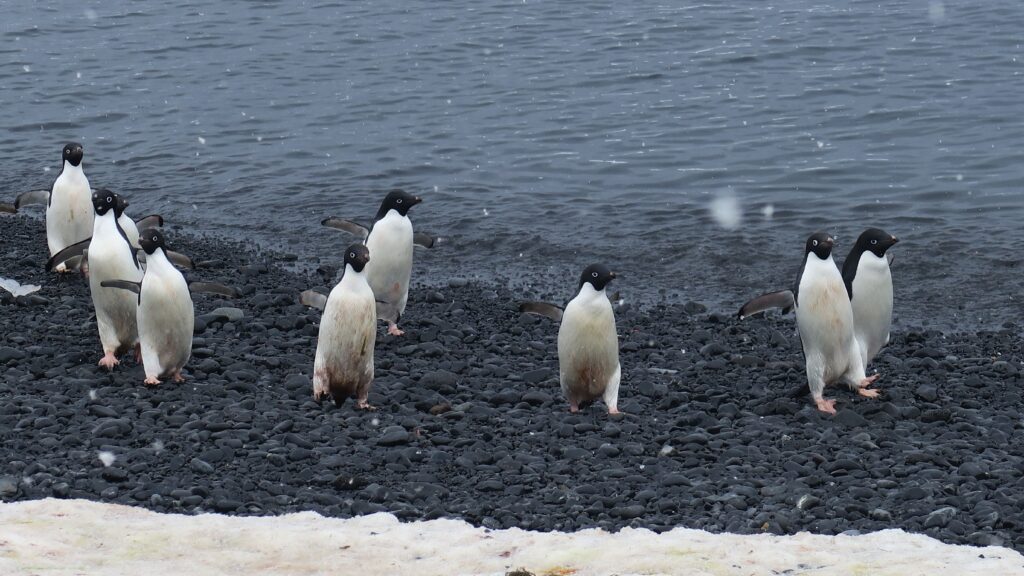
Adélie penguins are famous for their particularly loud, complex, and distinctive calls, even among penguins.
What do they sound like?
In short, Adélie penguin calls are:
️ “A noisy colony of overlapping ‘ga-ga,’ ‘squeak-squeak,’ and ‘kyurururu’ sounds.”
In reality, it’s not a simple call, but a combination of multiple sounds.
① Courtship Calls (Love Calls)
“Quack, quack, grrrrr…”
Made before and after handing over a stone.
Used by males to call females.
An important sign of couple formation.
② Nest Calling (Pair Recognition)
“Kee, kee, gya gya”
They remember each other’s calls.
They can identify their partners even among thousands of birds.
The key point is that they can distinguish between parent and offspring, and between mated couples.
③ Colony Noise (Colony Sounds)
The calls are constantly overlapping.
To the human ear, it sounds like a “wall of noise.”
Antarctic summer is like a “city of bird calls.”
Seasonal Activities of Adélie Penguins
Adélie penguins have a “life cycle of moving between sea and land” in accordance with the extreme seasonal changes of Antarctica. Their behavior is characterized by a fairly clear division between seasons.
Spring (October-November) | Return and Breeding Preparation
As spring arrives in Antarctica, the ice begins to recede little by little.
Individuals that spent the winter at sea return to their breeding grounds.
They compete for previously used nesting sites.
Males arrive first and prepare nests (stone nests).
“Courtship behavior” to attract females becomes active.
This period is the “breeding colony reopening season.”
☀️ Summer (December-February) | Peak Breeding and Child-rearing
This is the most important and busy season.
Egg-laying (usually 2 eggs)
Male and female take turns incubating the eggs (approximately 30-35 days)
Chicks hatch
Parents take turns going to the sea to bring food (krill, etc.)
Characteristics:
Colony is the largest in size
Their calls are the most intense
Chicks grow rapidly
“Full-time period of childcare and foraging”
Autumn (February-March) | Molting and inactivity
After summer ends, the sea becomes harsh.
Chicks fledge (become independent)
Adults enter molting all at once
They remain on land for approximately 2-3 weeks without food
They cannot enter the sea until their feathers have grown back
“Complete inactivity & regeneration period”
❄️ Winter (April-September) | Dispersed life at sea
This is the most harsh season.
The ice is expanding, making it impossible to return to breeding grounds.
They live on the ice edges of the Antarctic Ocean and in the open ocean.
The groups have disbanded and are relatively dispersed.
They survive by preying on krill and small fish.
Adelie Penguin Chicks
- From Egg to Hatching
Egg Laying: Usually 1-2
Nest: Built in reefs or ice crevices
Incubation Period: Approximately 32-34 days
Both parents take turns incubating the eggs
- Chick Characteristics
Fur: Soft gray or light brown feathers
Weight: Approximately 100-120g at hatch
Color: Subtle coloring to protect them from predators
- Growth and Fledging
Time to Fledging: Approximately 7-9 weeks
Learns swimming and foraging from parents
After fledged, they head out to sea with the group and become independent hunters
- Survival Challenges
Susceptible to predators (scavengers, seabirds, seals, etc.)
Survival rates vary depending on ice and weather conditions, and food availability
The chick stage is the most dangerous, requiring parental protection
Are the rumors about pushing your friends down true?
Adélie penguins, contrary to their cute image, are said to push their friends into the ocean where their natural enemies, killer whales and leopard seals, lurk. The reason for this is that they push their companions into the ocean where there are leopard seals to check for safety.
Are Adélie penguins an endangered species?
Adélie penguins are currently not an endangered species. However, their population is decreasing rapidly. The estimated number of individuals in 2014 is said to be around 3,790,000 pairs. The population is expected to decline due to the following reasons:
fishing competition
The human population is also increasing, which means they are taking more fish. As a result, the Adélie penguins have no fish to eat, making it difficult to find food nearby. Furthermore, due to climate change, it is becoming difficult to find food nearby. Sea surface temperatures are also rising due to the El Niño phenomenon, which is critical.
Is it possible to keep Adélie penguins?
Adélie penguins live in Antarctica and are extremely difficult to care for. This is because they have to recreate the environment of Antarctica, and many people give up at this point. It would cost a lot of money.
- Current Status of Breeding
There are very few successful cases of breeding or rearing these species in zoos and aquariums around the world.
Because they are specialized for the extremely cold environment of the Antarctic coast, it is extremely difficult to artificially recreate their natural environment.
Breeding is highly specialized, and they are often limited to research purposes or short-term exhibits.
- Breeding Challenges
Water and Air Temperature Management
Because they are adapted to the low temperatures of Antarctica, pool and land temperatures must be kept extremely low.
Feeding Management
They require large amounts of krill and small fish, making it difficult to maintain a balanced diet.
Breeding Difficulties
It is difficult to artificially create an environment similar to the ice and reefs required for breeding.
Constraints as an Endangered Species
International regulations (such as CITES) strictly restrict capture and transportation.
- Conclusion
Breeding in an ordinary home is impossible.
Even in specialized facilities, highly sophisticated management is essential, including the extreme cold environment, food security, and breeding management.
Protection of wild individuals and preservation of their habitat are of utmost importance.
Zoos where they are kept (Japan and around the world)
Adélie penguins are not kept in many zoos and aquariums around the world, including Japan. They are a rare species with very limited facilities for keeping them. This is because they are highly specialized for the Antarctic environment and are difficult to keep in captivity.
Main facilities where they are kept in Japan
In Japan, they are kept in several large aquariums:
Yokohama Hakkeijima Sea Paradise
Nagoya Port Aquarium
Kaiyukan
Adventure World
These are all “large aquarium class” facilities capable of temperature control and replicating a marine environment.
Global keeping status
Adélie penguins are kept in the world in:
Mainly in “facilities close to Antarctic and polar research”
Some large aquariums (North America, Europe, Japan)
They are kept only in these limited locations.
However, here are some important points
Significantly fewer in number than Humboldt penguins and African penguins
Primarily exhibited in aquariums rather than zoos
Fellow penguins
コメント