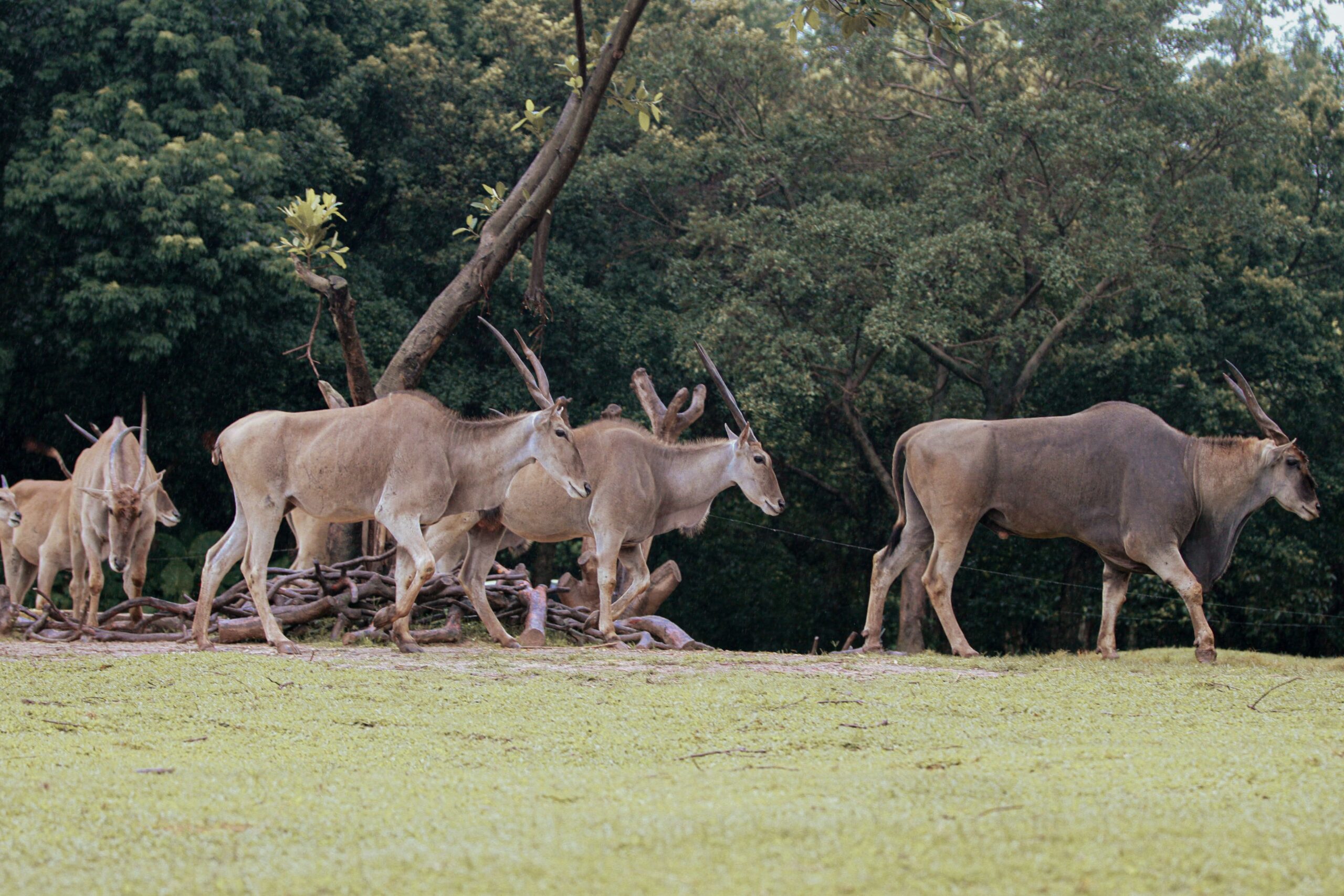
What kind of animal is an eland? We will explain its characteristics, ecology, and habitat. It is the largest of the antelopes and is a relative of cattle that is distributed mainly on the African continent. They are known to be very social animals, as they tend to form large groups.




- What is eland? About basic status
- What are the roots and origins of the eland?
- About habitat
- feature is? What kind of creature is it?
- What is your personality like?
- What is the ecology like?
- About Eland Vocalizations
- Seasonal Activities
- On Walking Speed
- About Eland Calves
- Is the eland an endangered species?
- Can elands be kept?
- Zoos Housing Elands (Japan & Worldwide)
- Introducing other animals
What is eland? About basic status
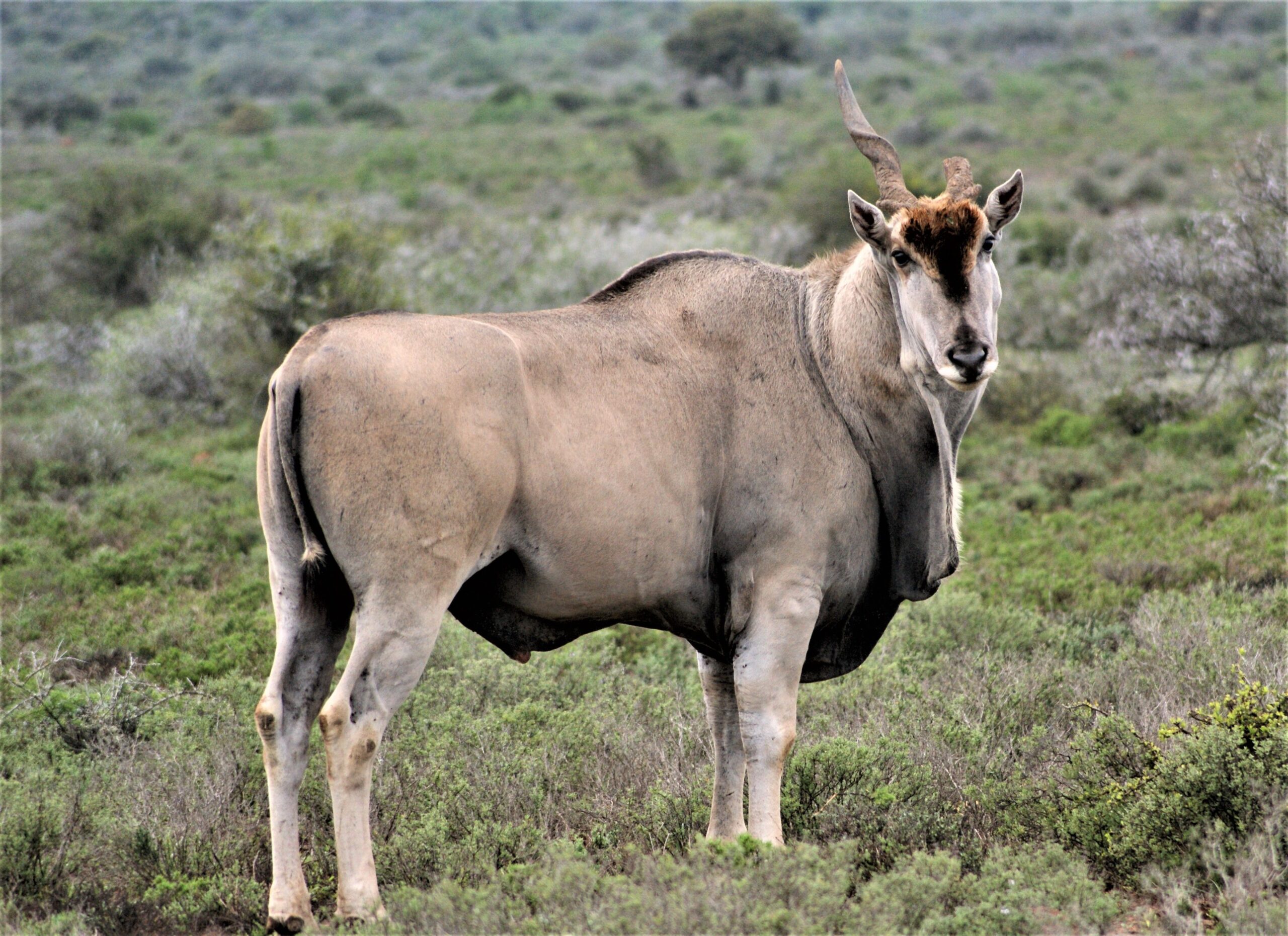
The eland is the second largest antelope in the world, and on average is slightly smaller than the greater eland. The scientific name is Taurotragus oryx, also known as Southern eland or eland antelope. The body length is 240-350cm for males, 200-280cm for females, and the weight is 400-1000kg, and 300-600kg for females.
| Japanese(和名) | エランド |
| English(英名) | eland |
| scientific name(学名) | Taurotragus oryx |
| classification(分類) | Mammalia、Artiodactyl、 Bovidae、Bovinae 哺乳綱、偶蹄目/鯨偶蹄目、ウシ科、ウシ属 |
| IUCN Status(保全状況) | LEAST CONCERN |
| Length(体長) | 240~350cm |
| Weight(体重) | 300-1000kg |
What are the roots and origins of the eland?
The eland is one of the largest species of antelope found in Africa. Taxonomically, it belongs to the family Bovidae, the subfamily Bovinae, and the genus Taurotragus. Two species are primarily recognized today.
① Ancestors: African bovids from about 20 million years ago
The distant ancestors of the eland were primitive bovids that evolved in Africa approximately 20 million years ago (during the Miocene epoch).
Their evolutionary path proceeded as follows:
Primitive bovids
↓
Divergence into large, hoofed herbivores
↓
Tribe Tragelaphini
↓
Group including elands, kudus, nyalas, and bongos
The tribe Tragelaphini, which includes the eland, is believed to have emerged around 6 million years ago during the Late Miocene.
② Close relatives: Kudus and bongos
Although they resemble cattle in appearance, their closest living relatives are:
Close relatives:
Kudus
Bongos
Nyalas
Sitatungas
…and other antelopes characterized by spiraled horns.
While their massive bodies make them look like cattle, from an evolutionary standpoint, they are a group of African antelopes that have evolved to a large size.
③ Existence of ancient elands (extinct species)
Fossil records indicate that elands already existed during the Pleistocene epoch (approximately 2.58 million to 11,700 years ago).
Representative ancient species:
Taurotragus arkelli
Inhabited East Africa during the Pleistocene
A candidate ancestor for the modern Cape eland
Fossils discovered in Olduvai Gorge, Tanzania
It is believed to have possessed more primitive characteristics than modern elands.
④ Divergence of the Common Eland and the Giant Eland
The two extant species—
the Common Eland
(primarily Southern and Eastern Africa)
and
the Giant Eland
(West to Central Africa)
are estimated to have diverged approximately 1.6 million years ago.
Possible reasons for this divergence include:
climate change
expansion of grassland environments
regional differences in food resources
habitat fragmentation caused by ice ages
and so on.
⑤ Why did they grow so large?
The reasons for the Eland’s large size are primarily as follows:
Defense against predators
In Africa,
lions,
hyenas,
and African wild dogs
were among the large carnivores present.
A larger body offers advantages such as:
being less vulnerable to attack
the ability to travel long distances
the ability to defend the herd collectively
Adaptation to grassland environments
Elands are capable of eating:
grass
tree leaves
fruit
twigs
They developed efficient digestive capabilities that allow them to survive in arid environments.
Reduced dependence on water
Elands have a high capacity for obtaining moisture from plants, enabling them to live in dry regions.
This served as a major advantage for survival in the savannas and semi-arid zones of Africa.
About classification
Elands are the largest of the antelopes. The name “Eland” means “elk” or “elk” in Afrikaans.
Systematic classification
| 階級 | 分類 |
|---|---|
| 界 | 動物界(Animalia) |
| 門 | 脊索動物門(Chordata) |
| 綱 | 哺乳綱(Mammalia) |
| 目 | 偶蹄目(Artiodactyla) |
| 科 | ウシ科(Bovidae) |
| 亜科 | ウシ亜科(Bovinae) |
| 属 | Taurotragus |
| 種 | 2種: ・グレーエランド (Taurotragus oryx) ・カラハリエランド (Taurotragus derbianus) |
About habitat
Elands are mainly distributed in southern Africa (Angola, Zambia, Botswana, Tanzania, Mozambique, Kenya, Democratic Republic of Congo, Sudan, Zimbabwe, and South Africa).
- Overall Habitat
Elands live in the savannas, grasslands, and semi-arid regions of Africa.
They live in herds in open grasslands and feed on grasses and leaves.
They depend on water sources, but are drought-tolerant and can travel long distances to obtain water.
- Habitats by Species
Type Habitat Characteristics
Grey Eland (Taurotragus oryx) Southern and Eastern Africa: Botswana, Zimbabwe, Namibia, South Africa, Kenya, Tanzania. Common in open grasslands and savannas, with relatively stable populations.
Kalahari Eland (Taurotragus derbianus) Western and Central Africa: Cameroon, Central African Republic, Chad, and the Kalahari Desert. Adapted to treeless, arid and semi-desert areas, with relatively small populations. - Habitat Conditions
Grasslands/Savannah
Suitable for feeding on grasses and shrubs
Wide field of vision makes it easy to spot predators (lions, leopards, etc.)
Semi-arid/Desert Areas
Can tolerate low water levels
Highly mobile and able to search for water and food
Suitable for large groups
Small groups capable of feeding at the same time, with dozens to hundreds of individuals
feature is? What kind of creature is it?
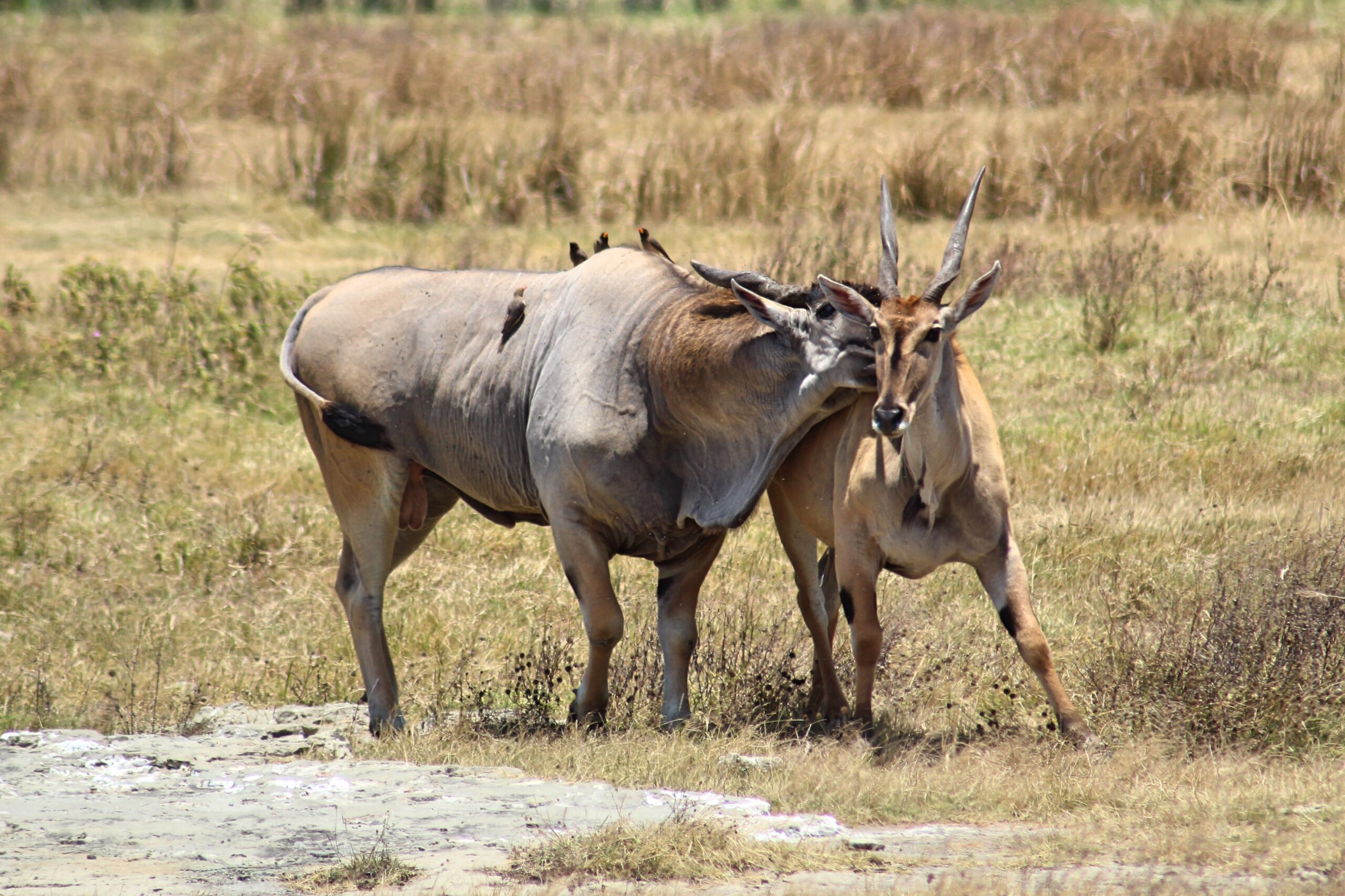
The eland’s body coat is brown, brown, or grey-brown. It is also often mixed with white. The inside of the limbs are whitish, and there is a black patch on the back of the front legs above the knees. The tip of the tail has long hairs and is black in color. Both male and female elands have horns that rotate about twice. Eland mainly forms herds in grasslands, bushlands, and shrublands in southern Africa. Elands are most active in the early morning and evening.
- Physical Characteristics
Physique
Body Length: 2-3 m
Shoulder Height: Approximately 1.5-1.8 m
Weight: 250-1,000 kg (depending on species and individual)
Large and sturdy build
Coat Color
Gray Eland: Light brown to yellowish brown
Kalahari Eland: Reddish brown
Some individuals have vertical white stripes on their backs
Horns
Present in both sexes
Splendid spiral-shaped horns
Males have thick, large horns, while females have slightly narrower horns
Face/Head
Long face and calm-looking eyes
Slightly rounded nose, allowing for easy breathing in rough grasslands
- Behavior and Personality
Highly social animals that live in groups
Groups can number from dozens to hundreds of individuals
Female-centered order and hierarchy exist within the group
Personality
Gentle and non-aggressive
Runs away quickly when predators approach
Curious, but cautious and wary
Activity
Diurnal, foraging and moving during the day
May travel wide areas in search of water
- Ecological Characteristics
Diet: Herbivorous (grasses, leaves, and shrub buds)
Reproduction:
Males join female-dominated groups
Males form harems during the breeding season
Defense:
Living in groups, they have a wide field of vision and protect themselves from predators
Ability to run quickly when needed
Adaptations:
Adapted to grasslands and semi-arid regions
Long-distance migration and tolerance of arid environments
What is your personality like?
Elands tend to be quiet, gentle, and cooperative. However, if the herd is attacked, they have an indomitable spirit and can bravely fight as a group against foreign enemies.
Eland Personality Characteristics
Calm and docile
Non-aggressive and generally peaceful
Few conflicts within the pack, maintaining order
Highly alert
Sensitive to predators (lions, leopards, baboons, etc.) and humans
Quickly flee when sensing danger
Scans a wide area as a group to ensure safety
Highly social
Live in groups, with female-centered order
Males use light threatening and intimidating techniques to protect the pack during breeding season
Strong bonds between females and between mothers and their young
Curious but cautious
Shows interest in new environments and new things, but does not jump on them immediately
Movement is calm and avoids sudden movements
Breeding Season Behavior
Males use their horns to lightly harass other males to protect their harem
Violent combat is rare, and they tend to avoid injury
What is the ecology like?
Elands are herbivorous, eating grasses, tree buds, leaves, etc. In addition to fruits, they also dig into the soil and eat tree roots. Elands are generally polygamous and breed during the rainy season. The gestation period is nine months and it is possible to give birth to one calf. The lifespan is about 15 years.
- Lifestyle
Living in groups
Groups can number from dozens to hundreds of individuals, and are governed by females.
Males form harem-like groups during the breeding season.
Diurnal
Forage and move during the day.
Rest and stay alert at night.
- Diet
Herbivore
Eat mainly grasses, leaves, and shrub shoots.
Able to digest low-nutrient grasses, allowing them to survive in arid regions.
Hydration
Uses water sources, but also obtains moisture from plants, even in arid regions.
Foraging Behavior
Forages simultaneously as a group while checking the surrounding area for safety.
Travels long distances to secure food.
- Reproduction and Rearing
Reproduction
Males join a female-dominated herd.
During the breeding season, males protect the herd and lightly warn other males.
Gestation Period
Approximately 9 months
Birth
Only one calf is born.
The entire herd protects the calf.
Development
Calves accompany their mother and the herd, becoming independent within 1-2 years.
They learn social rules and how to forage and move around.
- Habitat Adaptation
Adapted to savannas and semi-arid regions.
Strong hooves and legs allow for long-distance travel and foraging in arid areas.
They are highly adept at moving over large distances in herds and securing water and food.
Are there any natural enemies?
Natural enemies will be lions and wolves. Large carnivorous mammals attack.
About Eland Vocalizations
Eland vocalizations vary widely, ranging from very subdued sounds—surprising given their massive size—to deep, resonant tones. They are particularly known for a distinctive “clicking sound.”
① Key Feature: The “Clicking Sound from the Knees”
When walking, elands sometimes produce dry, clicking sounds:
“Click… click…”
“Clack, clack”
These sounds do not originate from the mouth or throat; instead, they are believed to be caused primarily by the movement of leg joints and tendons.
Why do they make this sound?
While the exact function is not yet fully understood, the leading theories include:
Signaling the male’s size
Asserting presence within the herd
Intimidating others or establishing social rank
Signaling to herd members at a distance
Larger males, in particular, tend to produce louder clicking sounds.
② Sounds for Everyday Communication
Elands are generally quiet animals, but they do make the following sounds depending on the situation:
Calves (Young Elands)
“Maa”
“Mya”
Soft bleating sounds
Used to call for their mothers.
Adults
When sensing danger or similar situations:
Low growls
Snorting sounds
Short alarm calls
③ Male Intimidation Sounds
During the breeding season, males engage in behaviors such as:
Snorting
Low growling
Stamping the ground
While male elands do fight using their horns, they rarely clash immediately; instead, they compete through a progression of stages:
Body size assessment
↓
Displaying horns to one another
↓
Clicking sounds and intimidation displays
↓
Physical clash (if necessary)
④ Why Elands Rarely Vocalize
Although elands are large herbivores of the savanna, they do not vocalize as frequently as deer or monkeys.
The reasons include:
They live in herds and rely heavily on visual communication
They do not want to reveal their location to predators
Their large size reduces the need to call out to herd members
Seasonal Activities
Eland activity is heavily influenced by the shift between the rainy and dry seasons. In the African savanna, factors such as vegetation volume, water availability, and breeding conditions change with the seasons, causing eland to alter their movement, foraging, and reproductive behaviors.
Spring (Start of the rainy season: roughly October to March, depending on the region)
Activities
Active foraging
Herds move over wide areas
Consuming large amounts of young grass
Rainfall leads to an increase in:
New shoots
Tender grass
Tree leaves
…making this the period when eland can most easily obtain nutrients.
Preparation for breeding
Males increase behaviors such as:
Displaying their physique
Making loud clicking sounds
Following herds of females
Summer (Rainy season: a time of abundant vegetation)
Peak activity
Summer is the most comfortable season for eland.
Foraging
They primarily eat:
Grass
Tree leaves
Fruit
Young branches
Although eland are herbivores, they are mixed feeders (browsers and grazers) that adjust their diet according to conditions.
Herd behavior
During the rainy season, there is a tendency for:
Female and calf herds to grow larger
Young individuals to grow
Travel distances to decrease
Since water and food are plentiful, there is no need for long-distance travel.
Autumn (Transition to the dry season)
Adapting to dietary changes
As rainy-season vegetation begins to decline, eland change their diet.
Behaviors that increase:
Eating tree leaves
Utilizing withered grass
Moving toward water sources
They make particular use of:
Acacia species
Shrub leaves
Period of intensified male competition
As the breeding season approaches, males increase behaviors such as:
Holding their necks low
Pushing matches using their horns
Making clicking sounds
Displaying to females
Winter (Dry season: the harshest period)
*Note: The timing of the dry season varies by region in Africa. Activity Patterns
During the dry season, their routine consists of:
foraging in the morning and evening,
resting during the day,
and congregating around water sources.
Reason:
To avoid depleting their energy due to the high daytime temperatures.
On Walking Speed
Although elands appear sluggish due to their massive size, they actually possess exceptional athletic ability among large antelopes. They switch between walking, trotting, and running depending on the situation.
① Normal Walking
Approximately 3–5 km/h
During routine foraging, they walk slowly while:
Searching for grass
Browsing on leaves
Moving along with the herd
As large animals, they employ an energy-efficient walking style to avoid wasting energy.
② Trotting
Approximately 8–15 km/h
They switch from a walk to a trot when sensing danger or when the herd is on the move.
Characteristics:
Moving with an up-and-down motion of the neck
Capable of maintaining the pace for long periods
The entire herd keeps the same pace
Elands excel at long-distance travel rather than short-burst explosive power.
③ Running Speed (Top Speed)
Elands are capable of reaching speeds of up to:
Approximately 40–70 km/h
Body Weight:
Females: Approx. 300–600 kg
Males: Approx. 500–900 kg or more
It is remarkable that they can achieve such speeds with such massive bodies.
Why can they run fast despite their large size?
- Long Legs
Elands have very long legs,
Allowing for a long stride
Covering distance with fewer steps
- Elastic Tendons
The tendons in their legs act like springs,
Absorbing the impact of landing
Utilizing that energy for the propulsion of the next step
- Body Temperature Regulation
While large animals tend to overheat when running, elands employ a strategy of:
Moving slowly over long distances
Running at high speeds only when necessary
About Eland Calves
This article provides a detailed overview of the characteristics and developmental stages of eland calves.
- Birth
Gestation Period: Approximately 9 months
Litter Size: Usually one calf
Birthing Location: A safe spot in the herd or a hidden spot in the grassland
Newborn Characteristics:
Weight: Approximately 15-25 kg
Height: Approximately 60-80 cm
Fur color is light brown, lighter than that of adults
Horns are still small, and gender differences are not very noticeable
- Relationship with Mother
Immediately after birth, newborns accompany their mothers, learning to walk and forage
They remain safe under the protection of the herd
Mothers become increasingly vigilant to protect their young
- Growth and Behavior
1-3 Months Old:
Practices walking and foraging while clinging to the mother within the herd
Nips grass little by little, and weaning begins
6 Months Old:
Forages and moves with the herd
Observes parental behavior and learns social rules
1-2 Years Old:
Develops independence and establishes its position within the herd
Learns breeding behavior before becoming fully independent
- Characteristics
Coat Color: Newborns are light-colored, and adulthood is light brown or reddish-brown, depending on the species
Personality: Curious, learns by observing the behavior of the mother and herd
Defense: Protected by the mother and herd, avoids predators
Is the eland an endangered species?
The eland has a stable population and is not an endangered species. They are protected by the U.S. Endangered Species Act and international trade is protected by the Convention on International Trade in Endangered Species. However, due to the expansion of human settlements and habitat loss due to poaching, the population is gradually decreasing, so close attention is required.
- Global Conservation Status (IUCN Red List)
Species Classification (Threat Level) Comments
Grey Eland (Taurotragus oryx) LC (Least Concern) Widely distributed in southern and eastern Africa, populations are relatively stable.
Kalahari Land (Taurotragus derbianus) NT (Near Threatened) Distributed in western and central Africa, with localized declines due to deforestation and hunting.
Key Points: The Grey Eland’s population is stable and not endangered, but the Kalahari Land is Near Threatened, requiring attention due to habitat loss.
- Causes of Extinction Risk
Hunting Pressure
Hunting for meat and horns
Habitat loss
Agricultural land development, deforestation, and road construction
Localized population decline
Kalahari Land is particularly affected by deforestation.
- Conservation Status in Japan
No natural distribution
Individuals kept in zoos are for conservation and breeding purposes
Imported and captive breeding are prohibited. Managed under the Convention on International Trade in Endangered Species of Wild Fauna and Flora (CITES) and domestic law
Can elands be kept?
Elands are not sold at pet stores. In that case, the most practical solution would be to ask the zoo to guide you and hand over the animal. Once you enter the park, there will be events, so be sure to check the general information and calendar before you go. Males and females are kept in zones.
- Legal and Conservation Regulations
Internationally, they are listed in Appendix II of the Convention on International Trade in Endangered Species of Wild Fauna and Flora (CITES), and their import and export are subject to restrictions.
Even in Japan, under the Wildlife Protection Act, private captivity is prohibited.
Captivity is limited to zoos, research facilities, and conservation facilities.
- Ecological Reasons
Large herbivores
Height: Approximately 1.5-1.8 m
Weight: 250-1,000 kg
They navigate a wide range of terrain and forage.
Homes and small spaces lack sufficient space.
They require social life. Being kept alone can be stressful.
They have unique dietary habits.
They eat large amounts of grass, leaves, and fruit.
Nutrition and hydration are difficult to maintain at home.
- Health and Safety
They are large and powerful, making them dangerous to keep at home.
They have strong wild instincts and may escape or become violent.
Inappropriate captivity increases the risk of stress and disease.
Zoos Housing Elands (Japan & Worldwide)
Elands are relatively easy to keep among large antelope species and are housed in zoos and safari parks around the world. In Japan, they can be seen at several facilities.
🇯🇵 Major Zoos Housing Elands in Japan
Tennoji Zoo (Osaka)
Species: Common Eland (Taurotragus oryx)
Displayed in the African Savanna area.
It is one of the leading facilities for keeping elands in Japan.
Features:
Massive body size
“Dewlap” (loose skin) under the neck
Thick, spiraled horns (on males)
…and more can be observed here.
Tobu Zoo (Saitama)
Houses elands.
Listed as the Common Eland in their animal encyclopedia.
Because they are kept in a spacious enclosure, it is a great place to observe elands moving about naturally.
🌍 Eland-Housing Facilities Worldwide
Askania-Nova Biosphere Reserve (Ukraine)
A facility with a very famous history regarding eland husbandry.
Known for keeping large herds.
A site associated with research into the domestication of elands.
For a long time, research has been conducted on the potential of elands regarding:
Meat
Milk
Use as livestock in arid regions.
National Zoo & Aquarium (Australia)
Houses Common Elands.
Displayed as part of the savanna animal exhibit.
Introducing other animals
コメント