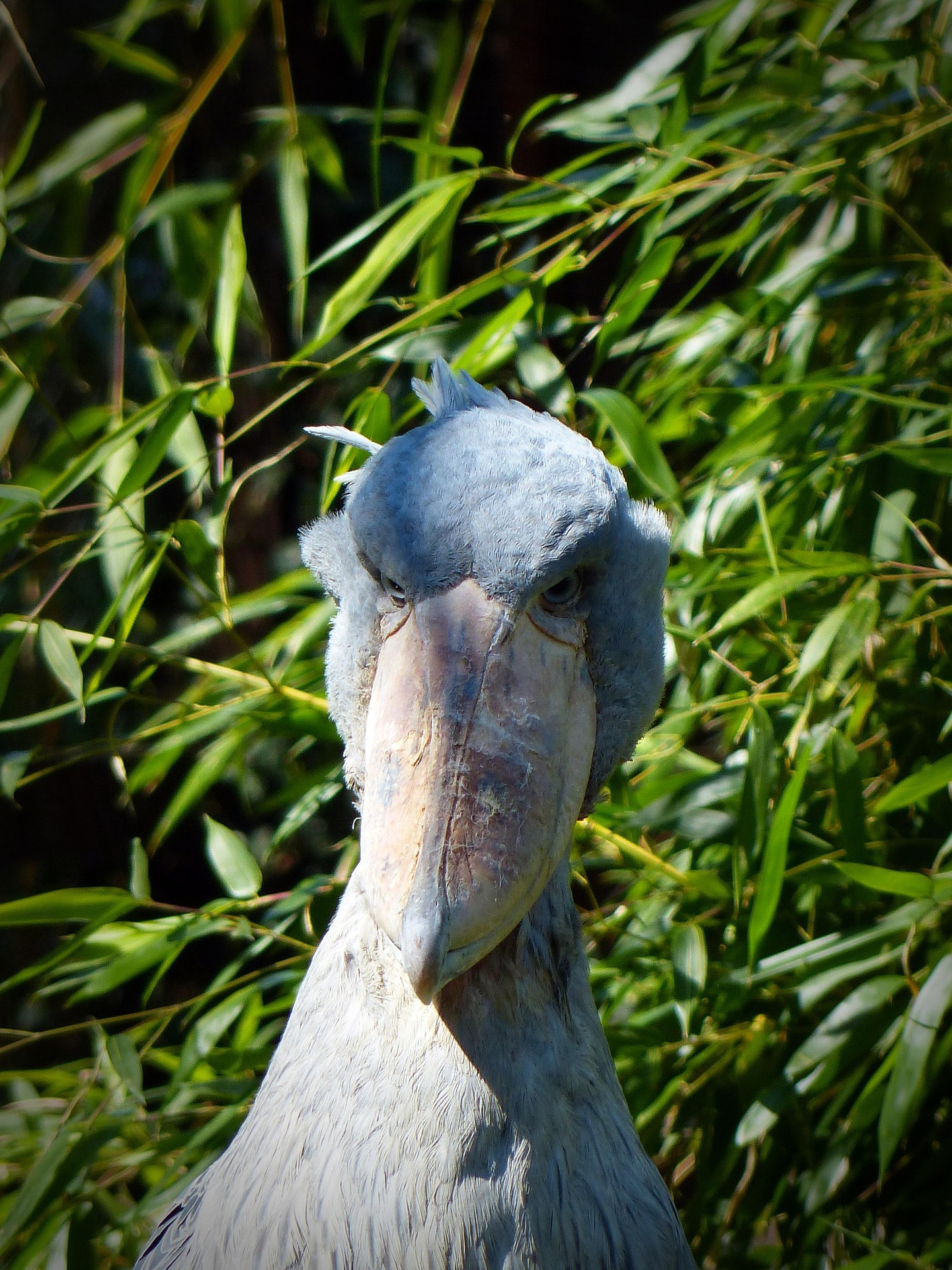
What kind of bird is a shoebill? We will explain its characteristics, ecology, and habitat. This African bird is also very popular at zoos. It is also known as a “stationary bird,” and because it stands still, it looks like a figurine. Let’s learn more about this bird.








- What is a shoebill? About basic status
- What are the roots and origins of the shoebill?
- Where is its habitat?
- feature is? What kind of creature is it?
- What is your personality like?
- What is the ecology like?
- Shoebill Molting
- Vocalizations
- Seasonal Activities
- Flight Speed
- About Shoebill Chicks
- Is the shoebill an endangered species?
- Can shoebill storks be kept?
- Zoos Housing Shoebills (Japan & Worldwide)
- Introducing other animals
What is a shoebill? About basic status
The shoebill is a bird classified in the order Pelecanidae, family Shoebill, and genus Shoebill. The scientific name is Balaeniceps rex, and the kanji is “Balaeniceps rex”. The body length is 110-140cm, the wingspan is 230-260cm, and the weight is 4-7kg. Males weigh an average of 5.6 kg, which is larger than females (average 4.9 kg). If you pay attention to them in the wild and observe their behavior, you will notice that they do not take any action, but remain standing all the time. They do not move on the surface of the water and wait for a long time to catch their prey.
| Japanese(和名) | ハシビロコウ |
| English(英名) | Shoe-billed Stork / Whale-headed Stork |
| scientific name(学名) | Balaeniceps rex |
| classification(分類) | Ave、 Pelecaniformes、Balaenicipitidae 、Balaeniceps 鳥綱、ペリカン目、ハシビロコウ科、ハシビロコウ属 |
| IUCN Status(保全状況) | VULNERABLE |
| Length(体長) | 110-140cm |
| Weight(体重) | 4-7kg |
What are the roots and origins of the shoebill?
The shoebill (scientific name: Balaeniceps rex) traces its roots to an “ancient lineage of birds” that survived in the wetlands of Africa. While they look like “surviving dinosaurs,” they are not dinosaurs themselves; rather, they are birds with a highly distinct evolutionary lineage within the avian world.
Origins in the vast wetlands of Central Africa
Modern shoebills are primarily distributed in the following regions:
Uganda
Zambia
South Sudan
The area surrounding the Congo Basin
Their primary habitats are the upper reaches of the Nile River and tropical freshwater wetlands. They have adapted to a lifestyle of patiently lying in ambush in swamps teeming with fish (such as lungfish and catfish) and catching them with their massive beaks.
Their ancestors are not storks
In the past, true to their name, shoebills were thought to be:
“Shoebills = members of the stork family”
However, as research progressed, they are now classified not under the order Ciconiiformes (storks), but rather:
A unique lineage closely related to the order Pelecaniformes (pelicans)
Taxonomically, they form an isolated group consisting of only a single species within the family Balaenicipitidae.
In short, the relationships are as follows:
Storks → Distant relatives
Pelicans and herons → Closer relatives
Shoebills → A unique, independently evolved species
When did they first appear?
Fossils of shoebill relatives are extremely rare, but fossil birds considered to be closely related include:
Goliathia
Paludavis
It is possible that a lineage leading to the modern shoebill existed in Africa during the Paleogene to Miocene epochs (tens of millions of years ago).
In other words, shoebill ancestors are considered to be:
A lineage of large waterfowl that emerged in the era following the extinction of the dinosaurs.
Why did it evolve this appearance?
Its most distinctive feature is that massive beak.
The reason for this evolution is simple:
“To reliably catch large fish in the swamp.”
The prey targeted by the shoebill includes:
lungfish
catfish
frogs
small reptiles
and more.
Its massive beak evolved to:
scoop up fish like a net
clamp down with great force
pin down escaping fish.
About classification
The mainstream theory was that shoebills were included in the order Storks. There have been various theories regarding the classification of shoebills, but recent advances in DNA analysis have revealed that they are closely related to pelicans. Others say they are similar to herons. The shoebill’s scientific name comes from the Latin word meaning “whale-headed king.”
分類学(Taxonomy)
- 界(Kingdom): 動物界 (Animalia)
- 門(Phylum): 脊索動物門 (Chordata)
- 綱(Class): 鳥綱 (Aves)
- 目(Order): コウノトリ目 (Pelecaniformes)
- かつては独自の「ハシビロコウ目(Balaenicipitiformes)」として扱われることもありましたが、近年の分子系統学によりコウノトリ目に含める説が有力です。
- 科(Family): ハシビロコウ科 (Balaenicipitidae)
- ハシビロコウはこの科で唯一の現生種です。
- 属(Genus): ハシビロコウ属 (Balaeniceps)
- 種(Species): ハシビロコウ (Balaeniceps rex)
Where is its habitat?
Shoebills live in tropical areas from South Sudan to the Democratic Republic of the Congo, Rwanda, Uganda, and Tanzania. There are many areas in the east.
Habitat
Region: Central-Eastern Africa
Distributed primarily in tropical and subtropical regions, including southern Sudan, Uganda, Zambia, the Democratic Republic of the Congo, and northern Tanzania.
Environment: Wetlands, swamps, and wet grasslands along rivers.
Commonly found in shallow marshes and along lake shores.
Often found waiting quietly in still waters.
Climate: Tropical rainforest and savannah wetlands.
Can survive in areas with seasonally changing water levels.
Characteristic Ecology and Habitat Relationships
It preys on fish and frogs with its large beak, so it requires a watery environment.
It prefers quiet, unpopulated wetlands because it can ambush hunt without moving for long periods of time.
Drought and drying-up of wetlands can limit its habitat.
feature is? What kind of creature is it?
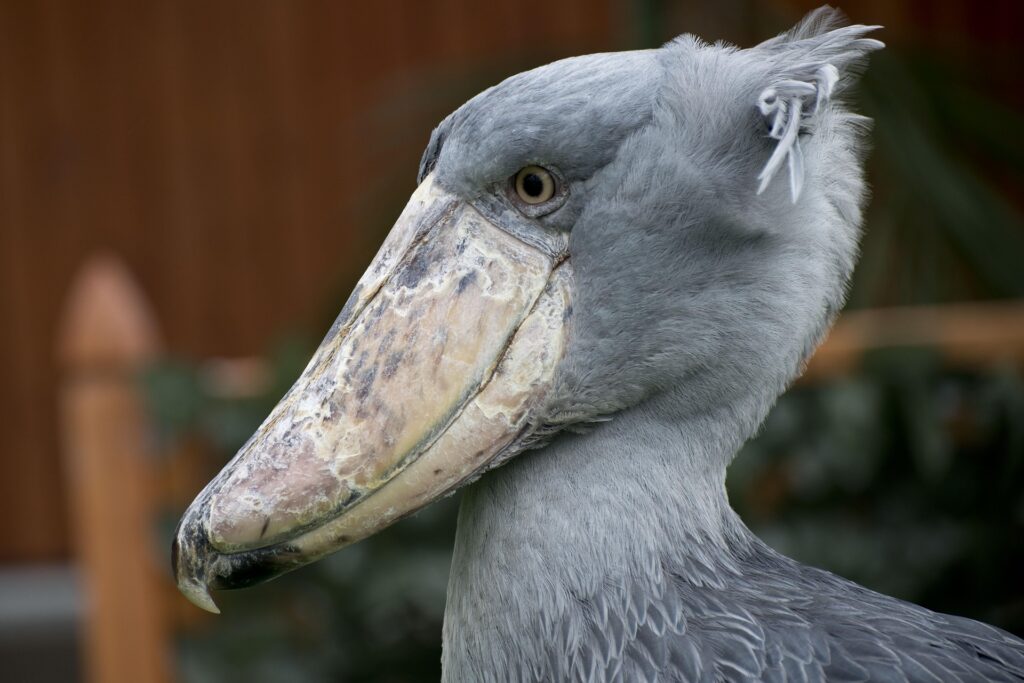
Shoebills are well known as “stationary birds.” One beak is large like that of a dinosaur. Its plumage is bluish-gray and it flies very well. They mainly live in wetlands, swamps, and surrounding grasslands, and they stay still all the time. By staying still and not making any noise, they make it easier to catch food. Shoebill storks are nocturnal, and during the day they often rest among grasses such as reeds and papyrus.
Physical Characteristics
Body Size
Total Length: Approximately 115-150 cm
Weight: Approximately 4-7 kg
Wingspan: Approximately 230 cm
Beak
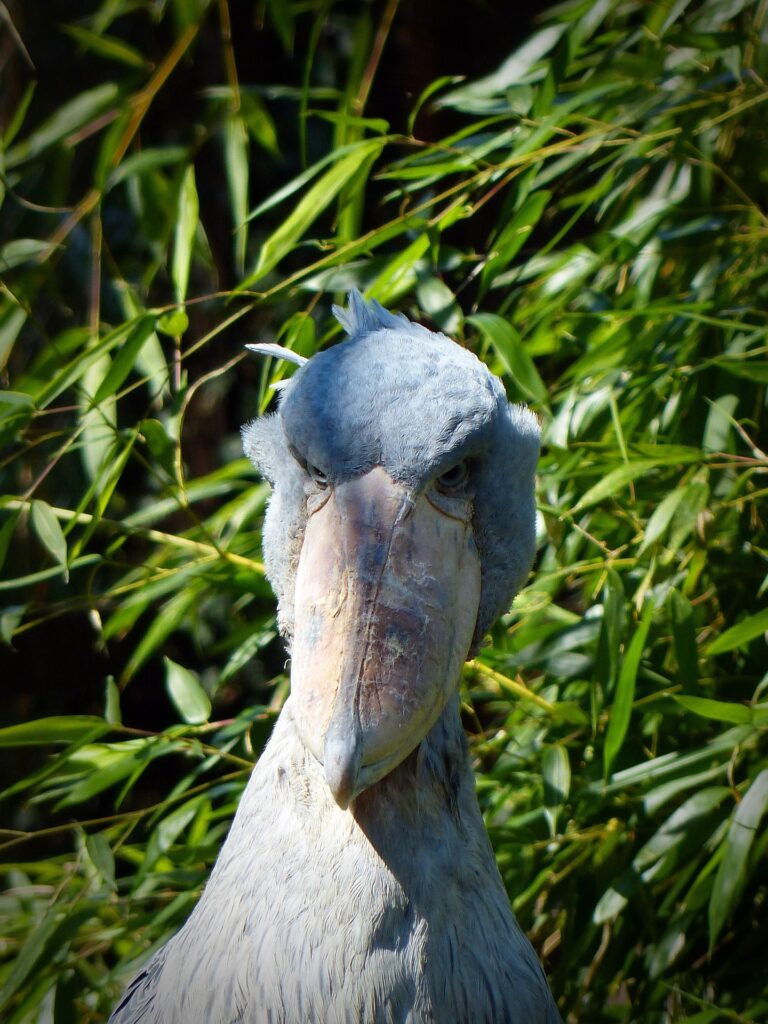
Large, broad, sturdy, shovel-shaped beak
Ideal for catching fish and frogs
Body Color
Overall color is blue-gray or dark gray
Sometimes the head has whitish feathers mixed in
Legs
Long and thick, walking slowly but standing with a stable posture
Structure adapted for hunting near water
Eyes
Large and sharp They use their eyesight to watch moving prey.
Behavioral Characteristics
Ambush Hunter
They wait motionless for hours, barely moving, for prey.
They are also known as the “world’s most motionless bird” due to their extremely low mobility.
Prey
Mainly fish, frogs, and small reptiles
Once they catch prey, they grab it with their beak.
Calls
They are generally silent.
They only call during mating season or when threatening.
Lifespan
They can live for approximately 35 years in the wild and over 40 years in captivity.
What is your personality like?
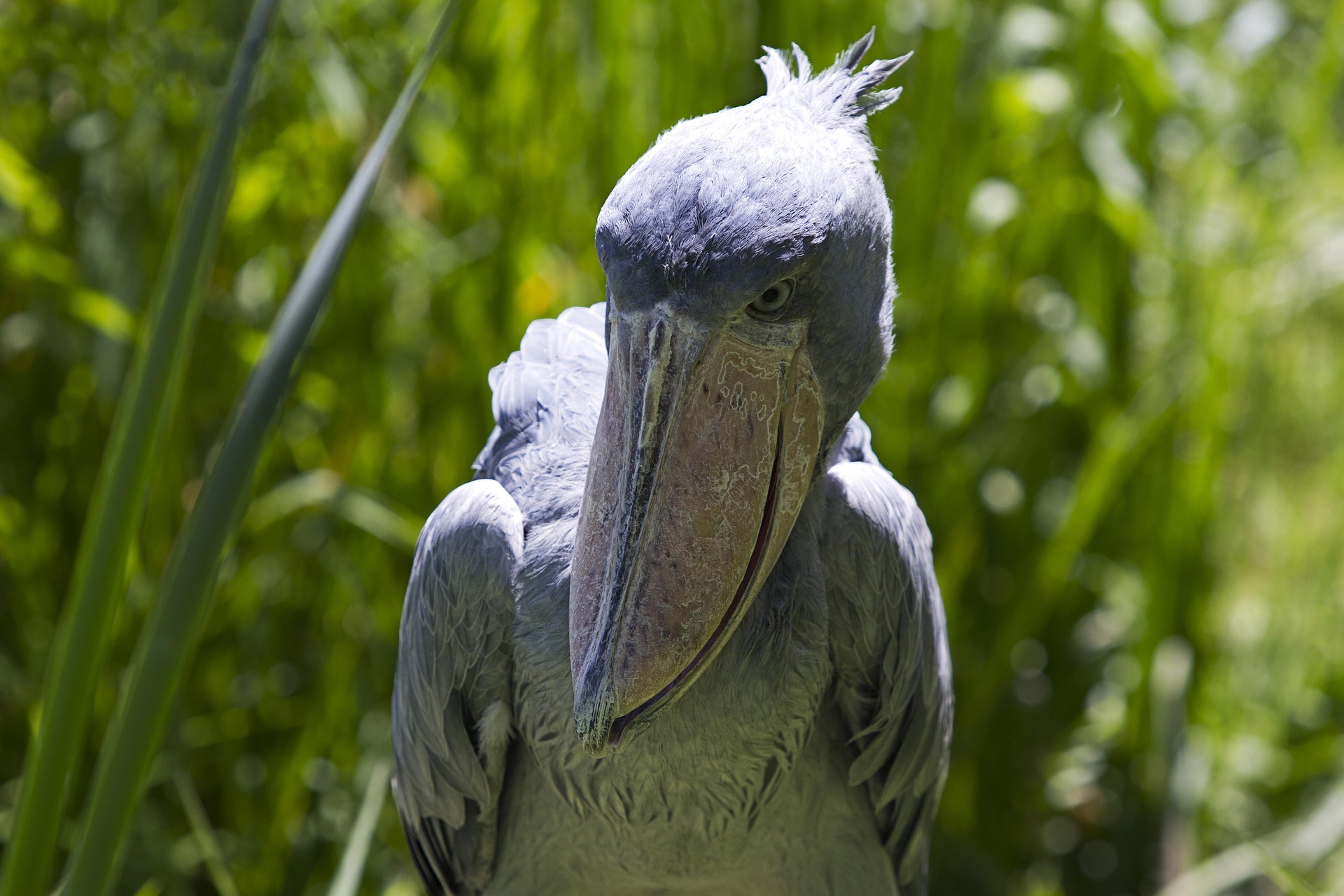
Basically, shoebills live near water, where there are crocodiles and catfish, and they are very solitary animals. Therefore, they are not very social and do not play around with other dogs. In addition, there are many mysterious animals that require more research.
Shoebill Personality and Behavior
Quiet and patient
Often stays motionless
Can wait for hours in the same place to catch prey
Cautious and wary
Very wary of humans and other animals
They may flee if suddenly approached, but are generally watchful
Curious but reserved
They may observe objects that interest them, but do not act immediately
In captivity, once they become accustomed to their handlers, they may observe intently
Not aggressive, but wary
They attack prey quickly, but rarely attack other animals or humans unnecessarily
They may use their beak to intimidate
Primarily solitary
They are not very social, and rarely gather in groups
They live alone outside of the breeding season
What is the ecology like?
The shoebill’s prey consists of insects and fish such as lungfish and polypterus, but it also eats frogs and snakes. During breeding season, pairs engage in displays such as cluttering and bowing. They lay 2-3 eggs at a time. The incubation period is about 30 days, and sexual maturity takes about 3 years. Lifespan is 30 to 40 years.
- Lifestyle
Soliloquy
They generally live alone.
They do not form groups except during breeding season.
Activity Period
Diurnal, active during the day.
They often stay still for long periods of time and hunt by ambush.
Movement
They walk slowly through marshes and grasslands near water.
They can fly, but do not fly frequently; they spend their time walking or standing still.
- Diet (Prey)
Characteristics as a Predator
They primarily feed on fish, frogs, small reptiles, and amphibians.
They capture prey by ambush.
Hunting Method
Once they find prey, they quickly grab it with their beak.
They excel at hunting in water and shallow areas of marshes.
- Breeding
Breeding Season
Both sexes are monogamous
Breeding season is primarily during the rainy season
Nest
They build large nests out of marsh grasses and aquatic plants.
Nests are built in shallow areas near water.
Eggs and Rearing
Lays 1-3 eggs at a time.
Both parents take turns incubating the eggs.
Parents continue to care for the eggs for long periods after they hatch.
- Lifespan
Wild: Approximately 35 years
Captive: Can live for over 40 years
- Distinctive Behavior
Ambush Hunting
They remain almost motionless, waiting for prey in the same position for hours.
Also known as the “world’s most motionless bird.”
Low Sociality
They rarely form flocks with other birds and prefer solitude.
Are there any natural enemies?
Their natural enemies are large birds such as vultures. Predators can sometimes lose sight of birds that remain stationary for several hours over a large area.
Shoebill Molting
Like other large birds, the Shoebill (Balaeniceps rex) undergoes molting to replace old, worn-out feathers with new ones. However, as there are few recorded observations of Shoebills, the precise cycles and mechanisms of their molting remain somewhat unclear.
“Partial Molting”: Replacing Feathers Gradually
Shoebills do not shed all their feathers at once.
Much like typical birds, they replace feathers—such as
body feathers,
wing feathers (remiges),
and tail feathers—
sequentially and gradually.
For large flying birds, losing all wing feathers at once would render them unable to fly; therefore, they molt in stages to ensure they can continue to live safely.
Appearance Changes During Molting
During the molting season,
feathers may look shaggy or unkempt,
white-to-gray plumage may appear disheveled,
wing feathers may look uneven,
and feathers on the neck or back may stand up.
This shifts their appearance from their usual “statue-like” look to a slightly wilder impression.
Replacing Large Wing Feathers Takes Time
The Shoebill is a large bird, reaching a body length of approximately 1.2 meters and a wingspan of about 2.5 meters.
Consequently, they are characterized by:
large individual flight feathers,
a need for time for feathers to fully develop,
and high energy consumption.
New feathers initially grow as “pin feathers” (containing blood vessels) before hardening into mature feathers.
Nutrition Is Crucial During Molting
Feathers are composed primarily of keratin (a protein).
Therefore, during molting, they require:
protein from fish,
minerals,
and sufficient energy.
In the wild, they primarily consume
lungfish,
catfish,
and fish such as tilapia
to support feather growth.
Vocalizations
The Shoebill’s vocalizations differ significantly from the typical “chirping” or “singing” of most birds. They are best known for “clattering”—rapidly clicking their beaks together.
Key Characteristic: Beak-Clattering
Shoebills produce a loud, machine-gun-like sound:
“Ga-ga-ga-ga-ga-ga-gat!”
Rather than being produced by the vocal cords, this sound is created by:
rapidly opening and closing their massive beaks, and
clacking the upper and lower mandibles together.
Why do they make this sound?
The primary purpose is communication.
Breeding Season
This behavior is particularly important during the breeding season.
Parent birds and chicks, or mating pairs, use it to signal things like:
“I am here”
“I have brought food”
“I recognize you”
Chicks vocalize too
Surprisingly, Shoebill chicks are quite vocal.
Chicks make noise to:
demand food
call for their parents
announce their presence
Young birds are far more expressive than one might imagine, given the stoic, deadpan appearance of the adults.
Seasonal Activities
The activity of the Shoebill is influenced more significantly by the shift between Africa’s wet and dry seasons than by the distinct four seasons found in Japan. Water levels and fish movement are particularly critical factors.
Wet Season (Generally November to April) | Breeding and Rearing Season
This is the period when rainfall increases and water levels rise in African wetlands.
Key Activities
Nest building
Egg-laying
Incubation
Chick rearing
Behavioral Characteristics
Increased activity in pairs
Gathering nesting materials (grass, aquatic plants, etc.)
Regulating the temperature of eggs and chicks
Parents taking turns foraging for food
Although Shoebills are large birds, they are cautious breeders; they typically lay a small number of eggs and provide parental care over an extended period.
Dry Season (Generally May to October) | Focus on Hunting
As water levels drop, fish in the wetlands tend to congregate in smaller areas.
This works to the Shoebill’s advantage.
Key Activities
Catching fish
Maintaining territory
Restoring physical strength
Hunting Characteristics
Shoebills are “ambush predators.”
Standing completely motionless at the water’s edge
Waiting for fish to approach
Swinging down their massive beaks in a split second
Grasping and swallowing the fish
…are the strategies they employ.
Morning | Peak Activity Time
Early morning is a prime time to observe foraging behavior because:
Temperatures are cooler
Fish are more active
Visibility is good
Key Behaviors:
Waiting at the water’s edge
Catching fish
Preening
Midday | Energy-Saving Mode
During the heat of the day, one can observe the Shoebill’s characteristic behavior:
Standing still for long periods
Standing on one leg
Preening
Resting in the shade
This is not laziness, but an energy-conservation strategy required to maintain their large bodies.
Evening to Night | Moving and Resting
As evening approaches,
they move to foraging grounds,
rest in safe locations,
and preen their feathers.
At night, they rest in safe spots, such as in trees or near the water’s edge.
Flight Speed
While there is little precise data on the shoebill’s flight speed, it is generally estimated to be around 30–50 km/h.
Wingspan of approximately 2.3–2.6 m
The shoebill is a large bird with the following dimensions:
Body length: approx. 1.1–1.5 m
Weight: approx. 4–7 kg
Wingspan: approx. 2.3–2.6 m
They fly by flapping their large wings slowly, conserving energy in the process.
Flight style resembles that of large birds of prey
Their flight is characterized by:
Slow, broad wingbeats
Gliding with wings spread
Flying with the neck retracted
Extending the legs backward
The habit of retracting the neck, in particular, is a flight style typical of large waterbirds such as herons and pelicans.
Infrequent flight
Shoebills do not fly very often.
The reasons for this include:
They can find food within the wetlands
They excel at hunting by waiting for prey
Their large size makes flight energy-intensive
They generally fly only when necessary, such as for:
Moving to breeding grounds
Moving between bodies of water
Avoiding danger
Changing feeding grounds
About Shoebill Chicks
Let’s summarize what we know about shoebill chicks.
- Eggs and Hatching
Egg Laying
Egg Size
Each egg is approximately 9-10cm long.
Egg color is pale blue-green, with a slight sheen.
Incubation Period
Hatching occurs after approximately 30-32 days.
Both parents take turns incubating the eggs.
- Chick Development
Immediately after Hatching
Feeding is white and fluffy.
Eyes are large, and beaks are still small.
Life in the Nest
Parents feed the chicks.
Chicks tend to stay still in the nest.
Growth Rate
Body development is relatively slow.
They often become able to flap their wings and fly 2-3 months after hatching.
- Independence
Parents provide food for approximately 3 months.
After that, they gradually learn to catch food and become independent.
- Characteristics
Slow growth rate in proportion to longevity
Chicks grow slower than other birds
Low movement rate
Like their parents, chicks spend a lot of time still in the nest
Survival rate
In the wild, chick survival rates are low due to the high risk of predators and environmental changes.
Is the shoebill an endangered species?
The shoebill is listed as an endangered species. International trade is also regulated by the Washington Convention and is very strictly controlled. He is popular among humans and has become a hot topic of discussion, and there are many videos and photos available on the Internet. Famous events are also held at zoos and other places.
Deterioration of habitat
The biggest problem is the deterioration of the shoebill’s habitat. Their population is decreasing due to water pollution and destruction of their nests due to being trampled by livestock. Hunting for meat, eggs, and chicks are also carried out. The estimated population is said to be around 10,000 birds.
Can shoebill storks be kept?
As explained above, the shoebill is designated as an endangered species. Furthermore, international trade is severely restricted by the Washington Convention, making it extremely difficult for the general public to keep them.
- Current Status of Captivity
They are often kept only in zoos and wildlife facilities around the world.
They are exhibited in a few zoos in Japan (e.g., Ueno Zoo, Kobe Animal Kingdom, etc.).
Importing wild specimens is prohibited, and captive specimens are bred or adopted.
- Difficulties of Captivity
Requires a large wetland environment
Requires water, shallow ponds, and wetlands similar to their natural environment.
Space is required to reproduce their ambush hunting behavior.
Food is difficult to obtain.
Mainly fish, frogs, and small reptiles.
Food availability and feeding timing are extremely important.
Nervous temperament.
Vulnerable to stress, and poor captivity can lead to health problems.
A quiet, calm environment is essential for breeding.
Long Lifespan
They can live for 35 years in the wild and over 40 years in captivity.
Responsible long-term management is required.
- Laws and Regulations
Shoebills are listed in Appendix I of the Convention on International Trade in Endangered Species of Wild Fauna and Flora (CITES).
International trade is generally prohibited.
In Japan, under CITES, keeping or importing them is prohibited without special permission.
Zoos Housing Shoebills (Japan & Worldwide)
The Shoebill is a rare bird with very few individuals kept in captivity worldwide. Due to the challenges involved in protecting wild populations and the difficulty of breeding them, only a limited number of zoos house them.
🇯🇵 Zoos in Japan
Japan is one of the leading countries in the world for keeping Shoebills.
Ueno Zoological Gardens (Tokyo)
One of the most famous facilities in Japan for keeping Shoebills.
Features:
Houses multiple individuals
Nationally popular as the “bird that doesn’t move”
Conducts research and observes the unique personalities of individual birds
Ueno Zoo shares information about Shoebill ecology and profiles of the individual birds.
Chiba Zoological Park (Chiba)
A facility with a long history of keeping Shoebills.
Notable individuals:
“Shizuka”
“Jitto”
…are among the well-known individuals here.
*Note: The exhibit is subject to temporary closure periods due to facility maintenance.
Kobe Animal Kingdom (Hyogo)
Famous for having a dedicated exhibit area for Shoebills.
Features:
Exhibit recreating a wetland environment
Engaged in breeding research
One of the largest exhibit environments in Japan
Efforts are underway with the goal of achieving the first successful breeding in Japan—and Asia.
Kakegawa Kachoen (Shizuoka)
Popular for exhibits that allow visitors to get close to the Shoebills.
Features:
Close proximity to the birds
Easy to observe their behavior
A facility popular on social media
🌍 Major Zoos Worldwide
🇧🇪 Pairi Daiza (Belgium)
One of Europe’s premier zoos.
Features:
Houses Shoebills
Known for vast, nature-replicating exhibits
🇩🇪 Weltvogelpark Walsrode (Germany)
One of the world’s largest bird parks.
Features:
Exhibits a vast array of bird species
Has a track record of keeping Shoebills
🇨🇿 Prague Zoo (Czech Republic)
One of the facilities in Europe where you can see Shoebills.
🇸🇬 Bird Paradise (Singapore)
It is a rare type of facility, even within Asia.
Introducing other animals
コメント