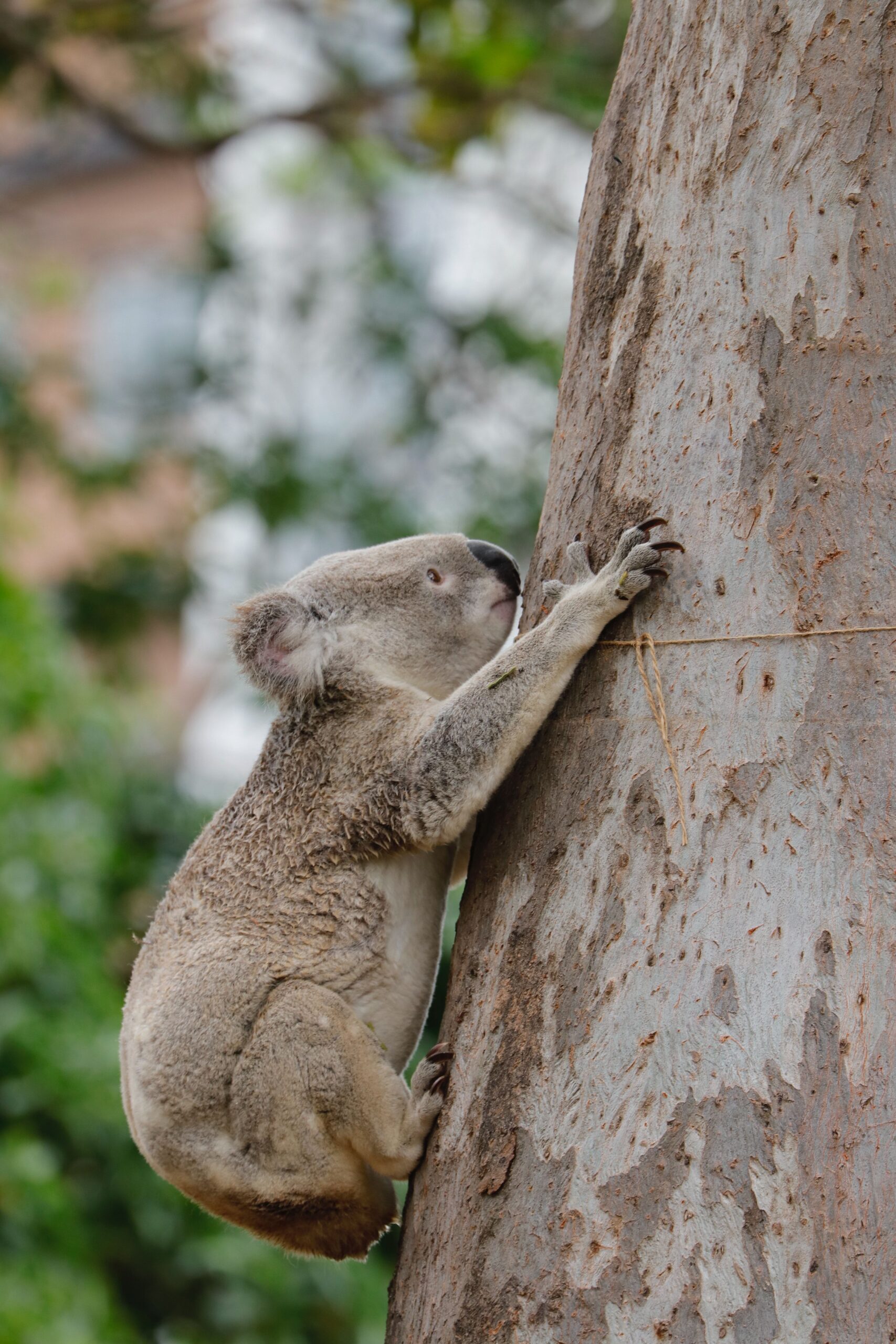
What kind of animal is a koala? We will explain its characteristics, ecology, and habitat. The koala, the symbol of Australia, is a very popular animal around the world, and is exhibited in many zoos. In this article, we will explain what characteristics it has, including its subspecies.


- What is a koala? About basic status
- What are the roots and origins of koalas?
- About koala habitat
- feature is? What kind of creature is it?
- What will your personality look like?
- What is the ecology of koalas?
- Koala Vocalizations
- Seasonal Activities
- Walking Speed
- About Baby Koalas
- Are koalas an endangered species?
- Is it possible to keep koalas?
- Zoos Housing Koalas (Japan & Worldwide)
- Introducing other animals
What is a koala? About basic status
Koalas are classified as mammals, Diprodontidae, Koala family, Phascolarctos genus, and are endemic to Australia. Their scientific name is Phascolarctos cinereus. They are 67-85cm long and weigh 5-15kg. In the wild, males are larger than females. They have a characteristic of clinging to trees, which is probably why they are so well-known. They have a gentle face. They are known to be good at climbing trees.
| Japanese(和名) | コアラ |
| English(英名) | Koala |
| scientific name(学名) | Phascolarctos cinereus |
| classification(分類) | Mammalia、 Diprotodontia、Vombatiformes、Phascolarctos 哺乳綱、双前歯目、コアラ科、コアラ属 |
| IUCN Status(保全状況) | VULNERABLE |
| Length(体長) | 67~85cm |
| Weight(体重) | 5~15kg |
What are the roots and origins of koalas?
The roots (origins) of koalas are thought to be marsupials that diverged from a common ancestor with wombats in Australia approximately 30 to 40 million years ago. In other words, although they look similar to bears, they are completely unrelated.
Evolutionary Path
Approximately 55 million years ago
Primitive marsupials inhabited Australia.
From these ancestors, kangaroos, wombats, and koalas branched off.
Approximately 30 to 40 million years ago
The koala lineage diverged from the wombat lineage.
The ancestors at that time were not as specialized in eucalyptus as modern koalas.
Approximately 25 million years ago
Fossils of “koala-like animals” have been found.
At that time, there were more species than there are today, and it is thought that there were about 15 to 20 species in the koala family.
Approximately 350,000 years ago
The modern koala (Phascolarctos cinereus) appeared.
Currently, this is the only surviving species of the Phascolarctidae family.
Why did they start eating only eucalyptus?
In the past, Australia was covered in tropical rainforests, but around 16 million years ago, the climate became drier, and eucalyptus forests expanded.
Therefore, the ancestors of koalas evolved the following characteristics:
The ability to break down toxins
The ability to ferment and digest leaves with a long cecum
Reduced activity levels to adapt to a low-nutrient diet (sleeping 18-20 hours a day)
These characteristics allowed them to become “specialists” in eating eucalyptus, which other animals could hardly utilize. While this avoided food competition, it also severely limited their diet.
Origin of the name “Koala”
The name “Koala” is widely believed to originate from words such as “gula” or “gulawany” in Australian Aboriginal languages (such as Dharug), supposedly meaning “no drink” or “does not drink water”; however, there are multiple theories regarding the etymology, and it has not been definitively established.
About classification
The koala genus is actually not just one species. There are many subspecies, each with their own characteristics. Although there are different types, they spend more time in the trees than on the ground, and stay still most of the time to conserve energy. They do come down to the ground occasionally to eat and drink. They can now be found in large numbers in the eastern and southern parts of the country.
| Name: (名前) | Academic Name (学名) |
| Queensland koala クイーンズランドコアラ | Phascolarctos cinereus adustus |
| New South Wales koala ニューサウスウェールズコアラ | Phascolarctos cinereus cinereus |
| Victorian koala ヴィクトリアコアラ | Phascolarctos cinereus victor |
What is a Queensland koala?
The Queensland koala is a koala found in the state of Queensland. It has the characteristics of being the smallest and having the shortest body hair.
What is a New South Wales koala?
The New South Wales koala is distributed in New South Wales. The size and length of the body hair are intermediate among the subspecies.
What is the Victoria Koala?
Victoria koalas are distributed in the state of Victoria. The koala is the largest and has long and fluffy body hair.
About koala habitat
Koalas are endemic mammals of Australia. They are not found in the wild in Western Australia or Tasmania, so be careful if you encounter one. They mostly live in trees, clinging to things using the claws and fingers of their hands and feet. They often sleep for long periods of time.
Habitat
Major Regions: Koalas are endemic to Australia and live in the forests of eastern and southeastern Australia.
Queensland (northeast)
New South Wales (east coast)
Victoria (southeast)
Parts of South Australia (small distribution)
Environmental Characteristics
Koalas feed primarily on eucalyptus trees and depend on eucalyptus forests and eucalyptus-rich forests.
They live at a wide range of elevations, from coastal to hilly, and prefer moist forests to dry areas.
Habitat
Human development, deforestation, and urbanization are shrinking their habitats, and koala populations are declining in some areas.
Conservation efforts are underway in protected areas and national parks.
feature is? What kind of creature is it?
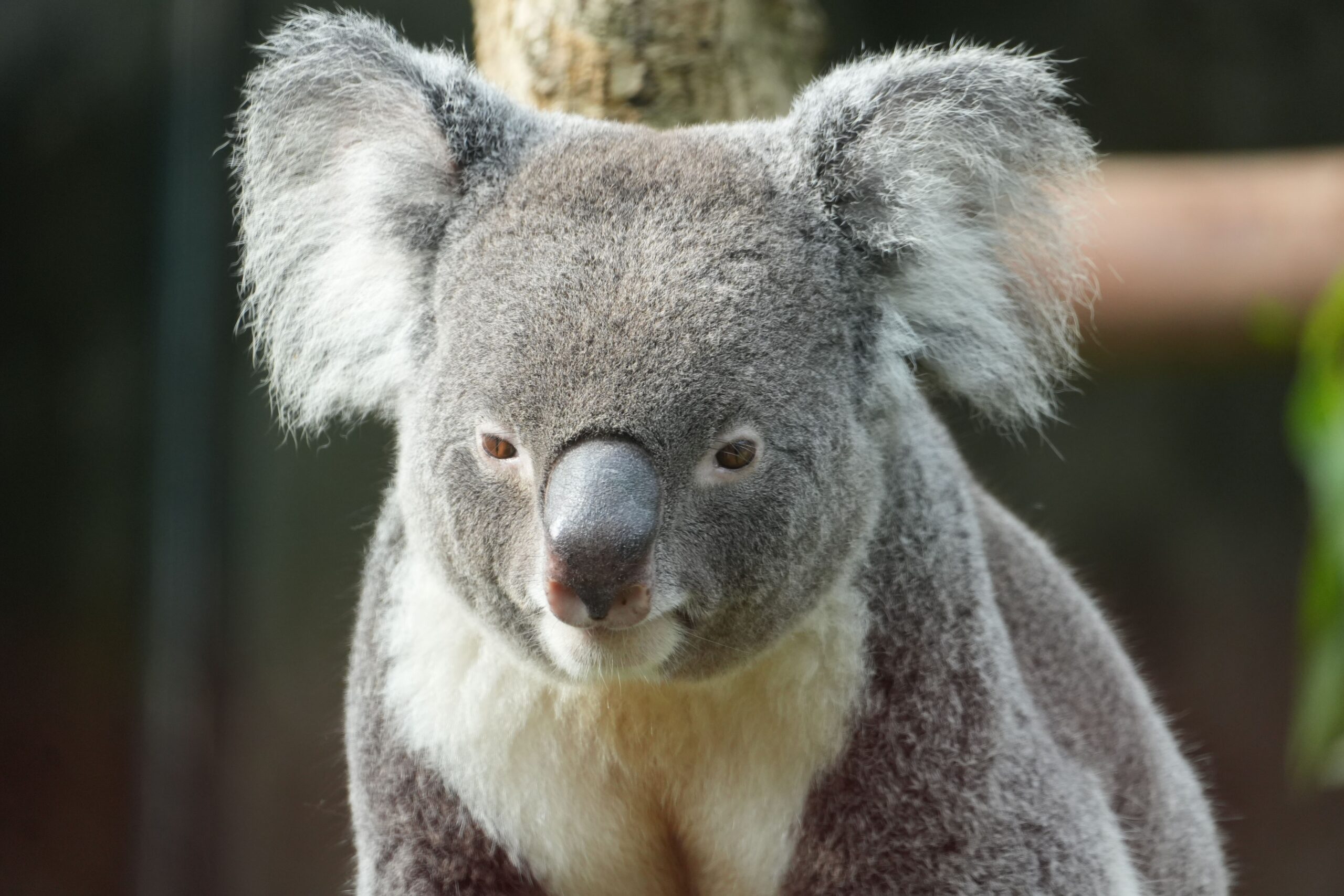
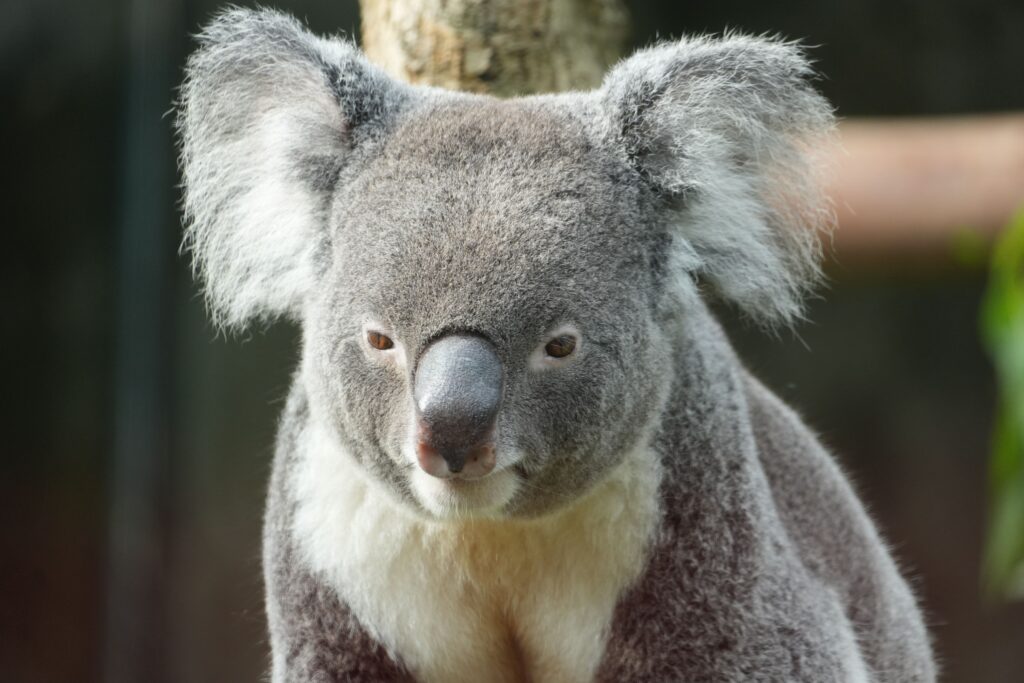
Koalas have pouches, like marsupials like kangaroos. Raise your child in a nurturing pouch. The whole body is sturdy, and the coat color is gray or dark gray on the back. The ends of the limbs are covered with hair. The ears are large, covered with thick hair, and there is no tail. Koalas rarely come down to the ground; they mostly live in trees and are solitary. They use the sharp, strong claws on their front legs to move deftly between trees.
Why do you keep clinging to trees?
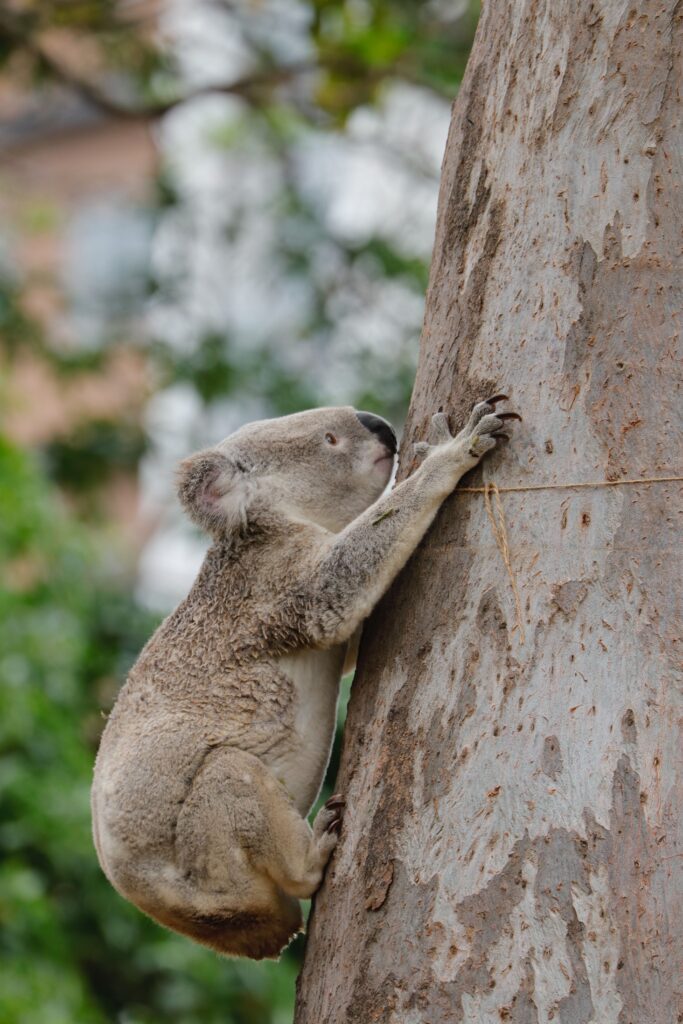
Koalas cling to trees all the time. Because koalas eat eucalyptus leaves, which other animals do not eat, their arms and legs have evolved to make it easier for them to climb trees. The reason they cling is because they regulate their body temperature by eating.
- Physical Characteristics
Size: Adults are 60-85cm long and weigh 4-15kg (males are larger, females are smaller).
Appearance: They have distinctive round faces, round ears, and black noses, and are often described as having an adorable, stuffed animal-like appearance.
Hair: Thick, soft gray to brown fur that becomes denser in cold weather and thinner in hot weather.
Feet: Their front feet have sharp claws adapted for climbing trees. They have two opposable digits (the front feet are “prehensile”) that are excellent for grasping branches.
- Diet
Staff: Eucalyptus leaves (especially certain species)
Digestion: Eucalyptus leaves are toxic and have little nutritional value, so they have highly digestible intestines and digest them slowly.
Water: They obtain most of their moisture from the leaves, so they may drink very little water.
- Behavior and Habits
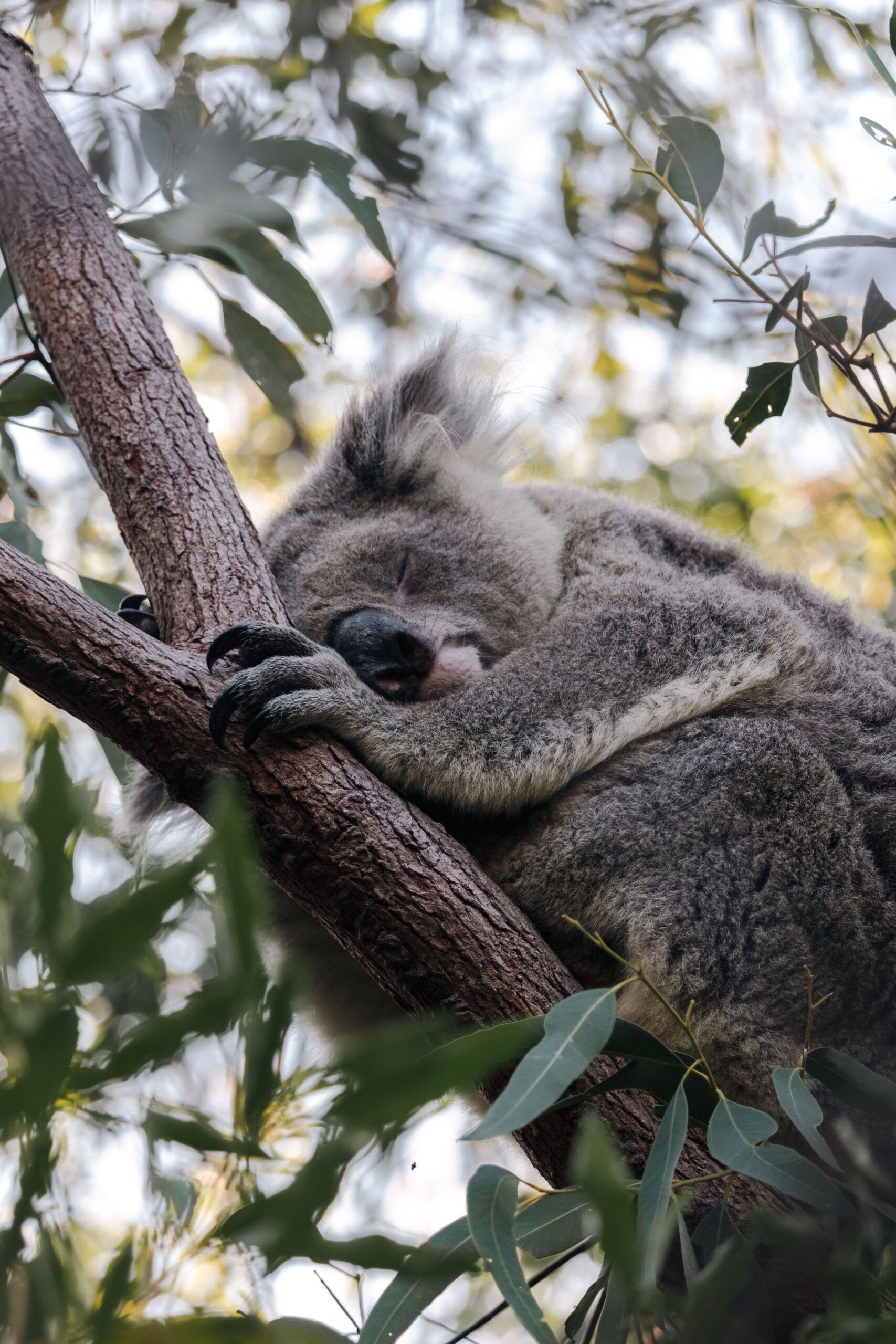
Lifestyle: They spend most of their time in trees.
Activity: They are nocturnal, active at night, feeding on leaves, and often sleeping in trees during the day.
Sleep: They are said to sleep 18-22 hours a day.
- Sociality
They are generally solitary, but may have territories.
During breeding season, males use voice and scent to claim territory or fight with each other.
- Other Characteristics
Calls: They make low, loud “rumbling” or scream-like sounds. Males’ calls in particular can be heard far and wide.
Lifespan: They live for approximately 10-15 years in the wild and 15-20 years in captivity.
What will your personality look like?
Koalas have bright and easy-going personalities, as their appearance suggests. They do not form groups and live alone. They are very territorial and will bite anyone who tries to enter their territory with their teeth exposed. Therefore, it can be said that he has a ferocious personality.
- Basic Personality
Quiet and Solitary
Koalas are generally solitary animals and spend most of their time alone.
Timid and Nervous
They are sensitive to loud noises and unfamiliar objects, and will quickly hide in trees if startled.
- Activity and Behavior Personality
Slow-paced
They spend most of the day sleeping, so they are not particularly rushed and tend to be laid-back.
Strongly Territorial
Males in particular have a strong instinct to protect their territory, and will intimidate other males with low growls or cries when they encounter them.
- Sociability
Low sociability
Except for their mothers and young, koalas rarely interact with other koalas and tend to avoid contact.
Wary of Humans
In the wild, koalas will either flee or stay still high in the trees when humans approach.
- Summary of Characteristic Personalities
Laid-back
Timid and cautious
Prefers to act alone
Strongly territorial
Despite their cute appearance, they can be quite moody
What is the ecology of koalas?
Koalas are herbivorous and eat highly toxic plants such as eucalyptus and acacia. It is said that the reason why they cling to each other and do not move is because they use their physical strength to neutralize this poison. The mode of reproduction is viviparous. They are polygamous, and females can give birth to one calf at a time from September to February. The lifespan is said to be about 15 years.
- Living Environment
Habitat: Eucalyptus forests in eastern and southeastern Australia.
Habitat: Arboreal, spending most of its time in trees. Rarely descending to the ground.
- Diet
Standing Food: Eucalyptus leaves (they only eat a few of the approximately 600 species of eucalyptus).
Nutrition: Because leaves are low in nutrients and contain toxins, their intestines take a long time to digest.
Water: They obtain most of their water from leaves, so they rarely need to drink water.
- Behavior
Activity: Primarily nocturnal, eating at night and sleeping during the day.
Sleep Time: 18-22 hours per day.
Migration: They move slowly from tree to tree and rarely walk long distances.
- Breeding
Breeding Season: Spring (September-November) in southern Australia; in northern Australia, they may breed at any time of the year.
Gestation Period: Approximately 35 days
Birth: Immature koalas (baby joeys) grow in the pouch for approximately six months.
Weaning: After leaving the pouch, they continue to ride on their mother’s back and become independent over the course of approximately one year.
- Sociality
Generally solitary
They have territories, with males being particularly territorial.
They avoid contact with other individuals outside of breeding season.
- Communication
Calls: Low rumblings and cries that can be communicated over long distances (especially males).
Scent: Males mark their territory with scent glands in their forelimbs.
- Lifespan
Wild: Approximately 10-15 years
Captive: Approximately 15-20 years
What are the koala’s natural enemies?
The natural enemies of koalas are monitor lizards, dingoes, owls, eagles, and pythons. Because they live in trees, they are rarely attacked, but the reality is that the number of carnivorous animals has increased in some areas and their population is decreasing.
Koala Vocalizations
Although it is hard to imagine based on their appearance, koalas—especially males—produce very deep, loud calls.
Male Calls
These are frequently heard during the breeding season (mainly September to February).
“Waaargh… grrrrr…”
“Bwooooo…”
“Goooo… ooooo…”
Depending on the listener, these sounds are sometimes likened to:
A pig’s grunt
The engine of a chainsaw
A dinosaur’s roar
The pitch is surprisingly low for their body size, and the sound can carry for hundreds of meters.
Female Calls
Females do not vocalize very often, but they may produce high-pitched sounds such as:
“Kyu”
“Kee”
“Gya”
Baby (Joey) Calls
When calling for their mothers, they make small, cute sounds like:
“Pip”
“Kyu”
“Chu-chu”
Why is the voice so deep?
Male koalas possess a specialized, well-developed vocal organ near the chest (such as a descended larynx), allowing them to produce a voice that is much deeper than their body size would suggest.
This is believed to serve the following purposes:
Alerting females to their presence
Intimidating other males
Asserting territorial claims
Seasonal Activities
While koalas are active year-round, their activity levels and behaviors shift significantly with the seasons. Here is an overview based on the seasons in the Southern Hemisphere (Australia):
🌸 Spring (September–November)
The start of the breeding season.
Males call out to females with a low, bellowing sound.
They move between trees more frequently.
Joeys (babies) begin to grow.
☀️ Summer (December–February)
The hottest season.
They often stay still in the shade of trees during the day, with most activity occurring at night.
They are observed pressing their bellies against tree trunks to lower their body temperature.
They obtain moisture primarily from eucalyptus leaves but may drink water during extreme heat or drought.
🍂 Autumn (March–May)
The breeding season ends, leading to a relatively calmer lifestyle.
Joeys are frequently seen riding on their mothers’ backs while moving.
They maintain their physical strength by alternating between eating and resting.
❄️ Winter (June–August)
Due to the cold temperatures, they curl up to conserve body heat.
Activity levels decrease slightly, but they do not hibernate.
The habit of eating eucalyptus leaves at night continues throughout the year.
Characteristics That Remain Constant Year-Round
💤 Sleep or rest for about 18–20 hours a day
🌿 Eat approximately 300–800g of eucalyptus leaves daily (varies by species and individual)
🌙 Primarily active from evening through the night (nocturnal/crepuscular)
🌳 Live mainly in trees; they rarely come down to the ground except to move between trees
Walking Speed
While koalas are generally slow-moving, they can move surprisingly quickly when necessary.
Walking speed on the ground
Normal walking: Approx. 2–4 km/h
When moving hurriedly: They may run at speeds of up to around 10 km/h.
They usually only descend to the ground to move from one tree to another, at which point they move with a quick, four-legged trot.
Tree-climbing ability
Koalas are more adept at moving in the trees than on the ground.
Grip trunks firmly with sharp claws
Traverse thick branches skillfully
Climb quickly to heights of several meters
Why are they usually slow?
Because the eucalyptus leaves that koalas eat are low in nutrients, they have evolved to avoid wasting energy.
Consequently, they lead a lifestyle where:
They spend about 18–20 hours a day resting or sleeping
They rarely move unless necessary
About Baby Koalas
Learn more about baby koalas (joeys).
- Birth
Gestation Period: Very short, approximately 35 days
Size at Birth: Only 2-3 cm, weighing approximately 0.5 g, and immature with closed eyes and ears
Characteristics: Very small, hairless, and limbs underdeveloped
- Development in the Pouch
Develops within the mother’s abdominal pouch
Duration: Approximately 6 months
Development: During this time, the baby’s eyes open, hair grows, limbs develop, and the baby is able to grasp onto trees
Breastfeeding: Receives nutrition by suckling the mother’s milk
- After Leaving the Pouch
Once out of the pouch, the baby climbs onto the mother’s back or stomach
Duration: Spends approximately 6 months with the mother
During this time, the baby gradually begins to eat eucalyptus leaves, but also breastfeeds
- Independence
Independence Period: Approximately 1 year after birth
Behavior: After independence, the baby climbs trees on its own and survives by eating eucalyptus leaves
- Personality/Characteristics
Very timid and docile
They are highly dependent on their mother for a long period of time, so they often adapt their behavior to hers.
Once out of the pouch, they are curious but still clumsy at climbing trees.
Are koalas an endangered species?
Koalas were originally an endangered species and were reassessed to Vulnerable in 2014. New South Wales and Queensland list the species as endangered in 2022. According to information from the Australian Government’s Endangered Species Scientific Committee, the koala population is estimated to be 92,000 in 2021, down from 185,000 20 years ago. Causes include:
heavily hunted by European settlers
Koalas were heavily hunted by European settlers. Fur was used to make rugs, coat linings, etc., and was profitable. Nowadays, they are restricted, but in the past they were heavily overhunted, and their numbers decreased considerably.
Habitat destruction and fragmentation
Habitat destruction and fragmentation is also a major problem. The area where koalas can live is drastically decreasing due to deforestation and other factors. In rural areas, habitat is being cleared for agriculture. It is in need of protection.
Is it possible to keep koalas?
Koalas have special bodies designed to digest eucalyptus. Therefore, it can be said that it is extremely difficult for ordinary people to keep them. Moreover, it is not easily available as it is an endangered species.
- Legal Restrictions
Koalas are endemic to Australia and are listed as endangered (endangered in some areas).
Import and export of koalas outside of Australia is strictly regulated, and in Japan, keeping them as pets is not permitted by law.
Only authorized organizations, such as zoos and research facilities, are permitted to keep them.
- Ecology and Difficulty of Raising
Extremely Unique Diet
Their staple food is eucalyptus leaves, and some species cannot eat them.
Freshness and variety of leaves must be constantly ensured.
Unique Activity Patterns
Nocturnal, sleeping most of the day.
They primarily live in trees, requiring ample arboreal space.
Vulnerable to disease and stress.
Stress often leads to loss of appetite and illness.
Vulnerable to capture and environmental changes, making it difficult to maintain long lives in a home environment.
- Examples of Captivity
They are kept in zoos around the world and in conservation facilities in Australia.
Keeping them requires specialized knowledge, equipment, permits, and a food supply.
For example, Japanese zoos source eucalyptus leaves from overseas and keep them in specialized facilities with temperature and humidity control.
Summary
It is impossible to keep them privately.
Only zoos and research facilities are allowed to keep them.
Specialized dietary management and environmental maintenance are required for keeping them.
Zoos Housing Koalas (Japan & Worldwide)
Because koalas require a steady supply of eucalyptus, there are relatively few zoos worldwide that keep them.
Zoos in Japan Housing Koalas
Currently, there are seven main zoos in Japan that house koalas:
Tama Zoological Park (Tokyo)
Saitama Children’s Zoo
Yokohama Municipal Kanazawa Zoo
Higashiyama Zoo and Botanical Gardens
Kobe Oji Zoo
Awaji Farm Park England Hill
Hirakawa Zoological Park
Famous Koala Facilities Worldwide
Australia
Lone Pine Koala Sanctuary
The world’s oldest koala sanctuary (opened in 1927)
Australia Zoo
Taronga Zoo Sydney
Currumbin Wildlife Sanctuary
United States
San Diego Zoo
San Diego Zoo Safari Park
Los Angeles Zoo
Europe
Zoo Duisburg
Zoo Leipzig
Wilhelma
Zoo Dresden
Can You Hold Them?
Opportunities for holding koalas are currently on the decline due to animal welfare considerations.
Regulations vary by state, even within Australia.
While photo opportunities may still be available at some facilities in Queensland, many places are shifting toward “viewing-only” exhibits.
Introducing other animals
コメント