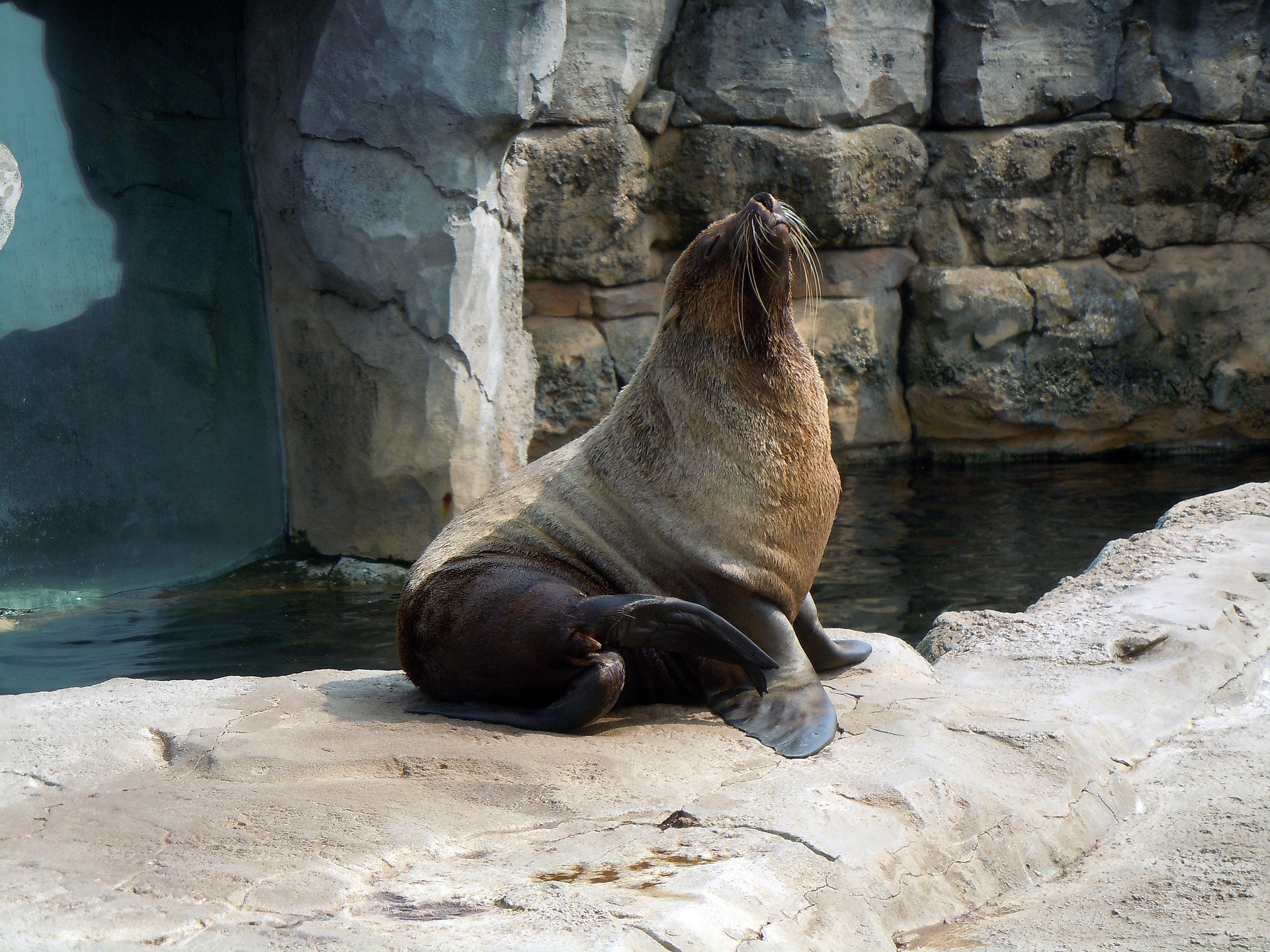
We will explain the characteristics, ecology, and habitat of fur seals. Fur seals consist of northern fur seals and southern fur seals, and are distributed all over the world. Fur seals are animals that you can definitely see in aquariums, but some of their subspecies are actually designated as endangered species.


- What is a fur seal? About basic status
- What are the roots and origins of the fur seal?
- About habitat
- feature is? What kind of creature is it?
- What is the ecology like?
- Fur Seal Diving
- Vocalizations
- Seasonal Activities
- Walking Speed
- About Baby Fur Seals
- Are fur seals an endangered species?
- Difference between fur seal and sea lion
- Can fur seals be kept?
- Zoos and Aquariums Housing Fur Seals (Japan & Worldwide)
- Introducing other animals
What is a fur seal? About basic status
Fur seal is a general term for the genus Northern fur seal (Northern fur seal) and southern fur seal (South fur seal) of the pinniped sea lion family. The scientific name is Arctocephalinae. The body length is 200-300 cm and the weight is 150-300 kg. The list below provides basic information.
| Japanese(和名) | オットセイ |
| English(英名) | fur seal |
| scientific name(学名) | Arctocephalinae |
| classification(分類) | Mammalia、 Carnivora、 Otariidae 哺乳綱、ネコ目、アシカ科 |
| IUCN Status(保全状況) | VULNERABLE~ |
| Length(体長) | 200-300cm |
| Weight(体重) | 150-300kg |
What are the roots and origins of the fur seal?
Tracing the roots of the fur seal leads—surprisingly—to a carnivorous mammal that lived on land. Fur seals belong to the group known as pinnipeds (Pinnipedia), which also includes sea lions, true seals, and walruses.
Fur seal ancestors: “Land animals related to weasels and bears”
Around 30 million years ago (during the late Oligocene epoch of the Cenozoic Era), the ancestors that would eventually give rise to modern fur seals were not yet fully adapted to marine life; they were land-dwelling carnivores. Pinnipeds are believed to have evolved from the order Carnivora.
The general evolutionary progression is as follows:
Land-dwelling carnivorous mammal
↓
Semi-aquatic animal living near the water’s edge
↓
Early pinniped adapted for swimming
↓
Evolution into the Otariidae family (fur seals and sea lions)
Earliest ancestors, such as Puijila
Animals such as Puijila, which lived approximately 24 million years ago, are known as early members of the pinniped lineage.
Characteristics:
Possessed four legs
Able to walk on land
Able to swim in water
Resembled an otter
In other words, they lived a “half-land, half-water” existence before evolving into the fully marine animals that modern fur seals are today.
Evolutionary traits specific to fur seals
Among pinnipeds, fur seals (and the Otariidae family) are a group that has retained significant capabilities for both swimming and moving on land.
Through evolution, they acquired the following characteristics:
Forelimbs
→ Transformed into large, flipper-like structures
→ Generate propulsion in the water
Hind limbs
→ Used for steering and swimming
Body hair
→ Dense fur for heat retention
Body fat
→ Maintains body temperature in cold ocean waters
The Divergence of Sea Lions and Fur Seals
Taxonomically, fur seals are classified as follows:
Order Carnivora
↓
Suborder Pinnipedia
↓
Family Otariidae
↓
Fur seals
Within the family Otariidae, fur seals evolved as “sea lions with fur.”
About classification
Fur seals are comprised of the northern fur seal genus and the southern fur seal genus. The following variants exist:
| Name (名前) | Scientific Name (学名) |
| Northern fur seal キタオットセイ | Callorhinus ursinus |
| Antarctic fur seal ナンキョクオットセイ | Arctocephalus gazella |
| Guadalupe fur seal グアダルーペオットセイ | Arctocephalus townsendi |
| Juan Fernández fur seal フェルナンデスオットセイ | Arctocephalus philippii |
| Galápagos fur seal ガラパゴスオットセイ | Arctocephalus galapagoensis |
| southern african fur seal ミナミアフリカオットセイ | Arctocephalus pusillus |
| new zealand fur seal ニュージーランドオットセイ | Arctocephalus forsteri |
| Ananctic fur seal アナンキョクオットセイ | Arctocephalus tropicalis |
| southern american fur seal ミナミアメリカオットセイ | Arctocephalus australis |
Callorhinus ursinus
The northern fur seal is the only fur seal that belongs to the genus Northern fur seal. They live in the Bering Sea and the Sea of Okhotsk in the United States. The total length is 213cm and the weight is 180-270kg. The auricles are small and the whole body is densely covered with fine underhair. The population of northern fur seals has decreased dramatically due to overhunting for their fur, and they are now designated as an endangered species.
Arctocephalus gazella
Antarctic fur seals belong to the genus Southern Fur Seals. They live in the South Orkney Islands, South Shetland Islands, South Sandwich Islands, and Kerguelen Island. They have dark brown fur and can grow up to 2 meters long and weigh between 110 and 230 kg. The population is stable.
Arctocephalus townsendi
Guadalupe fur seals can be found in large numbers on Guadalupe Island in Mexico. Male Guadalupe fur seals are much larger than females. Both males and females have a lifespan of 20 years. The population is stable.
Arctocephalus philippii
The Fernandez fur seal is the second smallest animal after the Galapagos fur seal. It has dark brown fur and a very thick neck. It can only be seen in the Fernández Islands and Desventuradas Islands on the Pacific coast of South America.
Arctocephalus galapagoensis
The Galapagos fur seal is endemic to the Galapagos Islands. With a total length of 154-160 cm and a weight of 60-68 kg, it is the smallest species of the southern fur seal genus and the sea lion family. Since the 19th century, their population has declined dramatically due to overhunting for their fur, and they are now designated as an endangered species.
Arctocephalus pusillus
Southern African fur seals can be found in coastal areas of Africa and Australia. Males are 2.0-2.2m long and weigh 190-280kg, while females are 1.2-1.8m long and weigh 36-110kg. It is dark gray to brown in color and its population is stable and is classified as low concern.
Arctocephalus forsteri
New Zealand fur seals can be found in New Zealand and Australia. It is 2m long, weighs 30-50kg, and has external ears and forward-swiveled hind legs. It is easy to recognize because of its long beard and pointed nose. Populations are stable and classified as low concern.
Arctocephalus tropicalis
Antarctic fur seals live in the Indian Ocean and the southern hemisphere of the Atlantic Ocean. They are 2m long and weigh 160kg, and both males and females have cream-orange chests and faces. The belly is gray and the back is dark gray to black. Populations are stable and classified as low concern.
Arctocephalus australis
Southern American fur seals are found along the ocean coasts of the Pacific Ocean in South America. It is 2 meters long and weighs 160 kg, with a thick neck and large shoulders. Males have a mane of long bristles on their necks and shoulders. Populations are stable and classified as low concern.
About habitat
Fur seals are widely distributed in the Atlantic, Pacific, and Indian oceans.
- Geographic Distribution
Fur seals primarily inhabit coastal areas of temperate and subarctic zones, resting and breeding on land or rocky areas.
California fur seal (California sea lion)
Ashore along the west coast of North America (southern Alaska to Mexico)
Australian fur seal (Australian sea lion)
Ashore along the southwest coast of Australia
South American fur seal (South American sea lion)
Ashore along the coast of Peru, Chile, and Argentina
Galápagos fur seal (Galápagos sea lion)
Ashore along the Galápagos Islands
- Habitat Characteristics
Rests, breeds, and molts in coastal areas, rocky areas, and sandy beaches.
In the sea, they primarily feed on fish and squid, so their range is shallow waters near the coast.
During the breeding season, males often form harems and live in groups on specific land areas.
- Movement and Behavior
Moves along coastal areas depending on the season and food resources.
Travels between feeding grounds (fish-rich marine areas) and land-based resting and breeding areas.
feature is? What kind of creature is it?
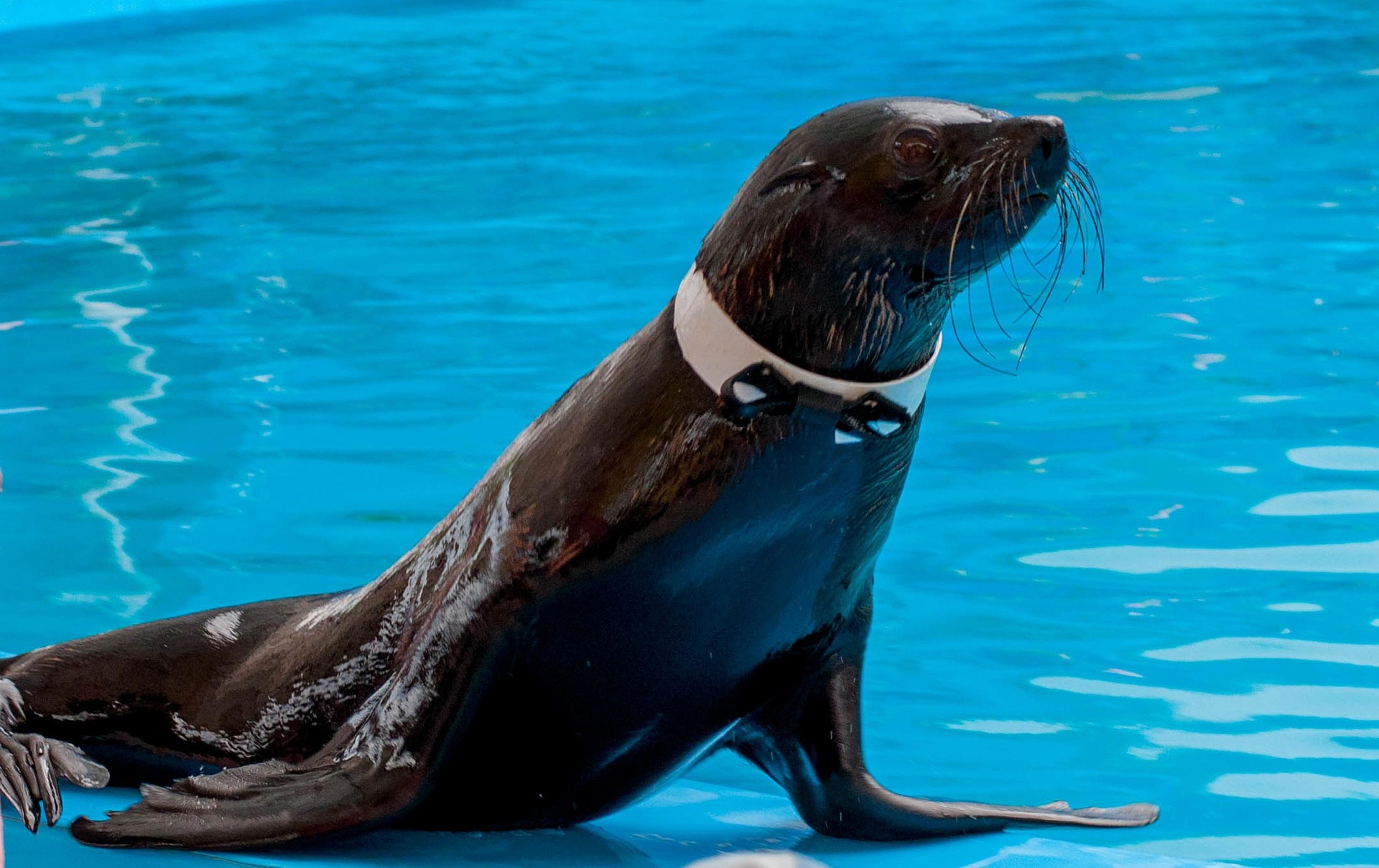
Fur seals have large earlobes. Fur seals are smaller than sea lions and have dense fur. The fur is soft, warm, and has excellent cold protection. Fur seal teeth, like humans, are made of dentin and cementum. They are very dexterous animals that can sleep not only on land but also underwater, and can put their left brain to sleep while keeping their right brain awake. It can stay underwater for about 70 minutes in one breath and can dive to a depth of 180 meters.
- Appearance and Physical Characteristics
Body Type: Streamlined and rounded, making it easy to swim in water.
Body Length and Weight:
Male: Approximately 2-2.5 m, 200-400 kg
Female: Approximately 1.5-2 m, 50-100 kg
Coat Color: Brown to dark brown, color tone varies depending on species and age.
Limbs: Powerful, flipper-like forelimbs used for propulsion, hind limbs used for turning and locomotion on land.
Head: Rounded, with earlobe-like external ears (a major difference from seals).
- Behavior and Personality
Excellent Swimmer: Moves agilely in water and excels at diving.
Ability on Land: Walks skillfully across rocky areas and sandy beaches.
Sociality: Often lives in groups, with males forming harems, especially during breeding season.
- Diet
Carnivorous (piscivorous)
Preys primarily on fish and squid
Highly adept at diving to catch prey
- Special Characteristics
External ears: Unlike seals, they have earlobes, allowing them to hear better.
Thick subcutaneous fat: Maintains body heat even in cold waters.
Diving ability: Depends on species, but can dive for several minutes to 10 minutes.
What is the ecology like?
Fur seals live on fish, squid, and crustaceans. Reproduction is polygamous and harems are formed. The calving period is from June to July, and it is possible to give birth to one calf at a time. They reach sexual maturity in 3-4 years after birth, and their lifespan is said to be 15-20 years.
- Diet
Carnivorous (piscivorous)
Preys primarily on fish and squid
Swims agilely and dives to catch prey
The type and amount of food varies depending on the season and ocean area.
- Reproduction and Growth
Breeding Season: Depending on the species, breeding occurs on land, beaches, or rocks from spring to summer.
Harem Formation: Mature males gather multiple females to form harems.
Gestation Period: Approximately 11 months
Birth: Usually gives birth to a single calf.
Baby Development: Calves are breastfed for approximately six months and learn swimming and hunting techniques.
Sexual Maturity: Females can reproduce at approximately 3-4 years, while males reach breeding age at approximately 5-6 years.
- Behavior and Lifestyle
Mainly Aquatic: Skilled at swimming and diving, they forage underwater.
Rests on land or rocks: Come ashore in groups during breeding and molting.
Sociality: Live in groups and communicate with others through calls and body movements.
- Movement and Distribution
Mostly coastal: Travels between feeding, resting, and breeding grounds
Seasonal Migration: Moves in response to changes in seawater temperature and food resources
Are there any natural enemies?
The fur seal’s biggest natural enemy is the killer whale.
Fur Seal Diving
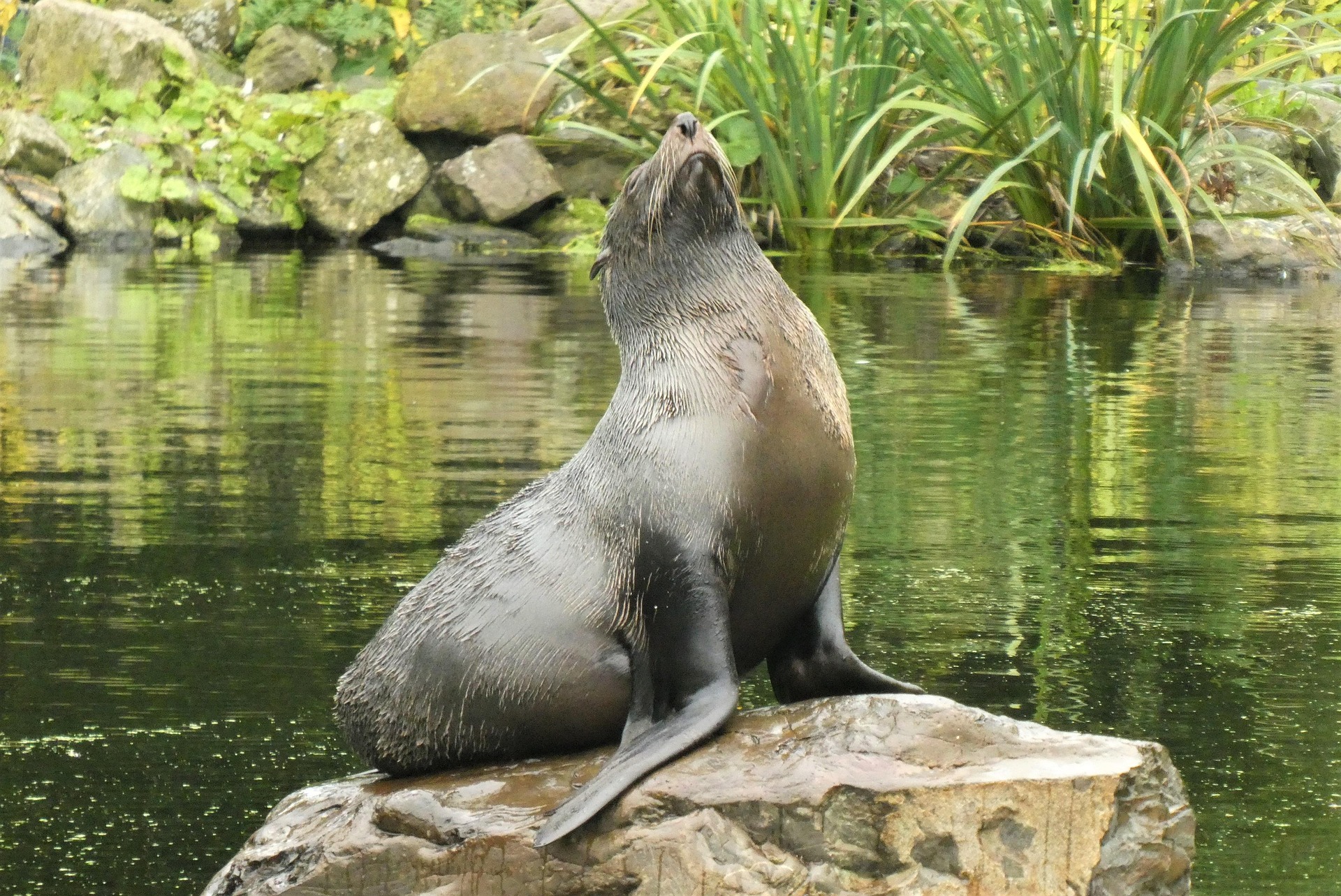
Fur seals possess diving capabilities far beyond what their appearance might suggest. They have evolved into high-speed underwater predators, and depending on the species, they can dive to great depths and remain submerged for extended periods.
Dive Duration
For the Northern Fur Seal, a representative species:
Typical dives: Around 2–5 minutes
Deep dives: Over 10 minutes
Record-breaking dives: Capable of staying submerged for well over 10 minutes
However, compared to other pinnipeds like elephant seals—some of which can dive for over an hour—these durations are on a different scale.
Dive Depth
For the Northern Fur Seal:
Average foraging depth: Around several tens of meters to 100 meters
Deep dives: Can reach depths of 200 meters or more
Primary prey:
Squid
Pacific saury
Herring
Cod
Small fish
They pursue these and other prey underwater.
How do they dive for so long?
Fur seal bodies are designed to conserve oxygen.
① Blood that stores large amounts of oxygen
Humans:
Transport oxygen via hemoglobin in the blood
Fur seals:
High levels of hemoglobin
High levels of myoglobin in the muscles
→ Allows oxygen to be stored directly within the muscles.
② Diving reflex
Upon entering the water:
Heart rate slows
Blood flow is concentrated on the brain and heart
Oxygen consumption in the muscles is reduced
They enter a “diving mode” characterized by these responses.
③ Efficient oxygen management rather than large lungs
Surprisingly, fur seals do not dive with their lungs full of air.
As water pressure compresses the lungs during deep dives,
They reduce the air in their lungs
They store oxygen in their blood and muscles
…utilizing this strategy instead.
Vocalizations
Contrary to their cute appearance, fur seals produce powerful and varied vocalizations. In breeding colonies, the coast becomes incredibly noisy as thousands or even tens of thousands of seals call out to one another.
Low barks (“Aa,” “Ou”)
These are primarily produced by adult males.
Functions:
Asserting territory
Intimidating other males
Attracting females
During the breeding season, males vocalize loudly on the shore to defend their territory.
Pup vocalizations (contact calls)
Seal pups make high-pitched sounds such as:
“Meow”
“Pee-pee”
“Kyu-kyu”
Purposes:
Locating their mother
Signaling their presence
Mother fur seals can distinguish their own pup’s voice even within a crowded colony.
Alarm and threat calls
When sensing danger, they produce:
Low growls
Short screams
Roar-like sounds
Targets:
Other fur seals
Predators
Humans, etc.
These serve as warnings.
Do they vocalize underwater?
Yes. Fur seals also produce sounds underwater.
Underwater, they may use:
Clicking sounds
Pulsed sounds
Short calls
While they do not use echolocation like some fish, they do utilize sound to communicate with one another.
Seasonal Activities
The lives of fur seals change significantly depending on the season. Northern fur seals, in particular, have distinct periods: one for gathering on land to breed and another for traveling long distances at sea to forage.
Spring (March–May): “Preparing to Move to Breeding Grounds”
Main activities:
Migrating from winter foraging grounds to breeding grounds
Recovering physical strength
Males preparing to secure breeding territories
During winter, fur seals live at sea, consuming large quantities of fish and squid to build up the energy reserves needed for the breeding season.
Summer (June–August): “Peak Breeding Season”
This is the most important season for fur seals.
Males
Coming ashore at breeding grounds (rookeries)
Fighting for territory
Attracting females with loud calls
Large males secure prime spots on the shore and may gather a harem of multiple females.
Females
Giving birth
Raising pups
Characteristics:
Pups cannot swim at birth
Mothers go to sea to forage and locate their pups by sound upon returning
Autumn (September–November): “End of Rearing / Return to Sea”
Main activities:
Pups learn to swim
Herds disperse
Heading out for winter foraging migration
During this period, young fur seals acquire skills in:
Swimming
Diving
Catching fish
Winter (December–February): “Life at Sea / Long-Distance Migration”
They spend almost the entire winter at sea.
Activities:
Pursuing fish and squid
Migrating over distances of thousands of kilometers
Repeated diving to forage
Some Northern fur seals travel to waters very far from their breeding grounds.
Daily Activity Pattern
Daytime
Diving to hunt
Preying on fish and squid
Nighttime
Sometimes diving to great depths
Resting at the ocean surface
Fur seals dive dozens of times a day to efficiently search for food.
Walking Speed
The speed at which fur seals move on land is faster than it looks. Unlike true seals, which merely crawl on their bellies, fur seals can rotate their hind flippers (hind limbs) forward and tuck them beneath their bodies, allowing them to lift themselves up and move about on land.
Land Movement
Normal movement speed: Approx. 3–5 km/h
Short-distance rapid movement: Can reach around 10 km/h
They can move at speeds comparable to—or, depending on the situation, faster than—human walking speed (approx. 4–5 km/h).
How can they walk?
A key characteristic of fur seals is their ability to rotate their hind limbs.
Fur Seal
✅ Can rotate hind flippers forward
✅ Supports body weight with all four flippers
✅ Can lift the body to perform a “walking” motion
True Seal
❌ Difficult to rotate hind flippers forward
→ Moves by wriggling the torso from side to side
Consequently, fur seals possess far greater mobility on land.
About Baby Fur Seals
The following summarizes the appearance, growth, behavior, and mother-child relationships of baby fur seals.
- Appearance and Physical Characteristics
Body Color: Immediately after birth, they are covered with soft, dark brown to black fur.
Body Length and Weight:
Body Length: Approximately 70-90 cm
Weight: Approximately 10-15 kg
Body Type: Round and soft body; fin-like limbs are underdeveloped; mothers assist in swimming.
- Growth and Development
Lactation Period: Breast-fed for approximately 6 months.
Weaning: After breastfeeding, they gradually begin to eat solid foods such as fish and squid.
Independence: They acquire swimming and hunting skills and become independent between 6 months and 1 year of age.
Sexual Maturity: Depending on the species, females are capable of breeding at approximately 3-4 years, and males at approximately 5-6 years.
- Behavior and Mother-Infant Relationship
Cubs spend close time with their mothers.
Mothers not only nurse their young, but also teach them how to swim, dive, and avoid danger.
Cubs acquire motor skills and social skills through play with each other.
- Threats and Survival
Cubs are vulnerable to predators (such as killer whales, sharks, and sea lions), so their mothers’ protection is crucial for their survival.
Ensuring the safety of breeding sites on rocky or sandy beaches also affects survival rates.
Are fur seals an endangered species?
Some subspecies of fur seals are listed as endangered. Overhunting for their fur has drastically reduced their population, and some subspecies are at risk of extinction due to fishing competition and bycatch. Capture for commercial purposes is now prohibited.
California fur seal (California sea lion)
It is not an endangered species. Its population is relatively stable and it is classified as “Least Concern” on the IUCN (International Union for Conservation of Nature) Red List.
Other species of the fur seal family (e.g., Australian fur seal, Antarctic fur seal, etc.)
Some species are experiencing population declines and may require protection.
For example, the Australian fur seal may be classified as “Vulnerable.”
⚠️ Note: The terms “sea lion” and “fur seal,” which are commonly seen in Japan, are somewhat confusing in terms of classification, as they differ between the Otariidae (with visible ears) and the Sealidae (with small ears and curved hind legs).
Difference between fur seal and sea lion
You can tell the difference between fur seals and sea lions by their appearance. You can tell by looking at the fins. If the tips of the fins are neatly aligned, it’s a fur seal, and if it’s not, it’s a sea lion. Fur seals also have longer fur and larger ears than sea lions.
Can fur seals be kept?
Can fur seals be kept? Unfortunately, it is not realistic for the average person to keep them as they require a huge pool. We recommend viewing it at an aquarium.
- Legal Restrictions
In Japan, fur seals are subject to the Wildlife Protection Act and the Convention on International Trade in Endangered Species of Wild Fauna and Flora (CITES).
Unauthorized keeping or importing is a violation of the law and subject to criminal penalties.
A zoo or aquarium license is required for keeping them in a facility.
- Environmental and Breeding Conditions
Fur seals require both large water areas and land.
Water temperature and quality must be managed, and facilities are particularly extensive in cold and tropical regions.
Large amounts of fish (over 10-20 kg depending on the species) are required daily, and food costs are extremely high.
- Behavior and Health
Fur seals are highly social animals and are easily stressed when kept alone.
Because they spend long periods of time swimming, diving, and playing, they may exhibit behavioral abnormalities (self-injury or aggression) in confined spaces.
Breeding is also difficult, with wild reproduction being nearly impossible.
Zoos and Aquariums Housing Fur Seals (Japan & Worldwide)
Fur seals are kept and exhibited at zoos and aquariums across Japan and the world. In Japan, the South American fur seal is particularly common, offering frequent opportunities to see them in shows or underwater exhibits.
🇯🇵 Major Facilities in Japan Where Fur Seals Can Be Seen
Sumida Aquarium (Tokyo)
Species: South American fur seal
Features:
Open-style pool
Swimming can be observed from an underwater tunnel
Visitors can hear their vocalizations and see them resting on land
Kyoto Aquarium (Kyoto)
Species: Fur seal
Features:
Close-up views of them resting on rocky areas
Interactions with keepers can be observed during feeding times
Yokohama Zoological Gardens “Zoorasia” (Kanagawa)
Species: South African fur seal
Features:
A large species among fur seals
Exhibits a species native to the coast of South Africa
🌎 Notable Fur Seal Facilities Worldwide
🇺🇸 Monterey Bay Aquarium
Famous for exhibits featuring marine life from the California coast
Facility involved in research and conservation efforts for pinnipeds
🇬🇧 ZSL London Zoo
A zoo with a long history
Experienced in exhibiting marine mammals
🇦🇺 Taronga Zoo Sydney
Known for exhibits featuring marine animals from the Australian coast
🇳🇿 Kelly Tarlton’s Sea Life Aquarium
Focuses on exhibiting marine life from the Southern Hemisphere
Introducing other animals
コメント