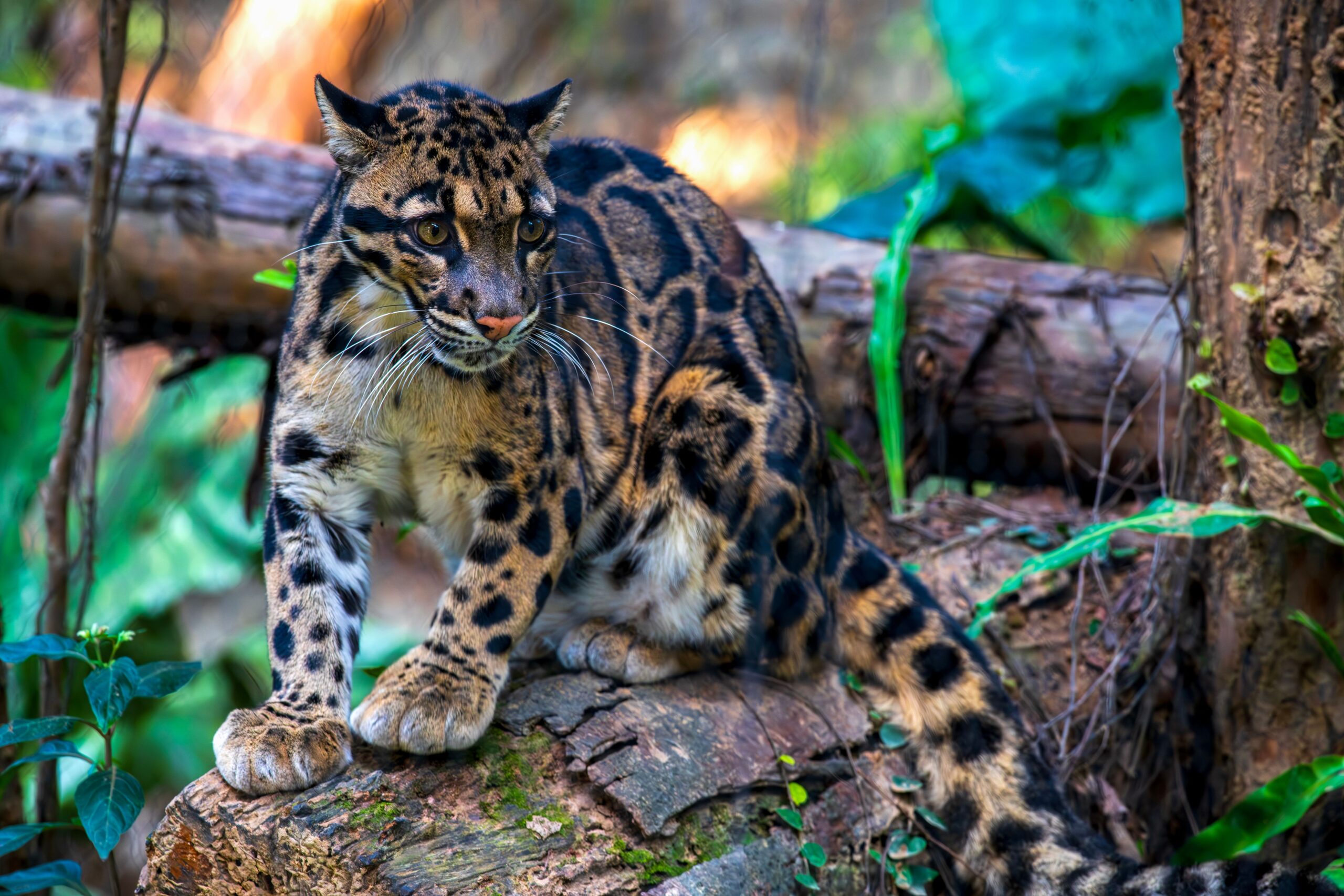
What kind of animal is a clouded leopard? We will explain its characteristics, ecology, and habitat. This is a member of the leopard family that lives in Asia, and some species are already extinct. This species is already listed as endangered and is in urgent need of protection.



- What is a clouded leopard? About basic status
- What are the roots and origins of the clouded leopard?
- About habitat
- feature is? What kind of creature is it?
- What is your personality like?
- What is the ecology like?
- Vocalizations
- Seasonal Activity
- Regarding Walking Speed
- About Clouded Leopard Cubs
- Is the clouded leopard an endangered species?
- Can clouded leopards be kept as pets?
- Zoos Housing Clouded Leopards (Japan & Worldwide)
- Introducing other animals
What is a clouded leopard? About basic status
Clouded leopards are carnivores that belong to the genus Clouded Leopard in the family Felidae. The scientific name is Neofelis nebulosa, and the kanji is “Cloud Leopard”. The body length is 62-107cm and the weight is 16-23kg. The list of information is as follows.
| Japanese(和名) | ウンピョウ |
| English(英名) | Clouded leopard |
| scientific name(学名) | Neofelis nebulosa |
| classification(分類) | Mammalia、Carnivora、 Felidae、Neofelis 哺乳綱、ネコ目、ネコ科、ウンピョウ属 |
| IUCN Status(保全状況) | VULNERABLE |
| Length(体長) | 62-107cm |
| Weight(体重) | 16-23kg |
What are the roots and origins of the clouded leopard?
The clouded leopard (Neofelis nebulosa) belongs to a lineage of “primitive large cats” that possesses particularly ancient evolutionary roots among extant felids.
Origins: An ancient feline lineage that evolved in Southeast Asian forests
The ancestors of the clouded leopard are believed to have diverged from the main felid lineage during the Miocene to Pleistocene epochs (approximately 6 to 2 million years ago).
A simplified evolutionary path looks like this:
Primitive feline ancestor
│
├── Small cats (e.g., domestic cats)
│
└── Pantherinae (subfamily)
│
├── Tigers, lions, leopards, etc. (genus Panthera)
│
└── Clouded leopards (genus Neofelis)
In other words, the clouded leopard…
…is closely related to the group containing tigers, lions, and leopards, but represents an ancient branch that underwent its own unique evolution.
Why it is called a “living fossil”
The clouded leopard attracts attention because its physical form retains characteristics of ancient large cats.
Characteristics:
Body length: Approx. 60–110 cm
Weight: Approx. 15–25 kg
Extremely long canine teeth
Exceptional tree-climbing ability
Uses a long tail for balance
Specialized for life in the forest
Its canine teeth, in particular, are among the longest in the felid family and are disproportionately large relative to its body size.
For this reason, it is sometimes said to resemble the “saber-toothed tiger,” though it is not actually a direct descendant of that animal. The resemblance is the result of convergent evolution, where similar traits evolved independently.
Where did it come from?
The ancestors of the modern clouded leopard are believed to have evolved in…
…the tropical forests of Southern and Southeast Asia. Distribution:
Northeastern India
The region around Nepal
Southern China
Myanmar
Thailand
Malay Peninsula
Borneo
Sumatra
…and others.
Clouded leopards are currently divided into two lineages
While they were once thought to be a single species, they are now broadly classified into two distinct species.
① Mainland clouded leopard
Neofelis nebulosa
Habitat:
Southern China
Eastern India
Indochina
② Sunda clouded leopard
Neofelis diardi
Habitat:
Borneo
Sumatra
It is estimated that these two lineages diverged more than 1.4 million years ago.
About classification
The clouded leopard is said to fall between the genus Feli and the genus Leopard.
Clouded leopard taxonomy
- 界 (Kingdom): 動物界 (Animalia)
- 門 (Phylum): 脊索動物門 (Chordata)
- 綱 (Class): 哺乳綱 (Mammalia)
- 目 (Order): 食肉目 (Carnivora)
- 科 (Family): ネコ科 (Felidae)
- 属 (Genus): ネコ属 (Neofelis)
- 種 (Species):
- Neofelis nebulosa(雲豹、アジア雲豹)
- Neofelis diardi(スマトラ雲豹やボルネオ雲豹など、近年別種として扱われることもある)
About habitat
Clouded leopards are distributed widely across India, China, Vietnam, Thailand, Nepal, Malaysia, etc. Many terrestrial species can be seen in Southeast Asia, such as on the islands of Sumatra and Borneo.
Geographical Distribution
It is found primarily in Southeast Asia.
It is known to be found in the following regions:
Northeastern India (Assam, Sikkim, etc.)
Southern China (Yunnan Province, Guangxi Zhuang Autonomous Region, etc.)
Myanmar
Thailand, Laos, Cambodia, Vietnam
Malay Peninsula (southern Thailand to Peninsular Malaysia)
Indonesia (Sumatra and parts of Borneo)
Habitat
Mainly found in tropical and subtropical jungles and mountain forests
Found in forests from lowlands to altitudes up to about 3,000 meters
Characteristics:
Excellent tree climbers, they often spend their time in trees
Primarily hunts and moves in trees rather than on the ground
Relationship between behavioral patterns and habitat
Nocturnal, often resting in trees during the day
Preferring high-altitude mountain forests and rugged terrain, they protect themselves from poaching and deforestation
Preference for forests with abundant water sources and prey (small mammals and birds)
feature is? What kind of creature is it?
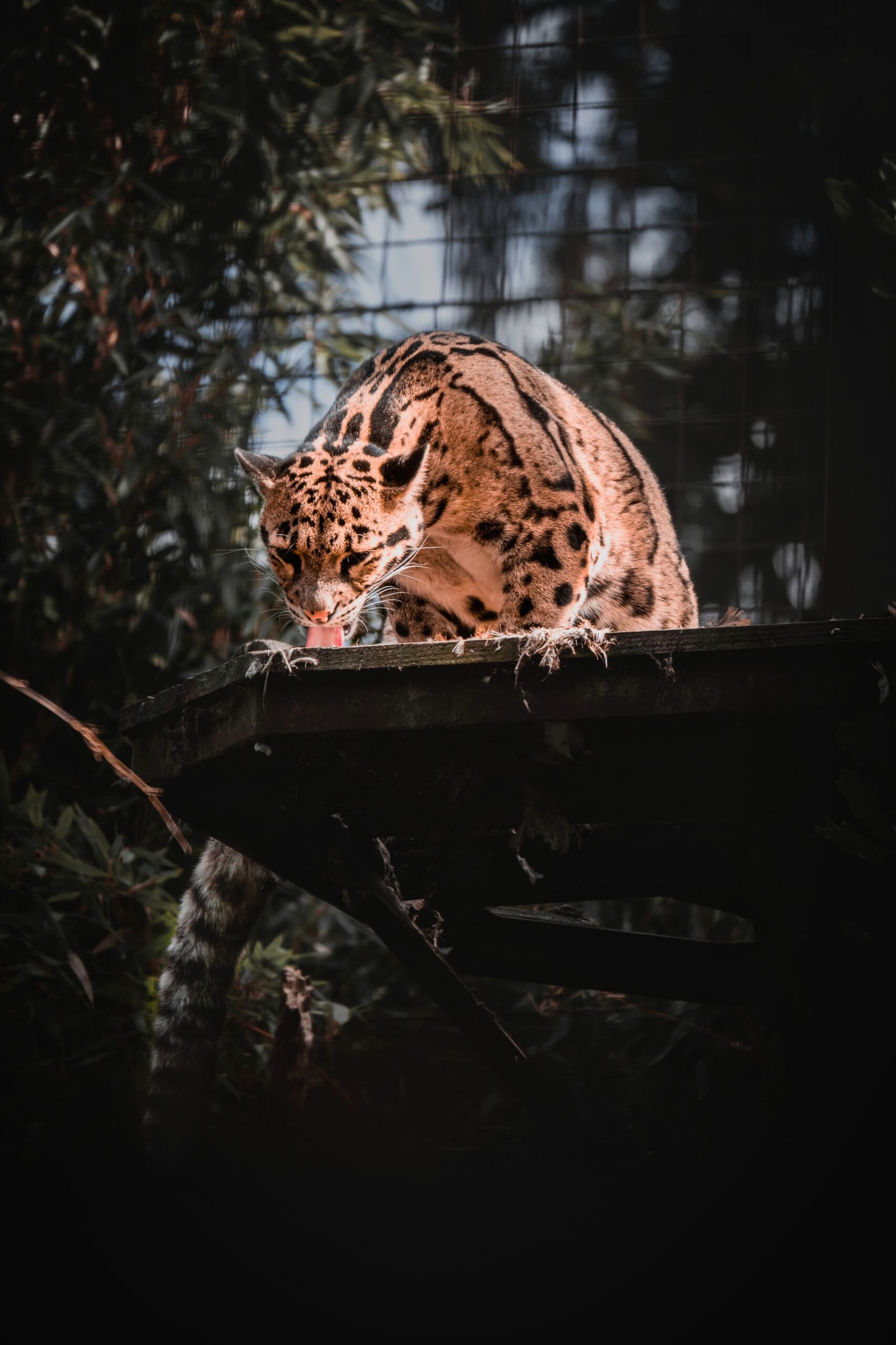
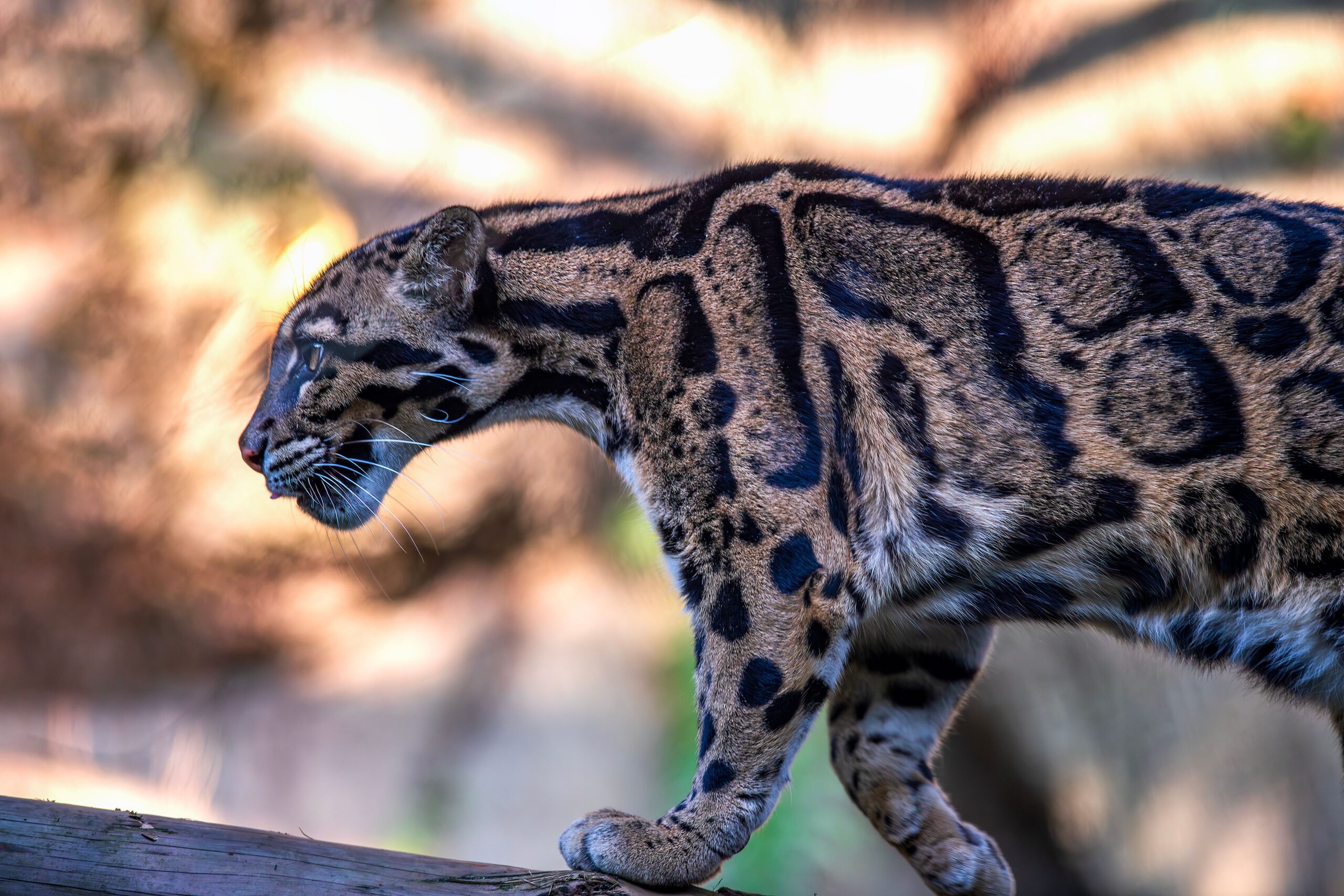
The head of a clouded leopard is large and elongated. The coat is dark gray or yellowish brown with dark markings and black spots and stripes. The back of the auricle is covered with black hair and has white spots. The auricles are rounded and the snout is wide. Clouded leopards often live in forest areas, but can also be seen in grasslands and wetlands where mangroves grow. They live alone and sometimes live in trees.
- Physical Characteristics
Size:
Body Length: Approximately 70-110 cm
Tail Length: 60-90 cm (approximately the same length as the body, for balance)
Weight: 11-23 kg (medium-sized feline)
Coat Color/Pattern:
Back and sides: Pale yellow to orange-brown
Black cloud-like spots and markings cover the entire body
The tail is long and bushy, with markings extending to the tip, which aids in tree climbing and balance
Facial Characteristics:
The face is round, typical of a feline, with small ears
Large eyes, adapted to nocturnal behavior
- Behavior and Habits
Activity: Nocturnal (hunts at night)
Diet: Carnivorous (small mammals, birds, lizards, etc.)
Habitat:
Specialized in arboreal living (top-class tree-climbing ability among cats)
Rests in trees and catches prey
Territory: Often solitary, has a large territory
- Distinctive Abilities
Arboreal Locomotion: Uses its long tail for balance and excels at crossing branches
Jumping Ability: Can leap between trees
Stealth Ability: Uses patterns to blend into the jungle and hide from prey and predators
What is your personality like?
Although clouded leopards are carnivores, they are very timid animals. There are more powerful carnivores living there, and clouded leopards actually live in fear. Therefore, they are also very cautious animals.
- Extremely cautious
Highly sensitive to humans and large animals
Usually hiding deep in the jungle and rarely seen
Because they are quick to notice noises and smells, they are also known as “phantom cats” in the wild.
- Prefers to be solitary
They generally live alone
They have territories and only interact with other individuals during mating season
They quietly search for prey in the forest and are cautious in their movements
- Nocturnal and calm
They often rest in trees during the day and hunt at night
They are quiet and patient
They are sometimes called “ninja cats” because of the way they slink between tree branches.
- Highly intelligent and observant
They carefully observe their prey and their surroundings before acting
They use their excellent climbing ability and the sense of balance on their tails to efficiently capture prey
- Although sensitive and cautious, they are not aggressive
If they sense danger, they will hide or flee from the tree
They only attack when hunting or defending themselves
What is the ecology like?
Clouded leopards are carnivores, feeding on small mammals, birds, deer, snakes, etc. They are good at hunting and climbing trees, and use their long fangs to catch prey in the forest. They reproduce viviparously. The gestation period is about three months. They can give birth to 1-5 pups at a time. Their current lifespan is about 15 years.
- Life Rhythm
Nocturnal: Active mainly at night, resting in trees during the day
Soliloquy: Acts alone except during breeding season
Territorial: Each individual has a territory and marks it with scent
- Habitat
Mainly arboreal, with excellent tree-climbing ability
Live in dense jungles, subtropical and tropical rainforests, and mountain forests
Altitude: Found in forests from lowlands to approximately 3,000m
- Diet
Completely carnivorous
Main Prey:
Small mammals (squirrels, mice, etc.)
Small monkeys and birds
Reptiles (lizards, etc.)
Hunting Method:
Sneaks up prey from trees or on the ground and quickly captures them
Using their high jumping ability and tail balance to move between trees and capture prey
- Breeding and Rearing
Breeding Season: Varies depending on region and climate, but concentrated in certain seasons
Gestation Period: Approximately 90-100 days
Litter Size: Normal 1-3 babies
Rearing:
Mothers raise their babies in trees or hidden places.
They depend on their mothers until they become independent (several months to a year).
- Movement and Living Range
They move both in trees and on the ground.
They have large territories, so they need to find food and hiding places.
They live a “hidden” life in the jungle, rarely seen by humans.
Are there any natural enemies?
Clouded leopards’ natural enemies include tigers. But humans are even more of a threat.
Vocalizations
The clouded leopard’s vocalizations differ significantly from those of typical domestic cats; they possess a unique voice that falls somewhere between that of large cats and small cats.
- “Meow” or “Nya” sounds
Clouded leopards sometimes produce sounds similar to those of domestic cats.
Functions:
Contact with others
Communication between mother and cub
Calling out to another individual
However, the vocal quality is lower-pitched and more “wild” than that of a domestic cat.
- Low growl (Grrr…)
Produced when threatening or on alert.
Characteristics:
Low frequency
A sound that resonates in the chest
Intended to keep others at a distance
Used during territorial disputes or when sensing danger.
- Unique “Moo” sound (Specific to clouded leopards)
Clouded leopards are particularly well-known for:
A low, cow-like “moo” or “war” sound.
This resembles the “roar” of large cats, though it differs from the full-fledged roars of lions or tigers.
- Whistle (Whistle-like sound)
Clouded leopards sometimes emit high-pitched calls—
“Pew” or “Fee”—
that resemble the sounds of birds.
These are used to communicate with individuals located far away.
Seasonal Activity
Clouded leopard activity is influenced more strongly by the tropical/subtropical “wet and dry seasons” than by the distinct seasonal changes found in Japan. As their habitat spans regions such as Northeast India, Southern China, Southeast Asia, and Borneo, activity patterns vary by location.
Spring (Late dry season to onset of wet season)
Activity Trends
Primarily active at night
Increased time spent in trees
Expanded foraging range
Behavior
Targets small mammals (squirrels, primates, rodents, etc.)
Also preys on birds and reptiles
Patrols and marks territory
As rainfall increases, forest vegetation becomes denser and prey animals become more active, creating more opportunities for hunting.
Summer (Wet season)
Activity Trends
Increased activity within the forest
Frequent movement through the tree canopy
Primarily solitary behavior
In tropical forests during the wet season:
Dense foliage
Reduced visibility
Prey animals can easily hide
These conditions favor the clouded leopard’s “ambush hunting” style.
Key Abilities:
Climbing down trees head-first
Walking along slender branches
Using a long tail for balance and posture control
They make full use of these arboreal capabilities.
Autumn (End of wet season to start of dry season)
Activity Trends
Period of heightened hunting activity
Increased territorial behavior
As prey distribution shifts in preparation for the dry season, they increasingly utilize:
Areas around water sources
Forest edges
Animal trails
Additionally, depending on the region and the breeding season, males may move more frequently or approach females.
Winter (Dry season)
*In tropical regions, this is a dry period rather than a “cold winter.”
Activity Trends
Primarily active before dawn and at night
Often rests in trees during the day
During the dry season:
Animals congregate near water sources
Prey behavior patterns become easier to predict
This can lead to increased hunting efficiency.
Daily Activity Rhythm
Clouded leopards are primarily crepuscular to nocturnal. Time of Day / Activity: Daytime – Resting in trees; Evening – Activity begins; Night – Hunting and moving; Dawn – Final hunt; Late morning – Returning to resting spot.
Regarding Walking Speed
As the clouded leopard is not a “top-speed specialist” like the cheetah, there is limited research data regarding its exact maximum speed. However, its approximate capabilities can be inferred from its body structure and behavior.
Normal Walking Speed
The clouded leopard’s normal pace of movement is estimated to be:
Around 2–4 km/h
This is comparable to a human’s leisurely walking pace (approximately 3–4 km/h).
Reasons:
They move quietly to avoid detection by prey.
Stealth is more important than high speed in a forest environment.
They must navigate carefully across tree branches and slopes.
Running Speed
Clouded leopards can run quite fast over short distances, but they are not high-speed pursuit predators like cheetahs.
Estimate:
Said to be around 40–50 km/h (short distance).
Comparison:
Benchmarks for top animal speeds: Cheetah (over 100 km/h), Tiger (approx. 50–60 km/h), Leopard (approx. 50–60 km/h), Clouded Leopard (approx. 40–50 km/h).
Clouded leopards are ambush predators that strike suddenly, rather than animals that chase down their prey.
About Clouded Leopard Cubs
Let’s take a closer look at clouded leopard cubs.
- Birth and Body Size
Litter Size: Usually 1-3
Weight: Approximately 400-500 g at birth
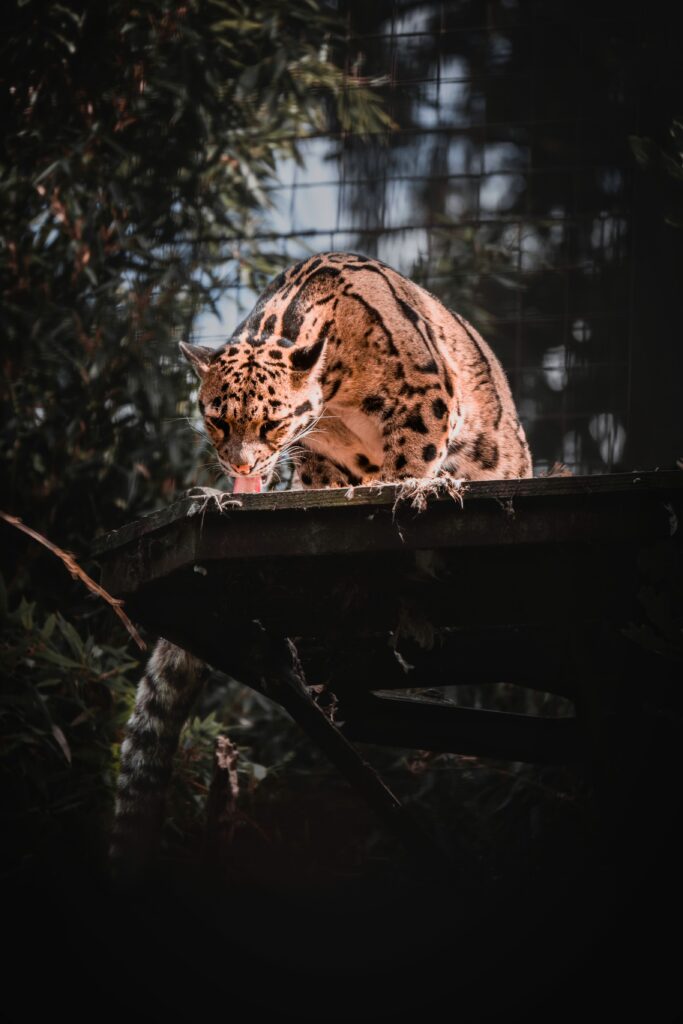
Fur:
Light gray to cream color immediately after birth
Spots are light, gradually developing cloud patterns like those of adults
- Growth
Eye Opening: Approximately 10 days to 2 weeks after birth
Weaning: Transition from breast milk to solid food at approximately 2-3 months
Independence: Begins tree climbing and hunting practice at 6 months to 1 year
Adult Appearance: Approximately 1 year after birth, the appearance is almost adult-like
- Behavior
Immediately after birth, they spend time with their mother in trees and hidden places
Learn hunting techniques by observing their mother hunt
At first, they are clumsy at walking and jumping, but as they grow, they become very dexterous
- Personality and Behaviors
Cubs They are curious and playful.
However, they are also very cautious and will quickly hide if they sense danger.
They are very dependent until they are separated from their mother.
- Caution (Dangers to Young Animals in the Wild)
They are susceptible to predators (such as large cats and birds of prey).
Their survival rate is low due to deforestation and poaching.
Ensuring the safety of their mothers and their habitat is essential to protecting young animals.
Is the clouded leopard an endangered species?
Unfortunately, clouded leopards are designated as an endangered species. The biggest threat is habitat destruction, but clouded leopards are in demand for their fur, and their population is declining due to overhunting and other factors. They are already confirmed to be extinct in Taiwan. They are also listed in Appendix I of the Convention on International Trade in Endangered Species of Wild Fauna and Flora (CITES), and international trade is strictly restricted. They are listed on the Red List due to a lot of poaching in tropical rainforests and other areas.
- Conservation Status (Endangered Species Classification)
IUCN Red List (International Union for Conservation of Nature):
Neofelis nebulosa (Asian Clouded Leopard) → Vulnerable (VU)
In other words, it is assessed as being at “high risk of extinction in the wild in the near future.”
Regional Differences:
Populations are extremely low in some habitats, and even more so in other areas.
- Causes of Extinction
Deforestation
Habitat loss due to agricultural development and illegal logging
Due to their reliance on arboreal habitats, forest loss is fatal
Poaching and illegal trade
Targeted for fur and parts used in traditional medicine
Targeting of young animals and mothers has a significant impact on populations
Decrease in prey
Food shortages due to declines in small mammals and birds
Contact with humans
Increased human activity near habitats increases stress and conflict
- Conservation Efforts
The International Union for Conservation of Nature (IUCN) and wildlife conservation organizations around the world are working to protect the species.
Conservation Methods:
Protecting forest habitats
Monitoring poaching and cracking down on illegal trade
Surveys of wild populations and population monitoring
Can clouded leopards be kept as pets?
Clouded leopards are extremely difficult to keep as pets. We recommend visiting the zoo.
- Legal Issues
Clouded leopards are endangered species (IUCN: Vulnerable) and are often listed internationally in Appendix I or II of the Convention on International Trade in Endangered Species of Wild Fauna and Flora (CITES).
This means that commercial trade and captivity are strictly restricted.
In many countries, including Japan, private captivity is illegal or requires special permission.
- Personality and Ecology
In the wild, they are highly cautious and primarily solitary.
They are nocturnal and primarily tree-climbing, which creates significant stress in a domestic environment.
Although not aggressive, they are strong and dangerous as adults.
- Difficulties in Captivity
Large cages and extensive forest environments are required.
They are strictly carnivorous, requiring an environment similar to that of wild prey.
Their breeding and rearing processes are unique, making them difficult to breed successfully in environments similar to the wild.
Zoos Housing Clouded Leopards (Japan & Worldwide)
The clouded leopard (Neofelis nebulosa) is a rare and difficult-to-keep felid; few zoos worldwide exhibit them. Because their bodies are specialized for an arboreal (tree-dwelling) lifestyle, their enclosures require a design distinct from those used for typical large cats. There are only a few dozen facilities worldwide that house them.
🇯🇵 Zoos in Japan
Tama Zoological Park
A prominent facility in Japan where clouded leopards can be seen.
Features:
Exhibits Asian forest animals
Enclosure designed to accommodate arboreal behavior
Engaged in research on felid breeding
As opening hours and exhibit status at Tama Zoological Park are subject to change, it is recommended to check for the latest information before visiting.
Note: Very few zoos in Japan offer the opportunity to see clouded leopards on a regular basis.
🌏 Major Facilities Worldwide
🇺🇸 United States
Smithsonian’s National Zoo
A facility renowned for clouded leopard conservation and breeding.
Features:
Participates in breeding programs
Research on husbandry techniques
Exhibits allowing observation of arboreal behavior
The zoo houses multiple individuals and conducts breeding research.
Nashville Zoo
Known for its successful track record in breeding clouded leopards.
Features:
International conservation cooperation
Contribution to captive breeding
Experience in rearing young individuals
🇸🇬 Singapore
Night Safari
A facility known for exhibiting nocturnal tropical animals; it houses clouded leopards.
🇩🇪 Germany
Germany has a relatively high number of facilities housing clouded leopards,
Tierpark Berlin
Zoo Duisburg
…among others.
🇳🇱 Netherlands
Ouwehands Dierenpark
…also houses the species.
Introducing other animals
コメント