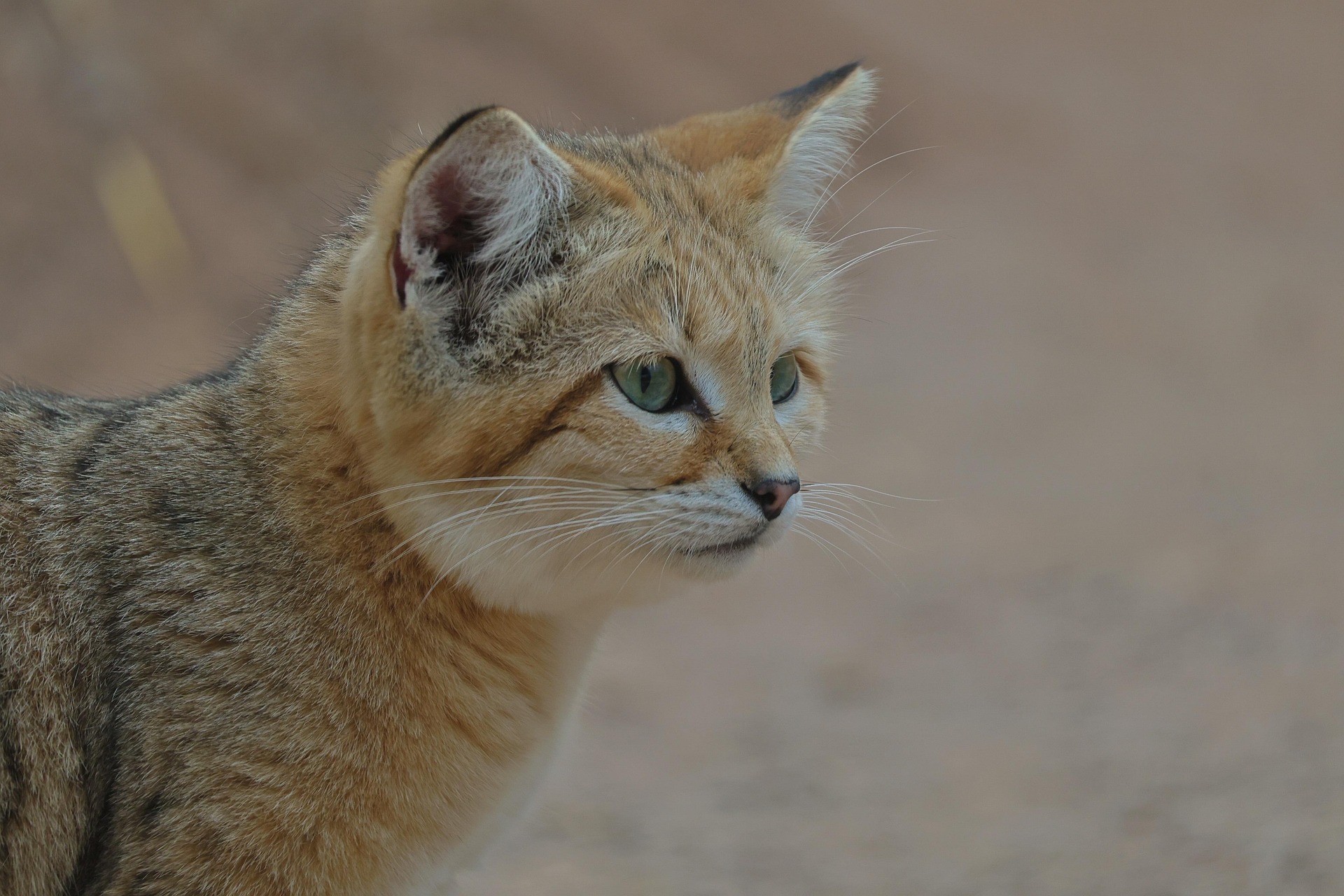
What kind of animal is a sand cat? We will explain its characteristics, ecology, and habitat. This cat is very cute and very popular, living from the Middle East to Africa. However, despite this background, the reality is that their numbers are decreasing and it cannot be said that they are in good condition.




- What is sand cat? About basic status
- What are the roots and origins of the sand cat?
- Where is its habitat?
- feature is? What kind of creature is it?
- What is your personality like?
- What is the ecology like?
- Sand Cat Vocalizations
- Seasonal Activities
- Walking Speed
- About Sand Cat Babies
- Is the sand cat an endangered species?
- Can sand cats be kept?
- Zoos Housing Sand Cats (Japan & Worldwide)
- Introducing other animals
What is sand cat? About basic status
The sand cat is a carnivorous animal classified in the order Carnivora, family Felidae, genus Felidae. Its scientific name is Felis margarita and it looks like a sand cat. This cat has a body length of 42 – 57 cm, a tail length of 28 – 35 cm, and a weight of 1 – 3 kg. It is the cat that represents the United Arab Emirates and is also known as the “Angel of the Desert.” If you are from the Middle East, you definitely know this. The list of information is as follows.
| Japanese(和名) | スナネコ |
| English(英名) | Sand Cat |
| scientific name(学名) | Acinonyx jubatus |
| classification(分類) | Mammalia、 Carnivora、 Felidae、Felis 哺乳綱、食肉目、ネコ科、ネコ属 |
| IUCN Status(保全状況) | LEAST CONCERN |
| Length(体長) | 42 – 57cm |
| Weight(体重) | 1 – 3kg |
What are the roots and origins of the sand cat?
The roots of the sand cat (Felis margarita) lie in an ancient lineage of the genus Felis that diverged approximately 6 to 7 million years ago.
Although they resemble ordinary domestic cats in appearance, they are actually a very old type of wild cat specialized for the extreme environment of the desert.
Ancestry: An ancient lineage of “small felids”
Taxonomically, the sand cat is classified as follows:
Felidae (Cat family)
↓
Felinae (Small cat subfamily)
↓
Felis (Cat genus)
↓
Sand cat (Felis margarita)
The genus Felis includes wildcat species that are ancestors to modern domestic cats, as well as other small wild cats such as:
European wildcat
African wildcat
Black-footed cat
Jungle cat
Sand cat (Felis margarita)
Genetic studies indicate that the sand cat belongs to a lineage that diverged relatively early within the genus Felis.
Evolutionary history
The general evolutionary timeline is as follows:
Prior to approx. 10 million years ago
↓
Ancient felids evolved in Asia
↓
Around 7 million years ago
↓
Ancestors leading to the modern genus Felis appeared
↓
From approx. 6 million years ago onwards
↓
Divergence of species such as the jungle cat, black-footed cat, and sand cat
↓
Sand cat ancestors moved into arid regions
↓
Evolution into the modern “desert-specialized cat”
Why did they adapt to the desert?
The sand cat is not merely a “sand-colored cat.”
They have adapted to desert life over the course of millions of years. Paws
Long fur grows between the paw pads
Protects the paws from hot sand
Leaves few footprints
Ears
Large ears detect the sounds of underground prey
Fur helps keep sand out
Coat Color
Pale sandy color
Provides perfect camouflage in sand dunes
Moisture
Highly capable of obtaining moisture from prey
Can live while drinking almost no water
Is it the ancestor of the domestic cat?
It is a common misconception, but
Sand Cat → Domestic Cat
is not the case.
The direct ancestor of the domestic cat (Felis catus) is primarily the African wildcat (Felis lybica).
The sand cat and the domestic cat
are like “cousins” that evolved separately from a common ancient ancestor.
About classification
Sand cats are a species very close to wildcats. There are four subspecies of this species. In general, their appearance, food, and cries are the same as domestic cats. The cost of keeping them is not much different. Many people in the area keep them as pets.
Felis margarita margarita
This subspecies is found in Algeria, Egypt, Niger, Mali, and Morocco. There are about 2 to 6 ring-shaped spots on the tail.
Felis margarita harrisoni
A subspecies that lives in Israel, Iraq, Syria, Jordan, and the Arabian Peninsula. There are 5-7 circular spots on the tail.
Felis margarita scheffeli
It is a subspecies that only lives in Pakistan, and its population is very small.
Felis margarita thinobia
This subspecies lives in Iran, Uzbekistan, Kazakhstan, and Turkmenistan. There is a theory that it is divided into two subspecies, and some scholars divide it into Felis margarita margarita and Felis margarita thinobia.
Where is its habitat?
The sand cat’s main habitat is the Arabian Peninsula. It is mainly distributed in the United Arab Emirates and Egypt, but it also lives in North Africa, such as Morocco, Kuwait, and Iran.
- Geographic Distribution
North Africa: Morocco, Algeria, Egypt, Libya
Middle East: Saudi Arabia, Oman, Iraq, Iran
Central Asia: Pakistan, Afghanistan
Distribution Characteristics: Found mainly in arid regions and deserts, at altitudes of approximately 0-1,500m.
- Habitat
Deserts and Semi-Deserts: Sand dunes, rocky areas, and sandy plains
Dry Grasslands and Barrens: Areas with shrubs and dry bushes
Securing Hiding Places:
Uses crevices in rocks and holes in sand dunes as burrows.
Hides in burrows during the day and is active at night.
- Environmental Characteristics
Adapted to hot, dry conditions
Can survive in areas with limited water sources (obtains moisture primarily from food)
Live within food-rich areas and move as feeding grounds change.
feature is? What kind of creature is it?
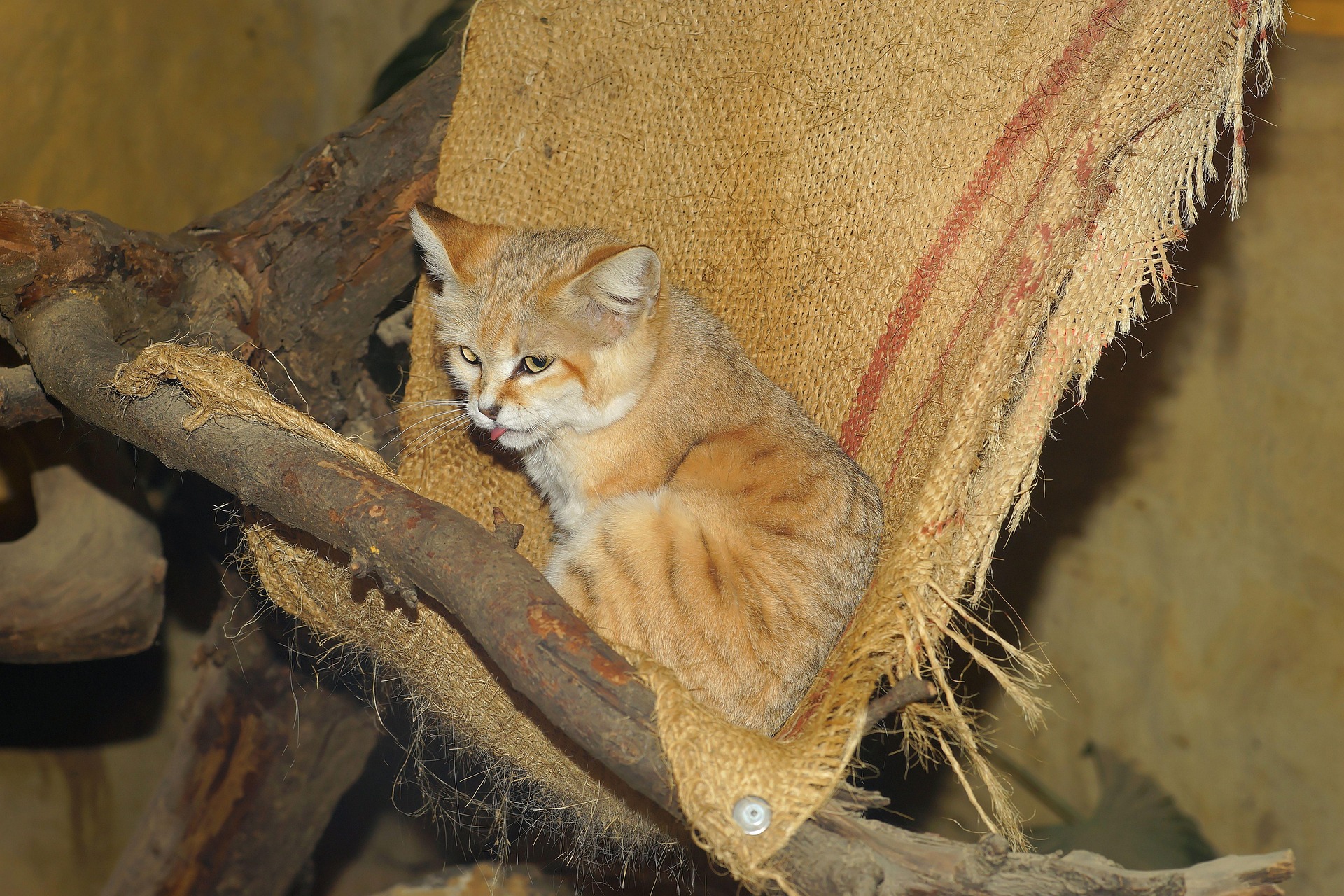
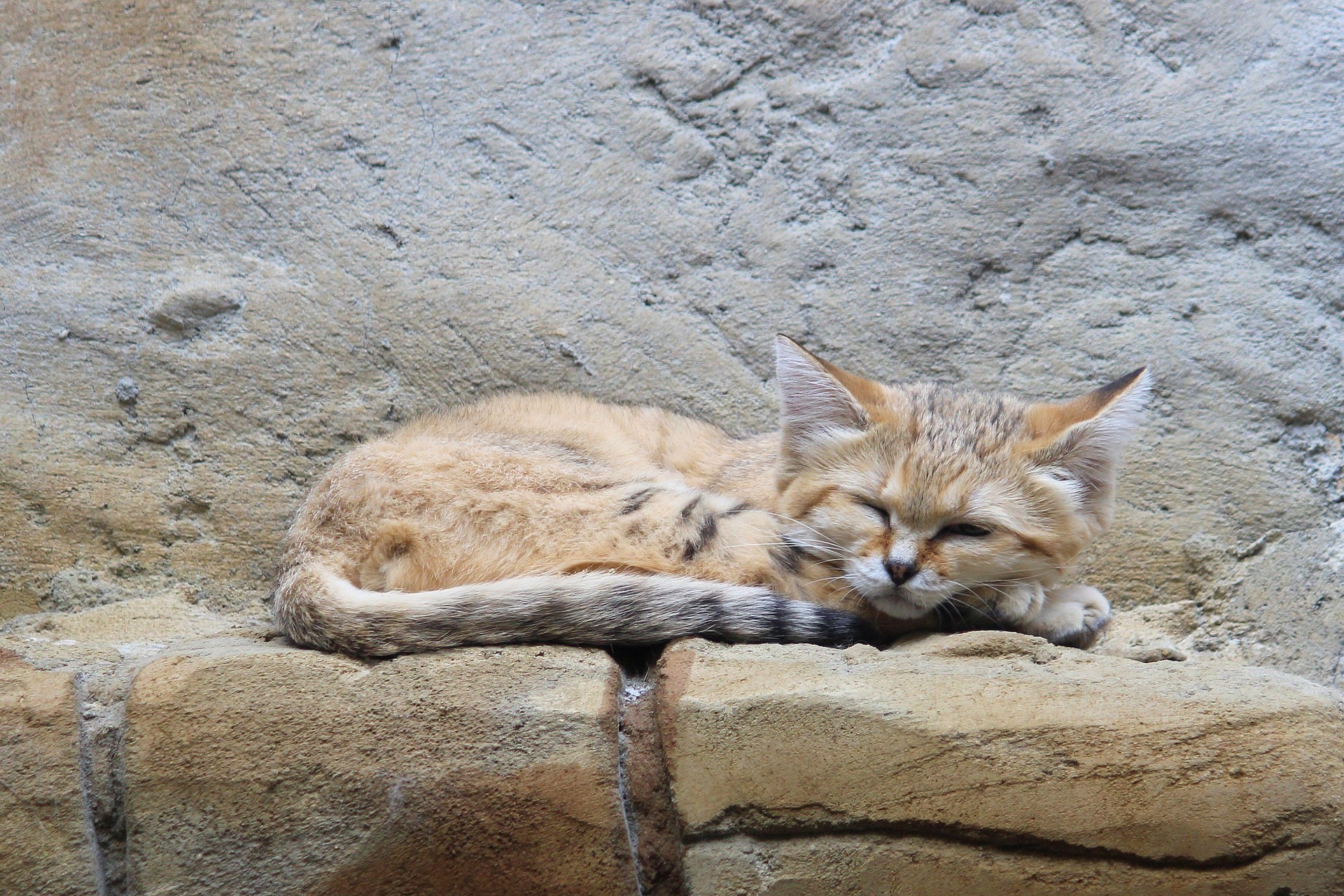
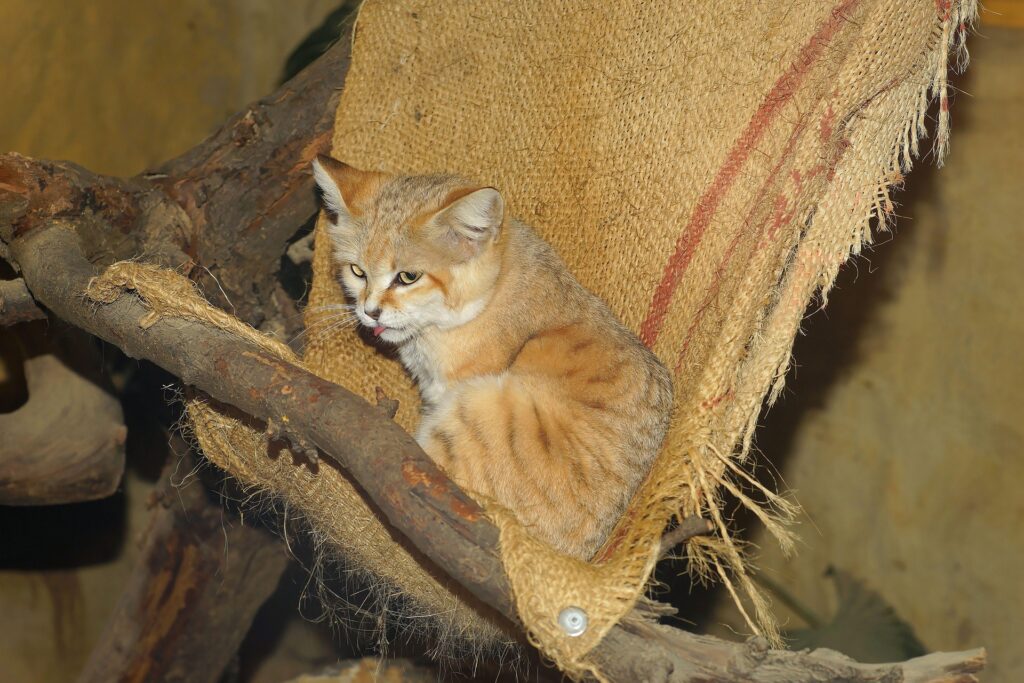
The color of the coat is grey-yellow, which is difficult to find in the desert, and the back part is a light grayish-yellow. The tail becomes blacker towards the tip and has a black ring pattern. The sand cat has long hair on the inside of its ears and on the soles of its feet, which are adapted to protect it from getting burned in the desert. The most distinctive feature is that the head is wide and the ears are large and wide triangular in shape. They hide in burrows during the day and are nocturnal.
- Body Size and Appearance
Body Length: Approximately 39-52 cm
Tail Length: 23-31 cm
Weight: 1.5-3.5 kg
Body Type and Coat Color:
Small and sturdy
Light sandy to tan coat that blends in with the desert environment
Black spots and vertical lines on the face, with distinctive patterns around the eyes
Ears:
Large, round ears with highly developed hearing
Able to accurately determine the direction of sounds and the location of prey
Feet and Claws:
The soles of the feet are covered with hair, protecting them from the desert sand and heat
Sharp claws, well-suited for capturing prey
- Behavior and Personality
Nocturnal and Solitary: They hide in burrows during the day and are active at night
Timid and cautious, but highly agile when hunting and traveling
Independent and territorial
- Diet
Carnivorous/Predator:
Feeds on small mammals (such as rodents), insects, and reptiles.
They drink little water, hydrating themselves through food.
They capture prey by sneaking up and quickly grabbing it.
- Biological Characteristics
Their body shape and coat color are adapted to the desert, allowing them to hide from predators.
Their ear and foot structures are optimized for desert life.
They maintain their own territories and hunt at night.
What is your personality like?
Sand cats are rare and very ferocious and have an aggressive personality. Many people want to keep a sand cat as a pet, but unless you are an expert who is used to handling cats, you will have a hard time keeping one. We do not recommend keeping multiple pets with other animals. They may prey on them or even get into fights.
Sand Cat Personality and Behavior
Timid and cautious
Sensitive to predators and humans, they quickly hide when they sense danger
Rest in their burrows during the day to protect themselves from predators
Independent
Generally solitary
Territorial, they only interact with other sand cats during breeding season
Nocturnal and agile
Active and hunt at night
Skillful at capturing small mammals and insects
Cautious and cautious
Approach new environments and objects cautiously
Ensure food and burrow safety before moving in
What is the ecology like?
Sand cats, wild animals, live in rocky, gravel, sandy, and sand dune deserts, where they prey on reptiles, large snakes, and small insects and mammals such as mice and scorpions. They generally search for prey in dry, hot desert areas such as Saudi Arabia, and often rest in burrows or in the shade during the day. They can also obtain a lot of water from their prey. They are viviparous. In captivity, they have a gestation period of about two months. They breed from March to April, and females can give birth to 2-6 pups at a time. They can live for over 14 years in captivity.
- Life Rhythm
Nocturnal: They hide in burrows during the day and hunt and move at night.
Burrows:
Hide in rock crevices or holes in sand dunes during the day.
Maintain body temperature in burrows in the harsh desert environment.
- Diet
Carnivorous (Predators):
Small mammals (rodents), insects, reptiles, etc.
Hydration:
Supplement necessary moisture from food.
Little need for drinking water.
- Breeding
Breeding Season: Varies by region, but most common from spring to summer.
Nest Building: Uses rock crevices or holes in sand dunes.
Little Birth: Usually 2-4 pups.
Brooding:
Mother holds and feeds chicks.
Becomes independent at about 2 months of age.
- Sociality/Behavior
Primarily solitary.
They have a territory and only interact with other individuals during breeding season.
Migration distance varies flexibly depending on the desert environment.
- Habitat Relationship
Specialized in desert and semi-desert areas
Ability to survive in hot, dry, and food-scarce environments
Uses terrain for hiding places and hunting
Are there any natural enemies?
The sand cat’s natural enemies are mainly large carnivores. Great threats include wolves, caracals, golden jackals, and golden eagles, which are often preyed upon.
Sand Cat Vocalizations
The vocalizations of the sand cat (Felis margarita) differ somewhat from their cute appearance; they are characterized by high-pitched, thin sounds typical of wild cats.
Common vocalizations include the following:
🐱 1. Short “Meow” sounds
Sand cats produce cat-like meows similar to those of domestic cats.
These are used for:
Calling out to other sand cats
Communication between mother and kitten
Reacting to humans in captivity
However, they do not vocalize as frequently as domestic cats; in the wild, they generally live quietly and keep their voices down.
🐱 2. High-pitched, thin “Peep” or “Chirp” sounds
Especially in kittens, they may produce:
High-pitched, bird-like sounds
Small squeaks
Hoarse calls
Since sound travels far in the desert, these vocalizations serve as a crucial means of communication for a mother and kitten to keep track of each other’s location.
🐱 3. Hissing when threatened
When they sense danger, they emit threatening sounds such as:
“Hiss” or “Fuh”
Although small, they are wild predators that remain wary of:
Foxes
Snakes
Large birds of prey
Other carnivores
🐱 4. Distinctive purring
Sand cats purr when they feel at ease or during interactions between mother and kitten.
In captivity, individuals that have become accustomed to humans may also purr.
Seasonal Activities
Sand cat (Felis margarita) activity patterns vary significantly by season.
Living in the extreme environment of the desert, they adjust their behavior based on temperature, prey availability, and breeding cycles.
🌸 Spring (March–May): Breeding and Rearing Season
Activity Characteristics
Breeding season begins; males increase their movement.
Females seek safe burrows in preparation for giving birth.
Rearing of young begins in some regions.
Behavior
Males patrol wide territories.
Increased scent marking via urine and other secretions.
More frequent vocalizations at night.
Rearing
Gestation lasts approximately 60–70 days, typically resulting in a litter of 2–4 kittens.
Kittens spend their first few weeks in the burrow and learn hunting skills from their mother.
☀️ Summer (June–August): Avoiding the Desert Heat
Activity Characteristics
In the summer desert, daytime conditions include:
Surface temperatures exceeding 50°C
Extremely hot sand
High risk of dehydration
Consequently, their lifestyle shifts to:
Daytime → Resting in burrows
Nighttime → Hunting
Hunting
Primary prey:
Small rodents (e.g., jerboas)
Geckos
Snakes
Small birds
Insects
They use their keen hearing to detect prey moving beneath the sand and dig them out.
🍂 Autumn (September–November): Peak Hunting Season
Activity Characteristics
As the intense summer heat subsides, activity levels increase.
Extended nighttime activity
Expanded patrol ranges
More active foraging for prey
This is a crucial period for building up physical reserves for the winter.
Behavior
Use of multiple burrows
Movement between hunting grounds
Primarily solitary behavior
Sand cats are fundamentally solitary animals.
❄️ Winter (December–February): Coping with Temperature Fluctuations
Deserts are not merely hot places.
In the winter desert:
Nighttime temperatures drop near freezing
Strong winds blow
Maintaining body temperature becomes essential Activity Characteristics
Activity shifts from nighttime to the early evening and dawn hours.
Hunting may occur not immediately after sunset, but before temperatures drop too low.
They seek shelter in burrows to escape the cold.
Physical Adaptations
Reasons for surviving the winter:
Thick fur
Long fur on the soles of the feet (protection against hot sand and cold)
Rounded body shape for heat retention
Sand Cat Daily Activity Rhythm
Daytime: Resting in the burrow
Early Evening: Activity begins
Night: Hunting and moving
Dawn: Returning to the burrow
Daytime: Sleeping
Walking Speed
There is very little official data on the average walking speed of sand cats (Felis margarita) accurately measured from wild individuals.
🐾 Normal walking speed (estimated)
Approximately 1–3 km/h
They walk slowly when patrolling or exploring.
They search for prey while moving silently.
Sand cats are not animals built for sustained long-distance running; they are “stalking hunters.”
🏃 Short-distance running speed (estimated)
When evading danger or approaching prey,
they are believed to possess the ability to sprint
at speeds of around 30–40 km/h.
However, they are not high-speed pursuit hunters like cheetahs.
About Sand Cat Babies
By summarizing the behavior of sand cat (Felis margarita) babies, we can understand their developmental stages and behavior from birth to independence.
- Birth and Nest
Breeding Season: Spring to Summer
Nest Building:
They build dens in safe locations such as rock crevices, holes in sand dunes, or depressions in the sand.
Litter Size: Usually 2-4
Birth Weight: Approximately 50-70g
- Characteristics of Babies
They are born with downy fur and their eyes are closed.
Their legs, ears, and sensory organs are underdeveloped.
They are barely able to move from the den and are completely dependent on their parents.
- Growth Stages
Growth and Behavior: From 0-2 weeks, they remain closed and are held by their mother in the den. They depend on feeding and warmth. From 2-4 weeks, their fur opens and their ears become erect. Their fur grows in and they play with their siblings. From 4-6 weeks, they begin walking and making small movements around the den. They learn hunting and survival techniques from their parents at 6-8 weeks, when they begin practicing hunting. They begin exploring outside the den at about 2 months, when they begin to move independently. They are able to hunt and move with the assistance of their parents.
- Survival Considerations
High risk of predation from natural enemies (birds of prey, snakes, weasels, etc.)
Poor food and den security reduce the survival rate of young.
Is the sand cat an endangered species?
Currently, sand cats are classified as least concern and are not endangered. However, their population is not stable, and the following problems are occurring locally, which are of great concern. Due to their aggressive behavior, they are not very suitable for keeping as a pet, even though they are a cute cat breed.
captured for pet trade
Sand cats are very famous cats that can be seen in zoos, but they are also captured for the pet trade. Overfishing is progressing and is a fairly serious problem in the United Arab Emirates and Iraq. They are attracting attention from breeders because they can sell for quite a high price.
risk of transmitting disease
This poses a risk of transmitting diseases from one sand cat to another, or even from your pet cat. Infections such as feline leukemia and feline AIDS have been observed, so epidemics are also a major threat.
receive revenge for killing poultry
Sand cats are carnivorous and wild animals. For this reason, they sometimes attack and kill farmers’ livestock, and are often killed by local farmers. In many cases, they actually die as a result of retaliation.
Can sand cats be kept?
It is questionable whether sand cats can be bred. Sand cats are much more ferocious than domestic cats, so they are not recommended for beginners. If possible, it would be a good idea to see it at an event at a zoo. In Japan, Nasu Animal Kingdom and Kobe Animal Kingdom are very famous. Although it is far away, you can see males and females. Visit the official website to see the news. Guided by videos and photos.
- Legal Issues
Sand cats are wild animals, often listed in Appendix I or II of the Convention on International Trade in Endangered Species of Wild Fauna and Flora (CITES), and their import and export are restricted internationally.
Even in Japan, keeping wild species requires special permission from the Ministry of the Environment or the prefecture.
Keeping, importing, or breeding them without permission is illegal.
- Difficulties in Keeping
Natural Habitat Reproduction Required:
The temperature difference between day and night and the dry environment of the desert must be reproduced.
They also need burrows to hide in during the day and space for nighttime activities.
Diet Issues:
They must be fed small mammals, insects, and reptiles.
They require a feeding environment tailored to their ecology, obtaining moisture from food.
Personality and Behavior:
They are timid, nocturnal, and prefer a solitary lifestyle, making them vulnerable to environmental stress.
Acclimatizing them to human living environments is extremely difficult.
- Cases Where Keeping is Possible
Only available in zoos, research facilities, and specialized facilities specializing in desert ecology.
Specialized equipment, breeding know-how, and legal permission are required.
Zoos Housing Sand Cats (Japan & Worldwide)
The sand cat (Felis margarita) is a rare wild cat that is difficult to keep in captivity; however, it is housed in several zoos, primarily in Japan, Europe, and the United States.
🇯🇵 Zoos in Japan where you can see sand cats
🐾 Nasu Animal Kingdom (Tochigi Prefecture)
A prominent facility that popularized sand cats in Japan.
Features:
First facility in Japan to successfully breed sand cats
Gained nationwide attention following the birth of kittens
Features an exhibit that recreates a desert environment
Plays a vital role in sand cat conservation and breeding efforts.
🐾 Kobe Oji Zoo (Hyogo Prefecture)
One of the Japanese facilities that houses sand cats.
Features:
Focuses on exhibiting small felids (cat species)
As they are nocturnal, they may sometimes be difficult to spot depending on the timing
🐾 Nagasaki Bio Park (Nagasaki Prefecture)
A facility participating in the sand cat husbandry and breeding network.
Known as a place in Japan where sand cats can be viewed.
🐾 Okinawa Zoo & Museum / “Okinawa Kodomo no Kuni” (Okinawa Prefecture)
One of the facilities that received sand cats transferred from Nasu Animal Kingdom.
🌍 Major zoos worldwide housing sand cats
🇺🇸 Smithsonian’s National Zoo (USA)
A world-renowned facility for sand cat husbandry.
Features:
Conducts ecological research and educational exhibits on sand cats
Showcases their adaptations to desert environments
Provides extensive public information about the individuals in their care
Currently houses multiple sand cats.
🇵🇱 Gdańsk Zoo (Poland)
One of the zoos in Europe where sand cats can be seen.
Features:
A facility involved in the European Endangered Species Programme (EEP)
Exhibited as a desert-dwelling animal
🇩🇪 Zoological Garden Berlin (Germany)
Known as a European facility that houses sand cats.
🇩🇪 Other facilities in Germany
Zoo Osnabrück
Zoo Neuwied
…and others also have records of keeping sand cats.
Introducing other animals
コメント