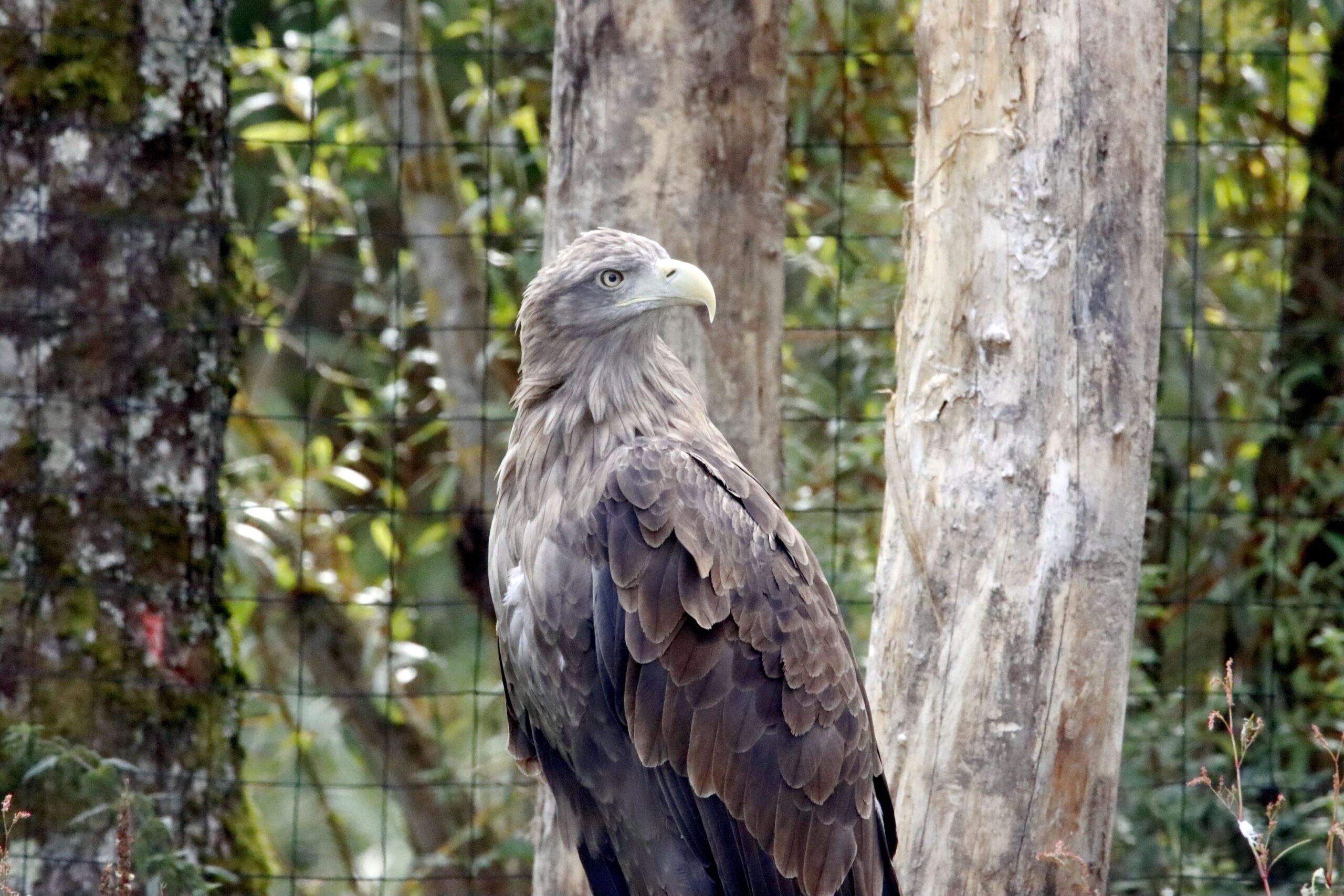
What kind of bird is a white-tailed eagle? We will explain its characteristics, ecology, and habitat. With a wingspan of 220 cm, it is quite strong among eagles and hawks. White-tailed eagles can be seen not only in Eurasia but also in Denmark and other countries.








- What is a white-tailed eagle? About basic status
- What are the roots and origins of the White-tailed Eagle?
- About habitat
- feature is? What kind of creature is it?
- What does the ecology look like?
- About Molting
- About Their Calls
- Seasonal Activities
- Regarding Flight Speed
- About White-tailed Eagle Chicks
- Is the white-tailed eagle an endangered species?
- Can white-tailed eagles be kept as pets?
- Zoos Housing the Species (Japan & Worldwide)
- Introducing other animals
What is a white-tailed eagle? About basic status
The white-tailed eagle is a bird classified in the genus White-tailed Eagle, in the order Accipitridae and in the family Accipitridae. Total length is 70-98cm, wingspan 180-240cm. Weight will be 3 – 7 kg. The scientific name is Haliaeetus albicilla, and the kanji is “tailed eagle”. The list of information is as follows.
| Japanese(和名) | オジロワシ |
| English(英名) | White-tailed eagle |
| scientific name(学名) | Haliaeetus albicilla |
| classification(分類) | Ave、 Accipitriformes、Accipitridae、Haliaeetus 鳥綱、タカ目、タカ科、オジロワシ属 |
| IUCN Status(保全状況) | LEAST CONCERN |
| Length(全長) | 70 – 98cm |
| Weight(体重) | 3 – 7kg |
What are the roots and origins of the White-tailed Eagle?
The White-tailed Eagle (scientific name: Haliaeetus albicilla) is a large sea eagle belonging to the family Accipitridae (hawks and eagles). In Japan, it arrives as a winter visitor, primarily in Hokkaido.
Its evolutionary roots lie in the lineage of eagles that developed as large birds of prey inhabiting waterside environments.
Ancestors: “Ancient Birds of Prey”
The ancestors of eagles and hawks were early birds of prey that appeared approximately 50 million years ago or earlier.
The general evolutionary progression is as follows:
Early birds of prey
(Carnivorous birds of the Paleogene period)
↓
Accipitridae (Hawks and eagles)
↓
Large eagles
↓
Genus Haliaeetus (Sea eagles)
↓
White-tailed Eagle
(Haliaeetus albicilla)
Emergence of the Genus Haliaeetus (Sea Eagles)
The genus Haliaeetus, to which the White-tailed Eagle belongs, is a group of eagles that evolved with the following characteristics:
Catching fish
Utilizing lakes, rivers, and coastlines
Possessing a large body size
Representative species include:
White-tailed Eagle
Bald Eagle (Haliaeetus leucocephalus)
Steller’s Sea Eagle
Solomon Sea Eagle (depending on classification)
Place of Origin of the White-tailed Eagle
The ancestors of the White-tailed Eagle are believed to have evolved primarily in the waterside environments of northern Eurasia.
Current distribution:
Northern Europe
Russia
Siberia
Central Asia
East Asia
Japan (e.g., Hokkaido)
The stage for their evolution was specifically regions rich in:
Large rivers
Lakes
Coastlines
Wetlands
About classification
There are two subspecies of white-tailed eagles.
Haliaeetus albicilla albicilla
It is found throughout the world, except in Greenland. They mainly fly to Hokkaido from Russia during the winter.
Haliaeetus albicilla groenlandicus
Individuals found only in Greenland correspond to this subspecies.
Taxonomy
- 界 (Kingdom): Animalia(動物界)
- 門 (Phylum): Chordata(脊索動物門)
- 綱 (Class): Aves(鳥綱)
- 目 (Order): Accipitriformes(タカ目)
- 科 (Family): Accipitridae(タカ科)
- 属 (Genus): Haliaeetus(オジロワシ属)
- 種 (Species): Haliaeetus albicilla(オジロワシ)
Note: The White-tailed Eagle is a large eagle that is adapted to coastal and open environments around lakes and ponds, and is distributed widely throughout the Northern Hemisphere.
About habitat
The white-tailed eagle is distributed in Eurasia, Japan, and Denmark.
- Natural Distribution (Place of Origin)
Northern Europe to Russia
Northern Europe (Norway, Sweden, Finland)
Baltic States, Northwestern Russia
Northern Asia to East Asia
Siberia, Mongolia, Northern China, Korea, Japan (Hokkaido)
A closely related species, the Bald Eagle, exists in North America.
- Habitat
Live mainly near water, such as lakes, rivers, wetlands, and coasts.
Breed and rest in open forests and treetops on forest fringes.
Often build nests in tall trees or on cliffs.
Prefer areas near water with an abundance of fish and waterfowl.
- Altitude/Range
Mainly flatlands to low mountains (0-1000 m)
Wide distribution, from coastal areas to inland lakes and ponds.
- Migration/Migration
Partially migratory
Individuals in Northern Europe and Siberia migrate south in winter
Individuals in Hokkaido, Japan, and East Asia are mostly sedentary
When feeding areas, such as lakes and ponds, freeze over, they migrate to find open water
- Distinctive Habitat Requirements
As a large eagle, it requires a wide hunting range
It is important for the area to have an abundance of fish and waterfowl, as well as tall trees and cliffs where it can safely rest.
feature is? What kind of creature is it?
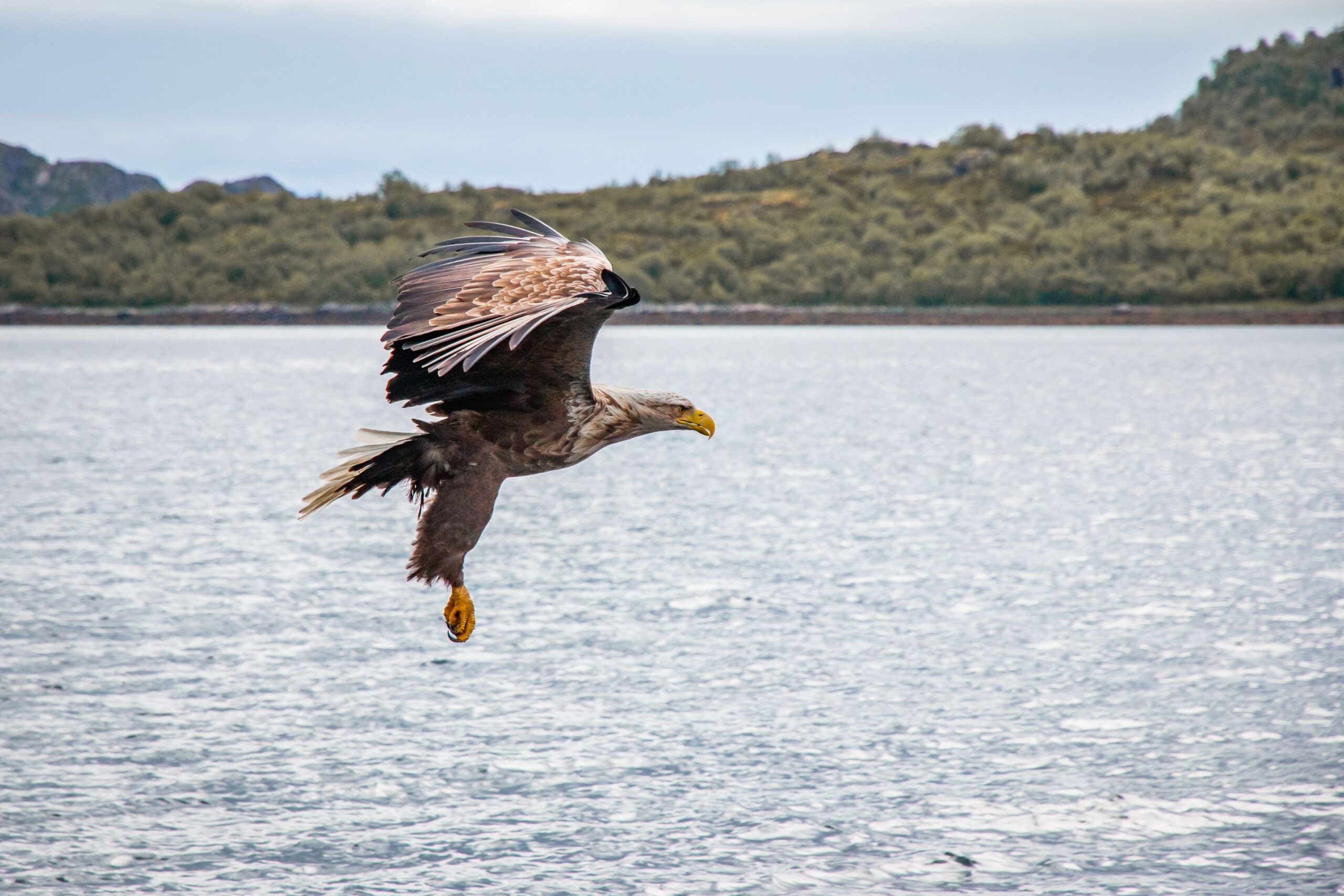
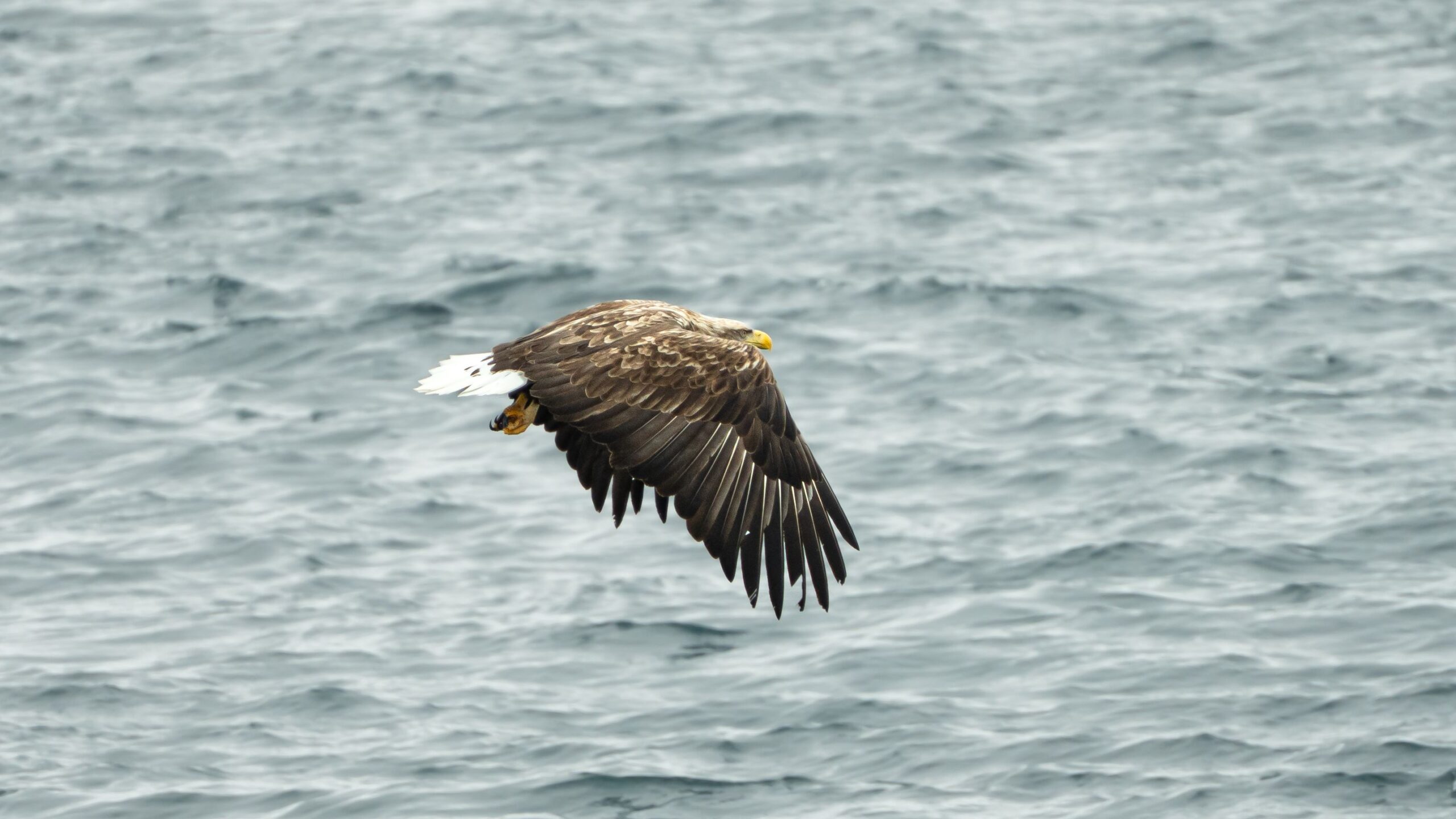
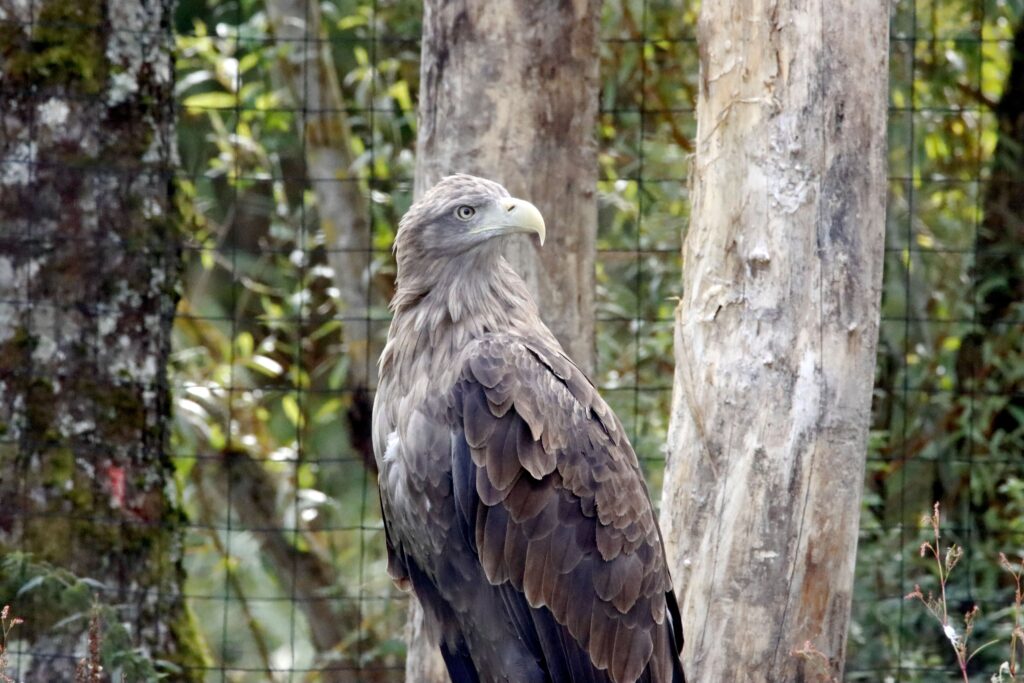
White-tailed eagles are members of the eagle and hawk family, and like the Steller’s sea eagle, females are larger than males. The whole body is dark brown, and the head is covered with pale brown or pale yellow feathers. The tail has 12 short feathers, and the tail is slightly wedge-shaped. The color of the tail feathers is white. It migrates throughout Japan as a winter bird. Their habitat is coasts, rivers, lakes, etc.
- Appearance and Physical Characteristics
Body Size
Body Length: Approximately 70-90 cm
Wingspan: Approximately 1.8-2.4 m
Weight: Approximately 3-6 kg
Body Color
Adult: Brown body with white tail feathers
Young Bird: Brown tail and takes several years to reach adulthood
Beak, Legs, and Claws
Their beaks are yellow and curved, suitable for catching fish and small animals.
They use powerful claws to grasp prey.
- Behavior and Personality
Personality
Timid and cautious
They usually live alone or in pairs.
Flight Ability
Powerful wings allow them to glide for long periods of time.
They sometimes fly low above the water surface to hunt for fish.
Hunting Behavior
Preys on fish, waterfowl, and small mammals.
They have excellent eyesight for hunting near water.
- Sociality
They are generally solitary outside of the breeding season.
They may come into contact with other individuals at feeding and resting areas.
What does the ecology look like?
White-tailed eagles are carnivorous, preying on fish, birds, and mammals. They also often eat carcasses. Prey is often captured by swooping down. The reproductive form is oviparous. The female lays two eggs at a time in March-April and incubates them. They reach sexual maturity at 5-6 years of age and have a lifespan of about 20 years.
- Habitat
Live mainly near water, such as lakes, rivers, wetlands, and coastlines.
Rest and nest in open forests or tall trees.
Select areas with abundant fish and waterfowl.
- Diet
Carnivorous (primarily fish-eating).
Preys primarily on fish.
Also eats waterfowl, small mammals, and carrion.
Hunting Method
Glides near the water’s surface and then dives down to catch fish.
Their claws are very powerful, and they sometimes fly back to their prey.
- Social Behavior
Primarily lives alone or in pairs.
During the breeding season, they defend their territory as a pair.
Even during the non-breeding season, they may encounter other individuals at feeding areas.
- Breeding Behavior
Nesting: They build large nests (approximately 1.5-2 cm in diameter) on top of tall trees or cliffs. m)
Breeding Season: Winter to Spring (Varies by Region)
Number of Eggs: Usually 1-3
Parent Roles
Both parents take turns incubating the eggs and feeding the chicks
Growing is slow, and it takes several months for them to fledge
- Migration/Migration
Partially Migratory
Individuals in Northern Europe and Siberia migrate south in winter
Sedentary
Many individuals are sedentary in Hokkaido, Japan, and warmer regions of Western Europe
Local migration in frozen lakes and ponds, seeking open water
Are there any natural enemies?
White-tailed eagles have no natural enemies. It is the highest bird in the sky.
About Molting
Molting in the White-tailed Eagle (Haliaeetus albicilla) is a vital physiological process in which feathers are gradually replaced as the bird grows and ages, and in response to seasonal changes.
Basics of Molting
Bird feathers play crucial roles in:
Flight
Body temperature maintenance
Waterproofing
Hunting ability
Consequently, old feathers are replaced periodically.
White-tailed eagles do not lose all their feathers at once;
instead, they undergo “sequential molting,”
where feathers are shed and replaced gradually and in a specific order.
As a result, there is essentially no period during which they are unable to fly.
Molting Season
Spring to Summer (Primary Molting Period)
For many individuals,
molting becomes most active
between May and September.
Reasons:
Breeding activity subsides
Food availability becomes relatively stable
Feathers are renewed before the harsh winter environment
Wing Molting
Wing feathers (remiges) are critically important.
Feathers replaced include:
Primaries (wingtips)
Secondaries (inner wing)
Tail feathers
etc.
Characteristics:
Replaced gradually and symmetrically (left and right sides)
Flight ability is maintained
Complete renewal takes several years
About Their Calls
Despite their massive size, White-tailed Eagles (Haliaeetus albicilla) do not produce the sort of low, ferocious roar one might imagine. Instead, they are birds of prey that emit a series of high-pitched, piercing calls.
Typical Calls
Their calls can be described as sharp sounds resembling a whistle, such as:
“Kee-kee-kee”
“Kwi-kwi-kwi”
“Pii-yo, pii-yo”
Characteristics:
High-pitched
Resonant/Carrying
Repeated/Continuous
Audible from a great distance
Although they are large eagles, the quality of their voice is surprisingly delicate.
Breeding Season Calls
Spring (mainly around February to May) is the time when their calls are most frequently heard.
Communication between mates
Pairs engage in behaviors such as:
Alternating calls between male and female
Calling while flying above the nest
Asserting territorial boundaries
Their calls convey information such as:
“This is our territory”
“My mate is nearby”
“The nest is safe”
Chick Calls
The calls of the chicks change as they grow.
Young chicks
Emit soft “pee-pee” sounds
Call to beg for food
Older chicks
Voices become louder
Make more demands of the parent birds
When a parent approaches,
They call out to signal, “Bring me food.”
Seasonal Activities
The White-tailed Eagle (Haliaeetus albicilla) is a large bird of prey whose habitat, hunting methods, and breeding behaviors change significantly with the seasons.
Spring (March–May)
Season for Breeding and Territory Defense
Spring is the most critical time of year for White-tailed Eagles.
Key Activities
Defending territory as a pair
Repairing the nest
Mating
Egg-laying
Beginning to raise chicks
Nest Building
White-tailed Eagles build massive nests.
Locations:
Large trees near the coast
Forests along rivers
Clifftops
Areas around lakes and marshes
Nests are often reused year after year; as new branches are added, they can grow to:
Over 1–2 meters in diameter
Weigh several hundred kilograms
Hunting
In spring, parent birds:
Catch fish, waterfowl, and small mammals
Carry the prey back to the chicks
Summer (June–August)
Raising Chicks and Fledgling Growth
Summer is the peak period for breeding activities.
Chick Growth
After hatching, chicks:
Initially stay in the nest
Gradually strengthen their wings
Fledge (leave the nest) after a few months
Parent Bird Behavior
Parents take turns:
Guarding the nest
Bringing food
Protecting chicks from heat and rain
Flight Training
Young birds develop their flying skills by:
Flying around the nest area
Moving from branch to branch
Practicing gliding
Autumn (September–November)
Season for Migration and Winter Preparation
In autumn, northern populations migrate southward.
Migration
From:
Russian Far East
Sakhalin
Kamchatka region
↓
To:
Hokkaido
Sea of Japan coast
Autumn Behavior
They begin to:
Search for areas rich in food
Rest in flocks
Secure winter territories
Winter (December–February)
The Best Season for Observation in Hokkaido
Winter is the time when White-tailed Eagles are most conspicuous in Japan. Key locations:
Hokkaido coast
Rivers
Lakes
Wetlands
Areas near drift ice
Regarding Flight Speed
Unlike high-speed falcons, the White-tailed Eagle (Haliaeetus albicilla) is an eagle specialized for gliding and energy-efficient flight using its massive wings.
Normal Flight Speed
The White-tailed Eagle’s cruising speed is estimated to be:
Approximately 40–50 km/h
Typical situations include:
Moving within its territory
Traveling to feeding grounds
Patrolling over coastlines or rivers
In these scenarios, it flies at this speed.
Gliding Speed
The White-tailed Eagle excels at gliding rather than flapping flight.
By utilizing updrafts, it can fly for extended periods at speeds of:
Approximately 30–60 km/h
Characteristics:
Minimal wing movement
Low energy expenditure
Ability to monitor a wide area
These are the advantages of this flight style.
Diving Speed
Speed increases when targeting prey.
During a dive:
It can reach speeds exceeding 100 km/h
However:
It does not perform the 300 km/h-class diving attacks seen in falcons.
Reason:
The White-tailed Eagle primarily hunts by:
Grabbing fish
Scavenging carcasses
Attacking waterfowl
Consequently, ultra-high-speed dives are unnecessary.
About White-tailed Eagle Chicks
This section provides a detailed overview of White-tailed Eagle (Haliaeetus albicilla) chicks. White-tailed eagles are large birds of prey, and parental cooperation and a safe nest environment are crucial for their development.
- Birth and Hatching
Number of Eggs: Usually 1-3
Incubation Period: Approximately 35-42 days
Characteristics Immediately After Hatching
Feathers: Soft, pale gray to white down
Beaks and talons are still weak, and they cannot fly
Compared to adults, they are smaller and weaker
- Life in the Nest
Nest Location
Large nests (approximately 1.5-2 m in diameter) built on tall trees or cliffs
Parent Care
Both parents take turns incubating and feeding the eggs
Hide chicks or defend the nest in times of danger
Diet
Parents feed them primarily fish and small animals caught by mouth
- Growth Process
Early Stage (Immediately after hatching – 2 weeks)
Feathers are soft and unable to fly
Completely dependent on parents’ temperature control and food
Middle Stage (2 weeks – 2 months)
Feathers grow and their bodies become stronger
Claws and beaks become stronger, and they are able to feed themselves a little
Late Stage (2-3 months)
Feathers approach those of adult birds, enabling them to fly short distances
Begins preparations for fledge
- Fledge
Time to learn flight: Approximately 2-3 months
After fledge
At first, they fly close to their parents and learn prey techniques
Gradually become independent and begin catching fish and small animals on their own
- Characteristics and Biology
Chicks’ feathers are paler and softer than those of adults
Under the protection and guidance of their parents, they learn how to forage and fly
The safety of the nest is directly linked to the chicks’ survival
Is the white-tailed eagle an endangered species?
White-tailed eagles are the largest species of eagles and hawks, so they have no natural predators. Therefore, it is not an endangered species. The population is stable. However, it is designated as an endangered species in Japan. Their numbers are drastically decreasing due to the destruction of nesting grounds due to deforestation, land reclamation, and road construction. It is designated as an endangered species. It is also listed in the Washington Convention. It is a wild bird designated as a natural monument by the Ministry of the Environment, and in 1993, it was designated as a domestic rare species of wild fauna and flora under the enforcement of the Species Conservation Act.
- IUCN Red List Assessment
Classification: Least Concern (LC)
Reason: Widely distributed throughout the Northern Hemisphere, with total populations stable or recovering.
- History of Endangered Species
Until the mid-20th century: Populations plummeted due to pesticides (DDT), hunting, and environmental destruction.
Recently: Populations have been recovering due to conservation efforts and environmental regulations.
- Regional Status
Japan (Hokkaido)
A small number of resident individuals remain, and conservation efforts are underway.
Europe and Russia
Populations have recovered and are stable, particularly in Northern Europe.
Siberia and Northern Asia
Large populations with widespread distribution.
Can white-tailed eagles be kept as pets?
Because of the above, it is difficult to keep them as pets. Because it is large, you can take good photos even in nature. In Japan, they winter in the northern part of Japan, so let’s take some photos.
- Difficulty in Keeping
Body Size
Body Length: Approximately 70-90 cm
Wingspan: Approximately 1.8-2.4 m
Weight: Approximately 3-6 kg
It is almost impossible to find space in the home for them to fly.
High Flying Ability
Capable of long glides and dives, they experience stress in small spaces.
Highly Wild Nature
Very wary and difficult to tame.
- Personality and Behavior
Can be timid and aggressive.
They have a strong prey instinct and may harm hands or pets.
Adapted to living alone.
They may feel loneliness and stress in captivity.
- Laws and Protection
In Japan, some areas are designated as natural monuments, requiring special permission to keep them.
Internationally, eagles are subject to the Convention on the Protection of Eagles and Hawks and the Eagle Protection Act.
Keeping or selling them without permission is illegal.
- Breeding Examples
Most birds are kept in zoos or raptor sanctuaries.
Requirements:
Large outdoor flying space (at least several hundred square meters)
Maintain a raw meat diet, primarily of fish and small animals
Protect nests and chicks during breeding season
Summary
White-tailed eagles are large raptors that are not suitable as pets and should be kept in specialized facilities under natural conditions.
Zoos Housing the Species (Japan & Worldwide)
The White-tailed Eagle (Haliaeetus albicilla) is a large bird of prey protected in Japan as a species of significant conservation value (comparable to a Natural Monument); it is kept in zoos and conservation facilities for public display and breeding research.
🇯🇵 Major Facilities in Japan
Kushiro City Zoo
A facility representing Hokkaido in the exhibition of large birds of prey.
Features:
Exhibits birds of prey native to Hokkaido
Engaged in White-tailed Eagle conservation and public awareness activities
Plays a role in rehabilitating injured or sick birds for release back into the wild
Highlights:
Huge wingspan
Yellow beak
White tail feathers (in adults)
A facility where visitors can learn about the species alongside Hokkaido’s natural environment.
Asahiyama Zoo
A zoo that focuses on exhibiting Hokkaido’s wildlife.
Features:
Introduces large bird species native to Hokkaido
Proven track record in exhibiting birds of prey, including White-tailed Eagles
Exhibits are designed to emphasize the observation of natural behaviors.
Maruyama Zoo
A prominent zoo in Hokkaido.
Features:
Exhibits wildlife native to Hokkaido
Promotes understanding of birds of prey
A facility for learning about Hokkaido’s birdlife, including the White-tailed Eagle.
Tama Zoological Park
A zoo with a track record of exhibiting large birds of prey.
Features:
Exhibits eagles and hawks
Showcases flight capabilities and ecological traits
🌍 Major Facilities Worldwide
Due to their wide distribution range, White-tailed Eagles are relatively commonly kept in zoos and raptor centers across Europe and Russia.
🇩🇪 Germany
Berlin Zoo
A zoo with one of the longest histories in the world.
Features:
Exhibits large birds of prey
Conservation-focused exhibits of European wildlife
Hannover Zoo
Known for its diverse animal exhibits, including waterfowl and birds of prey.
Leipzig Zoo
One of Europe’s major zoos featuring large bird exhibits.
🇬🇧 United Kingdom
Hawk Conservancy Trust
A facility specializing in birds of prey. Features:
Eagle exhibits
Flight shows
Conservation education
Get a close-up view of large birds of prey, such as the white-tailed eagle.
🇳🇱 Netherlands
Bird Park Avifauna
A facility specializing in birds.
Features:
Diverse species of birds of prey
Exhibits of birds from around the world
Breeding research
Introducing other animals



コメント