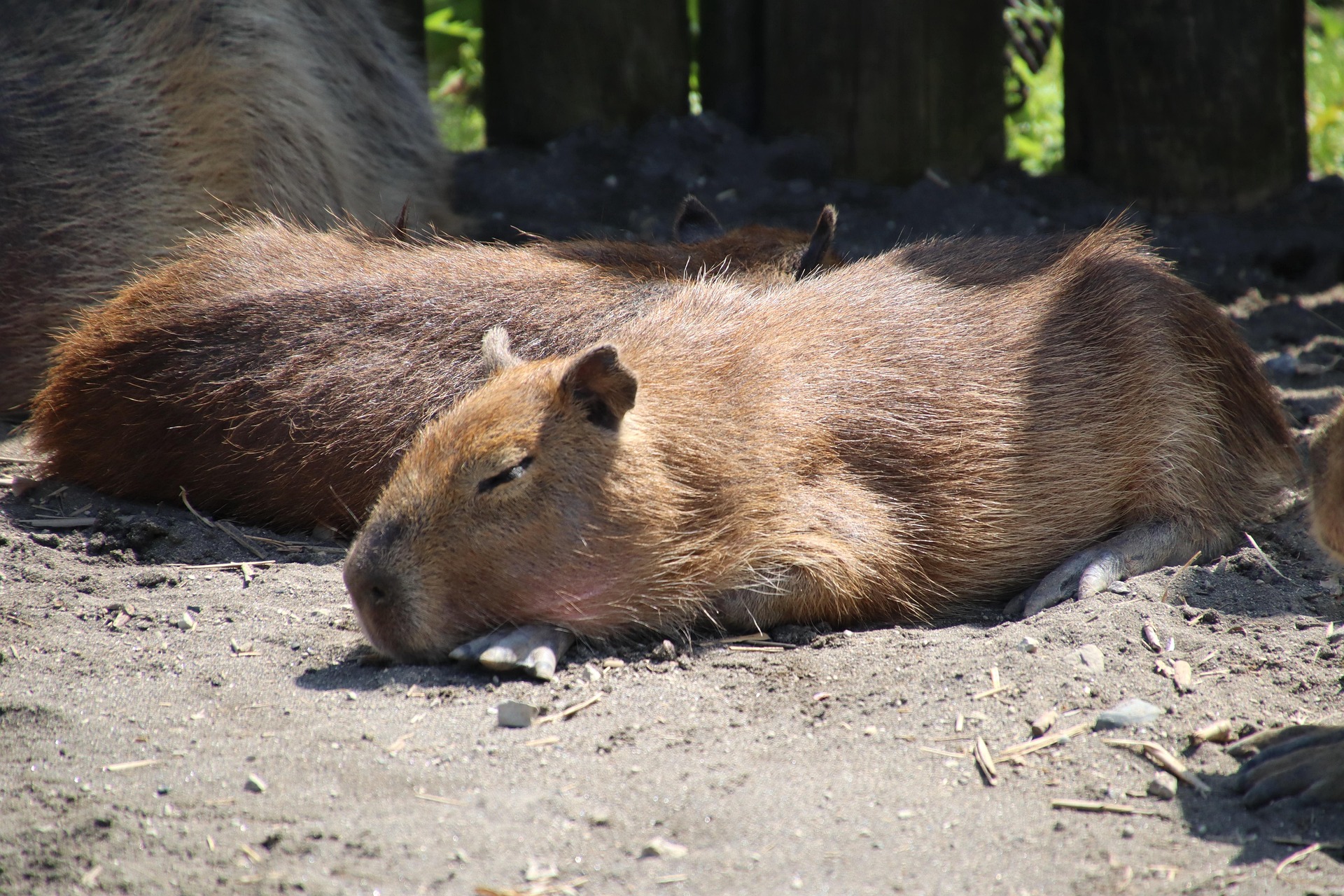
What kind of animal is a capybara? We will explain its characteristics, ecology, and habitat. Capybaras are so large and fat that they look like pigs, but they are actually different. It’s actually a member of the rat family. They are widely active on the continent of South America, so they are one of the animals that are familiar to South Americans.








- What is a capybara? About basic status
- What are the roots and origins of the capybara?
- About habitat
- feature is? What kind of creature is it?
- What is your personality like?
- What is the ecology like?
- About Molting
- About Diving
- About Capybara Vocalizations
- Seasonal Activities
- About Walking Speed
- About Baby Capybaras
- Are capybaras an endangered species?
- Can capybaras be kept as pets?
- Zoos Housing Capybaras (Japan & Worldwide)
- Introducing other animals
What is a capybara? About basic status
Capybara is a rodent that belongs to the Capybara family. The largest rat in the world. The body length is 106 – 134 cm and the weight is 35 – 64 kg. The scientific name is Hydrochoerus hydrochaeris. The list of information is as follows. Capybara is very popular in South America and events are held there. If you enter the zoo in a group, the animals will show you their swimming skills inside the zoo. She is often exposed at hot springs, capybara cafes, X (twitter), YouTube, etc.
| Japanese(和名) | カピバラ |
| English(英名) | Capybara |
| scientific name(学名) | Hydrochoerus hydrochaeris |
| classification(分類) | Mammalia、 Rodentia、 Hydrochoerinae、Hydrochoerus 哺乳綱、齧歯目、テンジクネズミ科、カピバラ属 |
| IUCN Status(保全状況) | LEAST CONCERN |
| Length(体長) | 106 – 134cm |
| Weight(体重) | 35 – 64kg |
What are the roots and origins of the capybara?
The capybara (scientific name: Hydrochoerus hydrochaeris) is the world’s largest rodent—a relative of mice and rats—that evolved in South America. While they currently inhabit riverbanks and wetlands in South America, their ancestry dates back tens of millions of years.
Ancestors from the “Giant Rodent Lineage” of Africa
The group to which capybaras belong—the Caviomorpha (caviomorph rodents)—did not originally exist in South America; their ancestors are believed to have drifted over from Africa during the Late Eocene epoch (approximately 40 million years ago). The prevailing theory is that small rodents crossed the ocean—likely on floating vegetation—and subsequently underwent unique evolution in South America.
The general evolutionary progression is as follows:
Small African rodents
↓
Arrival in South America (approx. 40 million years ago)
↓
Evolution into Caviomorpha
↓
Emergence of the Hydrochoeridae family (capybara family)
↓
Modern-day capybara
The Era When the Hydrochoeridae Family Emerged
The Hydrochoeridae family—the direct lineage of the capybara—flourished during the Miocene epoch (approximately 23 to 5 million years ago).
Among the oldest known fossils of this family is Cardiatherium chasicoense, discovered in Argentina. This represents a type of capybara-like animal from over 10 million years ago.
Even during this era, characteristics typical of modern capybaras were already beginning to take shape, such as:
Increased body size
Adaptation to life near water
Herd-based social behavior
Ancient Capybaras Were Even Larger Than Modern Ones
While modern capybaras measure about 1 to 1.3 meters in length and weigh between 35 and 70 kilograms, their ancestors included even more massive species. A prime example is:
Josephoartigasia monesi
Lived approximately 2 to 3 million years ago
Estimated weight of over 700 kg
Considered one of the largest rodents known to have existed.
In other words, the evolutionary history of the capybara lineage runs from
“giant rodents” to “the modern capybara adapted to a semi-aquatic lifestyle.”
Why did they adopt a semi-aquatic lifestyle?
Capybara ancestors originally lived in forests and grasslands, but amidst environmental changes in South America, they adapted to life near the water in order to:
escape predators (such as jaguars and crocodilians)
utilize aquatic plants and soft vegetation
regulate their body temperature
As a result, they evolved into semi-aquatic animals characterized by:
slight webbing between their toes
strong swimming ability
nostrils, eyes, and ears positioned high on the head
the ability to remain submerged for extended periods
About classification
There is a subspecies of capybara called the lesser capybara.
Hydrochoerus isthmius
Capybaras are found in eastern Panama, northwestern Colombia, and western Venezuela. Its name is lesser capybara or Hime capybara. The Japanese capybara looks a lot like a capybara, but the adult Japanese capybara usually weighs about 28 kg, so it is a little smaller.
Capybara Taxonomy
| 階級 | 分類 |
|---|---|
| 界 | 動物界 (Animalia) |
| 門 | 脊索動物門 (Chordata) |
| 綱 | 哺乳綱 (Mammalia) |
| 目 | 銃歯目 / 齧歯目 (Rodentia) |
| 科 | ケナガネズミ科 (Caviidae) |
| 属 | カピバラ属 (Hydrochoerus) |
| 種 | カピバラ (Hydrochoerus hydrochaeris) |
About habitat
Capybaras can be found in South America.
Capybara Habitat
Main Distribution Areas
Distributed throughout Central and South America
Tropical and subtropical regions, including Brazil, Venezuela, Colombia, Argentina, and Paraguay
Habitat
Prefers wetlands centered around water
Rivers, lakes, marshes, swamps, and mangrove forests
Grains grass near water and uses areas where it is easy to swim
Environmental Conditions
Adapted to warm, humid regions
Rarely found in areas without access to water
Swimming underwater protects them from predators
Relationship with Humans
Can sometimes be found around farmland and along rivers in South America
In some cases, they are kept as pets or kept in zoos
feature is? What kind of creature is it?
Capybara is the largest living rodent. It has four fingers on its front legs and three toes on its hind legs, and has small webs between its toes, which allow it to swim. Their body hair is hard and long, and has the ability to shed water just by shaking their body. Capybaras usually live in grasslands and riverside areas.
Characteristics of Capybaras
Body Size/Shape
Body Length: Approximately 100-130 cm
Weight: Approximately 35-66 kg (large individuals can exceed 70 kg)
Stout body with short limbs
Rounded snout and rodent-like front teeth
Fur/Color
Fur color is brown to reddish-brown
Coarse fur and not very water-repellent
Some individuals exhibit slight color changes between summer and winter
Head/Face
Round face, large nose and eyes
Nostrils can be closed They have small ears, allowing them to adjust their breathing while swimming underwater.
They have small ears, making them well-suited to aquatic life.
Diet
Completely herbivorous: Grasses, aquatic plants, fruits, bark, etc.
Prefers plants that can be gathered near water.
Behavior/Personality
They often live in groups and are highly social.
They are good at swimming underwater and will dive to escape.
They are gentle and easily tame.
Ecological Characteristics
Specialized for aquatic life: swimming, diving, finding resting places, etc.
They often actively feed at night and early in the morning.
What is your personality like?
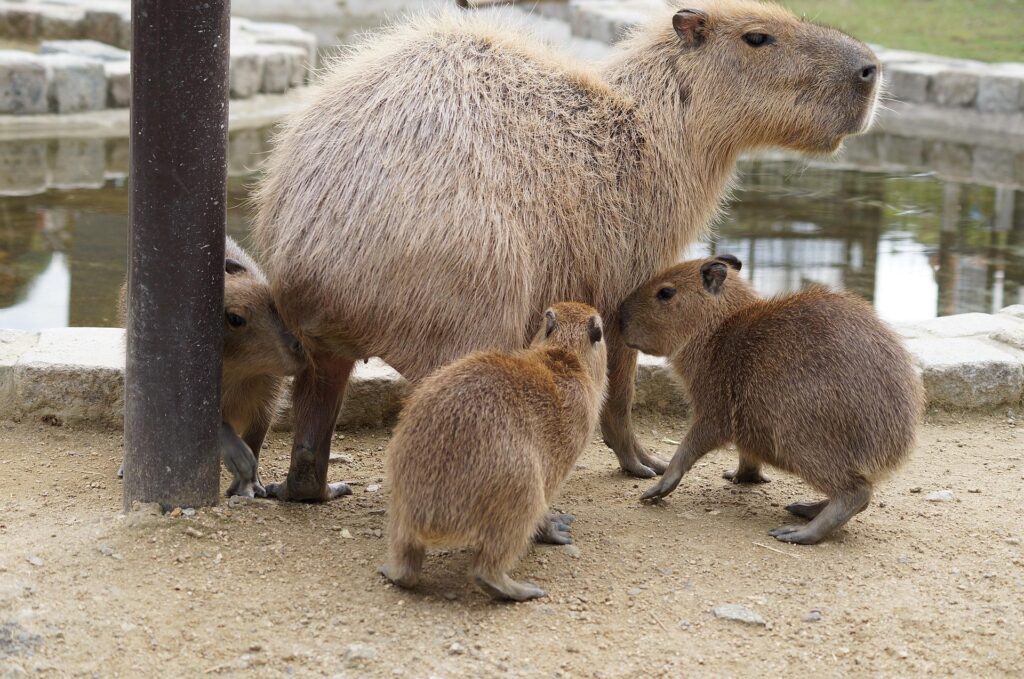
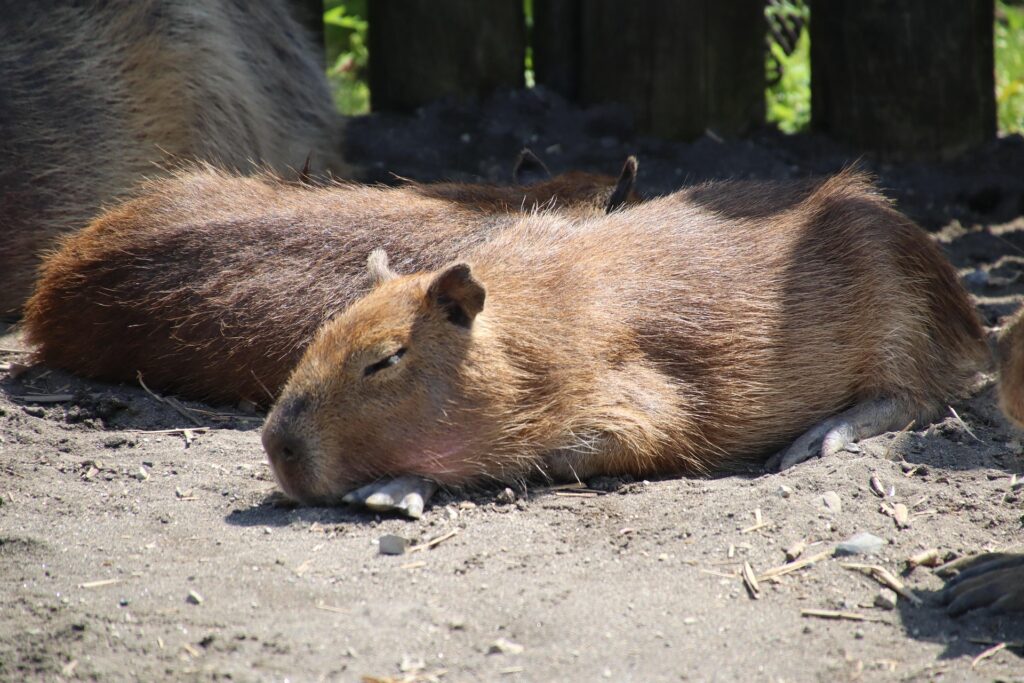
Capybaras are very gentle and gentle animals. Basically, capybaras live in groups rather than alone, so they are very social creatures. They often fall asleep and are very laid-back animals. They also do not like getting wet in the rain and tend to huddle together to regulate their body temperature.
Capybara Personality and Behavior
Gentle and gentle
Low-aggression, relatively friendly with other animals and humans
When threatened, they do not attack but instead take evasive action, such as fleeing into the water
Highly sociable
They live in groups and communicate with each other
Maintain social relationships through grooming and physical contact
Curious but cautious
They may show interest in their surroundings
They can also be cautious, quickly hiding when they sense danger
Pack order
They have a sense of hierarchy and territoriality within the pack
Dominant individuals may prioritize eating and resting areas
Relationship with humans
In captivity, they easily tame people and can be petted and interact with others
Their gentle nature makes them popular at zoos and petting centers
What is the ecology like?
Capybaras are herbivores, so their preferred food (meals) are pellets, cabbage, apples, and other fruits, vegetables, and grass. They are particularly big eaters, so be careful as food costs can be high. Even though they are the same giant guinea pig, they can grow large and eat a lot from morning to midday and into the night. There are now many exhibits of this species in Japan, so if you like them, be sure to check them out first.
Capybara Ecology
Habitat
Waterside grasslands and wetlands, such as rivers, lakes, marshes, and swamps, in Central and South America
They live in groups in areas with access to water
Waterside areas serve as bases for rest, refuge, feeding, and social activities
Diet
Completely herbivorous
Eats mainly grasses, aquatic plants, fruit, and tree bark
They often actively feed at night or early in the morning
Sociality/Pack Life
Highly social animals that live in groups
Pack sizes are typically around 10-20 individuals, but can grow to over 50
Dominant individuals maintain order in the group They have priority for eating and resting.
Relationship with Water
They are excellent swimmers and will enter the water to escape or rest.
They can also dive, allowing them to protect themselves from predators in the water.
Reproduction
Breeding occurs year-round, regardless of the season.
Gestation period: Approximately 150 days.
They give birth to 1-8 (usually 3-4) young at a time.
The young can walk immediately after birth, but grow up under the care of their mother.
Activity Pattern
Behavior patterns intermediate between diurnal and nocturnal.
They rest during the day, often near water, and forage during cooler times and at night.
Are there any natural enemies?
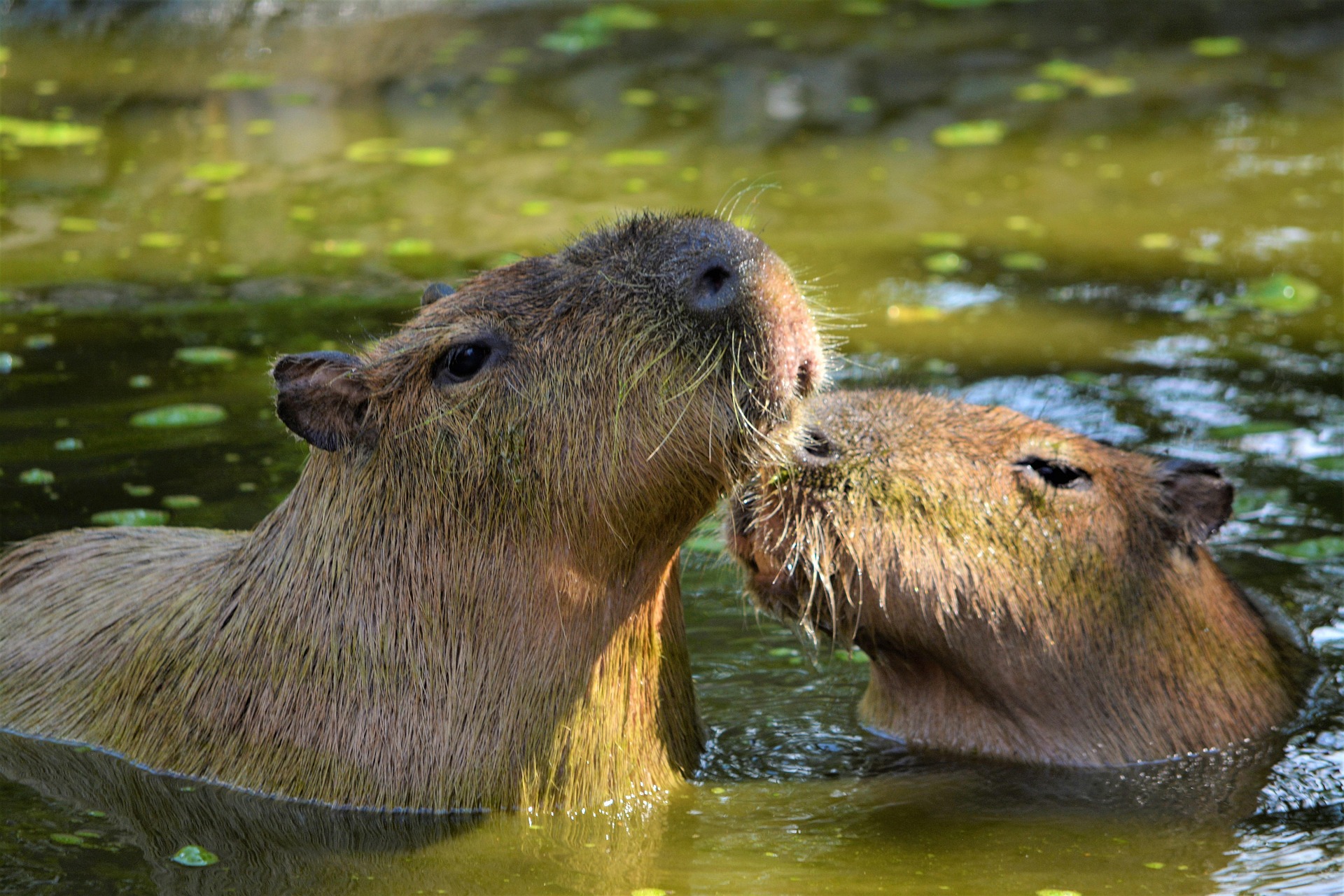
Capybaras are attacked by jaguars, pumas, etc. However, capybaras have a way of escaping into the water, and since they can swim, they often look for rivers when they escape.
About Molting
Capybaras are animals that undergo “molting,” a process where their fur changes according to the season. However, unlike dogs or cats that shed large amounts of fur at once, capybaras replace their fur gradually to suit their environment.
Characteristics of Capybara Fur
Capybara fur is:
Coarse, short, and stiff
Not particularly dense
Structured to dry quickly
While it may look fluffy at first glance, it is actually “functional fur” adapted for a semi-aquatic lifestyle.
Molting Season
Although it varies by region, capybaras generally molt according to this cycle:
Spring to early summer: Transition from winter coat to summer coat
Autumn: Transition from summer coat to winter coat
For wild capybaras in particular, the timing of the molt shifts based on factors such as temperature, rainfall, and daylight hours.
Why Do They Molt?
There are three main reasons:
① Body Temperature Regulation
Since capybaras live in hot regions, switching from a dense winter coat to a summer coat helps to:
Prevent heat from becoming trapped
Regulate body temperature while in the water
Conversely, during colder seasons, the fur becomes thicker to prevent a drop in body temperature.
② Adaptation to Aquatic Life
Capybaras are skilled swimmers that enter:
Rivers
Swamps
Wetlands
Molting allows them to shed old or damaged fur, thereby maintaining their ability to retain heat and dry off efficiently while in the water.
③ Maintaining Skin Health
Molting helps keep the skin clean by replacing:
Old fur
Fur coated in sebum (natural oils)
Soiled fur
Do Capybaras Groom Themselves?
Yes. Capybaras engage in behaviors such as:
Grooming the area around their faces with their front paws
Rubbing their bodies against objects
Grooming one another
Because they live in herds, mutual grooming serves several purposes:
Checking the condition of the fur
Removing insects or parasites
Facilitating social communication
About Diving
Although capybaras appear laid-back, they are actually semi-aquatic animals with exceptional adaptations for life in the water. When they sense danger or wish to escape the heat, they submerge themselves to hide.
How long can they stay underwater?
Generally, capybaras are known to:
Stay submerged for several minutes (around 5 minutes)
Remain hidden underwater for extended periods if necessary
They may submerge and wait quietly, particularly when evading natural predators.
Why are they able to stay submerged for so long?
① Nostrils, eyes, and ears are located on top of the head
This is the capybara’s most significant aquatic adaptation.
The parts that remain above the water’s surface—
eyes
nostrils
ears
—are positioned on the upper part of the head.
This structure allows them to:
Observe their surroundings while keeping the majority of their body submerged
This is an “ambush-style” aquatic adaptation similar to that of hippos and crocodiles.
② Ability to close their nostrils
They can close their nostrils when diving, preventing water from entering.
Underwater, they move safely by:
Holding their breath
Closing their nostrils
Submerging their bodies
③ Feet suited for swimming
Capybara feet feature:
Small webs between the toes on both front and hind feet
Powerful hind legs
These features enable them to:
Swim
Make sharp turns
Escape quickly from the water
About Capybara Vocalizations
While capybaras often give the impression of being very calm animals, they actually use a wide range of vocalizations to communicate with one another. Because they live in herds, communicating through sound is just as important as visual communication.
① High-pitched “pi-pi” sounds (Young capybara vocalizations)
These sounds are frequently made by young capybaras.
Functions:
Calling their mother
Checking the location of herd mates
Expressing anxiety
These sounds serve a purpose similar to a human saying, “I’m right here.”
② Low-pitched “purr-purr” or “kuk-kuk” sounds
These are typical communication sounds made by adult capybaras.
Situations where they are used:
Signaling herd mates
When feeling at ease
Interacting at close range
Even when close together, capybaras exchange information using these subtle vocalizations.
③ “Kyu” or “pi” alarm calls
These sounds are made when a capybara senses danger.
For example, they are used:
Upon spotting a predator
When an unfamiliar animal approaches
To alert the herd to danger
Hearing this sound puts the entire herd on alert.
④ Teeth grinding or clicking sounds
Capybaras communicate their intentions not only through vocalizations but also by making sounds with their teeth.
These sounds are particularly observed during:
Nervousness
Excitement
Establishing dominance hierarchies
Seasonal Activities
Since capybaras inhabit the warm wetlands, grasslands, and riverbanks of South America, their lifestyle rhythms are governed primarily by the shift between the rainy and dry seasons, rather than the four distinct seasons found in Japan.
Spring (End of the rainy season – a time of abundant vegetation)
Activity Level: ★★★★★
Spring is a season of plant growth, providing an abundance of food for capybaras.
Key Behaviors:
Actively grazing on grass
Moving across wide areas in herds
Intensified rearing of young
Frequent movement between waterside areas and grasslands
Diet:
They prefer nutrient-rich plants such as:
Tender grasses
Aquatic plants
Young leaves
Additionally, in areas where water levels stabilize after the rainy season, they spend more time swimming and bathing.
Summer (High-temperature period)
Activity Level: Low during the day; concentrated in the morning and evening
In the hot regions of South America, daytime temperatures soar during the summer.
Consequently, capybaras adopt the following lifestyle:
Active early in the morning
Active from evening through the night
Resting in water or shade during the day
Key Behaviors:
Increased bathing and diving
To cope with the heat, they engage in behaviors such as:
Entering rivers
Resting in swamps
Submerging their bodies in water
While in the water, they:
Regulate body temperature
Prevent skin from drying out
Evade predators
Autumn (Transition to the dry season)
Activity Level: ★★★★☆
As rainfall decreases, they adapt to the changing environment.
Changes:
Shifting their range of movement to center around water sources
Moving in search of edible plants
Strengthening herd bonds
In some regions, breeding activity is also observed during this period.
Males engage in behaviors such as:
Signaling via scent
Establishing dominance
Approaching females
Winter (Dry season – period of dropping temperatures)
Activity Level: ★★★☆☆
As capybaras are tropical and subtropical animals, they are not well-suited to extreme cold. Winter behavior:
They spend more time resting in sunny spots.
Activity levels decrease during the morning and evening.
They enter the water less frequently.
However, since their South American habitats do not get as cold as Japan, they do not hibernate.
About Walking Speed
While capybaras are often perceived as slow-moving animals, they are actually quite agile relative to their size. Although they usually walk at a leisurely pace, they are capable of running quickly and escaping into the water when they sense danger.
Normal Walking Speed
A capybara’s normal movement speed is estimated to be:
Approximately 2–4 km/h
This is comparable to the speed of a human taking a slow stroll (about 3–4 km/h).
In their daily lives, capybaras lead an energy-efficient lifestyle characterized by:
Walking while grazing
Moving alongside their companions
Traveling back and forth between the water’s edge and resting areas
Speed When Hurrying
When sensing danger or fleeing, they can run at speeds of:
Around 30 km/h
This represents remarkable athletic ability for a large rodent weighing between 40 and 70 kg.
Escape behavior:
Detect danger
↓
Emit a short alarm call
↓
Move as a group
↓
Run toward the water
↓
Dive and submerge to hide
Characteristics of Their Gait
Unusual for a rodent, the capybara’s gait resembles that of a large mammal.
Characteristics:
Walks stably on four legs
Places the soles of the feet flat on the ground
Sways the body from side to side while moving
Capable of rapid acceleration over short distances
Due to their large size, their way of walking is closer to that of a small wild boar or a hippopotamus than a typical mouse or rat.
More Capable in Water Than on Land
Although capybaras can run on land, they have evolved primarily for a semi-aquatic lifestyle.
In the water:
Buoyancy reduces the burden of their body weight
They can generate propulsion with their hind legs
They can make sharp turns
Consequently, the water offers a greater advantage than land when escaping from natural predators.
About Baby Capybaras
Baby capybaras have unique characteristics in appearance, behavior, and growth.
Characteristics of Baby Capybaras (Juvenile Capybaras)
Size at Birth
Body Length: Approximately 30-40cm
Weight: Approximately 1-2kg
Covered in soft, brown downy fur
Behavior
Able to walk immediately after birth (to escape predators)
Live protected by their mother or herd
While drinking breast milk, they gradually begin to eat grass and aquatic plants
Growth Process
At one month of age, they begin to adapt to a herbivorous diet
At three to four months, they are almost completely weaned from their mother’s milk
By six months, their physique is quite close to that of an adult, and they have learned social behavior within the group
Sociality
Juveniles play with each other and observe the behavior of their parents and other adults
Learning rules and hierarchical relationships within the group
Defensive Behaviors
When sensing danger, they hide near their mother or herd
Fleeing into the water is also observed from an early age
Are capybaras an endangered species?
Capybaras as a whole are not an endangered species. However, the lesser capybara, which is a subspecies, is in a pinch. The possibility of extinction has been pointed out due to the destruction of mining forests, the drainage of swamps, and the extremely small habitat.
Conservation Status Details
International Assessment (IUCN)
Classification: Least Concern (LC)
Reason: Widespread distribution, stable population
Distribution and Population
Found throughout South America (Brazil, Venezuela, Argentina, Paraguay, etc.)
They form schools near rivers and lakes, where relatively large numbers have been observed.
Threats
Habitat development, wetland destruction, and hunting have had localized impacts.
However, there has been no significant impact on the overall population, and the species is not currently at risk of extinction.
Can capybaras be kept as pets?
Can you keep a capybara as a pet? There is a big hurdle: money. To buy a capybara, you will need to spend 700,000 to 1 million yen. Since capybaras are rare animals to keep as pets, the price is high, so it is not easy. Another key is whether you can find a veterinarian who will treat capybaras. They can display unexpected behaviors, so humans need to take good care of them.
What should I feed?
Capybaras are herbivores, so they like pellets, fruits, vegetables, and grass. They are especially big eaters, so be careful as food costs can be high. Even though they are the same giant guinea pig, they can grow large and eat a lot from morning to midday and into the night. There are many exhibits of this species in Japan now, so if you like them, be sure to check them out first.
Breeding space
Capybaras are the largest rodents in the world. They require a fairly large space to be kept. A bathing area is essential. If they are not exposed to water for a long time, their skin will dry out. They also need a toilet, a place to sleep, and a heater. Their fur continues to grow to keep them warm in the winter, so this care is also necessary.
Zoos Housing Capybaras (Japan & Worldwide)
Capybaras are currently kept in zoos across the globe. They are particularly popular in Japan, where attractions like “Capybara Hot Springs” and interactive exhibits draw crowds; despite being native to South America, they have become one of the most beloved animals in Japanese zoo culture.
🇯🇵 Major Zoos in Japan Where You Can See Capybaras
Izu Shaboten Zoo (Shizuoka Prefecture)
Famous as the birthplace of the capybara craze in Japan.
Features:
Famous for the “Original Capybara Open-Air Hot Spring.”
Visitors can watch them bathing in the hot spring during winter.
Features interactive exhibits that allow for close encounters.
The capybara open-air bath, which began in 1982, is known as a unique Japanese attraction.
Nagasaki Bio Park (Nagasaki Prefecture)
A facility nationally renowned for its capybara husbandry.
Features:
Capybaras can be observed in a spacious environment.
Natural behaviors can be seen at the capybara pond.
Many individuals are accustomed to humans.
Nagasaki Bio Park also provides detailed information on capybara ecology and characteristics.
Nasu Animal Kingdom
Features:
Exhibits that recreate a waterside environment.
Allows for the observation of capybara behavior.
Popular for winter events.
Saitama Children’s Zoo
Features:
A long history of capybara exhibits.
Known for its “Capybara Hot Spring.”
Popular with families.
Aqua-Toto Gifu
Features:
A facility themed around river environments.
Displays capybaras as semi-aquatic animals.
Easy to observe swimming and waterside behaviors.
🌎 Major Zoos Worldwide Housing Capybaras
San Diego Zoo (USA)
One of the world’s leading large-scale zoos.
Features:
Extensive exhibits of South American animals.
Houses a diverse range of rodents, including capybaras.
Emphasizes naturalistic exhibit environments.
Bronx Zoo (USA)
One of the world’s largest urban zoos. Features:
Exhibits capybaras in the South American zone
Features spacious enclosures
Exhibits are designed to replicate natural habitats
London Zoo (UK)
A zoo with a long history.
Features:
A track record of exhibiting South American animals
Strong emphasis on educational exhibits
Berlin Zoo (Germany)
One of the oldest zoos in the world.
Features:
Houses a diverse range of mammals
Features exhibits of South American animals, including capybaras
Introducing other animals


コメント