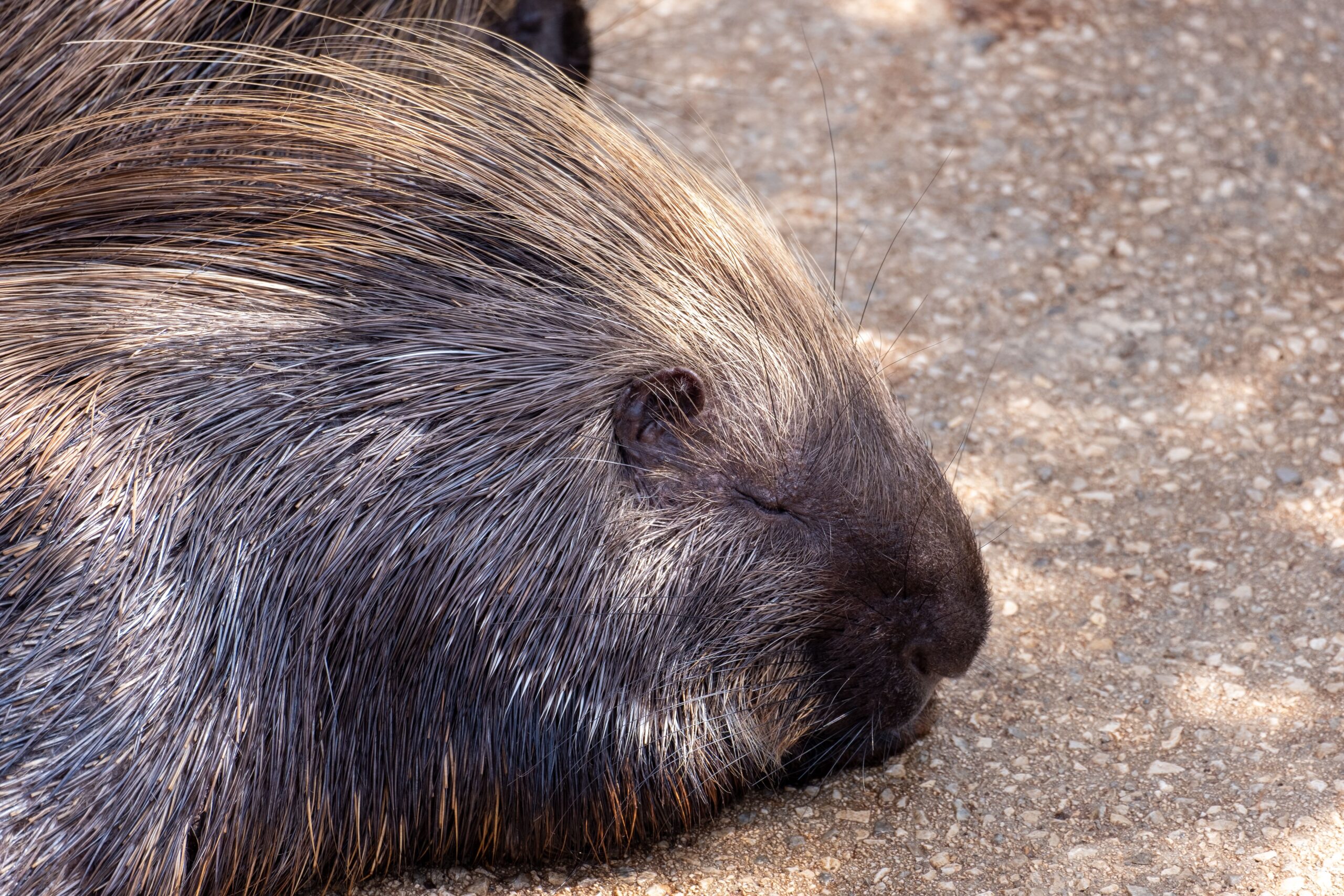
What kind of animal is a porcupine? We will explain its characteristics, ecology, and habitat. Their bodies are covered with long needles with modified hairs, and the length of the needles is very long, making it difficult for carnivores. Although they are an animal with a very stable population, they can remain calm even in the presence of carnivorous animals, which makes them very pretentious.


- What is a porcupine? About basic status
- What are the roots and origins of the porcupine?
- About habitat
- feature is? What kind of creature is it?
- What is your personality like?
- What does the ecology look like?
- About Molting
- Vocalizations
- Seasonal Activities
- Walking Speed
- About Porcupine Baby
- Is the porcupine an endangered species?
- Can you keep a porcupine as a pet?
- Zoos Housing Porcupines (Japan & Worldwide)
- Introducing other animals
What is a porcupine? About basic status
Porcupines are mammals belonging to the Porcupineidae and Porcupineidae families. The scientific name is Hystricidae (Erethizontidae). The kanji are Yamaara and Gobo. The body length is 90cm and the weight is 2kg. The list of information is as follows. Since it becomes a rodent, it is a member of the rat family. The English name is porcupine.
| Japanese(和名) | ヤマアラシ |
| English(英名) | Porcupine |
| scientific name(学名) | Hystricidae(Erethizontidae) |
| classification(分類) | Mammalia、Rodentia、 Hystricidae(Erethizontidae) 哺乳綱、齧歯目、ヤマアラシ科、アメリカヤマアラシ科 |
| IUCN Status(保全状況) | LEAST CONCERN |
| Length(体長) | 90cm |
| Weight(体重) | 2kg |
What are the roots and origins of the porcupine?
Porcupines are a type of large rodent that first appeared between 30 and 40 million years ago—spanning the late Eocene to the Oligocene epochs of the Cenozoic Era. While they are rodents, they are only distantly related to common mice (such as the house mouse); instead, they belong to a distinct evolutionary lineage known as the suborder Hystricomorpha.
① Ancestral origins likely in Asia
It is widely believed that the early ancestors of the Hystricomorpha suborder—which includes porcupines—originated in Asia. Early fossil evidence and molecular analysis indicate that the lineage leading to porcupines evolved from primitive Asian rodents.
Subsequently, they spread:
Asia → Africa & Europe → Various regions worldwide
② Timeline of porcupine evolution
The general timeline is as follows:
Approx. 40 million years ago
Ancestors of the Hystricomorpha suborder appear
Approx. 39 million years ago
Divergence between the Old World porcupine lineage (Hystricidae) and the lineage leading to South American species
From approx. 30 million years ago onwards
Evolution into modern-type porcupines
Why did they develop “quills”?
The porcupine’s most distinctive feature—its spines or quills—originated as modified hairs.
Evolutionary progression:
Ordinary hair
↓
Increase in thick, stiff hairs
↓
Development into hollow, sturdy, needle-like structures
↓
Functioning as defensive weapons against predators
These structures evolved to protect the animal from predators such as lions, leopards, and wolves.
However, the idea that porcupines “shoot” their quills is a misconception.
In reality, their defense strategy involves:
Making their bodies appear larger
Erecting their quills
Charging backwards
Having the quills embed themselves in any attacker that makes contact
About classification
Porcupines are mammals belonging to the Porcupineidae and Porcupineidae families. Only the western Indian porcupine is extinct, but the following subspecies exist for each species. This is a quote from Wikipedia.
ヤマアラシ科 Hystricidae
- アフリカフサオヤマアラシ Atherurus africanus
- アジアフサオヤマアラシ Atherurus macrourus
- アフリカタテガミヤマアラシ Hystrix cristata
- ケープタテガミヤマアラシ Hystrix africaeaustralis
- ヒマラヤヤマアラシ Hystrix hodgsoni
- インドタテガミヤマアラシ Hystrix indica
- マレーヤマアラシ Hystrix brachyura
- ボルネオヤマアラシ Thecurus crassispinis
- パラワンヤマアラシ Thecurus pumilis
- スマトラヤマアラシ Thecurus sumatrae
- ネズミヤマアラシ Trichys fasciculata
アメリカヤマアラシ科 Erethizontidae
- オマキヤマアラシ Coendou prehensilis
- フタイロオマキヤマアラシ Coendou bicolor
- クープマンヤマアラシ Coendou koopmani
- ロスチャイルドヤマアラシ Coendou rothschildi
- メキシコキノボリヤマアラシ Sphiggurus mexicanus
- ミナミキノボリヤマアラシ Sphiggurus spinosus
- オグロキノボリヤマアラシ Sphiggurus insidiosus
- ニシインドキノボリヤマアラシ Sphiggurus pallidus
- コロンビアキノボリヤマアラシ Sphiggurus vestitus
- チャイロキノボリヤマアラシ Sphiggurus villosus
- カナダヤマアラシ Erethizon dorsatum
- アマゾンヤマアラシ Echinoprocta rufescens
About habitat
Porcupines naturally live in Europe and other Eurasian continents, as well as North and South America, and can be seen in a wide range of areas.
- Geographic Distribution
There are several species of porcupines, but they can be broadly divided into New World (Americas) porcupines and Old World (African and Asian) porcupines.
Type Main Distribution Area
Old World Porcupines (Hystricidae) Africa, Southern Europe, Middle East, Southern and Southeast Asia
New World Porcupines (Erethizontidae) North and South America (Americas)
- Habitat Characteristics
Woodlands
Commonly found in temperate, tropical, and subtropical forests
Arboreal porcupines live in trees
Grasslands and savannas
Terrestrial porcupines are also adapted to open grasslands and savannas
Rocky areas and caves
Nocturnal and prefer safe hiding places
They often dig nests or holes and hide during the day
- Habitat Conditions
Availability of hiding places (caves, tree holes, rocky areas, etc.)
Abundant food sources (leaves, fruit, bark, grass, etc.)
Proximity to a water source is desirable, but they can obtain food from plants even without water
feature is? What kind of creature is it?
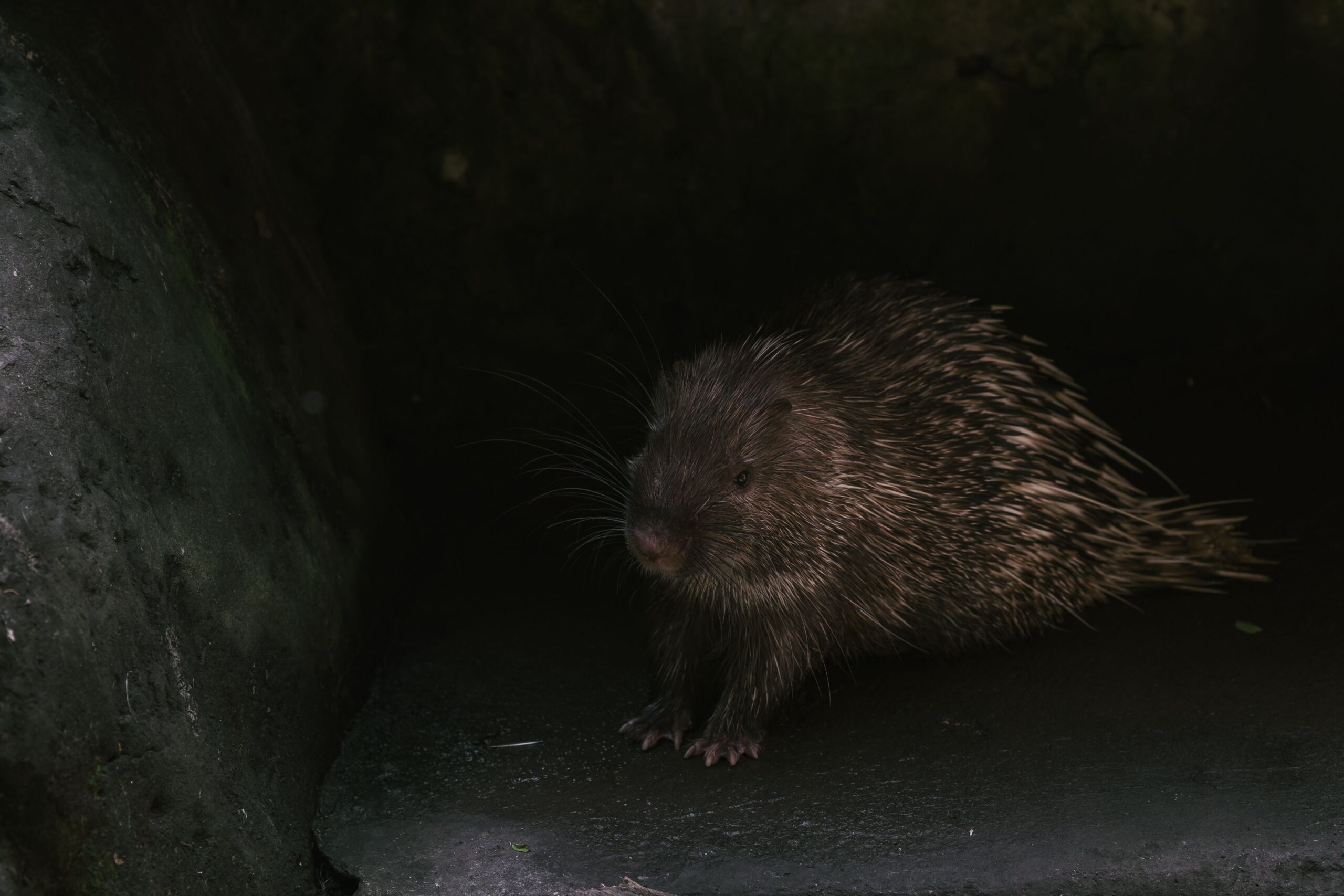
Porcupines are a general term for herbivorous rodents and are destined to be targeted by their natural enemies, but they have long, sharp needle-like hairs on their backs that they use to attack their predators. The length of the needle is 50 cm, making the body look larger and making it a powerful weapon. They tend to live by digging holes. Porcupines do not form groups, are nocturnal and live alone.
- Physical Characteristics
Physique
Body Length: Approximately 50-120 cm (depending on species)
Weight: Approximately 5-30 kg
Stout, rounded body
Hair/Spikes
Needle-like spines grow on their backs and tails.
For defensive purposes, they raise their fur when a predator approaches.
The length of the spines varies depending on the species (approximately 5-30 cm).
Face/Head
Small, round ears
Rounded snout and sharp incisors, suitable for gnawing on wood and grass.
Tail
Some species have spines that extend all the way to the tail.
They shake their spines to intimidate predators.
- Behavior and Personality
Nocturnal (mainly active at night)
Rests in burrows, caves, tree holes, and rock shelters during the day
Personality
Generally docile and calm
Uses threatening behavior and spines when sensing danger
Curious, but cautious of predators
Social
Depending on the species, they live solitary or in small groups
Terrestrial species tend to live alone, while arboreal species live in small groups
- Ecological Characteristics
Diet: Herbivorous, eating bark, leaves, fruit, and roots
Defense:
Defends against predators with spines
Deters predators by bristling spines and wagging tails
Adaptation:
Changes habitat depending on the environment, such as forests, grasslands, rocky areas, and treetops
Developed vision and sense of smell to adapt to nocturnal activity
What is your personality like?
Porcupines are usually very gentle, but before an enemy approaches or attacks them, they will make a threat and erect all the spines on their backs. It charges backwards and rams its body, resulting in fatal injuries to the opponent.
Porcupine Personality Traits
Gentle and calm
Generally non-aggressive and avoids conflict
Living at ease when there is no danger
Highly cautious
Sensitive to predators (lions, jackals, owls, snakes, etc.)
When sensing danger, they will rile up their spines and wag their tails to intimidate.
Solo individuals are particularly cautious.
Nocturnal and cautious
Forage and move at night
Rest in burrows, tree holes, or rocks during the day
Make sure to check their surroundings before moving or foraging.
Prefers solitary lifestyles, but some species also live in small groups.
Terrestrial: Often acts alone
Arboreal: Cooperative in small family groups
Curious but cautious
Shows interest in new environments and objects
However, tends to keep its distance rather than approaching immediately
What does the ecology look like?
Porcupines live by eating plants such as leaves, bark, roots, bark, buds, and fruits. It is known that they can live up to 17 years. Only 1-2 babies are born at a time.
- Lifestyle
Nocturnal (active primarily at night)
Rest during the day in caves, tree holes, or rock shelters
Feed and move at night
Live alone or in small groups
Terrestrial species tend to be solitary
Arboreal species cooperate in small groups
Use of nests and hiding places
Essential for daytime rest and protection from predators
- Diet
Primarily herbivorous: bark, leaves, fruit, and roots
Gnawing trees and grass with their spines and sharp front teeth
Mostly obtain moisture from plants
May travel extensively at night to find food
- Breeding and Rearing
Breeding Season
Many species breed once or twice a year
Gestation Period
Approximately 7 months
Birth
1-3 offspring
Mothers protect and raise their young in nests or caves
Growth of young
Begins foraging within a few weeks of birth
Learns nocturnal activity and hiding techniques within a few months
- Predators and Defense
Major Natural Enemies: Lions, jackals, snakes, and birds of prey
Defense methods:
Braise spines and wag tails
Hide in caves or rock shelters
Nocturnal, shifting activity times to avoid predators
- Adaptations
Adapted to a variety of environments, including forests, rocky areas, grasslands, and arboreal habitats
Developed senses of sight and smell to adapt to nocturnal activity
Can survive in dry areas with limited water
Are there any natural enemies?
Since porcupines are rodents, all carnivores are their natural enemies, but as explained above, they can use their spines to lunge at carnivores and inflict fatal injuries. The needles are so hard that they are said to be strong enough to penetrate rubber boots, and can cause fatal injuries to even humans.
About Molting
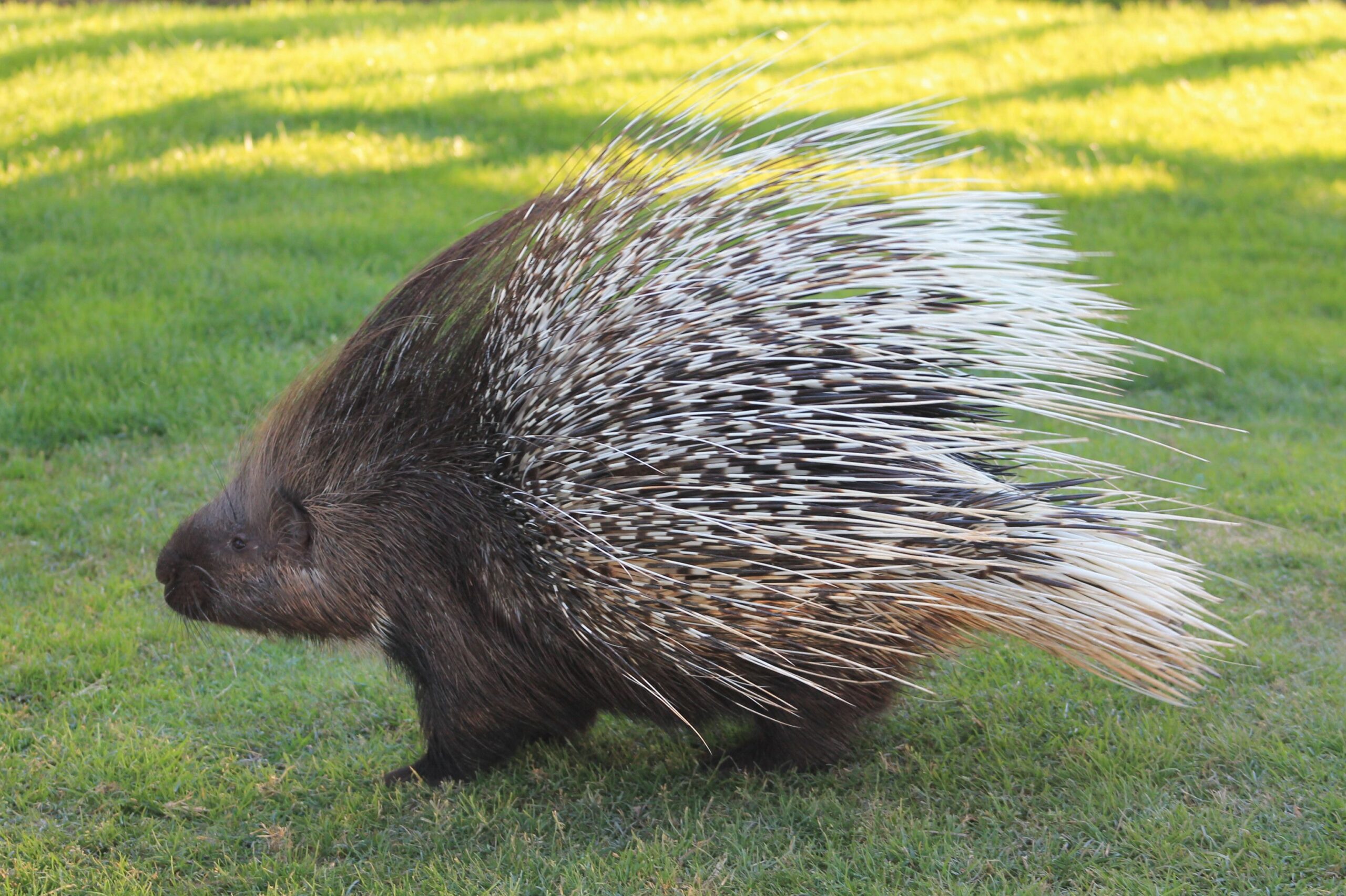
Porcupines do not merely shed and regrow their body fur like ordinary animals; they also gradually replace their distinctive quills.
Quills are evolved “hair”
A porcupine’s quills are actually specialized hairs.
Their structure is as follows:
Skin
↓
Hair root
↓
Hardened keratin
↓
Hollow quill
Like human hair and nails, their main component is keratin.
How are quills replaced?
Porcupine quills go through a repeating cycle of:
Aging
Shedding
Growing a new quill
However, the quills across the entire body do not shed all at once.
This is to ensure they do not lose their defensive capabilities.
If they were all to shed at once, the animal would:
Be vulnerable to predator attacks
Experience a drastic drop in defensive ability
…which would be an evolutionary disadvantage.
Therefore, they undergo a “continuous molting” process where quills are replaced in small numbers at a time.
The mechanism of quill shedding
Porcupine quills do not shed only when the animal is attacked.
They also shed naturally during normal conditions when:
An old quill reaches the end of its lifespan
The connection at the root weakens
A new, growing quill pushes the old one out
The base of a shed quill features small, backward-facing barbs; these make it difficult to remove once the quill has pierced an enemy’s skin.
Vocalizations
While porcupines are often perceived as “quiet animals,” they actually use a variety of sounds to communicate with others and signal alertness.
When Alert: Low-pitched sounds like “grrr” or “oink-oink”
When approached by predators or humans, they emit:
Low growls
Snorting sounds
Short grunts
These serve as a warning:
“Don’t come any closer.”
At the same time, they engage in threatening behaviors such as:
Inflating their bodies to look larger
Raising their quills
Vibrating the quills on their tails
Distinctive Feature: The “rattling” sound
Some porcupine species have a specialized structure at the tip of their tails.
Especially in Old World porcupines (native to Africa and Asia):
There are hollow, modified quills on the tail that produce a rattling sound when shaken.
This serves as a warning signal to predators.
It functions similarly to:
A rattlesnake’s rattle
↓
A warning that says “Danger!”
Baby porcupine vocalizations
Young porcupines vocalize relatively frequently.
Typical sounds include:
High-pitched squeaks (“pee-pee”)
Squeals (“kyu-kyu”)
Small, soft cries
Purposes:
Calling the mother
Signaling their location
Expressing anxiety
Since newborns have limited vision and motor skills, vocal communication is crucial for the mother and offspring to recognize each other.
Vocalizations during the breeding season
During the breeding season, they use:
Snorting
Soft growls
Contact sounds
Since many porcupine species are solitary, vocal communication is vital when searching for a mate.
Seasonal Activities
While porcupines vary by species and habitat (e.g., Africa, Asia, North America), they are animals that fundamentally adjust their diet, activity patterns, breeding, and physical condition in response to seasonal changes.
🌸 Spring (approx. March–May): Resuming Activity and Breeding
Activity
Activity levels rise as the winter cold subsides.
Key behaviors:
Increased nighttime foraging
Searching for new shoots and young leaves
Spending more time outside the burrow
Diet
As vegetation becomes abundant in spring, they eat:
New shoots
Grass
Roots
Flowers
Tree bark
Breeding
For many species, breeding activity peaks between spring and early summer.
Males engage in behaviors such as:
Locating females via scent
Vocalizing
Approaching and courting females
☀️ Summer (approx. June–August): Peak Activity
Activity Times
In hot regions, they avoid the heat of the day and are active:
From evening through the night until dawn
Old World porcupines (found in Africa and Asia) specifically rest in their burrows during the day.
Diet
Food is plentiful in summer.
They eat:
Grass
Fruit
Leaves
Roots
Bulbs
Tree bark
Some species may also feed on agricultural crops.
🍂 Autumn (approx. September–November): Preparing for Winter
Autumn is the season for preparing to survive the winter.
Behavior
Increased food intake
Storing nutrients
Increased use of burrows
Diet
To compensate for the scarcity of plants in winter, they consume large amounts of:
Nuts/seeds
Rhizomes
Tree bark
Roots
North American porcupines, in particular, increase their consumption of tree bark during the winter months.
❄️ Winter (approx. December–February): Energy Conservation
Porcupines do not undergo true hibernation like bears.
However,
They live in a state close to “semi-dormancy,”
significantly reducing their activity levels. Characteristics of Winter
More time is spent in the burrow.
Travel distances are shorter.
Frequency of feeding decreases.
Especially in areas with heavy snow,
they forage for food sources available even in winter,
such as tree bark,
twigs,
and conifer needles.
Walking Speed
Porcupines are not animals that flee by running fast. Their greatest asset is not leg power, but their defensive ability—specifically, their quills. Consequently, their movement style is essentially one of walking slowly and proceeding cautiously.
Normal Walking Speed
A typical porcupine’s walking speed is estimated to be:
Around 1–3 km/h
This is slower than a human’s normal walking pace (about 4–5 km/h) and reflects a pace suited for navigating forests and rocky terrain while exploring the surroundings.
Characteristics of their gait:
Walking using the entire sole of the foot
Swaying the body from side to side
Moving while checking scents with their nose
Conserving energy by not rushing
Speed When Hurrying
Even when sensing danger, porcupines do not flee at high speeds like a cheetah.
Over short distances,
They may increase their speed to around 5–8 km/h
However, the objective is not to
“Outrun the threat”
but rather to
“Move to a safe location”
For example, they might:
Move to the base of a tree
Return to their burrow
Hide behind a rock
Why Don’t They Run Fast?
There is an evolutionary reason for this.
Many animals:
Spot predator
↓
Flee
↓
Race for speed
Porcupines:
Spot predator
↓
Make their body look larger
↓
Raise their quills
↓
Keep the opponent at a distance
This is their strategy.
Because they possess a powerful defense in the form of quills, there was no need to expend significant energy on the ability to run fast.
Tree-Climbing Ability (New World Porcupines)
For New World porcupines, such as the North American porcupine, climbing ability is more important than walking ability.
Characteristics:
Sharp claws
Strong limbs
Ability to cling to trees
They possess these traits.
While in the trees, they can:
Eat leaves
Rest
Avoid predators
Movement in Water
Surprisingly, porcupines can swim. New World porcupines, in particular,
are able to swim
by using their hollow body quills for buoyancy
and paddling with their front and hind legs.
However, swimming serves more as a means of travel than as a way to escape.
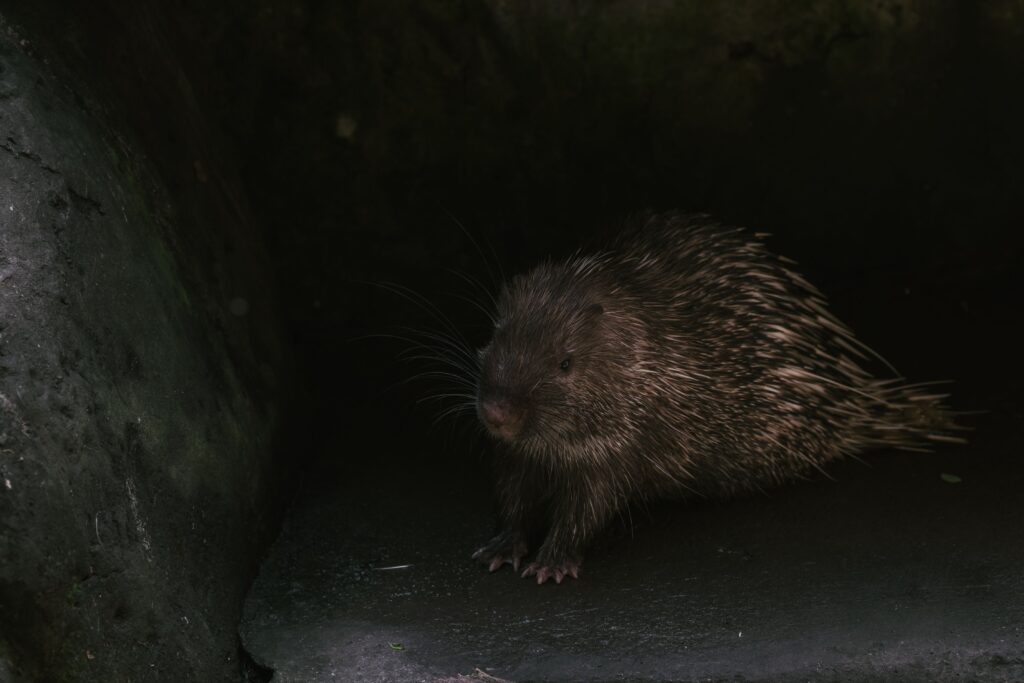
About Porcupine Baby
This section summarizes the characteristics and developmental process of porcupine baby cubs.
- Birth
Gestation Period: Approximately 7 months
Litter Size: Usually 1-3 pups
Newborn Characteristics:
Weight: Approximately 150-300 g (depending on species and individual)
Body Length: Approximately 15-25 cm
The spines on their backs are soft and not yet hard enough to pierce
They are often born with their eyes open, allowing them to quickly recognize their mother and their surroundings
- Relationship with Their Mother
They accompany their mother from birth
They nurse in caves or rock shelters under the protection of their mother
They depend on their mother’s warmth and the safety of their nest for growth
- Growth and Behavior
A few days to a few weeks after birth:
Rests with mother in a nest or hiding place
Soft spines gradually harden and begin to function as a defense mechanism
Around one month old:
Slowly practices nibbling on solid foods (bark and leaves)
Learns nighttime activities and hiding techniques from mother
Around two to three months old:
Able to forage independently and learn about their mother’s behavior and group life
A few months to one year old:
Spines completely harden, providing sufficient defense
Gradually becomes able to move independently at night
- Characteristics
Personality: Curious but cautious
Defense: Soft spines gradually harden
Sociality: Grows dependent on mother and group, centered around the nest
Is the porcupine an endangered species?
Although there are some species that have become extinct, the overall population is stable and there are no problems.
- Global Conservation Status (IUCN Red List)
Species Classification (Threat Level) Comments
Old World Porcupines (Hystricidae) LC (Least Concern) Widely distributed in Africa and Asia, with stable populations.
New World Porcupines (Erethizontidae) LC (Least Concern) Widely distributed in North and South America, with stable populations in forests and grasslands.
Some rare species (e.g., species found in certain mountainous regions) NT (Near Threatened) May be declining due to habitat loss or localized hunting.
Key Points: The common porcupine is not endangered and its population is stable.
However, caution is required for localized species with limited habitats and rare species.
- Causes of Extinction Risk
Habitat Destruction: Deforestation, Agricultural Development, Urbanization
Hunting Pressure: For Food and Pest Control
Local Population Declines: Particularly for Species Living in Mountainous Regions or Limited Forests
- Status in Japan
No Natural Distribution
Very Few Captive Species
Captivity for Research and Educational Purposes Is Regulated by the Convention on International Trade in Endangered Species of Wild Fauna and Flora (CITES)
Can you keep a porcupine as a pet?
Porcupines have sharp spines, so they are not suitable for breeding at all. Even humans can be seriously injured. There is information on events such as zoos, so we recommend that you check them out. Once you enter the park, it will be on display inside the park, so be sure to wait until it opens.
- Legal and Conservation Restrictions
Some species are subject to import and export restrictions under the Convention on International Trade in Endangered Species of Wild Fauna and Flora (CITES).
Even in Japan, captivity in the wild is prohibited under the Wildlife Protection Act.
Captivity is limited to zoos, research facilities, and conservation facilities.
- Ecological Reasons
Large, powerful rodents.
Body length: 50-120 cm, weight: 5-30 kg.
Spined, they can puncture and injure when provoked.
Nocturnal and require hiding places.
Living in caves, tree holes, and rock shelters, these environments cannot be replicated at home.
Living alone or in small groups.
Although social, they experience stress without a group or hiding place.
Unique diet.
Eats large amounts of leaves, bark, fruit, etc.
Nutrition and hydration are difficult to manage at home.
- Health and Safety
Due to their large size and spines, it is dangerous to handle them at home.
They have strong wild instincts and may escape or become violent.
Improper care increases the risk of stress and illness.
Zoos Housing Porcupines (Japan & Worldwide)
The porcupines most commonly kept in zoos are African Crested Porcupines (Hystrix cristata). Possessing large, sturdy bodies and being relatively easy to observe in captivity, they are exhibited in zoos around the world.
🇯🇵 Major Zoos in Japan
Sapporo City Maruyama Zoo
Species: Crested Porcupine
One of the prominent zoos in Hokkaido where you can see them.
They often rest during the day, but can sometimes be seen active from the evening onwards.
Characteristics:
Large porcupine
Long quills on the back
Threat display involving shaking the tail to make noise
Chiba Zoological Park
Species: African Crested Porcupine
Exhibits this large porcupine species native to Africa.
A large rodent weighing between 15 and 27 kg; they feed on plant roots, fruits, and more.
Highlights:
Movements typical of nocturnal animals
Defensive posture with raised quills
Dexterous use of forepaws while eating
Yokohama Zoological Gardens “Zoorasia”
Species: African Crested Porcupine
At Zoorasia, they are exhibited in the African animal zone.
In the wild, they are nocturnal and may travel long distances to forage.
Kyoto City Zoo
Species: Crested Porcupine
Houses the species distributed across central-northern Africa and Italy.
They have a habit of resting in burrows during the day and becoming active at night.
🌍 Zoos Worldwide
🇺🇸 USA
Wildlife World Zoo, Aquarium & Safari Park
A large zoo that keeps porcupines.
🇹🇭 Thailand
Chiang Mai Night Safari
A facility for observing nocturnal animals; features a porcupine exhibit.
🇳🇱 Netherlands
Ouwehands Dierenpark
Has a history of keeping porcupines in Europe.
🇰🇷 South Korea
Seoul Grand Park Zoo
One of the facilities in Asia where porcupines can be seen.
Introducing other animals
コメント