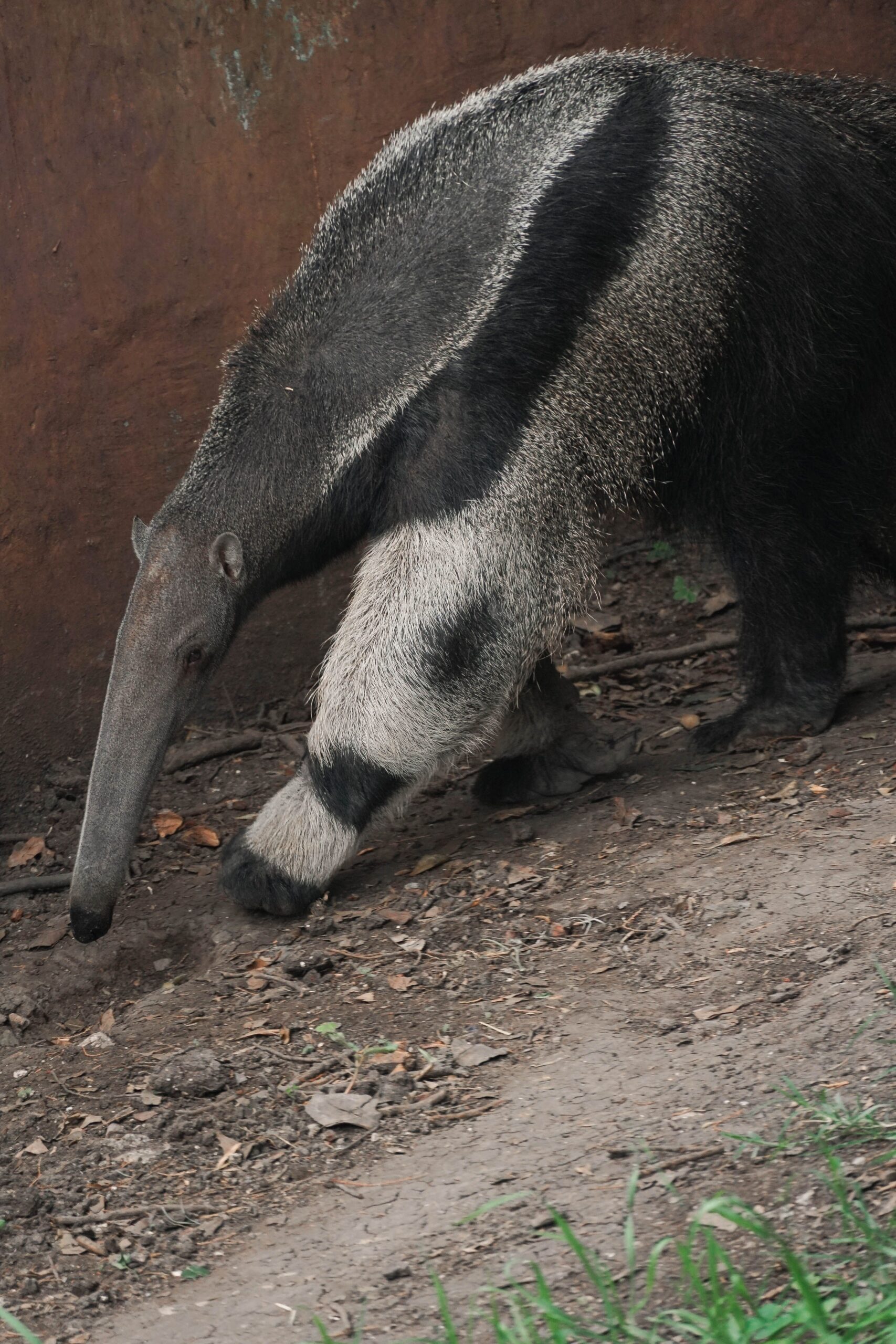
What kind of animal is an anteater? We will explain its characteristics, ecology, and habitat. A general term for animals belonging to the mammalian class Oligodontidae and the family Antidae. The species includes 3 genera and 4 species, including 1 species of Giant Anteater, 2 species of Coreanthus, and 1 species of Common Anteater, and they often live in the grasslands and forest areas of Central and South America.


- What is an anteater? About basic status
- What are the roots and origins of the anteater?
- About habitat
- feature is? What kind of creature is it?
- What is your personality like?
- What does the ecology look like?
- About Molting
- About Vocalizations
- Seasonal Activities
- About Walking Speed
- About Baby Anteaters
- Are anteaters an endangered species?
- Can anteaters be kept as pets?
- Zoos Housing Giant Anteaters (Japan & Worldwide)
- Introducing other animals
What is an anteater? About basic status
Anteater is a general term for species that make up the suborder Vermilingua, which is classified into the class Mammalia. The scientific name is Vermilingua, and the kanji is ant-eating, ant-eating, eating ant beast. English name is anteater. The body length is 100-120cm and the weight is 18-39kg. The list of information is as follows. It has the longest tongue of any animal.
| Japanese(和名) | アリクイ |
| English(英名) | anteater |
| scientific name(学名) | Vermilingua |
| classification(分類) | Mammalia、Pilosa、 Vermilingua 哺乳綱、有毛目、アリクイ亜目 |
| IUCN Status(保全状況) | LEAST CONCERN |
| Length(体長) | 100~120cm |
| Weight(体重) | 18~39kg |
What are the roots and origins of the anteater?
Anteaters belong to a very ancient lineage of animals that originated from prehistoric mammals in South America. Their evolutionary path diverged significantly from common mammals like elephants or lions; instead, they belong to the group known as Xenarthra (meaning “strange joints”), making them close relatives of sloths.
Taxonomic roots of the anteater
Anteaters are classified as follows:
Class: Mammalia
Superorder: Xenarthra
Order: Pilosa
Suborder: Vermilingua
Close relatives include:
🦥 Sloths
🦔 Armored mammals such as the (extinct) Glyptodonts
In short, the evolutionary progression looks like this:
Ancient Xenarthran ancestor
↓
Divergence into sloth and anteater lineages
↓
Evolution into modern giant anteaters and lesser anteaters
Where did they originate?
Anteater ancestors originated on the continent of South America.
Around:
50 million years ago (Eocene epoch)
…primitive Xenarthrans already existed in South America.
At that time, South America was:
A massive island continent isolated from other landmasses
A place where unique evolutionary paths were taken
Consequently:
Anteaters
Sloths
Armadillos
…and other unique mammals developed there.
Why did they evolve to eat ants?
The defining characteristics of anteaters are:
A lack of teeth
A long, slender snout
An extremely long tongue
Powerful claws on their forelimbs
These traits are the result of evolutionary specialization.
The transformation occurred as follows:
Ancestral animal
↓
Tendency to feed on insects
↓
Specialization in feeding on ants and termites
↓
Modern anteater
About classification
The classification consists of the family Cyclopedidae and the family Myrmecophagidae.
Anteater Taxonomy
- 界(Kingdom): 動物界 (Animalia)
- 門(Phylum): 脊索動物門 (Chordata)
- 綱(Class): 哺乳綱 (Mammalia)
- 目(Order): 食虫目 (Pilosa)
- 科(Family):
- ミツユビアリクイ科(Myrmecophagidae)
- ミツユビアリクイ (Myrmecophaga tridactyla)
- ナマケモドキ (Tamandua tetradactyla / Tamandua mexicana)
- オオアリクイ科(Cyclopedidae)
- オオアリクイ (Cyclopes didactylus)
- ミツユビアリクイ科(Myrmecophagidae)
- 属(Genus)と種(Species): 属種コメントMyrmecophagaM. tridactylaオオアリクイ、最大のアリクイTamanduaT. tetradactyla, T. mexicanaナマケモドキ、樹上生活に適応CyclopesC. didactylusシナアリクイ、最小で樹上生活
About habitat
Anteaters primarily live in South America.
- Geographic Distribution
Anteaters are found throughout Central and South America.
Each species’ habitat varies slightly.
Species Main Distribution
Giant Anteater (Myrmecophaga tridactyla) Tropical rainforests, grasslands, savannas, and wetlands of South America (Brazil, Venezuela, northern Argentina, etc.)
Two-toed Sloth (Tamandua tetradactyla / T. mexicana) Forests, grasslands, and lowland and mountain woodlands of Central and South America
Chinese Anteater (Cyclopes didactylus) Treetops in tropical rainforests (mainly the Amazon River basin in Central and South America)
- Habitat Characteristics
Giant Anteater
Mainly terrestrial, but also a good swimmer
Feeds on ants and termites in savannas and grasslands
Two-toed Sloth
Live both on the ground and in trees
Feeds on fruit, ants, and termites in trees
Chinese Anteater
Completely arboreal
Feeds on leaves, bark, ants, and termites
- Habitat
Temperate climate: Warm and humid regions such as tropical rainforests and savannas
Abundant ants and termites
Hidden places: Rest during the day in trees, caves, and bushes
feature is? What kind of creature is it?
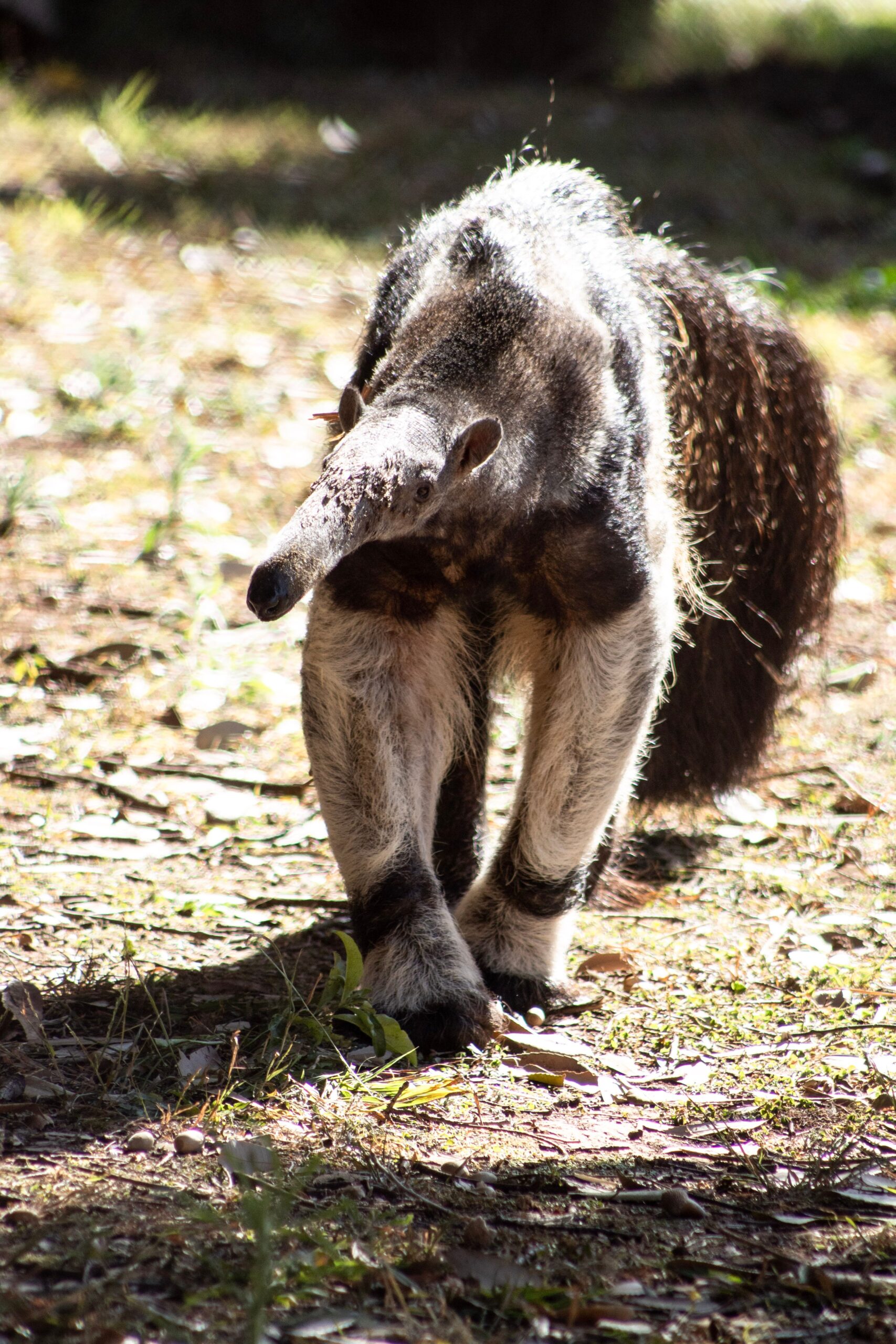
Anteaters are called anteaters because they eat ants and termites. They have a long, slender tongue and use sticky saliva to catch prey. All ears are small and round. The tail is covered with long hair. They have no teeth at all, their skulls are elongated, and their snouts are small and cylindrical. Anteaters are terrestrial, active during the day and at night, and live alone or with their parents.
- Physical Characteristics
Physical Size
Size varies greatly depending on the species.
Giant Anteater: Body length approximately 1.5-2 m, 2.4 m including tail, weight approximately 20-40 kg
Sloth: Body length approximately 50-70 cm, weight approximately 4-7 kg
Chinese Anteater: Body length approximately 30 cm, weight approximately 0.4-0.6 kg
Slender, muscular body, not stocky
Head/Face
Long, slender snout, small ears
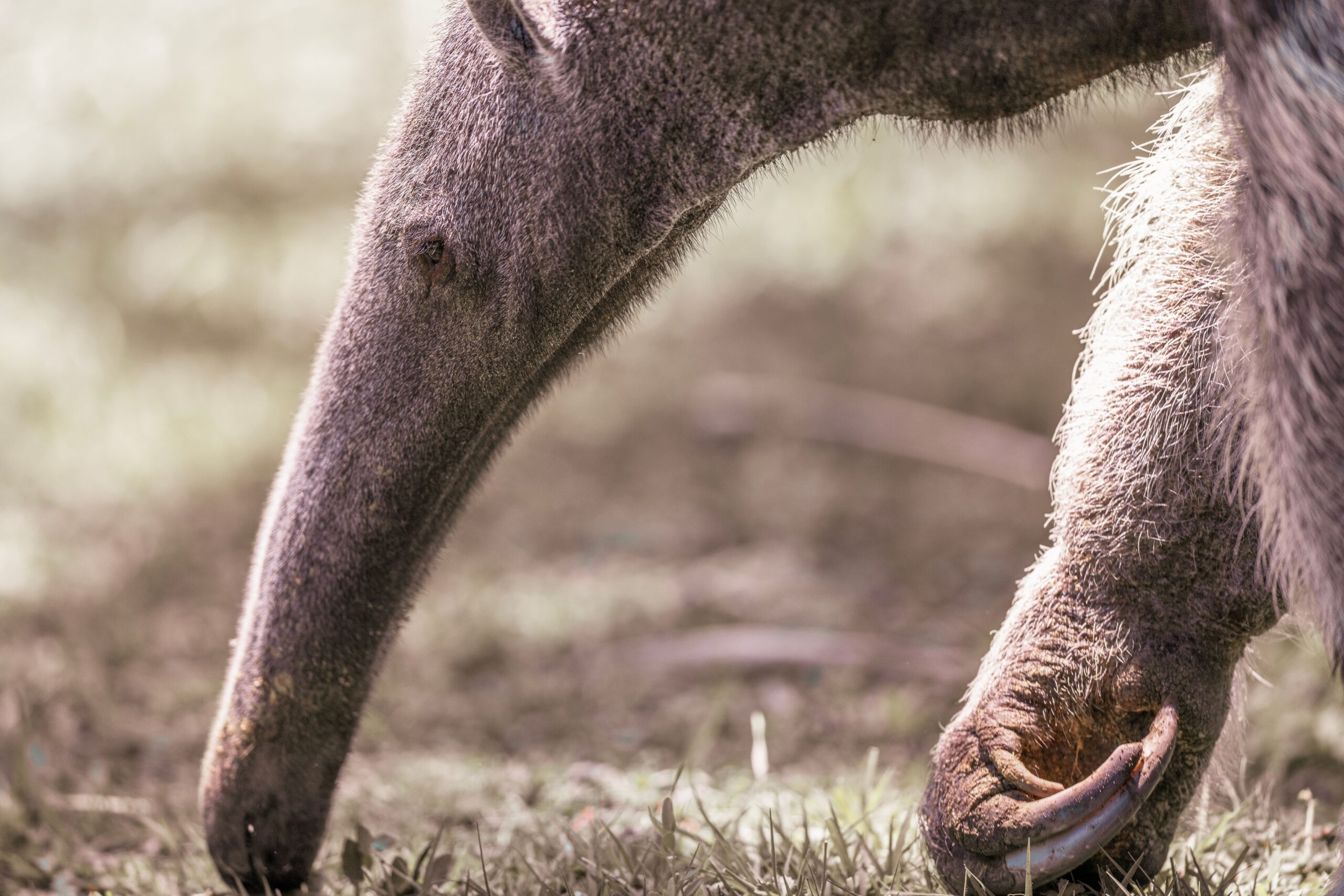
Very long tongue (up to 60 cm in the case of the giant anteater) for licking up ants and termites
Hands/Feet
Sharp claws on front feet, adapted for destroying termite and termite mounds
Terrestrial species have powerful claws, while arboreal species have a shape suited to climbing
Tail
Various tails, from short to long, used for weight support, depending on the species
Sloths use their tails for balance in trees
- Fur/Skin
Thick, coarse fur protects the body.
Chinese anteaters have thin, soft fur adapted to arboreal life.
Their coloring is generally brown to grayish-brown, with some species having spots or stripes on their backs.
- Behavior/Personality
Diet: They primarily feed on ants and termites (insectivorous).
Personality:
Generally docile and gentle.
When sensing danger, they defend themselves with their sharp claws.
Sociality:
Generally solitary.
Some species live in small family groups.
- Special Abilities
Efficiently prey on ants and termites with their long tongues and saliva.
Powerful claws on their front feet destroy nests and soil.
Nocturnal and arboreal lifestyles allow them to adapt to their environment.
What is your personality like?
Anteaters are generally very quiet and have a gentle side. They rarely take the initiative to attack other animals.
Anteater Personality Characteristics
Gentle and calm
Generally avoids conflict
Not aggressive, and will flee or take defensive action if confronted with a predator
Highly cautious
Sensitive to predators (jaguars, pumas, wolves, snakes, etc.)
When sensing danger, they will defend themselves with their claws and front legs
Solitary, and have a strong tendency to protect themselves
Prefers solitary behavior
Generally lives alone
They may form small family groups, but this is rare
They rarely come into contact with other individuals over habitats or food
Cautious and wary
They observe their surroundings while searching for food
Tree-dwelling sloths and Chinese anteaters live safely in high places
Nocturnal and calm
Giant anteaters and sloths are active at night or during dim light
They often rest in hiding places during the day
What does the ecology look like?
Anteaters eat about 30,000 ants and termites a day. The mode of reproduction is viviparous. The estrus period is 50 – 60 days. The gestation period is about six months. The lifespan is about 15 years.
- Lifestyle
Solitary Living
Giant anteaters, sloths, and Chinese anteaters tend to be solitary.
They may form small groups consisting of family units or mothers and their young.
Activity Period
Primarily nocturnal or dim-light activity
Rest during the day in burrows, tree holes, or rock shelters.
Habitat
Giant anteaters: Use burrows and grass patches on the ground.
Sloths: Both arboreal and terrestrial.
Chinese anteaters: Completely arboreal.
- Diet
Specialized Insectivores
Mainly lick and consume ants and termites.
Efficiently feed using their long tongues and mucus.
Some species also consume fruit and plants.
Food Acquisition
Giant anteaters travel widely to search for burrows and termite mounds.
Arboreal species feed in crevices in tree bark and tree cavities.
- Breeding and Rearing
Breeding Season
Breeding is possible year-round, depending on the species.
Gestation Period
Approximately 6-8 months (depending on the species)
Giving Birth
Usually one cub, but rarely two
The mother carries the cub on her back while traveling
Growth of the Cubs
Learns to forage using their tongues within a few weeks of birth
Learns nocturnal behavior and hiding techniques from their mother within a few months
Are there any natural enemies?
Natural enemies include jaguars, mountain lions, and American alligators. If they are mainly large animals and carnivores, they pose a big threat and are preyed upon.
About Molting
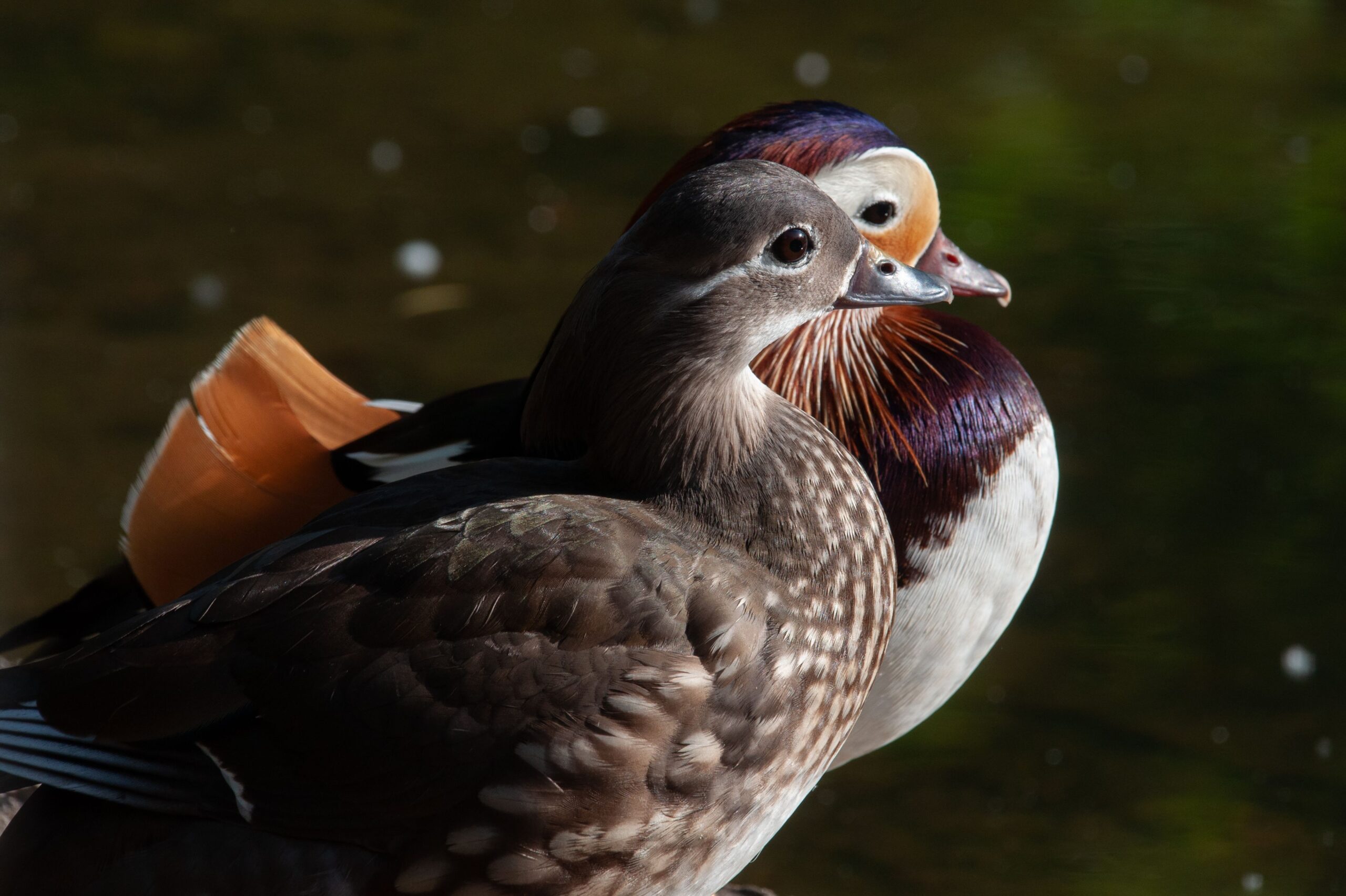
Anteater molting is not a dramatic “feather replacement” like that seen in birds; rather, it is the gradual replacement of fur typical of mammals. While they do not undergo drastic changes in appearance based on the season—unlike the Mandarin duck—their fur is constantly being renewed.
Characteristics of Anteater Molting
Anteaters generally undergo a continuous molting process:
Old fur sheds
↓
New fur grows in
Characteristics:
They rarely shed their entire coat at once.
The process occurs gradually throughout the year.
Shedding may increase due to seasonal changes.
Seasonal Molting
🌸 Spring (March–May)
Transition from winter coat to summer coat
As the weather warms up:
Dense winter fur sheds.
The coat changes to a more breathable type.
This is the time for such changes.
Shedding in spring can be particularly noticeable in individuals living in cold regions or those kept outdoors at zoos.
☀️ Summer (June–August)
Adaptation to heat
The summer coat:
Has slightly less volume.
Facilitates heat dissipation.
Makes it easier to regulate skin temperature.
However, since giant anteaters are adapted to tropical and subtropical climates, the difference between their summer and winter coats is not as distinct as it is in dogs or deer.
🍂 Autumn (September–November)
Preparation for winter
As temperatures drop:
The fur becomes thicker.
Heat retention improves.
The coat changes to suit these conditions.
This trend is more pronounced in individuals living in cold climates or high-altitude areas.
❄️ Winter (December–February)
Focus on heat retention
During winter:
Undercoat density increases.
The ability to maintain body temperature improves.
Giant anteaters, in particular, have a relatively low capacity for thermoregulation compared to other mammals, making fur-based heat retention crucial.
About Vocalizations
Contrary to their appearance, anteaters are generally very quiet animals. Adult giant anteaters, in particular, rarely vocalize, relying instead on their senses of smell and touch, as well as their behavior, to communicate.
Giant Anteater Vocalizations
Typical sounds:
“Hn-hn” or “buu-buu” (snorting/grunting sounds)
“Kuu” or “hyuu-hyuu” (whistling or wheezing sounds)
Low growls
Characteristics:
They do not vocalize loudly or continuously.
Sounds are primarily low-pitched and brief.
Vocalizations are intended for close-range communication.
Vocalizations of Young Anteaters
Vocalizations are heard most frequently from the young (offspring).
Young anteaters make high-pitched “pee-pee” or “kyuu-kyuu” sounds to convey messages to their mothers, such as:
“I’m here”
“Don’t leave me”
“Help me”
Mother-Offspring Communication
The bond between a giant anteater mother and her offspring is very strong; for some time after birth, the young live by riding on their mother’s back.
Consequently, they confirm each other’s location using:
Scent
Physical contact
Soft vocalizations
Their lives rely more on the mother’s movements and scent than on vocalizations.
Vocalizations During Threat Displays
When sensing danger, anteaters adopt a defensive posture rather than vocalizing immediately.
Typical behaviors:
Standing on their hind legs
Positioning their massive foreclaws
Intimidating the opponent
In such situations, they may emit:
Low growls
Snorting sounds
Sharp exhalations (a “huffing” sound)
Seasonal Activities
Anteater activities vary by habitat (such as rainforests, savannas, or wetlands). The Giant Anteater, in particular, is adapted to the grasslands and forests of South America—environments that lack the drastic temperature fluctuations characteristic of Japan’s four seasons.
🌸 Spring (March–May)
“A Time of Increased Activity”
*In South America, this period marks the transition from the rainy season to the dry season, depending on the region.
Key Activities
Foraging for ants and termites
Moving within their territory
Breeding
As insect activity peaks from spring to early summer, this is a crucial foraging period for anteaters.
Behaviors:
Walking while sniffing the ground
Searching for ant or termite mounds
Breaking open nests with their claws
Capturing insects with their long tongues
☀️ Summer (June–August)
“Adapting to Heat and Nocturnal Activity”
Some regions of South America experience hot, dry conditions during this time.
Key Characteristics
Daytime:
Resting in the shade
Regulating body temperature within the forest
Nighttime:
Increased activity levels
Extended foraging time
Giant Anteaters, in particular, are not efficient at regulating body temperature, so they tend to:
Avoid the hottest times of day
Move during cooler periods
🍂 Autumn (September–November)
“A Time for Breeding and Rearing Young”
Anteaters do not have a fixed, short breeding season; depending on the region, they may breed throughout the year.
Breeding Behaviors
Males and females approach one another
Exchanging information via scent
Mating
Gestation Period:
Approximately 6 months
After giving birth, the mother:
Carries her offspring on her back
Takes them to foraging grounds
Protects them from predators
❄️ Winter (December–February)
“Energy-Conserving Lifestyle”
Winters in South America are not as harsh as those in Japan.
Behaviors
Adjusting activity times
Moving to search for food
Increasing rest time
In colder areas, they may:
Reduce nighttime activity
Become active during the day
About Walking Speed
Contrary to their slow appearance, anteaters can move quite nimbly when the situation demands it. However, they are not built for high-speed sprinting like cheetahs; instead, they are adapted for an “exploratory” style of movement, walking over vast areas in search of food.
Walking Speed of the Giant Anteater
For the Giant Anteater (Myrmecophaga tridactyla), the representative species, speeds are generally estimated as follows:
Normal walking: Approx. 2–4 km/h
Movement while foraging: Approx. 1–3 km/h
Movement in danger: Up to nearly 20–30 km/h
They typically walk slowly while using their keen sense of smell to locate ant and termite mounds.
Characteristics of Their Gait
Anteaters have a unique way of walking.
Walking with forelimbs “curled inward”
Giant anteaters possess massive claws.
Consequently, unlike typical mammals,
they cannot walk with their claws touching the ground.
Instead, they employ a specialized gait where they:
curl their forelimbs inward,
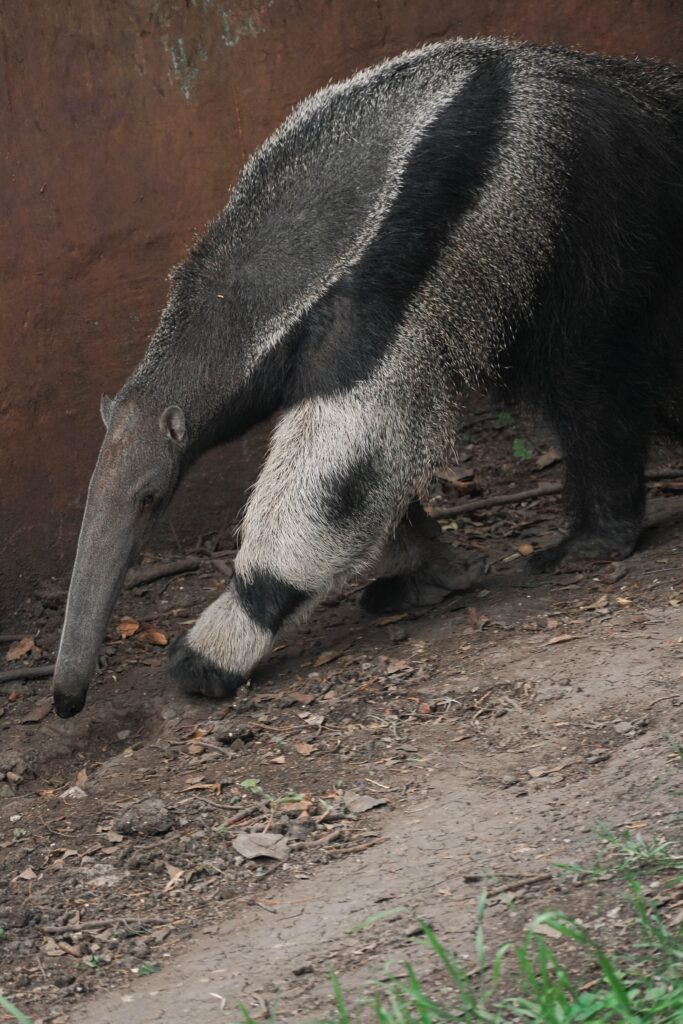
make contact with the ground using their knuckles (the joint side of the fingers),
and walk in a way that avoids damaging their claws.
This mechanism is similar to the “knuckle-walking” seen in some other animals, such as gorillas.
Why Can They Walk Long Distances?
Anteaters are not predators that chase down their prey.
Their food sources—
ants
and termites—
are small, and their nests are scattered across the landscape.
Therefore, the abilities they have evolved are:
❌ Explosive short-distance speed
⭕ The ability to keep walking for long periods
They spend their lives traveling over wide areas each day,
searching for scents,
investigating the ground,
and locating nests.
Running Speed
When sensing danger, anteaters switch from their usual gait to a run.
When running:
they move while protecting their forelimb claws,
propel themselves using the power of their hind legs,
and utilize a long stride involving their entire body. However, due to their body structure, they are better suited for short-distance flight than for endurance running.
About Baby Anteaters
This section summarizes the characteristics and developmental process of baby anteaters.
- Birth
Gestation Period: Approximately 6-8 months depending on the species
Litter Size: Usually one (rarely two)
Newborn Characteristics:
Body Length: Approximately 20-30 cm (depending on species)
Weight: Approximately 400 g-1 kg (depending on species)
Their back fur and spines are soft, making them easy to carry on their mother’s back.
They are often born with their eyes open, allowing them to quickly recognize their mother and their surroundings.
- Relationship with Their Mother
They travel by riding on their mother’s back.
Common in giant anteaters and sloths.
Mothers protect their young in burrows and safe hiding places.
They learn foraging and hiding places from their mother.
- Growth and Behavior
A few weeks after birth:
Rests safely on mother’s back
Begins practicing foraging with tongue
1-2 months after birth:
Introduces simple foods (ants and fruit) on its own
Learns nighttime behavior by accompanying mother
A few months after birth:
Able to forage and move independently
Gradually becomes able to move independently at night
- Characteristics
Personality: Curious and observant
Defense: Closely attached to mother with soft fur, relies on mother for defense
Sociality: Dependent on mother as a young animal, grows in the safety of the pack and mother until independence
Are anteaters an endangered species?
The anteater is not an endangered species, but when looking at subspecies, the giant anteater is designated as an endangered species. The reality is that they are overfished because they are used as food and their leather is in high demand for commercial purposes. Currently, the reality is that their population has decreased by more than 30% in the past 10 years, and they have been listed on Appendix II since the CITES came into force.
- Global Conservation Status (IUCN Red List)
Species Classification (Threat Level) Comments
Giant Anteater (Myrmecophaga tridactyla) VU (Vulnerable) The largest anteater found in South America. Habitat loss, deforestation, and road accidents are threats.
The Mexican sloth (Tamandua tetradactyla / T. mexicana) LC (Least Concern) is widely distributed in forests and woodlands, with a relatively stable population.
The Chinese anteater (Cyclopes didactylus) LC (Least Concern) is specialized for arboreal habitats, found in the Amazon rainforest, with a stable population. - Factors contributing to extinction risk
Deforestation and land development: Habitat loss due to deforestation in the Amazon and savannas.
Road accidents: Giant anteaters move mostly on land, increasing the risk of road accidents.
Hunting and human activity: They are sometimes targeted for consumption and capture.
Local population decline: Populations are declining in areas with limited habitat.
- Status in Japan
No natural distribution
Almost no captive specimens
While captivity is permitted in zoos and research facilities, imports are restricted by the Convention on International Trade in Endangered Species of Wild Fauna and Flora (CITES).
Can anteaters be kept as pets?
As mentioned above, anteaters are classified as endangered species, making them difficult to keep as pets. We recommend that you receive information about zoos and events before entering and viewing them.
- Legal and Conservation Restrictions
International trade of some species is restricted by the Convention on International Trade in Endangered Species of Wild Fauna and Flora (CITES).
Even in Japan, captivity in the wild is generally prohibited under the Wildlife Protection Act.
Captivity is limited to zoos, research facilities, and conservation facilities.
- Ecological and Behavioral Issues
Specialized Diet
Anteaters primarily feed on ants and termites, making it difficult to provide them with a consistent diet at home.
They also require fruit and other supplemental foods, but nutritional management is difficult.
Nocturnal and require hiding places.
They rest in burrows or tree cavities during the day, which can be stressful in a home environment.
Large Size and Sharp Claws
Giant anteaters grow to nearly 2 meters in length and have sharp claws on their front feet.
Defensive attacks can be dangerous.
- Health and Safety
They have a strong wild instinct and tend to run away or become violent.
Improper care can cause stress and illness.
Zoos Housing Giant Anteaters (Japan & Worldwide)
Among the various species of anteaters, the Giant Anteater (Myrmecophaga tridactyla) is the one most commonly kept in zoos. Known for their large size and distinctive appearance, they are housed in zoos around the world as subjects for conservation and breeding research.
🇯🇵 Major Zoos in Japan Housing Giant Anteaters
🐜 Yokohama Zoological Gardens “Zoorasia”
A leading facility for keeping Giant Anteaters in Japan.
Features:
Visitors can observe them roaming within a spacious enclosure.
Actively engaged in breeding efforts.
Exhibits recreate the South American environment.
Zoorasia houses multiple Giant Anteaters and is advancing breeding plans, including the introduction of new individuals from zoos in the United States.
🐜 Higashiyama Zoo and Botanical Gardens
A facility with a long history of keeping Giant Anteaters.
Features:
Exhibits showcasing their natural behavior.
Visitors can observe feeding times and their long tongues.
A track record of successfully keeping and breeding individuals.
Some individuals have previously been transferred to Zoorasia.
🐜 Shizuoka City Nihondaira Zoo
Keeps Giant Anteaters.
Features:
Introduces individuals specifically for breeding purposes.
Aims to form pairs with males.
A female named “Sae” was transferred here from Zoorasia.
🐜 Edogawa City Natural Zoo
A smaller-scale facility with experience in keeping Giant Anteaters.
Features:
Allows for observation within an urban zoo setting.
Participates in individual transfers and breeding plans.
An individual named “Iris” was transferred to Higashiyama Zoo and Botanical Gardens.
🌎 Examples of Zoos Worldwide
Although native to South America, Giant Anteaters are kept in major zoos across the globe.
🇺🇸 United States
Houston Zoo
One of the prominent facilities for keeping Giant Anteaters.
Features:
Captive breeding.
Educational programs.
Has conducted events allowing for close interaction with the animals.
San Diego Zoo
Has a track record of keeping Giant Anteaters as part of its South American animal exhibits. Features:
Spacious, naturalistic exhibits
Breeding and research activities
Smithsonian’s National Zoo
A premier facility for South American mammal exhibits.
🇬🇧🇪🇺 Europe
Zoological Garden Berlin
A zoo with a long history in Europe and a track record of exhibiting South American mammals.
Prague Zoo
A zoo known for its naturalistic exhibits featuring large animals.
Diergaarde Blijdorp
Features diverse mammal exhibits, including South American species.
Introducing other animals
コメント