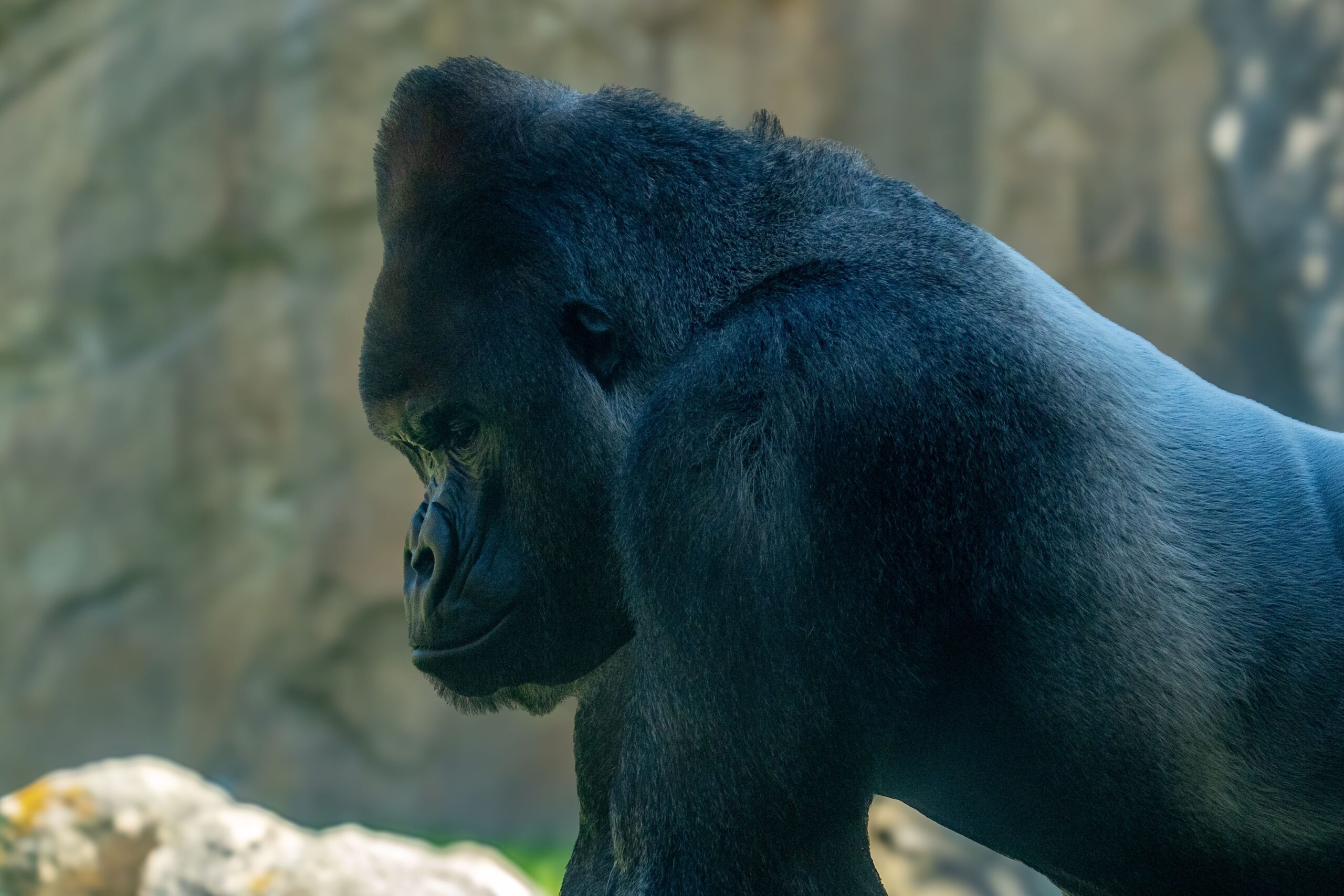
What kind of animal is a gorilla? We will explain its characteristics, ecology, and habitat. They are classified into two species, the eastern gorilla and the western gorilla, and both have suffered serious habitat destruction and poaching, and both are designated as endangered species.






- What is a gorilla? About basic status
- What are the roots and origins of gorillas?
- About habitat
- feature is? What kind of creature is it?
- What is your personality like?
- What is the ecology like?
- About Gorilla Vocalizations
- Seasonal Activities
- Walking Speed
- About Baby Gorillas
- Are gorillas an endangered species?
- Can gorillas be kept?
- Zoos Housing Gorillas (Japan and Worldwide)
- Introducing other animals
What is a gorilla? About basic status
Gorillas are mammals that belong to the genus Gorilla in the order Primates and family Hominidae. The body length is 150-180cm and the weight is 80-100kg. The scientific name is Gorilla gorilla. The list of information is as follows.
| Japanese(和名) | ゴリラ |
| English(英名) | Gorilla |
| scientific name(学名) | Gorilla gorilla |
| classification(分類) | Mammalia、Primate、 Hominidae、Gorilla 哺乳綱、霊長目、ヒト科、ゴリラ属 |
| IUCN Status(保全状況) | ENDANGERED |
| Length(体長) | 150 – 180cm |
| Weight(体重) | 80 – 100kg |
What are the roots and origins of gorillas?
The roots (origins) of gorillas trace back to a common ancestor of African great apes that lived approximately 10 million years ago. From this ancestor, humans, chimpanzees, and gorillas each followed distinct evolutionary paths.
The evolutionary timeline of gorillas
Approximately 15 to 10 million years ago
Many great apes inhabited Africa.
It is believed that the common ancestor of modern gorillas, chimpanzees, and humans existed during this period.
Approximately 10 million years ago
The gorilla lineage was the first to diverge from the line that would eventually lead to humans and chimpanzees.
Subsequently, the human and chimpanzee lineages are thought to have diverged from each other about 6 million years ago.
Approximately 1.6 to 0.9 million years ago
Gorillas split into western and eastern lineages.
Genomic analysis indicates that genetic exchange continued between them for some time.
Gorillas today
They are currently classified into two species and four subspecies:
Western gorilla
Western lowland gorilla
Cross River gorilla
Eastern gorilla
Mountain gorilla
Eastern lowland gorilla (Grauer’s gorilla)
Why did they evolve such a large physique?
As a result of adapting to a lifestyle in dense forests involving the consumption of large quantities of plant matter, gorillas developed:
A massive physique
Extremely powerful jaws and chewing muscles
Long arms
Hands capable of a strong grip
A body suited for both tree-climbing and ground locomotion (knuckle-walking)
They are large primates that are primarily herbivorous—feeding mainly on leaves, stems, and fruits—rather than being carnivores.
Relationship with humans
Humans and gorillas share approximately 98% of their DNA.
However, the living species most closely related to humans is the chimpanzee, with the gorilla being the next closest relative. Simplified Evolutionary Tree
Approx. 10 million years ago
Common ancestor
│
┌──────┴──────┐
Gorilla lineage Human-Chimpanzee lineage
│
Approx. 6 million years ago
┌───┴───┐
Human Chimpanzee
About classification
There are the following subspecies of gorillas: Western Lowland Gorilla, Eastern Lowland Gorilla, Cross River Gorilla, Mountain Gorilla, etc. They are apes, with females and males forming families, and are no different from humans in terms of image. Recently, research has been progressing greatly in Africa.
Western gorilla
The western gorilla is a primate classified into the genus Gorilla, in the order Mammalia, order Primates, and family Hominidae. It lives in Angola, Gabon, and Nigeria, and its head and body length is 103 to 107 cm, and its weight is 145 to 191 kg. It is listed on Appendix I of the Washington Convention and is designated as an endangered species. The Ebola virus has decimated the population to the point of no return.
Eastern gorilla
The eastern gorilla is a primate classified into the genus Gorilla, in the order Mammalia, Primates, Hominidae, and lives in Uganda, Congo, and other countries. They live in natural forests and secondary forests, and are designated as an endangered species due to habitat destruction due to farmland development and timber extraction, as well as the spread of infectious diseases. It is listed on CITES Appendix I, which places strict restrictions on international trade.
About habitat
Gorillas mainly live on the African continent.
Main Gorilla Habitats
① Western Lowland Gorilla
Habitat:
Cameroon, Gabon, Republic of the Congo, Equatorial Guinea, etc.
Environment:
Lowland tropical rainforests, swamp forests
Characteristics:
The most abundant gorilla
② Cross River Gorilla
Habitat:
Border region from eastern Nigeria to western Cameroon
Environment:
Mountain forests and hill forests
Characteristics:
Very small population, the rarest
③ Mountain Gorilla
Habitat:
Uganda, Rwanda, Democratic Republic of the Congo
Environment:
Mountainous areas (mist forests) at altitudes of 2,000-4,000 meters
Characteristics:
Famous for tourism conservation efforts (populations are recovering)
④ Eastern Lowland Gorilla (Grauer’s Gorilla)
Habitat:
Eastern Democratic Republic of the Congo
Environment:
Lowland to mountain forests
Characteristics:
Large body size, but populations have declined dramatically due to civil war and other factors
Commonalities
Living in forested areas such as tropical rainforests and montane forests
They are herbivorous, eating fruits, leaves, and stems
They are an endangered species due to deforestation and poaching
feature is? What kind of creature is it?
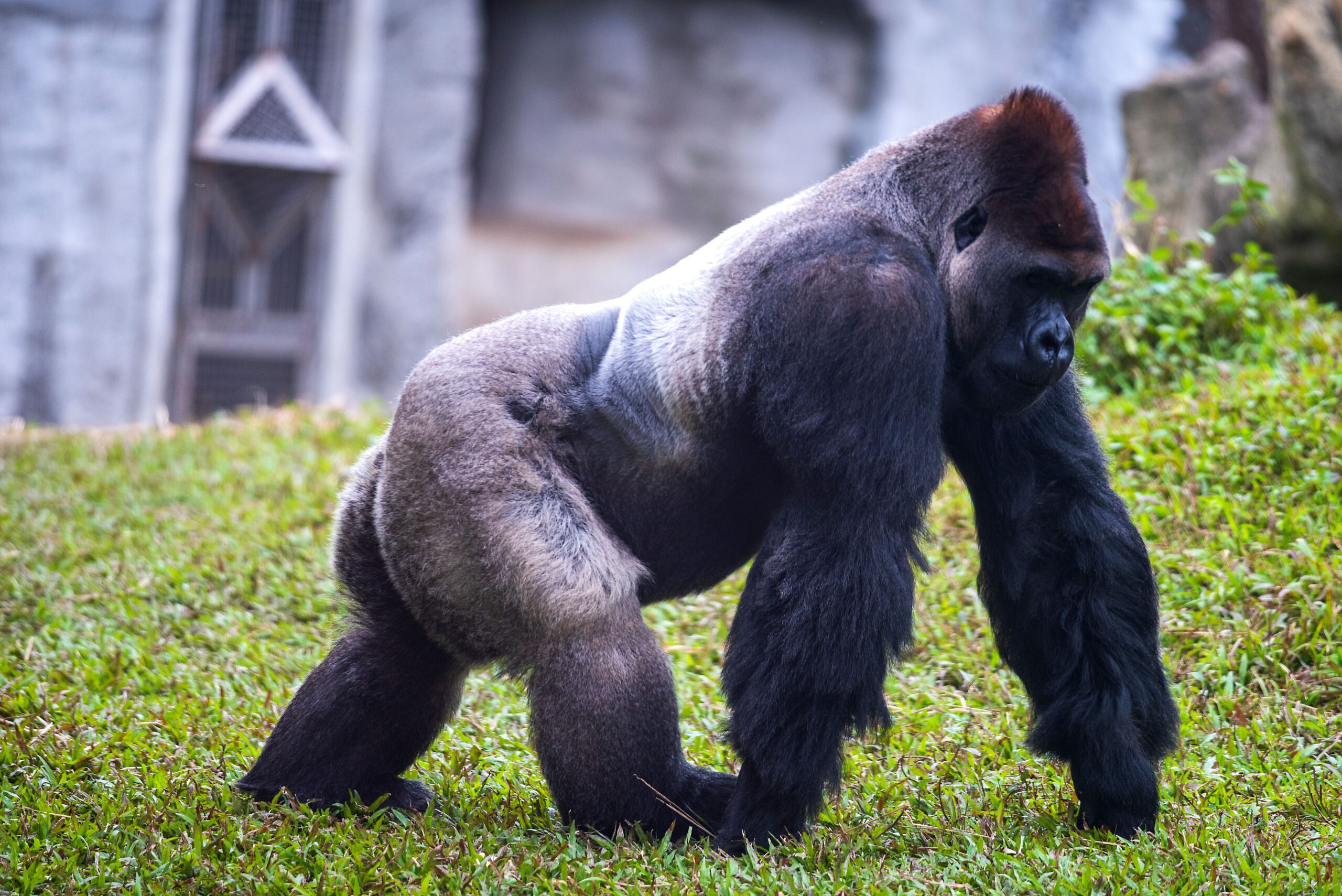
Gorillas mainly live in forest areas. Basically, they are highly social animals and live in groups. A gorilla’s chest-beating gesture is called “drumming,” and it is a means of communication and negotiation with the other person. This can be seen when avoiding conflicts with males or asserting oneself. It is characterized by a quadrupedal gait called knuckle walking, in which the forelimbs are clenched into fists and hit the ground.
① Physical Characteristics
Weight:
Males: 140-200kg or more (maximum nearly 250kg)
Height:
Standing height: Approximately 160-180cm
Extremely high muscle mass (several times that of humans)
Mature males have silvery fur on their backs
→ Known as silverbacks
Although they look quite intimidating, they generally avoid conflict.
② Personality and Behavior
Very gentle and timid
When they sense danger, they first
beat their chest
growl
→ This is a warning signal and they do not attack suddenly
Only attack when truly cornered
They have a much more patient personality than humans.
③ High Intelligence
Uses tools (such as measuring water depth with a stick)
Expresses emotions through facial expressions and gestures
Some individuals have learned simple sign language
Understands family relationships and hierarchical relationships
Their intelligence is said to be close to that of a 5- or 6-year-old human child.
④ Sociality and Family Structure
They live in families (herds) of 5-30 individuals centered around a single silverback.
Silverbacks
protect the herd
mediate disputes
decide where to move
become very protective of their females and young
What is your personality like?
Like humans, gorillas value social connections with their fellow gorillas. Some primates have a strict hierarchical relationship, but in the case of gorillas, all relationships are flat. They also have very high intelligence, comparable to humans.
① They are generally very calm.
Usually laid-back and quiet.
They do not like conflict and avoid fights as much as possible.
They are calm around other animals and their peers.
They are among the more gentle wild animals.
② They are very timid and cautious.
They are sensitive to unfamiliar sounds and movements.
They first signal “stay away” by
glaring.
growling.
smacking their chest.
They almost never attack suddenly.
Chest smacking is a warning, not a threat.
③ They are family-oriented and responsible.
Pack leaders (silverbacks)
Protect their young.
Stop fights.
Take the lead in times of danger.
They are very kind to their young and will play with them.
They are close to the ideal father figure.
④ They are highly emotional.
They express joy, anxiety, anger, and sadness through facial expressions, voice, and gestures.
They embrace and comfort each other.
Their emotions are very similar to those of humans.
⑤ Individual differences exist.
Gentle type
Curious type
Nervous type
Every group has its own “personality differences.”
What is the ecology like?
Gorillas primarily eat fruit, plants, and termites. Regardless of species, they have a strong tendency to eat fruit, and in environments where fruit is abundant, they will primarily eat fruit. They reproduce by viviparity. The gestation period is 256 days. Their lifespan is approximately 40-50 years. They are gentle wild creatures who are polygamous and raise their young.
① Living in groups (social structure)
Living in groups of 5-30 individuals
Mature males dominate the group
Silverback
Composition
One silverback
Several females
Children and young individuals
Division of roles
Silverback:
Determining migration routes, mediating disputes, and protecting from predators
Females: Mainly raising children
Young: Playing and learning
② Daily rhythm
Diurnal (active during the day)
Time of day Behavior
Morning: Eating while traveling
Lunch: Resting and grooming
Evening: Eating again
Night: Sleeping in the nest
They have a very regular lifestyle.
③ Food (mostly herbivorous)
Leaves, stems, fruit, bark, bamboo shoots
Eats 20-30 kg per day
Often obtains water from food
Eats large amounts, but does not hunt
④ Movement and Territory
Moves several hundred meters to several kilometers daily
Few clear territorial disputes
When encountering other groups,
they usually keep their distance without fighting
⑤ Sleeping and Nest Building
Builds a new nest every night
On the ground or in a shrub
Completes in about 10 minutes by breaking off leaves and branches
Babies sometimes sleep with their mothers.
⑥ Breeding and Rearing
Gestation Period: Approximately 8.5 months
Births are single
Mothers carry and raise their young at all times
Weaning: Approximately 3-4 years
Grows slowly (lifespan 40-50 years)
Are there any natural enemies?
Its natural enemy is the leopard. Others include humans.
About Gorilla Vocalizations
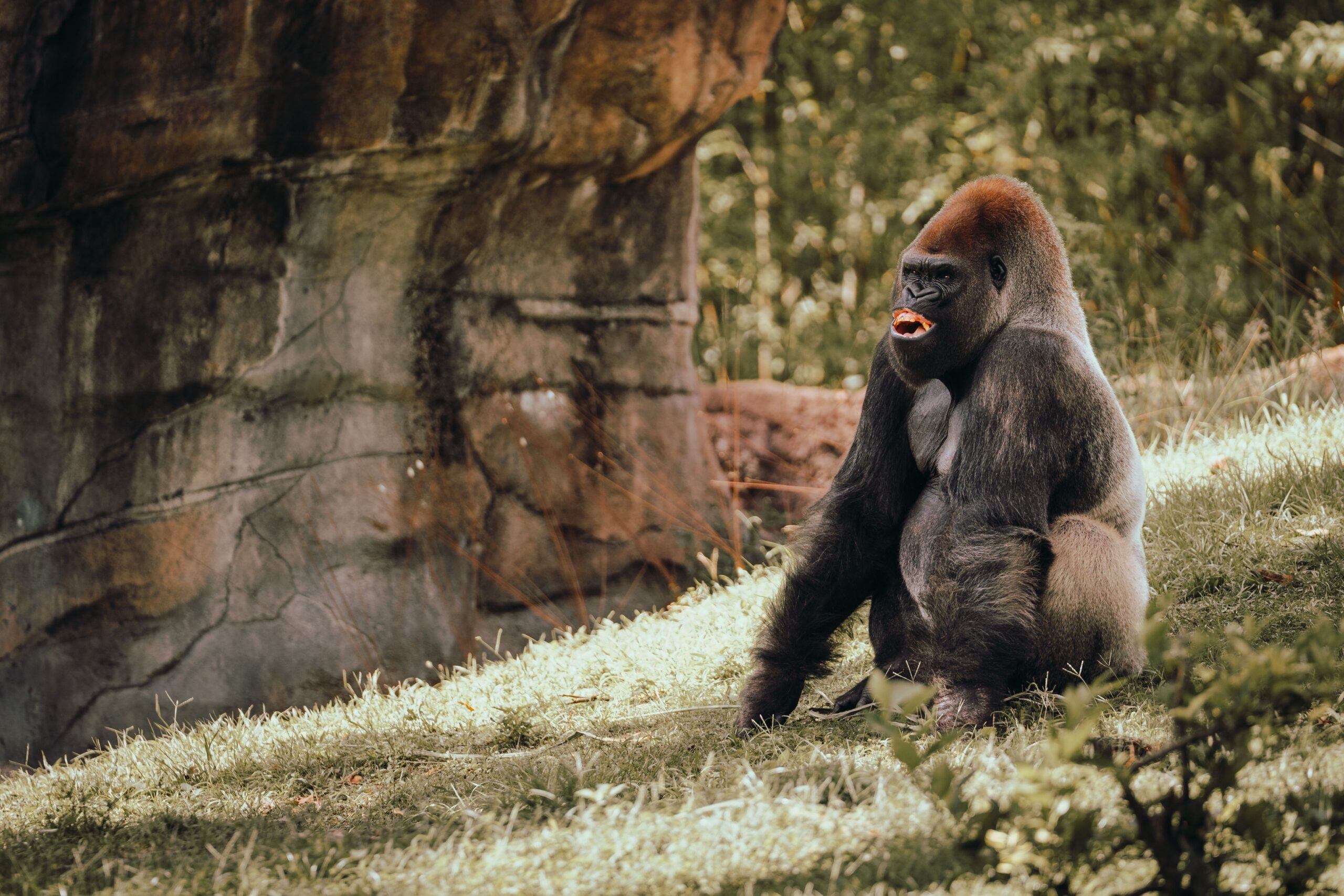
While gorillas are often imagined to make “uho-uho” sounds, they actually use over 20 different types of vocalizations and sounds to communicate with one another. Beyond vocalizations, chest-beating and body language also serve as vital means of conveying intent.
Humming
A gentle sound resembling “mm” or “hmmm.”
Often heard while eating.
It is believed to convey feelings of satisfaction—such as “this is delicious” or “it is safe to eat”—to the rest of the group.
Grunt
A short, low sound like “guh” or “uh.”
Used to keep track of group members’ locations or as a gentle greeting.
One of the most common vocalizations heard within a family group.
Belch Vocalization
A sound like a belch, resembling “ururu…”
A vocalization unique to gorillas; it is considered a friendly signal meaning “I have no hostile intent” or “it is safe to approach.”
Bark / Roar
A loud sound like “wow!” or “gaaa!”
Produced when sensing danger or to intimidate an enemy.
Often observed when a male silverback is defending his territory.
Scream
A high-pitched, piercing cry.
Produced when startled, during a fight, or when experiencing intense fear.
Young gorillas scream more frequently than adults.
Chest-beating (Drumming)
Chest-beating, or “drumming,” is an iconic gorilla behavior.
They beat their chests rapidly using loosely cupped hands rather than clenched fists.
The sound, resonating within the chest cavity, can carry for hundreds of meters.
It does not necessarily indicate anger; it serves several purposes:
Announcing one’s presence
Displaying strength or physical size
Communicating with the group
Issuing a warning to avoid unnecessary conflict
Seasonal Activities
Because gorillas inhabit the forests of tropical Africa, they do not experience the distinct four seasons—spring, summer, autumn, and winter—found in places like Japan. Instead, their activities shift according to the rainy and dry seasons.
Rainy Season (Approx. March–May and September–November; varies by region)
Activity Characteristics
They eat plant leaves, stems, and young shoots starting in the morning.
In areas where fruit is abundant, they spend more time eating fruit.
Due to the high availability of water, there is less need to travel long distances.
They range over a relatively small area within the forest.
Daily Life
They sometimes forage while taking shelter from the rain.
Walking distances tend to be slightly shorter because the ground becomes muddy.
Child-rearing takes place throughout the year.
Dry Season (Approx. June–August and December–February; varies by region)
Activity Characteristics
As fruit becomes scarce, they consume more leaves, bark, stems, and bamboo.
They may travel longer distances in search of food.
They spend more time foraging, from morning through evening.
Daily Life
They obtain most of their moisture from plants and rarely go to rivers to drink water.
The silverback (mature male) leads the troop and efficiently searches for foraging grounds.
Daily Routine (Common to all seasons)
Time | Activity
6:00–8:00 | Waking up and breakfast
8:00–11:00 | Foraging and traveling
11:00–14:00 | Napping, grooming, and playing
14:00–17:00 | Foraging again
17:00–18:00 | Building a sleeping nest
Night | Sleeping
Walking Speed
While gorillas usually move at a leisurely pace, they are capable of moving very quickly when necessary.
Normal Walking Speed
Approximately 3–5 km/h
When foraging or moving as a group, they travel at a speed comparable to a human’s leisurely walk.
They move using “knuckle-walking,” a method where they walk with their finger joints touching the ground.
Running Speed
Top speed: Approximately 35–40 km/h
They sprint over short distances when escaping danger or intimidating adversaries.
This speed rivals that of human sprinters, but they cannot maintain it for long periods.
Movement While Climbing Trees
Young gorillas are adept at climbing and move quickly from branch to branch.
Adult gorillas—especially heavy males—spend most of their time on the ground, typically climbing trees only to forage or rest.
Differences Based on Terrain
Mountain gorillas, which inhabit mountainous regions, can move steadily across steep slopes and rugged terrain.
Western lowland gorillas move efficiently across the relatively flat terrain of tropical rainforests.
About Baby Gorillas
Baby gorillas are very affectionate and resemble human babies. There’s a stark difference between their appearance and behavior compared to adult gorillas.
① Immediately after birth
Weight: Approximately 2kg (roughly the same as a human newborn)
Thin fur, large eyes
Unable to walk immediately after birth, they cling to their mother
Fed exclusively by breast milk
They look very “baby-like.”
② Around 0-1 year old
Always held by their mother
Crying to communicate their intentions
Still unstable in independent movement
Completely dependent on their mother
③ Around 1-3 years old
Slowly walks around
Begins nibbling on grass and leaves
Begins playing with other cubs
(chasing and playing)
Suddenly becomes more active
④ Around ages 3-5
Very active and curious
They climb trees and jump
They learn social skills by pretending to fight
This is the equivalent of “kindergarten to early elementary school” in humans.
⑤ Relationship with mother
Mothers are very devoted
They are always kept within sight
They are immediately picked up if there is any danger
They are highly overprotective.
⑥ Position within the pack
They are protected by the entire pack
The silverback (father figure)
They may play with them
Some mischief is tolerated
Young are the idols of the pack.
⑦ Growth and Independence
Weaning: Ages 3-4
Males often leave the pack between ages 8-12
Females may remain in their birth pack
Are gorillas an endangered species?
Gorillas are listed as an endangered species. All of this is caused by humans, and habitat destruction is the biggest problem, and the number of individuals that can survive is rapidly decreasing due to the reduction of forest areas.
① Mountain Gorilla
Classification: Endangered (EN)
Estimated Population: Approximately 1,000
Status:
Recovering thanks to conservation efforts and ecotourism
However: Numbers are still very small
② Eastern Lowland Gorilla (Grauer’s Gorilla)
Classification: Critically Endangered (CR)
Status:
Pulpably declining due to civil war, poaching, and deforestation
Most endangered
③ Western Lowland Gorilla
Classification: Critically Endangered (CR)
Status:
Relatively large populations, but rapidly declining due to Ebola hemorrhagic fever
Defeat
④ Cross River Gorilla
Classification: Critically Endangered (CR)
Estimated Population: Fewer than 300
Characteristics:
The rarest gorilla
Why is it endangered?
Main causes
Deforestation (farmland development, logging)
Poaching (bushmeat)
Disease (human-derived infectious disease, Ebola)
Conflict and civil war
Climate change
Human influence is particularly significant.
Can gorillas be kept?
Gorillas are designated as an endangered species, listed in the Washington Convention, and international trade is restricted, making it extremely difficult for the general public to keep them.
① Legally, it is almost impossible.
Gorillas are listed in Appendix I of the Convention on International Trade in Endangered Species of Wild Fauna and Flora (CITES).
Commercial trade is prohibited.
Even in Japan, under the Animal Welfare Act and regulations related to invasive alien species, private captivity is not permitted.
Import and trade are generally illegal.
Only permitted in zoos, research facilities, and other institutions with special permits.
② Extremely dangerous from a safety perspective.
Adult gorillas weigh nearly 200kg of muscle.
When they get serious, humans cannot resist.
Even if they are normally calm,
if they feel surprised or stressed, it could lead to an accident.
Even if they become tame, they remain dangerous.
③ From an animal welfare perspective.
Gorillas
Live in groups.
Require a spacious environment.
Highly intelligent and emotional.
Private homes and small facilities can cause severe mental stress.
Keeping them in captivity can be considered cruel.
So what about zoos?
Only facilities with the necessary equipment, specialized staff, and breeding programs can keep them.
Rather than just one animal, they are kept in groups of multiple animals.
Comprehensive medical, behavioral, and genetic management are also provided.
Conservation and educational purposes, rather than “exhibition”
Zoos Housing Gorillas (Japan and Worldwide)
Gorillas are kept in zoos around the world; however, as they are an endangered species, many facilities participate in international breeding programs and conservation efforts. All gorillas kept in Japan are Western Lowland Gorillas.
Major Zoos in Japan Where You Can See Gorillas
Currently, there are approximately 20 gorillas housed across six facilities in Japan.
Ueno Zoological Gardens
Home to one of Japan’s most famous gorilla exhibits.
Visitors can observe a family group in the “Gorilla Woods” area.
Chiba Zoological Park
Houses a small number of gorillas.
Higashiyama Zoo and Botanical Gardens
Home to “Shabani,” a gorilla who became a viral sensation for his handsome looks.
Hamamatsu City Zoo
Houses Western Lowland Gorillas.
Kyoto City Zoo
Known for its family group centered around “Momotaro.”
Japan Monkey Centre (JMC)
A facility also renowned for research and education regarding great apes.
Famous Zoos Worldwide for Gorillas
Zoo Berlin
Famous for housing “Fatu,” one of the oldest gorillas in the world.
Bronx Zoo
One of the world’s largest zoos, featuring a massive gorilla exhibit.
San Diego Zoo
Displays gorillas in environments that closely mimic nature and is actively involved in conservation.
Columbus Zoo and Aquarium
A facility with one of the most successful gorilla breeding records in North America.
Bristol Zoo Project
Gorillas are housed in a vast new exhibit designed to recreate a forest habitat.
Zoo Atlanta
Globally renowned for its research on gorilla breeding and conservation.
Introducing other animals


コメント