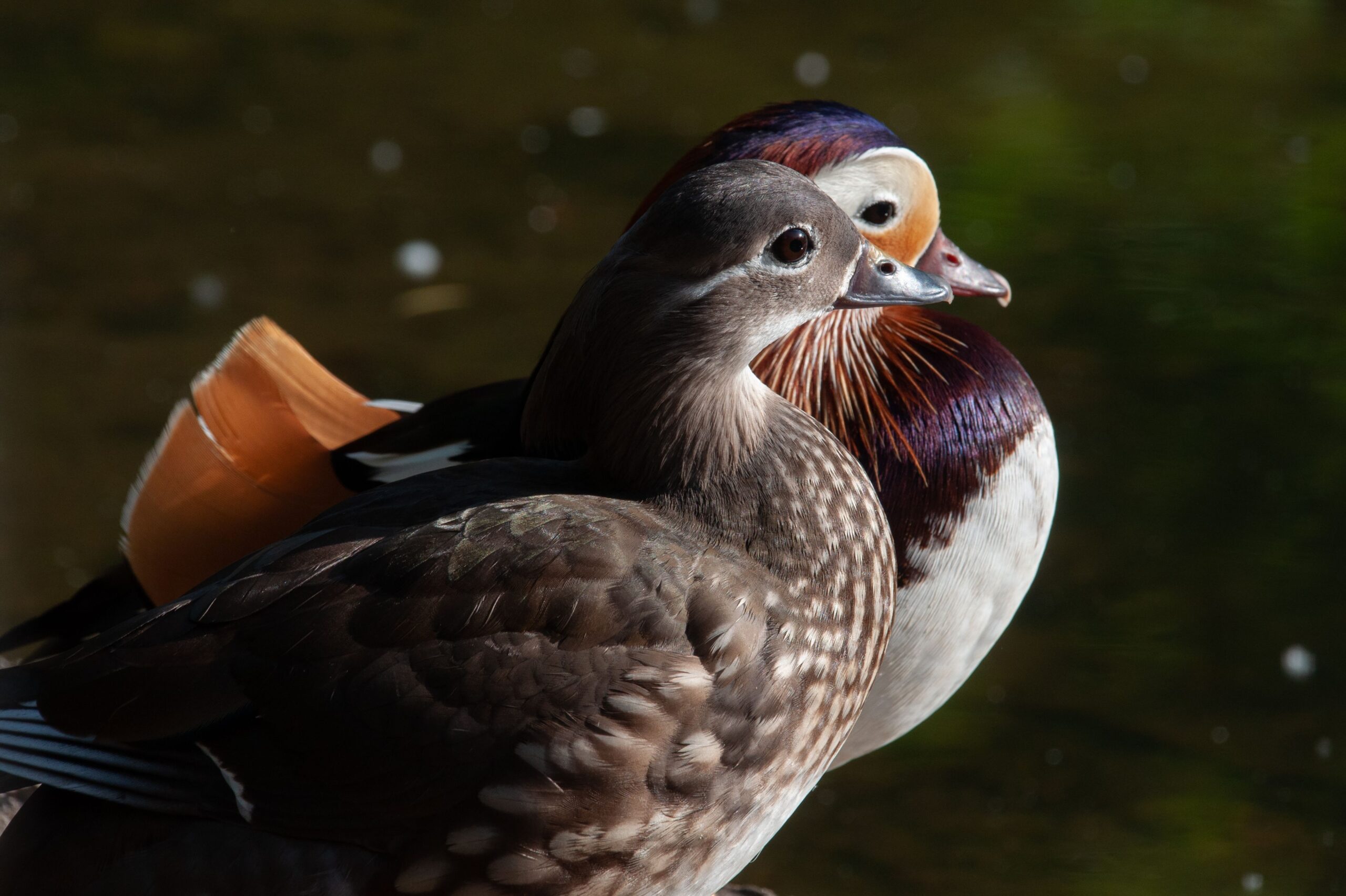
What kind of bird is a mandarin duck? We will explain its characteristics, ecology, and habitat. Mandarin ducks are generally drifting birds, but they are distributed quite widely from Japan to China. Its population has been stable for a long time, and it is probably one of the most familiar birds.







- What is a mandarin duck? About basic status
- What are the roots and origins of the Mandarin Duck?
- About the habitat of the mandarin duck
- feature is? What kind of creature is it?
- What kind of personality does a mandarin duck have?
- What is the ecology of mandarin duck?
- About Molting
- About Their Calls
- Seasonal Activities
- Swimming Speed
- About Mandarin Duck Chicks
- Is the mandarin duck an endangered species?
- Can mandarin ducks be kept as pets?
- Zoos Housing Mandarin Ducks (Japan & Worldwide)
- Introducing other animals
What is a mandarin duck? About basic status
The mandarin duck is a bird classified in the genus Mandarin, in the order Anseriformes and in the family Anatidae. The kanji is 鴛鴦, and the scientific name is Aix galericulata. The body length is 40-50cm and the weight is 0.6kg. The list of information is as follows. The color of its plumage is sober, and it is a bird that often appears in pictures and pictures in illustrated books. You can observe and see how well they get along with each other.
| Japanese(和名) | オシドリ |
| English(英名) | Mandarin duck |
| scientific name(学名) | Aix galericulata |
| classification(分類) | Ave、 Anseriformes、 Anatidae、Aix 鳥綱、カモ目、カモ科、オシドリ属 |
| IUCN Status(保全状況) | LEAST CONCERN |
| Length(全長) | 40-50cm |
| Weight(体重) | 0.6-1kg |
What are the roots and origins of the Mandarin Duck?
Tracing the roots of the Mandarin Duck (Aix galericulata) reveals it to be a member of the duck family originating in East Asia. Based on its current distribution and evolutionary history, its primary region of origin is believed to be the area spanning Northeast China to Primorsky Krai (the Russian Far East).
Ancestry and Evolutionary Roots
The Mandarin Duck is a bird belonging to:
Order: Anseriformes
Family: Anatidae
Genus: Aix
A close relative is the Wood Duck (Aix sponsa) found in North America.
In other words, the lineage is thought to have proceeded as follows:
Ancient ducks
↓
Ancestor of the Aix genus
↓
Divergence into East Asian and North American lineages (several million years ago or earlier)
↓
Modern Mandarin Duck (Aix galericulata)
Where did they come from?
The core regions for wild Mandarin Ducks today are:
Northeast China
Primorsky Krai (Ussuri region), Russia
The Korean Peninsula
Japan
The forest zones stretching from Northeast China to the Russian Far East are considered particularly important areas where the ancestors of the Mandarin Duck evolved.
This is because, unlike typical waterfowl, Mandarin Ducks prefer:
Lakes and marshes near forests
Mountain streams overhung by trees
Tree hollows (holes in trees)
These characteristics—earning them the nickname “forest ducks”—suggest they likely evolved through adaptation to forest environments.
When did they arrive in Japan?
They are believed to have inhabited the Japanese archipelago since ancient times.
Currently:
They breed in Hokkaido and northern Honshu.
Many individuals migrate to central Honshu and regions further south as winter visitors.
It is thought that as the global climate cycled between glacial (cold) and interglacial (warm) periods, bird populations in East Asia moved back and forth between the continent and the Japanese archipelago, leading the Mandarin Duck to establish itself in Japan.
Why are they known as birds with a strong marital bond?
In Japan and China, there has long been a term used to describe a devoted couple:
“Oshidori fūfu” (Mandarin duck couple).
This term stems from the beautiful sight of the male and female swimming close together during the breeding season.
However, their actual behavior in the wild differs somewhat.
They do not necessarily mate with the same partner every year,
and the male does not play a long-term role in raising the offspring after the breeding period.
In other words, the image of them as “lifelong partners” is largely a symbolic concept created by human culture.
Taxonomy of Mandarin Ducks
- 界(Kingdom): 動物界 (Animalia)
- 門(Phylum): 脊索動物門 (Chordata)
- 綱(Class): 鳥綱 (Aves)
- 目(Order): カモ目 (Anseriformes)
- 科(Family): カモ科 (Anatidae)
- 属(Genus): オシドリ属 (Aix)
- 種(Species): オシドリ (Aix galericulata)
About the habitat of the mandarin duck
Mandarin ducks are distributed primarily in Japan and also in China.
- Geographic Distribution
Origin (Natural Distribution): East Asia
Japan: Central and northern Honshu, Hokkaido, and parts of Kyushu
Eastern China and the Korean Peninsula
Eastern Russia (Amur River basin, etc.)
Introduced Distribution:
Parts of Europe (UK, France, etc.), Eastern United States
This is a result of released or escaped individuals becoming wild.
- Habitat
Freshwater lakes and rivers in forested areas
Small rivers, ponds, wetlands, and lakes
Prefers calm waters surrounded by trees
Near trees
Nests in tree cavities during the breeding season
Forests are essential as they lay eggs in tree branches and cavities
Wintering Grounds
Gathers in unfrozen rivers and ponds in winter
Forms schools in warm, safe waters
- Habitat Conditions
Water Quality and Quantity: Relatively calm freshwater
Vegetation: Surrounded by trees and bushes, with hiding places
Safety: Prefers an environment with few predators and human activity
feature is? What kind of creature is it?
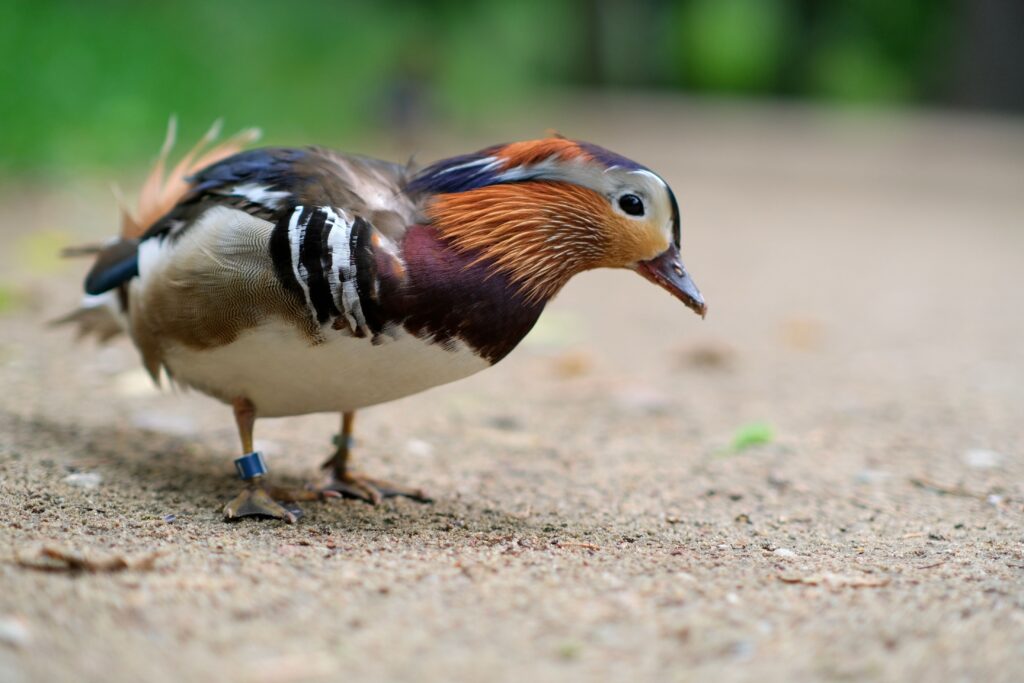
The mandarin duck’s head is flat and pinched from the sides, and it has beautiful colored feathers, including a showy crest, which is its main characteristic. The male’s beak is red with a white tip. The plumage on the thorax is purple, and there are white markings on the sides of the neck. Mandarin ducks live in villages, mountain streams, lakes, etc. Although they are generally wandering birds, they are also known to migrate to Japan from overseas in the winter. Their feet are orange and their fingers are webbed, allowing them to swim.
- Appearance
Male (Breeding Season)
Very flashy plumage
Face red, white brows, and a variety of orange, purple, and blue colors from the neck to the chest
The feathers on the back are bright green or blue, and there are “sail-like” feathers (ornamental feathers) on the shoulders
Beak: Short, reddish
Body length: Approximately 42-49 cm, wingspan approximately 65-75 cm
Tail: Long, black, and decorative
Female (Non-breeding Season)
Dull plumage
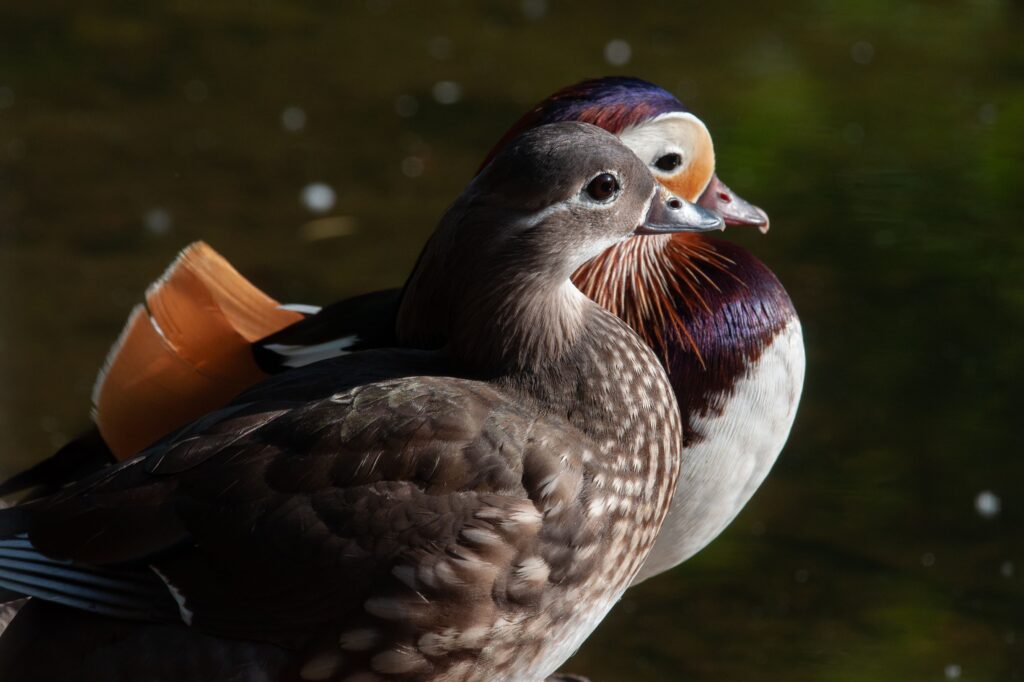
Grayish-brown with white spots, acting as a protective color
Body Shape
Rounded and smaller than the male
- Behavior and Personality
Personality: Quiet and timid
Will flee into the water if it senses humans or predators
Swimming and Flight
Adapted to life on water
Excellent fliers, capable of short-distance flight to build nests in tree cavities
Solo or in small groups
Pairs during the breeding season
Form small flocks during the winter
- Ecological Characteristics
Adaptations as a Waterfowl
Webbed feet, suitable for swimming
Can climb trees and build nests in tree holes
Diet
Omnivorous, feeding on aquatic plants, seeds, insects, and small fish
What kind of personality does a mandarin duck have?
As a side note, in Japan there is a phrase that is often referred to as “mandarin duck couple.” It is said that once a pair is created, they will stay together forever, but in reality, this is not the case and people cheat and have affairs. As you can see by observing them in a coop, we already know that male and female mandarin ducks change partners every winter. The term “Oshidori couple” is not used correctly.
Mandarin Duck Personality Traits
Quiet and timid
Generally not aggressive, they will quickly flee if they sense humans or predators.
Even in rivers or ponds, they will hide underwater at the slightest noise.
Highly cautious
Sensitive to predators (hawks, dogs, cats, humans)
Even during the breeding season, they remain vigilant of anyone approaching their nest or chicks.
Mostly solitary or paired.
Males and females pair up during the breeding season.
Outside the breeding season, they live in small flocks or alone.
Rather than being socially active, Mandarin Ducks tend to keep their distance from other individuals, unlike ducks that form large flocks.
Even during the winter, they live in small flocks of just a few birds.
Timid but observant.
Sensitive to changes in their surroundings, they closely observe those who approach.
Choosing safe locations for nesting and migration.
What is the ecology of mandarin duck?
They are omnivores with a strong tendency to eat plants, subsisting on aquatic plants, fruits, seeds, insects, and terrestrial shellfish. The breeding form is oviparous, and they build nests in mountains and lay eggs from April to July. The female lays 9-12 eggs and incubates them. The lifespan is said to be about 10 to 20 years.
- Lifestyle
Waterbirds that live both on and off the water
Forage while swimming in freshwater bodies of water such as rivers, ponds, and lakes
They often build nests in tree cavities during the breeding season, but are also capable of arboreal habitats
Activity Period
Primarily diurnal, active during the day
Feeds, rests, and breeds around rivers and ponds
- Diet
Omnivorous
Vegetation: Aquatic plants, seeds, and fruit
Flesh: Insects, small aquatic fish, and small invertebrates
Feeding Method
Pecks at plants and insects on the surface of the water
Grabs aquatic plants and small fish underwater with their beaks
- Breeding and Rearing
Breeding Season: Spring to Early Summer (Varies by Region)
Nesting: Nests in tree cavities or hollows
Tree nests protect eggs and chicks from predators
Egg Size: Usually 8-12
Rearing
The female incubates the eggs and guides them after they hatch.
Chicks can jump into water immediately after hatching.
Males often return to the group outside of the breeding season, and the female is generally responsible for rearing the young.
- Migration and Wintering
Wintering: Moves to unfrozen waters
Migratory Behavior
In some areas, individuals migrate for wintering.
Habitat Selection
Prefers calm, predator-free waters.
Are there any natural enemies?
The natural enemies of mandarin ducks are martens and crows, and animals larger than themselves pose a major threat.
About Molting
The molting process of the Mandarin Duck is highly distinctive. Males, in particular, are known for undergoing dramatic changes in appearance depending on the season.
The Male Molting Cycle
Male Mandarin Ducks primarily go through the following sequence of feather changes:
① Transition to Breeding Plumage
Autumn–Winter
In autumn, males molt into their “breeding plumage.”
Characteristics:
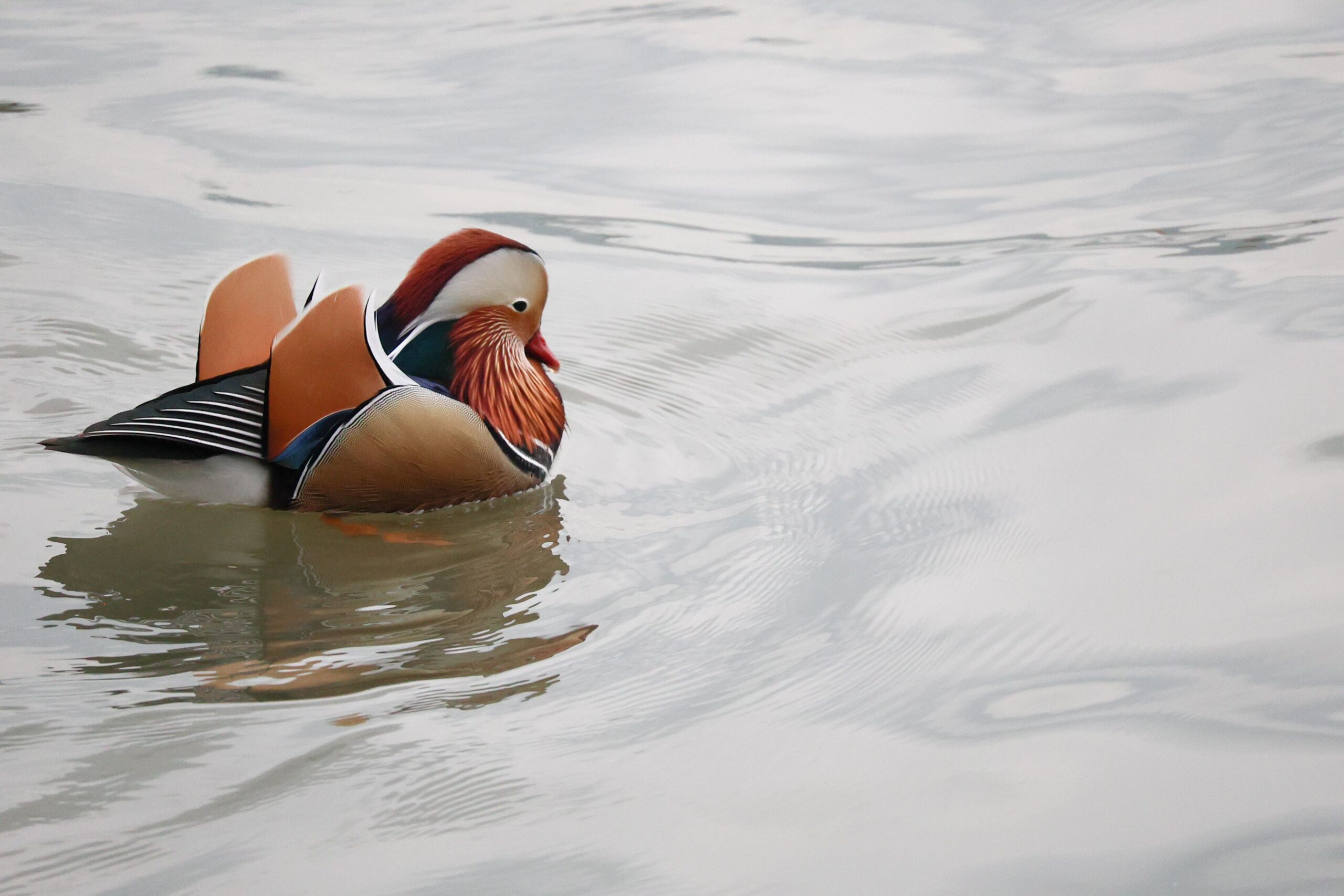
Vibrant orange, fan-shaped ornamental feathers (known as “ginkgo feathers”) appear.
They display beautiful colors, including purple, green, white, and red.
They take on an appearance suited for courting females.
This is the look commonly recognized as the “male Mandarin Duck.”
② Molting into Eclipse Plumage (Non-breeding Plumage)
Early Summer–Summer
Once the breeding season ends, males rapidly lose their flashy feathers.
This state is called eclipse plumage.
Characteristics:
They turn a subdued brown color, resembling the female.
The vibrant facial markings and “ginkgo feathers” disappear.
They become less conspicuous, making it easier to protect themselves from predators.
This is a phenomenon commonly observed in duck species.
“Wing Molting” is Particularly Important
Ducks, including Mandarin Ducks, undergo a complete molt after the breeding season, replacing feathers across their entire bodies.
Of particular importance are the:
Flight feathers (remiges)
These are the large feathers used for flying.
Because these feathers are shed and replaced all at once:
They temporarily lose the ability to fly.
They spend this time in hiding spots near water or in forests.
They focus on avoiding natural predators.
This period is known as the molting season.
Female Molting
Females do not undergo changes as dramatic as the males.
Throughout the year, they maintain:
A grayish-brown color
A white eye-ring (a white line around the eye)
A subdued body color
However, females do replace their feathers after the breeding season as well.
Why Do Only Males Become Flashy?
This is the result of evolution. The male’s flashy plumage evolved to:
attract females,
demonstrate that the individual is strong, and
increase reproductive success.
In contrast, because the female plays a major role in incubating eggs and protecting chicks,
inconspicuous colors and
patterns that blend into the surroundings
became advantageous.
About Their Calls
In contrast to their flamboyant appearance, the calls of the Mandarin Duck are relatively quiet and understated. Unlike some other duck species that produce loud “quacking” sounds, Mandarin Ducks tend to make short, soft vocalizations.
Male Calls
Male Mandarin Ducks vocalize to attract females during the breeding season.
Typical calls:
Short, low-pitched sounds such as “kwet,” “kuru,” or “pyu.”
Characteristics:
Low and soft
Rarely repeated in rapid succession
Used for courtship and communication with other ducks
Because they possess such striking plumage, males rely primarily on visual displays to attract mates rather than making loud vocal assertions.
Female Calls
Females vocalize more frequently than males.
Typical calls:
Sounds such as “koo” or “kwet-kwet.”
Uses:
Calling out to males
Checking the location of other ducks
Alerting others to danger
Signaling to ducklings
Female calls are frequently heard, especially during the breeding and chick-rearing seasons.
Duckling Calls
Ducklings make small,
high-pitched “pi-pi” sounds.
These are used to communicate with the mother,
serving purposes such as calling out when separated,
confirming safety,
and reacting to danger.
Seasonal Activities
The annual activities of the Mandarin Duck vary significantly, centering on breeding, molting, migration, and overwintering. Based on the Mandarin Ducks observed in Japan, their seasonal life cycle is as follows:
| Season | Main Activities | Mandarin Duck Status |
|---|---|---|
| Spring (Mar–May) | Breeding, nest building, egg-laying | Pair formation, start of chick-rearing |
| Summer (Jun–Aug) | Molting, chick-rearing | Males transition to drab plumage |
| Autumn (Sep–Nov) | Winter prep, movement, courtship prep | Males return to beautiful plumage |
| Winter (Dec–Feb) | Overwintering, flocking | Easily observed on ponds and lakes |
🌸 Spring (March–May): “Breeding Season”
In spring, Mandarin Ducks begin their breeding activities.
Key Behaviors
Pair formation
Courtship displays
Nest site selection
Egg-laying
Mandarin Ducks are more dependent on forests than typical ducks; they build their nests not by the water’s edge, but in places such as:
Holes in old trees (tree cavities)
Hollows high above the ground
The female lays approximately 7 to 14 eggs in a single clutch.
During this period, the male displays his most beautiful breeding plumage,
“Ginkgo-leaf” feathers (sail feathers)
Orange ornamental feathers
Vibrant facial markings
…using these features to attract the female.
☀️ Summer (June–August): “Chick-rearing and Molting”
Summer is a time of major change for Mandarin Ducks.
Males
They molt after the breeding season ends.
Changes:
Vibrant feathers are shed
Plumage turns brown, resembling the female’s
They stay in hiding to avoid temporarily losing flight capability
This appearance is known as eclipse plumage (non-breeding plumage).
Females
Females engage in chick-rearing activities such as:
Leading the chicks to the water’s edge
Protecting them from predators
Teaching them how to forage
Shortly after hatching, the chicks jump down from the nest cavity and head toward the water.
🍂 Autumn (September–November): “Preparing for Winter”
In autumn, Mandarin Ducks undergo another change in appearance. Changes in Males
As the molt progresses,
their vibrant faces,
white markings,
and distinctive “ginkgo-leaf” feathers
reappear.
This is in preparation for the following year’s breeding season.
Behavior
Migrating to wintering grounds
Forming larger flocks
Gathering in safe bodies of water
In Japan, individuals from northern regions may migrate south.
❄️ Winter (December–February): “The Wintering Season”
Winter is the best time to observe Mandarin ducks.
Gathering Spots
Mountain lakes
Reservoirs
Forest-surrounded ponds
Quiet stretches of rivers
Behavior
Resting in flocks
Swimming on the water
Resting in the shade of trees
Feeding on nuts, plants, and aquatic life
In winter, the males display their most beautiful plumage of the year.
Swimming Speed
The swimming speed of the Mandarin Duck falls into the moderate-to-fast range among typical waterfowl. However, like many duck species, they excel more at quick movements and rapid changes of direction in forest ponds or slow-moving waters than at swimming long distances at high speed.
Typical Swimming Speed
As a general guide:
Normal swimming: Approx. 0.5–1.5 km/h
When alert or fleeing: Approx. 2–3 km/h
Note: In the wild, speeds vary significantly depending on water conditions and the purpose of the activity, so they are rarely measured at a constant speed.
Swimming Characteristics
While keeping their bodies afloat on the surface, Mandarin Ducks swim by:
Kicking their legs backward alternately
Propelling themselves with their webbed feet
Gliding forward with their bodies held low
A key characteristic is their:
Agility (ability to make tight turns)
In forest ponds and mountain streams, they must navigate around:
Tree branches
Aquatic plants
Rocks
Driftwood
Consequently, turning ability is more important than straight-line speed.
Diving Ability
Mandarin Ducks do not dive as deeply as diving ducks.
Their primary foraging methods include:
Pecking at plants from the water’s surface
Extending their necks underwater
“Upending” (tipping tail-up) to forage in shallow areas
However, they may briefly submerge underwater if they sense danger or need to make a quick escape.
Take-off Ability
Mandarin Ducks possess exceptional flight capabilities, even more so than their swimming skills.
When taking off from the water, they:
Kick the water surface forcefully with their feet
Flap their wings rapidly
Lift off within a short distance
In forest waters, if they sense danger, they often choose to:
“Swim, then immediately take flight”
rather than trying to escape by swimming alone.
About Mandarin Duck Chicks
Here is a detailed overview of Mandarin Duck chicks (young birds).
- Birth
Hatching Period: Spring to Early Summer (Depending on Region)
Egg Number: Usually 8-12
Hatching Time: Approximately 28-30 Days
Characteristics at Hatch:
Body Length: Approximately 7-8 cm
Feathers are pale yellow and brown mottled.
Eyes are already open.
They quickly acquire the ability to dive into water (immediately after leaving the tree cavity).
- Fledging
Diving from the Nest:
About one day after birth, chicks dive from the tree cavity, guided by their mother, onto the ground or into the water.
Diving is an important behavior in nature for avoiding predators.
Starting Life in Water:
After diving, they learn how to feed by swimming after their mother.
Initially, they peck on small insects and plant leaves.
- Growth and Behavior
First few weeks:
Learns to swim, dive, and forage on the surface of the water
Travels with the mother and rests in safe places
First few months:
Feathers gradually adapt to adult color
Males still have a dull color, while females remain camouflaged
Their feathers do not change to their vibrant colors until the breeding season, which begins the following year
- Biological Characteristics
Sociality:
Immediately after birth, they follow their mother and move around on the water
Hides with their mother when danger approaches
Independence:
Learns basic feeding, swimming, and flying within a few months
Becomes independent by the following year, ready for the breeding season
Is the mandarin duck an endangered species?
Mandarin ducks are not an endangered species. The population is very stable so far, and there are no particular problems.
- Global Conservation Status (IUCN Red List)
Classification: LC (Least Concern)
Comments:
Widely distributed in East Asia (Japan, China, and eastern Russia)
Populations are stable and showing little decline
Deforestation and wetland loss may have an impact in some areas, but overall they are not a threat
- Habitat Threats
Decrease in nests and water bodies due to deforestation and urban development
Hunting and capture for pets are common in some areas
Localized impacts from invasive species and environmental changes
However, these are localized issues, and the species as a whole is not classified as endangered.
- Status in Japan
Natural records show a stable population in Japan
Able to breed in forests around rivers and lakes
In some areas, they are sometimes protected in tourist areas and parks
Can mandarin ducks be kept as pets?
Generally speaking, a small mandarin duck costs around 2,000 to 3,000 yen. They are difficult to obtain, so it is best to have them gifted to you by the zoo. They are small birds and are popular as household pets. They can be kept like parakeets and parrots.
- Legal and Regulatory Issues
In Japan, the Wildlife Protection Act prohibits the capture and captivity of wild mandarin ducks.
While they can be kept in zoos and research facilities, it is illegal to obtain wild specimens at home.
Regulations may be more lenient for introduced or bred specimens, but proper captivity is essential.
- Ecological and Behavioral Issues
Aquatic Life is Essential
They primarily swim in freshwater areas such as rivers, ponds, and wetlands.
Water must be provided in the captivity environment.
Highly cautious and timid.
They are not easily accustomed to humans and are susceptible to stress-related health problems.
Flying Capability
Because they fly freely, escape prevention measures such as enclosures or cages are necessary.
- Dietary Management
Although omnivorous, in the wild they eat aquatic plants, seeds, fruits, insects, and small fish.
Feeding a diet similar to their natural diet at home is difficult.
Inadequate nutritional management poses a high risk of health problems.
Zoos Housing Mandarin Ducks (Japan & Worldwide)
The Mandarin duck (Aix galericulata) is kept in a relatively large number of zoos and bird parks across Japan. They are a popular species in waterfowl exhibits and bird areas, as visitors can observe the males’ beautiful breeding plumage, unique courtship behaviors, and their natural tendency to utilize tree hollows. They are also kept in zoos throughout Europe and North America.
🇯🇵 Major Facilities Housing Mandarin Ducks in Japan
🦆 Inokashira Park Zoo (Tokyo)
Inokashira Park Zoo houses and exhibits Mandarin ducks.
Features:
Can be observed in the waterfowl area.
Research is conducted on breeding behaviors and the use of nest boxes.
The enclosure replicates their natural habit of nesting in tree hollows.
Visitors can observe behaviors that are difficult to see in the wild, such as:
“Nest selection”
“Pairing behaviors”
“Chick development”
🦆 Ueno Zoological Gardens (Tokyo)
Ueno Zoo also has a history of exhibiting Mandarin ducks.
Features:
A prominent facility for observing Mandarin ducks within an urban area.
Kept as part of the waterfowl exhibit.
🦆 Chiba Zoological Park (Chiba)
Chiba Zoological Park exhibits Mandarin ducks.
Features:
Observed in the bird and aquatic zone.
Introduced as a familiar wild bird native to Japan.
🌍 Examples of Zoos Worldwide
Mandarin ducks are kept in zoos across the globe. Records confirm their presence in over 70 facilities across 19 countries.
🇳🇱 Netherlands
Diergaarde Blijdorp
One of Europe’s leading zoos; it houses Mandarin ducks.
🇧🇪 Belgium
Pairi Daiza
A zoo known for its vast, naturalistic exhibits; it has a record of keeping Mandarin ducks.
🇩🇪 Germany
Facilities housing them include:
Tierpark Hagenbeck
Cologne Zoological Garden
…and others.
🇨🇿 Czech Republic
Prague Zoo
One of Europe’s major zoos; it houses Mandarin ducks.
Introducing other animals
コメント