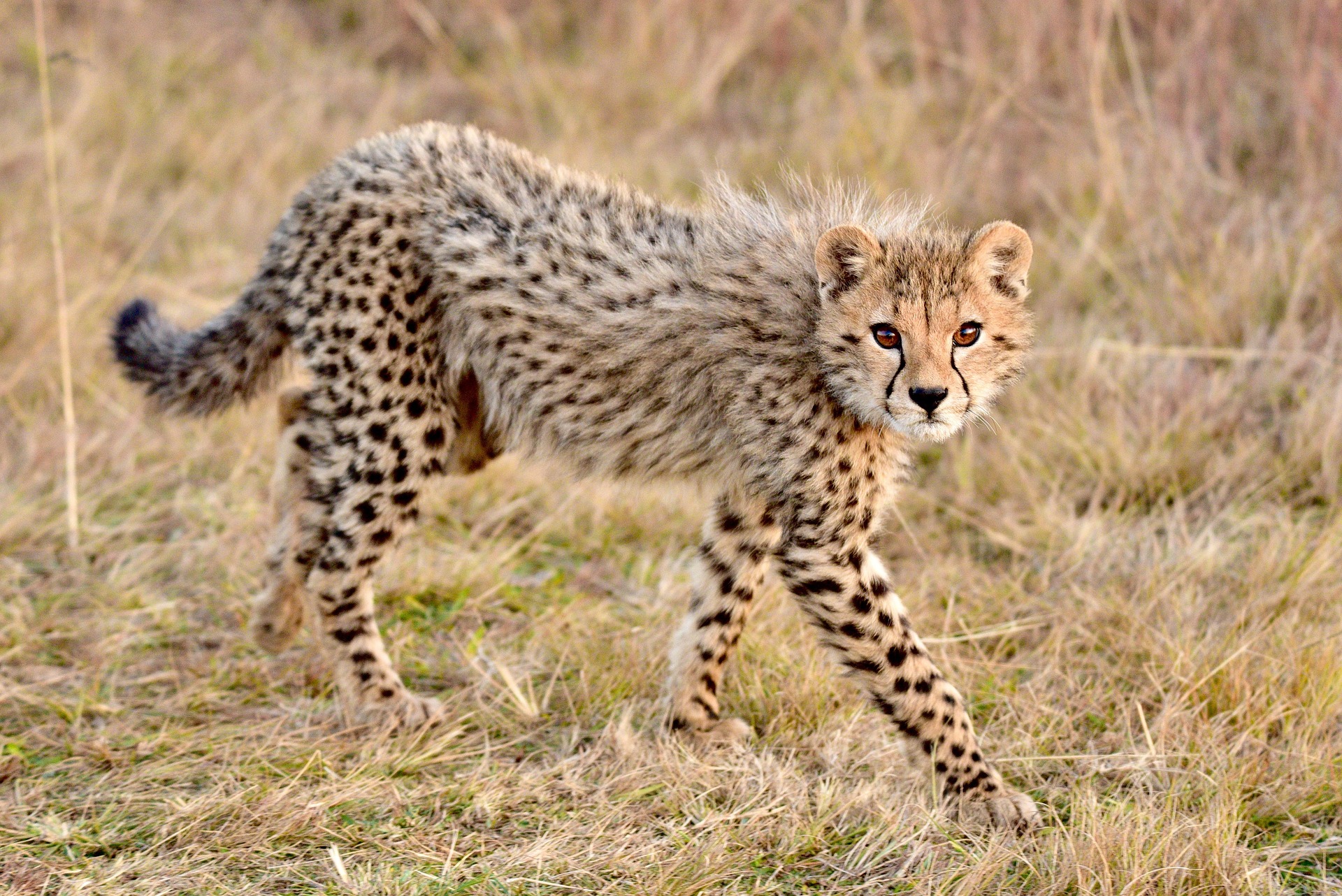
What kind of animal is a cheetah? We will explain its characteristics, ecology, and habitat. They are extremely capable carnivores that can catch prey at speeds of over 100km/h, but they can also be chased by lions, hyenas, and other carnivores. I will explain the characteristics and personality.




- What is a cheetah? About basic status
- What are the roots and origins of the cheetah?
- About habitat
- feature is? What kind of creature is it?
- What is your personality like?
- What is the ecology like?
- Cheetah Vocalizations
- Seasonal Activities
- Walking Speed
- About Cheetah Cubs
- Are cheetahs an endangered species?
- Can cheetahs be kept?
- Zoos Housing Cheetahs (Japan & Worldwide)
- Introducing other animals
What is a cheetah? About basic status
The cheetah is a carnivorous mammal classified in the genus Cheetah, in the order Carnivora, order Carnivora, and family Felinae. The scientific name is Acinonyx jubatus. The body length is 110-150cm and the weight is 35-72kg. Tail length 60-90cm, shoulder height 67-94cm. This is a land tiger that can run fast and is an animal from Asia and Africa. You may be shown around the park during events, etc. The list of information is as follows.
| Japanese(和名) | チーター |
| English(英名) | Cheetah |
| scientific name(学名) | Acinonyx jubatus |
| classification(分類) | Mammalia、 Carnivora、 Felidae、Felinae 哺乳綱、食肉目、ネコ科、チーター属 |
| IUCN Status(保全状況) | ENDANGERED |
| Length(体長) | 110 – 150cm |
| Weight(体重) | 35 – 72kg |
What are the roots and origins of the cheetah?
The roots of the cheetah (scientific name: Acinonyx jubatus) lie in a lineage that diverged from a feline ancestor appearing approximately 7 to 8 million years ago. While cheetahs are strongly associated with Africa today, their evolutionary history suggests they originated in Eurasia (the Old World).
Cheetah ancestors were “ordinary cats”
Although cheetahs belong to the Felidae (cat) family—just like lions and tigers—their classification is somewhat unique.
Lions, tigers, and leopards → Genus Panthera
Pumas → Genus Puma
Cheetahs → Genus Acinonyx
They belong to distinct lineages.
Cheetah ancestors were not specialized for high-speed running from the very beginning. Over the course of evolution, they acquired traits such as:
Long legs
A lightweight body
High cardiopulmonary capacity
A flexible, elastic spine
Semi-retractable claws
…and transformed into “hunters capable of explosive short-distance sprints.”
Origins lie in the “Old World,” not Africa
At one time, there was a theory that cheetahs evolved from the puma lineage in the Americas.
However, current fossil research strongly supports the theory that:
The cheetah lineage emerged in the Old World, spanning Asia and Africa.
Early cheetah-like species existed across Eurasia—including China and Europe—prior to approximately 2.5 million years ago. Fossils of primitive cheetahs dating back roughly 2.2 to 2.5 million years have even been discovered in China.
Ancient cheetahs were much larger than modern ones
Modern cheetahs have:
A body weight of approximately 35–65 kg
A top speed in the range of 100 km/h
However, giant species existed in the past.
A prime example:
Giant cheetah (Acinonyx pardinensis)
Inhabited the region from approximately 2.5 million years ago through the Pleistocene epoch. Characteristics:
Larger than modern cheetahs
Widely distributed across Eurasia
Likely competed with wolves and other large carnivores
Furthermore, the existence of an even more massive type of cheetah (Acinonyx pleistocaenicus) has been confirmed in East Asia.
Why did they evolve for “speed”?
The survival strategy cheetahs adopted was the exact opposite of that of lions and tigers.
Lions & Tigers
Emphasis on muscle power
Surprise attacks
Powerful jaws
Pinning down prey
Cheetahs
Lightweight build
Acceleration
High-speed, short-duration chases
Targeting small- to medium-sized herbivores
In short, the cheetah is a cat that chose the path of becoming
“Earth’s fastest pursuer” rather than a “powerful carnivore.”
About classification
Cheetahs are classified as cats. The following variants exist:
- Acinonyx jubatus jubatus
- Acinonyx jubatus fearsoni
- Acinonyx jubatus hecki
- Acinonyx jubatus soemmeringii
- Acinonyx jubatus venaticus
Cheetah Taxonomy
- 界(Kingdom):動物界 (Animalia)
- 門(Phylum):脊索動物門 (Chordata)
- 綱(Class):哺乳綱 (Mammalia)
- 目(Order):食肉目 (Carnivora)
- 科(Family):ネコ科 (Felidae)
- 亜科(Subfamily):ヒョウ属に近い小型ネコ亜科ではなく、チーター亜科 (Acinonychinae)(単型亜科)
- 属(Genus):Acinonyx
- 種(Species):Acinonyx jubatus
About habitat
Cheetahs live mainly in Africa and can be seen in the African continent, the Sahara Desert, Iran, and elsewhere.
Cheetah Habitat
- Africa
Main Distribution Area:
Sub-Saharan Africa (Sub-Saharan Africa)
Namibia, Botswana, South Africa, Kenya, Tanzania, etc.
Habitat:
Savannas, grasslands, and arid regions
Prefers open plains, choosing areas with good visibility and easy tracking of prey
- Asia
Former Distribution:
India, Middle East (Iran, etc.)
Current Status:
Only a few wild individuals remain in northeastern Iran
Known as Acinonyx jubatus venaticus (Iranian cheetah)
Habitat:
Arid regions, low grasslands, and rocky areas
Environmental Characteristics
Prefers open terrain (wider visibility makes hunting easier)
Rarely found in dense forests or swamps
Tends to avoid areas near water (to avoid competing large predators)
⚠️ Conservation Status
In Africa, populations vary greatly by region and are declining.
Wild populations in Asia are extremely rare, and the species is classified as “Vulnerable” or “Critically Endangered” on the IUCN Red List.
feature is? What kind of creature is it?
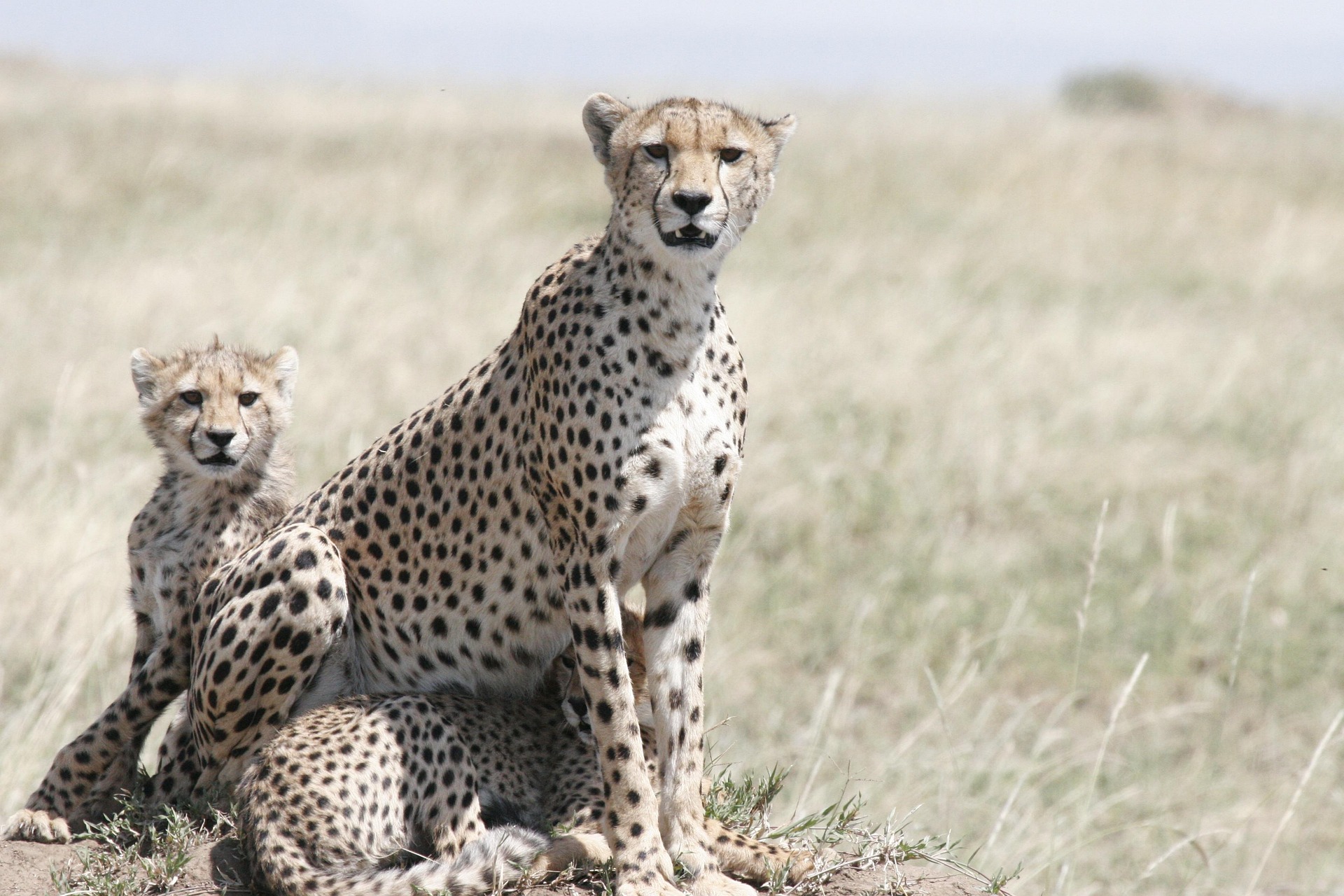
Cheetahs live in grasslands, open forests, and shrublands in the savannah, and have small heads, small ears, and small canine teeth and tooth roots. The limbs are elongated. There is no sheath to hold the claws, so they cannot be retracted. When chasing prey, it is said to be able to travel at an astonishing speed of 72 km/h in 2 seconds. They sometimes climb trees and add scent. Cheetahs mostly live alone, but sometimes they form groups with their young and their families.
Physical Characteristics
Body: Slender, muscular, and lightweight (Weight: Approximately 40-65 kg, Body Length: Approximately 1.1-1.5 m, Tail Length: Approximately 70-80 cm)
Face/Head:
Small head
Black tear lines (vertical lines from under the eyes to the mouth) protect them from the sun and make it easier to see prey
Legs/Claws:
Long, slender legs specialized for high-speed running
Higher sprinting ability than crawling ability
Claws are semi-retractile, meaning they are the only cat in the family that do not fully retract (improving gripping power)
Back/Tail:
Flexible spine allows the body to stretch and contract, allowing it to extend forward and backward significantly when running
Long tail serves as a steerer
Pattern/Color
Fur is yellowish-brown to pale ochre
All Their bodies are uniformly covered with black spots, and the pattern varies from individual to individual.
The tip of their tail is black, which is sometimes used for identification.
Behavior/Ecology
Specialized for running: They can reach a top speed of approximately 100 km/h, but can only sustain short distances (approximately 200-300 m).
Hunting Method:
In open grasslands, they use their visibility to sneak up on prey and then accelerate rapidly to capture it.
They usually hunt during the day (especially in the morning and evening).
Sociality:
Females generally live alone.
Males sometimes form small groups (colonies) with their siblings or companions.
Diet: They feed on small to medium-sized herbivores (gazelles, impalas, hyraxes, etc.).
What is your personality like?
Cheetahs do not get discouraged even when they fail and have a tenacious mental strength. On the other hand, they also have a cat-like quality, and are capricious and selfish.
Cheetah Personality and Behavior
Timid and cautious
They tend to avoid predators such as humans, lions, and hyenas.
They have a “flight” personality, fleeing immediately when they sense danger.
Low aggression
They rarely attack other animals or humans outside of hunting.
Prey behavior is efficient, prioritizing quick kills over combat.
Curious
Young individuals are playful, jumping and chasing each other.
Play also serves as hunting practice.
Sociable
Females are primarily solitary and are mostly alone except when raising their young.
Males sometimes form small groups (colonies) with siblings or companions.
Compared to other cats, they are less socially active.
Vulnerable to stress
Crowded, noisy, and overcrowded environments can make them sick.
Special environmental considerations are required even in aquariums and zoos.
What is the ecology like?
Cheetahs subsist on small, medium, and large ungulates. The mode of reproduction is viviparous. The gestation period is 3 months, and it is possible to give birth to 2 to 4 puppies at a time. Children can hunt at 15 – 17 months old. The lifespan is said to be 11 to 15 years.
- Life Rhythm
Mainly diurnal (most active in the morning and evening)
Often rests or seeks shade during the hot days
Avoids other large predators such as lions and leopards at night
- Predatory Behavior
Prey: Small to medium-sized herbivores (gazelles, impalas, hyraxes, young zebras, etc.)
Hunting Method:
Sneaks up on prey in the grasslands (stealth)
Captures prey in short sprints of several tens to hundreds of meters
Targets the neck or throat with claws or bites
Hunting success rate is relatively high, at around 50%
After hunting, they eat quickly to avoid being snatched by lions or hyenas
- Reproduction
Breeding Season: Breeding is possible throughout the year, but varies by region.
Gestation Period: Approximately 90-95 days
Litter Size: 3-5 pups per litter
Rearing:
Females raise their pups alone.
They spend the first 6 weeks of their lives in a hideout, then gradually begin training them in hunting.
They become independent after about a year.
- Sociality
Females: Generally solitary.
Males: May form small groups (colonies) with siblings or peers.
Communication:
Marking with urine and feces.
Body posture, vocalizations (rumbling, growling, howling).
- Habitat Relationship
Prefers open grasslands and savannas.
Avoids dense forests and swamps.
Can survive in dry areas some distance from water.
Changes behavior and hunting times depending on predation pressure (e.g., lions and hyenas).
Are there any natural enemies?
Cheetahs are not invincible. Natural enemies are lycaons, jackals, lions and leopards. Eagles are also attacked from the sky, and children are especially targeted.
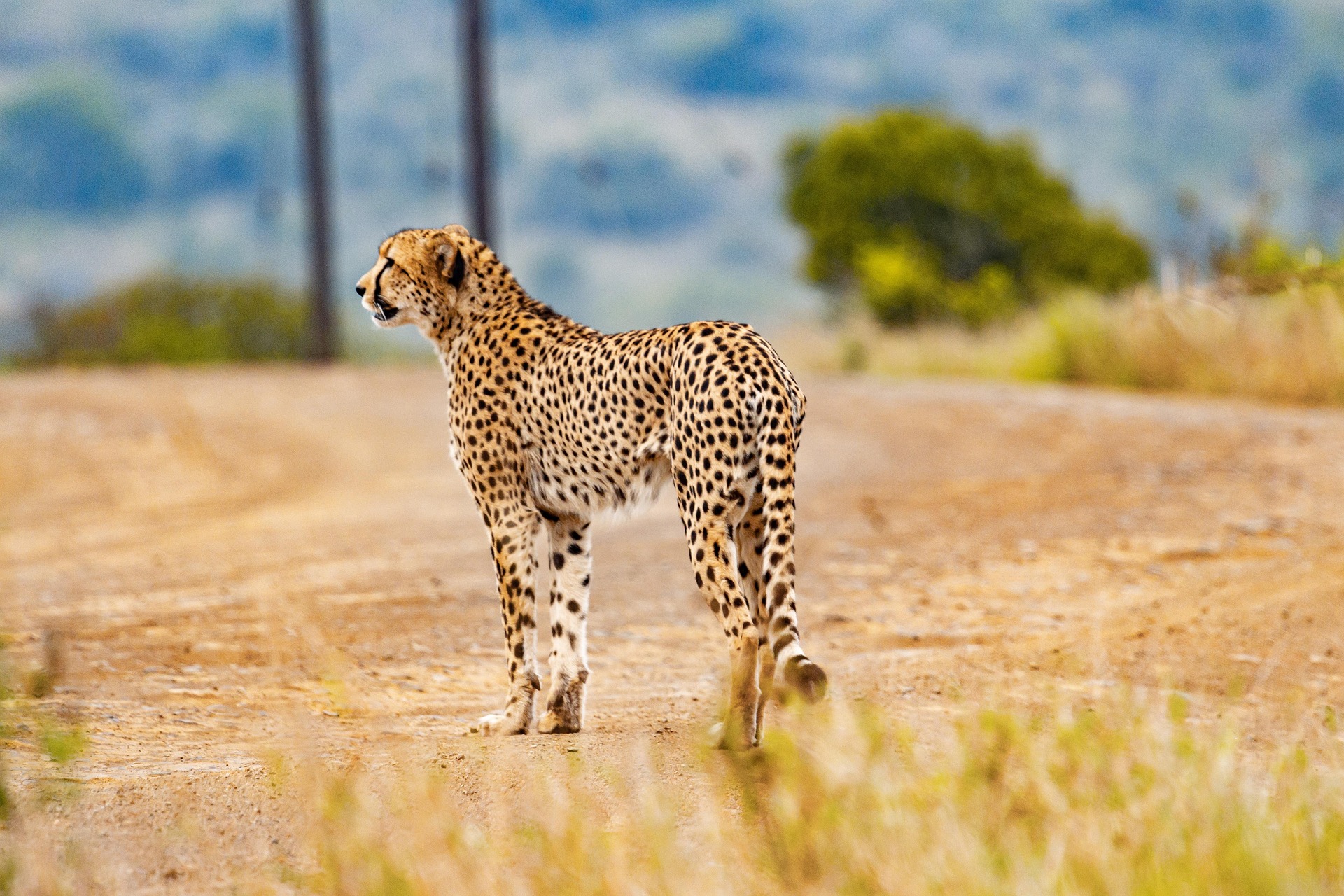
Cheetah Vocalizations
Cheetah vocalizations do not include the “mighty roar” characteristic of lions or tigers. Although cheetahs belong to the cat family (Felidae), they are a species incapable of roaring like the so-called “big cats” (genus Panthera).
Chirp (a high-pitched sound like a small bird)
This is their most distinctive vocalization.
Sounds like “pi!” “kyururu,” or “chi-chi-chi.”
They use these high-pitched sounds to call out to companions or cubs that are far away.
They are used particularly when:
A mother is searching for her cubs
Cubs are calling for their mother
Checking the location of companions
Meow
Surprisingly, cheetahs can also make sounds similar to a domestic cat’s “meow.”
They use these sounds when:
Acting affectionately
Interacting with companions
Cubs are making a request
Purr
Cheetahs purr.
They produce a “goro-goro” (rumbling) sound
When feeling secure
For communication between mother and cub
When relaxing
This behavior is similar to that of domestic cats.
Threatening sounds (hiss / growl)
When angry or on alert, they make sounds like:
“Shaa!” (hiss)
“Uuu…” (growl)
However, these are not the powerful, deep roars characteristic of lions.
Seasonal Activities
Cheetah activity varies significantly depending on the season, temperature, prey movements, and water source conditions. In their primary habitat—the African savanna—behavioral patterns shift mainly between the rainy season (roughly November to April) and the dry season (May to October), rather than the four seasons experienced in Japan.
🌧 Rainy Season (Approx. November–April)
Activity characteristics: Expanded range; peak time for raising cubs
Grass grows tall, and prey populations (such as gazelles) increase
More water sources are available, reducing the need for long-distance travel
Females raising cubs hunt more frequently
Hunting
Tall grass impairs visibility, making it difficult to approach prey
Cheetahs seek out open areas for hunting
Active during cooler times of the day (morning and evening)
Raising Cubs
Mothers leave cubs in a hidden spot and go hunting alone
Cubs must protect themselves from predators (lions, hyenas, etc.)
☀️ Dry Season (Approx. May–October)
Activity characteristics: Period of higher hunting success rates
The dry season is a crucial time for cheetahs.
Reasons:
Grass is shorter
Visibility improves
Prey is easier to spot
Hunting
Primary prey:
Thomson’s gazelles
Impala fawns
Small antelope species
Hunting sequence:
① Scan for prey from high ground or open areas
↓
② Approach slowly (within 100–200m)
↓
③ Accelerate rapidly
↓
④ High-speed chase (approx. 20–60 seconds)
↓
⑤ Bring down prey by targeting the neck
🌅 Daily Activity Rhythm (Morning, Day, Night)
Morning (Most active)
Temperatures are lower
Prey is active
Ideal for hunting
Daytime (Rest)
Rest in the shade
Hydrate
Lower body temperature
Because cheetahs generate immense heat during high-speed runs, they may rest for tens of minutes after a hunt. Night (low activity)
Visibility is reduced in the dark.
There is a high risk of encountering lions or hyenas.
For this reason, they are primarily diurnal.
Walking Speed
A cheetah’s walking speed (its normal pace of movement) is generally around 3–6 km/h.
Movement Speed & Characteristics
- Walking: ~3–6 km/h (Patrolling territory, moving around)
- Slow Run: ~10–20 km/h (Searching for prey, approaching before the chase)
- Stealthy Approach: ~20–40 km/h (Approaching without alerting prey)
- Short-Distance Dash: ~80–100 km/h (The moment of the hunt)
Why are they slow most of the time?
It is because cheetahs are specialized for explosive speed rather than endurance.
High-speed running causes:
- A rapid spike in heart rate
- A sharp rise in body temperature
- Massive oxygen consumption
- Immense strain on the muscles
…so they cannot run for long periods.
Therefore,
They hunt by: walking to search → approaching slowly → sprinting at full speed for just a few to several dozen seconds.
🐾 Normal Activity
- Walks with head held low
- Frequently checks surroundings
- Uses wind direction to approach prey
🐾 Before the Hunt
- Lowers body close to the ground
- Uses tail for balance
- Carefully approaches within a range of a few dozen meters
🐾 The Charge
- Reaches over 70 km/h in about 3 seconds
- Maintains top speed only briefly
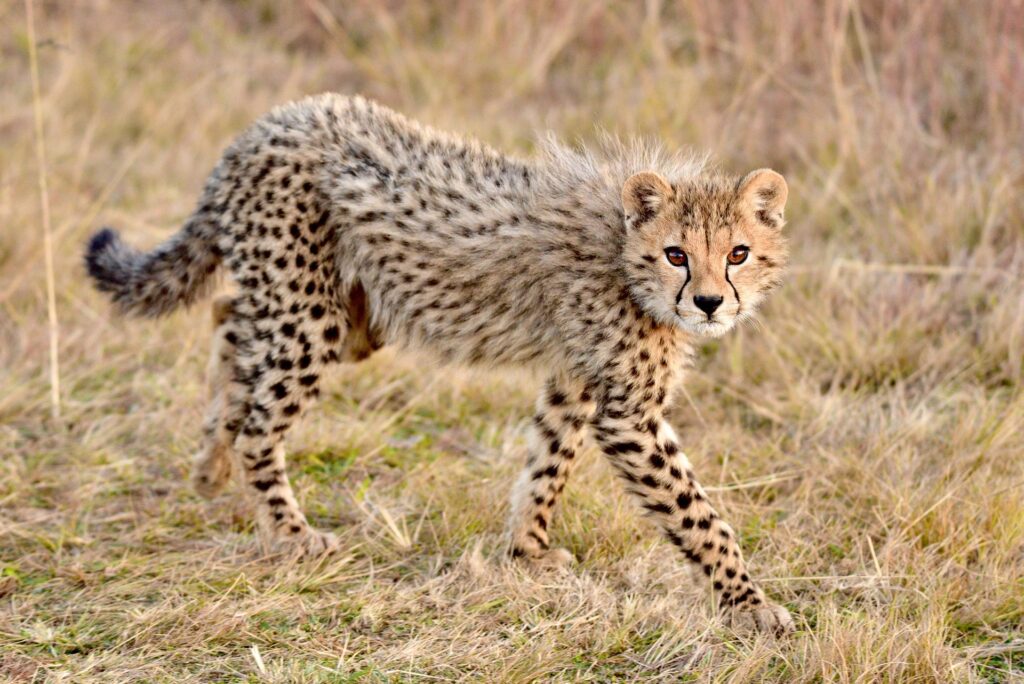
About Cheetah Cubs
This detailed summary of cheetah cubs (calves) provides insight into their postnatal developmental stages, behavior, relationship with their parents, and the process leading up to independence.
- Birth and Early Stages
Gestation Period: Approximately 90-95 days
Litter Size: Typically 3-5 cubs (although occasionally 2-8 cubs)
Newborn Characteristics:
Weight: Approximately 250-350g
Eyes are closed, and the fur is soft.
Long gray or silver mantil hair (mantilia) on the neck and back aids in camouflage (making them less conspicuous in grasslands).
- Cubs’ Development Stages
Monthly Development and Behavior: 0-6 weeks: Cubs stay in their mother’s hideout. While the mother is out hunting, the cubs hide. 6 weeks-3 months: Cubs gradually begin to follow their mother. They learn strength and hunting skills through play. 3-6 months: They begin short-distance hunting practice. They acquire tactics and tracking skills while playing with their siblings. 6 months-1 year: They hunt with their mother. They begin to become independent between 12 and 18 months of age, gradually developing a sense of independence. Males may form small groups with their siblings, while females transition to solitary living.
- Behavior and Personality
Playful and curious
They learn hunting and fighting skills through playing with their siblings.
Their timid nature is evident from an early age, and they quickly hide when they sense danger.
- Developmental Considerations (Risks in the Wild)
They are at high risk of death from predators (lions, hyenas, and birds of prey) within the first six months of life.
They must master prey hunting skills to survive after becoming independent.
Their mother’s hunting ability and habitat significantly affect their offspring’s survival rate.
Are cheetahs an endangered species?
Unfortunately, cheetahs are listed as an endangered species. The estimated population in the 1970s and 1980s was 15,000.
hunting for fur
Cheetah fur sells well. Hunting for their fur has increased significantly and they are being killed by traders. In other cases, they are often overhunted for pets.
habitat destruction
Due to habitat destruction, the area where cheetahs live has become very small. They are sometimes exterminated as pests, and when livestock raised by farmers are attacked, they are exterminated in retaliation.
Can cheetahs be kept?
Unfortunately, they are designated as an endangered species, so their population is small to begin with and they cannot be kept as pets. You can see them at the zoo. They are known to be very fast, and because of their speed, they are famous animals that appear in games and event exhibits. They are more well-known and well-known than other animals.
- Legal Issues
In Japan, cheetahs are listed under Appendix I of the Convention on International Trade in Endangered Species of Wild Fauna and Flora (CITES), requiring strict permission to import, raise, or sell them.
Keeping them without permission is a violation of the law and subject to penalties.
Keeping them is only permitted in facilities with special permits, such as zoos and certain research facilities.
- Difficulties in Raising Cheetahs
Highly Active: As the fastest land mammal, they require ample space to run.
Food Requirements: Each cheetah requires at least 5-10 kg of raw meat per day.
Environmental Requirements:
An environment similar to open grasslands or savannas is required.
Temperature and humidity control, as well as stress management, are essential.
Health Management:
Wild cheetahs are delicate and prone to illness due to stress.
Breeding and rearing also require careful management.
- Personality and Behavior
Timidy and cautious, with low aggressiveness.
Vulnerable to small spaces and noise.
Primarily solitary and not very sociable.
Zoos Housing Cheetahs (Japan & Worldwide)
Cheetahs are currently classified as an endangered species (specifically “Vulnerable” on the IUCN Red List) and are kept in zoos and safari parks around the world for breeding and conservation purposes. They can be seen at several facilities in Japan as well.
🇯🇵 Major Zoos in Japan Where You Can See Cheetahs
🐆 Tama Zoological Park (Tokyo)
One of the most famous cheetah-keeping facilities in Japan.
Features:
A strong track record of successful cheetah breeding
Opportunities to see them running in a spacious enclosure
Collaborates with zoos in Japan and abroad on breeding programs
Has achieved breeding success, including the birth of six cubs in the past.
🐆 Yokohama Zoological Gardens “Zoorasia” (Kanagawa Prefecture)
Features:
Exhibits that recreate the African environment
Easy to observe the cheetahs’ natural behaviors
Actively involved in breeding programs
🐆 Fuji Safari Park (Shizuoka Prefecture)
Features:
Safari-style viewing experience
Cheetahs can be seen in a spacious environment
Involved in supplying captive-bred individuals within Japan
🐆 Himeji Central Park (Hyogo Prefecture)
Features:
Safari-style park
Can be observed in the carnivore zone
Involved in cheetah breeding programs
🌍 Famous Cheetah Facilities Worldwide
🇺🇸 San Diego Zoo Safari Park (USA)
Features:
Vast safari environment
Renowned for cheetah conservation and breeding research
Exhibits that showcase their running ability
🇺🇸 Smithsonian’s National Zoo (USA)
Features:
Participates in rare animal conservation programs
Kept for educational and research purposes
🇿🇦 Cheetah Conservation Fund (Namibia)
While slightly different from a standard zoo, this is a world-famous cheetah conservation facility.
Activities:
Research on reintroduction to the wild
Breeding management
Research on human-cheetah coexistence
🇦🇺 Monarto Safari Park (Australia)
Features:
Vast grounds
Carnivore conservation program
Cheetahs kept in an environment close to nature
Introducing other animals
コメント