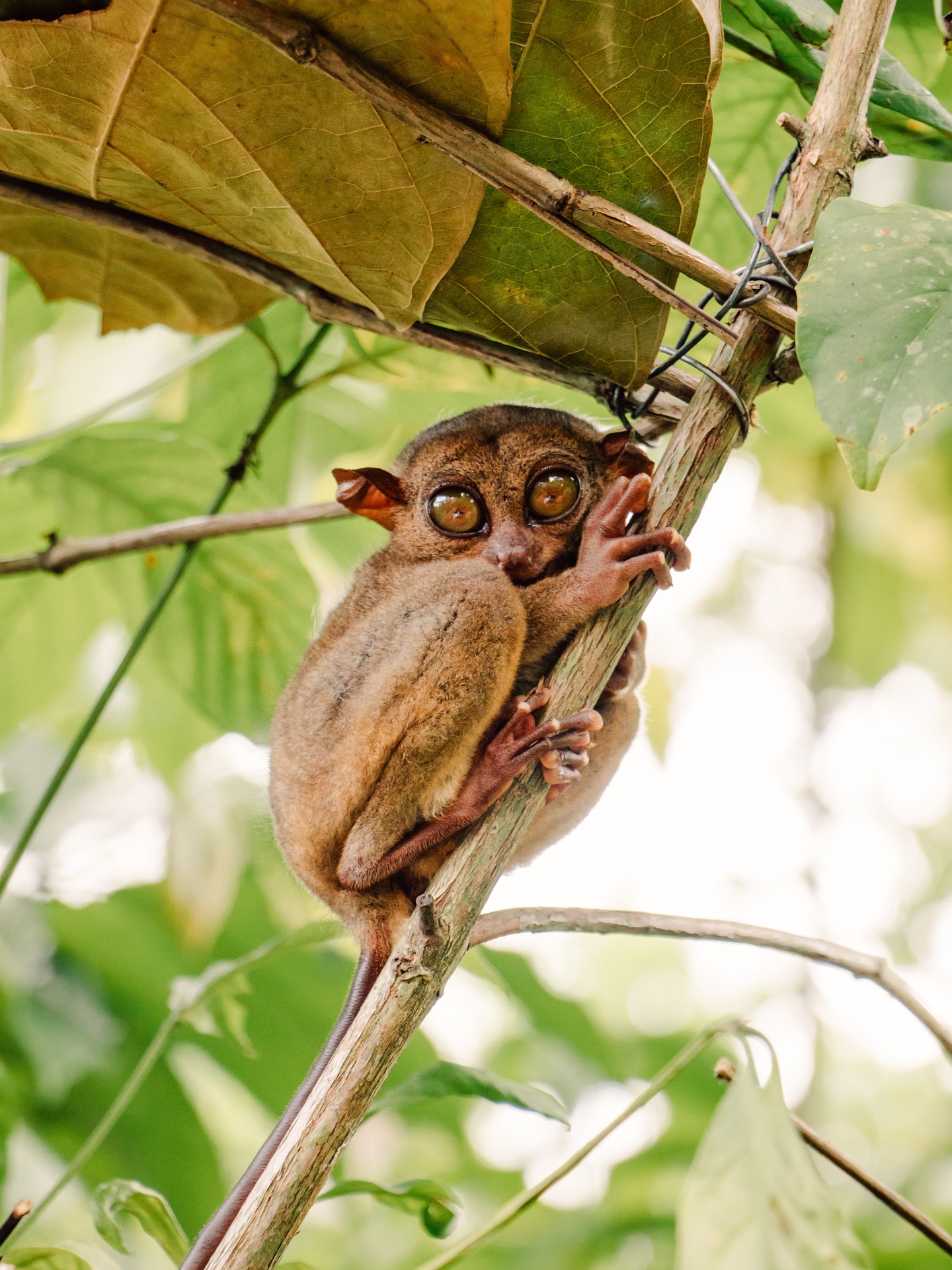
What kind of animal is Tarsier, which is famous in the Philippines? We will thoroughly explain its characteristics, ecology, and habitat. Did you know about the world’s smallest monkey that lives in Bohol? This tarsier is an idol that is like the mascot of Bohol Island and is very popular among tourists.
Who is Tarsier? About basic status
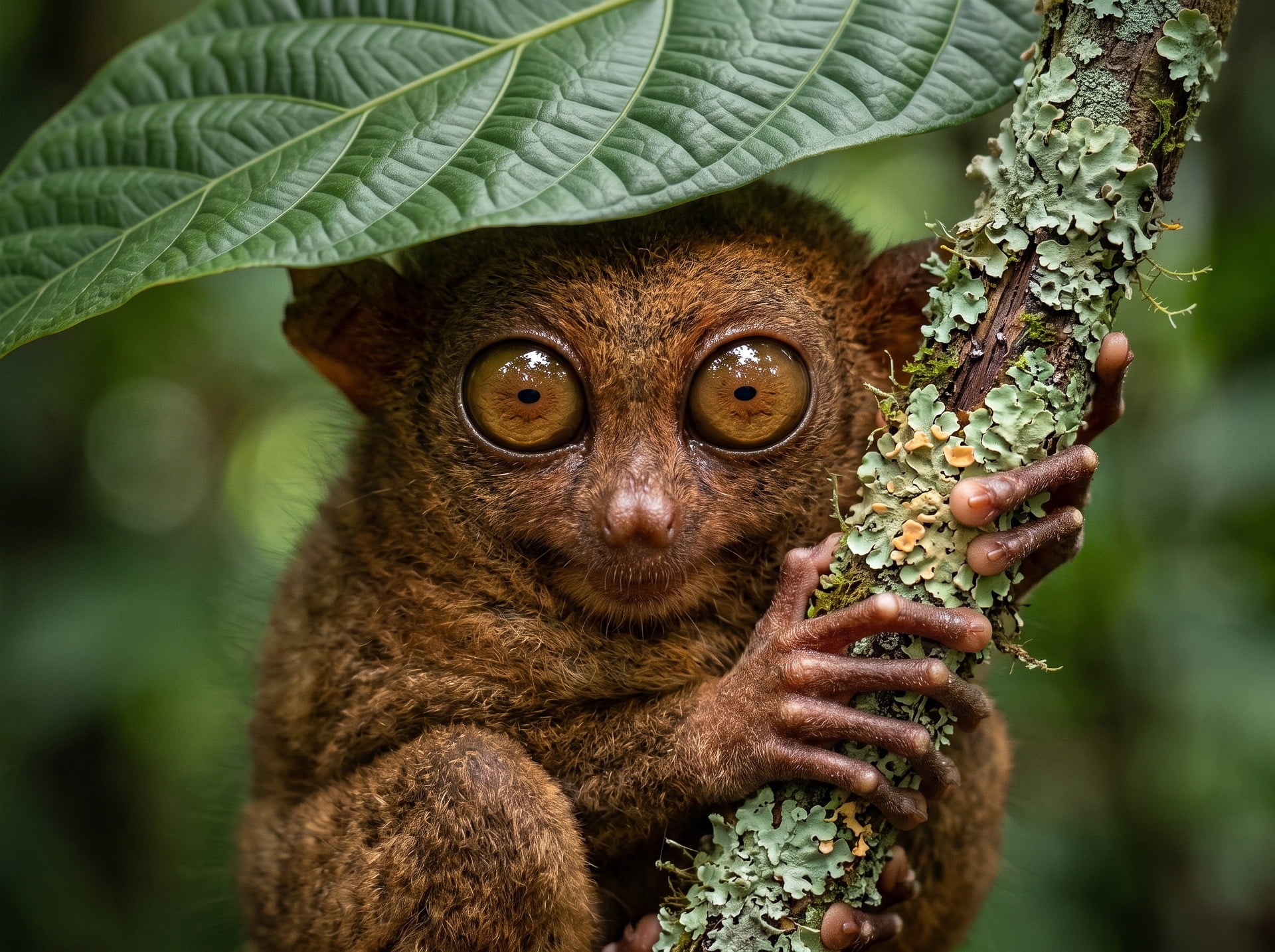
Tarsier is the world’s smallest tarsier. It is a haplorphine primate of the tarsier family. As for its size, it is the world’s smallest monkey, with a body length of only 118 to 149 mm and a weight of approximately 113 to 142 g. Animals in the order primates are broadly divided into prosimians and eusimians. Tasha is classified as a “prosimian”.
| Japanese(和名) | ターシャ |
| English(英名) | Tasier |
| scientific name(学名) | Leopardus guigna |
| classification(分類) | Mammalia、 Tarsiiformes、tarsiridae 哺乳綱、タルシイ目、メガネザル科 |
| IUCN Status(保全状況) | VULNERABLE |
| Length(体長) | 118〜149mm |
| Weight(体重) | 113〜142g |





- What are the roots and origins of the tarsier?
- About habitat
- feature is? What kind of creature is it?
- What do you think about your personality?
- About ecology
- Tarsier Vocalizations
- Seasonal Activities
- Walking Speed
- About Baby Tarsiers
- Is Tarsier an endangered species?
- Can Tarsier be bred?
- Zoos and Facilities Housing Tarsiers (Japan & Worldwide)
- Introducing other animals
What are the roots and origins of the tarsier?
Tarsiers are animals that preserve a particularly ancient lineage among primates. Unlike slow lorises, tarsiers are classified as primitive members of the “Haplorhini” (dry-nosed primates) group—the same lineage that includes monkeys and humans.
Origins: Ancient primates from 45–55 million years ago
Tarsier ancestors were small, arboreal primates that appeared during the early Cenozoic era, following the extinction of the dinosaurs.
The general evolutionary progression is as follows:
Early primates (approx. 55 million years ago)
↓
Tarsier-like primates such as Omomyiformes
↓
Tarsiidae (Tarsier family)
↓
Modern tarsiers
Fossils of early primates exhibiting characteristics similar to tarsiers have been discovered in China, dating back to the Eocene epoch (approx. 55 million years ago).
Where did they come from?
Modern tarsiers inhabit islands in Southeast Asia, including:
The Philippines
Indonesia (around Sulawesi)
The area around Borneo
However, their ancestors inhabited a much wider range.
Fossils of tarsier-related species have been found in:
China
Thailand
Pakistan
Europe
It is believed that they once had a much broader distribution than they do today.
Why did they develop such huge eyes?
The most distinctive feature of the tarsier is:
“Having eyes that are among the largest in the world relative to body size”
The reason for this is their adaptation to a nocturnal lifestyle.
Tarsiers evolved large eyeballs to:
Be active at night
Hunt for insects in dark forests
Accurately detect sounds and movements
Incidentally, because tarsiers cannot move their eyes within their sockets, they rotate their heads extensively to survey their surroundings.
Distant relatives of monkeys and humans
Taxonomically, tarsiers belong to the:
Haplorhini (dry-nosed primates) Same group:
Tarsiers
Old World monkeys (such as Japanese macaques)
Chimpanzees
Gorillas
Humans
In short, the tarsier is:
“A small, nocturnal animal, yet a primate that is evolutionarily closer to the human lineage.”
Among extant primates, tarsiers are closely related to the lineage that gave rise to apes and monkeys.
Why they are called “living fossils”
Tarsiers have maintained their basic body plan for over 40 million years.
Retained characteristics:
Large eyes
Long fingers
Powerful jumping ability
Insectivorous diet
Nocturnal habits
In particular, the characteristics of their teeth and skulls are considered to have undergone little change since the time of ancient tarsiers.
About classification
Fossils of tarsiform primates have been found throughout Asia, Europe, and North America. Tarsiers like Tasha can now only be found in Southeast Asia. Below is a list of extinct monkeys. Tarsiers were distributed in China, Pakistan, and Thailand during the Miocene era, but are now extinct.
- Tarsius eocaenus (China)
- Hesperotarsius thailandicus(Thailand)
- Hesperotarsius sindhensis(Pakistan)
- Tarsius sirindhornae(Thailand)
分類階級(taxonomy)
- 界:動物界 (Animalia)
- 門:脊索動物門 (Chordata)
- 綱:哺乳綱 (Mammalia)
- 目:霊長目 (Primates)
- 亜目:ハプロルヒネ亜目 (Haplorrhini) — 霊長類の「乾鼻類」グループ
- 下目:ターシイ形下目 (Tarsiiformes) — ターシャ類だけのグループ
- 科:ターシイ科 (Tarsiidae)
- 属:Tarsius / Cephalopachus / Carlito(3属に分けられる)
- 種:複数のターシャ種(約12〜14種)
About habitat
Tarsier can currently be seen only on Bohol Island, Cebu Island, Philippines. Since it is a tourist spot, it is a place that adults visit on tours. Care must be taken when moving around the island. Please be careful when taking photos at the facility. There are also rules prohibiting humans from visiting. Be careful and move quietly.
1. Philippine Tarsier (Carlito syrichta)
Distribution: Several islands in the Philippines
Mainly: Bohol, Cebu, Negros, and Panay
Habitat:
Lowland to hilly tropical rainforests
Living in the lower to mid-story trees
Characteristics: Nocturnal, moving by jumping in trees. Requires dense forests.
2. Western Tarsier (Cephalopachus bancanus)
Distribution: Sumatra, Borneo, Malay Peninsula (Sundaland region)
Habitat:
Also found in tropical rainforests, mangrove forests, and secondary forests
Arboreal, using shrubs and thin branches
Characteristics: Small, strong jumper, preying on insects and small animals at night
3. Sulawesi Tarsier (Tarsius genus)
Distribution: Sulawesi Island and surrounding islands, Indonesia
Habitat:
Tropical rainforests, secondary forests, and forests near agricultural fields
Lying in the lower to mid-story treetops
Representative species:
Tarsius tarsier
Tarsius wallacei (Wallace’s Tarsier)
Tarsius lariang (Lariang’s Tarsier)
Tarsius niemitzi (Niemitzi’s Tarsier)
4. Common Ecological Characteristics
Nocturnal: Active in dark forests
Arboreal: Spends almost their entire life in trees
Highly dependent on forests: Habitats are shrinking due to deforestation and agricultural development
Diet: Insects, small invertebrates, small birds
feature is? What kind of creature is it?
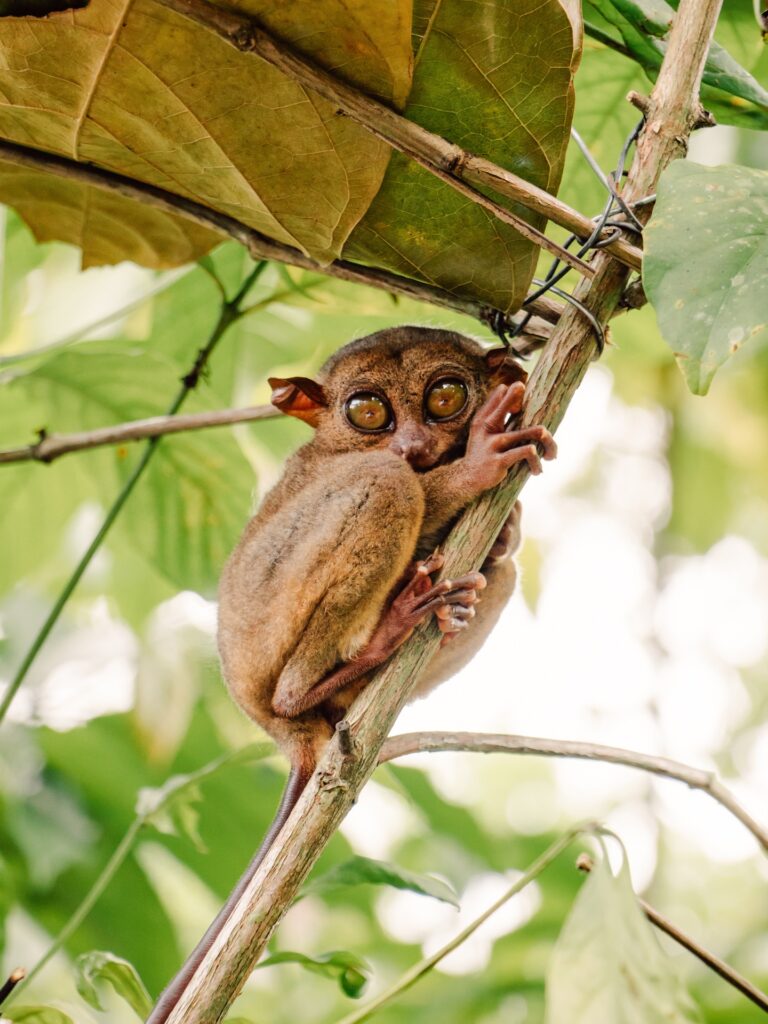
Tasha’s big eyes are her charm point. He developed large eyes to help him see at night, but this became his enemy and his eyes stopped moving. Tasha’s neck can now move 180 degrees to the side, making her look like an owl. They are nocturnal creatures, sleeping during the day because they have many predators. They usually climb up trees or hide in hollows on the ground.
1. Physical Characteristics
Body Size: Small
Body Length: Approximately 10-15 cm (head and body length)
Tail Length: Approximately 20-25 cm
Weight: Approximately 80-160 g
Face: Characterized by large eyes
Because they are nocturnal, their eyes are very large relative to their body.
Their eyes are fixed and immovable, but they can rotate their heads 270 degrees to survey their surroundings.
Ears: Large, round, and movable
Limbs: Very long hind limbs, allowing for powerful jumping.
Long toes, suitable for grasping in trees.
Fur: Covered in soft, short hair, typically brown to gray in color.
2. Ecological and Behavioral Characteristics
Nocturnal
Active at night, feeding on insects and small animals
Arboreal Life
Spends most of its time in trees
High jumping ability for mobility between trees
Social
Live alone or in small family units
Communicates through calls and smell
Diet
Mainly insectivores (locusts, beetles, etc.)
May also eat small vertebrates and fruit
3. Intelligence and Senses
Large eyes allow for excellent vision, even at night
Sensitive ears allow for the detection of subtle sounds
Developed muscles in the hind legs allow for long-distance jumps
High agility for a small primate
4. Human Impression
“A cute monkey with big eyes like a small owl”
“Long limbs allow it to fly through the trees like a miniature ninja”
Because it is nocturnal, it stays still most of the day, but is agile when it moves.

What do you think about your personality?
Tasha is very sensitive and sensitive to stress. If they are under a lot of stress, they may commit suicide by banging their head against a tree. There are very strict rules set locally when going to see someone, and tourists must strictly follow them.
1. Basic Personality and Characteristics
Timid and cautious
Sensitive to noise and light to protect themselves from predators (snakes and birds of prey)
Quiet and nocturnal
Moves almost motionless during the day, staying still in tree crevices and branches
Becomes active at night
Nimble and agile
Jumps from tree to tree with incredible speed
Moves like a “little ninja”
2. Sociality and Interactions with People
Mainly solitary or in small groups
Live alone or in small family units such as a parent and child
Unlike large monkeys, which live in groups, they tend to prefer solitude
Methods of Communication
Signals to others with high-pitched calls
Tail and body movements, as well as scent, indicate territory and presence
Highly territorial
Will call out to intimidate other Tarsiers if they enter their territory
3. Diet and Hunting Personality
Strong curiosity and hunting instinct
Looking for insects and small animals at night, they observe them closely
Sensitive to even the smallest movements
Careful and calculated movements
When moving between tree branches, they always look before leaping
Careful to avoid falls and mistakes
4. Overall Impression
Small and cute, but with a cautious and wary personality
Prefers solitude, is agile, and intelligent
Nocturnal, with a strong hunting instinct and excellent observation skills
About ecology
Tarsiers are insectivores and will jump on and capture invertebrates. They may also eat scarab beetles, small flying frogs, and lizards. During breeding, the gestation period is half a year, and they give birth to one offspring. Primarily Tashas live in small family groups. Their lifespan is very short, said to be 10 to 20 years.
1. Habitat
Region: Southeast Asia
Philippines, Sundaland (Sumatra, Borneo, and the Malay Peninsula), Sulawesi
Environment: Tropical rainforest lowlands to hills, secondary forests, and mangrove forests
Habitat: Primarily arboreal (low- to mid-story branches)
Characteristics: Requires dense forests and tree canopies; deforestation has reduced their habitat
2. Behavior
Nocturnal
Rests quietly in tree crevices and branches during the day
Active at night, searching for food
Arboreal Movement
Jumps between branches using their long hind legs (capable of jumps of up to 3 meters or more)
Quietly walks along tree branches to protect themselves from predators
Solitary/Territorial
Mainly lives alone or in small parent-child groups
Has a territory and communicates with others by vocalization and scent
3. Diet
Main Food: Insects (beetles, locusts, spiders, etc.)
Other: Small vertebrates, fruit, tree sap, etc.
Hunting Characteristics:
Carefully observe movements before pouncing
Highly skilled at nighttime hunting, with agile, calculated movements
4. Reproduction and Growth
Reproduction: Viviparous (mammals)
Birth: Usually one baby at a time
Gestation Period: Approximately 6 months (varies by species)
Rearing: Mothers carry and raise one baby
Growth: Baby tarsiers are able to jump on their own within a few months of birth
5. Sociality and Communication
Calls: High-pitched calls to signal to peers
Smell: Used for territorial marking and individual recognition
Quiet and hidden during the day, but active and hunt at night
Who is Tasha’s natural enemy?
Since Tasha is a very small animal, it has many natural enemies in nature. They are preyed upon by monitor lizards, owls, and other animals, so they are very careful when living their lives.
Tarsier Vocalizations
Tarsiers are known for using high-pitched, quiet vocalizations. Despite their cute appearance, in the wild, they engage in “silent communication” that is difficult for humans to hear.
High-pitched “chee” or “pee” sounds
These are their most well-known vocalizations.
Uses:
Locating other group members
Communication between parent and offspring
Alerting others to danger
Although the volume is low, the sound carries over long distances in the forest.
High-frequency sounds bordering on ultrasound (barely audible to humans)
A major characteristic of tarsiers is their ability to produce sounds at frequencies exceeding the human hearing range.
Philippine tarsiers, in particular,
have been confirmed to use ultra-high-frequency sounds
of around 70 kHz.
This is a very rare ability among primates.
Uses:
Communicating without alerting predators
Signals audible only to other group members
Linked to the ability to detect sounds made by insects and other prey
Alarm calls
When sensing danger,
“Kitt”
“Chitt”
—short, sharp sounds—
they emit alarm calls.
Because tarsiers are small, they do not merely flee; they also use vocalizations to warn others of danger.
Courtship and mating calls
During the breeding season,
males and females exchange short calls
to confirm each other’s presence.
However, tarsiers are not animals that make loud noises in large groups; they generally live quietly, either alone or in small family units.
Seasonal Activities
Since tarsiers inhabit the forests of tropical and subtropical islands, they do not exhibit the distinct seasonal changes (such as hibernation or migration) seen in animals native to Japan.
However, their activity patterns do shift based on the wet and dry seasons of their habitat, insect abundance, and breeding cycles.
🌱 Spring (Transition from dry season to wet season)
Activity level: Trending upward
As rainfall increases, insect activity within the forest picks up.
Key behaviors:
Increased nocturnal hunting
Moving within their territory to search for insects
Increased exploratory behavior by males
Heightened breeding activity in some regions
Tarsiers primarily prey on:
Grasshoppers
Crickets
Moths
Praying mantises
Small lizards
☔ Summer (Wet season)
Activity level: High
A time of abundant food for tarsiers.
Nocturnal behavior:
Activity begins immediately after sunset
Jumping from tree to tree
Searching for prey with large eyes
Locating insects by sound
Hunting efficiency improves due to the increase in insects during the wet season.
In some regions, this is also a crucial time for breeding and rearing offspring.
🍂 Autumn (End of wet season / Transition to dry season)
Activity level: Slightly lower
As insect numbers begin to decline, they:
Adjust their range of movement
Utilize feeding grounds more efficiently
Reduce unnecessary jumping
Tarsiers are very small and expend significant energy maintaining body temperature, making them highly sensitive to food availability.
🌵 Winter (Dry season)
Activity level: Lower (varies by region)
In tropical regions like the Philippines, “dryness” has a greater impact than cold temperatures.
Changes:
Insect numbers decrease
Hunting duration shortens
Securing water becomes critical
Daytime resting periods may increase
However, tarsiers do not hibernate.
They remain active at night as usual.
🌙 Daily Activity Rhythm
Daytime
Mostly resting.
Locations:
Tree branches
Thickets
Tree hollows
They sleep curled up in these spots.
Evening to Night
Most active. Activity:
Around 18:00–20:00
↓
Activity begins
↓
Hunting for insects
↓
Vocal confirmation with the group
↓
Rest at dawn
Walking Speed
They are highly agile primates.
Rather than “walking speed,” they have evolved to specialize in movement via jumping (leaping).
🚶 Walking Speed
While there is limited precise data on their walking speed in the wild, when moving along branches, they:
Walk slowly: approximately 0.2–0.5 km/h
Usually move while quietly gripping the branches
However, this is their speed during routine movement; it does not represent the Tarsier’s true capabilities.
🦘 Jumping Speed and Leaping Ability
The Tarsier’s most distinctive feature is its leaping ability.
Capabilities:
Jump distances several to over ten times their body length
Cover several meters in a single leap
Leap from branch to branch using powerful hind legs
This is an astonishing level of physical ability for a small animal with a body length of only about 10–15 cm.
Why can they move so quickly?
Tarsiers evolved as nocturnal insect hunters.
Features:
① Long hind legs
Well-developed thighs
Powerful pushing-off force
② Large eyes
Spot prey in the dark
Accurately judge distances
③ Rotating neck
Check surroundings
Assess the landing spot before jumping
About Baby Tarsiers
This article summarizes the biology of baby tarsier (or tarsiers) from an ecological perspective, including their appearance, growth, and behavior.
1. Birth and Early Characteristics
Birth: Usually one pup per litter
Weight and Size: Approximately 15-20g at birth, approximately 10cm in length
Fur: Covered in soft fur
Eyes: Their large eyes are striking until they mature, but their eyesight is still immature
Ears and Limbs: Large, but their hind legs are not yet strong enough for jumping
2. Growth and Development
Nursing Period: Nursing by mother
Independence: By 2-3 months of age, they are gradually able to move between branches without their mother’s assistance
Jumping Ability: They are able to jump from tree to tree by 3-6 months of age
Weight Gain: By 6 months of age, they have grown to about half their adult weight
3. Behavior and Personality
Living Closely to Their Mother
Alertness: Young animals are naturally alert and sensitive to sound and light.
Play Behavior: They develop athletic and jumping abilities by playing with their paws near their mother.
Communication: They communicate with their mother and neighbors through vocalizations.
4. Adaptation to Nocturnal Life
Young animals are nocturnal, but initially spend the night in their mother’s arms.
As their large eyes and nighttime vision improve, they gradually become able to move independently.
5. Ecological Points
Highly Dependent on Their Mother: They are almost always held in their mother’s arms for the first few months.
Agility Acquisition Period: They learn hind leg jumping ability and arboreal skills through play and imitation.
Sense of Danger: They are naturally alert, and their instinct to protect themselves from predators develops early on.
Is Tarsier an endangered species?
Unfortunately, the tarsier is listed as an endangered species. A protected area near the town of Cholera on the island of Bohol in the Philippines has been set up and strictly managed. In 2008, it was listed as one of the world’s 25 most endangered primate species by Conservation International and the IUCN/SCC Primate Specialist Group.
1. Reasons for Endangerment
The Tarsier’s habitat is restricted to the tropical rainforests of Southeast Asia, and its population is declining due to the following factors:
Deforestation
Agricultural land development (plantations, agriculture)
Logging
Urban development
Habitat fragmentation
Forest fragmentation leads to population isolation
Decreased genetic diversity and breeding difficulties
Captivity for pets
Due to their cute appearance, they are sometimes captured as illegal pets.
Can Tarsier be bred?
Unfortunately, Tarsier are designated as an endangered species, so it is extremely difficult for the general public to keep them. The only way to see it is at a zoo.
1. Difficulty in Raising Tarsiers
Nocturnal and with a Unique Activity Rhythm
Sleeping Most of the Day
Because they are active at night, they are difficult to observe in a home environment, and their rhythms do not match theirs.
Highly sensitive and timid
Sensitive to sound, light, and stimuli, they become easily stressed.
They have a strong instinct to protect themselves from predators, and do not easily adapt to human contact.
Unique Diet
They are exclusively carnivorous, eating mainly insects and small animals.
Securing food in captivity is difficult, and maintaining a balanced diet is difficult.
They must live in trees.
They require high jumping ability and arboreal mobility.
They suffer from severe lack of exercise and stress in captivity.
2. Laws and Regulations
Many Tarsiers are classified as Endangered Species (IUCN: VU-EN), and trade and captivity are restricted internationally.
They are listed in Appendix II of the Convention on International Trade in Endangered Species of Wild Fauna and Flora (CITES), and import and export require permission.
They are likely to be restricted in Japan under the Wildlife Protection Act and the Alien Species Act.
3. Cases Where Captivity is Possible
Public institutions, zoos, and research facilities are the primary breeding locations.
Breeding programs and conservation purposes
A suitable environment can accommodate their nocturnal behavior, arboreal lifestyle, and specialized diet.
Keeping them at home is not practical.
Despite their small size and cute appearance, they are sensitive to stress and difficult to maintain healthy.
4. Summary
The Tarsier is an endangered wild animal with a unique ecology.
Keeping them as pets at home is inappropriate.
Zoos and nature reserves are the primary locations for conservation and observation.
Zoos and Facilities Housing Tarsiers (Japan & Worldwide)
Tarsiers are primates that are extremely difficult to keep in captivity.
This is due to characteristics such as:
Being nocturnal and highly susceptible to stress
Requiring a large home range
Having a specialized diet consisting mainly of insects
Requiring delicate environmental management
Consequently, they are rarely found in typical large-scale zoos and can only be seen at conservation centers, research facilities, and select zoos.
🇯🇵 Facilities in Japan where you can see Tarsiers
Nasu World Monkey Park
One of the prominent facilities in Japan that has exhibited tarsiers.
Features:
A track record of exhibiting small primates
A facility dedicated to showcasing rare monkey species
Previously provided information on tarsier ecology
*Note: Housing status changes based on animal transfers or health conditions; it is recommended to check before visiting.
Kochi Prefectural Noichi Zoological Park
A zoo that places great emphasis on the care and exhibition of primates.
They have a track record of keeping rare small primates, including tarsiers.
🌏 Major facilities worldwide where you can see Tarsiers
🇵🇭 Philippines
Philippine Tarsier Sanctuary
One of the world’s most famous tarsier conservation facilities.
Features:
Conservation of the Philippine Tarsier
Observation in a forest environment close to the wild
Breeding and research activities
Globally, this is the premier location for seeing tarsiers.
Tarsier Conservation Area
A major observation spot on Bohol Island.
Features:
An environment close to natural forest
Protection as a nocturnal animal
Focuses on observing wild individuals
🇺🇸 USA
San Diego Zoo
A world-renowned zoo.
Features:
Conservation research on rare primates
International breeding and research activities
Note: Tarsier exhibition status varies depending on the time of year.
🇬🇧 UK
ZSL London Zoo
A zoo famous for primate research and conservation.
Features:
Conservation of rare animals
Primate research
Introducing other animals


コメント