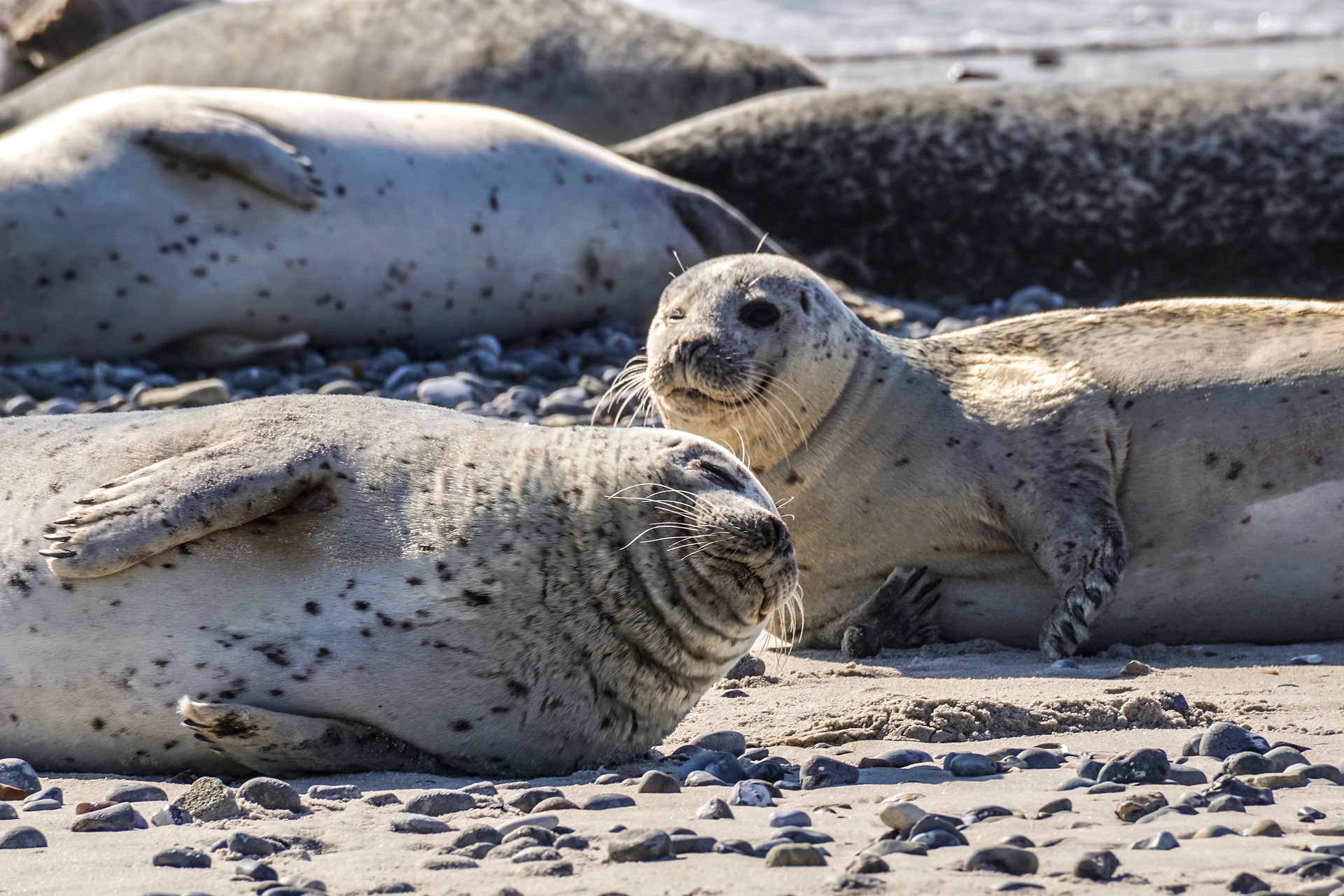
What kind of animal is a seal? We will explain the physical characteristics, ecology, and habitats of marine mammals. One of the creatures that attracts a lot of attention at aquariums is seals. You can see seals in any aquarium or zoo, but what kinds of seals are there? Please use this as a reference as we have summarized the types and characteristics.



- What is a seal? About basic status
- What are the roots and origins of seals?
- Ancestors were land-dwelling carnivores
- An early seal ancestor: Puijila
- Unique evolution of seals
- About classification
- Cystophora cristata
- Erignathus barbatus
- Halichoerus grypus
- Histriophoca fasciata
- Hydrurga leptonyx
- Leptonychotes weddellii
- Lobodon carcinophagus
- Mirounga angustirostris
- Mirounga leonina
- Monachus monachus
- Monachus tropicalis
- Ommatophoca rossii
- Pagophilus groenlandicus
- Phoca largha
- Phoca vitulina
- Pusa caspica
- Pusa hispida
- Pusa sibirica
- Where is its habitat?
- feature is? What kind of creature is it?
- What is your personality like?
- What is the ecology like?
- Seal Diving
- Vocalizations
- Seasonal Activities
- Walking Speed
- About Seal Pups
- Are seals an endangered species?
- Difference between seal and sea lion
- Can seals be kept?
- Facilities Housing Seals (Japan & Worldwide)
- Introducing other animals
What is a seal? About basic status
Seals are a group of marine mammals (sea animals, fish) that belong to the pinniped order. Their scientific name is Phocidae, which means they are like seals. Depending on the subspecies, they can be 200-300cm long and weigh 200-400kg. The basic information is as follows. Both young and adults can often be seen moving around and eating on the ice or coasts. In Japan, you can see many of them in zoos from Hokkaido to Kyushu. They catch a variety of prey in the water.
| Japanese(和名) | アザラシ |
| English(英名) | Seal |
| scientific name(学名) | Phocidae |
| classification(分類) | Mammalia、 Carnivora、 Phocidae 哺乳綱、食肉目、アザラシ科 |
| IUCN Status(保全状況) | VULNERABLE~ENDANGERED |
| Length(体長) | 200-300cm |
| Weight(体重) | 200-400kg |
What are the roots and origins of seals?
Tracing the roots of seals leads us back to a carnivorous mammal that walked on land—a fact hard to imagine given their current appearance. Seals belong to the group known as Pinnipedia (which also includes fur seals and sea lions) and are the descendants of animals that ventured into the ocean approximately 30 million years ago.
Ancestors were land-dwelling carnivores
Between 50 million and 40 million years ago, the lineage leading to modern seals consisted of land-dwelling members of the order Carnivora.
The evolutionary progression:
Land-dwelling carnivorous mammal
↓
Semi-aquatic animal living near the water’s edge
↓
Early pinniped
↓
Evolution into the family Phocidae (true seals)
An early seal ancestor: Puijila
A well-known early pinniped is:
Puijila darwini
It lived approximately 24 million years ago (early Miocene).
Characteristics:
Body length: Approx. 1 meter
Had four legs
Capable of walking on land
Capable of swimming in water
Resembled an otter
It was an “amphibious” animal that existed before evolving into the modern seal.
Unique evolution of seals
The family Phocidae underwent significant physical changes to adapt to life in the ocean.
Forelimbs
Past:
Legs used for walking
Present:
Small, flipper-like forelimbs
Used for steering while swimming
Hind limbs
This is the seal’s most distinctive feature.
Hind flippers extend backward
Propel the body by swinging side-to-side
Cannot rotate forward on land
Consequently, on land, they move by:
“Wriggling the body while lying on the belly”
Body shape
Adapted for life in the ocean by acquiring:
A streamlined body
A thick layer of fat (for insulation)
Dense fur
The ability to store oxygen
About classification
Seals are made up of many different species. There are the following subspecies. It is said that seals branched off from a common ancestor with weasels. It is said that their ancestors are close to bears. There are various species of mammals in some areas.
| Name (名前) | Scientific Name (学名) |
| Hooded seal ズキンアザラシ | Cystophora cristata |
| Bearded Seal アゴヒゲアザラシ | Erignathus barbatus |
| Gray Seal ハイイロアザラシ | Halichoerus grypus |
| Ribbon Seal クラカケアザラシ | Histriophoca fasciata |
| Leopard seal ヒョウアザラシ | Hydrurga leptonyx |
| weddell seal ウェッデルアザラシ | Leptonychotes weddellii |
| Crabeater seal カニクイアザラシ | Lobodon carcinophagus |
| Northern Elephant Seal キタゾウアザラシ | Mirounga angustirostris |
| Southern elephant seal ミナミゾウアザラシ | Mirounga leonina |
| Mediterranean monk seal チチュウカイモンクアザラシ | Monachus monachus |
| Caribbean Monk Seal カリブモンクアザラシ | Monachus tropicalis |
| Ross seal ロスアザラシ | Ommatophoca rossii |
| Harp seal タテゴトアザラシ | Pagophilus groenlandicus |
| Spotted Seal ゴマフアザラシ | Phoca largha |
| Harbour Seal ゼニガタアザラシ | Phoca vitulina |
| Caspian seal カスピカイアザラシ | Pusa caspica |
| Ringed Seal ワモンアザラシ | Pusa hispida |
| Baikal seal バイカルアザラシ | Pusa sibirica |
Cystophora cristata
Hooded seals are 200-300cm long. Weight 200-400kg. Males are larger than females and have gray fur with irregular dark spots. This seal lives in the North Atlantic and Pacific Ocean, and its meat is eaten, its fat is used for fuel, and its fur is used for leather products, and it is listed as an endangered species.
Erignathus barbatus
Bearded seals belong to the genus Bearded Seal and live from the Arctic to the Bering Sea. The body length is 200-260cm, the weight is 200-360kg, and the body color is light gray to dark brown. Populations are very stable and are classified as Least Concern.
Halichoerus grypus
Gray seals live in the North Atlantic Ocean and can grow up to 1.6m to 2m in length and 100kg in weight. In recent years, the population of gray seals has increased so much on the western side of the North Atlantic that there are calls for their removal in Canada.
Histriophoca fasciata
The black seal is a subspecies with distinctive band-like patterns around its neck, waist, and legs, and it lives near the Sea of Okhotsk. The body length is 170cm and the weight is 70-130kg. They are very solitary, usually traveling in groups of one or two, and their population is very stable.
Hydrurga leptonyx
Leopard seals live in Antarctica and are 2.8 to 3.3 meters long and weigh 300 to 500 kg. The body shape is elongated. The head is large and the tip of the snout is pointed. Seals do not form groups and live alone, have few natural predators, have a stable population, and are classified as low concern.
Leptonychotes weddellii
Weddell seals live in Antarctica and are approximately 2.9 meters long for males and 3.3 meters for females. Weight is 400-450 kg. This species is distributed in the waters near Antarctica and often appears at Antarctic bases, so many photographs have been taken of it. The population is stable and it is classified as low concern.
Lobodon carcinophagus
The crabeater seal lives in Antarctica and is 220-230cm long and weighs 200-300kg. The body shape is elongated. Their whole body is covered with pale gray hair, and they live mainly on drift ice. The population is stable and it is classified as low concern.
Mirounga angustirostris
Northern elephant seals belong to the genus Elephant Seal. Male seals are very large, weighing 1,500 to 2,300 kg and reaching 4 to 5 meters in length. They are polygamous, and the elephant seal’s distinctive feature is its elephant trunk. The population is stable and it is classified as low concern.
Mirounga leonina
Southern elephant seals live on islands in the sub-Antarctic and can be seen in large numbers in areas such as South Georgia. The body length is 4.2 to 5.8 m and the weight is 1,500 to 3,700 kg. The elephant seal, which is polygamous and is characteristic of elephant seals, is larger in northern elephant seals. The population is stable and it is classified as low concern.
Monachus monachus
Testudo monk seals live in the Atlantic Ocean and the Mediterranean Sea, and are 230-280 cm long and weigh 200-300 kg. The fur on the back is black or brown, and there are white markings on the abdomen. Due to overfishing and competition with fishing, their population has declined dramatically, and they are designated as an endangered species.
Monachus tropicalis
Caribbean monk seals live in the Caribbean Sea and can be over 2m long and weigh 160kg. Caribbean monk seals were overhunted and became completely extinct in 1952.
Ommatophoca rossii
Ross seals live in Antarctica and have a body length of 1.68-2.09m and a weight of 129-216kg. The snout is short and wide, and the fur is the shortest of all seals. Populations are very stable and are classified as Least Concern.
Pagophilus groenlandicus
Harp seals are widely distributed in the North Atlantic Ocean, and can reach a length of 190 cm and a weight of about 135 kg. The fur is gray and has markings. Harp seals live in the ocean and on glaciers, and sometimes live in groups. Populations are very stable and are classified as Least Concern.
Phoca largha
Harbor seals live in the Bering Sea and the Sea of Okhotsk, and their body length is between 160 and 170 cm, and their weight is between 70 and 130 kg. The back is gray with scattered black markings. Populations are very stable and are classified as Least Concern.
Phoca vitulina
Harbor seals are widely distributed from the Atlantic Ocean to the Pacific Ocean. Harbor seals are 120-170cm long and weigh 50-150kg. There are two types of body color: dark and light. Populations are very stable and are classified as Least Concern.
Pusa caspica
The Caspian seal is a seal that lives in the Caspian Sea and other areas.In the summer, it lives in the southern part of the Caspian Sea, and in the winter, it moves north to the northern part of the Caspian Sea. The body length is 180cm, the weight is 90kg, and it is endemic to the Caspian Sea, so it is designated as an endangered species because its population is small.
Pusa hispida
Ringed seals are small seals that are widely distributed in the northern part of the Northern Hemisphere, with a body length of 120 to 130 cm and a weight of 50 kg. The back side is gray with gray-brown to black markings, and it is smaller than other seals. Populations are stable and classified as low concern.
Pusa sibirica
Baikal seals live around Lake Baikal in Russia. The body length is 100-110cm and the weight is 50-90kg. The flanks are yellowish gray and the overall color is dark grayish brown. It is the only seal in the world that lives exclusively in freshwater, and its population is stable and classified as low concern.
Where is its habitat?
Seals are distributed in the world’s oceans, including the Atlantic, Pacific, and Caribbean.
- Geographic Distribution
Seals can be broadly divided into “species that live in cold regions such as the Arctic and Antarctic” and “coastal species that live in temperate and subtropical regions.”
Arctic and Cold Region Seals
Arctic Seals: Northern Canada, Greenland, and the Arctic Ocean coast
Harp Seals: North Atlantic coast, Greenland, Iceland, and Norway
Antarctic and Cold Region Seals
Ringed Seals and Bearded Seals: Sea ice around Antarctica
Temperate and Coastal Seals
Spotted Seals: North Pacific coast, Hokkaido, the Kuril Islands, and the Aleutian Islands
California Seals: West Coast of North America
- Habitat Characteristics
Marine: Spends most of its time in the water
Coastal and Ice Resting: Comes onto the shore or ice for breeding and molting
Ice and Beach Use: Spawning (birth) and raising children are limited to safe areas
- Migration and Range
Migrates in response to seasonal changes in ice and water temperature
Travels widely across the ocean in search of food (fish, squid, and crustaceans)
feature is? What kind of creature is it?
Seals are marine mammals that belong to the family Sealidae. Seals have very sensitive whiskers to detect prey. The neck is short and the limbs have five fingers, with webs between them. Seals are known for their excellent diving ability, and some subspecies can dive more than 1,000 meters. The nasal passages can be closed and most of the air in the lungs can be exhaled.
- Appearance and Physical Characteristics
Body Shape: Streamlined and rounded, making them easy swimmers.
Body Length and Weight: Varies by species.
Small species (spotted seal): Body length 1.2-1.5m, weight 50-100kg.
Large species (ringed seal): Body length 2.5-3m, weight 400-500kg.
Skin and Fur: Hair is short and dense, with spots or stripes depending on the species.
Flipper-like Limbs: Forelimbs for direction control, hind limbs for propulsion.
- Behavior and Personality
Excellent Swimmers: Capable of high-speed underwater movement and diving.
Rests on land or ice: Spends time on the coast or ice during breeding and molting seasons.
Sociality: Many species live in groups, congregating in large numbers at breeding grounds.
- Diet
Carnivorous (piscivorous)
Preys primarily on fish, squid, and crustaceans
Hunts underwater
Highly diving ability, allowing them to catch prey in the deep sea
- Special Characteristics
Thick subcutaneous fat (blubber layer): Maintains body heat even in cold climates
Well-developed sensory organs: Uses whiskers to detect the location of underwater prey
Diving ability: Can dive for several minutes to 10 minutes, with some species even longer
What is your personality like?
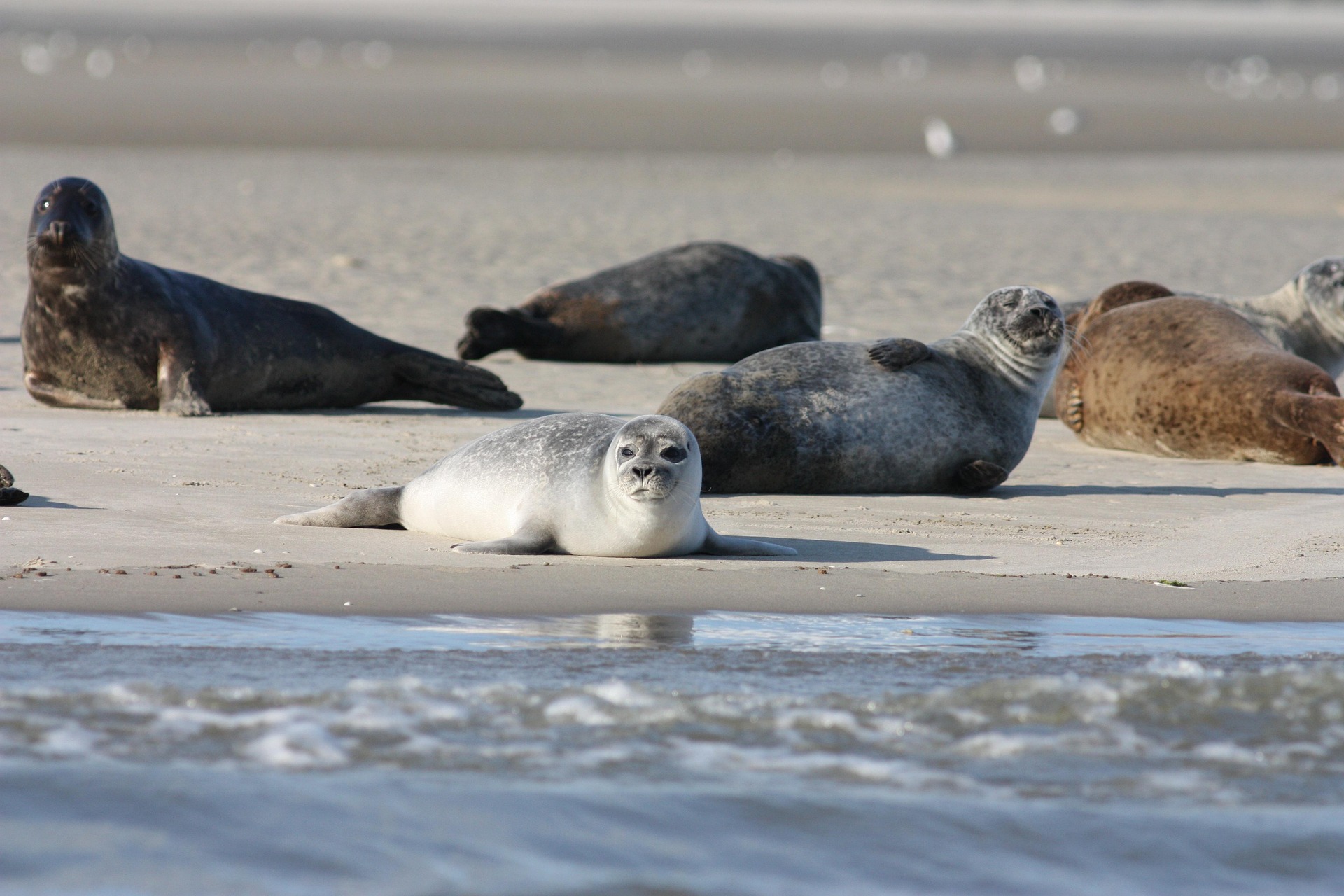
Seals have a curious personality. You can clearly see this when you are in an aquarium. They will probably approach the person in front of the aquarium and make a gesture as if they are looking into your face. One of their characteristics is that they are highly social and tend to live in groups.
- Basic Personality
Timid and cautious
Sensitive to natural predators (wolf seals, polar bears, humans, etc.)
Especially cautious on land, they will immediately flee to the sea at the first sound or human presence
Curious
Once accustomed to their environment, they may approach and observe others.
- Sociality
Many species live in groups
They gather in dense groups at breeding and resting areas
They are not aggressive when in contact with other individuals, but fights between males can occur during the breeding season.
Communication Skills
They communicate with each other through vocalizations and body movements
- Relationship between Behavioral Patterns and Personality
Highly adapted to swimming and diving, they behave calmly in the water.
They are cautious on land and ice, and often suddenly flee in groups.
What is the ecology like?
Seals make a living by eating fish, squid, and crustaceans. Most seal couples are polygamous, and they give birth on land or on the sea ice. The lifespan of a seal is said to be 25 to 30 years.
- Diet
Carnivorous: Feeds primarily on fish, squid, and crustaceans.
Hunting Method: Dive underwater to pursue and capture prey.
Some species are capable of deep-sea prey.
- Reproduction and Growth
Breeding Season: Varies by species, but generally breeds on land or ice in winter and spring.
Gestation Period: Approximately 9-11 months (depending on species).
Birth: Usually gives birth to a single calf on ice or shore.
Calves: Fed by their mother’s milk, they learn to swim within a few weeks to a few months.
Sexual Maturity: Varies by species, but they are capable of breeding at around 2-6 years of age.
- Behavior and Lifestyle
Aquatic Lifestyle: Spends most of their time underwater.
Rest on Land and Ice: Comes ashore to rest, molt, and breed.
Diving Ability: Able to dive for a few minutes to 10 minutes, longer depending on species.
- Migration/Habitat
Seasonal Migration: They move according to water temperature, ice conditions, and food availability.
Many species live in groups: They gather in dense groups at resting and breeding areas.
Are there any natural enemies?
In the natural world, killer whales are our natural enemies. Seals have very large bodies, so they don’t have many enemies.
Seal Diving
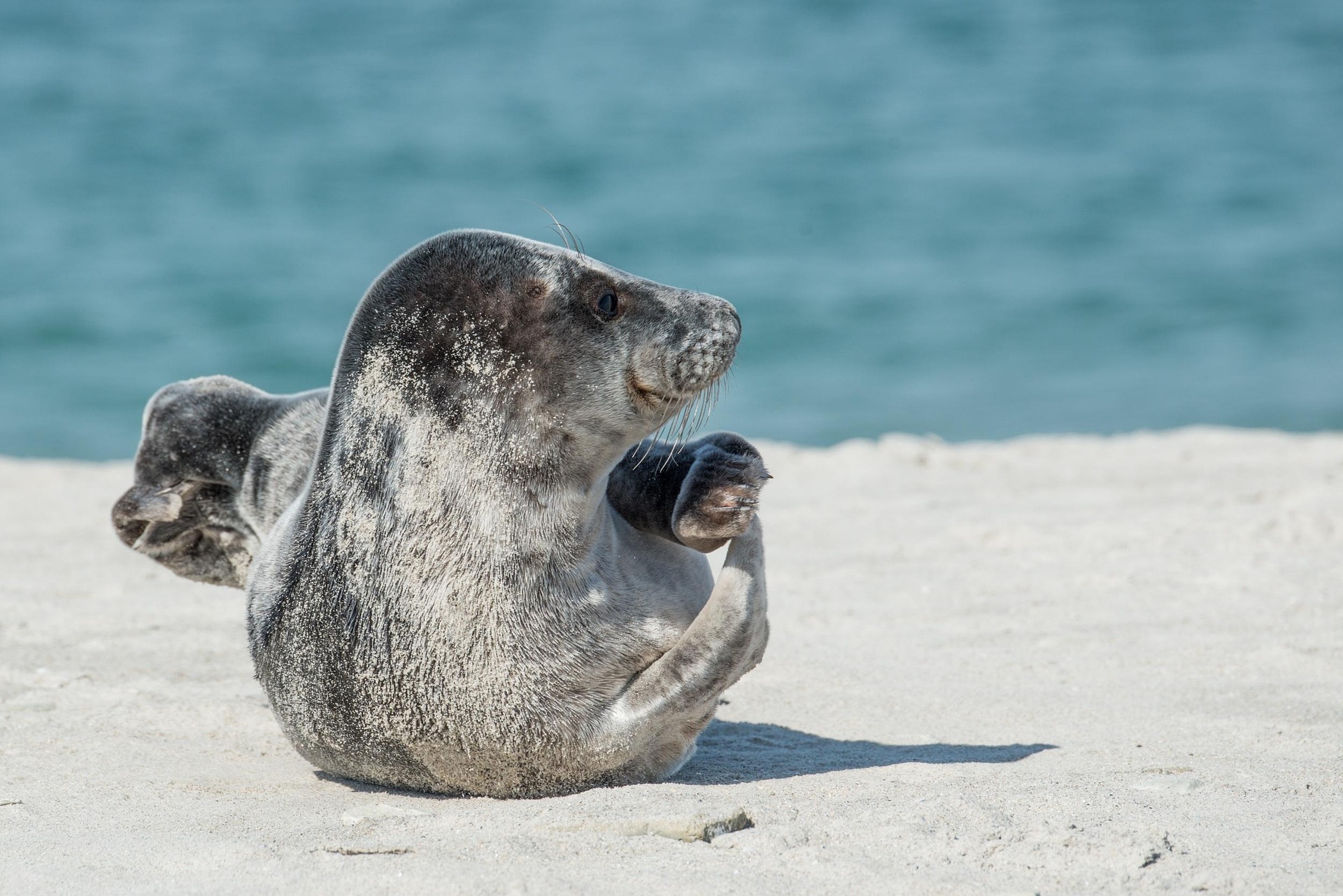
Seals possess exceptional diving capabilities among marine mammals. While abilities vary by species, the Weddell seal of the Antarctic and elephant seals, in particular, are specialists capable of diving to great depths for extended periods.
Dive Duration
This varies significantly by species.
| Species | Approximate Dive Duration |
|---|---|
| Spotted seal | Approx. 10–20 minutes |
| Harbor seal | Approx. 5–15 minutes |
| Weddell seal | Approx. 20–30 minutes |
| Elephant seal | Approx. 1–2 hours |
Elephant seals, in particular, possess some of the best diving capabilities of any mammal.
Dive Depth
| Species | Maximum Dive Depth |
|---|---|
| Spotted seal | Approx. 200m range |
| Harbor seal | Approx. 300m range |
| Weddell seal | Over 600m |
| Elephant seal | 2,000m range |
Weddell seals swim beneath Antarctic ice, hunting for fish and squid in the deep ocean.
How can they dive for so long?
Seal bodies are structured to conserve oxygen.
① Storing large amounts of oxygen in the blood
Compared to humans, they have:
Higher hemoglobin concentration
Greater blood volume
…allowing them to transport more oxygen.
② Oxygen tanks in the muscles
They have very high levels of myoglobin in their muscles,
supplying oxygen to muscles during dives
and enabling them to keep swimming for long periods.
Seal muscles are so rich in myoglobin that they appear dark in color.
③ Diving reflex
Upon entering the water:
Heart rate slows
Blood flow concentrates on the brain and heart
Oxygen consumption decreases
…triggering these specialized physiological responses.
Vocalizations
Seal vocalizations vary significantly depending on the species and the situation. They produce not only “barks”—like those of fur seals or sea lions—but also specialized sounds for communicating underwater.
“Coo-coo” or “kyu-kyu” calls
These are frequently made by seal pups.
Functions:
Calling the mother
Signaling their location
Checking in with others
Since pups can become separated from their mothers, they use these sounds to locate one another.
Low “goh” or “goo” sounds made by adults
Adult seals produce:
Low growls
Deep, rumbling growls
Short barks
Purposes:
Asserting territory
Attracting a mate
Warning other individuals
Males, in particular, use vocalizations to compete with one another.
Underwater vocalizations
Seals are very vocal underwater as well.
Typical sounds include:
“Clicking” sounds
Whistling sounds
“Pew” sounds
Low-frequency “rumbling” or “purring” sounds
Because sound travels farther underwater than in the air, seals use these vocalizations to communicate with others.
Seasonal Activities
While seal activities vary by species and habitat (Arctic, Antarctic, or temperate zones), they generally follow a repeating seasonal cycle of breeding, giving birth, molting, foraging, and migration.
🌸 Spring (March–May)
“Season for Giving Birth and Rearing Pups”
Spring is a crucial time for many seal species.
Key Activities
Giving birth
Rearing pups
Nursing
Resting in groups
Pups (Young Seals)
Newborn pups:
Have whitish natal fur (depending on the species)
Practice swimming
Grow rapidly on mother’s milk
Mothers provide high-fat milk, allowing the pups to grow quickly over a short period.
☀️ Summer (June–August)
“Season for Foraging and Molting”
Summer is a time of active foraging in the ocean.
Key Activities
Hunting fish and squid
Long-duration diving
Recovering physical strength
Molting (shedding and regrowing fur)
Seals consume large amounts of food to…
Withstand the winter cold
Prepare for the breeding season
…and build up fat reserves.
🍂 Autumn (September–November)
“Migration and Preparation for Winter”
As autumn arrives, seals adapt to changing environmental conditions.
Key Activities
Increasing food intake
Migrating to different habitats
Seeking winter feeding grounds
Arctic species migrate in response to changes in sea ice.
❄️ Winter (December–February)
“Season of Sea-Ice Life and Hunting”
This is a critical season for seals living in cold regions.
Key Activities
Diving beneath the ice
Hunting fish and squid
Using breathing holes
Weddell seals in the Antarctic, in particular:
Swim beneath the ice
Dive to depths of several hundred meters
Hunt for extended periods
…as part of their daily lives.
Daily Activity Rhythm
Daytime
Diving to search for food
Hunting fish and squid
Moving through the water
Nighttime
Resting on the water’s surface or on the ice
Communicating with others
*Activity patterns during the day and night vary by species.
Walking Speed
Seals do not move quickly on land. Unlike fur seals and sea lions, seals have evolved bodies specialized for life in the water rather than for movement on land.
Normal movement
Approx. 1–3 km/h
Short, hurried bursts
Approx. 5–8 km/h
Speeds vary depending on the species and the terrain (e.g., sandy beaches vs. ice).
Why are they slow?
The primary reason is the structure of their hind flippers (hind limbs).
Physical characteristics of seals
Hind flippers
Extend backward
Developed for swimming by swaying side-to-side
Cannot rotate forward
Consequently, on land, their movement is not
“walking”
but rather
“moving by wriggling their bodies side-to-side while lying on their bellies.”
This method of movement is also known as galumphing.
About Seal Pups
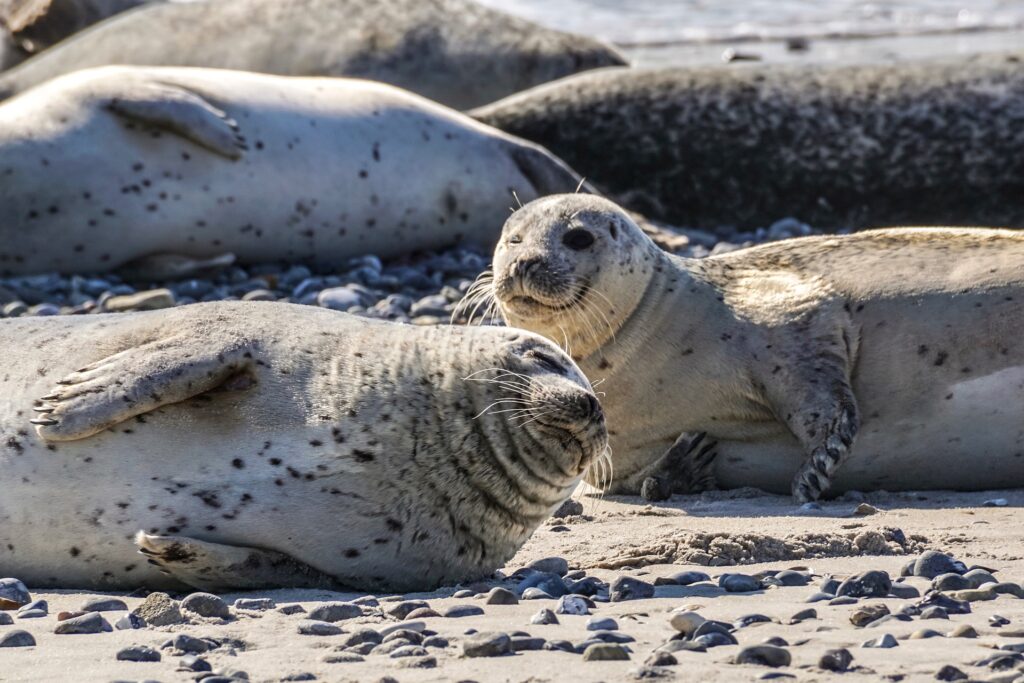
The following summarizes the appearance, growth, behavior, and mother-pup relationship of seal pups.
- Appearance and Physical Characteristics
Body Color: Varies depending on species, but most are covered in white or pale gray fur immediately after birth (e.g., ringed seals have white fur for several weeks after birth).
Body Length and Weight:
Small Species: Approximately 50-70 cm, 5-10 kg
Large Species: Approximately 1-1.5 m, 20-30 kg
Body Shape: Round and soft body; flipper-like limbs are underdeveloped; mothers help them move in the water.
- Growth and Development
Lactation Period: Breastfed for approximately 4-6 weeks
Weaning: After lactation, they gradually begin to eat solid foods such as fish.
Independence: Depending on species, they acquire swimming and diving skills within a few months and become independent.
Sexual Maturity: Depending on species, they are capable of breeding at age 2-6.
- Behavior and Mother-Child Relationships
Cubs spend time closely with their mothers.
Mothers not only nurse their young but also teach them how to swim, dive, and avoid danger.
Cubs acquire motor skills and group behavioral skills through play with other animals.
- Threats and Survival
Cubs are vulnerable to predators (wolf seals, polar bears, killer whales, etc.).
If their birthplace (on the ice or on the beach) is unsafe, their survival rate decreases.
Are seals an endangered species?
Unfortunately, seals are listed as an endangered species. The meat is edible, the fat can be used as fuel, and the fur can be used to make coats. Therefore, some subspecies are endangered. Conservation efforts are underway around the world.
- IUCN Red List Assessment (Selected Representative Species)
Arctic Seal (Phoca hispida)
Distribution: Arctic
Assessment: Least Concern
Ringed Seal (Leptonychotes weddellii)
Distribution: Circum-Antarctic
Assessment: Least Concern
Bearded Seal (Ommatophoca rossii)
Distribution: Circum-Antarctic
Assessment: Least Concern
Monk Seals (Monachus spp.)
Distribution: Mediterranean, Hawaii, California
Assessment: Endangered or Critically Endangered
- Seals Around Japan
Spotted Seal (Phoca largha)
Distribution: North Pacific coast, Hokkaido, and the Kuril Islands
Assessment: Least Concern
- Threats
Bycatch in fishing activities
Marine pollution (chemicals, plastics)
Decreased sea ice (Arctic and Antarctic species)
Habitat destruction and tourism pressure
Difference between seal and sea lion
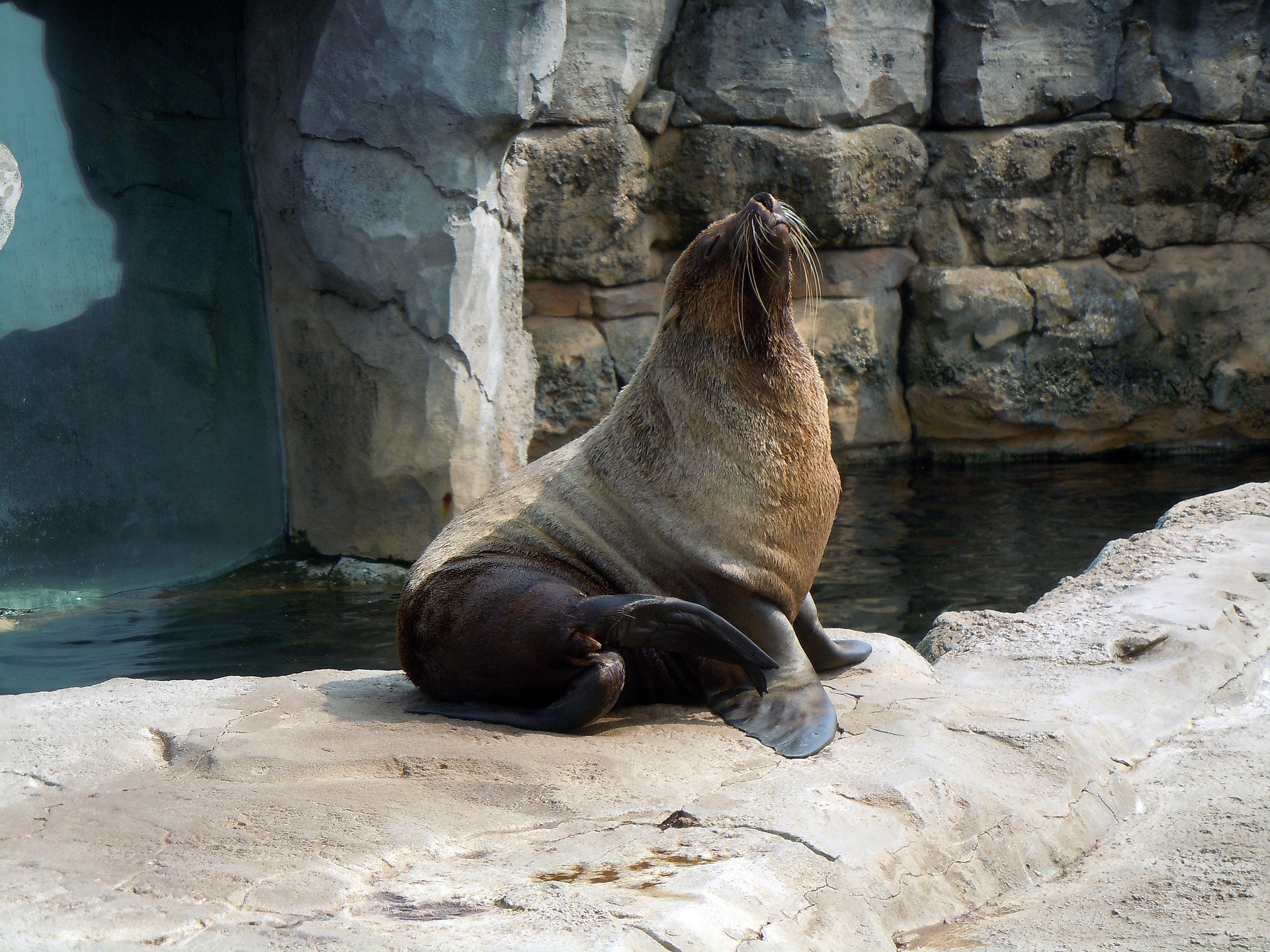
Seals are often mistaken for sea lions. There is a decisive difference that can be determined by appearance. Sea lions have pinnae, but seals do not. Furthermore, sea lions walk on four legs, but seals cannot lift their bodies and move by crawling.
Can seals be kept?
Seals will need a large swimming pool. You also need a space where you can rest, so it’s not always easy. The main food is raw fish. They eat a lot of fish, so it’s quite expensive. Some species are highly protected and may require permission, so be sure to check carefully. It is realistic to obtain seals from zoos or aquariums.
- The Reality of Breeding
Breeding is generally done in specialized facilities such as aquariums and marine parks.
Keeping seals on your own is extremely difficult, requiring large aquariums, pools, filtration systems, water temperature control, and food (fish, squid, etc.).
Even young seals need swimming and hunting skills learned from their mothers, making it difficult to fully develop them in an artificial environment alone.
- Ecological Constraints
They primarily live underwater and require ample swimming space.
If an environment does not allow them to fully utilize their swimming and diving abilities, they will suffer from stress and health problems.
Highly social species require social life in groups, and keeping seals alone can be psychologically stressful.
- Laws and Regulations
In Japan, seals are subject to the Wildlife Protection Act, and individuals are prohibited from capturing and breeding wild seals.
Breeding is only permitted in licensed aquariums and research facilities.
Facilities Housing Seals (Japan & Worldwide)
Seals are kept and exhibited in many aquariums and zoos across Japan and the world. In Japan, commonly seen species include the spotted seal, harbor seal, and Baikal seal.
🇯🇵 Major Facilities in Japan Where Seals Can Be Seen
Osaka Aquarium Kaiyukan
Species: Spotted seals, etc.
Features:
Observe natural swimming behaviors in a massive tank
Witness underwater turning and diving actions
Exhibits recreate the ecosystem of the Arctic Circle
Enoshima Aquarium
Species: Spotted seals, etc.
Features:
Marine mammals can be viewed alongside exhibits of Sagami Bay wildlife
Active movements can be seen during feeding and training sessions
Marine World Uminonakamichi
Species: Various seal species
Features:
Extensive marine mammal exhibits
Observe underwater swimming and surfacing behaviors
Toba Aquarium
Species: Various seal species
Features:
Long history of exhibiting marine mammals
Viewable alongside a diverse range of marine life
Asahiyama Zoo
Species: Spotted seals
Features:
Famous “Marine Way” (cylindrical tank)
See seals swimming up and down at close range
🌎 Notable Seal-Housing Facilities Worldwide
🇺🇸 Monterey Bay Aquarium
Famous for exhibits featuring marine life from the California coast
Known for exhibition and conservation efforts regarding spotted seals and related species
🇺🇸 San Diego Zoo
Famous for marine mammal exhibits
A track record of exhibiting seals and sea lions
🇬🇧 SEA LIFE London Aquarium
Facility specializing in marine life
Known for marine conservation education that includes seals
🇩🇰 National Aquarium Denmark (Den Blå Planet)
One of Northern Europe’s largest aquariums
Extensive exhibits of marine life from the waters surrounding Northern Europe
🇨🇦 Vancouver Aquarium
Famous for exhibits featuring North Pacific marine life
Conducts conservation and research activities for seals
Introducing other animals
コメント