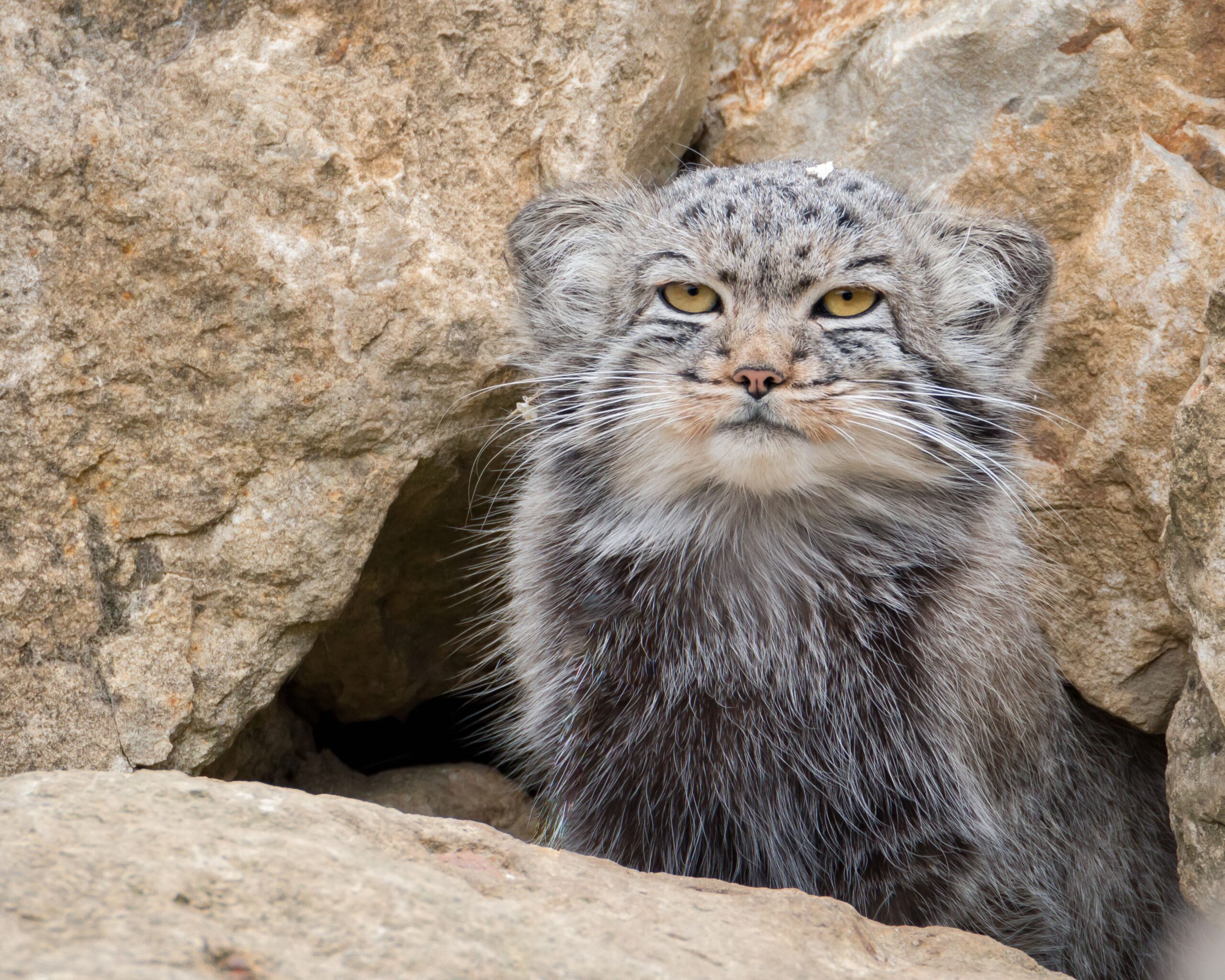
What kind of cat is a manul cat? We will explain its characteristics, ecology, and habitat. The manul cat, which has a stocky body like a human, is distributed from central Asia to the Middle East, and is a cat that can be found in zoos. Unfortunately, they are now extinct in some areas and are in a critical situation.








- What is a manul cat? About basic status
- What are the roots and origins of the Pallas’s cat?
- About habitat
- feature is? What kind of creature is it?
- What is your personality like?
- What is the ecology like?
- About Molting
- Vocalizations
- Seasonal Activities
- Walking Speed
- About Pallas’s Cat Juveniles
- Is the manul cat an endangered species?
- Can manul cats be kept as pets?
- Zoos Housing Pallas’s Cats (Japan & Worldwide)
- Introducing other animals
What is a manul cat? About basic status
The manul cat is a carnivorous animal classified in the class Mammalia, order Carnivora, family Felidae. The scientific name is Otocolobus manul. The body length is 50-65 cm and the weight is 3-5 kg. The name “Manul” is Mongolian. It means “small wild cat”. In English, it is also written as pallas cat. It has a stockier shape than a small domestic cat. This cat is often talked about in the news.
| Japanese(和名) | マヌルネコ |
| English(英名) | Manul Cat |
| scientific name(学名) | Otocolobus manul |
| classification(分類) | Mammalia、Carnivora、 Felidae、Otocolobus 哺乳綱、食肉目、ネコ科、マヌルネコ属 |
| IUCN Status(保全状況) | LEAST CONCERN |
| Length(体長) | 50-65cm |
| Weight(体重) | 3-5kg |
What are the roots and origins of the Pallas’s cat?
The Pallas’s cat (also known as the manul; scientific name: Otocolobus manul) is an ancient feline species that evolved in the cold, high-altitude regions of Central Asia. It belongs to a lineage quite distinct from modern domestic cats and has followed its own unique evolutionary path.
Origins: An ancient feline lineage
The Pallas’s cat represents a highly distinct lineage within the Felidae family.
Evolutionary timeline:
Approx. 25 million years ago
Ancient feline ancestor
↓
Evolution of small cats
↓
Genus Otocolobus
↓
Modern Pallas’s cat
The genus Otocolobus is very ancient and retains primitive characteristics not found in many other modern felines.
Where did they originate?
The ancestors of the Pallas’s cat evolved primarily in the arid highlands and grasslands of Central Asia.
Current distribution:
Mongolia
Western China
Tibetan Plateau
Kazakhstan
Southern Russia
Regions surrounding Iran
Elevation:
Approx. 500–5,000 meters
They are adapted to these extremely harsh environments.
Why do they have such a unique appearance?
The distinctive features of the Pallas’s cat are the result of adaptation to cold climates.
① Round body shape
Features:
Short legs
Round face
Stocky body
Reason:
To minimize body surface area and prevent heat loss.
This is an adaptation similar to “Bergmann’s Rule.”
② World-class fur density
Pallas’s cats possess exceptionally dense fur compared to other felines.
Features:
Tens of thousands of hairs per square centimeter
Long, thick winter coat
Adaptation to extreme cold
In winter, their fur grows so thick that their bodies appear even rounder.
③ Flat face
Their unique facial structure is also an adaptation to cold climates. Reasons:
To reduce the protrusion of the nose and ears
To lower the risk of frostbite
To make it harder to inhale cold air
About classification
There are the following subspecies of manul cat:
Otocolobus manul manul
This subspecies is found in Afghanistan, Iran, Kazakhstan, the People’s Republic of China (Gansu Province), Pakistan, Mongolia, Central Asia, and southern Siberia.
Otocolobus manul nigripectus
A subspecies that lives in Nepal, Bhutan, Tibet, and Kashmir.
Taxonomy of the Pallas’s Cat
| 分類階級 | 分類名 |
|---|---|
| 界 | 動物界(Animalia) |
| 門 | 脊索動物門(Chordata) |
| 亜門 | 脊椎動物亜門(Vertebrata) |
| 綱 | 哺乳綱(Mammalia) |
| 目 | 食肉目(Carnivora) |
| 科 | ネコ科(Felidae) |
| 亜科 | ネコ亜科(Felinae) |
| 属 | マヌルネコ属(Otocolobus)※単型属 |
| 種 | マヌルネコ(Otocolobus manul) |
About habitat
Its habitat ranges from the Middle East to Central Asia.
- Distribution
Widely distributed, mainly in Central Asia
Major Countries:
Mongolia
Kazakhstan
Kyrgyzstan
Tajikistan
Uzbekistan
Afghanistan
Northwestern China (Xinjiang Uyghur Autonomous Region, Inner Mongolia)
Southern Russia (Altai Mountains)
- Habitat
Prefers high-altitude, dry grasslands, semi-deserts, and rocky areas
Typically lives at altitudes between 1,000 and 5,000 meters above sea level
Environmental Characteristics:
Sparse grass and scattered shrubs
Provides hiding places in rocks and cliffs
In winter, it is active on slopes with little snow or in the shade of rocks
- Nests and Hiding Places
Rests in rock crevices, caves, and old burrows of small animals
Rarely digs its own holes
Securing hiding places is important to protect itself from predators
- Climate and Environmental Adaptation
Adapted to the cold climates of arid and alpine regions
Having a fluffy coat that allows them to be active even in harsh winters
Rarely found in tropical or humid forests, these animals are found primarily in dry, grassland, and rocky areas
feature is? What kind of creature is it?
Manul cats have a stocky build and are very sturdy. Their body hair is long and dense, giving them a plump body. The body is orange-gray, the ventral surface is whitish-gray, the limbs are ocher, and there is a brown horizontal stripe on the lower back. As the seasons change, the coat changes, and the winter coat is grayer than the summer coat. This cat can be found in rocky grasslands, steppes, and semi-deserts at altitudes of 400 to 5,000 meters.
- Physical Characteristics
Body Shape/Size
A small wild cat with a body length of approximately 46-65 cm and a tail length of approximately 21-31 cm.
Weight: Approximately 2.5-4.5 kg.
Face/Head
Round, flat face with a low, broad nose.
Ears set low on the sides of the head, making them nearly invisible.
Large, round eyes with developed night vision.
Coat/Tail
In winter, they have thick, fluffy fur, adapting to cold climates.
Back is gray to light brown, and the belly is light-colored.
Long, fluffy tail, used for balance and protection from the cold.
- Personality/Behavior
Predominantly solitary and do not form groups.
Timid and cautious.
When encountering predators or humans, they will quickly hide in the shade of a rock or in a burrow.
Patient and cautious.
Waiting for long periods of time before hunting prey.
- Biology and Abilities
Diet: Carnivorous, preying on small mammals, birds, and insects
Catches mice, prairie dogs, bird chicks, and insects
Nocturnal and crepuscular, resting in rock shelters or caves during the day
Cold Climate Adaptation
Thick fur allows them to be active even in harsh winters
Adapted to dry grasslands and rocky areas at high altitudes
- Special Abilities
High stealth capabilities
Approaches prey carefully, keeping low to the ground
Environmental Adaptability
Can survive in cold, high-altitude areas
Uses rocks and caves as hiding places
What is your personality like?
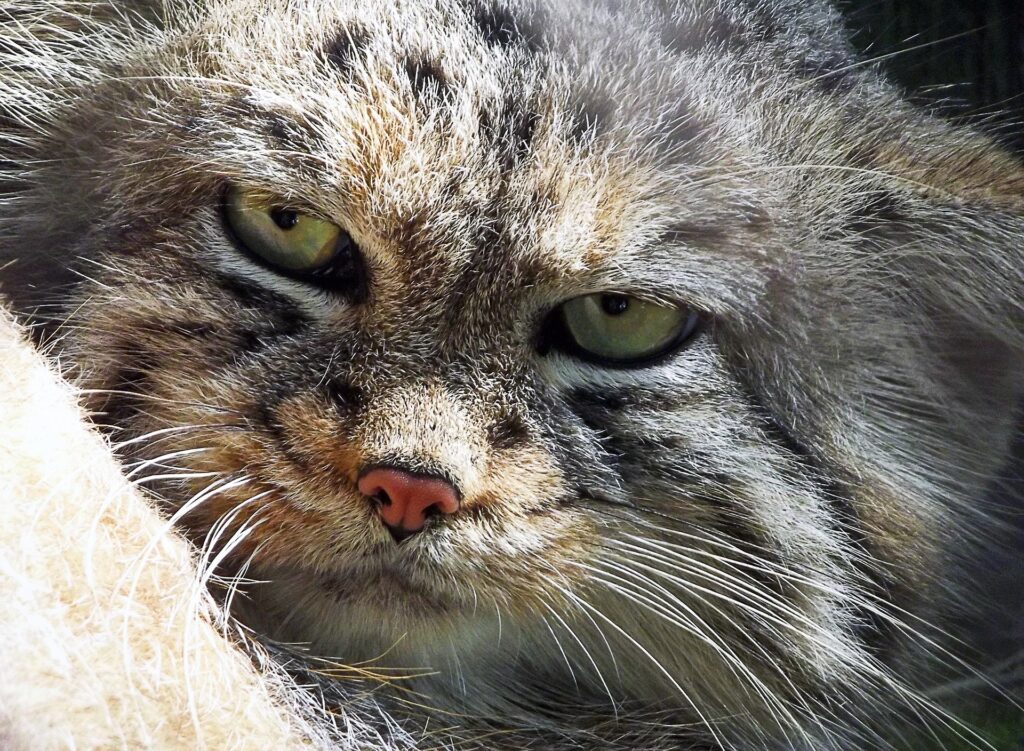
Manul cats are very cautious and cautious cats. Therefore, they tend to run away or hide in the shadows as soon as they see someone.
Pallas’s Cat Personality Characteristics
Timid and cautious
Sensitive to predators and humans
If they sense danger, they will quickly hide in the shade of a rock or a burrow
Primarily solitary and do not form groups
Prefers solitary living
Strongly territorial, they only interact with other individuals during breeding season or mother-child interactions
Values their living space and hiding places
Patient and cautious
Waiting quietly for long periods of time when hunting prey
Avoids unnecessary behavior and minimizes risk
Low aggressiveness
Mainly defensive behavior
Protecting themselves by curling up or hiding in the shade of a rock
Moderately curious
Move cautiously while observing their surroundings
If there is no danger, they will move around to search for food
What is the ecology like?
The manul cat’s prey consists of small pikas, rodents, rockfish, and other birds. Breeding occurs mostly in spring and autumn, and the gestation period is about two months. They can give birth to 2-6 puppies at a time. The lifespan is about 10 years.
- Habitat
Inhabits the highlands, dry grasslands, semi-deserts, and rocky areas of Central Asia.
Altitude: Adapted to altitudes of approximately 1,000-5,000 meters.
Uses rock crevices and caves as shelters.
Prefers open environments with shrubs and rocky areas rather than trees or forests.
- Behavior
Nocturnal and crepuscular (active from dusk to early morning).
Rests in rock shelters or caves during the day.
Generally solitary.
Strongly territorial, only interacting with other individuals during breeding season or when mothers and their young are present.
When hunting prey, it waits quietly for long periods of time and approaches in a low-slung position.
- Diet
Small carnivores (mainly small mammals).
Mice, prairie dogs, Japanese house mice, etc.
Also preys on bird chicks and insects.
Capture method: Patiently ambushes and captures.
- Breeding
Breeding season is from late winter to early spring.
Gestation period: Approximately 65 days.
Give birth to 2-6 calves at a time.
Mothers shelter their young in caves or rock shelters.
Calves become independent within a few weeks and learn hunting skills and territorial behavior.
Are there any natural enemies?
The manul’s natural enemies are birds of prey such as eagles, foxes, and wolves, which are preyed on by larger animals.
About Molting
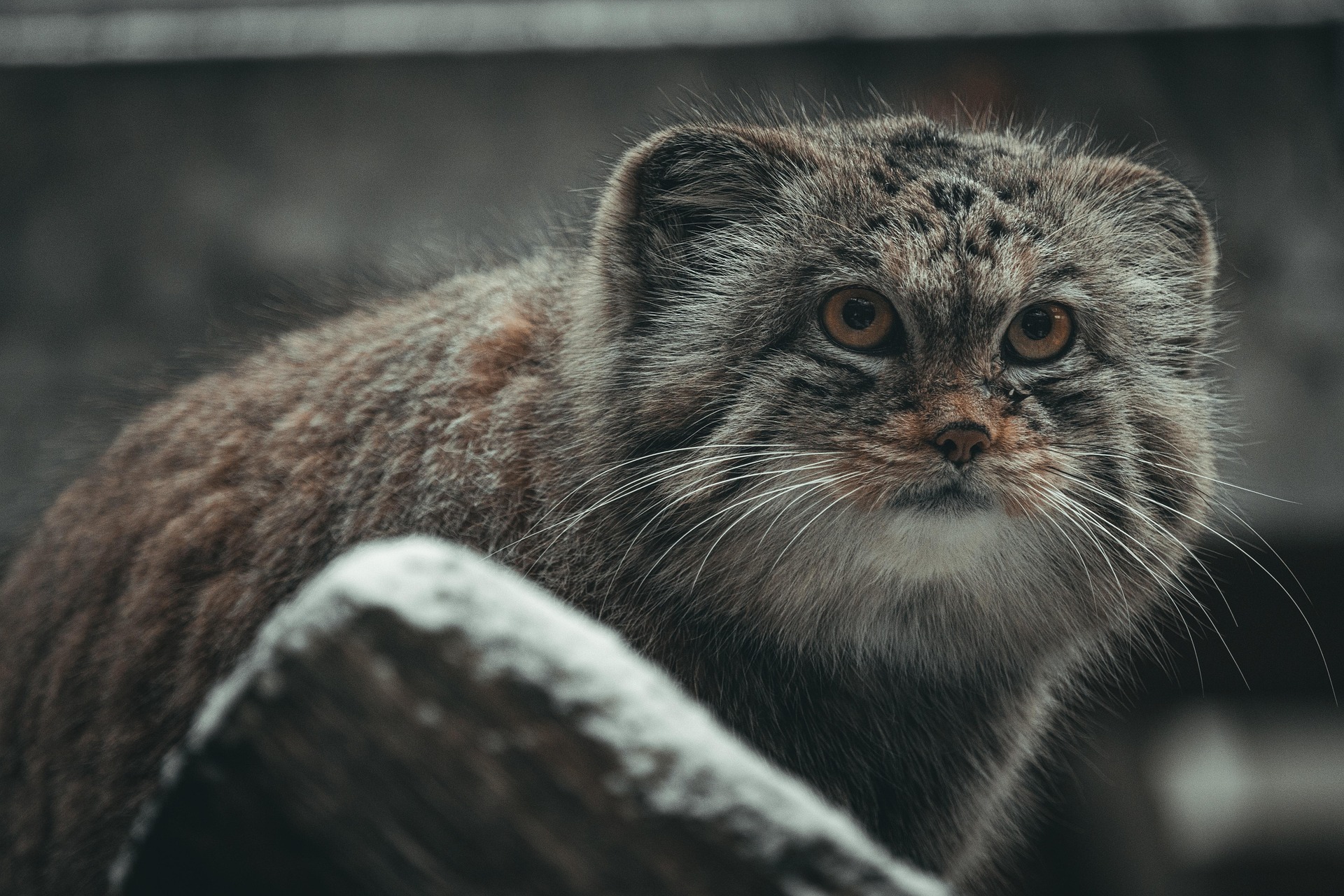
The molting process (shedding and regrowth of fur) of the Pallas’s cat (Manul) is highly distinctive, having adapted to the harsh climate of Central Asia. Pallas’s cats possess one of the densest coats in the entire cat family, and they undergo dramatic seasonal changes in fur volume.
🌸 Spring Molt (Around March–May)
Winter coat → Summer coat
They shed the thick fur developed during winter and transition to a coat suited for warmer weather.
Changes:
Fur density decreases
Body appears slightly slimmer
Long winter fur is shed
Heat dissipation becomes easier
🍂 Autumn Molt (Around September–November)
Summer coat → Winter coat
Fur volume increases rapidly in preparation for the cold.
Changes:
Undercoat develops
Fur grows longer
Body appears round and large
In winter, Pallas’s cats look like stuffed toys; this appearance is due to their massive amount of insulating fur.
World-Class Fur Density
The most defining characteristic of the Pallas’s cat is the volume of its fur.
Characteristics:
Exceptionally high fur density for a feline
Individual hairs are long
Thick undercoat
Long fur grows especially on the belly, tail, and legs.
Purpose:
Maintains body temperature even during sub-zero nights
Protects against snow and wind
Acts as insulation when resting on rocky terrain
Vocalizations
The vocalizations of the Pallas’s cat (Manul) differ somewhat from those of the common domestic cat, ranging from low, short sounds to surprisingly sharp threat calls. In contrast to their stoic facial expressions, they are animals that actively communicate through sound.
Basic Vocalizations: Low sounds rather than “meows”
Pallas’s cats do not frequently make the sweet “meow” sounds typical of domestic cats.
Typical sounds include:
“Gya”
“Nya”
“Oo”
“Purring”
…and other short sounds.
Their voices are relatively low, conveying a wild, untamed impression.
Communication between mother and kittens
Vocalizations are used for communication between parent and offspring.
Kittens
Characteristics:
Higher-pitched calls
Calling out to the mother
Seeking food or reassurance
Mother
Short calls
Checking the kittens’ location
Alerting to danger
Since Pallas’s cat kittens are raised in rocky areas or grasslands where they hide, vocal confirmation is crucial.
Vocalizations during courtship
During the breeding season (mainly late winter to spring), males and females interact vocally.
Males:
Low-pitched calls
Signals to attract a mate
Females:
Responsive calls
Signals permitting approach
…are produced.
As Pallas’s cats are fundamentally solitary animals, vocalizations during the breeding season are particularly important.
Sounds during threats or defense
Although small, Pallas’s cats are highly wary animals.
When sensing danger, they produce:
Hissing sounds (“Shaa”)
“Hoo” sounds
Low growls
Threatening sounds accompanied by baring their teeth
Characteristics:
Arching the back
Making the body appear larger
Flattening the ears
…and other defensive behaviors typical of felids.
Seasonal Activities
Pallas’s cat (Manul) activity patterns shift in response to the extreme seasonal changes of Central Asia—harsh winters and dry summers. Primarily solitary and crepuscular (active at dawn and dusk) or nocturnal, their behaviors regarding breeding, molting, and hunting vary by season.
🌸 Spring (Around March–May)
Breeding and Rearing Season
Spring is the most critical time of year for Pallas’s cats.
Key Activities
Mating
Giving birth
Rearing young
Increased hunting
The breeding season generally falls in February and March; after a gestation period of about two months, they give birth in the spring.
Female Behavior
Giving birth in rock crevices or burrows
Protecting kittens
Nursing and ensuring safety
Male Behavior
Searching for a mate
Patrolling the territory
Interactions between these normally solitary cats increase during this period.
☀️ Summer (Around June–August)
Season of Expanded Range
Summer is a relatively mild time of year in Central Asia.
Key Activities
Kitten growth
Hunting practice
Foraging
Kittens begin to:
Follow their mother
Learn how to catch small animals
Prepare for independence
Hunting
Main prey:
Pikas
Voles
Small birds
Insects
Rather than chasing prey by running, Pallas’s cats use a hunting method of:
Ambushing from behind rocks → Pouncing in a split second
🍂 Autumn (Around September–November)
Preparation for Winter
Autumn is a crucial season for preparing for the winter ahead.
Physical Changes
Molting into winter fur
Increased fur density
Improved body heat retention
Appearance:
Face becomes rounder
Body appears larger
Tail becomes thicker
Behavior
Eating heavily when food is available
Securing good hiding spots
Increased hunting time
❄️ Winter (Around December–February)
Season of Survival in Harsh Conditions
This is the season when the Pallas’s cat truly comes into its own. In their habitat, they face:
Sub-freezing temperatures
Strong winds
Snow accumulation
Food scarcity
Activity
They remain active during the warmer parts of the day.
They seek shelter from the wind behind rocks.
They efficiently hunt scarce prey.
In winter, rather than being strictly nocturnal, they may engage in behaviors that utilize daytime sunlight to maintain body temperature.
Walking Speed
The Pallas’s cat (or Manul) is not built for high-speed running like the cheetah; instead, it employs a “low-speed, energy-efficient” gait suited for ambushing prey in rocky terrain and grasslands. While it possesses the agility typical of small felids, it moves in a way that minimizes unnecessary motion.
Normal Walking Speed
Although there are few recorded measurements of speed for wild Pallas’s cats, estimates based on their physique and behavior suggest:
Normal walking: Approx. 1–3 km/h
Exploration/Travel: Approx. 3–5 km/h
To human observers, they appear to walk very slowly, but this movement is well-suited to their hunting strategy.
Running Speed
Pallas’s cats can move quite quickly over short distances.
Estimated:
Top speed: Approx. 30–40 km/h
However, they rarely chase prey over long distances.
Their hunting style is not:
Run → Chase
But rather:
Hide → Wait → Pounce in an instant
Characteristics of Their Gait
① Walking with a low posture
Pallas’s cats move while keeping their bodies close to the ground.
Reasons:
To stay hidden among surrounding grass and rocks
To avoid detection by prey
To protect themselves from predators
Staying inconspicuous is crucial in the open grasslands of Central Asia.
② Short legs
While short legs might seem like a disadvantage at first glance, they offer benefits in cold climates.
Effects:
Reduces body heat loss
Allows movement through rocky terrain in a low posture
Provides walking stability
③ Fur on the soles of the feet
Pallas’s cats have thick fur on their feet.
Functions:
Prevents slipping on snow
Protects against cold ground
Allows for silent approach
This physical structure is well-suited for life on the cold highlands in winter.
About Pallas’s Cat Juveniles
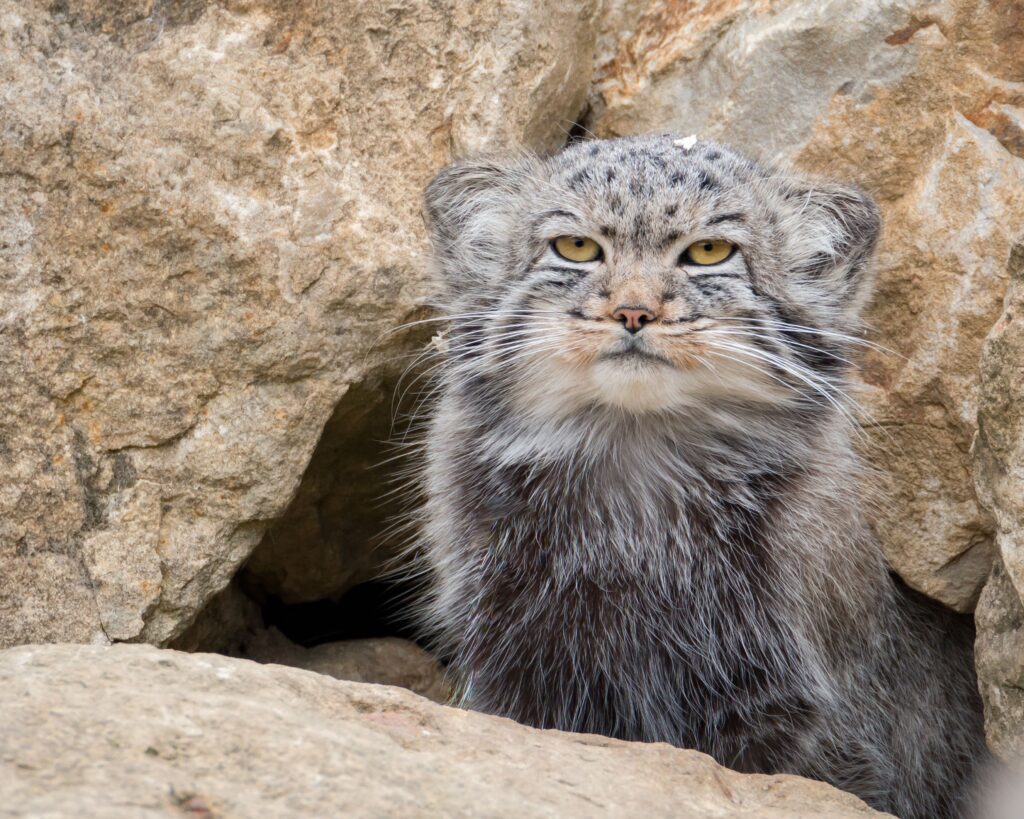
This article provides detailed information about Pallas’s cat (Otocolobus manul) juveniles (baby Pallas’s cats).
- Appearance and Characteristics
Immediately after birth, they are small and covered in soft fur.
Body Length: Approximately 15-20cm, Weight: Approximately 90-130g
Their round, flat faces are similar to those of adults, but their ears and tails are still short and their fur is soft.
They have gray to light brown fur, and the fluffy winter fur of adults does not develop until a few weeks later.
- Behavioral Ability
Immediately after birth, they live protected on their mother’s back or in a den.
For the first few weeks, they are mainly breastfed, with the safety of the den being their top priority.
A few weeks after birth, they begin to walk gradually and learn by observing their mother’s hunting and preying behavior.
- Diet and Growth
Initially, they receive nutrition from breast milk.
At 4-6 weeks of age, they begin to sample insects, small mammals, and other prey.
At 2-3 months of age, they begin hunting on their own and become more active outside the den.
It is also around this time that their fluffy winter fur and tail begin to develop.
- Sociality
Young animals depend on their mothers for survival.
They have little contact with other animals, and learning is primarily between mother and child.
Through play and imitation, they acquire patience, hunting skills, hiding techniques, and vigilance.
- Defense and Safety
They hide in their mother’s den to protect themselves from predators.
Since they lack armor and other defenses, their mother’s protection is key to their survival.
Is the manul cat an endangered species?
Manul cats are an endangered species. Manul cats were previously confirmed to inhabit Armenia and Azerbaijan, but they are now completely extinct. It is also rarely seen in Central Asian countries such as Uzbekistan and Tajikistan.
- IUCN Assessment
The International Union for Conservation of Nature (IUCN) Red List classifies the Pallas’s cat as “Near Threatened.”
This means that while the species is not currently extinct, there is a risk of population decline in the future.
- Population Status
Distributed throughout a wide area of Central Asia (including Mongolia, Kazakhstan, and northwestern China)
The exact population size is unknown, but it is declining locally in fragmented habitats.
Decline is particularly evident in areas of highland and dry grassland habitats where human activity is increasing.
- Major Threats
Habitat Destruction
Conversion of grasslands and rocky areas due to development, farming, and livestock farming
Hunting for food and pets
Captivity for the fur and pet markets
Decrease in small mammals, which serve as prey
Decrease in prey due to pesticides and ecosystem destruction
Climate Change
Vulnerable to environmental changes in highland and dry areas
- Conservation Status
Hunting is prohibited in some countries, and protected areas have been established.
Habitat protection is the biggest challenge, and research and monitoring are ongoing.
Can manul cats be kept as pets?
Can manul cats be kept as pets? Unfortunately it’s difficult. The reason for this is that, as explained above, they are an endangered species, and also because they are wild to begin with, so they do not easily get attached to humans.
- Legal Issues
Manul cats are wild animals, and in many countries, it is illegal to keep them as pets without special permission.
In Japan, they may be classified as a “designated animal” or “endangered wild animal,” requiring permission from the prefectural governor to keep them.
Internationally, import and export restrictions are imposed by the Convention on International Trade in Endangered Species of Wild Fauna and Flora (CITES), making it difficult to even obtain specimens.
- Ecological and Behavioral Issues
Solitary, timid, and cautious
Easily stressed in captivity
Nocturnal and crepuscular, they are difficult to adapt to daytime human habitation
Highly predatory, requiring specific small animals and insects
Recreating their diet at home is extremely difficult
Limited environmental adaptability
They are adapted to high-altitude, arid climates, and may be unhealthy in warm, humid environments
- Theoretical Requirements
A large exercise area resembling the dry grasslands of highlands
A dark environment that allows for nocturnal activity
Providing hiding places such as rocks and caves
Preyable food sources, such as small mammals and insects
Wildlife management expertise and veterinary care
- Practical Alternatives as Pets
While Pallas’s cats themselves cannot be kept as pets, small felines suitable for the home include
Squirrel monkeys and ferrets (improved species of the mustelid family) that are practical pets.
Zoos Housing Pallas’s Cats (Japan & Worldwide)
The Pallas’s cat (also known as the manul) is a rare felid with a small wild population and is challenging to keep in captivity; however, Japan is one of the leading countries in the world for their husbandry and breeding.
🇯🇵 Major Zoos in Japan Where You Can See Pallas’s Cats
🐈 Nasu Animal Kingdom (Tochigi Prefecture)
One of the most famous facilities in Japan for keeping Pallas’s cats.
Features:
Nationally renowned for its Pallas’s cat exhibit
Exhibit designed to replicate a rocky habitat
Actively engaged in breeding programs
Allows for observation of individual behaviors
This facility played a key role in sparking the popularity of Pallas’s cats.
🐈 Ueno Zoological Gardens (Tokyo)
A zoo with a long history of keeping Pallas’s cats.
Features:
Exhibition of rare felids
Focus on captive health management and research
Experience in caring for elderly individuals
Ueno Zoo provides specialized care for elderly Pallas’s cats, including managing their molting cycles and overall health.
🐈 Asahiyama Zoo (Hokkaido)
Located in a cold region, the climate here is relatively similar to the Pallas’s cat’s natural habitat.
Features:
Easy to observe them in their winter appearance
Witness the changes in their thick winter coats
Exhibits that utilize the Hokkaido environment
🐈 Saitama Children’s Zoo (Saitama Prefecture)
A facility known for keeping and breeding Pallas’s cats.
Features:
Extensive experience in keeping felids
Exhibits that prioritize natural behaviors
🐈 Higashiyama Zoo and Botanical Gardens (Aichi Prefecture)
A facility in the Tokai region where Pallas’s cats can be seen.
Features:
Exhibition of rare animals
Participation in breeding programs
🐈 Kobe Animal Kingdom (Hyogo Prefecture)
A highly popular facility for viewing Pallas’s cats.
Features:
Indoor exhibit makes observation easy
Exhibits designed to allow close proximity to the animals
🌎 Major Facilities Worldwide
🇺🇸 United States
Many zoos across the United States keep Pallas’s cats. Representative examples:
Smithsonian National Zoo
Features:
Conservation education
Breeding research
Showcasing Pallas’s cat ecology
Cincinnati Zoo
Features:
Experience keeping Pallas’s cats
Participation in international breeding programs
Denver Zoo
Features:
Exhibits of rare felids
Conservation activities
🇫🇮 Finland
Ranua Zoo
A zoo located in an environment close to the Arctic Circle.
Features:
Cold-climate environment
Ideal for observing Pallas’s cats in their winter coats
Helsinki Zoo (Korkeasaari Zoo)
Features:
Experience keeping Pallas’s cats
Involvement in international conservation activities
Introducing other animals
コメント