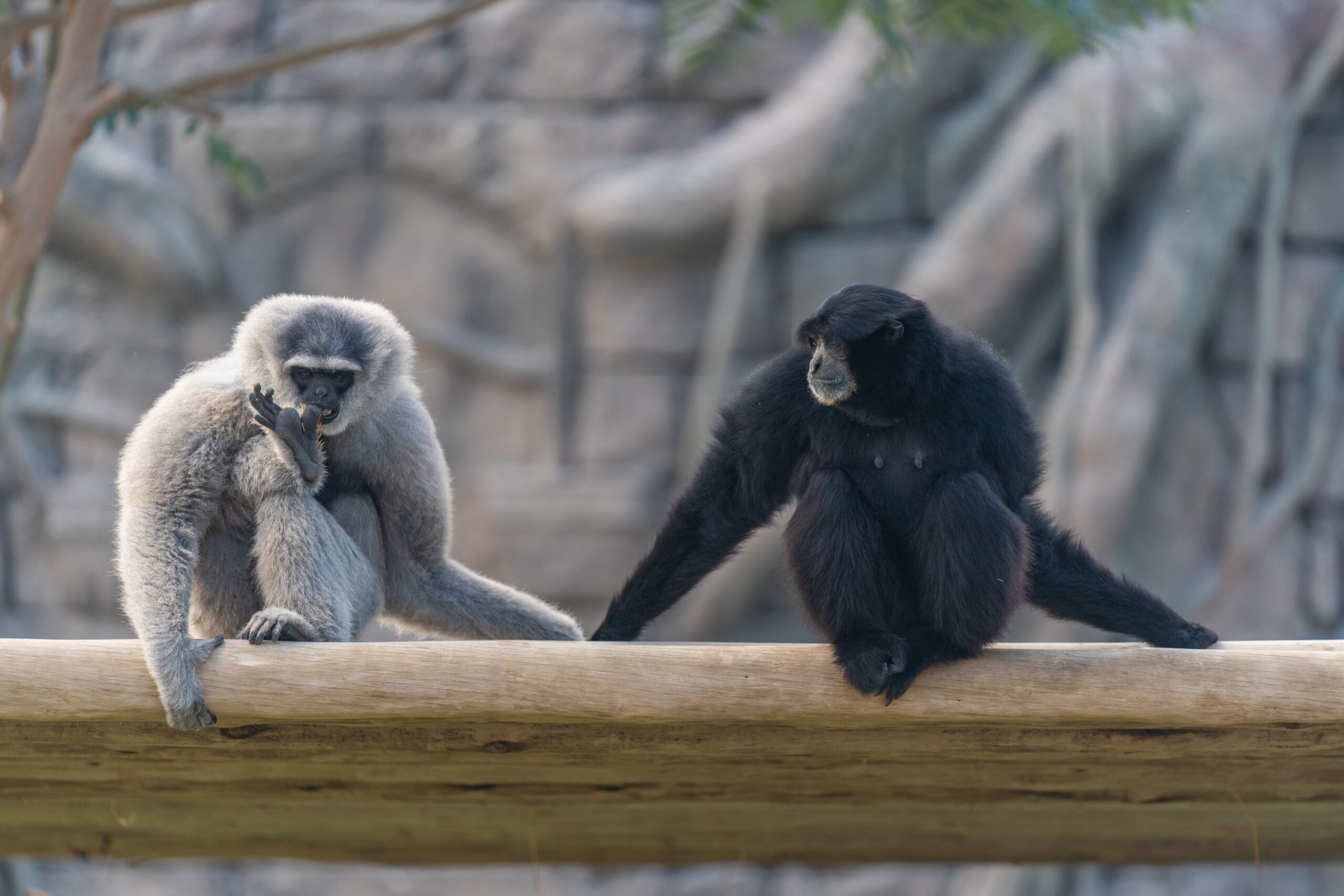
What kind of animal is a gibbon? We will explain its characteristics, ecology, and habitat. White-handed gibbons are introduced at animal parks, but this species is mainly distributed from East Asia to Southeast Asia. As the name suggests, it is characterized by its long forelimbs, but this subspecies is actually an endangered species.









- What is a gibbon? About basic status
- What are the roots and origins of gibbons?
- About habitat
- feature is? What kind of creature is it?
- What is your personality like?
- What is the ecology like?
- About Molting
- About Their Vocalizations
- Seasonal Activities
- Regarding Walking Speed
- About baby gibbons
- Is the gibbon an endangered species?
- Can gibbons be kept as pets?
- Zoos Housing These Animals (Japan & Worldwide)
- Introducing other animals
What is a gibbon? About basic status
Gibbons are a family of monkeys that belong to the order Primates and family Gibbonidae. The scientific name is Hylobatidae. The size varies depending on the subspecies, but most have a total length of 40-60 cm and a weight of 4-6 kg. The list of information is as follows. This is an animal that can be seen in picture books, so if you have time, check it out.
| Japanese(和名) | テナガザル |
| English(英名) | Gibbon |
| scientific name(学名) | Hylobatidae |
| classification(分類) | Mammalia、Primate、 Hylobatidae 哺乳綱、霊長目、テナガザル科 |
| IUCN Status(保全状況) | ENDANGERED |
| Length(体長) | 40~60cm |
| Weight(体重) | 4~6kg |
What are the roots and origins of gibbons?
Gibbons are apes—a group of primates—characterized by exceptionally long arms and a high degree of adaptation to life in the trees. Taxonomically, they belong to the same superfamily (Hominoidea) as humans, chimpanzees, gorillas, and orangutans.
The distant ancestors of gibbons
The ancestry of gibbons traces back to early apes that existed approximately 25 to 20 million years ago.
Evolutionary timeline:
Primitive primates
↓
Approx. 25 million years ago
Early apes (Hominoidea)
↓
Approx. 18–12 million years ago
Divergence of the great ape lineage and the gibbon lineage
↓
Modern gibbons
Relationship to humans and great apes
Although gibbons are often referred to as “monkeys” in casual conversation, taxonomically they belong to a group closely related to humans.
Phylogenetic relationships:
Apes (Hominoidea)
│
├── Gibbons (Hylobatidae)
│
└── Great Apes (Hominidae)
├── Orangutans
├── Gorillas
├── Chimpanzees
└── Humans
While gibbons belong to a lineage separate from great apes, they share a common ancestor.
Where did they originate?
Gibbon ancestors are believed to have evolved in the forest environments of what are now:
Southern China
Myanmar
Thailand
Vietnam
The Malay Peninsula
…and surrounding regions.
Today, they are primarily distributed in the rainforests of:
Indonesia
Malaysia
Thailand
Vietnam
Myanmar
Why did they evolve such long arms?
As their name suggests, the most distinctive feature of gibbons is:
arms that are far longer than their bodies.
This is an adaptation for a mode of locomotion known as “brachiation” (swinging from branch to branch using the arms). Brachiation
Hanging from branches
Swinging the arms
Leaping to the next branch
Moving through the tree canopy at high speed
…is something they can do.
About classification
There are many subspecies of gibbon. This is a quote from Wikipedia. The hoolocks consist of the genus Hoolock, the genus Hylobates, the genus Nomascus, and the genus Symphalangus. There are many monkeys that prefer tropical habitats, such as white-handed gibbons.
- Hoolock hoolock ニシフーロックテナガザル Western hoolock gibbon
- Hoolock leuconedys ヒガシフーロックテナガザル Eastern hoolock gibbon
- Hylobates agilis アジルテナガザル Agile gibbon
- Hylobates albibarbis ボルネオシロヒゲテナガザル Bornean white-bearded gibbon
- Hylobates klossii クロステナガザル Kloss’s gibbon
- Hylobates lar シロテテナガザル White-handed gibbon
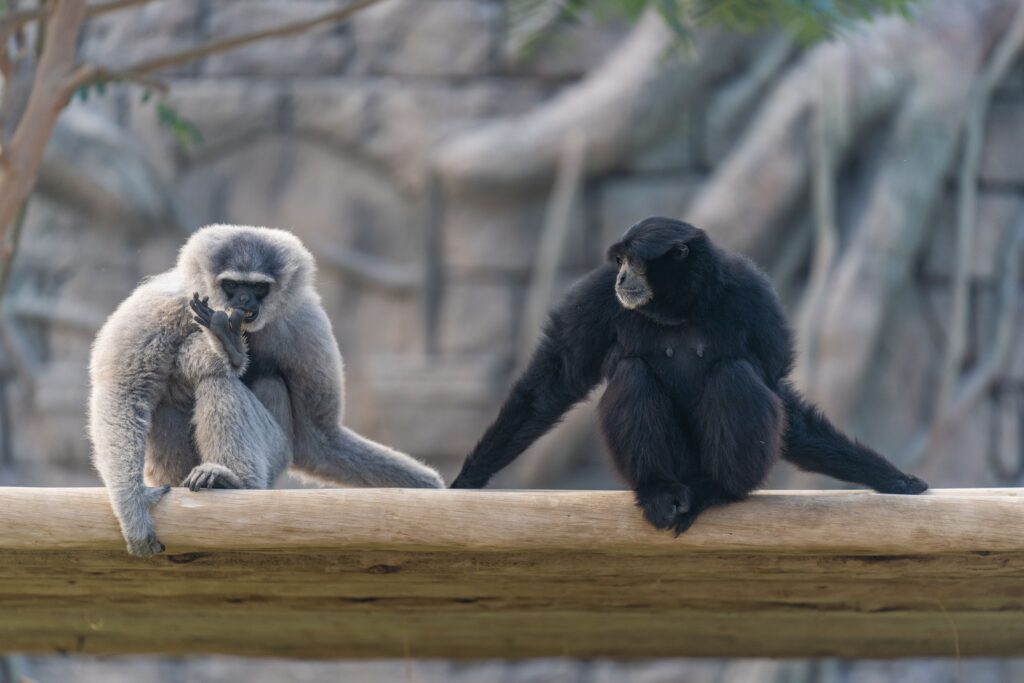
- Hylobates moloch ワウワウテナガザル Silvery gibbon
- Hylobates muelleri ミュラーテナガザル Müller’s Bornean gibbon[2]
- Hylobates pileatus ボウシテナガザル Pileated gibbon
- Nomascus concolor カンムリテナガザル Crested gibbon
- Nomascus gabriellae キホオテナガザル Red-cheeked gibbon
- Nomascus hainanus ハイナンテナガザル Hainan gibbon
- Nomascus leucogenys キタホオジロテナガザル Northern white-cheeked gibbon
- Nomascus nasutus カオヴィットカンムリテナガザル Cao-vit crested gibbon
- Nomascus siki ミナミホオジロテナガザル Southern white-cheeked gibbon
- Symphalangus syndactylus フクロテナガザル Siamang
About habitat
Its wild habitat is distributed from East Asia, including China, to Southeast Asia (Indonesia, the Malay Peninsula, Malaysia, Myanmar, and Thailand).
- Geographic Distribution
Gibbons are primates that live in the tropical rainforests of Southeast Asia. The main distribution areas are as follows:
Indochina Peninsula: Thailand, Laos, Cambodia, Vietnam
Malay Peninsula: Peninsular Malaysia, Singapore
Indonesia: Sumatra, Borneo (Kalimantan), Java, Sulawesi
Other Islands: Bali and other small islands
- Habitat
Main habitat: The canopy layer (the upper part of the forest) of tropical rainforests
Prefers forests with dense trees and vines
Living in the trees, they rarely descend to the ground
Elevation ranges from lowlands to mid-mountainous areas (approximately 0-2000 m)
- Relationship between Behavior and Habitat
Completely arboreal (especially red gibbons, who live mainly in the canopy layer)
Movement by hanging from trees using their long arms (brachiation)
Move widely within the forest in search of fruit, leaves, flowers, and insects
Highly territorial, they communicate through vocalizations and movements to defend their territory
feature is? What kind of creature is it?
The most distinctive characteristic of gibbons is the length of their forelimbs. Among modern hominoids, it is small, with forelimbs about 1.7 times longer than hind limbs. Gibbons prefer tropical rainforests and live in trees. Gibbons are known for their singing, and the male and female couples take turns shouting and singing to each other. It also has the meaning of claiming territory against other groups.
- Physical Characteristics
Body Type: Slender and agile, with very long limbs
Arm Length: Approximately 1.5 to 2 times the body length, ideal for brachiation
Weight: Approximately 4 to 12 kg (varies by species)
Body Length: Approximately 40 to 70 cm (no tail)
Coat Color: Varies by species
Various colors, including black and white, black, brown, and pale yellow
The face is hairless, allowing for clear facial expressions
- Limb and Locomotion Characteristics
Long Arms: Excellent for hanging from tree branches
Legs are relatively short, better suited to arboreal locomotion than ground locomotion
Tailless: Uses arms for balance, not tail, and moves by hanging
- Diet
Mainly frugivorous (fruit)
Also consumes small amounts of leaves, flowers, buds, and insects
Forages by moving through the fruit-rich canopy
- Behavior/Lifestyle
Completely arboreal
They use their long arms to swing between trees (brachiation)
They live in the upper reaches of the forest and rarely descend to the ground
They often live in monogamous family groups
What is your personality like?
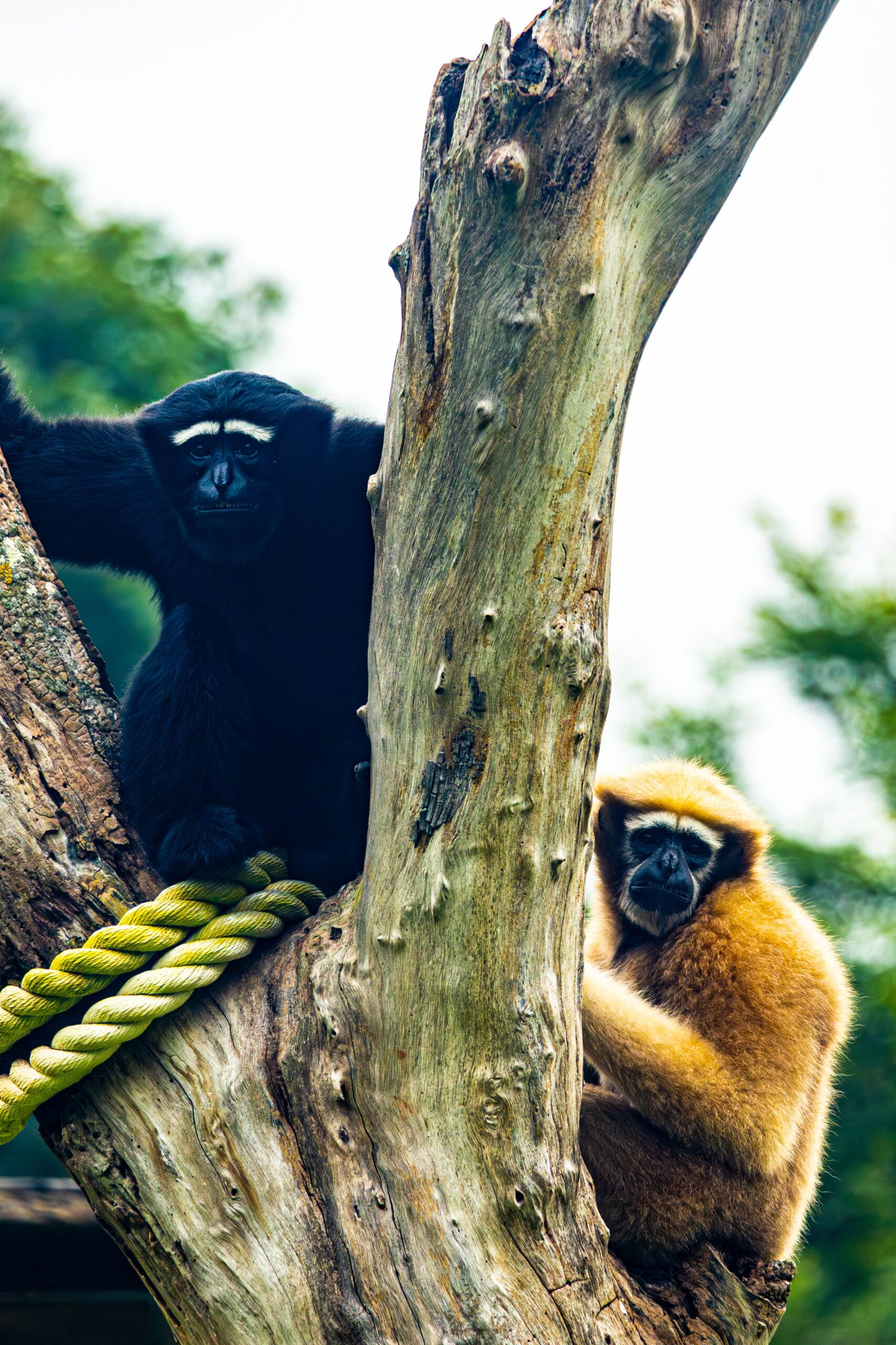
As gibbons grow older, they become more wary. They are also social animals who value discipline. Therefore, they live and travel in groups such as families rather than alone.
- Active and Dexterous
Using their long arms to navigate freely through the trees, they have excellent athletic ability.
They excel at jumping and swinging in trees, and they also have a playful side.
- Timid and Cautious
In the wild, they are highly wary of humans and predators.
If they sense danger, they will quickly hide in trees or branches.
- Social and Territorial
They often live in monogamous family units (pairs or parent-child pairs).
They mark their territory with calls and movements.
They communicate using “duet calls,” especially in the morning and evening.
They can be aggressive towards individuals outside their group.
- Gentle but Territorial
Gentle and cooperative within the family.
They are sensitive and can be aggressive when it comes to territory and pair relationships.
What is the ecology like?
Gibbons mainly eat fruits, leaves, and flowers, as well as insects. There is no specific breeding season and the gestation period is 7 months. They are monogamous and can have one litter at a time. Males also help with child rearing, and the young are nursed for about two years. Their lifespan is about 25 to 40 years, and the longer they live in captivity.
- Living Environment
Completely arboreal (canopy layer)
Movement mainly by brachiation, climbing tree branches
Rarely descends to the ground
Habitat: Tropical rainforests of Southeast Asia, from lowlands to altitudes of approximately 2,000 m
- Diet
Mainly frugivorous (fruit)
Also consume small amounts of leaves, buds, flowers, bark, and insects
Move while searching for food in the upper forest
Foraging range is relatively wide, with a daily range of approximately 1-2 km
- Breeding and Rearing
Breeding: Approximately once a year (varies by region and species)
Gestation Period: Approximately 7 months
Litter Size: Usually 1
Mothers raise their young for 1-2 years, teaching them how to move and eat in the trees
Pairs live together for long periods of time, and parent-offspring relationships are strong
- Social Structure
Family unit (pair + offspring) They live in a diurnal habitat.
They maintain their territories and pair relationships through vocalizations.
They often duet with their pairs, especially in the morning and evening.
They minimize contact with other individuals and protect their territories.
- Movement and Activity
They move by swinging along branches (brachiation).
They are diurnal.
They change their range daily depending on the distribution of fruit.
They are sensitive to deforestation and human activity and are highly cautious.
Are there any natural enemies?
Their natural enemies include gibbons, tigers, leopards, clouded leopards, Asian golden cats, and dholes, so they must always be on guard against their enemies.
About Molting
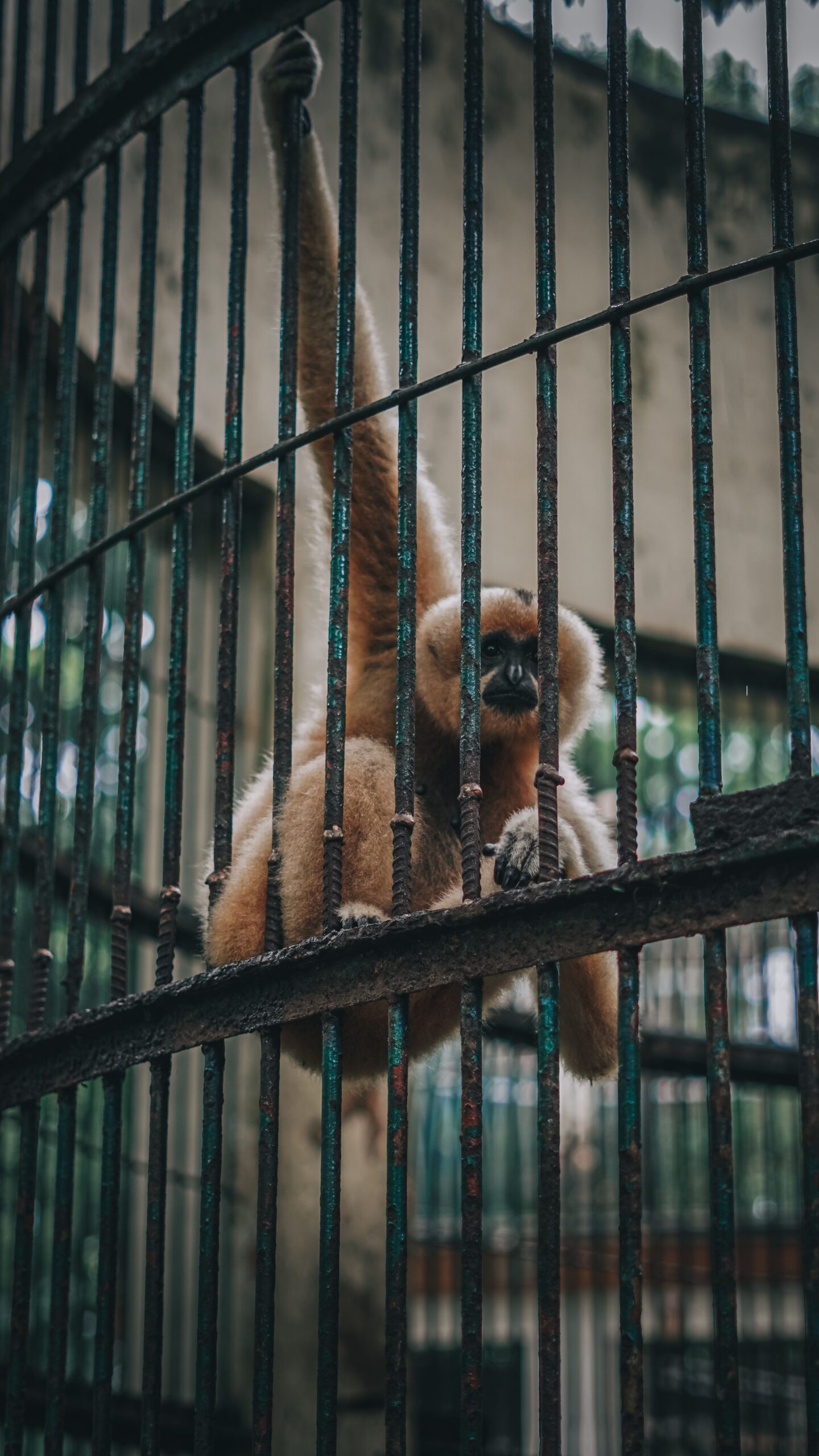
Unlike animals such as dogs or foxes that undergo a massive seasonal shedding of fur, gibbons experience “continuous molting,” where their fur is replaced gradually over time.
Gibbon Molting Cycle
Gibbons shed and replace their fur little by little throughout the year.
Characteristics:
They rarely lose fur over their entire body at once.
A constant amount of fur is replaced continuously.
They are relatively unaffected by seasonal changes.
In tropical regions:
Annual temperature fluctuations are minimal.
There is no snow or extreme cold.
Thick winter fur is unnecessary.
Consequently, they did not evolve the dramatic seasonal molting patterns seen in animals like foxes or wolves.
Functions of Fur
Gibbon fur serves the following primary functions:
① Body Temperature Regulation
Tropical rainforests feature:
Intense sunlight
High humidity
Sudden rainfall
Their fur serves to:
Block direct sunlight
Buffer against body temperature fluctuations
Protect the skin from rain
② Skin Protection
An arboreal lifestyle requires skin protection against:
Contact with branches
Insect bites
Rain and moisture
Their dense fur is well-suited for life in the forest.
③ Communication with Others
Fur color plays an important role for gibbons.
Example:
Lar gibbon (White-handed gibbon)
White fur on the hands, feet, and around the face
Black or brown body fur
These features aid in individual identification and mutual recognition among group members.
About Their Vocalizations
Gibbons are primates known for using particularly loud and complex vocalizations. Their calls are not merely “noises”; they have evolved into “songs” that serve to maintain territory, strengthen pair bonds, and facilitate communication with other group members.
The Characteristic “Gibbon Song”
Researchers refer to these vocalizations simply as “gibbon songs.”
Characteristics:
They follow a steady rhythm.
Each species has its own distinctive pattern.
Males and females produce different types of calls.
They often sing at specific times of the day.
They are particularly active in the morning.
Why Do They Sing So Loudly?
In the rainforests where gibbons live, they face several challenges:
Dense tree cover
Poor visibility
Difficulty in locating other group members
Consequently, they have developed the ability to:
“Signal their presence through sound rather than sight.”
Primary purposes:
Declaring territory
Strengthening pair bonds
Warning other groups
Locating group members
The Morning Song (Duet)
The duet (joint song) performed by the male and female is particularly well-known.
The sequence:
① The female begins
↓
② The male responds
↓
③ The pair creates a complex song together
This song serves to:
Reaffirm the pair bond
Advertise their territory to other individuals
Seasonal Activities
Since gibbons primarily inhabit the rainforests of Southeast Asia, they do not undergo changes like hibernation or the growth of a winter coat, as animals in Japan do.
While they remain active year-round, their behavior shifts based on the transition between wet and dry seasons, food availability, reproduction, and child-rearing.
🌸 Spring (Around March–May; transition into the wet season)
A period focused on reproduction and child-rearing
Although tropical regions do not experience a distinct “spring” in the temperate sense, this is a time when plant life becomes active in many areas.
Key activities
Moving through the canopy in search of fruit
Foraging in groups
Child-rearing
Territory maintenance
Growth of offspring
Gibbons generally:
Give birth to a single infant at a time
Have a gestation period of approximately 7 months
Engage in long-term child-rearing
Mothers carry their infants while moving and raise them over the course of several years.
☀️ Summer (Around June–August; wet season)
A period of high activity and abundant food
Rainfall is heavy in the rainforest, promoting plant growth.
Key activities
Searching for fruit
Traveling long distances through the canopy
Eating leaves and flowers
Resting in groups
Foraging behavior
Gibbons are primarily frugivores (fruit-eaters).
Diet:
Figs
Fruits
Young leaves
Flowers
Insects
When food is plentiful, there is less need to travel over wide areas.
🍂 Autumn (Around September–November; transition to the dry season)
Foraging and territory maintenance
In regions where rainfall decreases, changes in vegetation begin to occur.
Key activities
Moving to areas rich in fruit
Territorial patrols
Communication via morning songs
Growth of young individuals
Young gibbons:
Practice brachiation (swinging through branches)
Learn about food sources
Gain social experience within the group
❄️ Winter (Around December–February; dry season)
A season of movement in search of food
In the tropics, the challenge is adapting to dry conditions rather than cold temperatures. Key Activities
Expanding the foraging range
Long-distance travel
Hydration
Territorial disputes
Characteristics of the dry season
In areas with low rainfall:
Fruit becomes scarce
The proportion of leaves in the diet increases
Travel distances increase
Regarding Walking Speed
Gibbons are apes primarily adapted for an arboreal (tree-dwelling) lifestyle; they are not animals built for walking long distances on the ground.
Consequently, they have evolved superior capabilities for arm-swinging locomotion (brachiation) and maintaining balance in the trees rather than for walking speed.
Normal Walking Speed
When walking on the ground, their speed is estimated to be:
Approximately 3–5 km/h
This is comparable to a human’s leisurely walking pace, though gibbons do not frequently travel on the ground.
Characteristics:
Walking slowly and cautiously
Remaining alert to their surroundings
Extending arms to maintain balance
Ground Locomotion Style
The way gibbons walk differs slightly from that of other apes.
Bipedal Walking
On the ground, gibbons sometimes:
Walk bipedally (on two legs)
Characteristics:
Extending both arms overhead or out to the sides
Walking while maintaining balance
Keeping the body upright
This behavior is thought to have evolved as a means of balancing, as their long arms would otherwise easily touch the ground.
Arboreal Locomotion Speed (Brachiation)
Gibbons are truly in their element in the trees, not on the ground.
When brachiation (swinging by their arms) occurs:
They can reach speeds of nearly 30–40 km/h
Characteristics:
Supporting the body weight with one arm
Moving via large pendulum-like swings
Leaping distances ranging from a few meters to over 10 meters
Moving almost continuously from branch to branch
Jumping Ability
Gibbons possess exceptional jumping capabilities.
Abilities:
Leaping between branches separated by several meters or more
Using both arms and legs simultaneously
High spatial awareness to prevent falls
Their light body weight and long arms give them an advantage when moving through the forest canopy.
About baby gibbons
This article provides detailed information about baby gibbons (Hylobatidae).
- Birth and Body Size
Litter Size: Usually 1 pup
Weight: Approximately 400-600 g at birth (varies by species)
Body Length: Approximately 30-40 cm at birth
Fur is thin, light brown or gray, and not yet as vibrant as adult fur.
Eyes are large and develop to cling tightly to their mother.
- Growth
Nursing Period: Approximately 6-12 months of breastfeeding
Cubs are held on their mother’s back or chest and learn to move and live in trees.
Independence: By around 1 year of age, they are able to navigate and eat independently to some extent.
Sexual Maturity: 3-5 years, depending on species and environment.
- Behavior
Living closely with their mother or family mate
Learns how to move in trees (brachiation)
Learns how to forage for fruit and leaves by imitating their mother
Playful, practicing jumping from branch to branch
- Personality and Behaviors
Cubs They are curious and playful.
However, they are also very cautious and will cling to their mothers if they sense danger.
They learn social skills through trusting relationships with their mothers and mates.
- Caution (Dangers to Young Animals in the Wild)
There is a risk of falls and predators (such as large birds of prey).
Deforestation and human proximity can reduce their survival rate.
Is the gibbon an endangered species?
Some subspecies of gibbons are already listed as endangered species. Due to large-scale deforestation, the habitat of many individuals is rapidly decreasing. Particularly in Southeast Asia, where development is progressing rapidly, habitat destruction is quite serious. Some species are also listed in the Washington Convention.
- Conservation Status (IUCN Red List)
Many species of the gibbon family are classified as Endangered (EN) or Vulnerable (VU).
Examples:
Red gibbon (Hylobates agilis): VU (Near Threatened)
Black gibbon (Hylobates klossii): EN (Endangered)
White-handed gibbon (Hylobates lar): EN (Endangered)
- Causes of extinction
Deforestation
Logging of rainforests, agricultural development, and plantation development
Habitat fragmentation leading to population isolation
Poaching and pet trade
Young animals are sometimes captured for pets or as ornamental animals
Conflict with human activities
Stress due to road construction and human proximity
Food shortages and increased risk of predators
- Conservation Activities
Habitat protection in national parks and protected areas
Reforestation projects
Regulation of illegal capture and pet trade
Can gibbons be kept as pets?
Some subspecies of gibbons are designated as endangered species, so breeding them is extremely difficult. We recommend that you check out the information provided at zoos and events.
- Legally Prohibited
International Regulations
Gibbons are listed in Appendix I or II of the Convention on International Trade in Endangered Species of Wild Fauna and Flora (CITES).
→ International trade is generally prohibited or strictly controlled.
In Japan
Subject to the Act on Conservation of Species and the Act on Welfare and Management of Animals.
It is virtually impossible for individuals to keep them as pets.
Keeping is permitted only in facilities with special permission, such as zoos and research institutions.
→ Illegal keeping or trading is subject to penalties.
- Ecologically, they are not suitable for keeping as pets.
They are completely arboreal and require large, three-dimensional spaces.
They travel long distances per day and have a strong desire for exercise.
They have a highly developed intelligence and social skills.
In cramped environments, they are prone to severe stress, self-harm, and aggression.
- Personality and Behavioral Issues
Adults are extremely strong.
They are highly territorial and pose a risk of biting.
Their loud calls (duet calls) are a serious problem in residential environments.
- Ethical Issues
In the pet trade,
parents are often killed and only young animals are captured.
This is an international issue due to its direct link to the decline in populations of endangered species.
Zoos Housing These Animals (Japan & Worldwide)
Many gibbon species are seeing a decline in wild populations due to factors such as deforestation; zoos keep them for the purposes of education, research, and conservation through breeding.
🇯🇵 Zoos in Japan where you can see gibbons
Tama Zoological Park
A prominent facility for keeping gibbons.
Species housed:
Lar gibbon (White-handed gibbon)
Features:
A tall enclosure designed for an arboreal lifestyle
Visitors can observe brachiation (swinging from branch to branch using their arms)
Visitors may hear their vocalizations, often referred to as “songs”
A family of Lar gibbons is currently housed here.
Sapporo Maruyama Zoo
Species housed:
Silvery gibbon (also known as the Javan gibbon or Hylobates moloch)
Features:
A gibbon species native to the island of Java
Characterized by loud “singing” behavior
Visitors can observe them moving through the treetops
The Silvery gibbon is showcased for its canopy movement via brachiation and its territorial “songs.”
Ichikawa City Zoo and Botanical Garden
Species housed:
Lar gibbon (White-handed gibbon)
Features:
Housed in mated pairs
Visitors can observe physical activity involving play equipment
Characterized by movement using their long arms
The zoo has a record of keeping Lar gibbons.
Higashiyama Zoo and Botanical Gardens
Species housed:
Siamang
Features:
Loud vocalizations produced using a throat sac (gular sac)
Particularly powerful singing voice among gibbon species
Kochi Prefectural Noichi Zoological Park
Species housed:
Lar gibbon (White-handed gibbon)
Features:
Facility with a successful breeding track record
Exhibits designed to replicate an arboreal lifestyle
🌍 Gibbon-keeping facilities around the world
Singapore Zoo
Species housed:
Lar gibbon
Siamang
Features:
Replicates a tropical environment
Easy to observe arboreal movement
San Diego Zoo
Species housed:
Gibbons
Features:
Extensive great ape and gibbon exhibits
Strong focus on conservation research
Smithsonian National Zoo
Species housed:
Gibbons
Features:
Endangered species conservation
Primate research
London Zoo
Species housed:
Gibbons
Features:
Zoo with a long history
Famous for its primate exhibits
Schönbrunn Zoo
Species housed:
Gibbons
Features:
One of Europe’s most historic zoos
Engaged in breeding endangered primates
Introducing other animals



コメント