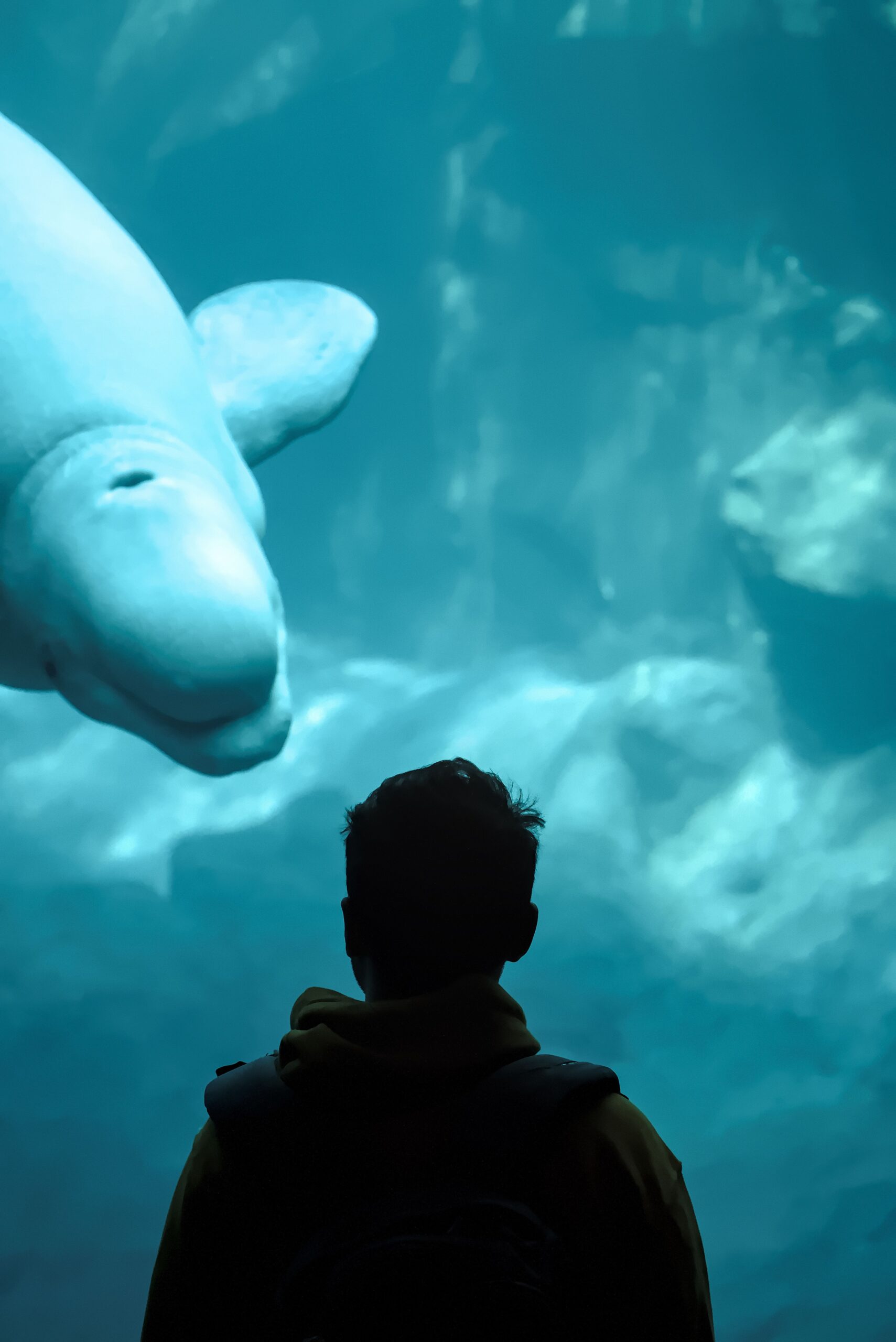
What kind of animal is a beluga? We will explain its characteristics, ecology, and habitat. This dolphin has white flesh and is found mainly in the Arctic Ocean. This species is the only one that makes up the genus Beluga. This dolphin is very familiar to humans, so we will introduce it to you.








- What is a Beluga? Basic Status
- What are the roots and origins of the beluga whale?
- Habitat
- What are its characteristics? What kind of creature is it?
- What is their personality like?
- What is their ecology like?
- About Diving
- About Their Vocalizations
- Seasonal Activities
- Swimming Speed
- About Baby Beluga Whales
- Are beluga whales an endangered species?
- Can beluga whales be kept as pets?
- Facilities Housing Beluga Whales (Japan & Worldwide)
- Introducing other animals
What is a Beluga? Basic Status
Belugas are marine mammals classified as part of the Mammalia class, Artiodactyla order, Family Narwhalidae, Genus Beluga. They are very large dolphins, with a body length of 3-5m and a weight of 0.5-1.5t. Their scientific name is Delphinapterus leucas, and their English name is Beluga. The kanji for Beluga is “White Sea Pig”. The list of information is as follows.
| Japanese(和名) | シロイルカ |
| English(英名) | Beluga White whale |
| scientific name(学名) | Delphinapterus leucas |
| classification(分類) | Mammalia、Artiodactyla/Cetartiodactyla、 Monodontidae、Delphinapterus 哺乳綱、偶蹄目、イッカク科科、シロイルカ属 |
| IUCN Status(保全状況) | LEAST CONCERN |
| Length(体長) | 3-5m |
| Weight(体重) | 0.5-1.5t |
What are the roots and origins of the beluga whale?
The roots of the beluga whale (scientific name: Delphinapterus leucas) trace back to cetaceans that evolved from primitive artiodactyls—land-dwelling mammals related to modern hippopotamuses—approximately 50 million years ago. The direct ancestors of the beluga itself belong to the Monodontidae family, a group of toothed whales (odontocetes) that adapted to the Arctic environment.
Origins leading to the whale
Approx. 50 million years ago: From land mammals to the sea
Their ancestors were small land mammals (of the artiodactyl lineage) that lived in the region of present-day India and Pakistan.
Evolutionary progression:
Land mammals
↓
Semi-aquatic primitive whales (e.g., Pakicetus)
↓
Fully aquatic cetaceans
↓
Toothed whales (e.g., dolphins, sperm whales)
↓
Monodontidae family (beluga whales, narwhals)
↓
Modern beluga whale
This is the evolutionary path they followed.
The beluga’s ancestors: The Monodontidae family
Although belugas resemble dolphins, their classification is somewhat unique.
Classification:
Order: Cetartiodactyla
Suborder: Odontoceti (toothed whales)
Family: Monodontidae
Genus: Delphinapterus
There are only two extant species in the Monodontidae family:
Beluga whale
Narwhal
These two species are very closely related and diverged from a common ancestor.
Reasons for evolving in the Arctic environment
From approximately 10 million years ago onwards, the ancestors of the beluga whale expanded into the waters of the Northern Hemisphere as the climate grew colder. Thus, they evolved adaptations for the Arctic environment, such as:
White body color
→ Camouflage in icy, snowy environments
→ Turning pure white upon reaching adulthood
Absence of a dorsal fin
→ To facilitate swimming beneath the ice
Thick fat (subcutaneous fat)
→ To maintain body temperature in freezing waters
Flexible neck
→ To search for food among the ice and in shallow waters
Ancient ancestors of the beluga whale
The fossil record identifies ancient members of the family Monodontidae—such as Denebola brachycephala (dating back approximately 9–10 million years to the Miocene epoch) and Bohaskaia monodontoides (dating back approximately 3–5 million years to the Pliocene epoch)—as ancestors leading to the modern beluga whale.
These species were smaller than modern belugas and were not yet as highly specialized for the Arctic environment.
Beluga whale taxonomy
- 界(Kingdom): 動物界 (Animalia)
- 門(Phylum): 脊索動物門 (Chordata)
- 綱(Class): 哺乳綱 (Mammalia)
- 目(Order): 鯨偶蹄目 / 鯨目 (Cetacea)
- 亜目(Suborder): 歯鯨亜目 (Odontoceti)
- 科(Family): ハクジラ科 (Monodontidae)
- 属(Genus): シロイルカ属 (Delphinapterus)
- 種(Species): シロイルカ (Delphinapterus leucas)
Habitat
Beluga whales can be seen widely in the Arctic Ocean. They are found in Hudson Bay, Greenland, the north coast of Iceland, and the north coast of Norway.
- Main Habitat
Coastal waters around the Arctic Ocean
Northern Canada (Hudson Bay, Churchill River Estuary)
Northern Alaska (Bering Sea, Chukchi Sea)
Northern Russia (Laptev Sea, Chukotka Sea, around the mouth of the Ob River)
Greenland Coast
Estuarine, Bay, and Shallow Water
In summer, they gather in estuaries and bays to breed and raise their young.
In winter, they migrate along the edge of pack ice to search for food.
- Habitat Characteristics
Water Temperature: Adapted to cold regions (approximately -2°C to 10°C)
Relationship with Sea Ice: Their rounded body shape, lacking a dorsal fin, allows them to swim easily under ice.
Estuarine and Shallow Water: Young animals often grow up safely in shallow water.
Migration: Seasonal coastal migration (estuaries and bays in summer, the edge of sea ice in winter).
- Highlights
Beluga whales sometimes enter freshwater.
Populations have been observed temporarily entering rivers in Alaska and Canada.
Plants live in relatively small to medium sizes (10-50 individuals).
They migrate flexibly depending on feeding grounds and ice conditions.
What are its characteristics? What kind of creature is it?
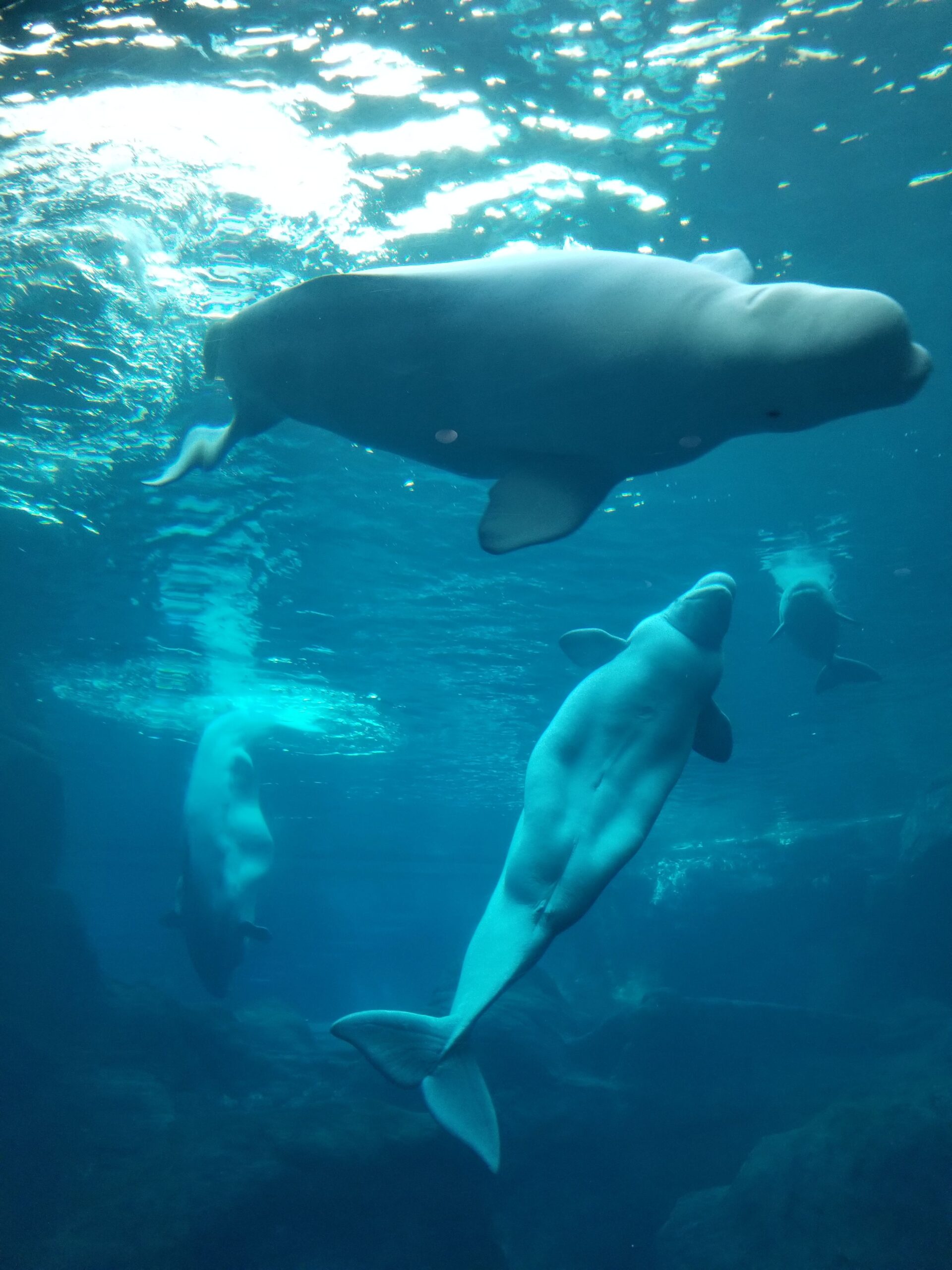
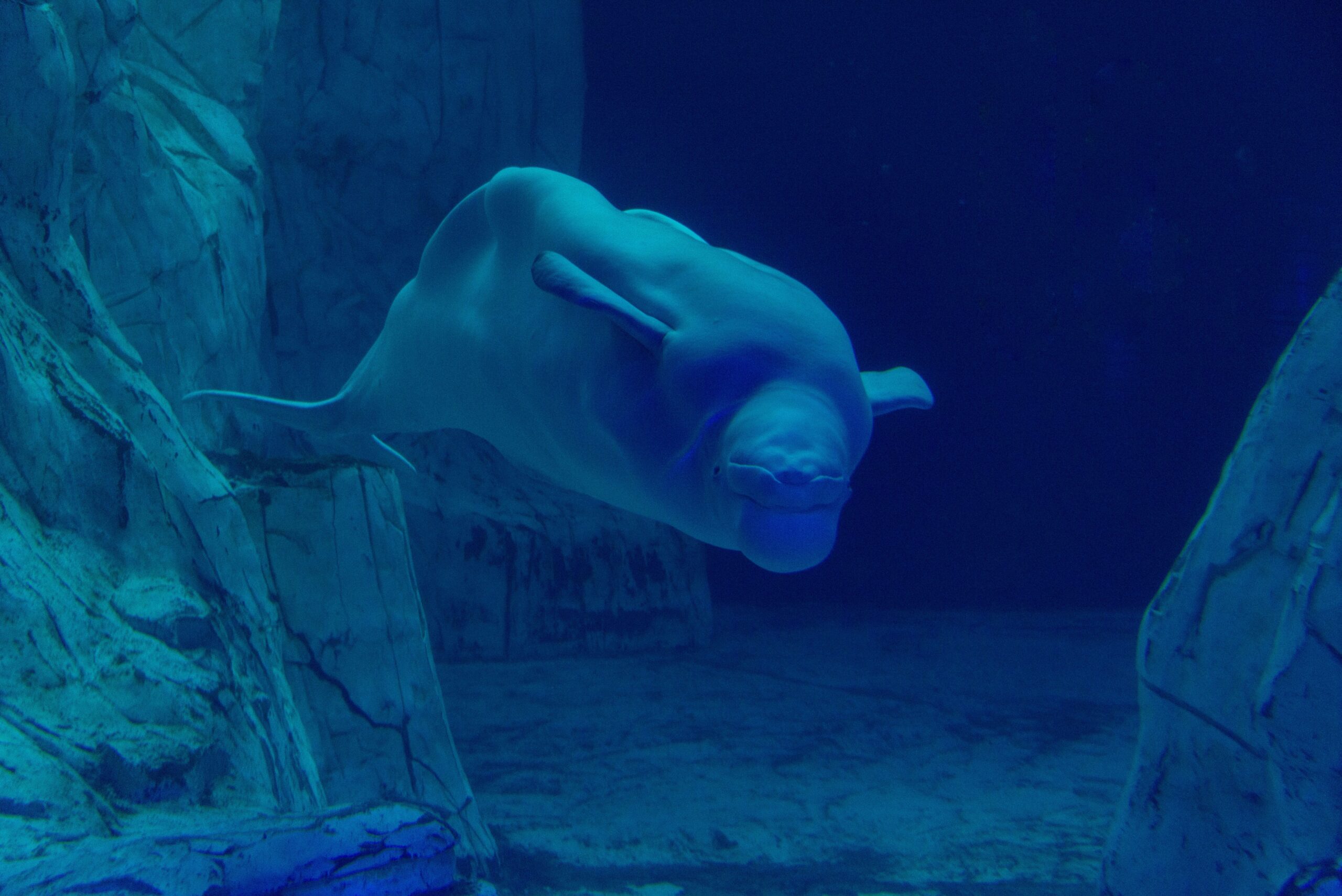
Beluga whales are large dolphins that come from the Arctic Ocean. They are pure white and have no dorsal fin. They have a fatty tissue called melon in the front of their heads. They use the melon to communicate with each other and for echolocation, generating sound waves by vibrating the back of their nasal cavity. Unlike other toothed whales, melons can change their shape at will. Their heads are small and their pectoral fins curl upward as they age. They are called the “canaries of the sea” because their cries sound like small birds.
- Physical Characteristics
Body Color: Adults are pure white. Juveniles are gray or bluish-gray, turning white as they mature.
Body Shape: Rounded, streamlined, and lacks a dorsal fin.
The lack of a dorsal fin allows them to swim easily under drifting ice.
Body Length and Weight:
Males: Approximately 4-5 m, Females: Approximately 3-4 m
Weight: Approximately 1,000-1,600 kg
Head: A round, soft “melon” emits sound waves (echolocation).
Mouth: Because it appears to be smiling, it is sometimes called the “sea canary.”
- Behavior and Personality
Highly Social
Live in small to medium-sized groups (approximately 10-50 individuals)
Communicate with each other using calls and clicking sounds.
Curious
May approach boats and humans.
Playful
Jumps on the water surface and splashes with their tail fin.
- Biological Characteristics
Diet: Fish (cod, salmon, etc.), squid, and crustaceans
Reproduction: Gives birth to one baby at a time
Gestation Period: Approximately 14-15 months
Raising is dominated by the mother, but they sometimes cooperate in groups
Adaptability
Body shape allows them to swim under drifting ice
They can safely raise their young in estuaries and shallow waters
What is their personality like?
Beluga whales are very social animals that value discipline. They are usually seen in groups. However, they often act alone. They are curious but also fearful, so they behave favorably towards humans.
- Sociable
Live in small to medium-sized groups (approximately 10-50 individuals)
Communicate with each other using vocalizations and clicking sounds
Mothers and their young form strong bonds, and the entire group sometimes helps raise their young.
- Inquisitive
Interested in boats, people, and objects
They often play on the water or sea ice, and may approach observers.
They are nicknamed “sea canaries” because of their vocalizations and playful nature.
- Playful
Jumping on the water, splashing with their tails, and chasing each other.
Young individuals learn hunting and social skills, especially through play.
- Gentle but cautious
Generally not aggressive
Quickly avoids perceived danger, such as boats or predators.
What is their ecology like?
Beluga whales live by eating fish, crustaceans, invertebrates, etc. Mating occurs from February to May and the gestation period is about 14 months. They can give birth to one baby at a time and can live for 30-40 years in the wild. Males reach sexual maturity at 8 years old and females at 5 years old. There is a 2-year gap between births.
- Habitat
Coastal areas, estuaries, and bays around the Arctic Ocean
Northern Canada (Hudson Bay, Churchill River Estuary)
Northern Alaska (Bering Sea, Chukchi Sea)
Northern Russia (Laptev Sea, Chukotka Sea, Ob River Estuary)
Relationship with Pack Ice
Without a dorsal fin, their rounded body shape allows them to swim easily under the ice.
In winter, they search for food by moving along the edge of the sea ice.
Estuarine and shallow waters
Suitable for rearing and breeding young.
- Diet
Mainly fish (cod, salmon, haddock, etc.)
Also eats squid and crustaceans.
Predation Method: They sometimes herd and hunt fish in schools.
- Social and Behavioral Characteristics
Public Life: Small to medium-sized groups of 10-50 individuals
Communication: Communicate using clicks and whistling calls
Swimming Behavior: Jumping on the water surface and splashing with their tail fins
Migration: Move between coastal areas and the sea ice edge depending on the season
- Reproduction and Rearing
Gestation Period: Approximately 14-15 months
Birth: One calf at a time
Rearing: The mother takes the lead, but the entire pack protects the young
Growth: Within a few years, the young reach adult size and learn to hunt and live in groups.
Do they have any natural enemies?
The biggest threat to beluga whales is the killer whale. When they are in danger, they use their melons to warn their companions of the danger.
About Diving
Beluga whales possess a highly advanced diving system that evolved to enable survival in the icy waters of the Arctic. Among the dolphin family, they are a species specifically adapted to shallow-water and under-ice environments.
Maximum Diving Depth
Recorded dives exceeding approximately 700 meters exist.
Typical dives range from a few tens to a few hundred meters.
However, belugas are not deep-sea hunters; they primarily forage along continental shelves and in coastal areas, so they do not usually dive to extreme depths.
Dive Duration
Typical: Around 5–10 minutes
Long dives: Over 15 minutes
They lack the ability to stay submerged for nearly an hour, unlike deep-diving whales such as sperm whales.
This is because belugas employ a different hunting strategy.
Belugas…
…repeatedly perform short dives while searching for prey such as:
Cod
Herring
Squid
Shrimp and crabs
Small crustaceans
① Muscles that store large amounts of oxygen
Beluga muscles contain high levels of a protein called…
…myoglobin,
…which stores oxygen.
The concentration is far higher than in human muscles,
…enabling muscle activity during dives
…and efficient oxygen use when the heart rate slows down.
② Diving reflex
Upon entering the water, the body automatically triggers a response that:
Lowers the heart rate
Concentrates blood flow to vital organs
Reduces oxygen consumption
Oxygen is preferentially supplied to the…
…brain
…and heart.
③ Flexible ribcage
When diving deep, belugas can…
…strongly compress their lungs.
This serves to:
Prevent excessive nitrogen from dissolving into the blood
Reduce the risk of decompression sickness
About Their Vocalizations
Beluga whales produce an exceptionally diverse range of sounds—so much so that they are known as the “Canaries of the Sea.”
Types of Beluga Vocalizations
Belugas are believed to use dozens of different types of sounds.
Common examples:
“Pip-pip” clicking sounds
(Click sounds)
Purpose:
Echolocation
Checking surrounding terrain
Locating fish
They emit ultra-fast sound waves and use the returning echoes to determine:
Distance
Size
Shape
Movement
“Q-q” or “Gyu-gyu” sounds
(Whistle sounds)
Purpose:
Communicating with others
Calling out
Maintaining the pod
These serve a function similar to humans calling each other by name.
High-pitched, bird-like sounds
These are characteristic sounds of the beluga whale.
In settings like aquariums,
Bird chirps
Children’s laughter
Electronic sounds
…are some of the things they can sound like.
This is why they earned the nickname
“Canaries of the Sea.”
How do they produce sound?
They do not have vocal cords like humans do.
Belugas use
A sound-producing organ (phonic lips)
Located deep within their nasal passages.
The process:
Air moves from the nasal passages
The phonic lips vibrate
Sound is focused by the “melon” (the rounded organ on the forehead)
Sound is projected into the water
…this is the mechanism involved.
Do they “converse”?
Yes, they do.
Belugas are highly social animals,
Engaging in complex vocal exchanges with
Mothers and calves
Pod members
Mating partners
Calves, in particular, may possess
A unique vocalization (signature whistle)
To identify their mothers.
This functions much like a “name” among dolphins.
Seasonal Activities
Beluga whales are animals that significantly alter their habitats, behaviors, diets, and herd structures depending on the season. In the Arctic region particularly, changes in sea ice dictate their annual life rhythm.
Spring (March–May): Ice begins to melt; the season for moving north
Key activities:
Begin migrating from wintering grounds
Travel north using leads (cracks in the sea ice)
Herds grow larger
During winter, belugas avoid areas where the sea is completely frozen,
Bering Sea
Chukchi Sea
Waters around Norway
…spending the season in areas with relatively little ice.
As the sun returns and the ice begins to break up in spring,
a massive migration involving hundreds to thousands of whales
begins.
Summer (June–August): The most active season
Summer is the most important time of year for belugas.
① Gathering in estuaries and shallow waters
Well-known gathering spots include:
Estuaries in northern Canada
Cook Inlet, Alaska
Coasts of the Russian Arctic
Purposes:
Molting (shedding skin)
In summer, belugas rub their bodies against shallow sandy or pebbly seabeds.
This serves to:
Shed old skin
Condition new skin
② Birthing season
Summer is the season for raising calves.
Gestation period:
Approximately 14–15 months
Birth:
Mainly June–August
Newborn calves are characterized by:
Gray to blue-gray coloration
Turning white over the course of several years
Mothers nurse their calves for about two years.
③ Feeding heavily
Food is abundant in summer.
Diet:
Cod
Salmon
Herring
Squid
Shrimp
They build up fat reserves in preparation for winter.
Autumn (September–November): Moving south and preparing for winter
As temperatures drop and sea ice expands again,
they migrate south from the Arctic. Activities:
Moving between feeding grounds
Traveling long distances in pods
Storing fat
Beluga whales feed particularly actively in the autumn.
Since food sources dwindle in winter,
a thick layer of fat (ranging from several centimeters to over ten centimeters)
becomes crucial.
Winter (December–March): A season of survival in icy waters
Winter presents the harshest conditions.
They utilize:
the edge of the sea ice
cracks in the ice
open water areas (polynyas)
Because beluga whales lack a dorsal fin,
they can easily swim beneath the ice
and surface to breathe through cracks in the ice.
Swimming Speed
Beluga whales are not high-speed hunters; rather, they are “low-speed, high-maneuverability” whales that move freely through icy waters.
Normal Speed
Approx. 2–6 km/h
They swim at this leisurely pace during routine movement or when swimming in a pod.
Purposes:
Maintaining distance from other pod members
Foraging for food
Exploring beneath the ice
Cruising Speed (Long-distance travel)
Approx. 5–10 km/h
During seasonal migrations, they travel hundreds to thousands of kilometers, swimming at a pace that conserves energy.
During northward migration in spring/summer
and southward migration in autumn,
they travel over the course of days to weeks,
moving as a pod.
Top Speed
Approx. 20–25 km/h
They can reach high speeds temporarily to avoid danger or pursue targets.
Examples include:
Escaping from orcas
Chasing prey
Rapidly approaching other pod members
About Baby Beluga Whales
To take a closer look at baby beluga whales (Delphinapterus leucas), their appearance, behavior, and lifestyle differ slightly from those of adult whales.
- Physical Characteristics
Body Length: Approximately 1.2 m at birth
Weight: Approximately 80-100 kg
Body Color: Gray to blue-gray, turning white as they grow
Head and Dorsal Fin: Their rounded head and lack of a dorsal fin are the same as those of adults
- Behavior and Personality
Dependent on Their Mother
For about a year after birth, they swim alongside their mother, protecting them from food and danger.
Playful
Jumping on the surface of the water and splashing with their tail fin and body
Playing games with their packmates
Learning Behavior
They learn how to catch food and the rules of the pack by observing the behavior of their mother and the pack.
- Biological Features
Diet: Breastfed for the first few months
Weaning: Begins eating fish at around 6-12 months
Growth Rate: Reaches near adult size in 1-2 years and is able to participate in pack activities
Dangers: Young animals are sensitive to drifting ice, shallow waters, ships, and predators, making them at high risk
Are beluga whales an endangered species?
Beluga whales are not endangered when viewed as a whole. However, the population in Cook Inlet has drastically decreased due to whaling. More than 2,000 whales are hunted annually throughout the Arctic, which is a very critical situation. There are also concerns about a decrease in the population due to changes in water temperature. In 1979, they were listed as an endangered species in Appendix II of the Convention on International Trade in Endangered Species of Wild Fauna and Flora (CITES). Environmental destruction caused by the installation of pipelines and the construction of dams for hydroelectric power generation has become a problem.
- International Union for Conservation of Nature (IUCN) Assessment
Beluga whales as a whole
Rated “Least Concern” on the IUCN Red List
The population is considered relatively stable throughout the Arctic.
Regional Populations
Some populations in Alaska and Canada are locally vulnerable due to impacts from fishing, shipping, and pollution.
Some populations in the Russian Arctic have been reported to be declining due to mining development and pollution.
- Reasons why they are not endangered
Distributed along the wide Arctic coast.
Living in groups, with a relatively stable reproductive rate.
Their only natural predators are killer whales and large sharks, and they are stable in areas without human impact.
- Caution
Reduction of sea ice due to global warming may affect beluga whale habitats and prey resources.
Populations that gather in estuaries and bays are vulnerable to shipping and water pollution.
Can beluga whales be kept as pets?
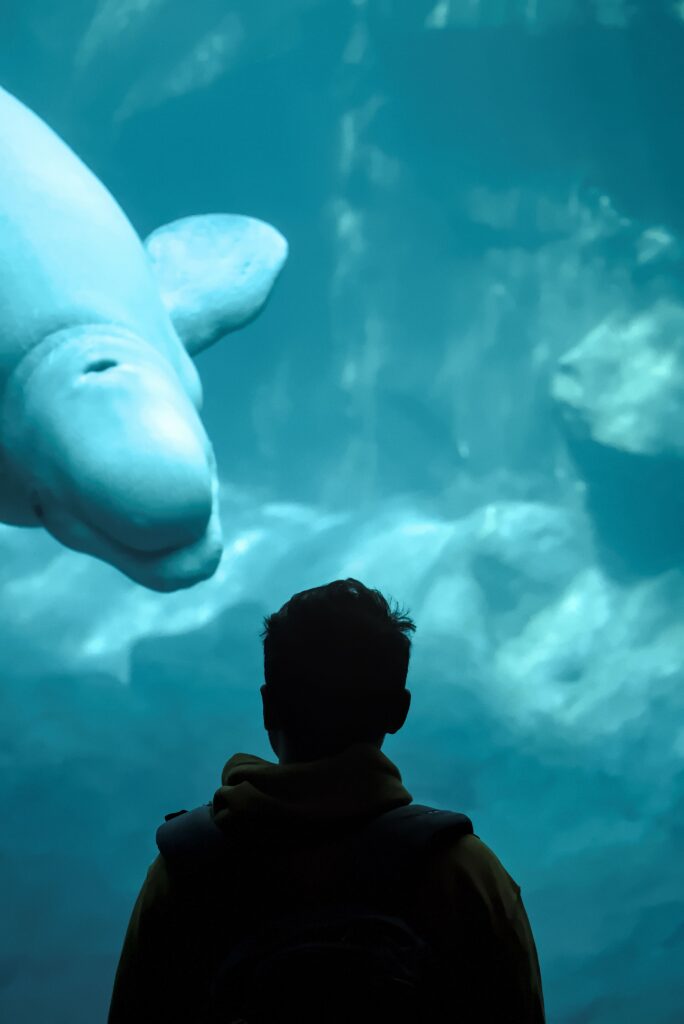
Beluga whales are an endangered species and cannot be kept by the general public. If you are looking for them, we recommend visiting an aquarium or other place to view them and getting guided or guided at events. The performances of beluga dolphin shows and play are popular. You can also purchase illustrations, photos, and goods such as stuffed animals at the store. They are noteworthy for their diverse expressions and large size. You can also observe bubble rings, where beluga whales blow ring-shaped bubbles.
- Legal and Conservation Issues
Beluga whales are Arctic wildlife, internationally listed under Appendix II of the CITES, and international trade is strictly restricted.
Even in Japan, capturing and keeping wild beluga whales is prohibited by law.
Only individuals with special permission can be kept in aquariums or research facilities.
- Ecological and Breeding Environment Issues
Large water area required: They live in vast environments along the coasts and estuaries of the Arctic, making them impossible to recreate at home.
Water temperature control is difficult: They are adapted to cold water temperatures (-2°C to 10°C), and maintaining them in an artificial environment requires highly advanced equipment.
Highly social: They live in groups, so keeping them alone is stressful.
Diet: They require large amounts of fish and crustaceans, and their feeding behavior requires training.
- Aquarium Breeding
Only kept in specialized facilities worldwide.
Only a few aquariums in Japan can observe them.
Breeding requires large pools, low water temperature control, veterinarians, and specialized staff.
Facilities Housing Beluga Whales (Japan & Worldwide)
Beluga whales are kept in select aquariums and marine facilities in Japan and around the world. They have a long history of captivity; due to their high intelligence, ability to communicate with humans, and adaptability to cold waters, they are subjects of both research and public exhibition. There are approximately 30 facilities worldwide known to house them.
🇯🇵 Major Facilities in Japan
Port of Nagoya Public Aquarium
One of Japan’s most famous facilities for exhibiting beluga whales.
Features:
Visitors can observe them swimming in a large tank.
Exhibits explaining echolocation (ultrasonic sound).
Demonstrations of physical capabilities through training sessions.
Beluga whales are currently housed here.
Kamogawa Sea World
A facility in Japan particularly renowned for its beluga whale exhibits.
Features:
Beluga whale performance shows.
Underwater training sessions.
Research into individual personalities and behaviors.
Engaged in breeding and artificial rearing—activities that are rare for belugas in Japan.
Yokohama Hakkeijima Sea Paradise
Features:
Extensive marine life exhibits.
Known as a facility where visitors can see beluga whales.
🌎 Major Facilities Worldwide
Georgia Aquarium (USA)
One of the world’s largest aquariums.
Features:
Beluga whale research.
Breeding research.
Marine mammal education.
Shedd Aquarium (USA)
Features:
A facility with a long history of keeping beluga whales.
Known for individual identification and behavioral research.
SeaWorld San Antonio
Features:
Extensive experience in housing beluga whales.
Accumulated expertise in veterinary research and breeding techniques.
Mystic Aquarium
Features:
Famous for beluga whale research.
Involved in health management and cognitive research.
Introducing other animals


コメント