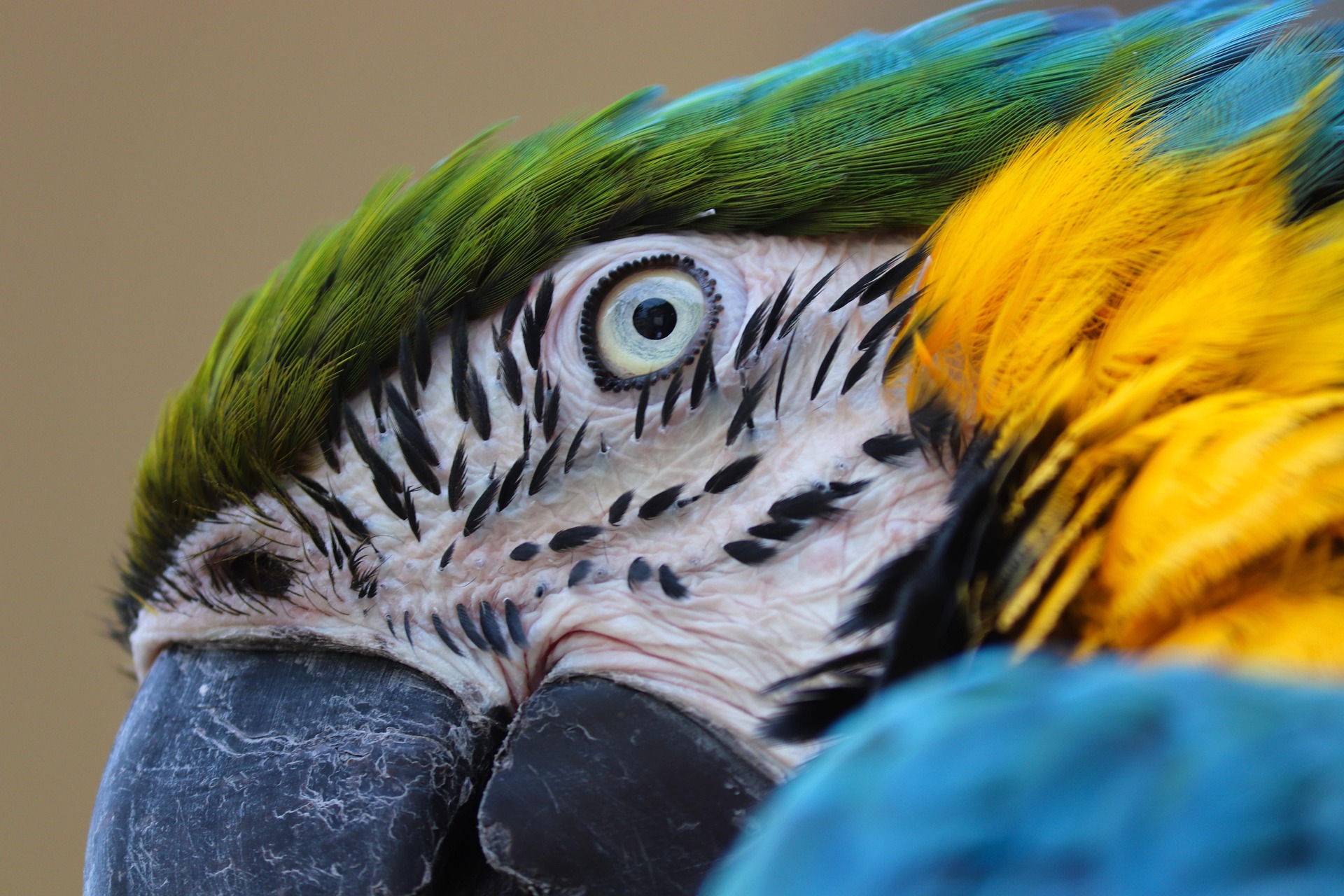
What kind of bird is a macaw? We will explain its characteristics, ecology, and habitat. Macaws are famous birds that are widely distributed in Central and South America, the Caribbean, and even South America, and many households keep them as pets, but some subspecies are also designated as endangered species, and there is a possibility of extinction. is also suggested.





- What is a macaw? About basic status
- What are the roots and origins of the macaw?
- Origins: “Ancient Parrots” (Over 50 Million Years Ago)
- Direct Macaw Ancestors Evolved in South America
- Why Did They Become So Large and Colorful?
- A relationship with humans spanning millennia
- About classification
- Anodorhynchus glaucus
- Anodorhynchus hyacinthinus
- Anodorhynchus leari
- Cyanopsitta spixii
- Ara ararauna
- Ara glaucogularis
- Ara militaris
- Ara ambiguus
- Ara macao
- Ara chloropterus
- Ara rubrogenys
- Ara severus
- Ara atwoodi
- Ara erythrocephala
- Ara gossei
- Ara guadeloupensis
- Ara tricolor
- Ara autocthones
- Orthopsittaca manilatus
- Primolius couloni
- Primolius maracana
- Primolius auricollis
- Diopsittaca nobilis
- Where is its habitat?
- feature is? What kind of creature is it?
- What is your personality like?
- What is the ecology like?
- Macaw Molting
- Macaw Vocalizations
- Seasonal Activities
- Flight Speed
- About Scarlet Macaw Chicks
- Are macaws an endangered species?
- Can macaws be kept as pets?
- Zoos Housing Macaws (Japan & Worldwide)
- Introducing other animals
What is a macaw? About basic status
Macaws are birds that belong to the family Parrotidae. The English name is “Macaw” and the scientific names include the genus Ara, Anodorhynchus, Cyanopsitta, Propyrrhura, Orthopsittaca and Diopsittaca.
| Japanese(和名) | コンゴウインコ |
| English(英名) | Macaw |
| scientific name(学名) | Ara Anodorhynchus Cyanopsitta Propyrrhura Orthopsittaca Diopsittaca |
| classification(分類) | Ave、 Psittaciformes、 Psittacidae 鳥綱、オウム目、インコ科 |
| IUCN Status(保全状況) | LEAST CONCERN – ENDANGERED |
| Length(体長) | 90-100cm |
| Weight(体重) | ~1kg |
What are the roots and origins of the macaw?
Macaws trace their roots to tropical regions, primarily in South America. Their evolution into the massive, brightly colored birds we see today spans tens of millions of years.
Origins: “Ancient Parrots” (Over 50 Million Years Ago)
Taxonomically, macaws belong to the order Psittaciformes and the family Psittacidae.
Their ancestral parrots were ancient, believed to have existed between 60 million and 50 million years ago (during the early Cenozoic Era). DNA research indicates that South American and Australian parrots diverged from a common ancient ancestor.
At that time, continental drift meant that landmasses like South America, Antarctica, and Australia were arranged differently than they are today. Consequently, it is believed that ancestral parrot populations followed separate evolutionary paths as the continents split apart.
Direct Macaw Ancestors Evolved in South America
Modern macaws developed primarily within the Neotropical realm (covering Mexico, Central America, and South America).
In South America specifically, they adapted to diverse environments—such as the Amazon rainforest, the Brazilian Highlands, Bolivian forests, and savanna regions—leading to a proliferation of species.
Research suggests that the group containing macaws (Arini) underwent significant diversification in South America starting around 28 million years ago. Factors such as the formation of the Andes Mountains and changes in forest and grassland environments are believed to have driven the emergence of new species.
Why Did They Become So Large and Colorful?
Characteristics of macaws:
Massive beak
Long tail feathers
Vibrant plumage (blue, red, yellow, etc.)
High intelligence
Strong social nature
These traits are adaptations to the tropical environment.
Massive beak
For cracking open hard fruits and nuts. Examples:
Coconut
Hard seed
Fruit seed
Flashy colors
Visibility is crucial in the rainforest.
Finding a mate
Pair bonding
Moving in flocks
…are believed to be the reasons why such vibrant plumage evolved.
A relationship with humans spanning millennia
For the indigenous peoples of South America, macaws have been regarded as:
Sacred birds
Sources of decorative feathers
Symbols of abundance
Species such as the Scarlet Macaw (with its red plumage) and the Blue-and-Yellow Macaw hold significant cultural value and were utilized even by ancient civilizations.
About classification
There are many different subspecies of macaws. We will also briefly introduce each subspecies.
| 名前 | Name | Scientific name (学名) |
| ウミアオコンゴウインコ | Glaucous macaw | Anodorhynchus glaucus |
| スミレコンゴウインコ | Hyacinth Macaw | Anodorhynchus hyacinthinus |
| コスミレコンゴウインコ | Indigo Macaw | Anodorhynchus leari |
| アオコンゴウインコ | Little Blue Macaw | Cyanopsitta spixii |
| ルリコンゴウインコ | Blue-and-gold Macaw | Ara ararauna |
| アオキコンゴウインコ | Blue-throated macaw | Ara glaucogularis |
| ミドリコンゴウインコ | Blue-green macaw | Ara militaris |
| ヒワコンゴウインコ | Great green macaw | Ara ambiguus |
| アカコンゴウインコ | Scarlet Macaw | Ara macao |
| ベニコンゴウインコ | Red-and-green macaw | Ara chloropterus |
| アカミミコンゴウインコ | Red-cheeked macaw | Ara rubrogenys |
| ヒメコンゴウインコ | Chestnut-fronted macaw | Ara severus |
| ハイチコンゴウインコ | Dominican green-and-yellow macaw | Ara atwoodi |
| アカズキコンゴウインコ | Red-headed macaw | Ara erythrocephala |
| ゴッスミイロコンゴウインコ | Jamaican Red Macaw | Ara gossei |
| グァダループコンゴウインコ | Lesser Antillean macaw | Ara guadeloupensis |
| ミイロコンゴウインコ | Cuban Red Macaw | Ara tricolor |
| セントクロコンゴウインコ | St. Croix macaw | Ara autocthones |
| ズグロヒメコンゴウインコ | Red-bellied macaw | Orthopsittaca manilatus |
| ヤマヒメコンゴウインコ | Blue-headed macaw | Primolius couloni |
| アカビタイヒメコンゴウインコ | Blue-winged macaw | Primolius maracana |
| キエリヒメコンゴウインコ | Golden-collared macaw | Primolius auricollis |
| コミドリコンゴウインコ | Red-shouldered macaw | Diopsittaca nobilis |
Anodorhynchus glaucus
The Black-tailed Macaw is an endangered species of large blue and gray South American parrot. It is 70cm long and can only be seen in the border area between Brazil and Argentina. A 2018 study suggested that the bird is extinct, and it may be extinct since there have been no sightings of it.
Anodorhynchus hyacinthinus
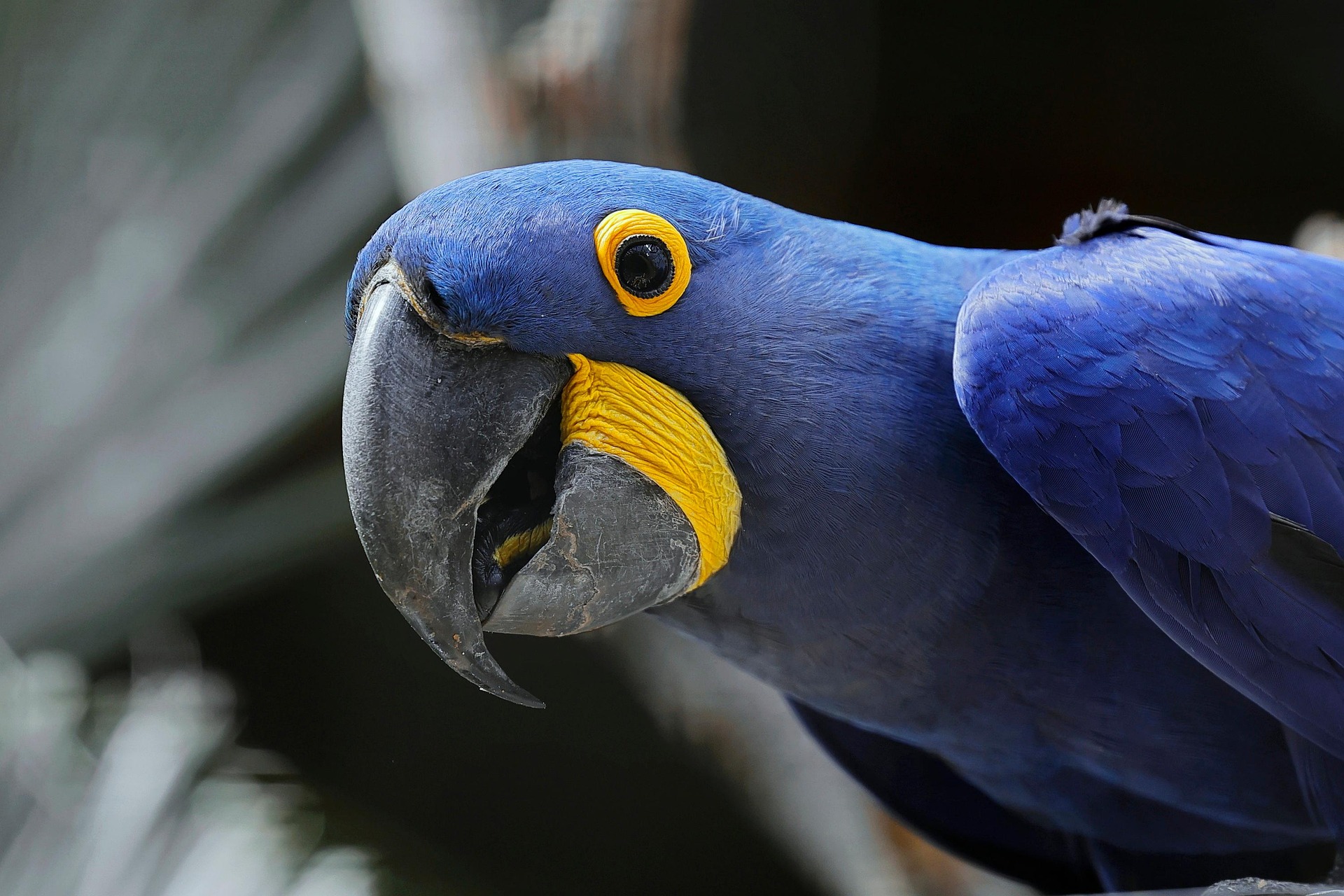
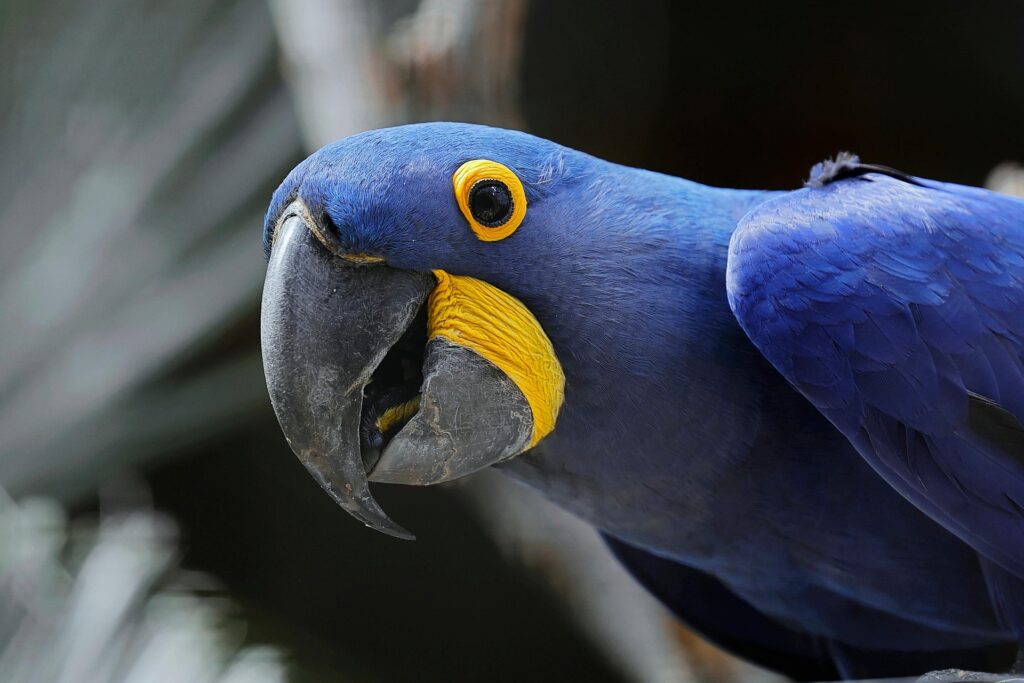
The violet macaw is endemic to Brazil and can grow up to 100 cm in length. The plumage of the whole body is bright blue, the wings are purplish, and the tail feathers and underside of the wings are dark gray. It is already listed on CITES Appendix I and is listed as an endangered species. Their population is drastically decreasing due to habitat destruction and overhunting for their feathers, food, and pets.
Anodorhynchus leari
The violet macaw is endemic to the Brazilian state of Bahia. The total length is about 70 cm, and the whole body is covered with shiny blue feathers with a green tinge. They live in semi-desert areas and grasslands, but their numbers have declined dramatically due to habitat destruction and overhunting for their feathers, food, and pets. It is already listed on CITES Appendix I and is listed as an endangered species.
Cyanopsitta spixii
The green macaw is endemic to the Brazilian state of Bahia. The total length is about 60 cm, the upper surface and wings are purplish blue, and the head and underside are pale blue-gray. It is already listed on CITES Appendix I and is listed as an endangered species. It is in a very dangerous condition and is on the verge of extinction.
Ara ararauna
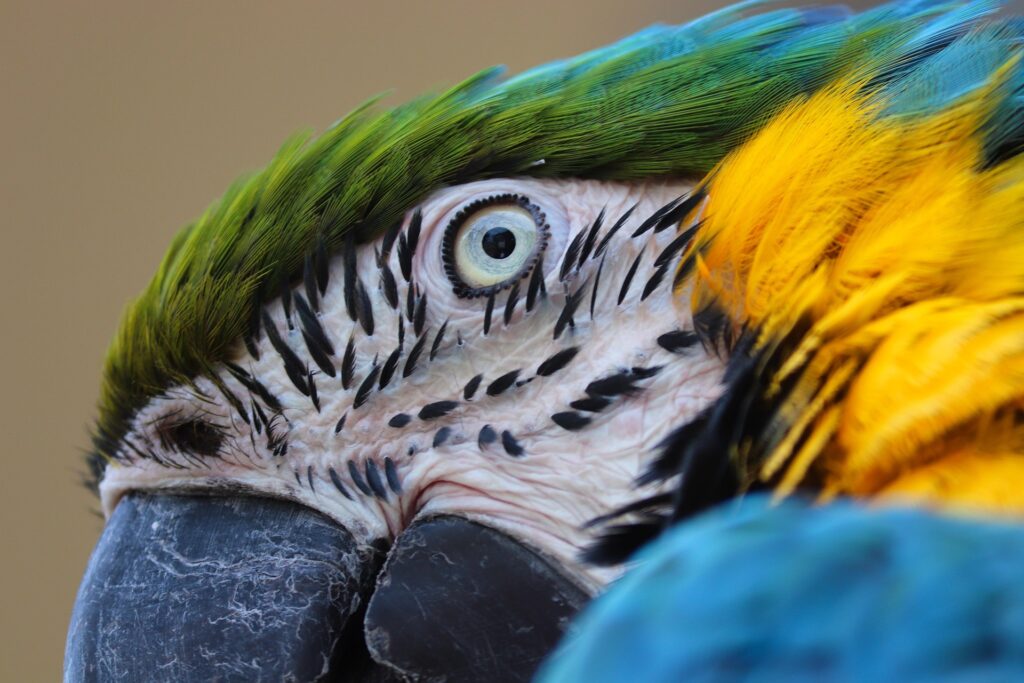
The blue-fronted macaw is distributed in Brazil, Panama, Bolivia, and Paraguay. With a body length of 70-80cm, it is one of the largest parrots in the world. Blue-winged macaws can live for over 60 years and generally mate for life. The population is very stable, and although it is listed on CITES Appendix II, it is classified as low concern.
Ara glaucogularis
The blue-throated macaw is endemic to Bolivia. The total length is 85 cm, and the upper surface, thighs, and lower surface of the base of the tail feathers (lower tail tube) are greenish-blue, and the underside is orange-yellow. It lives in wet forests at 200-300 meters above sea level, and is already listed in Appendix I of the CITES and is listed as an endangered species.
Ara militaris
Green Macaws are distributed in Argentina, Mexico, Ecuador, and Colombia. The total length is 70-71 cm, and the head and neck are covered with bluish-green feathers. It is already listed on CITES Appendix I and is listed as an endangered species.
Ara ambiguus
The lesser macaw is an endangered Central and South American parrot found in Nicaragua, Honduras, Costa Rica, Panama, Colombia, and Ecuador. It lives in the canopy of tropical forests and is already listed in Appendix I of the Washington Convention, making it an endangered species.
Ara macao
The red macaw is a parakeet that can be found in an area from Mexico to Peru and Brazil. The body length is 81cm to 96cm, and most of the feathers are deep red. It is already listed in Appendix I of CITES and is classified as low concern.
Ara chloropterus
Green-winged macaws have the most powerful beaks of any member of the parakeet family. It is widely distributed in the forest areas of South America, so there is no threat of extinction. It is the most popular and largest macaw in the macaw family. Illegal capture for the pet trade is increasing and is a cause for concern.
Ara rubrogenys
The red-eared macaw is a parrot endemic to Bolivia. The total length is 55 – 60 cm, and the rear part of the ear canal and the shoulders are orange-red. They live in deciduous forests between 1,100 and 2,500 meters above sea level. It is already listed on CITES Appendix I and is listed as an endangered species.
Ara severus
The Asian macaw has a body length of about 45 cm. It is found in a wide range from southern Panama to the Amazon, Brazil, and Bolivia. Mostly green with red and blue spots on the wings. Due to its wide range of habitats, its population is very stable and there is no danger of extinction.
Ara atwoodi
The Haitian macaw is a large parrot, with a yellow abdomen and green head, back, and tail feathers. It is now extinct and was previously found in the Caribbean, including Haiti. It has already been confirmed that it became extinct in the late 18th or early 19th century.
Ara erythrocephala
The red-skinned macaw is a macaw that lived in Jamaica. The head is red, and the neck, shoulders, and underbelly are a vibrant green. It has already become extinct. The reason is overfishing by Europeans.
Ara gossei
The Jamaican red macaw and the Goth’s brown macaw are parrots that lived in Jamaica. The basal half of the maxilla is black. Apical half, gray. The lower jaw is black, with only the tip gray. It is said to have become extinct in modern times.
Ara guadeloupensis
The Guadeloupe macaw is endemic to the Lesser Antilles region of Guadeloupe. The body is red, and the wings are red, blue, and yellow. It was thought to have lived on islands in the Caribbean, but it is now extinct.
Ara tricolor
The Gray Macaw is an extinct species that is said to have lived near Cuba. It is large and its body color is red on the head, abdomen, and the first half of the back, with the rest of the body being blue. Both males and females have the same color, and it is said that their favorite food was nuts.
Ara autocthones
The St. Croix Macaw is an extinct species of macaw whose remains have been found on the Caribbean island of St. Croix and Puerto Rico. Since it was discovered in a grave, there are many mysteries surrounding it. It is thought that overhunting by humans drove them to extinction.
Orthopsittaca manilatus
The Black-fronted Macaw is a medium-sized, mostly green parrot. It is distributed from Trinidad and southern Colombia to Peru and Bolivia in the Amazon, and Brazil. Their numbers have declined due to hunting for the pet trade, but they are still stable.
Primolius couloni
The mountain macaw is a macaw that lives in Peru, Bolivia, and Brazil. The total length is 50 cm, the tail is long and pointed, and the beak is large and heavy. It is already listed on CITES Appendix I and is listed as an endangered species.
Primolius maracana
The red-breasted macaw is a small macaw that lives in central and eastern South America. The total length is approximately 36-43 cm, and it is characterized by a black beak, long tail, and mainly green feathers. It is already listed on CITES Appendix I and is listed as an endangered species.
Primolius auricollis
The Kieri’s macaw is a parrot that lives in Central and South America. The total length is about 38 cm, and the overall plumage is green, with the widest yellow patch on the back of the neck, which is a distinctive feature. It is already listed on CITES Appendix I and is listed as an endangered species.
Diopsittaca nobilis
The lesser macaw is a parrot that lives in Brazil, Guiana, Bolivia, Venezuela, and Peru. Although they are often kept in captivity for the pet trade, their population is relatively stable.
Where is its habitat?
As mentioned above, macaws are widespread throughout Central America, the Caribbean, and South America.
- Geographic Distribution
Mainly Central and South America
Brazil, Peru, Colombia, Bolivia, Ecuador, Guyana, Venezuela, etc.
Distributions vary by species
Example: Blue-and-white macaws (Ara ararauna) range from northern Brazil to Venezuela
Blue-and-white macaws (Ara chloropterus) range from southern Brazil to Bolivia
- Habitat
Tropical rainforests:
Live in densely forested areas
Wide range from lowlands to mountains:
Mainly live in forests between 0 and 1,000 meters above sea level
Nesting:
Build nests in hollows of large trees or at high altitudes
Protect eggs and chicks from predators
- Environmental Characteristics
Tropical climate with high temperatures, humidity, and rainfall
Use tree canopies and hollows to find safe resting and feeding areas
Eat fruits, seeds, and nuts, and prefer forests rich in food
feature is? What kind of creature is it?
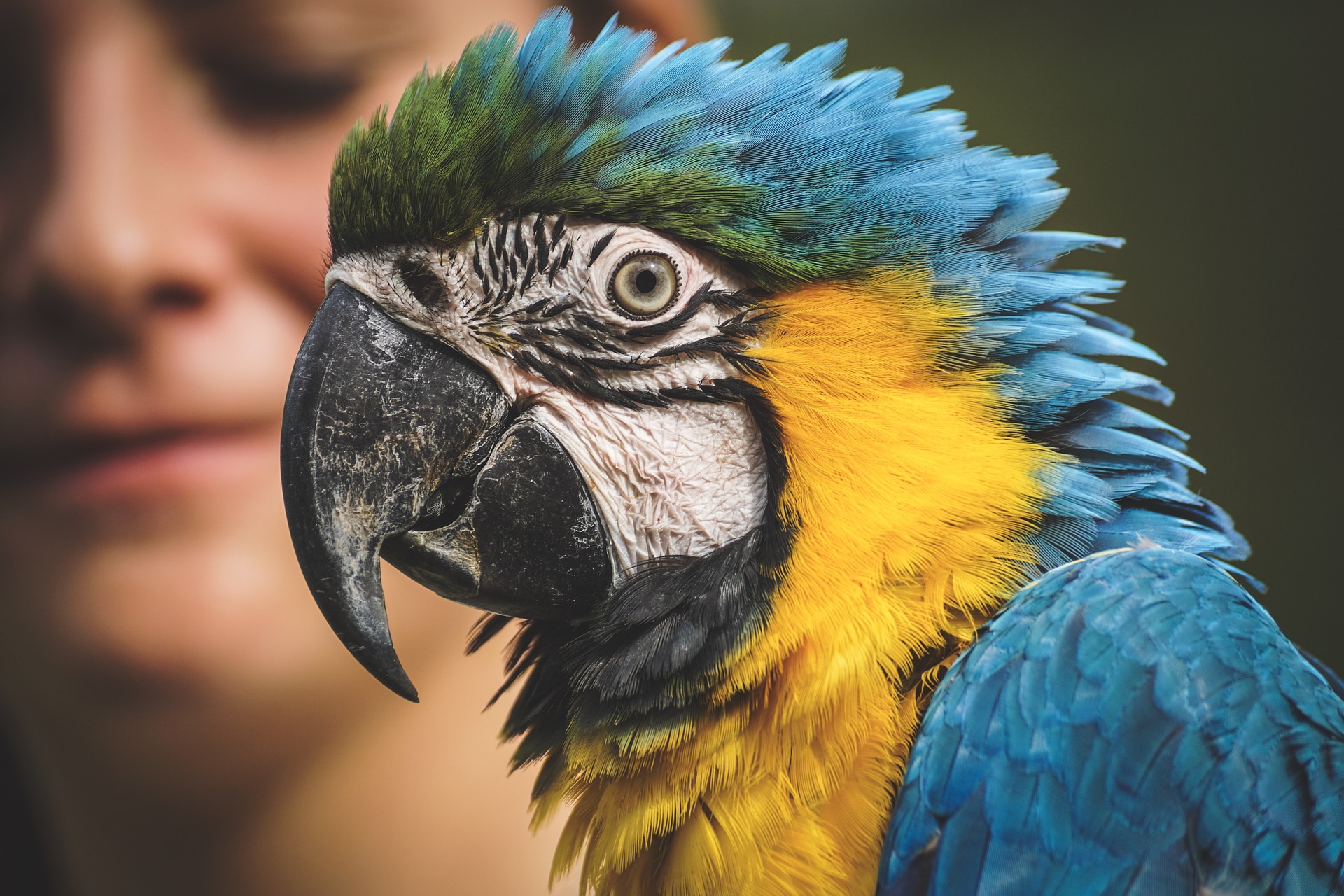
The most distinctive feature of macaws is their very bright colors. It loves tropical rainforests and often lives in forest areas, and is the largest bird in the parakeet family in terms of body length and wingspan. Each leg has four toes, two pointing forward and two pointing backward.
- Body Size and Appearance
Body Length: Approximately 80-95cm (depending on species)
Weight: Approximately 0.9-1.5kg
Feather Color and Pattern:
Characterized by vibrant feather colors such as red, blue, yellow, and green
Color arrangement varies by species
Beak:
Large, curved, powerful beak
Adapted for crushing nuts and hard seeds
Tail Feathers and Wings:
Long, beautiful tail feathers
Large wings for excellent flying ability
- Behavior and Personality
Social, living in groups
Highly intelligent, with excellent learning and imitation abilities
Loud calls used to communicate with peers
- Diet
Omnivorous, primarily plant-based:
Fruits, seeds, nuts, bark, etc.
Able to crack even hard seeds with their large beak
Occasionally eats twigs and soil to replenish minerals
- Ecological Characteristics
Nests in tree cavities or high in trees
Lays 2-4 eggs at a time
Excellent flying ability and long lifespan (approximately 30-40 years in the wild)
What is your personality like?
Many macaws are cheerful and obedient. They also tend to be very good at communicating because they talk a lot. Because they are intelligent and have a gentle personality, they are very easy to get along with.
Scarlet Macaw Personality and Behavior
Social
They live in groups, so communication with others is extremely important.
They cooperate with others and exchange information through vocalizations.
Highly intelligent
They have excellent imitation skills and excellent learning abilities.
They are ingenious in their behavior, such as finding food and using burrows.
Curious and active
They are interested in their environment and new objects.
They have excellent flying ability and actively move through trees.
Vigilant and self-defensive
They avoid predators by vocalization and flight.
They cooperate in groups rather than alone to ensure safety.
What is the ecology like?
Macaws subsist primarily on fruits, seeds, and insects. Reproduction is oviparous, and the breeding period differs depending on the species. It is said that they can live for more than 100 years, but in reality most of them live around 50 years. . They tend to be monogamous and mate for life.
- Life Rhythm
Diurnal: Active during the day and forage for food.
Tree-based Resting: Sleeps in tree hollows or high branches at night.
High Flying Ability: May fly long distances to search for food.
- Diet
Omnivorous/Mainly plant-based:
Fruits, seeds, nuts, bark, etc.
Occasionally eats soil and twigs to replenish minerals.
Dietary Strategies:
Uses its large beak to crush hard seeds and nuts.
May cooperate with others to forage for food.
- Sociality/Flock Life
Live in flocks (tens to hundreds of birds).
Communicates with others through calls and warns of danger.
Travels, forages, and lives cooperatively as a flock.
- Breeding
Nest Building: Nests are built in tree hollows or high up in trees.
Egg Laying: 2-4 eggs per clutch.
Brooding:
Both parents take turns incubating and feeding the eggs.
Chicks leave the nest at approximately 3 months.
- Habitat Relationship
Distributed widely from lowlands to mountains, primarily in tropical rainforests
Selects environments rich in fruit and seeds
Uses tree hollows and canopies for safety
Are there any natural enemies?
Macaws are very large birds, so they don’t have many natural enemies. However, the chicks are targeted and preyed upon by peregrine falcons and condors.
Macaw Molting
Molting in macaws is the natural cycle of shedding old feathers and growing new ones. For macaws—which are large parrots—molting is a vital physiological process for maintaining health and flight capabilities.
When Macaws Molt
In the wild, macaw molting typically occurs at the following times:
About once or twice a year
After the rainy season
Around the breeding season
During periods of stable food availability
However, for birds kept in captivity, the timing varies depending on:
Temperature
Daylight hours
Diet
Stress levels
Health status
For macaws kept in Japan, major molting periods are generally observed:
Between spring and summer
Around autumn
Characteristics Observed During Molting
① Heavy feather shedding
During a normal molt, feathers such as:
Tail feathers
Wing flight feathers
Back and chest feathers
…gradually fall out.
Owners may worry that the bird is sick due to the accumulation of feathers on the floor; however, if the feather shafts look clean and there are no skin abnormalities, it is a perfectly natural process.
② Emergence of spiky new feathers (pin feathers)
A common sight during molting is:
Pin feathers (also known as “blood feathers” or “spikes”)
Characteristics:
Whitish, tube-like appearance
Often found around the head and neck
Hard to the touch
Contain the new feather inside
Over time, the sheath splits open, revealing the beautiful new feather.
③ Itchiness
As new feathers grow, they irritate the skin, leading to behaviors such as:
Rubbing the head
Increased preening
Asking the owner to scratch their head
Macaws, in particular, cannot groom the pin feathers on their heads themselves; if there is a bond of trust, they may ask their owner for a scratch.
Macaw Vocalizations
Macaw vocalizations are known for being exceptionally loud, powerful, and capable of carrying over long distances. In stark contrast to their beautiful appearance, their voices are quite wild.
Characteristics of Macaw Vocalizations
Their typical calls include sharp, high-pitched screeches and squawks, such as:
“Gyaa!”
“Gwaaa!”
“Kii!”
“Kwa, kwa”
Large macaws have incredibly loud voices; in the wild, they use them to communicate with flock members located hundreds of meters away.
In a domestic setting, the volume can be loud enough to be perceived as a nuisance.
Why Are Their Voices So Loud?
The reason lies in the environment where macaws live.
🌳 Sound Struggles to Carry in the Rainforest
In the Amazon rainforest:
Trees grow densely
Foliage absorbs sound
Visibility is poor
…so a loud voice was necessary to locate other members of the flock.
As a result, they evolved the ability to:
“Pinpoint each other’s location via sound, even when out of sight.”
The Role of Vocalizations in the Wild
① Communicating with the Flock
When flying in a group, they call out to signal things like:
“I’m over here”
“We’re moving now”
Loud calls are particularly audible during the morning and evening:
When leaving the roost
When returning to the roost
② Communicating with a Mate
Macaws form very strong pair bonds.
Mated pairs communicate using:
Quiet sounds
Beak-clicking noises
Gentle calls
They do not rely solely on loud screeches; they vary their vocalizations depending on the situation and the individual they are addressing.
Seasonal Activities
Macaw activity varies significantly depending on the shift between the rainy and dry seasons, food availability, and the breeding cycle. Because they inhabit tropical regions of South America, their behavior is shaped more by the alternation between wet and dry periods than by the temperature fluctuations characteristic of Japan’s four seasons.
🌱 Rainy Season (Approx. November–April): A Season of Activity and Breeding
Timing varies by region.
Key Activities
Active movement in search of fruits and seeds
Increased pairing behavior
Preparation for breeding
During the rainy season, vegetation flourishes, making food abundant.
In particular, there is an increase in:
Palm fruits
Nuts
Fruits
Flowers
New shoots
This makes it a time when macaws can easily secure the energy they need.
Breeding Behavior
While it varies by species, many macaws breed around the rainy season.
Behaviors such as the following increase:
Strengthening of pair bonds
Inspecting nesting hollows
Nest building
Courtship displays
Once paired, macaws often remain with the same partner for a long time, and their bond becomes particularly close during the breeding season.
☀️ Dry Season (Approx. May–October): A Season of Foraging and Movement
As the dry season arrives, rainfall decreases and environmental conditions change.
Key Activities
Traveling over wide areas in search of food
Spending more time moving in flocks
Gathering at water sources
During the dry season, they specifically seek out high-calorie foods such as:
Seeds
Nuts
Palm fruits
Focus on Morning and Evening Activity
In the hot regions where they live, the following pattern becomes common during the dry season:
Early morning
↓
Foraging
↓
Resting during the day
↓
Resuming activity in the evening
Flight Speed
While flight speeds vary depending on the species and flight style, macaws generally fly at speeds of around 30–50 km/h. Large macaws possess more powerful flight capabilities than their appearance might suggest.
Estimated Flight Speeds for Macaws
| Condition | Estimated Speed |
|---|---|
| Normal flight (traveling/foraging) | Approx. 30–40 km/h |
| Traveling in a flock | Approx. 40–50 km/h |
| Short-distance rapid acceleration | Can exceed the above speeds |
*Note: Exact top speeds vary by species and measurement conditions.
How can they fly fast despite their large size?
Macaws have large wings relative to their body weight.
Key characteristics:
Wingspan: Some species exceed 1 meter
Posture control via long tail feathers
Powerful pectoral muscles
Efficient flapping using large wings
The tail feathers are particularly important;
they are used for:
sharp turns
deceleration
adjusting for landing
① Powerful flapping flight
Unlike small birds that flap rapidly with short strokes,
they use a style of “large, slow wingbeats to propel themselves forward powerfully.”
Over the Amazon rainforest, they can also be seen gliding with their wings spread.
② Long-distance travel capability
Macaws regularly travel between:
roosting sites
foraging areas
watering holes
Depending on the species, they may travel tens of kilometers in search of food.
About Scarlet Macaw Chicks
By understanding the developmental process of Scarlet Macaw (Ara spp.) chicks, we can understand how they grow from birth to fledging and how they are cared for by their parents.
- Birthing and Nesting
Nest Building:
They use tree hollows or branch depressions in tall trees.
They protect eggs and chicks from predators and rain.
Egg Laying: Usually 2-4 eggs.
Egg Size: Approximately 5cm.
- Chick Characteristics
Newborns have few feathers and their eyes are closed.
They are small and have soft beaks.
They are completely dependent on their parents.
- Growth Stages
Day/Week Growth and Behavior: From 0-2 weeks, the nest is closed and they are held and fed by their parents in the nest. From 2-4 weeks, the nest opens and soft feathers begin to grow. From 4-6 weeks, the nest is fully developed and they become more active within the nest. From 6-8 weeks, they begin flapping their wings and practicing flights around the nest hole. Approximately 3 months, they are able to fly, leaving the nest and joining the flock with their parents.
- Parental Care:
Both parents take turns incubating and feeding the eggs.
They are responsible for maintaining and protecting the chicks’ body temperature.
After weaning, they learn food and flight from their parents.
Are macaws an endangered species?
Unfortunately, macaws are listed as an endangered species. As you can see from the subspecies, many of them have become extinct. Most likely, this is due to overhunting by humans and being consumed as food. It is in urgent need of protection.
- Conservation Status (From the IUCN Red List)
Blue-and-white Macaw (Ara ararauna): Least Concern (LC)
Blue-and-white Macaw (Ara chloropterus): Least Concern (LC)
Green-and-green Macaw (Ara macao): Near Threatened (NT)
Red-bellied Macaw (Ara rubrogenys): Endangered (EN)
- Reasons for Endangerment
Habitat destruction due to deforestation and land development
Population decline due to capture for pets and smuggling
Decreased reproductive rate due to lack of food and nesting sites
Can macaws be kept as pets?
Macaws are classified as endangered species and cannot be kept as pets. It rarely appears on the market and cannot be priced. Therefore, it is extremely difficult to obtain.
need a cage
Macaws need a cage because they will run away if left alone. Because the beak is strong, choose a cage with thick wire. It also has a very long lifespan, so a durable cage is preferable.
perch
A perch is also a must-have item. The appropriate thickness of the perch is so that the tip of the front finger and the tip of the back finger can barely touch each other. Place the macaw’s perch inside the cage.
pet food
Macaws’ diet consists mainly of seeds and vegetables. Recommended vegetables include bok choy, carrots, and pumpkin. If your pet gets used to it, try using artificial pellets as bait.
Air conditioning equipment
Macaws live in tropical rainforests. An environment with a humidity of about 60% and a temperature of 25 to 35 degrees Celsius is best. Air conditioning and heating are essential.
Zoos Housing Macaws (Japan & Worldwide)
Macaws are large, highly intelligent, and long-lived birds, making them popular residents in zoos and bird parks around the globe. The most commonly kept species include the Blue-and-yellow Macaw, the Scarlet Macaw, and various macaw hybrids.
🇯🇵 Major Facilities in Japan Where You Can See Macaws
Tama Zoological Park (Tokyo)
A facility with a long history of keeping these birds.
Species housed:
Scarlet Macaw
Blue-and-yellow Macaw
Features:
Actively breeds large macaws
Opportunities to observe pair bonding and chick-rearing
Extensive bird exhibits
Has successfully bred Scarlet Macaws in the past.
Fukuoka City Zoo
Species housed:
Blue-and-yellow Macaw
Features:
Vibrant blue and yellow plumage
Some individuals are accustomed to humans
Visitors can observe their vocalizations and communication skills
The zoo provides information on the individual personalities and diets of the birds.
Komoro City Zoo
Species housed:
Blue-and-yellow Macaw
Features:
Some individuals are skilled at mimicking speech
Known for interaction with visitors
A facility where you can experience the high intelligence of Blue-and-yellow Macaws.
Okazaki City Higashi Park Zoo
Species housed:
Blue-and-yellow Macaw
Features:
Impressive, majestic appearance typical of large macaws
Showcases their longevity and friendly nature toward humans
🌎 Famous Macaw-Housing Facilities Worldwide
San Diego Zoo
A world-renowned zoo housing a vast array of bird species.
Features:
Exhibits featuring large birds
Conservation research
Educational programs
Singapore Zoo
Known for exhibits that recreate tropical environments.
Features:
Bird exhibits that take advantage of the warm climate
Environments designed to mimic nature
London Zoo
A historic zoo housing a diverse range of bird species, including parrots. Brasília Zoo
A facility located in Brazil, the native home of the macaw.
Features:
Conservation of South American endemic species
Breeding activities
Research on reintroduction to the wild
Introducing other animals
コメント