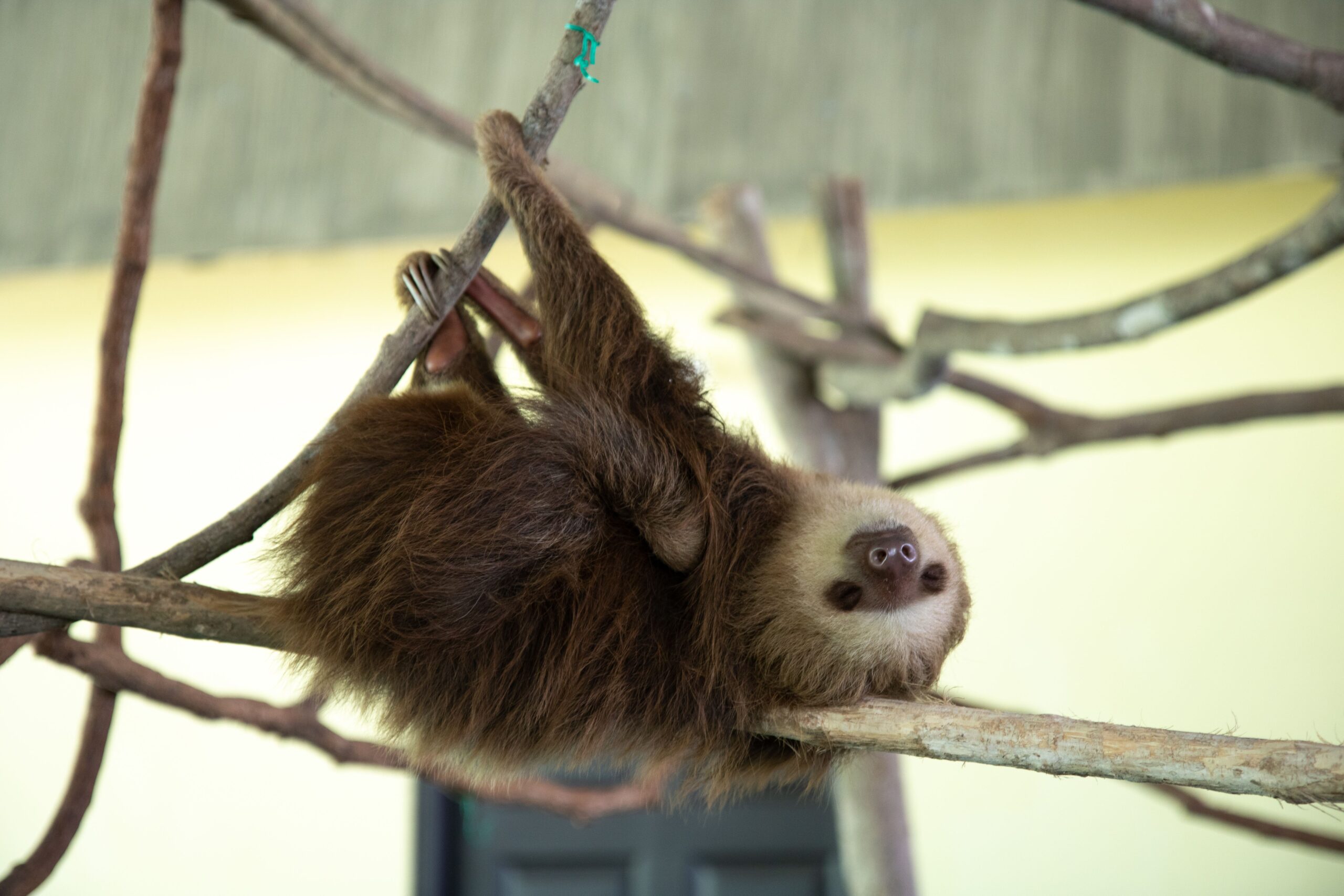
What kind of animal is a sloth? We will explain its characteristics, ecology, and habitat. Sloths are animals that live in Central and South America and are often seen in zoos. It is a cute animal whose slow movements and hair make you feel very relaxed, but some of its subspecies are classified as endangered species.








- What is a sloth? About basic status
- What are the roots and origins of the sloth?
- About habitat
- feature is? What kind of creature is it?
- What is your personality like?
- What is the ecology like?
- About Molting
- About Vocalizations
- Seasonal Activities
- About Walking Speed
- About Baby Sloths
- Are sloths an endangered species?
- Can sloths be kept as pets?
- Zoos Housing Sloths (Japan & Worldwide)
- Introducing other animals
What is a sloth? About basic status
Sloths are classified as mammals, Pilosa, and Sloths. Their scientific name is Folibora, and they are 60-70cm long and weigh 4-8kg. The list of information is as follows. Their movements are very slow, and they have no muscles from their fingers to their front legs and bodies. In the wild, they hang from branches to reduce energy consumption.
| Japanese(和名) | ナマケモノ |
| English(英名) | Sloth |
| scientific name(学名) | Folivora |
| classification(分類) | Mammalia、Pilosa、 Folivora 哺乳綱、有毛目、ナマケモノ亜目 |
| IUCN Status(保全状況) | LEAST CONCERN |
| Length(体長) | 60~70cm |
| Weight(体重) | 4~8kg |
What are the roots and origins of the sloth?
The roots of the sloth lie in an ancient group of mammals known as Xenarthra, which originated in South America approximately 50 million years ago.
Origins: Ancient South American Mammals
The lineage of the sloth is as follows:
Ancient placental mammals
↓
Xenarthra
↓
├── Anteaters
├── Armadillos
└── Sloths
Xenarthra is an ancient mammalian group that is now emblematic of South America. They are characterized by:
Specialized joints (xenarthrous joints) in the spine
A low metabolic rate
A unique skeletal structure
Sloth Ancestors Were “Giant”
While modern sloths are:
About 50–80 cm in body length
About 4–10 kg in weight
…their ancient ancestors looked completely different.
A prime example:
Megatherium
Lived from approximately 5 million to 10,000 years ago.
Size:
Body length: Approx. 6 m
Weight: Several tons
Characteristics:
Size comparable to an elephant
Terrestrial (ground-dwelling) lifestyle
Thick hind legs
Huge claws
It is believed that they stood on their hind legs to eat tree leaves.
Why did they become smaller and take to the trees?
The ancestors of modern sloths shifted their evolutionary direction over time.
Ancient times:
Large size
Ground-dwelling
Survival through strength
↓
Present day:
Smaller size
Arboreal (tree-dwelling) lifestyle
Energy-efficient
Possible reasons include:
① To escape predators
On the ground, there were:
Saber-toothed cats
Large birds of prey
Carnivorous mammals
…and other threats.
The treetops offered a safe place to live.
② To avoid competition for food
Competition with large herbivores on the ground was fierce, so…
…they evolved to “eat leaves that no one else was consuming in large quantities.”
③ Adaptation to a low-energy lifestyle
Because leaves are low in nutritional value,
moving slowly,
taking a long time to digest,
and minimizing muscle mass
—these are the unique evolutionary traits they developed.
Evolutionary lineage of sloths
General progression:
Approx. 50 million years ago
South American Xenarthrans
↓
Ancient sloths
↓
Large ground-dwelling sloths
↓
Approx. 10 million years ago
Small tree-dwelling sloths
↓
Modern sloths
About classification
Sloths are classified into the following types: Modern sloths are classified into two families: Slothidae and Slothidae. The following variants exist: The maned southern sloth is already classified as an endangered species.
- Bradypus pygmaeus ヒメミユビナマケモノ Pygmy three-toed sloth
- Bradypus torquatus タテガミナマケモノ Maned sloth
- Bradypus tridactylus ノドジロミユビナマケモノ Pale-throated sloth
- Bradypus variegatus ノドチャミユビナマケモノ Brown-throated sloth
- Choloepus didactylus フタユビナマケモノ Linnaeus’s two-toed sloth
- Choloepus hoffmanni ホフマンナマケモノ Hoffmann’s two-toed sloth
Bradypus pygmaeus
The pygmy three-toed sloth, also known as the monk sloth or dwarf sloth, is endemic to Escudo de Veraguas, a small island off the Caribbean coast of Panama. The length of the head and body is 48 to 53 cm, the weight is 2.5 to 3.5 kg, and there are only 79 individuals in total, so it is classified as an endangered species.
Bradypus torquatus
The maned southern sloth is a South American sloth that is endemic to the states of Espírito Santo, Rio de Janeiro, and Bahia. The maned southern sloth is classified as critically endangered according to the IUCN Red List, and its population is on the decline.
Bradypus tridactylus
The green sloth is a type of sloth that lives in the rainforests of northern South America. The head and body length of the male is 45-55 cm, the tail is short, 4-6 cm, and the weight is 3.2-6 kg. However, females are significantly larger, measuring 50 to 75 cm in length and weighing 3.8 to 6.5 kg.
Bradypus variegatus
The black-throated sloth is a type of sloth found in the Neotropics of Central and South America. It is similar in size and build to most other species of sloths, with a rounded head with a blunt snout and inconspicuous ears.
Choloepus didactylus
The southern sloth, also known as the unau, or Linnaeus’ three-toed sloth, is found in Venezuela, Suriname, Guyana, French Guiana, Colombia, and north of the Amazon River in Ecuador, Peru, and Brazil.
Choloepus hoffmanni
The Hoffmann’s sloth, also known as the northern sloth, is a type of sloth that lives in Central and South America. It is a solitary, primarily nocturnal, arboreal animal found in mature and secondary rainforests and deciduous forests. The population is stable.
About habitat
Sloths are widely distributed from Central America to South America.
- Basic Information
Sloths live in the tropical rainforests of Central and South America.
They are arboreal mammals that spend most of their time in trees.
- Distribution by Region
Sloth Species
Habitat
Family: Slothidae (Brazil, Costa Rica, etc.): Southern Mexico, Central America (Costa Rica, Panama)
South American Three-Toed Sloth: Amazon River Basin (Brazil, Peru, Bolivia, Ecuador, Colombia)
South American Two-Toed Sloth: Amazon River Basin, Guyana, Venezuela, Colombia - Habitat Characteristics
Tropical Rainforest
Densely treed environment
Finds food (leaves, fruit, flowers) in trees
Near rivers and wetlands
May descend from the treetops to the water
Altitude: Flatlands to low mountain ranges (generally 0-1500 m)
- Relationship between behavior and ecology
Adapted for arboreal life
Spend most of their time hanging from tree branches
Protects them from predators (jaguars, eagles, etc.)
Slow movement speed
In their habitat, they can secure food even if they travel short distances
feature is? What kind of creature is it?
Although sloths are mammals, they have the unusual characteristic of being cold-blooded. Body temperature is low, fluctuating between 24 and 33 degrees Celsius. Sloths have an even weirder feature: they have almost no muscles. Sloths that don’t move much can’t generate heat. A sloth’s fur is green. This is because algae grows on the hair. They spend most of their lives in trees, sleeping and eating there. However, only the toilet is made of wood.
- Physical Characteristics
Body Size:
Two-toed Sloth: 50-60 cm, weight approximately 4-9 kg
Three-toed Sloth: 50-70 cm, weight approximately 4-8 kg
Fur:
Covered with long, coarse fur, sometimes with green algae growing on their bodies → camouflage in the forest
Limbs:
Long, curved claws (7-10 cm)
Ideal for hanging from tree branches
Face:
Small, round head, round eyes
Appears to have a calm, absent-minded expression
Tail:
Short or almost non-existent
- Behavior/Lifestyle
Arboreal (arboreal)
Spend most of their time hanging from trees
Move from tree to tree slowly
Very slow locomotion
May only move a few meters per minute
Long Sleep
Sleep approximately 15-20 hours a day
- Diet (What they eat)
Mainly plant foods
Leaves, fruits, flowers, and buds
Slow digestion
Eating leaves slowly breaks down in the stomach, and it takes about a week for the nutrients to be absorbed.
- Defense/Personality
Evading predators
Instead of moving slowly, they hide using green algae for camouflage.
Defend themselves from predators (jaguars, eagles, crocodiles, etc.)
Personality: Gentle and avoids conflict
Swimming ability: Surprisingly good at swimming
What is your personality like?
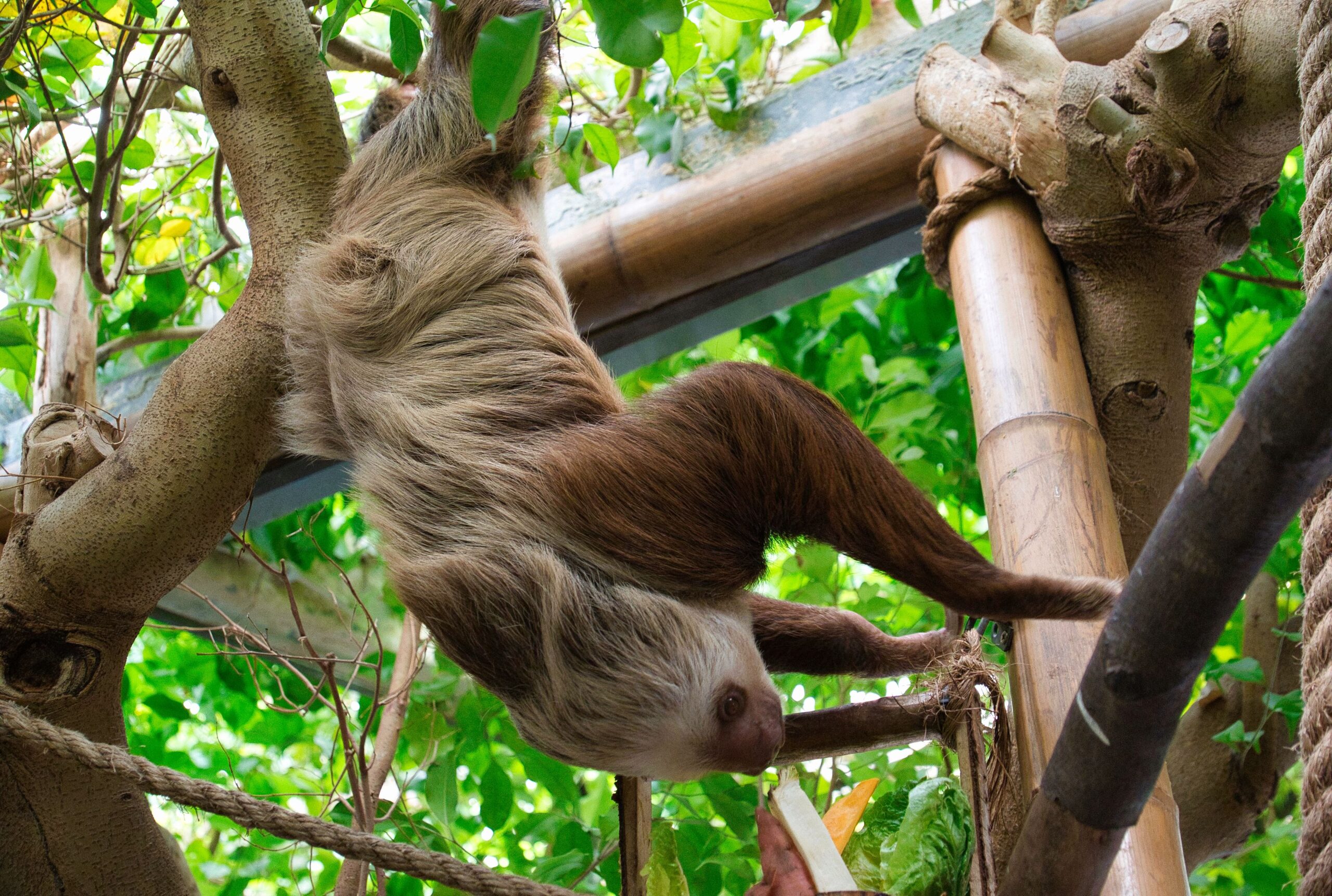
As you can see, sloths are very docile and quiet animals. However, when an enemy approaches, it will put out its claws and fight back. It is also known that even if you get a wound, the wound rarely becomes infected and recovers naturally, so it has a very high healing ability.
Sloth Personality Traits
Very docile
Little aggressive and avoids conflict
Rarely attacks other animals or humans
Move slowly, so they are not intimidating to those around them
Laid-back
Sleep for most of the day (15-20 hours)
Eat, sleep, and move at a very leisurely pace
They are not in a hurry and have adapted to a lifestyle where they do not need to rush
Cautious but reserved
Because they move slowly, they cannot escape predators
Avoid danger by hiding (camouflaging with green algae or staying still in trees)
They are not very reactive unless necessary
Prefers solitude
Generally lives alone
Rarely interacts with other individuals except during breeding season
Curious but reserved
Slowly observe their surroundings
Move cautiously, avoiding falling off branches
What is the ecology like?
Sloths eat about 10g of plants, leaves, insects, and reptiles per day. They have a very low basal metabolic rate and can survive on only a small amount of food. The breeding season is from March to April, and the gestation period is about 5 to 10.5 months, with sloths usually giving birth to one baby at a time. The lifespan of sloths in captivity is about 30 years.
- Lifestyle
Arboreal (arboreal)
Spend most of their time hanging from tree branches
Move slowly, sometimes only a few meters per day
Move from branch to branch carefully using their claws
Long Sleep
Sleep 15-20 hours a day
Not nocturnal, spends much of the day resting
- Diet
Stands in plants
Eats leaves, buds, fruits, flowers, etc.
Digests very slowly, absorbing nutrients slowly over about a week
Low-calorie diet to protect against predators
Slow movements reduce energy consumption, allowing them to survive on limited food
- Movement/Behavior
Slow and careful movement
Slow movements help them avoid being noticed by predators and protect themselves
Excellent Swimming
Can swim across forest rivers
Low territorial awareness
Does not engage in large-scale territorial disputes with other members of the same species, and individuals generally maintain their own living space
- Reproduction
Breeding Season: Approximately once a year (varies by region)
Gestation Period: Approximately 6 months
Rearing:
Usually gives birth to a single calf
The mother carries and raises the calf
The father may provide indirect support
Independence: Calves become independent after 1-2 years and begin their own arboreal life
Are there any natural enemies?
The harpy eagle is a natural enemy of sloths. Sloths basically live on trees, so they are rarely attacked by animals on the ground, except when they go down to the ground to use the toilet.However, on the other hand, when they come down to the ground, they are in the biggest pinch and account for half of the deaths. A pattern of being attacked when going to the toilet. When it comes to moving, it is one of the slowest living creatures, so its body is slow, so its location is quickly determined and it is eaten.
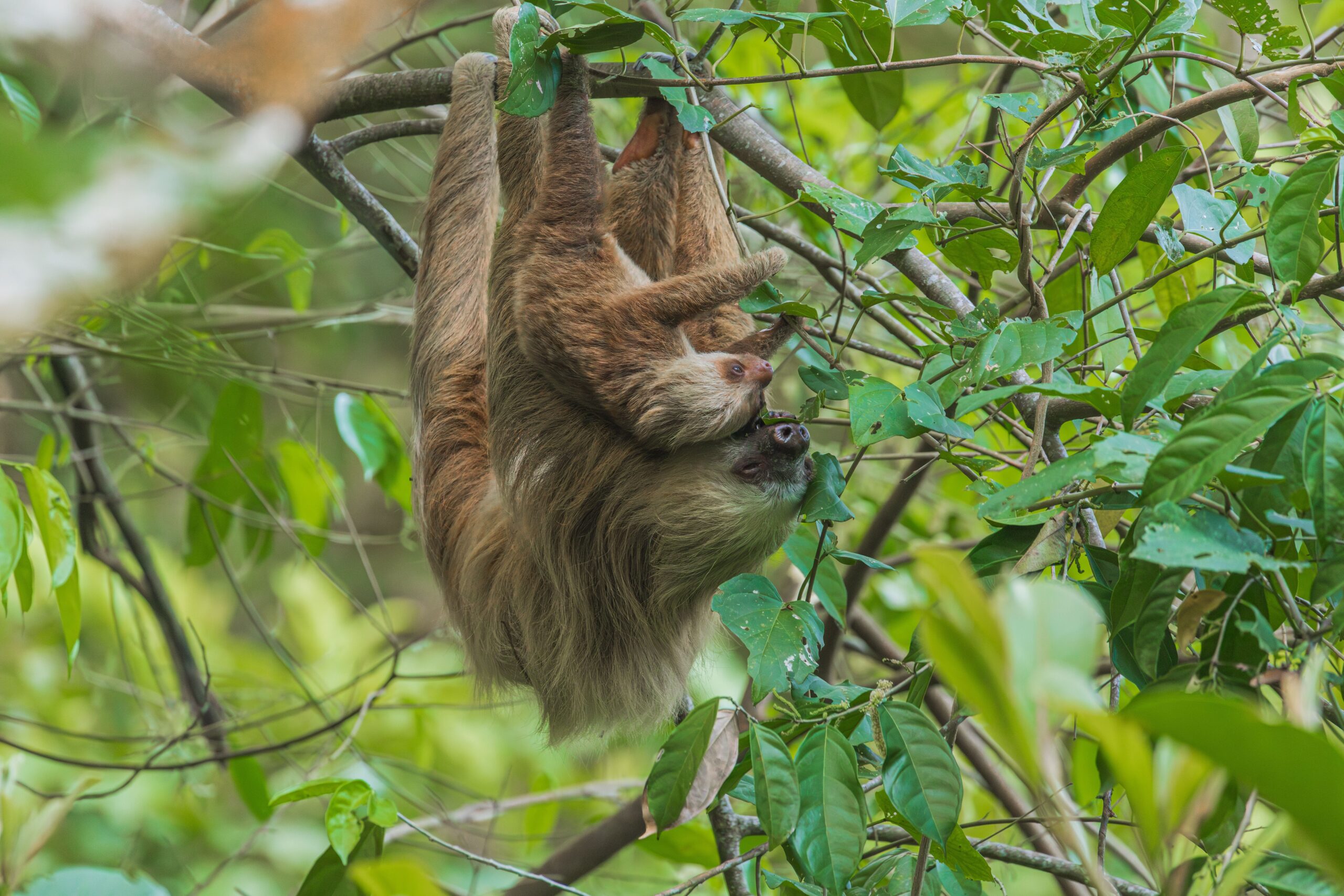
About Molting
Sloth molting (the process of shedding and replacing fur) differs slightly from that of typical mammals. Rather than shedding large amounts of fur seasonally like dogs or cats, sloths gradually replace old fur with new fur over an extended period.
Frequency of Molting
Sloths do not exhibit distinct seasonal molting patterns, such as a specific “spring molt” or “autumn molt.”
Reasons:
They inhabit rainforests.
Temperature fluctuations are minimal.
They have an energy-conserving physiology.
Consequently, they shed and replace their fur little by little throughout the year.
Unique Fur Structure
The direction of a sloth’s fur growth is the reverse of that found in typical mammals.
Typical mammals:
Fur flows downward from the back.
Sloths:
Fur flows from the belly toward the back.
This arrangement serves to:
Efficiently channel rainwater off the body
when hanging upside down from trees.
Rainwater flows from the back toward the belly, running off along the direction of the fur.
Algae Living Within the Fur
A sloth’s fur serves purposes beyond mere insulation against the cold.
The surface of the fur hosts a symbiotic community of:
Algae
Fungi
Microorganisms
In three-toed sloths especially, green algae thrive on the fur, aiding in:
Camouflage that blends in with forest foliage
Protection against ultraviolet (UV) rays
Symbiosis with microorganisms
In short, the fur functions as a combination of:
“Insulation, camouflage, and a miniature ecosystem.”
The Relationship Between Molting and Algae
When old fur is shed, new fur grows in its place.
New fur:
Has a smooth surface
Contains little algae
Is relatively light in color
Over time:
Microscopic grooves form in the fur
Moisture is retained
Algae and microorganisms colonize the fur
…causing it to gradually take on a greenish hue.
About Vocalizations
Sloths are generally very quiet animals; they tend to vocalize softly and only when necessary. Beyond their slow movements, they are also animals that rarely draw attention to themselves through sound.
Adult Vocalizations: “Soft, Whistle-like Sounds”
The characteristic sounds heard primarily from three-toed sloths include
“Kee,” “Qew,” or “Fee”
—high-pitched, thin sounds.
Functions:
Locating others
Calling out to potential mates
Expressing anxiety or stress
Because sound does not travel far in the dense rainforest, these vocalizations serve as short-range signals rather than loud, far-reaching calls.
Juvenile Vocalizations: “Calls to the Mother”
The most well-known sloth vocalization is the sound made by the young.
When separated from their mothers, the young call out with high-pitched sounds such as:
“Qew, Qew”
“Kee, Kee”
Mothers rely on these sounds and tactile cues—rather than vision—to locate their offspring.
Breeding Season Vocalizations
Female three-toed sloths, in particular, may emit a
long, high-pitched “Kee” call
when they are ready to breed.
Purpose:
Attracting males
Signaling their location
Since sloths typically lead solitary lives, vocal communication during the breeding season is crucial.
Threat and Defense Sounds
Although generally docile, when they sense danger, they may produce:
Hissing sounds
Low growls
Teeth-chattering sounds
They also adopt a defensive posture using the long claws on their forelimbs.
Two-toed Sloth Vocalizations
Two-toed sloths are relatively quiet,
producing mostly low growls,
snorting sounds,
and brief vocalizations.
They do not exhibit the distinct “contact calls” seen in three-toed sloths.
Seasonal Activities
Unlike the large-scale seasonal migrations seen in animals like Przewalski’s horses, the seasonal activities of sloths center on an “energy-conserving lifestyle” adapted to the changing conditions of the rainforest.
🌱 Rainy Season (Generally May–November)
“An active period with abundant food”
Main activities:
Eating new leaves
Moving through the canopy (the upper part of the tree)
Recovering physical strength
Breeding
The rainy season is a time of vigorous plant growth.
Sloths’ primary food sources—
Tree leaves
Young leaves
New shoots
—increase, resulting in favorable feeding conditions.
However, they consume relatively little, spending only a few hours a day foraging.
Characteristics of the rainy season:
① Increased movement in the canopy
They move slowly in search of trees with abundant foliage.
Movement speed:
In the canopy: Moving a few meters to a few tens of meters over the course of hours.
Although very slow, this minimizes energy expenditure.
② Birth and rearing
In many regions, breeding coincides with the period of food abundance.
Offspring:
Cling to their mother’s belly immediately after birth
Stay with their mother for several months
Learn how to eat leaves
☀️ Dry Season (Generally December–April)
“A season of energy conservation and frugality”
Main activities:
Reducing movement
Increasing rest time
Selecting specific trees to eat from
During the dry season,
Leaves become tougher
Food becomes scarcer
Water becomes scarce
…so they further reduce their activity levels.
Characteristics of the dry season:
① Increased sleep and rest
Sloths typically
Rest for about 10–15 hours a day
…but they further suppress activity during the dry season.
② Body temperature regulation
Unusual for mammals, sloths are animals that:
Experience significant fluctuations in body temperature
Have a low metabolic rate
When hot:
Move to the shade
When cold:
Bask in the sun
About Walking Speed
Sloths have one of the slowest walking speeds among all mammals. However, this does not mean they cannot walk; rather, they have evolved to move slowly in order to conserve energy to the absolute limit.
Walking Speed on the Ground
🦥 Approx. 0.1–0.3 km/h (roughly 100–300 meters per hour)
A typical three-toed sloth moves very slowly on the ground.
For comparison:
| Animal | Walking Speed |
|---|---|
| Sloth | Approx. 0.1–0.3 km/h |
| Human (normal walk) | Approx. 4–5 km/h |
| Tortoise | Approx. 0.3–1 km/h |
| Elephant | Approx. 4–6 km/h |
This is less than one-tenth of a human’s walking speed.
Movement Speed in Trees
🌳 Approx. 0.2–0.5 km/h
They move slightly more efficiently in the trees than on the ground.
Method:
Grasping branches with long claws
Pulling their body forward using arm strength
Slowly moving from branch to branch
For a sloth, climbing trees is not merely “locomotion”—it is essentially their entire way of life.
Speed in Dangerous Situations
While usually extremely slow, they speed up slightly when they sense danger.
Examples:
When attacked by a predator
When sensing danger on the ground
Speed:
Maximum of about 1–2 km/h
That is the estimated top speed.
However, sloths are not animals that rely on speed to escape.
Why Are They So Slow?
① Their diet is low in calories
Main diet:
Tree leaves
Young shoots
Leaves are:
Difficult to digest
Low in energy content
…so they cannot obtain the energy required for high-speed movement.
② Low muscle mass
Sloths have:
A low muscle-to-body-weight ratio
An emphasis on endurance for hanging rather than explosive power
③ Low body temperature and metabolism
Although sloths are mammals, they have:
A low metabolic rate
A body temperature that fluctuates easily
They limit their movement in order to survive on minimal energy.
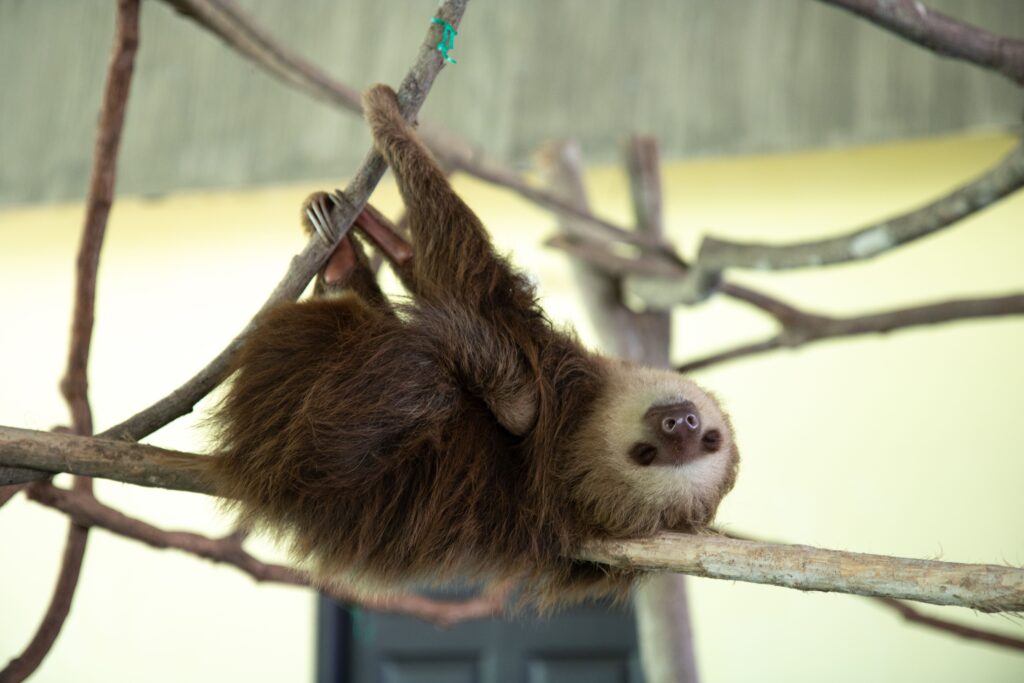
About Baby Sloths
This article provides a detailed summary of the ecology and developmental process of baby sloths (children).
- Birth
Gestation Period: Approximately 6 months
Number of Pups: Generally 1
Birthing Location: Birth occurs in a tree from which the mother is hanging
Newborn Characteristics:
Weight: Approximately 300-500 g (varies by species and individual)
Hair is short and soft
Claws are still small and hold tightly to the mother’s fur
- Growth and Behavior
Immediately after birth:
They cling tightly to their mother’s abdomen or chest and are unable to move independently
They cling to their mother’s fur while nursing
1-3 months:
Their claws develop and they begin practicing hanging from branches
They gradually begin to nibble on leaves, but their main diet remains breast milk
3-6 months:
They can gradually grasp branches and move around
They increase their diet and practice eating leaves and fruit
6 months-1 year:
They can move between trees almost independently
They leave their mother and seek their own territory in the forest
- Characteristics
Hair Color: They are slightly lighter than adults and do not yet have green algae.
Movement: Very cautious and slow.
Personality: Curious and learns by observing their mother’s behavior.
Protection: Because their mother always carries and protects them, they are less vulnerable to predators.
- Until Adulthood
They become fully independent at 1-2 years old.
As they grow, their claws, muscles, and digestive system develop, making them perfectly adapted to arboreal life and a leaf-eating lifestyle.
They spend a lot of time with their mother, learning their behavioral patterns and how to navigate in the trees.
Are sloths an endangered species?
The maned sloth is classified as an endangered species. Habitat destruction due to deforestation and other causes poses a major risk and threat, so their population will likely fluctuate greatly depending on human activities, for better or for worse. Pygmy three-toed sloths can only be found in the Caribbean, and their population is extremely small, making them extremely dangerous.
- Global Conservation Status (IUCN Red List)
Species Classification (Threat Level) Comments
Sloth (three-toed, Brazil, etc.) LC (Least Concern) Populations are stable globally. Widely distributed in tropical rainforests.
Sloth (two-toed, parts of South America) LC (Least Concern) Populations are stable, but localized declines are occurring due to habitat loss.
Pygmy Sloth (Rare Species) NT (Near Threatened) Habitat loss due to deforestation.
Key Points: While many species are not globally endangered, there are localized areas of population decline.
- Relationship with Habitat and Human Activities
Logging of tropical rainforests → habitat loss
Road construction and agricultural expansion → forest fragmentation
Captivity for pets → threat in some areas
As a result, even though populations are stable, there are areas where they are close to endangered.
- Conservation Status in Japan
Sloths do not naturally occur in Japan.
They are sometimes kept in zoos and research facilities, but there are no wild populations.
Legally, import and export are restricted under Appendix I and II of the Convention on International Trade in Endangered Species of Wild Fauna and Flora (CITES).
Can sloths be kept as pets?
Considering that they are extremely sensitive to stress and are cold-blooded animals, it is difficult to raise them in ordinary households. First of all, think it’s impossible.
- Legal Restrictions
Sloths are regulated by the Convention on International Trade in Endangered Species of Wild Fauna and Flora (CITES).
Import and export require permission.
In Japan, sloths are protected under the Wildlife Protection Act, and private captivity is prohibited.
Captivity is permitted only in facilities with special permits, such as zoos and research facilities.
- Ecological Restrictions
Perfectly adapted to arboreal life.
They spend 15 to 20 hours a day hanging from trees, barely moving.
Home environments do not provide sufficient space for them.
Slow, energy-efficient lifestyle.
They move very slowly, so they cannot be walked or exercised like regular pets.
They have a unique diet.
They primarily eat leaves, buds, and fruit, and digest them very slowly.
Nutrition is difficult, making long-term captivity on an artificial diet nearly impossible.
- Health and Safety
Their bodies are well-suited to long periods of hanging, making them unsuited for life on the ground.
Inappropriate captivity increases the risk of stress and disease.
They have strong wild instincts, making them unsuitable for human companionship.
Zoos Housing Sloths (Japan & Worldwide)
Sloths are popular tropical animals currently kept in zoos around the world. In Japan, in particular, they can be seen at many zoos, and breeding programs have been successful.
🇯🇵 Major Zoos in Japan Housing Sloths
Ueno Zoological Gardens
One of Japan’s premier zoos.
Features:
Houses two-toed sloths
Exhibits recreating a rainforest environment
Visitors can watch them spending time leisurely in the trees
Ueno Zoo provides information on sloth ecology and rainforest conservation.
Tama Zoological Park
Features:
Extensive experience keeping tropical animals
Spacious exhibit environments
Allows for observation of natural behaviors
Higashiyama Zoo and Botanical Gardens
Features:
Houses two-toed sloths
One of the popular tropical animal exhibits
Kobe Animal Kingdom
Features:
Exhibits that allow for close proximity to animals
Easy to observe sloths living in the trees
Nasu Animal Kingdom
Features:
Comprehensive tropical animal exhibits
Focuses on behavioral exhibits for arboreal animals
Izu Shaboten Zoo
Features:
Exhibits South American animals, including sloths
Husbandry that utilizes the warm climate
🌎 Notable Sloth-Housing Facilities Worldwide
🇺🇸 San Diego Zoo
A world-leading wildlife conservation facility.
Features:
Houses two-toed sloths and other species
Recreates a rainforest environment
Conducts breeding and research activities
🇺🇸 Smithsonian National Zoo
Features:
Tropical animal conservation research
Exhibits on sloth ecology
Educational activities
🇬🇧 Chester Zoo
Features:
World-renowned wildlife conservation facility
Breeding research for tropical species
Exhibits that mimic natural habitats
🇸🇬 Singapore Zoo
Features:
Exhibits that leverage the tropical climate
Expertise in keeping rainforest animals
Environment well-suited for sloths
Introducing other animals




コメント