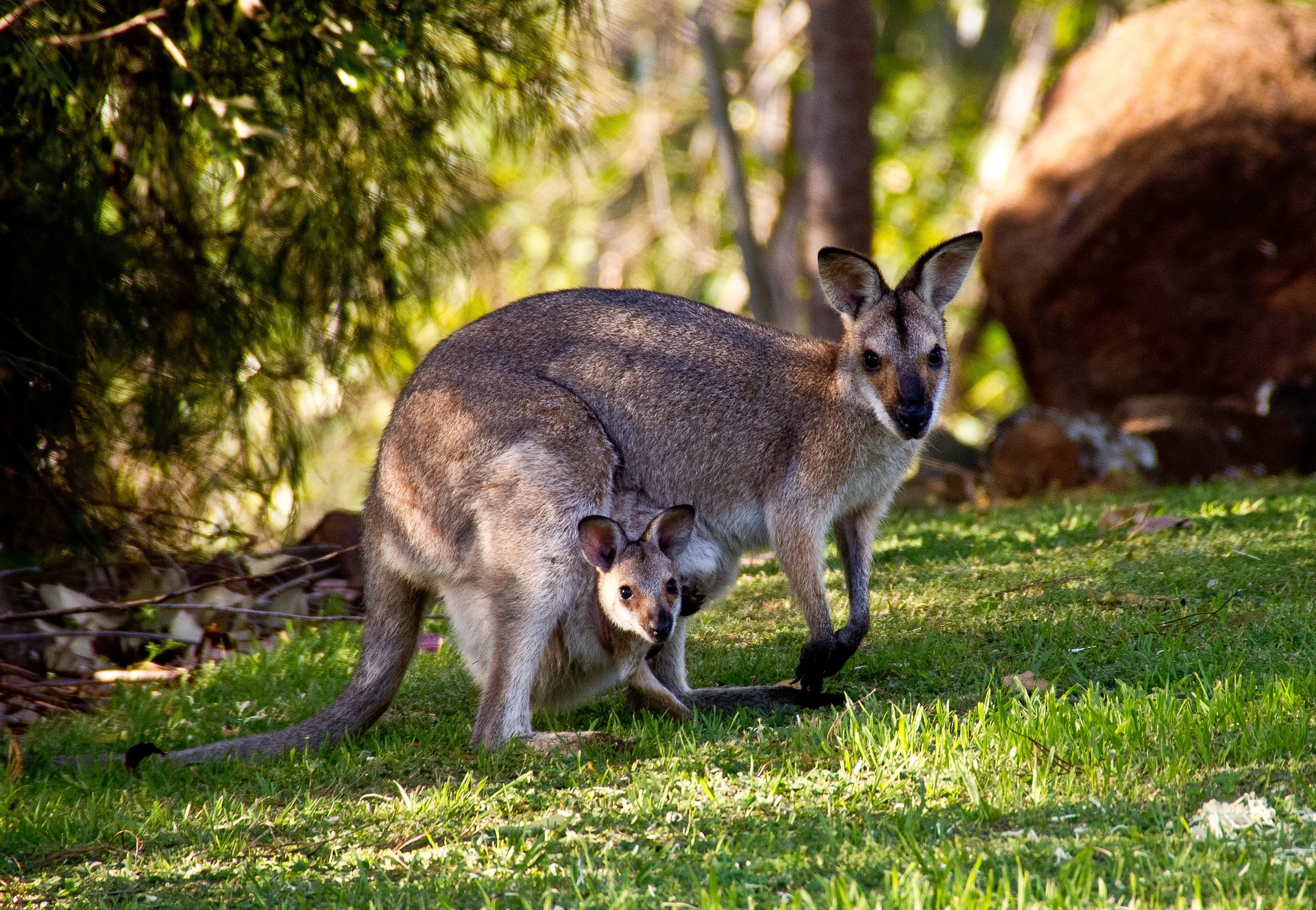
What kind of animal is a wallaby? We will explain its characteristics, ecology, and habitat. There are many subspecies of this animal, which lives in the forest areas and rocky areas of Australia, so I will explain its characteristics and ecology in detail, including this point, so please use it as a reference. I think so.



- What is a wallaby? About basic status
- What are the roots and origins of the wallaby?
- Where is its habitat?
- feature is? What kind of creature is it?
- What is your personality like?
- What about the ecology?
- Wallaby Vocalizations
- Wallaby Molting
- Seasonal Activities
- Locomotion Speed
- About Baby Wallabies
- Are wallabies an endangered species?
- Wallabies can be kept as pets
- Zoos Housing Wallabies (Japan & Worldwide)
- Introducing other animals
What is a wallaby? About basic status
A wallaby is an animal classified in the diprodentate order and the kangarooform suborder, Kangaridae. The scientific name is Macropus eugenii. Wallabies are smaller and very cute animals than kangaroos. Their basic habits are the same as kangaroos, including raising their young in pouches. Males have larger bodies than females. You can search for videos, photos, etc. online.
| Japanese(和名) | ワラビー |
| English(英名) | wallaby |
| scientific name(学名) | Macropus eugenii |
| classification(分類) | Mammalia、 Diprotodontia、Macropodidae 哺乳綱、双前歯目、カンガルー科 |
| IUCN Status(保全状況) | NEAR THREATENED~ENDANGERED |
| Length(体長) | 40-50cm |
| Weight(体重) | 1-3kg |
What are the roots and origins of the wallaby?
Wallabies are marsupials that evolved on the Australian continent. While they resemble small kangaroos, they are not simply “miniature kangaroos”; rather, they represent a lineage within the Macropodidae family that adapted to forest and scrubland environments.
Evolutionary Timeline
Over 100 million years ago
Early marsupials
│
↓
Spread to the Southern Hemisphere
│
↓
Unique evolution in Australia
│
↓
Macropodidae family
│
├── Increased size → Kangaroo
│
└── Decreased size & forest adaptation → Wallaby
Where did they originate?
Wallaby ancestors were ancient marsupials that lived in the region of present-day Australia and New Guinea.
Although marsupials originally developed in South America, it is believed that in ancient times, they migrated toward Australia via the Antarctic continent.
Once Australia became isolated from other continents,
Few predators
Unique flora
Little competition
…these environmental factors led to an explosion in marsupial diversity.
When did kangaroos and wallabies diverge?
Wallabies and kangaroos are very closely related.
After diverging from a common ancestor:
Kangaroo lineage
→ Moved into open grasslands
→ Developed long legs and larger bodies
→ Specialized in high-speed hopping
Wallaby lineage
→ Adapted to forests, rocky areas, and scrublands
→ Became smaller in size
→ Developed agility and the ability to hide
…each evolved in these respective directions.
Why did they become smaller?
Wallabies are small because that size offered advantages in forest environments.
🌿 In forests…
Large bodies are difficult to maneuver
Movement between trees and rocks is necessary
Hiding from predators is crucial
Consequently, they evolved to:
Have smaller bodies
Use their tails for balance
Perform short-distance hops using strong hind legs
About classification
Wallabies are made up of many subspecies. There are too many variants to list here. I will introduce the genus name. Some subspecies are listed as endangered in nature, and conservation projects are underway in some places.
| scientific name(学名) | Habit:生息地 |
| Lagorchestes ウサギワラビー属 | southeast australia オーストラリア南東部 |
| Lagostrophus fasciatus シマウサギワラビー属 | Australia (Dole Island, Vernier Island) オーストラリア(ドール島、バーニア島) |
| Macropus カンガルー属 | southeast australia オーストラリア南東部 |
| Onychogalea ツメオワラビー属 | wider australia オーストラリア広域 |
| Petrogale イワワラビー属 | wider australia オーストラリア広域 |
| Thylogale ヤブワラビー属 | wider australia オーストラリア広域 |
| Wallabia オグロワラビー属 | southeast australia オーストラリア南東部 |
Lagorchestes
This is a species that is considered to be extinct. Only one specimen of the lesser rabbit wallaby was collected in 1932, and it was previously distributed in southeastern Australia, but is said to have become extinct due to predation.
Lagostrophus fasciatus
The genus Striped Rabbit Wallaby is endemic to Australia (Dole Island, Vernier Island). The striped rabbit-wallaby is the only species in this species, and it is listed as an endangered species.
Macropus
There are also wallabies of the kangaroo genus. The striped wallaby, elegant wallaby, and red-necked wallaby are all found in southeastern Australia, and some of them are listed as endangered species.
Onychogalea
The genus Tsumeo-wallaby is classified into the class Mammalia, Diprodontidae, family Kangaridae, and the Mikazuki-eki wallaby is exactly like that. It was once distributed over a wide area of Australia, but its numbers have declined dramatically due to predation and hunting. It is thought to be extinct.
Petrogale
Rock wallabies are unique because they have hair on the soles of their feet, which prevents them from slipping even on steep rocky mountains. The Black-tailed Rock Wallaby and his Proserpine Rock Wallaby are very famous.
Thylogale
The characteristic feature of the genus Thrush is that it has bare parts that are not covered with body hair. It is a genus classified into the mammalian class Diprodontidae and the Kangaridae family.In some areas, the number of species has decreased dramatically, and it has been designated as an endangered species.
Wallabia
A small wallaby that lives in eastern Australia. This species, the black-tailed wallaby, is the only one whose population is stable and is classified as Least Concern.
Where is its habitat?
The wallaby’s habitat is Australia. Although they are distributed all over the country, the reality is that their numbers are decreasing overall.
① Distribution within Australia
Wallabies are widely distributed, but their habitat varies by species.
● Forest/grassland habitat
Eastern and southeastern Australia
Eucalyptus forests, grasslands, and shrublands
Found near human settlements
Example:
Bennett’s wallaby
Palma wallaby
● Rocky/mountain habitat
Arid zones and rocky mountains
Prefers cliffs and steep slopes
Example:
Rock wallaby
● Tropical/humid zone habitat
Northern Australia
Rainforest and wetlands
Example:
Agile wallaby
② Island habitats
Tasmania
→ Species adapted to cool climates
Small islands
→ Few predators, evolved independently
③ Relationship with artificial environments
Around farmland
Golf courses
Park
Some species have adapted to human environments.
④ A unique case in New Zealand
Artificially introduced
Few natural predators allow them to thrive
Invasive species problem
⑤ Why can they live in a wide range of environments?
Small size and versatile diet
High jumping ability
Nocturnal and avoids humans
Highly adaptable to their environment
feature is? What kind of creature is it?
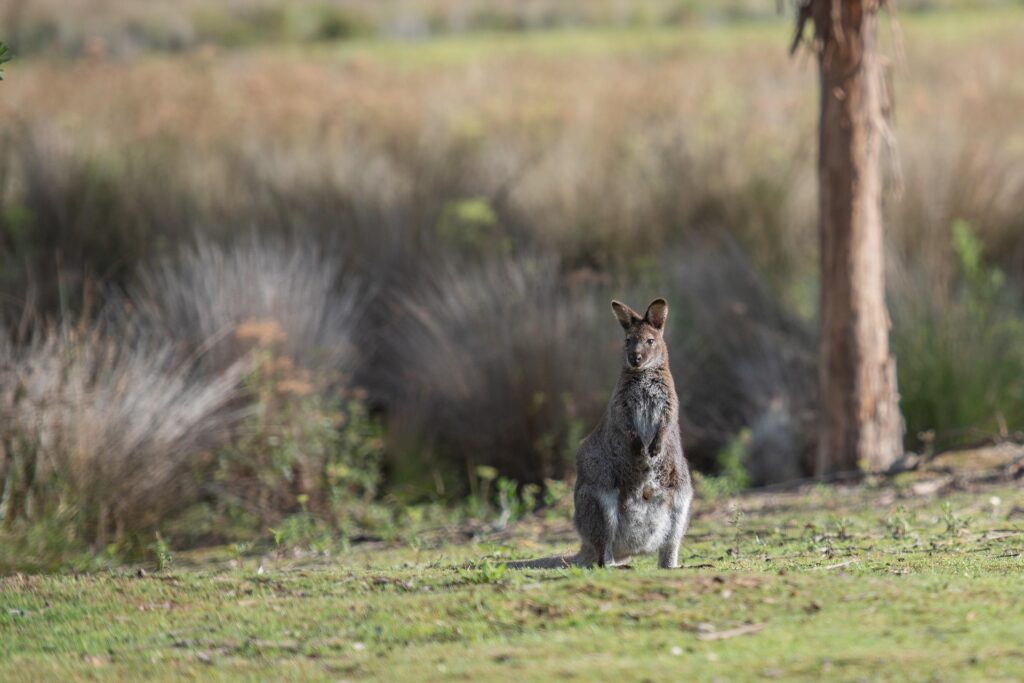
Wallabies are like small kangaroos. Their fur is coarse and dark brown all over, and they move by flying. They usually live alone or in groups, relaxing in forests with a lot of undergrowth. Some types prefer to bathe in water, and each type has a different lifestyle. They are primarily nocturnal animals, but can be seen during the day as well.
① Smaller than a kangaroo
Body length: Approximately 60-90cm
Weight: Approximately 10-25kg
Looks like a “mini” kangaroo
Easy-to-maneuver body size.
② Powerful hind legs and tail
Hidden legs: Muscles specialized for jumping
Tail: Thick, used for balance and support
Jumping speeds of nearly 40km/h
A body evolved for jumping.
③ Soft-looking face
Round eyes
Short nose
Overall charming
Very gentle appearance
④ Herbivorous and ruminates
Grass, leaves, and shrubs
Multi-chambered stomach
Typically feeds at night
What is your personality like?
Because wallabies are small animals, they tend to be more docile and timid than kangaroos. Therefore, they often run away when strangers approach them.
① Very timid and cautious.
Reacts to even the smallest noises.
Immediately avoids anything unfamiliar.
Flees as fast as they can when they sense danger.
“Flee” is their defense, not “fight.”
② Gentle and low-aggression.
Generally do not fight.
Rarely engage in violent fights, even with males.
Not aggressive toward humans.
Gentle, typical of herbivores.
③ Quiet and docile.
Quiet.
Few unnecessary movements.
Calm even in groups.
④ Moderately social.
Keeps small groups.
Often acts alone.
Keeps distances at a moderate level.
Not overly clingy.
⑤ Takes time to get used to.
Does not quickly become attached to humans.
Accustoms to the same environment and individuals.
Sudden contact is very stressful.
⑥ Moderately curious.
Less aggressive than quokkas.
Makes moves only after confirming safety.
Cautious.
What about the ecology?
Ecology varies depending on the type of wallaby. Like kangaroos, they feed on grass, tree buds, shrub leaves, and ferns. The breeding season can be seen throughout the year. The gestation period is 33 to 38 days, and it is possible to give birth to 1 to 2 calves at a time. The lactation period is 15 months, and they reach sexual maturity at around 18 months. The lifespan is said to be about 15 years.
① Daily Rhythm
Day
Rests in bushes or woods
Lays down and ruminates
Moves almost motionless
Evening to night
Actively feeds
Moves to grasslands in groups
Evacuates immediately in case of danger
To avoid heat and predators.
② Movement and Behavior
Main method of locomotion: jumping
Moves quickly using hind legs and tail
Normally energy-saving behavior
Sprints only when necessary
③ Diet (What do they eat?)
Grass
Leaves
Young shoots
Shrubs
Digestive Characteristics
Multiple stomachs
Digestion by fermentation
Can survive on nutrient-poor grass
④ Social Structure
Small groups
Fluid groups
Weak hierarchy
Low conflict
Loose social relationships.
⑤ Reproduction and Rearing
Reproduction
Once a year (multiple times depending on the environment)
Some species can breed year-round
Birthing
Gestation period: Approximately 30 days
Birth is extremely small
Rearing
Baby develops in a pouch (brood pouch)
Begins to emerge from the pouch at approximately 6-8 months
Independent after about a year
Are there any natural enemies?
In Australia, where wallabies live, their natural enemies include red foxes, cats, and dingoes. However, the greater threat is probably humans. Environmental destruction has become a major problem.
Wallaby Vocalizations
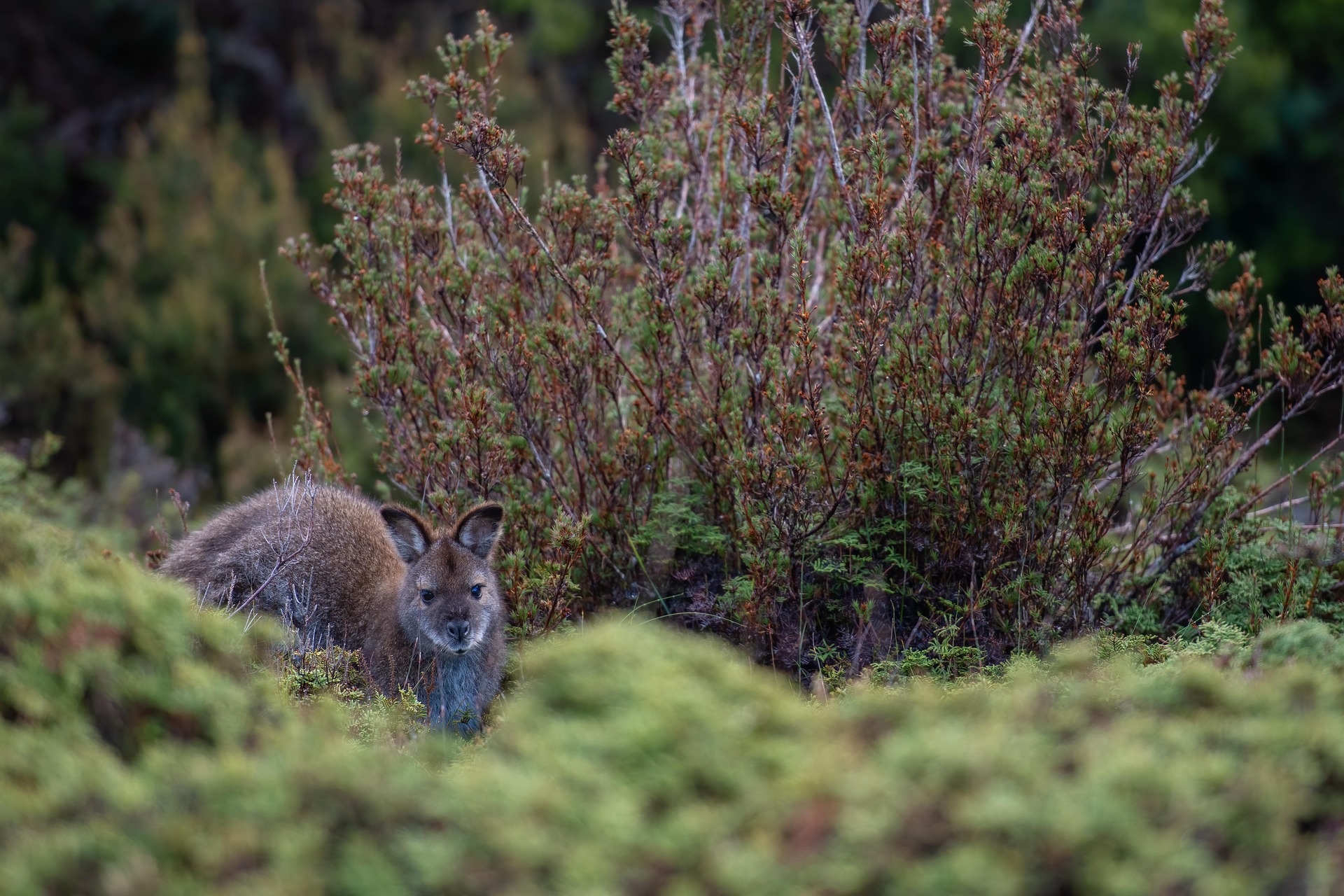
Wallabies are generally very quiet animals. Like their kangaroo relatives, they do not usually make loud noises, relying instead on sounds, posture, and scent to communicate.
🍼 Sounds made by young wallabies (joeys): “Kuk-kuk” or “kyu-kyu”
When approaching their mothers, young wallabies (joeys) make:
Soft vocalizations
High-pitched calls
Snorting or sniffing sounds
Purpose:
Locating the mother
Seeking milk
Expressing anxiety
⚠️ Sounds of alertness: “Gon-gon” or “don-don” (thumping)
Wallabies are well-known for the behavior of striking the ground with their hind legs (foot-stomping).
Purpose of the sound:
Alerting the group to danger
Warning predators
Intimidating the surroundings
They stomp their feet vigorously when wary of threats such as:
Dingoes
Foxes
Birds of prey
😠 Low growls for intimidation
When sensing danger or engaging in a conflict, they may make sounds such as:
“Grrr”
“Hoo” (hissing/puffing)
Low growls
This behavior is particularly common during disputes between males or when a mother is protecting her young.
💕 Soft sounds between companions
At close range, they communicate using:
Snorting or sniffing
Exhaling sounds
Soft clicking sounds
Wallaby Molting
Wallaby molting (the shedding and replacement of fur) is a natural physiological process that adjusts their coat in response to seasonal changes. Unlike dogs or cats, which may shed large amounts of fur at once, wallabies replace their fur gradually to adapt to their environment.
🌱 Spring (Transition from dry season to rainy season)
A time when molting is most noticeable
Transition from the thick coat prepared for winter to a summer-appropriate coat
Old fur sheds
New fur grows in
Coat condition improves
Especially in captivity, increased shedding may occur around spring due to changes in temperature and lighting.
☀️ Summer
Fur is short and lightweight
Coat texture facilitates heat dissipation
Easier to regulate body temperature
Activity levels increase
Since wallabies have few sweat glands, they cope with heat through their coat condition and behavior.
🍂 Autumn
Preparation period for the winter coat
Fur becomes slightly denser
Heat retention improves
Volume of fur on the body increases
Species living in cold regions undergo more significant changes in preparation for winter.
❄️ Winter
Coat focused on heat retention
Fur becomes thicker
Some species develop a thick undercoat
Easier to maintain body temperature
Adaptation to cold is particularly pronounced in wallabies living in mountainous regions.
Seasonal Activities
While wallaby activities vary by species and habitat, they generally shift in response to Australia’s dry and wet seasons, temperature fluctuations, and plant growth cycles.
🌱 Spring (Approx. September–November: Southern Hemisphere)
Activity Level: Increases
This is a time when the winter chill subsides and vegetation begins to grow.
Key Behaviors:
🌿 Eating new shoots and young leaves
🦘 Increased foraging time
🍼 Active child-rearing
💕 Mating behavior observed
With food abundant, spring is an ideal season for mother wallabies to raise their young.
☀️ Summer (Approx. December–February)
Activity Level: Decreases (during the day)
They adjust their activity times to avoid the heat.
Key Behaviors:
🌅 Active during early morning, evening, and night
🌳 Resting in the shade of trees or bushes
💧 Moving to find water
🌱 Foraging at night
As wallabies are sensitive to heat, they minimize movement during the day to conserve energy.
🍂 Autumn (Approx. March–May)
Activity Level: High
Temperatures drop, making conditions more comfortable.
Key Behaviors:
🌿 Increased food intake
🦘 Expanded range of movement
🏞️ Moving between feeding grounds
🍼 Continued growth of young
This is also a time to build up nutritional reserves in preparation for winter.
❄️ Winter (Approx. June–August)
Activity Level: Slightly lower
Changes are particularly pronounced for wallabies living in colder regions.
Key Behaviors:
🌄 Active during the warmest parts of the day
🌿 Foraging for grass and shrubs
🪨 Resting in rocky crevices or forests
🦘 Adjusting travel distances
Species living in mountainous areas cope with the cold by growing thick fur.
Daily Activity Rhythm
Most wallaby species are crepuscular (active at dawn and dusk) or nocturnal.
🌅 Morning
Foraging
Hydration
Movement
☀️ Midday
Resting
Thermoregulation in the shade
Rumination
🌙 Night
Most active
Grazing
Moving within territory
Locomotion Speed
While wallabies move slowly when walking, they can travel very quickly by hopping. True to their nature as relatives of the kangaroo, their primary mode of locomotion is hopping rather than walking.
Approximate Wallaby Speeds
- Slow walking: Approx. 2–4 km/h
- Normal movement (small hops): Approx. 5–15 km/h
- High-speed hopping (when fleeing): Approx. 30–50 km/h
- Top speed (short distances): Around 50 km/h for some species
*Note: Speeds vary depending on the species (e.g., Red-necked Wallaby, Bennett’s Wallaby, Rock-wallaby) and the environment.
🦵 Powerful Hind Legs
Using:
- Thick muscles
- Long ankles
- Elastic tendons
…they can make large leaps while expending minimal energy.
🦘 The Tail Acts as a Balancer
A wallaby’s long tail is used for:
- Changing direction
- Balancing upon landing
- Providing support while walking slowly
About Baby Wallabies
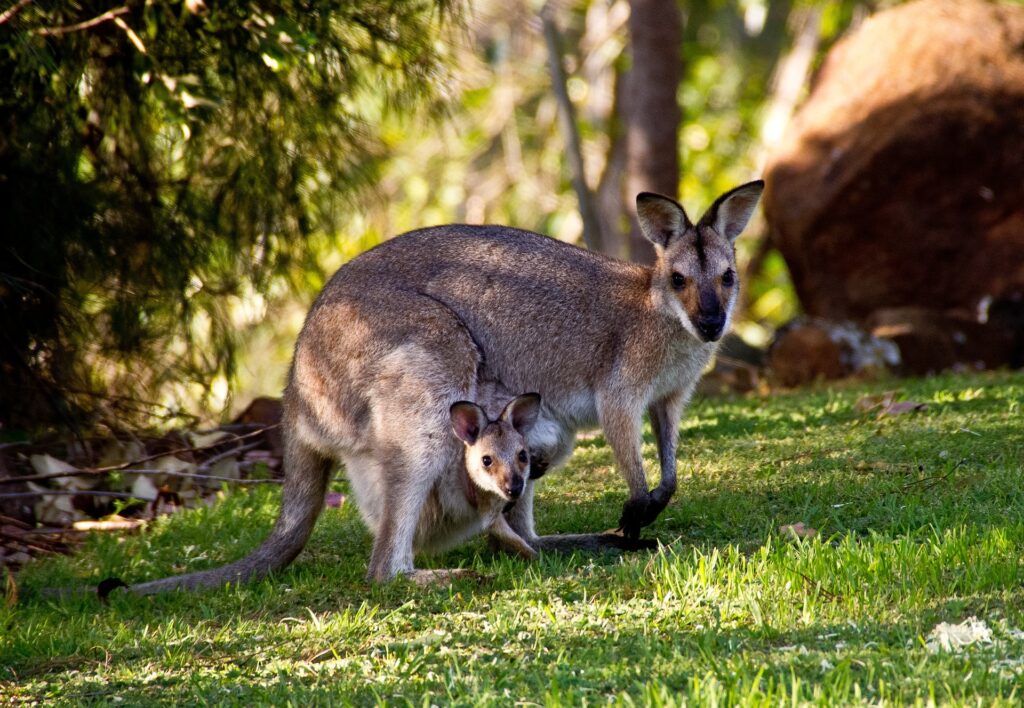
Baby wallabies (joeys) are born tiny and spend a long time in their mother’s pouch, a developmental process typical of marsupials.
Baby Wallabies: Basics
Name: Joey
Birth Season: Year-Round (Varies by Region and Species)
Size at Birth:
Approximately 2 cm, Weight: Approximately 1 g (Pea-sized)
Litter Size: Usually 1
Appearance Immediately After Birth
Surprisingly Immature
Almost Hairless
Eyes and Ears Underdeveloped
Cannot Regulate Body Temperature
Almost Like a Continuation of the Fetal Stage
Behavior Immediately After Birth (Significant Characteristic)
Immediately After Birth
Climb to Mother’s Pouch on Their Own
Only Front Legs and Sense of Sense of Sense of Sense are Developed
Reach the Pouch Within a Few Minutes
This is the First and Most Important Challenge After Birth
Growth in the Pouch (Brood Pouch)
What Happens Inside the Pouch
Mouse Attaches to the Nipple
Continues to Suck
Rapid Growth Over Several Months
Growth Stages
Time: 0-2 Months (Always in the Pouch)
3-4 Months (Fur Begins to Grow)
5-6 Months (Emerges from the Pouch)
6-8 Months (Repeatedly Goes in and Out)
Approximately 1 Year (Fully Independent)
Relationship with Mother
Very Close
Mother Always Protects Her Young
Returns to the Pouch in Times of Danger
Milk Composition Changes as the Young Grow
Completely Customized Parenting.
Young Behavior
Imitates Mother After Leaving the Pouch
Small Jump Practice
Learning Through Falls
Play = Survival Training
Survival Rate and Harshness
Natural Predators
Accidents
Environmental Changes
The Most Dangerous Time Is After Leaving the Pouch.
Are wallabies an endangered species?
Although it depends on the subspecies, wallabies are generally designated as endangered species in many cases. The reasons for the decline in population are as follows.
exterminated as a pest
Wallabies are often exterminated as pests. Wallabies tend to destroy crops and are hated by farmers. There are areas where the population is decreasing because they are sometimes exterminated.
Bringing in carnivorous animals
In modern times, Europeans introduced cats and dogs. This may lead to being preyed upon. Kangaroos are small, so they are easy to eat.
Wallabies can be kept as pets
Although some wallabies are listed as endangered species, they can be kept as pets. However, unlike cats and dogs, they are not animals that you can always meet at a pet store, so it is more realistic to get them from a zoo or national park. There will be information on exhibits at events and other events at the facility, so let’s take a look first.
What is your lifestyle?
They are sensitive to changes in their environment, and are easily startled and panicked by sudden or loud noises. Since they are herbivores, they are generally timid. It will take some time to get used to it, so make sure to take your time to train it. Unfortunately, wallabies cannot learn to use the toilet, so be careful.
wallaby food
The most practical food for wallabies is pellets, hay, and green grass. You can also eat apples, mandarin oranges, etc.
Be careful of kangaroo disease
What is kangaroo disease? This is a common disease among members of the kangaroo family, in which a bacterial infection in the oral cavity spreads to the jawbone, causing the jawbone to suppurate. It is a scary disease that can lead to death in the worst case scenario. Please be careful as it can spread due to infection from the wound or cavities caused by food getting stuck in the tooth. If you are unsure, see a veterinarian.
Zoos Housing Wallabies (Japan & Worldwide)
Many wallaby species within the kangaroo family are relatively easy to keep in captivity, and they can be found in numerous zoos across Japan and the world. Bennett’s wallabies (also known as red-necked wallabies) are particularly common in zoo collections.
🇯🇵 Major Zoos in Japan Where You Can See Wallabies
Yokohama Zoological Gardens “Zoorasia”
Extensive Australian animal exhibits
Features animals from the kangaroo family
Characterized by spacious, habitat-style enclosures
Shizuoka City Nihondaira Zoo
Houses Bennett’s wallabies (red-necked wallabies)
Successful breeding record
Facility dedicated to educating visitors about wallaby ecology
Himeji Central Park
Experience keeping kangaroo family species, including Bennett’s wallabies
Features exhibits that allow for close encounters with animals
Nagasaki Bio Park
Diverse animal exhibits, including species native to Australia
Known for free-roaming style enclosures
Saitama Children’s Zoo
Known for keeping kangaroo family species
Features exhibits of Australian animals
🌍 Notable Zoos Worldwide Where You Can See Wallabies
🇬🇧 ZSL London Zoo
Exhibits include Bennett’s wallabies
A zoo with a long, historic legacy
🇳🇱 Artis Royal Zoo
Registered facility for keeping red-necked wallabies
🇧🇪 Pairi Daiza
Extensive Australian animal exhibits
Houses wallabies
🇦🇺 Taronga Zoo Sydney
A leading facility for the conservation and exhibition of animals native to Australia
Houses numerous species from the kangaroo family
🇺🇸 San Diego Zoo
Large zoo featuring exhibits of animals from the Australian region
Engaged in the exhibition and conservation of marsupials
Introducing other animals
コメント