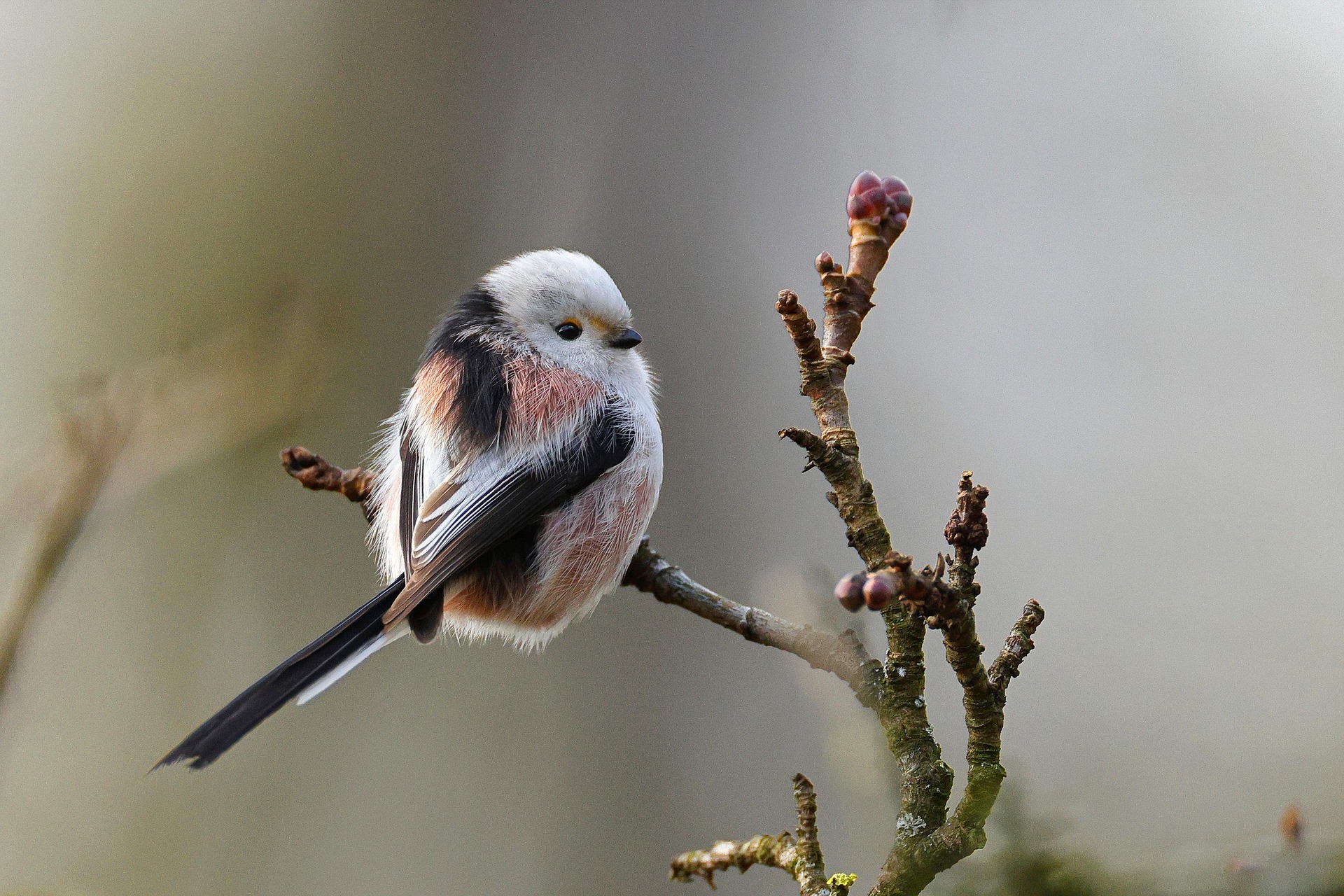
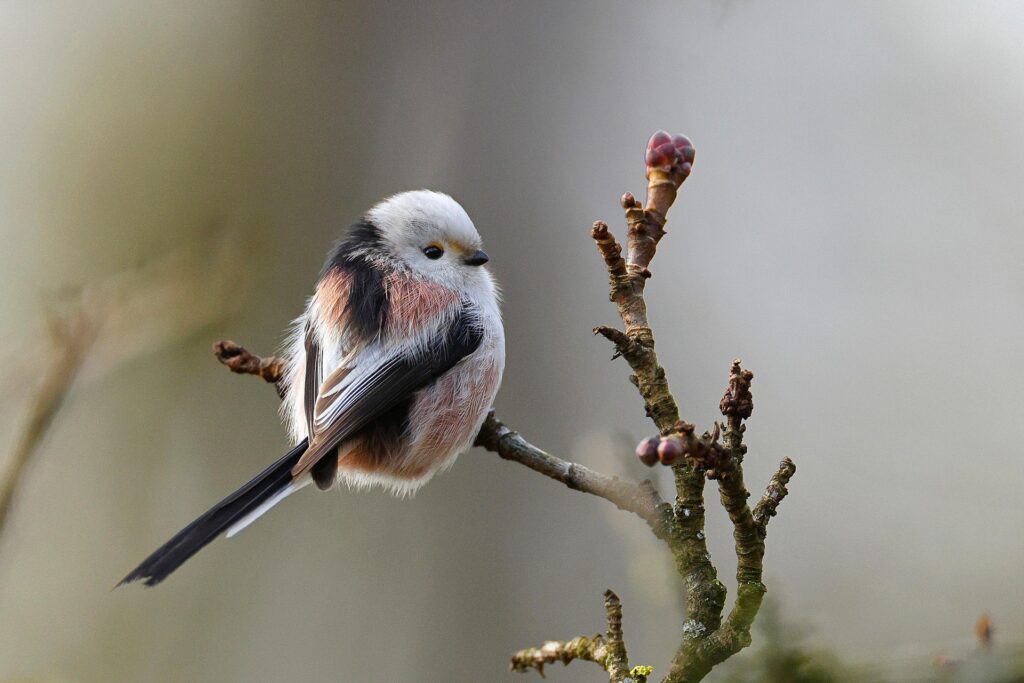
What kind of bird is the popular and adorable long-tailed tit? Explaining its cute characteristics, ecology, and habitat This bird, called the snow fairy, can be seen in Hokkaido, Japan. It is said to be one of the subspecies of the long-tailed tit, and is a bird classified in the long-tailed tit family, and is also famous as a very cute bird because its entire body is pure white.










- What is Shimaenaga? About basic status
- What are the roots and origins of the Shima-enaga?
- About habitat
- feature is? What kind of creature is it?
- What is your personality like?
- What is the ecology like?
- Long-tailed Tit Molting
- Vocalizations
- Seasonal Activities
- Flight Speed
- About Japanese Long-tailed Tit Chicks
- Is the long-tailed moth an endangered species?
- Differences between the long-tailed tit and other long-tailed tits
- Can I keep a striped long-tailed moth?
- Zoos Keeping the Species (Japan and Worldwide)
- Introducing other animals
What is Shimaenaga? About basic status
The long-tailed moth is a bird classified in the family Longtail, genus Longtail. The scientific name is Aegithalos caudatus trivirgatus. The English name is Long-tailed Tit. The body length is about 10 to 14 cm, and the weight is about 10 g, which is about the same size as a sparrow. This popular bird is called the “snow fairy” because of its adorable appearance. In Japan, it is sold as goods, illustration designs, and products. The list of information is below. Many people purchase stuffed animals and post them on social media.
| Japanese(和名) | シマエナガ |
| English(英名) | Long-tailed Tit |
| scientific name(学名) | Aegithalos caudatus trivirgatus |
| classification(分類) | Ave、 Passeriformes、 Aegithalidae、Aegithalos 鳥綱、スズメ目、エナガ科、エナガ属 |
| IUCN Status(保全状況) | LEAST CONCERN |
| Length(体長) | 10~14cm |
| Weight(体重) | 10g |
What are the roots and origins of the Shima-enaga?
The Shima-enaga (Hokkaido Long-tailed Tit) is a member of the Long-tailed Tit family that evolved in Hokkaido.
While it appears to be a small bird unique to Hokkaido, tracing its origins reveals a lineage connected to the Long-tailed Tit (Aegithalos caudatus), which is widely distributed across the Eurasian continent.
Ancestry: The Eurasian Long-tailed Tit
Taxonomically, the ancestor of the Shima-enaga is the Long-tailed Tit (Aegithalos caudatus), a bird belonging to the order Passeriformes and the family Aegithalidae.
Members of the Long-tailed Tit family are widely distributed from Europe to Asia and are characterized by their long tails.
Regarding the origin of the name “Enaga”:
Enaga (literally “long handle”) refers to an appearance resembling a ladle with a long handle.
The prevailing theory is that the bird’s long tail was likened to such a handle.
Why is the Hokkaido Shima-enaga pure white?
The Shima-enaga is a subspecies of the Long-tailed Tit that inhabits Hokkaido.
As it adapted to life in Hokkaido’s cold environment, the black markings on its head disappeared, transforming it into a bird with an entirely white face.
The standard Long-tailed Tit:
Has black lines around the eyes
Has markings on the face
The Shima-enaga:
Has a pure white face
Appears round
Has an appearance that blends into the snowy landscape
These are the key differences.
The meaning of “Shima”
The “Shima” (island) in Shima-enaga is believed to derive from the fact that Hokkaido is an island located in the north of the Japanese archipelago.
In other words:
Shima-enaga = A Long-tailed Tit found on the island of Hokkaido.
About classification
The cute striped long-tailed moth is classified as a family of long-tailed moths. There are four subspecies living in the vicinity: Long-tailed tit (Honshu, etc.), Kyushu-enaga (Shikoku and Kyushu), and Chosen long-tailed tit (Tsushima, etc.). With the exception of the striped long-tailed moth, all of them are southern subspecies, so the striped long-tailed moth can be said to be a special entity. It looks like a stuffed animal, and has been featured in books and photographs, making it very attractive.
Taxonomy of the Japanese long-tailed tit
- 界(Kingdom):動物界 (Animalia)
- 門(Phylum):脊索動物門 (Chordata)
- 綱(Class):鳥綱 (Aves)
- 目(Order):スズメ目 (Passeriformes)
- 科(Family):エナガ科 (Aegithalidae)
- 属(Genus):Aegithalos
- 種(Species):Aegithalos caudatus
- 亜種(日本産):Aegithalos caudatus japonicus
About habitat
The long-tailed moth inhabits and is distributed mainly in Hokkaido, Japan. Their cries can often be heard in urban areas like Sapporo, and flocks sometimes visit stores and become a hot topic of conversation.
- Habitat in Japan
Distribution: Hokkaido, Honshu, Shikoku, Kyushu
Habitat:
Coniferous and mixed forests (coniferous and broadleaf)
Can survive in areas with snow, even in winter
Prefers densely forested areas, feeding on insects on the tips of branches and among leaves
- Relationship with Forest Environment
Mostly found in the middle to upper forest stratum
Dense forests are necessary to feed on insects hiding in tree leaves and branches
Rarely found in urban or developed areas
- Global Distribution
Closely related species are found in northern Eurasia (Russia, China, the Korean Peninsula, etc.)
The Japanese subspecies is particularly well adapted to cold, snowy climates
feature is? What kind of creature is it?
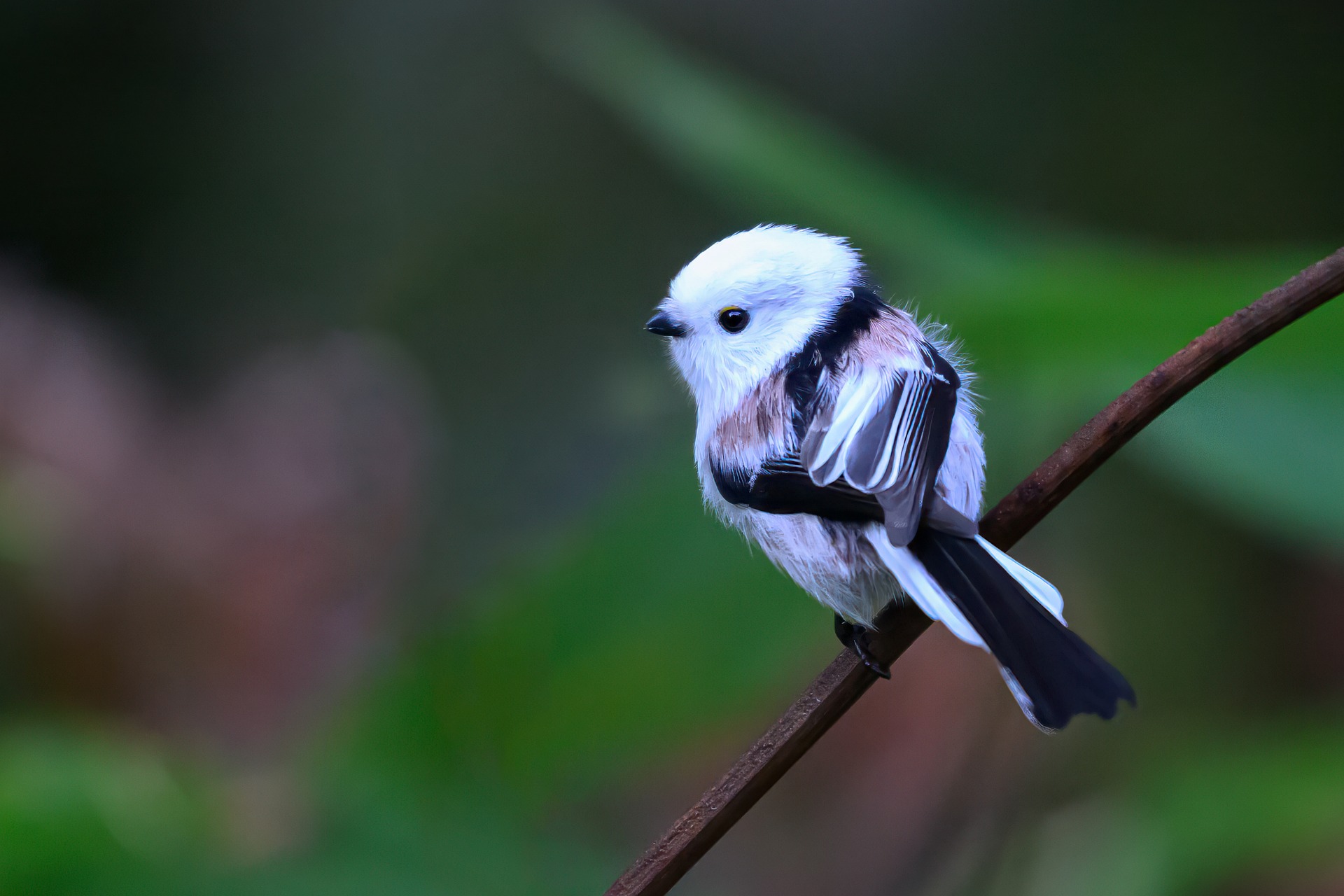
The long-tailed moth is a bird that lives in cold regions and is widely distributed from Hokkaido in Japan to Europe and Siberia. This bird can mainly be seen in forests and forests, as well as on flatlands and mountains. They are distributed throughout Hokkaido and can be seen in parks and green areas. It can be said that it is characterized by the fact that the whole body is pure white with some black mixed in. Their fluffy and fluffy feathers and feathers are noticeable when you look at them. The color changes in winter and summer.
- Body Size and Appearance
Total Length: Approximately 13 cm (including tail)
Weight: Approximately 5-9 g
Body Type: Small, round body, long, slender tail (accounting for about half of total length)
Feather Color:
White, round head
Black and gray back, black and white patterned wings
Whitish underside
Eyes: Black, round, cute expression
- Behavior and Personality
Active and curious
Often travels in flocks, often in groups of several dozen birds, even in winter
Flying around on twigs, they hunt for insects and spiders
Makes a high-pitched, cute chirping sound
- Diet
Mainly insectivorous (also eats nuts and seeds in winter)
Carefully searches leaves and branches to catch insects
- Other Characteristics
A small, cold-hardy bird that can live in snowy regions
Sometimes called “snow fairies” due to their cute appearance
What is your personality like?
The long-tailed moth is very active. Basically, I move around a lot like a child, so I move around a lot like a child. There is a reason why the striped long-tailed moth moves around so actively. This is also to protect them from predators such as snakes, crows, and weasels since they have a very small body. The slightly white appearance is very adorable.
Personality and Behavior of the Japanese Long-tailed Tit
Active and curious
Flying among the branches and leaves of forests, searching for insects and small objects
Always on the move, observing their surroundings even when in a flock
Social
Even in winter, they form flocks of several dozen birds
They communicate with each other through vocalizations
Timid but not overly cautious
Highly sensitive to predators (such as birds of prey and cats)
They often flee when humans approach, but living in a flock gives them a sense of security
Cooperative
When searching for food or moving between branches, they closely observe the behavior of their companions
In harsh winter conditions, they may huddle together to keep warm
What is the ecology like?
The long-tailed moth is omnivorous. Their staple food is tree sap, small nuts, and insects. Their favorite food is often eaten by aphids. Since it is a resident bird rather than a migratory bird, it can be seen in Hokkaido throughout the year. The breeding season is from April to June, when they build nests. They will reproduce monogamously. They lay about one egg a day, and about 10 eggs over a period of 1 to 2 weeks. Unfortunately, it is a very short-lived bird, with a maximum lifespan of only 5 years.
- Life Rhythm
Diurnal: Active during the day and forage for food
Rests among branches and leaves at night
Active in winter, but travels in groups to endure the cold
- Diet/Foraging
Main Food:
Small arthropods such as insects and spiders
Also eats nuts and seeds in winter
Foraging Method:
Finds prey by flying among twigs and leaves
Sometimes forage cooperatively in groups
- Breeding
Breeding Season: April to July (Japanese subspecies)
Nest Building:
Builds ball-shaped nests at the ends of tree branches using moss, spider web silk, and feathers
These small, round nests are placed in easily concealed locations
Egg Laying: Approximately 5-10
Brooding:
Both parents take turns incubating and feeding the eggs
Chicks hatch in about two weeks and fledge in another two weeks
- Sociality
They often travel in flocks in winter, sometimes numbering in the dozens.
Flocking allows them to better protect themselves from the cold and guard against predators.
They communicate within the flock through vocalizations and behavior.
- Habitat Relationship
Sylvan Habitat: Depends on coniferous and mixed forests.
Activates in the mid- to upper-story forests.
Because they fly between trees and branches, they are vulnerable to habitat loss due to development and deforestation.
Are there any natural enemies?
Unfortunately, since the long-tailed moth is a very small bird, it has many natural enemies. They are preyed upon not only by weasels and crows, but also by dogs and cats.
Long-tailed Tit Molting
Molting is the process by which a Long-tailed Tit sheds its old feathers and grows new ones.
While they replace feathers throughout the year, the “complete molt” that occurs from summer to autumn is particularly important.
① Spring (Breeding Season)
Around March–June
Time for nest-building and breeding
Maintains the plumage prepared during winter
No major molting occurs during the breeding period
Reproduction takes priority over renewing feathers during this time.
② Summer–Autumn (Major Molt)
Around July–October
This is the most significant molting period for the Long-tailed Tit.
Main feathers replaced:
Body feathers
Head feathers
Wing feathers
Tail feathers
Feathers across almost the entire body are renewed.
During this period, you may notice:
Feathers looking shaggy or unkempt
A slightly altered facial appearance
The tail appearing shorter
Unstable flight patterns
③ Winter (Transforming into a “Snow Fairy”)
November–February
After molting concludes, they acquire new winter plumage.
Characteristics:
Denser plumage
Plumper body appearance
Improved heat retention
More prominent white face
In Hokkaido’s harsh cold, their feathers are not merely “clothing” but essential insulation for survival.
Why do Long-tailed Tits look round in winter?
The reason Long-tailed Tits resemble “snowballs” in winter isn’t solely due to their post-molt feathers.
When it is cold, they employ a mechanism where they:
Fluff up their feathers → Create a layer of air → Retain body heat
This results in the following changes:
Summer:
Slender appearance
Long-looking tail
Active impression
Winter:
Round shape
Face appears buried in feathers
Resembles a stuffed toy
Vocalizations
The Long-tailed Tit (specifically the Shima-enaga subspecies) is characterized by small, high-pitched calls that sound like “chee-chee,” “juri-juri,” or “churiri.”
Although their small bodies mean their voices lack volume, they travel in flocks, so their calls can be surprisingly audible within the forest.
① Calls between flock members
“Chee-chee,” “churi-churi”
These are the calls heard most frequently.
Purpose:
Confirming the presence of flock members
Signaling location while moving
Preventing members from getting separated
Since Long-tailed Tits travel in small flocks during winter, these calls can often be heard in quick succession as they move through the trees.
② Alarm calls
“Juri-juri,” “jiri-jiri”
These calls are made when the birds sense danger.
For example:
When a bird of prey (such as a sparrowhawk) approaches
When a human or animal approaches
When danger threatens the nest
In these situations, the calls become more intense.
③ Breeding season calls
During the spring breeding season,
Males and females calling back and forth to each other
Short calls made near the nest
Signals to flock members
…and other variations occur, resulting in a wider range of vocalizations than usual.
Seasonal Activities
The Long-tailed Tit (specifically the Shima-enaga subspecies) is a resident bird that lives in the forests of Hokkaido year-round. Its lifestyle changes significantly depending on the season.
Its appearance and behavior differ markedly, particularly between the “breeding season in spring” and the “flocking season in winter.”
🌸 Spring (March–June) | Breeding and Rearing Season
Key Activities
Pair formation
Nest building
Egg-laying and chick-rearing
In spring, they leave their winter flocks and begin moving in pairs.
Nest Building
Long-tailed Tits build highly elaborate nests.
Materials:
Moss
Spider silk
Tree bark
Feathers
They use these materials to construct a round, bag-shaped nest.
The use of spider silk allows the nest to expand and contract, creating a structure that can accommodate the growing chicks.
Chick-rearing
Lays a large number of eggs in a single clutch
Both male and female participate in rearing the chicks
Other adult birds sometimes assist with child-rearing
Long-tailed Tits are known for being highly social birds.
☀️ Summer (July–August) | Post-rearing and Molting Season
Key Activities
Fledglings become independent
Foraging
Molting begins
The young birds born in spring grow up and begin moving independently of their parents.
Since insects are abundant during this period,
Diet:
Small insects
Spiders
Larvae
Small organisms found in tree bark
…are what they forage for.
Molting
They replace their entire plumage from late summer through autumn.
Appearance:
Feathers may look disheveled
They appear less fluffy
The whiteness of the face may look less intense
…are some of the changes observed.
🍂 Autumn (September–November) | Preparation for Winter
Key Activities
Molting complete
Flock formation
Foraging for winter food
In autumn, Long-tailed Tits begin moving in flocks once again.
These flocks may include:
Long-tailed Tits
Marsh Tits
Coal Tits
Nuthatches
…and other small birds.
This behavior is known as a “mixed-species flock,” and it offers the advantage of enhanced collective vigilance against predators.
❄️ Winter (Dec–Feb) | Life in a flock and the battle against the cold
Key Activities
Moving in flocks
Foraging for food
Maintaining body temperature
In winter, the Long-tailed Tit (Shima-enaga) takes on its most famous appearance.
Characteristics:
Pure white face
Round, fluffy body
Long tail
Food
Since insects are scarce in winter, they search for:
Tree buds
Eggs and larvae in tree bark crevices
Small spiders
…and other such items.
Coping with the Cold
As temperatures in Hokkaido drop below freezing, they preserve body heat by:
Fluffing up their feathers
Resting in flocks
Huddling close together
Flight Speed
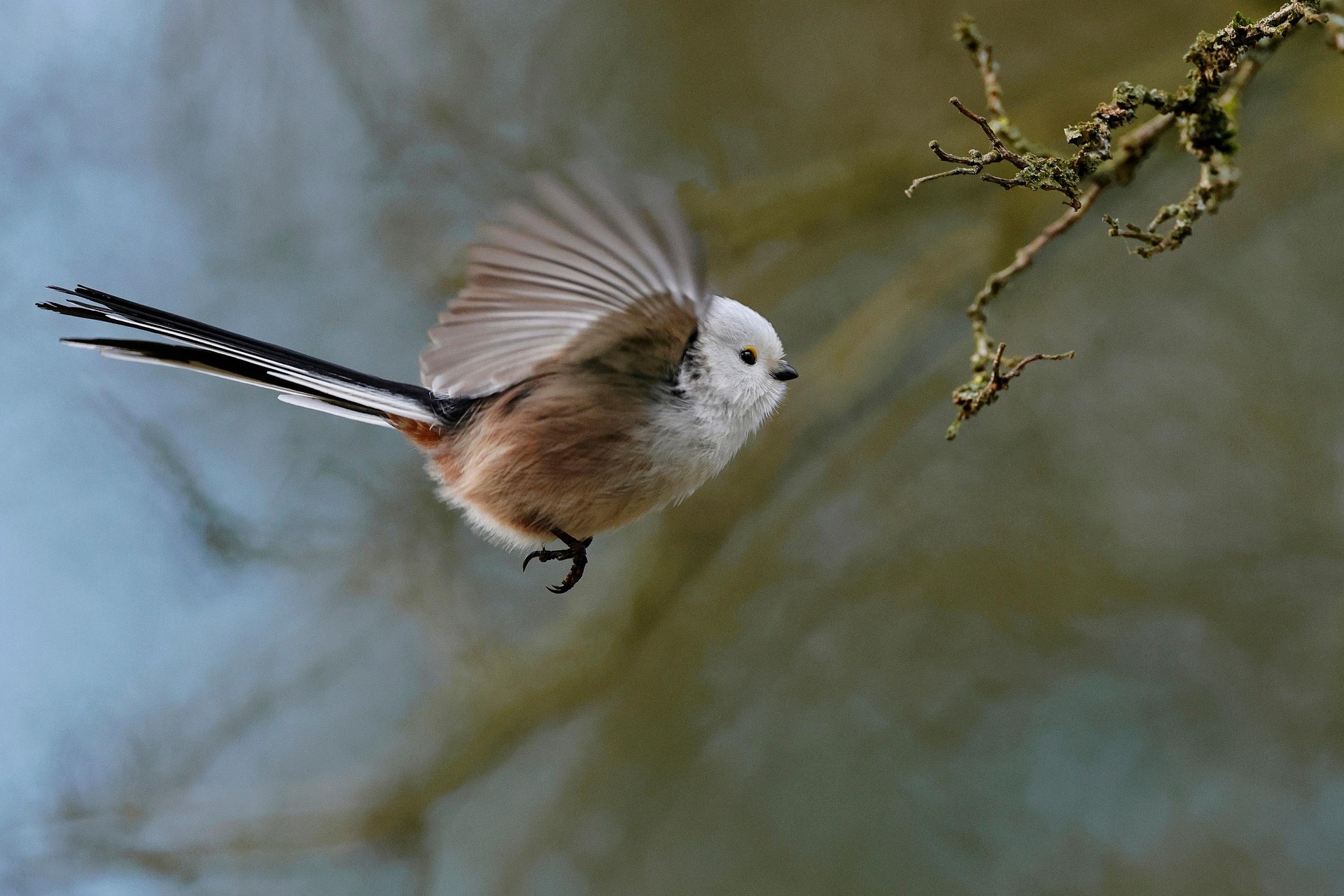
While there is little scientifically detailed data on the exact top flight speed of the Long-tailed Tit (Shima-enaga), estimates based on its body size and flight style suggest a typical speed of around 20–30 km/h.
① “Undulating Flight” Rather Than Straight-Line Flight
The Long-tailed Tit is not a bird that flies in a straight line at high speeds, like a swallow.
Characteristics:
Flapping
Brief gliding
Flapping again
It moves with an undulating, wave-like flight pattern.
This is a common flight style among small, forest-dwelling birds.
② Skilled at Short-Distance Movement
Rather than flying continuously over long distances, the Long-tailed Tit is physically adapted for:
Moving from tree to tree
Flying from branch tip to branch tip
Moving through the forest in a flock
Most individual flights cover only a few meters to a few tens of meters, allowing for quick changes in direction.
Flight Capability Characteristics
| Item | Characteristic |
|---|---|
| Estimated Speed | Approx. 20–30 km/h |
| Flight Distance | Primarily short distances |
| Flight Style | Undulating flight |
| Strengths | Moving between slender branches; sharp turns |
| Wings | Small; prioritized for maneuverability |
Why Is There No Need for High-Speed Flight?
The Long-tailed Tit primarily inhabits forests.
In a forest environment, the following abilities are more important than raw top speed:
Navigating between trees
Making sharp turns
Quickly landing on branches
Consequently, the Long-tailed Tit has evolved not as a bird that flies fast and far, but as one that moves freely and nimbly through the forest.
About Japanese Long-tailed Tit Chicks
By summarizing the chicks of Japanese Long-tailed Tit (Aegithalos caudatus japonicus), we can understand their developmental stages, behavior, and relationship with their parents from hatching to fledging.
- Hatching/Nest
Nest Building: They build small, round nests on the tips of tree branches.
Egg Number: 5-10
Egg Size: Approximately 1.5cm
Incubation Period: Approximately 14 days
- Chick Characteristics
Weight: Approximately 1-2g at hatching
Feathers: At first, they are soft and whitish with down.
Eyes: Closed immediately after hatching, but open within a few days.
Behavior:
Initially, they stay still in the nest.
Parents take turns incubating and feeding.
- Development Stages
Age/Week Development/Behavior: 0-2 weeks: They stay still in the nest with down. Parents feed them. 2-3 weeks: Their feathers begin to form. They build muscle strength by playing with their siblings. Weeks 3-4: They begin practicing flapping their wings and moving between branches. Weeks 4-5: Their flight ability improves. They practice with their parents in preparation for leaving the nest. Around week 5, they leave the nest. They begin to move independently, but may rely on their parents for support.
- Survival Considerations
They may be vulnerable to natural predators (such as birds of prey and small mammals).
Poor weather and food availability reduce their survival rate.
Is the long-tailed moth an endangered species?
The long-tailed moth is classified as low concern, and there is currently no possibility of extinction nationwide. For this reason, it is stable, but the estimated population is said to be gradually decreasing. The cause is land development by humans.
- Conservation Status in Japan
Under Japanese law (Natural Monuments and Wildlife Protection Act), the species is not designated as a specially protected species.
Although local declines have occurred due to forest development and logging, the species remains stable nationwide.
- IUCN Red List Assessment
The IUCN (International Union for Conservation of Nature) classifies the Long-tailed Tit (Aegithalos caudatus), which includes the Japanese Long-tailed Tit, as Least Concern.
The population is stable and the risk of extinction is considered low.
- Habitat Impact
Local declines have occurred due to deforestation and urbanization.
However, the species as a whole remains stable due to the presence of extensive forested areas.
Differences between the long-tailed tit and other long-tailed tits
What is the difference between the striped long-tailed moth and other long-tailed moths? The key to distinguishing them is the striped pattern on their faces. The face of the long-tailed moth is completely white. However, other species of long-tailed tits have a large eyebrow-shaped black area that can be spotted and identified here.
Can I keep a striped long-tailed moth?
The long-tailed moth is considered a wild bird, as its population is stable. The breeding of wild birds is strictly restricted by the Bird and Wildlife Protection and Management Act. Protecting wild birds without permission is also illegal and subject to fines and punishments, so the only way to see the original is at a zoo with a guide. We recommend taking photos during the period when you can observe and meet them. We are also often featured in media news and services.
- Legal Issues
Under the Wildlife Protection Act in Japan, capturing and keeping wild Japanese long-tailed tits is prohibited.
Capturing wild individuals and bringing them home or importing them is also illegal.
Even for breeding or research purposes, special permission from the prefecture or Ministry of the Environment is required.
- Difficulties in Raising
Requires space for flight: These birds have a habit of flying around branches in the forest, causing stress in small cages.
Dietary Issues:
They primarily eat small animals such as insects and spiders.
They also eat seeds and nuts in winter, so they require a feeding environment similar to their natural habitat.
High Sociality:
As a flock-living bird, keeping them alone can cause significant loneliness and stress.
- Cases Where Raising is Possible
Only in specialized facilities with legal permits, such as zoos and bird exhibition facilities.
Facilities provide flock-living environments, natural-looking food, and flight space for these birds.
Zoos Keeping the Species (Japan and Worldwide)
To put it briefly, very few zoos currently have the Long-tailed Tit (Shima-enaga) on permanent display, and there are virtually no instances of the bird being kept for public viewing.
As a wild bird native to the forests of Hokkaido, the Long-tailed Tit is a strong flyer that travels over wide areas in flocks; consequently, it is a species that is difficult to keep and display in a zoo setting over the long term.
Captivity Overseas
Although the Long-tailed Tit (Aegithalos caudatus japonicus) is known as a subspecies endemic to Hokkaido, it is extremely difficult to find confirmed instances of the bird being kept on public display in zoos overseas.
Introducing other animals




コメント