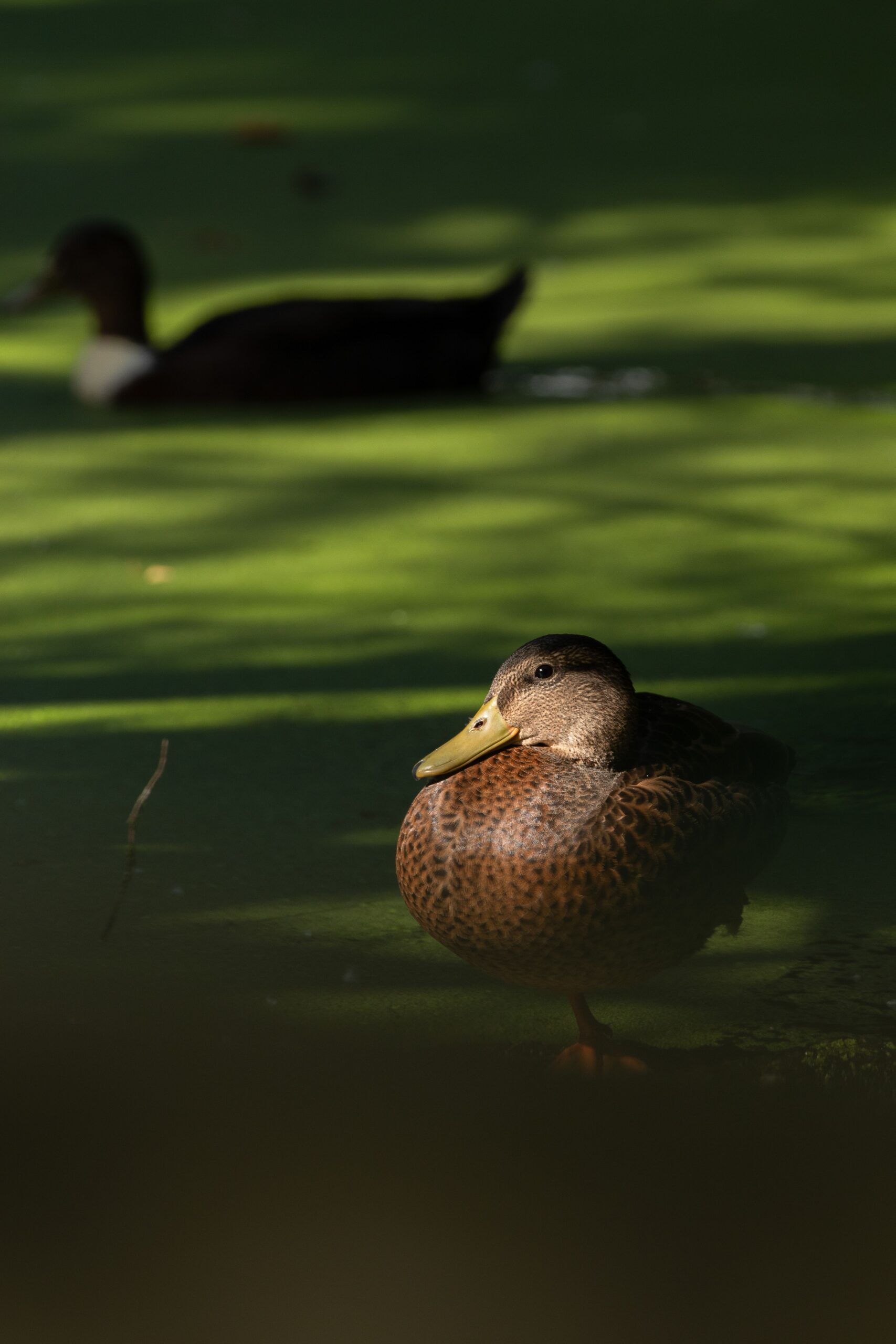
What kind of bird is a mallard? We will explain its characteristics, ecology, and habitat. The entire beak is pale yellow, which is its most distinguishing feature. Ducks are improved versions of mallards as poultry, so please refer to the article below as well, as you will see that they are very similar.
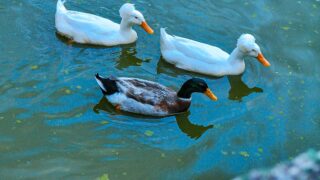



- What is mallard? About basic status
- What are the roots and origins of the Mallard?
- About habitat
- feature is? What kind of creature is it?
- What does the ecology look like?
- About Molting
- About Their Calls
- Seasonal Activities
- Flight Speed
- About Mallard Duck Chicks
- Is the mallard an endangered species?
- Can mallards be kept as pets?
- Zoos Housing Mallards (Japan & Worldwide)
- Introducing other animals
What is mallard? About basic status
Mallard ducks are birds classified in the order Anseriformes and family Anseriformes. The English name is mallard, the scientific name is Anas platyrhynchos, and the kanji is mallard. We will introduce the information in a list. Body length 50-65cm. Wingspan 75-100cm. Both males and females look similar to ducks.
| Japanese(和名) | マガモ |
| English(英名) | Mallard |
| scientific name(学名) | Anas platyrhynchos |
| classification(分類) | Ave、 Anseriformes、Anatidae、Anas 鳥綱、カモ目、カモ科、マガモ属 |
| IUCN Status(保全状況) | LEAST CONCERN |
| Length(全長) | 50-65cm |
| Weight(体重) | 1kg |
What are the roots and origins of the Mallard?
The Mallard (scientific name: Anas platyrhynchos) is a representative wild duck belonging to the family Anatidae and the genus Anas. It is also the ancestor of many modern domestic duck breeds.
Ancestry: “Ancient Ducks”
The Mallard’s ancestors are believed to be a lineage of primitive waterfowl that appeared approximately 20 to 30 million years ago (during the Miocene epoch of the Cenozoic era) and eventually gave rise to the modern Anatidae family.
The general evolutionary progression is as follows:
Primitive waterfowl
↓
Divergence of the order Anseriformes (geese and ducks)
↓
Formation of the family Anatidae (ducks, geese, and swans)
↓
Evolution of the genus Anas
↓
Modern Mallard (Anas platyrhynchos)
Where did they originate?
The ancestral lineage of the Mallard is believed to have evolved in what is now northern to central Eurasia.
Today, they have a very wide distribution, spanning:
Europe
Asia
North America
Parts of North Africa
This widespread distribution is due to the Mallard’s characteristics:
High flight capability
Omnivorous diet and strong adaptability to various environments
Ability to inhabit both freshwater and brackish water areas
Relationship with other ducks
The Mallard belongs to the evolutionary lineage of “typical ducks.”
Closely related species include:
Eastern Spot-billed Duck (East Asian lineage)
American Black Duck
Hawaiian Duck
Certain species of scoters
They are particularly closely related to the Eastern Spot-billed Duck, and genetic hybridization between the two can occur.
Relationship with humans: Ancestor of domestic ducks
Most modern domestic ducks are descended from wild Mallards that were domesticated.
Humans began raising Mallards over 4,000 years ago,
breeding them for specific purposes such as:
Meat production
Egg production
Feather/down utilization
This selective breeding resulted in the creation of:
Standard domestic ducks
Peking Duck lineages
Egg-laying duck breeds Genetic studies have also confirmed that many duck breeds are derived from the mallard.
About classification
Mallards and ducks are genetically the same species. Ducks are improved versions of mallards as poultry. The following subspecies of mallard exist:
- Anas platyrhynchos platyrhynchos マガモ
- Anas platyrhynchos conboschus グリーンランドマガモ
- Anas platyrhynchos maculosa マダラマガモ
- Anas platyrhynchos diazi メキシコマガモ
- Anas platyrhynchos diazi フロリダマガモ
- Anas platyrhynchos wyvilliana ハワイマガモ
- Anas platyrhynchos laysanensis レイサンマガモ
(Mallard / Anas platyrhynchos)
| 分類階層 | 名称 |
|---|---|
| 界 (Kingdom) | Animalia(動物界) |
| 門 (Phylum) | Chordata(脊索動物門) |
| 綱 (Class) | Aves(鳥綱) |
| 目 (Order) | Anseriformes(カモ目) |
| 科 (Family) | Anatidae(カモ科) |
| 属 (Genus) | Anas(カモ属) |
| 種 (Species) | Anas platyrhynchos(マガモ) |
About habitat
Mallard ducks live in the northern hemisphere and are quite widespread in cold to temperate regions. In Japan, it can be seen all over Honshu.
- Global Distribution
Ducks widely distributed throughout the Northern Hemisphere
Distributed from North America, Europe, Asia, and North Africa
Many individuals migrate south in winter, performing partial migration
- Distribution in Japan
Can be observed nationwide (resident and wintering birds)
Breeding season: Breeds in freshwater bodies and wetlands from Honshu to Kyushu
Migrates from northern Japan and cold regions to warmer regions south in winter
Live mainly near water, such as lakes, ponds, rivers, and tidal flats
- Habitat Characteristics
Prefers freshwater bodies
Rivers, lakes, ponds, wetlands, rice fields, etc.
Wintering Grounds
Migrates to coastal areas, rice paddies, artificial lakes, etc. for wintering
Adaptation to Urban Areas
Can also live in park ponds and artificial waterways
Food Environment
Prefers areas rich in aquatic plants, seeds, insects, and small fish
- Seasonal Habitat
Spring to Summer (Breeding Season): Pairs and families build nests in freshwater areas and wetland thickets.
Autumn to Winter (Wintering Season): Form large flocks in rivers, ponds, and tidal flats.
Mix of Resident and Migratory Birds: Resident birds are established in warmer climates.
feature is? What kind of creature is it?
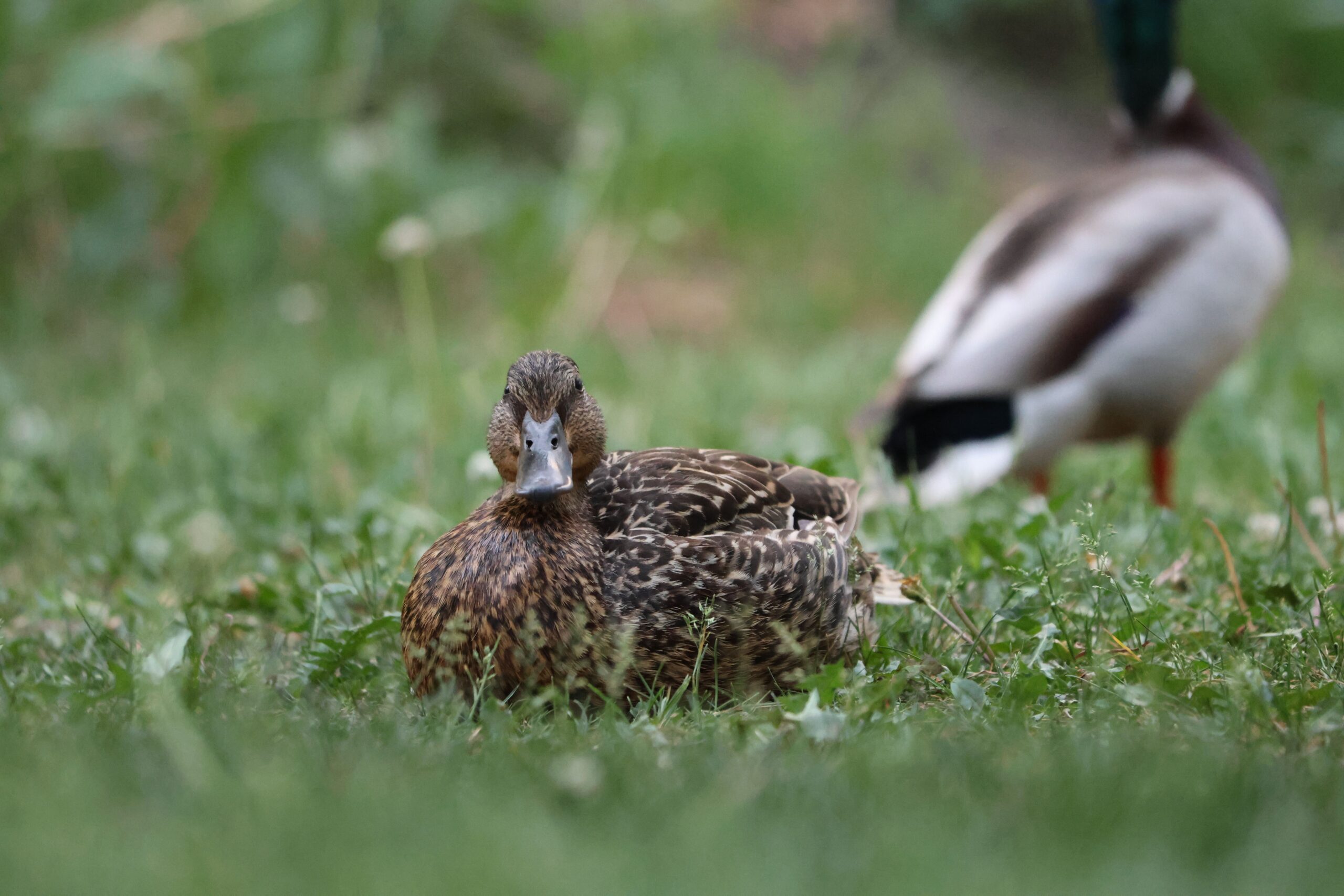
Mallard ducks have white markings and the entire beak is pale yellow. Many of these birds migrate to Japan’s lakes, rivers, and coasts as winter birds or migratory birds. Those that breed in the north tend to overwinter. Mallard ducks are primarily herding animals, living in large groups. They are good at swimming on the water’s surface and can stick their heads underwater or do handstands.
- Physical Characteristics
Body Shape/Size
Body Length: Males approximately 60 cm, females slightly smaller
A medium-sized duck with a stocky, waterfowl-like body shape
Plumage
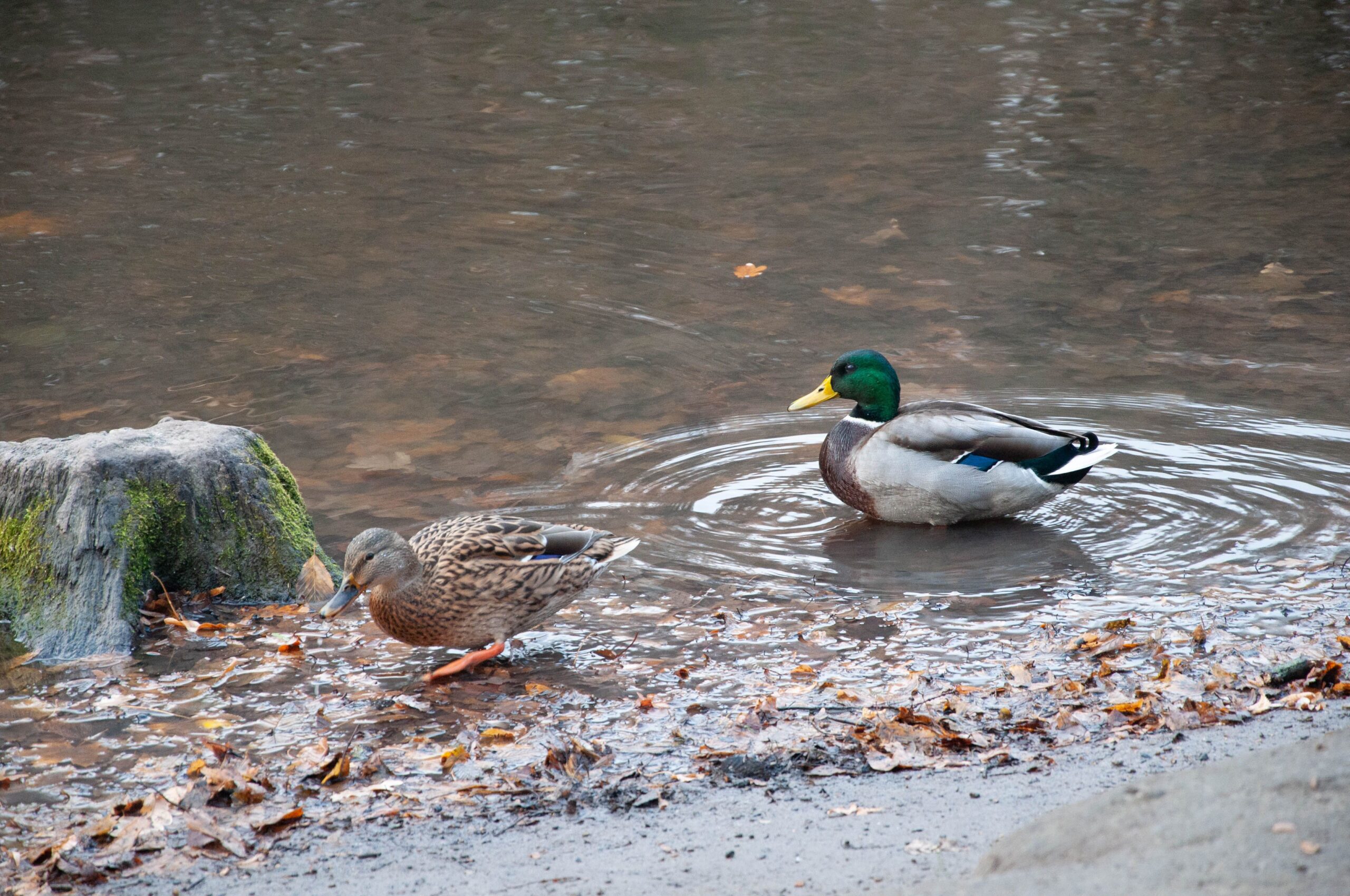
Male (Breeding Plumage)
Head: Glossy green
Chest: Reddish-brown
Sides/Back: Gray
Tip of Tail: White and curved
Female
Drab brown, body color is a camouflage
Wing Pattern
Distinguishing features include blue-purple wing speculum (highly shiny areas) that stand out in flight
Beak/Eyes
Beak: Males are yellow, females are orange with black spots
Eyes: Black
Tail/Legs: The tail is short and rounded, and the legs are orange
- Diet/Foraging
Omnivorous
Aquatic plants, seeds, insects, small fish, crustaceans, etc.
Foraging Method
Feeds on the surface or in shallow waters by dipping its beak into the water.
Sometimes dives its head underwater to search for food.
- Behavior/Personality
Highly social bird that lives in groups.
In winter, they can form flocks of several hundred birds.
Flight Ability
Fast, direct flight, capable of long-distance flight.
Territoriality
During the breeding season, they travel in pairs and defend territories around their nests.
Calls
Females have a distinctive “quack-quack” call.
- Reproduction
Nests are built on grass or bushes near water, or on land.
Eggs are laid at a rate of 8-13 eggs.
Incubation takes approximately 28 days, and chicks begin swimming immediately after hatching.
What does the ecology look like?
Mallard ducks have a herbivorous diet. They eat leaves, stems, and seeds of plants. The reproductive form is oviparous. They form pairs and the breeding season is from April to August. They build shallow dish-shaped nests and can lay 1 to 13 eggs. The incubation period is one month. The lifespan is said to be about 5-10 years.
- Diet and Foraging Behavior
Omnivorous waterbird
Feeds on aquatic plants, seeds, insects, small fish, shrimp, crustaceans, etc.
Foraging Method
Feeds by dipping its beak into the water in shallow waters or at the surface.
May also dive its head underwater, limiting its diving ability.
Activity Period
Actively forages during the daytime from early morning to late evening.
Often searches for food while swimming on the surface.
- Breeding
Breeding Season: Spring to Early Summer (March to June)
Nest Building
Nests are built in grass and bushes near water, or on the ground.
Nesting materials include grass and feathers.
Eggs and Hatching
8-13 eggs per nest
Incubation Period: Approximately 28 days
Chick Rearing
Chicks begin swimming immediately after hatching and are guided to feeding areas by their parents.
Become independent within a few weeks.
- Sociality and Behavior
Often travel in groups
In winter, they form flocks of dozens to hundreds of birds.
During the breeding season, pairs form territories.
They defend their nest area and chase away other birds that approach.
Flight Ability
Fast, straight flight
Capable of long-distance flight like migratory birds.
- Migration and Migration
Mixed Resident and Migratory Species
In warm regions, they remain resident near water year-round.
In cold regions and northern regions, they partially migrate south in winter.
Migration Distance
They can travel hundreds of kilometers, seeking locations with access to water.
- Habitat Adaptation
Mainly live in freshwater areas.
Rivers, ponds, lakes, marshes, rice fields, etc.
Adaptation to Urban Areas
Can be observed in parks and artificial ponds.
Sensitivity to Environmental Change
Habitat loss can occur due to water quality deterioration and embankment construction.
Are there any natural enemies?
Mallard ducks’ natural enemies include crows.
About Molting
Molting is the process of shedding old feathers and growing new ones. Birds molt periodically because damaged feathers impair their ability to fly and retain body heat. Among Mallards, the color change in males is particularly well-known.
① Molting into Breeding Plumage
Late summer to autumn
Males develop beautiful plumage in preparation for the breeding season.
Males:
Head → Glossy green
Neck → White ring
Chest → Brownish-brown
Body → Fine gray patterning
This is the appearance commonly recognized as the “male Mallard.”
② Post-breeding Molt (Full Body Molt)
Early summer to summer, after the breeding season
This is the most critical molt for Mallards.
During this period, males:
Lose all their flight feathers (remiges) at once
Are unable to fly for about 3 to 4 weeks
Stay in safe areas near the water
Males in this state are said to be in “eclipse” (non-breeding) plumage.
Why males temporarily resemble females
In summer, male Mallards:
Have brownish heads
Have drab-colored bodies
Look similar to females
This serves to make them less conspicuous during a vulnerable time.
Since they cannot easily escape predators while flightless due to molting,
shifting from flashy breeding plumage to drab plumage
increases their chances of survival.
Female Molting
Females also molt, but the change is not as dramatic as it is for males.
Throughout the year, females maintain:
Brownish mottled patterns
Protective coloration that blends into the surroundings
This is an evolutionary adaptation for:
Guarding the nest
Incubating eggs
Hiding from predators
About Their Calls
While the call of the mallard is commonly described as a loud “quack-quack,” the sounds made by males and females differ significantly in reality.
Female Calls (The familiar “quacking” sound)
“Quack, quack” or “Kweh, kweh”
These are sounds primarily made by the female.
Characteristics:
High volume
Clear, low-pitched voice
Carries over long distances
Functions:
Calling out to the flock
Signaling to ducklings
Attracting males
Warning of danger
They call frequently, especially before taking flight or when moving as a flock.
Male Calls
Males do not produce the loud “quack-quack” sounds that females do.
Typical calls:
“Kweh, kweh”
“Pee”
“Rap, rap”
…and so on.
Characteristics:
Quiet, raspy voice
Low-pitched and subdued
Greater variety of sounds than females
They use unique vocalizations for courtship during the breeding season.
Courtship Calls
During the breeding season (winter to spring), males engage in the following behaviors toward females:
Stretching the neck
Bobbing the head up and down
Wagging the tail
Making soft vocalizations
The sounds made during these moments are short, such as:
“Rap, rap”
“Pyu”
Calls While Flying
When flying in a flock, they make sounds like:
“Quack”
“Kweh”
“Pee”
These serve to:
Locate the flock
Adjust flight direction
Maintain distance from other flock members
For migratory mallards, these calls serve as a means of communication while in the air.
Seasonal Activities
Mallards undergo significant changes in their lifestyle depending on the season.
Four cycles are particularly important: breeding, molting, migration, and overwintering.
Spring (March–May) | Breeding Season
Key Activities
Pair formation
Nest building
Egg-laying
Rearing ducklings
Breeding begins with pairs formed during the winter.
Male
Green head (breeding plumage) is at its most vibrant
Courtship displays toward females
Territorial behavior toward other males
Female
Builds nests in grasslands or thickets near the water
Lays approximately 8–13 eggs
Incubates eggs for about 28 days
Ducklings
Hatch from mid-to-late spring.
Walk, enter the water, and follow their mother immediately after hatching.
Summer (June–August) | Molting and Resting Season
Summer is a time of major change for mallards.
Male
After breeding ends:
Loses breeding plumage
Transitions to “eclipse” plumage (non-breeding plumage)
Simultaneously replaces flight feathers
Unable to fly for about 3–4 weeks
During this period, they live in groups in:
Remote areas of lakes
Reed beds
Wetlands difficult for humans to access
Female
Watches over the growth of ducklings
Molts after rearing ducklings
Recovers strength in preparation for autumn migration
Autumn (September–November) | Preparing for Winter
Key Activities
Feather regrowth
Migration begins
Flock formation
Once the summer molt is complete, males regain their beautiful breeding plumage.
Male
Green head returns
Courtship displays begin
Competition over females
Diet
Builds up nutritional reserves for winter.
What they eat:
Aquatic plants
Seeds
Grains
Aquatic insects
Shellfish
Individuals in northern regions
(e.g., Siberia, Hokkaido) migrate to southern areas.
Winter (December–February) | Overwintering and Breeding Preparation
This is the easiest season to observe them in Japan.
Activities
Overwintering
Flock living
Pair formation
They form large flocks on rivers, ponds, lakes, and in parks. The male
looks his most beautiful in winter:
a green head,
a yellow beak,
a white neck ring,
and a brown chest.
This is to attract a mate for the spring breeding season.
Flight Speed
Mallards are capable of flying at higher speeds than their appearance might suggest. Although they are small waterfowl, they possess excellent flight capabilities suited for long-distance migration.
Normal Flight Speed
The typical flight speed of a mallard is:
Approximately 50–65 km/h.
They fly at this speed during routine movements or when traveling to foraging grounds.
Migration Speed
During long-distance travel (migration):
Speeds can reach approximately 60–80 km/h.
Individuals migrating from the north (such as Siberia) to Japan travel distances ranging from hundreds to thousands of kilometers.
Speeds can increase further when there is a strong tailwind.
Top Speed
While the maximum flight speed depends on conditions,
It is estimated to reach around 90 km/h.
High speeds are particularly reached when:
Escaping from predators
Diving rapidly
Taking advantage of a strong tailwind
Takeoff Ability
Mallards can take off from the water’s surface in a nearly vertical ascent.
Characteristics:
Kicking off the water’s surface with their feet
Flapping their wings rapidly
Lifting off after a short run of just a few meters
Unlike large waterfowl (such as swans), they can take off from relatively confined spaces.
About Mallard Duck Chicks
This section summarizes the characteristics and ecology of mallard (Anas platyrhynchos) chicks (young birds).
- Birth and Nest
Hatching Period: Spring to early summer (breeding season, March to June)
Number of Eggs: 8-13 per clutch
Incubation Period: Approximately 28 days (female incubates)
Nests: Built in grass or bushes near water, or on land
- Appearance (Chick Feathers)
At birth, chicks have fluffy down with a mottled yellow or brown pattern.
Their beaks are short and their eyes are black and round.
Their camouflage makes them easy to hide in nests and bushes.
- Behavior and Development
Before Fledging
Chicks are protected and warmed by their parents in the nest, learning how to wait for food.
Foraging Practice
At 1-2 days old, they begin practicing pecking for food near the water with their parents.
Fleeding
They leave the nest 1-6 days after birth (mallard ducklings are “swimming chicks” that can swim on the day of birth).
Immediately after leaving the nest, they learn how to forage while accompanying their parents.
- Developmental Stages
Date Characteristics: 0-14 days after birth: Immediately after leaving the nest, they learn how to feed while accompanying their parents on the water. 1-2 weeks after birth: Their feathers grow, and they improve their swimming and foraging skills by following their parents’ movements. 3-4 weeks after birth: They begin practicing flight, and learn independent behavior while separating from their parents. 1 month after birth: They become independent and join a flock or pair.
- Ecological Characteristics
Parents guide them to feeding areas, where they learn how to hunt for fish and aquatic insects.
They can swim immediately after birth, providing some protection from land and aquatic predators.
They grow quickly and become independent within about one month.
Is the mallard an endangered species?
Mallard ducks as a whole are not an endangered species. However, in Japan, it has been designated as a near-threatened species in Tochigi Prefecture, and it is known that the number of individuals in the area is decreasing.
- International Status (IUCN)
IUCN Red List: Least Concern (LC)
Reason:
Very wide distribution, found throughout the Northern Hemisphere
Populations are relatively stable
Although there have been local declines, there is no overall trend toward decline
- Status in Japan
Not listed as endangered in Japan
Distributed widely from Hokkaido to Kyushu
Many individuals migrate south for winter, and the population is generally stable
Localized habitat loss may occur due to deteriorating water quality and the loss of wetlands
- Conservation Precautions
Captivity and egg collection are prohibited under the Wildlife Protection Act
Conservation of aquatic environments is important for maintaining future populations
Can mallards be kept as pets?
Wild mallards are difficult to raise. They don’t feel attached to humans. Also, keeping wild birds is prohibited under Japanese law. It is photographed in illustrated books along with spot-billed ducks and other animals, and is often posted on internet pages.
- Can they be kept as pets?
Mallards are wild ducks, and capturing them is prohibited by law. Therefore, they generally cannot be kept as pets.
However, foster-born ducks or domesticated ducks (derived from mallards) can be kept as pets.
- Difficulties of Raising
Aquatic environments are essential
They require space to swim and bathe.
Neglecting water quality management can have a negative impact on their health.
They are omnivorous, but require an aquatic environment.
They require aquatic plants, grains, insects, small fish, etc.
Highly social
They can become stressed if kept alone, so they require multiple breedings or companionship.
- Examples of Poultry Breeding
Domesticated mallard ducks are easy to raise as pets or ornamental animals.
Wild mallards are difficult to breed and reproduce, making them unrealistic for households.
Zoos Housing Mallards (Japan & Worldwide)
The Mallard (Anas platyrhynchos) is a very common duck species worldwide. In zoos, however, they are typically kept not as “rare animals,” but rather for waterfowl exhibits, educational purposes, as rescued individuals, or to demonstrate the ancestry of domestic ducks.
🇯🇵 Major Facilities in Japan Where Mallards Can Be Seen
Inokashira Park Zoo (Tokyo)
Mallards are kept as part of the waterfowl exhibit.
Exhibits include:
Mallards
Eastern Spot-billed Ducks
Mandarin Ducks
Northern Pintails
Swans, etc.
This facility allows for the comparative observation of various waterfowl.
Chiba Zoological Park (Chiba Prefecture)
Mallards are kept and exhibited here.
Features to observe:
The male’s green head
The female’s protective coloration
Characteristics showing their role as the ancestors of domestic ducks
How to find other locations
Many zoos and aquariums in Japan keep waterfowl.
You can search for facilities housing specific species using the “Animal Search” tool provided by the Japanese Association of Zoos and Aquariums (JAZA).
🌎 Facilities Worldwide Housing Mallards
San Diego Zoo (USA)
Large North American zoos often exhibit Mallards in their waterfowl areas.
Bronx Zoo (USA)
Ducks are featured as part of wetland and bird exhibits.
London Zoo (UK)
In the UK, Mallards are very familiar wild birds; they are included in waterfowl exhibits and used for conservation education.
Berlin Zoological Garden (Germany)
A prominent European zoo featuring a diverse collection of waterfowl.
Introducing other animals
コメント