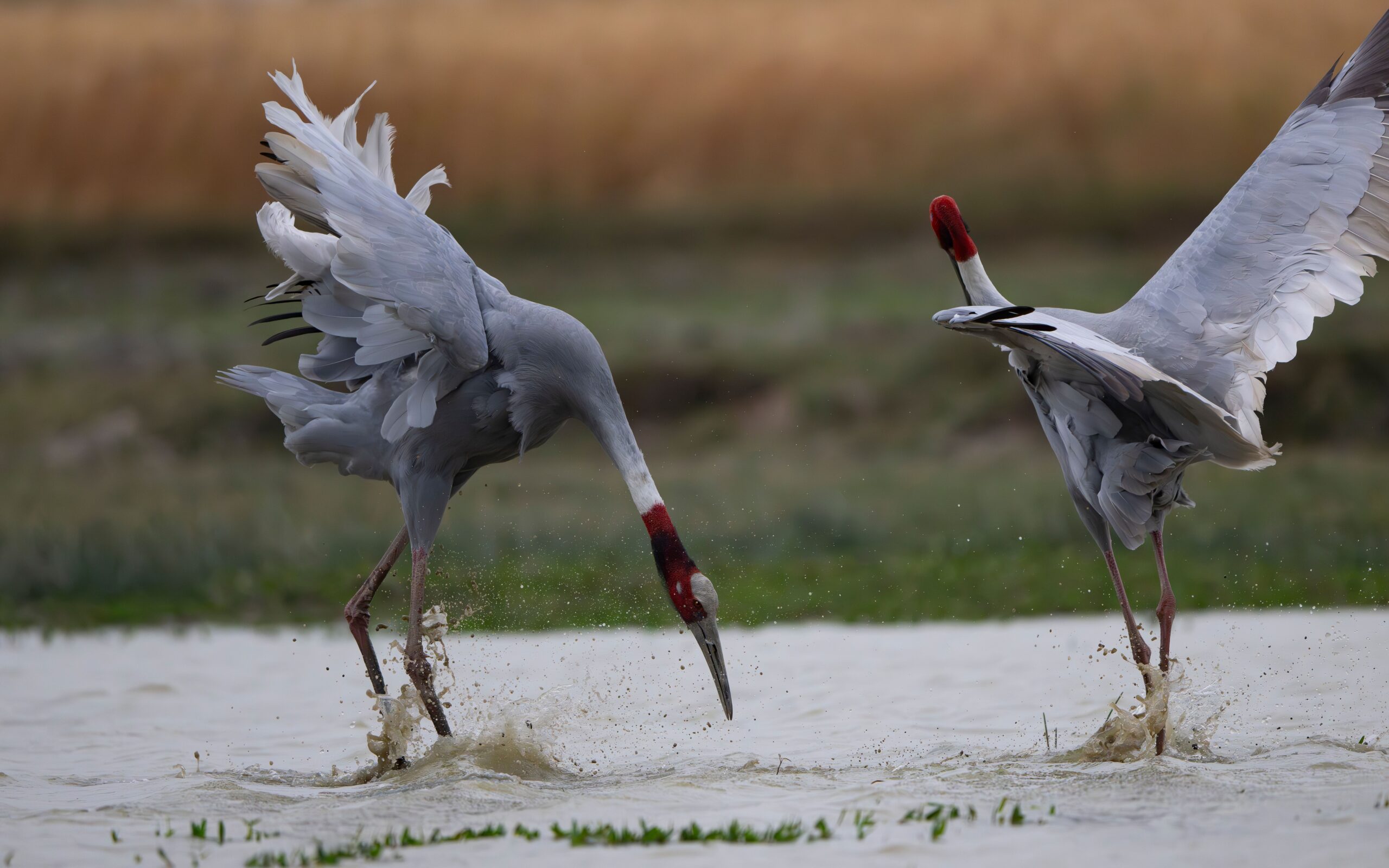
What kind of bird (animal) is the sarus crane? We will explain its characteristics, ecology, and habitat. It is the largest species of the crane family and is a very large bird. This bird is widely distributed from India to Southeast Asia and even Australia, but it is also an endangered species.



- What is a sarus crane? About basic status
- What are the roots and origins of the Sarus Crane?
- About habitat
- feature is? What kind of creature is it?
- What does the ecology look like?
- About Molting
- About Their Calls
- Seasonal Activities
- Flight Speed
- About Sarus Crane Chicks
- Is the sarus crane an endangered species?
- Can sarus cranes be kept as pets?
- Zoos Housing the Species (Japan & Worldwide)
- Introducing other animals
What is a sarus crane? About basic status
The sarus crane is a bird classified in the family Crane, family Crane, and genus Crane. Its kanji name is Ōtsuru, and its scientific name is Grus antigone. The list of information is as follows.
| Japanese(和名) | オオヅル |
| English(英名) | Sarus crane |
| scientific name(学名) | Grus antigone |
| classification(分類) | Ave、 Gruiformes、Gruidae、Grus 鳥綱、ツル目、ツル科、ツル属 |
| IUCN Status(保全状況) | CRITICALLY ENDANGERED |
| Length(全長) | 140-156cm |
| Weight(体重) | 3-4kg |
What are the roots and origins of the Sarus Crane?
The Sarus Crane (scientific name: Antigone antigone; formerly Grus antigone) is one of the world’s largest crane species. It is a large wetland bird that evolved across a range extending from the Indian subcontinent and Southeast Asia to northern Australia.
Ancestry: “Ancient Large Cranes”
Broadly speaking, the evolutionary lineage is as follows:
Primitive birds
↓
Ancestors of the order Gruiformes
↓
Family Gruidae (cranes)
↓
Lineage of large cranes
↓
Sarus Crane (Antigone antigone)
Cranes are a very ancient group of birds; fossil records indicate that species closely related to modern cranes already existed during the Cenozoic Era (tens of millions of years ago).
Origins: The Region Spanning India to Southeast Asia
The ancestors of the Sarus Crane are believed to have evolved in warm wetland environments corresponding to the following present-day areas:
Northern India
The Ganges River basin
Southeast Asia
Northern Australia
Current distribution:
India
Nepal
Pakistan
The vicinity of Myanmar
Southeast Asia
Northern Australia
Why did they grow so large?
The reason the Sarus Crane grew to be one of the largest cranes in the world is its adaptation to wetland environments.
Long legs
In wetlands, it is necessary to:
Walk through deep water
Move among aquatic plants
Traverse muddy terrain
Therefore, the following traits were advantageous:
Long legs
A long neck
A large body
About classification
The following subspecies of Sarus crane exist:
- Grus antigone antigone (Linnaeus, 1758)
- Grus antigone sharpei (Blanford, 1895)
- Grus antigone gilliae (Schodde, 1988)
- Grus antigone luzonica (Hachisuka, 1941)
Taxonomy
- 界 (Kingdom): Animalia(動物界)
- 門 (Phylum): Chordata(脊索動物門)
- 綱 (Class): Aves(鳥綱)
- 目 (Order): Gruiformes(クイ目・ツル目)
- 科 (Family): Gruidae(ツル科)
- 属 (Genus): Antigone
- 種 (Species): Antigone antigone(オオヅル)
About habitat
Sarus cranes are distributed in India, the Philippines, Malaysia, and Australia.
- Natural Distribution (Place of Origin)
Indian Subcontinent
India, Pakistan, Bangladesh, Nepal
Southeast Asia
Cambodia, Vietnam, Thailand, Laos
Northern Australia
Wild individuals have been spotted in some areas
- Habitat
Prefers wetlands, swamps, and shallow rice paddies
Can also be found in open grasslands and marshes
Waterside habitat is essential
Requires shallow water for breeding and feeding
Coexistence with agricultural land
In rice-growing regions, they often feed in rice paddies
- Altitude/Range
Mainly flatlands to low mountains (0-500 m above sea level)
Open wetlands and agricultural land are more suitable habitats than highland forests
- Migration/Migration
Most individuals are sedentary
May migrate locally in search of food and water during the rainy and dry seasons
Long-distance migration is rare
feature is? What kind of creature is it?
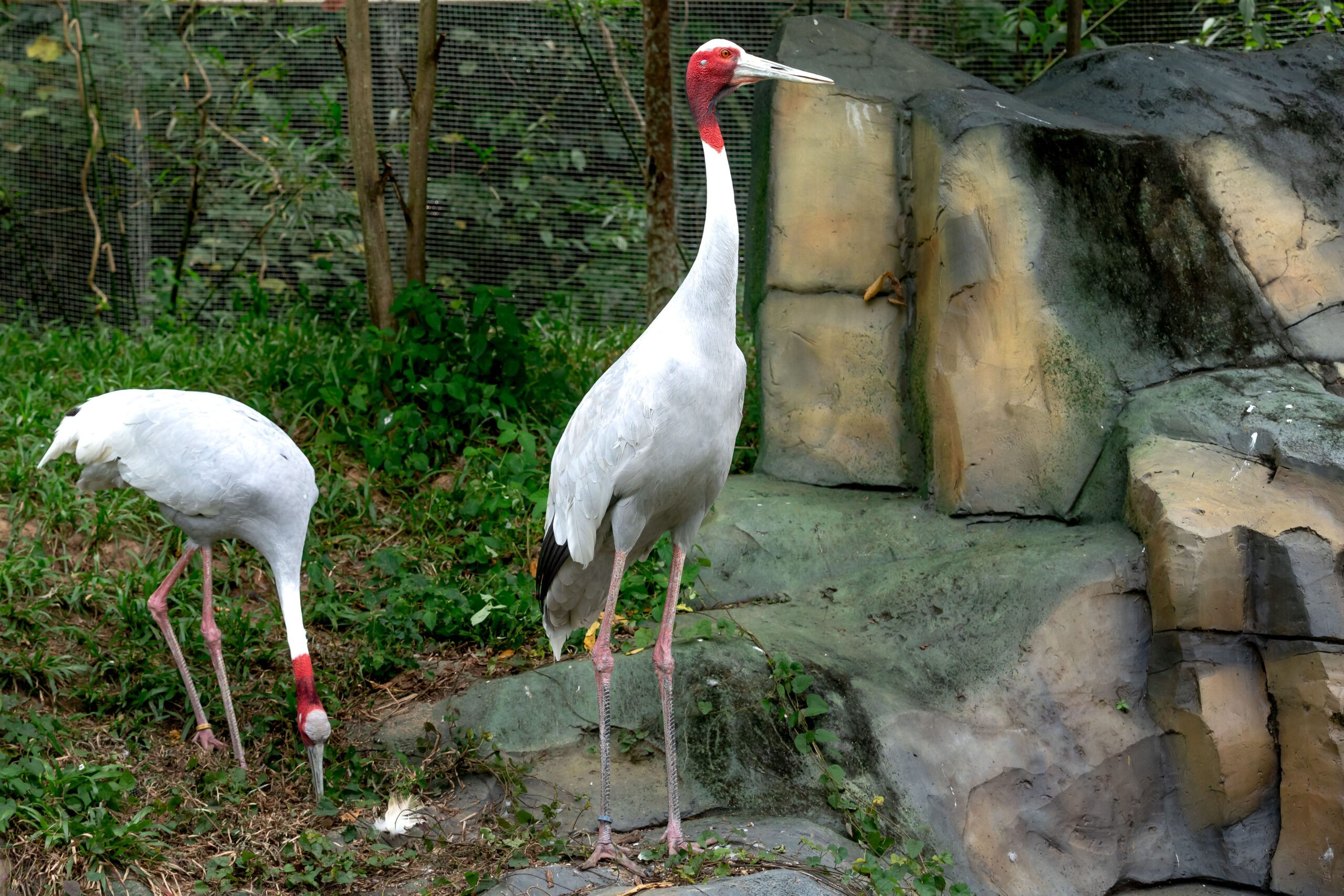
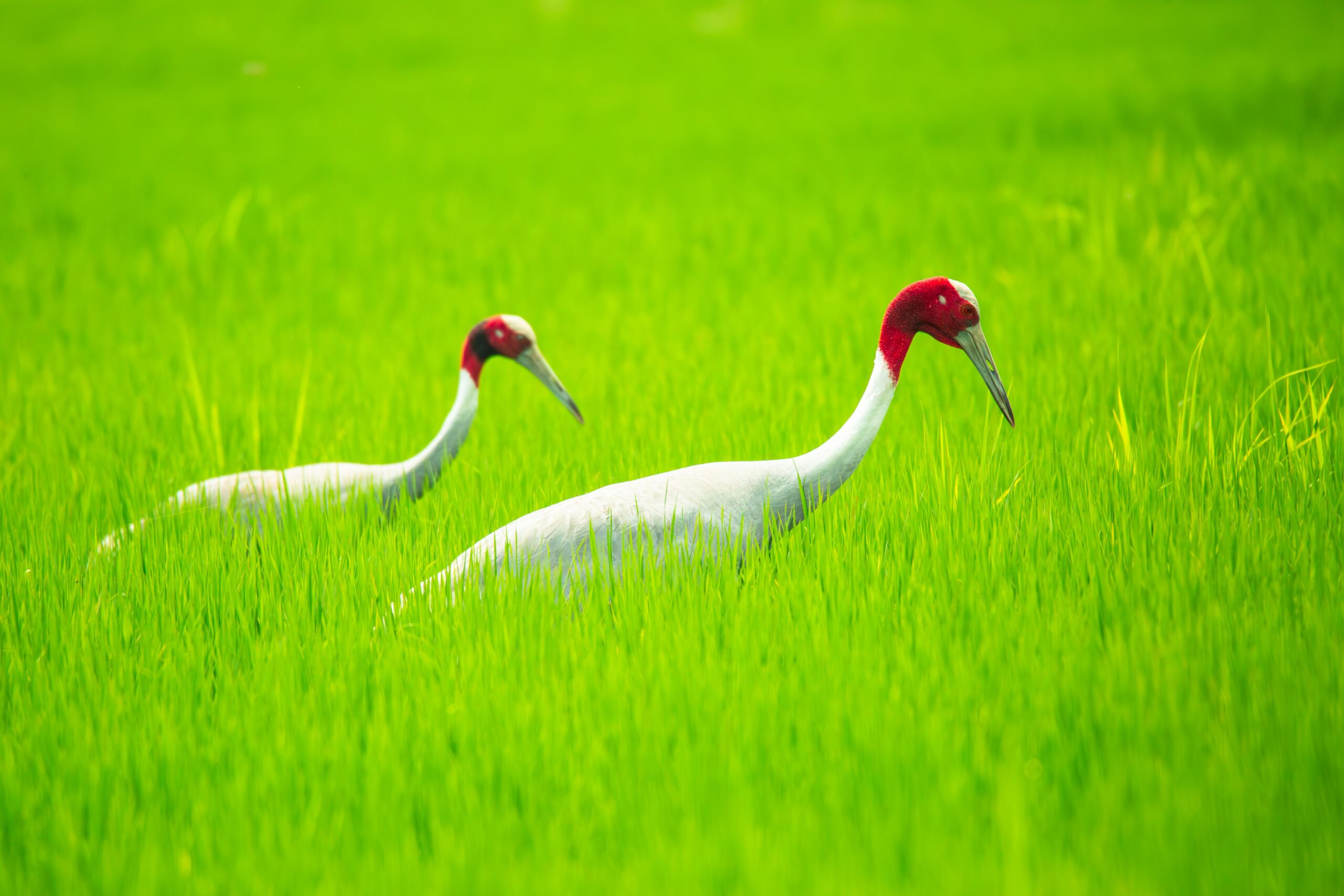
The sarus crane is the largest species of the crane family, and its entire body is covered with pale gray feathers. The top of the head and the tips of the eyes are grey-green, and the skin from the head to the top of the neck is exposed and red. It is a resident bird that settles from Southeast Asia to South Asia and Australia. The neck is covered with white feathers in the shape of a collar, and it lives in grasslands, wetlands, rivers, and farmland.
- Appearance and Physical Characteristics
Body Size
Body Length: Approximately 1.5 m
Wingspan: Approximately 2.2 m
Weight: Approximately 6-8 kg
Body Color
Overall color: Off-white to pale gray
The head and neck are red and featherless, exposing the skin
Tail feathers: Black
Legs and Beak
Long legs allow it to walk along waterside and grasslands
Its beak is somewhat long, suitable for pecking at food
Call
A distinctive “kurururu…” call that can be heard far and wide
Informs the presence of a flock or territory
Appearance: Large and imposing, it is a majestic bird that stands out in open areas near water.
- Behavior and Personality
Personality
Timid and cautious
When threatened, they make loud noises and fly away in flocks.
Social
They live in couples or small flocks rather than alone.
They can sometimes gather in flocks of several dozen birds at feeding grounds.
Flight
Powerful flight with large wings.
They rarely migrate long distances, but tend to move locally.
- Diet
Omnivorous, but primarily feeds on plants.
Aquatic plants, seeds, grains, young rice shoots, etc.
They occasionally consume animal matter.
They also eat small insects and mollusks.
What does the ecology look like?
Sarus cranes are omnivores with a strong tendency to eat animals. This bird lives in large wetlands, lakes, and wetlands, and nests in the wetlands during the rainy season when it breeds. In India, two eggs are laid between July and October. The male and female take turns incubating the eggs. The incubation period is 1 month. The lifespan of the sarus crane is not clearly known.
- Living Environment
Live mainly in wetlands, shallow rice paddies, and marshes.
Often forage in open grasslands and rice paddies.
Waterside habitats are essential, and they are used for nest building and foraging.
- Diet
Omnivorous, but primarily plant-based.
Aquatic plants, seeds, and grains (such as rice).
Also eat sprouts and young grasses.
Animal feeding is supplementary.
May also eat insects, mollusks, and small fish.
Mainly find food by pecking, prodding, and pulling.
- Sociality
Mostly solitary. Spend in pairs or small groups.
Pairs cooperate during the breeding season.
May form flocks (of up to several dozen birds) at feeding areas.
Voice to mark territory and their presence within the flock.
- Breeding Behavior
Nest Building: Builds small ground nests in wetlands or grasslands surrounding rice paddies.
Breeding Season: Varies by region, but primarily during the rainy season.
Number of Eggs: Usually 2.
Parent Roles: Both parents take turns incubating the eggs and caring for the chicks until they leave the nest.
- Movement and Behavior Patterns
Primarily sedentary
Moves locally depending on water and food availability
Rarely engages in long-distance migration
During the day, they forage, rest, and practice nesting.
Are there any natural enemies?
Sarus cranes have no natural enemies.
About Molting
The Sarus Crane (Antigone antigone) is a very large species of crane that undergoes molting—the process of replacing feathers—in accordance with its developmental stage and the seasons.
Because cranes need to maintain their ability to fly, they do not lose all their feathers at once; instead, they replace them gradually over time.
Timing of Molting
Sarus Crane molting primarily occurs:
After the breeding season and the rainy season (summer to autumn).
While the timing varies by region:
Northern India: Around June–October
Southeast Asia: After the rainy season
Northern Australia: After the breeding season
…is when feather replacement becomes most active.
Sequence:
Spring–Summer
↓
Breeding and rearing chicks
↓
Summer–Autumn
↓
Molting
↓
Entering the dry season/winter with new feathers
Molting in Adult Birds
① Molting of Body Feathers
The first feathers to be replaced are those on the body, such as:
Around the neck
Chest
Back
Abdomen
As old feathers are shed and replaced by new ones:
Heat retention
Waterproofing
Feather alignment
…are restored.
② Molting of Wing Feathers
The flight feathers are particularly important.
Feathers replaced include:
Primary flight feathers (wing tips)
Secondary flight feathers (inner wing)
Because these are directly linked to flight, they are replaced sequentially.
As Sarus Cranes are large and heavy, the condition of their wings is crucial.
Molting in Juvenile Birds
Juvenile Sarus Cranes look very different from adults.
Immediately after hatching
Characteristics:
Brown to yellowish-brown plumage
No red coloration on the neck
Soft down covering the entire body
Growth process
Stage 1
Juvenile plumage:
Brownish tones
Strong camouflage coloration
↓
Immature plumage
Gradually turns gray
Red coloration develops on the neck
↓
Adult plumage
White to gray body
Red bare skin on the head
Black neck
…develops into this form.
About Their Calls
The Sarus Crane (Antigone antigone) is a particularly large species of crane known for having a call that carries over great distances.
Their calls echo across wetlands and grasslands, sometimes audible from hundreds of meters away.
Typical Calls
Sarus Crane calls are generally described as:
“Kurururu”
“Gaa, gaa”
“Koo, koo”
…low, deep, and resonant sounds.
They are characterized by:
A penetrating, metallic quality typical of cranes
Deep, resonant bass tones
Continuous, loud cries
How Do They Produce Such Loud Calls?
Sarus Cranes possess an exceptionally long trachea (windpipe).
Cranes are able to produce voices that are louder than their body size would suggest because:
Their trachea is coiled within the chest
They possess structures that resonate sound
This mechanism is similar to that of musical instruments like:
Trumpets or French horns, which feature long tubing
Purpose of the Calls
① Communication Between Mates
The most well-known example is:
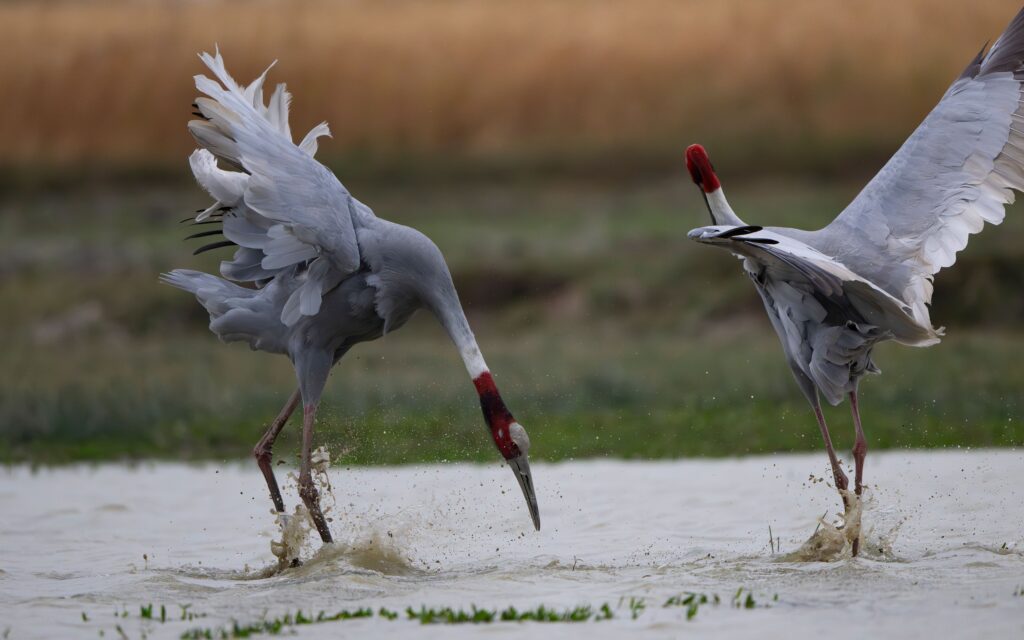
The duet (pair-calling)
The male and female face each other and:
Extend their necks
Spread their wings
Call back and forth
Purposes include:
Reaffirming the pair bond
Declaring territory
Coordinating with their breeding partner
② Territorial Defense
Sarus Cranes are highly territorial during the breeding season.
They use their calls to signal to other cranes:
“This is our territory”
③ Communication with the Flock
Within a flock, calls are used for:
Signaling the start of movement
Warning of danger
Locating other members of the group
Seasonal Activities
The Sarus Crane (Antigone antigone) is a large, non-migratory crane adapted to wetlands, rice paddies, and grasslands across the Indian subcontinent, Southeast Asia, and northern Australia.
🌱 Spring (March–May)
Breeding Preparation and Territory Establishment
Spring is a time of heightened breeding activity for the Sarus Crane.
Key activities include:
Strengthening pair bonds
Courtship dancing
Securing territory
Preparing for nest-building
Courtship Behavior
Sarus Cranes are monogamous and maintain long-term pair bonds with the same partner.
Pairs engage in behaviors such as:
Facing each other
Stretching their necks
Spreading their wings
Calling loudly to one another (duetting)
These actions serve to:
Confirm the pair bond
Signal readiness for breeding
Assert territorial claims against other individuals
☀ Summer (June–August)
Peak Breeding and Rearing Season
In many regions, this period coincides with the rainy season.
Key activities include:
Nest-building
Egg-laying
Incubation
Rearing chicks
Nest Characteristics
Sarus Cranes build large nests in wetlands by piling up:
Aquatic plants
Dried vegetation
Mud
Nests are sometimes constructed directly over the water.
Chick Development
After hatching, chicks grow by:
Following their parents
Foraging for food near the water
Learning to recognize danger
Parent birds become highly vigilant to protect their chicks from predators.
🍂 Autumn (September–November)
End of Rearing and Movement to Foraging Grounds
Once breeding concludes, the birds expand their range of activity.
Key activities include:
Chicks practicing flight
Exploring foraging grounds
Forming flocks
Replenishing nutritional reserves
Dietary Changes
As food becomes abundant in autumn, they consume a wide variety of items, including:
Insects
Frogs
Fish
Small reptiles
Grains
Plant seeds
They may also forage in harvested rice paddies.
❄ Winter (December–February)
A lifestyle centered on overwintering and foraging
While the Sarus Crane is generally a resident bird, some individuals in colder regions do migrate seasonally.
Key activities
Foraging
Pair bonding
Resting in flocks
Utilizing wetlands
Winter daily routine
Morning:
Move from the roosting site to foraging grounds
Daytime:
Forage in rice paddies and wetlands
Evening:
Return to a safe waterside area
This forms their daily rhythm.
Flight Speed
The Sarus Crane (Antigone antigone) is one of the largest crane species in the world; it possesses large wings and excellent gliding capabilities to support its massive body.
Normal Flight Speed
Approximately 40–60 km/h
The Sarus Crane’s standard cruising speed is estimated to be
around 40–60 km/h.
Characteristics:
Slow, powerful wingbeats
Posture with neck and legs extended
Straight-line flight path
They maintain stable flight despite their massive size.
Speed During Long-Distance Travel
Approximately 50–70 km/h
When traveling between feeding grounds or different regions,
speeds can reach around 50–70 km/h.
Sarus Cranes travel between:
Wetlands
Rice paddies
Grasslands
Rivers
They utilize their wide field of vision and often glide by riding thermal updrafts.
Gliding Speed Utilizing Wind
Large cranes utilize air currents in addition to flapping their wings.
With a tailwind or updrafts,
speeds can exceed 70 km/h.
They fly particularly efficiently during:
Migration
Long-distance travel
High-altitude flight
About Sarus Crane Chicks
This article provides detailed information about Sarus Crane (Antigone antigone) chicks. Sarus Cranes are large cranes, and their development depends heavily on the cooperation of their parents and the wetland environment.
- Birth and Hatching
Number of Eggs: Usually 2
Incubation Period: Approximately 28-30 days
Characteristics Immediately After Hatching
Feathers are pale gray or pale brown
Beaks are small and soft
Flightless
- Life at the Nest
Nest Location: Small ground nests built in marshes or grasslands
Parental Care
Both parents take turns incubating the eggs and feed them after hatching
While the chicks are small, the parents guard them and keep a watchful eye on their surroundings
- Development
Early Stage (After Hatching – A Few Weeks)
Feathers are soft and flightless
They accompany their parents near water or grasslands and receive food
Middle Stage (A Few Weeks – 2 Months)
Feathers grow in and their bodies become stronger
They begin to practice pecking for food, imitating their parents
Late Stage (2-3 Months)
Feathers are fully grown and they are capable of short-distance flight
They gradually become independent from their parents
- Flight and Fledging
Learns to fly: Approximately 2-3 months after hatching
Fledging
Initially flies close to their parents
Once safety is ensured, they become fully independent
- Characteristics and Biology
Feathers are lighter than adult birds, ranging in color from gray to light brown
Learns how to forage under the guidance of their parents
Survival rates of eggs and chicks vary depending on the environment
Is the sarus crane an endangered species?
Sarus cranes are listed in Appendix II of CITES, and international trade is restricted. It is also designated as an endangered species. A 2009 survey estimated the population at 15,000 to 20,000 birds. Habitat destruction, hunting and gathering are major threats to this bird, and it is a bird that requires urgent conservation efforts. The Philippine population became extinct in the late 1960s.
- IUCN Red List Assessment
Classification: Vulnerable (VU: Endangered)
Reason: Population decline due to habitat destruction and the loss of agricultural land and wetlands
- Causes of Endangerment
Reduction of wetlands and rice paddies
Habitat shrinkage due to development and reclamation
Nesting and feeding habitat loss due to changes in water level management
Pesticides and pollution
Pesticides reduce the insect and aquatic plant populations that serve as food
Water pollution affects chick survival
Human capture and hunting
Captivity for food and ornamental purposes has been reported in some areas
Low reproductive rate
Only two eggs are usually laid, and chick survival rates vary depending on the environment
- Conservation Status
Protected areas and wetland conservation efforts are underway in India, Nepal, Bangladesh, and other countries.
In addition to wild conservation, captive breeding programs are also conducted in zoos.
Can sarus cranes be kept as pets?
As mentioned above, sarus cranes are designated as an endangered species, so keeping them in captivity is extremely difficult.
- Difficulty in Raising
Large Body Size
Adult birds reach a body length of approximately 1.5 m and a wingspan of approximately 2.2 m.
They cannot fit into a home cage or garden.
Wide Range
Prefers open areas such as wetlands and rice paddies.
They roam for long periods of time, so require ample space.
Loud Call
Their “Kurururu…” call can be heard far away.
Can be noisy in residential areas.
- Personality and Behavior
Timid and cautious.
They will fly away if they sense danger.
They are gregarious.
Keeping them alone is likely to cause stress.
- Laws and Permits
The Sarus Crane is a critically endangered species (VU) and is subject to the Wildlife Protection Act.
Special permits are required to keep them in Japan.
Keeping or selling them without a permit is illegal.
- Breeding Examples
Breeding in zoos and conservation facilities is practical.
Requirements:
Large outdoor space or a wetland-like environment
Diet: Maintain grains, aquatic plants, vegetables, insects, etc.
Breeding season management and chick protection
Veterinary health care
Zoos Housing the Species (Japan & Worldwide)
The Sarus Crane (scientific name: Antigone antigone; formerly Grus antigone) is one of the largest species in the crane family (Gruidae). In the wild, it is distributed across India, Southeast Asia, and northern Australia. While it is a large crane species relatively well-maintained in captivity, there are few facilities exhibiting them in Japan.
🇯🇵 Zoos in Japan
Tennoji Zoo
Species Housed
Sarus Crane
Scientific name: Antigone antigone (formerly Grus antigone)
Tennoji Zoo houses and exhibits Sarus Cranes. Visitors can observe them in the crane enclosure and appreciate the impressive physique, long legs, and red heads characteristic of large cranes.
Features:
A prominent facility in Japan for observing large crane species.
Opportunities to witness behaviors unique to cranes, such as vocalizations and courtship dances.
Educational information is provided regarding their ecology as wetland birds.
Kyoto City Zoo
Species Housed
Sarus Crane (subspecies A. a. antigone)
Scientific name: Antigone antigone antigone (formerly Grus antigone antigone)
Kyoto City Zoo houses the Sarus Crane. They are introduced as a large crane species distributed across north-central India, Nepal, Pakistan, Bangladesh, and northern Australia.
🌏 Zoos Worldwide
There are more instances of Sarus Cranes being kept in captivity overseas compared to Japan, particularly in facilities specializing in large birds or conservation.
🇺🇸 USA
Cougar Mountain Zoo
Houses Sarus Cranes.
The exhibit showcases behaviors unique to cranes, such as:
Pair displays
Vocalizations
Dancing behaviors
🇺🇸 Disney’s Animal Kingdom
Has a record of exhibiting Sarus Cranes.
They can be observed as part of the bird exhibits within this large-scale facility that recreates a natural environment.
🇩🇪 Europe
Several zoos in Europe have also kept this species.
Examples:
Frankfurt Zoo
Krefeld Zoo
Erfurt Zoopark
…all have records of housing the species.
Introducing other animals
コメント