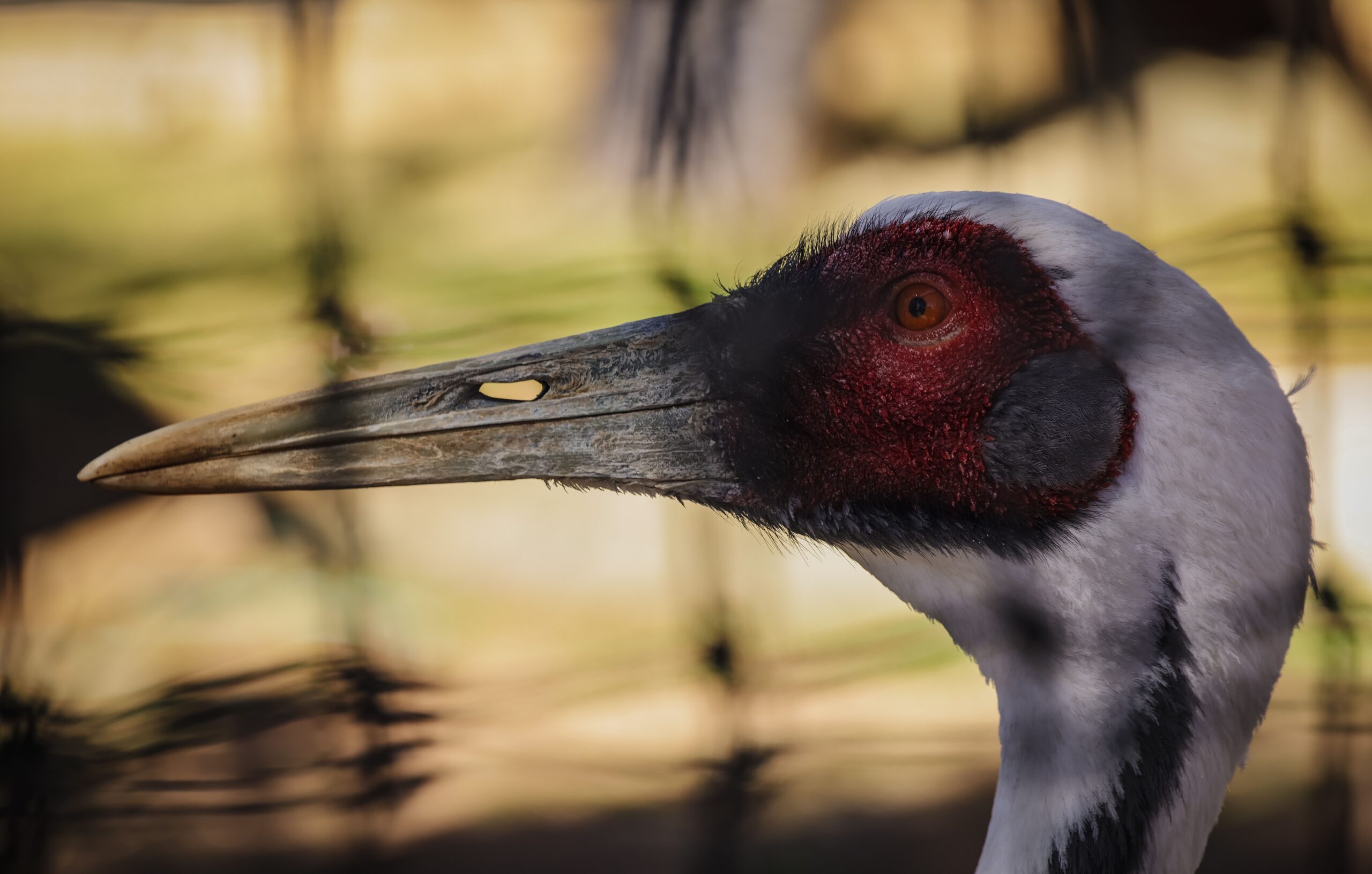
What kind of bird is a red-crowned crane? We will explain its characteristics, ecology, and habitat. Red-crowned cranes are birds that can be seen not only in Japan but also in the Korean Peninsula and China. The total number of birds in the world is said to be 3,050, but did you know that most of them are in Hokkaido?









- What is a red-crowned crane? About basic status
- What are the roots and origins of the Red-crowned Crane?
- About habitat
- feature is? What kind of creature is it?
- What is your personality like?
- What does the ecology look like?
- About Molting
- About Their Calls
- Seasonal Activities
- Flight Speed
- About Red-crowned Crane Chicks
- Is the red-crowned crane an endangered species?
- Can cranes be kept as pets?
- Zoos and Facilities Housing Red-crowned Cranes (Japan & Worldwide)
- Introducing other animals
What is a red-crowned crane? About basic status
The red-crowned crane is a bird classified in the genus Crane, family Crane, order Craniformes. The kanji word for it is Tancho, and the scientific name is Grus japonensis. Total length 102 – 147cm. Wingspan 64 – 67cm. Wingspan length 240cm. Weight 4 – 10.5kg. The list of information is as follows.
| Japanese(和名) | タンチョウ |
| English(英名) | Japanese crane Manchurian crane Red-crowned crane |
| scientific name(学名) | Grus japonensis |
| classification(分類) | Ave、 Gruiformes、Gruidae、Grus 鳥綱、ツル目、ツル科、ツル属 |
| IUCN Status(保全状況) | VULNERABLE |
| Length(全長) | 102 – 147cm |
| Weight(体重) | 4 – 10.5kg |
What are the roots and origins of the Red-crowned Crane?
The Red-crowned Crane (Grus japonensis) originated in the wetlands of East Asia. It is believed to have diverged from a common ancestor of the crane family (Gruidae) millions of years ago and evolved to adapt to wetland environments in regions such as Northeast China, the Russian Far East, the Korean Peninsula, and Hokkaido.
Origins
It is one of the largest species within the crane family (Gruidae).
Fossil and genetic studies suggest it is a lineage that evolved independently in East Asia.
Although its scientific name, japonensis, means “of Japan,” it is not a bird found exclusively in Japan.
Original Distribution
Its current natural distribution covers the following regions:
Japan (Hokkaido)
Russian Far East (Amur River basin and Primorsky Krai)
Northeast China (Heilongjiang and Jilin provinces, etc.)
Korean Peninsula (rarely visited)
There are two major populations of Red-crowned Cranes:
Hokkaido population: Resident birds that inhabit Hokkaido year-round.
Continental population: Migratory birds that breed in Russia and China and migrate to coastal areas of China and the Korean Peninsula.
Relationship with Japan
Before the Edo period, they were widely distributed across Honshu, but their numbers plummeted due to development and hunting. Today, most wild individuals in Japan inhabit eastern Hokkaido (such as the area around the Kushiro Wetland). Thanks to winter feeding programs and conservation efforts, the population has recovered and now stands at approximately 2,000 wild birds.
Origin of the Name
The name “Tancho” (Red-crowned) comes from the red skin on the top of its head (tan means red). This is not actually red plumage; rather, it is exposed, featherless skin that turns a more vivid red when the bird is excited.
Taxonomy of the Red-crowned Crane
- 界(Kingdom): 動物界 (Animalia)
- 門(Phylum): 脊索動物門 (Chordata)
- 綱(Class): 鳥綱 (Aves)
- 目(Order): ツル目 (Gruiformes)
- 科(Family): ツル科 (Gruidae)
- 属(Genus): タンチョウ属 (Grus)
- 種(Species): タンチョウ (Grus japonensis)
About habitat
Red-crowned cranes are distributed around Japan, the Korean Peninsula, and China. Depending on the region, they can be found and seen overwintering during the winter. The pair then returns in the spring.
- Geographic Distribution
Japan: Kushiro Wetlands and Nemuro Wetlands in eastern Hokkaido
Russia: Sakhalin, Primorsky Krai, and the lower Amur River Basin
China: Northeast China (Heilongjiang Province, Jilin Province)
Northern Korea: Wintering individuals have been recorded
The Hokkaido population is sedentary and does not migrate, while the Honshu and continental populations are migratory, traveling south in winter
- Habitat
Grasslands and marshes along wetlands and rivers
Feeds in shallow areas of rivers and lakes
Rests in grasslands and marshes
Around agricultural land
Feeds in unfrozen rice fields in winter (especially on fallen rice grains and vegetable residues)
Avoids forests and hilly areas
Habitats in open marshes and along rivers
- Habitat
Water is essential: Feeding is primarily required near shallow water.
Safe resting places: Wetlands, reed beds, and other environments where they can hide from predators.
Wintering grounds: Unfrozen wetlands and rice paddies in eastern Hokkaido and southern Chugoku.
feature is? What kind of creature is it?
The only wild crane that breeds in Japan. Red-crowned cranes have almost no feathers on the top of their heads, with exposed red skin and black feathers. In Japan, it is distributed mainly in the wetlands of eastern Hokkaido. Most individuals are gathered in Lake Kucharo, Sarobetsu Wetland, and the Tokachi River basin. In the summer, they disperse in wetlands to nest and raise their young, and in the winter, they migrate to areas near their villages and live in groups.
- Physical Characteristics
Physique
Large Waterfowl
Body Length: Approximately 150-158 cm
Wingspan: Approximately 220-250 cm
Weight: Approximately 8-10 kg
Posture: Beautiful, graceful upright posture
Feathers and Color
Mainly white body
Red skin is exposed on the crown (head) → Origin of the name
Black wingtips create a beautiful contrast in flight
There is little significant color difference between males and females
Beak and Feet
Beak: Long and strong, adapted for catching fish and aquatic creatures
Feet: Long and gray-black, suitable for walking and feeding near water
- Behavior and Personality
Personality: Gentle and gentle
Fly away when they sense danger
Highly wary of predators and humans
Social
Monogamous, living in pairs
Except for breeding season, they live in family groups or small flocks
Calls
A low, resonant “grrr…” call used for pair communication
- Ecological Characteristics
Diet: Omnivorous
Plants: Aquatic plants, grains, and vegetable scraps
Animal Life: Fish, frogs, insects, and small invertebrates
Reproduction
Nests are built in wetlands or reed beds
Lay one to two eggs at a time
Males and females work together to incubate and raise the eggs
What is your personality like?
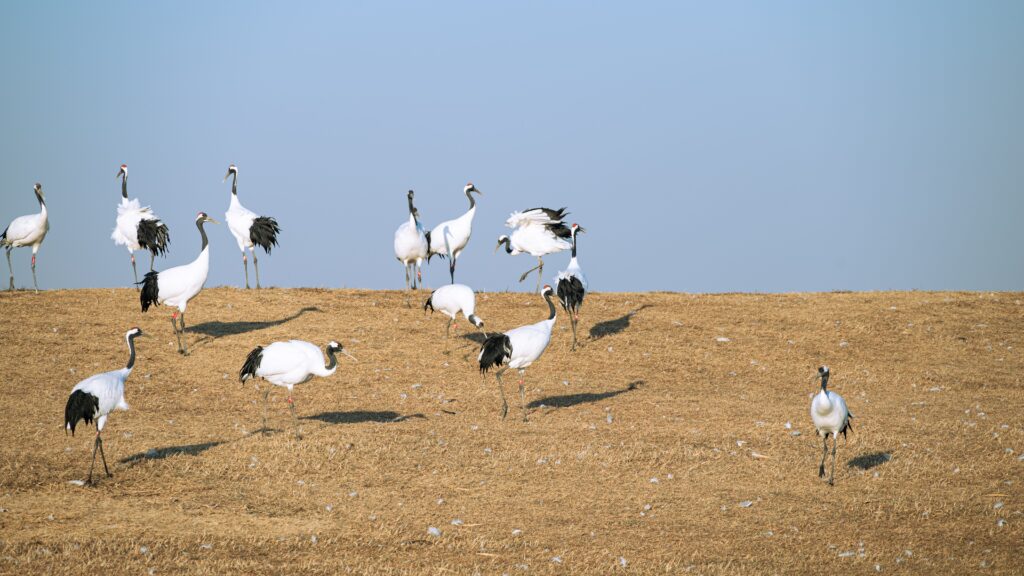
Red-crowned cranes are generally far from peaceful, and fights often occur between members. They fight surprisingly often considering they live in groups.
Personality traits of the Japanese crane
Gentle and docile
Generally low in aggression
Coexist peacefully with other waterfowl and their own species
Timid and cautious
Sensitive to predators and humans
Fly away immediately if they sense danger
Especially alert during breeding season, they protect their nests and chicks
Highly sociable, but pair-oriented
Monogamous and primarily pair-bonded
Live in family groups or small flocks outside of breeding season
Do not form large flocks
Loyal and cooperative
Pair behavior and communication through vocalizations are important
Males and females cooperate in raising their chicks
Calm and graceful
Upright and graceful when walking and flying
Live leisurely near water and in wetlands
What does the ecology look like?
Red-crowned cranes are omnivores, subsisting on insects, crustaceans, and snails. The mode of reproduction is oviparous. They lay two eggs around spring, and the incubation period is one month, with the male and female taking turns incubating them. The lifespan is said to be about 25 years.
- Lifestyle
Large waterbird living in wetlands and along rivers
Feeds in shallow rivers and ponds
Rests in grasslands and reed beds
Activity: Diurnal, foraging, resting, and breeding during the day
Moves in pairs or family groups
Moves in pairs during the breeding season, and in family groups or small flocks outside of the breeding season
- Diet
Omnivorous
Vegetation: Aquatic plants, grains, and vegetable scraps
Flesh: Fish, frogs, insects, and small invertebrates
Feeding Method
Uses its beak to feed on fish and plants in shallow water
In winter, feeds on fallen rice grains and vegetable scraps in unfrozen rice fields
- Breeding and Rearing
Nest Building
Nests are built on the ground in marshes or reed beds.
Egg Laying: 1-2
Incubation and Rearing
Males and females take turns incubating the eggs.
Chicks follow their mothers immediately after hatching and learn to forage in shallow water.
Development
Chicks master foraging and water behavior within a few weeks.
Able to perform the same behaviors as their parents within a few months.
- Migration
Migratory: Continental populations
Wintering in northeastern China, southern Korea, and Primorsky Krai, Russia
Sedentary: Hokkaido populations
Wintering mainly in the Kushiro Wetlands
Are there any natural enemies?
Natural enemies of cranes include foxes, mustelids, and wild dogs.
About Molting
Molting—the process of replacing old feathers with new ones—is a vital physiological phenomenon for the Red-crowned Crane (Tanchō). It is essential for maintaining flight capabilities and surviving Hokkaido’s harsh winters.
Characteristics of Molting in Red-crowned Cranes
The bird’s entire plumage is gradually replaced about once a year.
Unlike swans, which molt all their flight feathers simultaneously, these cranes replace their feathers little by little.
Consequently, they generally remain capable of flight even while molting.
Molting Season
Spring to Summer (around May–August)
Full-scale molting begins after the breeding season ends.
Body feathers, wing feathers, and tail feathers are replaced in sequence.
By late summer, the plumage closely resembles the beautiful winter coat.
Autumn to Winter
New feathers are fully grown, providing excellent insulation.
This allows the birds to maintain their body temperature even during Hokkaido’s bitter cold.
Changes During Molting
Feathers may temporarily appear disheveled
Time spent preening (grooming) increases
Old feathers fall out
New feathers (pin feathers) grow in
Flight ability may temporarily decline
Molting in Young Cranes
Young Red-crowned Cranes have different coloration than adults.
Immediately after hatching: Fluffy brown down feathers
Growth: Capable of flight in about 3–4 months
Around 1 year: Transition from juvenile plumage to sub-adult plumage
Around 2–3 years: Appearance begins to resemble the adult black-and-white pattern
Age of sexual maturity: Approximately 3–4 years
About Their Calls
The call of the Red-crowned Crane is known for being loud and beautiful, carrying further than that of almost any other crane species. Powerful enough to travel several kilometers across the wetlands, these calls play a vital role in communication between mates and within the flock.
High-pitched, resounding calls (“Kwoh, kwoh”)
The most characteristic call
Used by mates or parents and chicks to locate one another
Often observed while the bird extends its neck
Short calls (“Kak-kak,” “Kururu”)
Signals to other cranes
Used during times of alertness or excitement
Used for communication within the flock
Calls of young birds
High-pitched “Pee-pee” or “Piyo-piyo” sounds
Used to call for parents
Frequently heard when begging for food
The Pair “Duet”
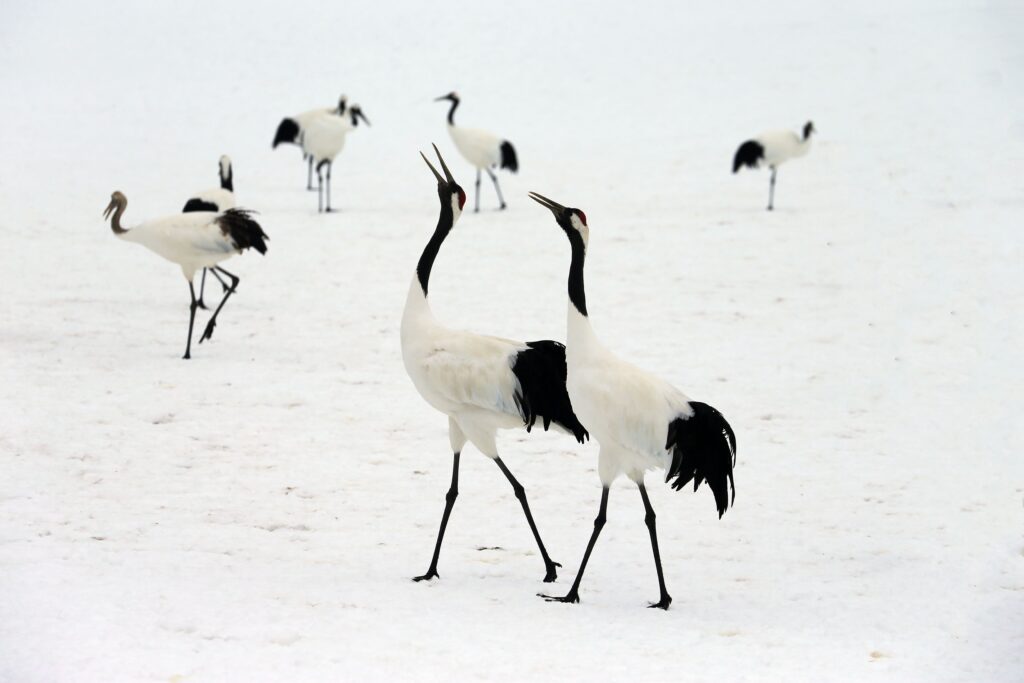
One of the Red-crowned Crane’s most famous behaviors is the unison call performed by a mated pair.
Characteristics:
The male and female call in synchronization
The male produces a low, long call, while the female produces a high-pitched call
Often performed with necks extended and wings spread
This is not merely conversation; it serves to:
Strengthen the bond between the pair
Assert territorial claims
Signal their presence to other Red-crowned Cranes
Seasonal Activities
The Red-crowned Crane is a large crane inhabiting primarily eastern Hokkaido; its activities—such as breeding, rearing young, migrating, and flocking—vary significantly by season. The Hokkaido population generally does not migrate, remaining in the same region throughout the year.
Spring (March–May)
Breeding and Courtship Season
Pair formation and territorial behavior intensify
The famous “Red-crowned Crane dance” is frequently observed
Males and females engage in “duets” (calling back and forth)
Nests are built within the wetlands
Egg-laying occurs around April–May (usually two eggs)
Key Activities
Courtship dancing
Territorial defense
Nest building
Incubation begins
Summer (June–August)
Rearing Young and Molting Season
Chicks hatch and are fed by their parents
Chicks grow while following their parents
They prey on insects, fish, frogs, and small animals near the water
Adults molt after the breeding season
Key Activities
Chick protection
Foraging
Molting (feather replacement)
Flight training
*By late summer, the young birds are able to fly.
Autumn (September–November)
Growth and Preparation for Winter
Chicks mature into young birds
They often move in family units
They consume large amounts of food to prepare for winter
An increasing number of individuals spend time in flocks
Key Activities
Increased foraging
Flight practice
Flock formation
Movement to overwintering sites (local movement)
Winter (December–February)
Overwintering and Flocking Season
They gather at feeding grounds and around wetlands in eastern Hokkaido
Flocks can range from dozens to hundreds of birds
Courtship dancing can be seen even on snowy fields
They fluff their feathers to maintain body heat in the severe cold
Key Activities
Foraging
Resting in flocks
Calling back and forth
Maintaining pair bonds
Flight Speed
Although the Red-crowned Crane is a large bird, it possesses wings that are large relative to its body size, granting it excellent flight capabilities.
Flight Speed
Normal flight speed: Approx. 40–60 km/h
With a tailwind: Approx. 70 km/h
Maximum flight speed: Can reach approximately 80 km/h
*Flight speed varies depending on wind direction, age, and the purpose of the flight.
Flight Characteristics
Flies with its long neck and legs extended straight out
Flaps its large wings slowly yet powerfully
Conserves energy by gliding after gaining altitude
May form a V-shaped formation when flying in a flock
Wing Dimensions
Wingspan: Approx. 220–250 cm
Body length: Approx. 120–140 cm
Weight: Approx. 7–10 kg
Its large wings allow it to fly efficiently with minimal flapping.
About Red-crowned Crane Chicks
This section provides detailed information about Red-crowned Crane chicks.
- Birth
Hatching Period: Spring to Early Summer (April to June)
Eggs Laid: 1-2
Hatching Days: Approximately 28-30 Days
Characteristics at Hatch:
Feathers are soft and fluffy, a pale gray to brown color.
Eyes are open, allowing them to recognize their surroundings.
Feet and beaks are strong, ready for walking and feeding.
- Fleeting and Aquatic Life
Fleeting:
Chicks begin walking immediately after birth and can navigate to shallow water on their own.
They are guided from the nest to safety by their mother (female) and father (male).
Aquatic Behavior:
Learns foraging while wading in shallow water.
Initially, they eat insects, small aquatic animals, and soft plants.
- Growth and Development
First few weeks:
Learn basic behaviors such as feeding, water activities, and preening.
Follow their parents and learn safe areas.
First few months:
Plumage becomes more like that of an adult, and their body size increases.
Become able to forage independently and adapt to flocks.
- Sociality and Personality
Obedience to parents: They follow their parents when in danger or when changing feeding areas.
Cooperativeness: They form flocks with their siblings and parents and move safely.
Alertness: Even shortly after birth, they are sensitive to predators and will hide near water or in reed beds.
Is the red-crowned crane an endangered species?
According to the Ministry of the Environment’s conservation status, the red-crowned crane is an endangered species. The current estimated population is around 3,000 birds, most of which live and work in Hokkaido, Japan. In Japan, hunting was prohibited by the Hokkaido Government in 1889, and it was designated as a no-hunting area in 1925. With the enactment of the Species Conservation Law in 1993, this species has been designated as a domestic rare wild animal and plant species and is now being fed. So you can see that it’s pretty well protected. It is also listed in Appendix I of the Washington Convention.
- International Conservation Status
IUCN Red List: EN (Endangered)
Reasons:
Decrease in wetland and river habitat
Habitat destruction due to agricultural land development and urbanization
Impact of past hunting and human activities
- Status in Japan
Population in eastern Hokkaido (Kushiro Wetland and Nemuro Wetland)
Population size: Approximately 1,800 birds (estimated as of the early 2020s)
Conservation Measures:
Habitat protection in nature reserves and national parks
Provision of feeding areas (supplementary feeding in rice fields in winter)
Reintroduction program
- Status on the Continent (Russia and China)
Distributed in Primorsky Krai, Sakhalin, Heilongjiang Province, Jilin Province, etc.
Migratory populations are also declining
Conservation Measures: Wetland conservation, crackdown on illegal hunting
Can cranes be kept as pets?
Red-crowned cranes are difficult to keep as pets. This is because, as mentioned above, it is an endangered species. Check out the site map on the zoo’s website or enter the zoo to enjoy it. It is designated as a special natural monument wild bird. Research is progressing in nature.
- Legal and Regulatory Issues
In Japan, they are listed as an endangered species in Appendix I of the Convention on International Trade in Endangered Species of Wild Fauna and Flora (CITES).
Domestically, the Wildlife Protection Act and the Wild Fauna and Flora Protection Act strictly restrict captivity and capture.
Keeping them outside of specially licensed facilities such as zoos and research facilities is illegal.
- Ecological and Behavioral Issues
Large in size and with excellent flying ability.
They can fly freely, so they require a large space.
Highly cautious and timid.
They are not easily accustomed to humans, and stress can cause health problems.
They are primarily pair-bonded.
They are prone to stress if kept alone.
- Diet and Environmental Management
They are omnivorous, but require a feeding environment similar to their natural habitat.
They require a diverse diet, including fish, frogs, aquatic insects, and plants.
It is difficult to perfectly recreate their natural habitat under human care.
They require wetlands, shallow water, and a large space.
They have difficulty surviving in homes or small ponds.
Zoos and Facilities Housing Red-crowned Cranes (Japan & Worldwide)
As an endangered species, the red-crowned crane is kept in zoos and conservation facilities around the world. In Japan, they are housed in numerous facilities—particularly in Hokkaido—dedicated to conservation and breeding research.
Key Facilities in Japan
Kushiro City Red-crowned Crane Natural Park
A conservation facility specializing in red-crowned cranes
Allows observation in an environment close to natural outdoor conditions
A vital facility for breeding research
Akan International Crane Center
A facility for the research and conservation of red-crowned cranes
Many cranes gather at the feeding grounds during winter
Conducts ecological exhibits and research activities
Asahiyama Zoo
Exhibits Hokkaido wildlife, including red-crowned cranes
A facility where visitors can learn about Hokkaido’s natural environment
Tama Zoological Park
A zoo with a track record of keeping crane species
Part of the domestic zoo network
Other Facilities
Maruyama Zoo
Obihiro Zoo
Akita City Omoriyama Zoo
Key Facilities Worldwide
San Diego Zoo
A premier North American zoo
Engaged in conservation efforts for rare East Asian bird species
Berlin Zoo
One of the oldest zoos in the world
Houses a diverse range of bird species
Moscow Zoo
Has a track record of keeping rare birds, including crane species
Beijing Zoo
Conserves and exhibits red-crowned cranes native to northeastern China
Introducing other animals

コメント