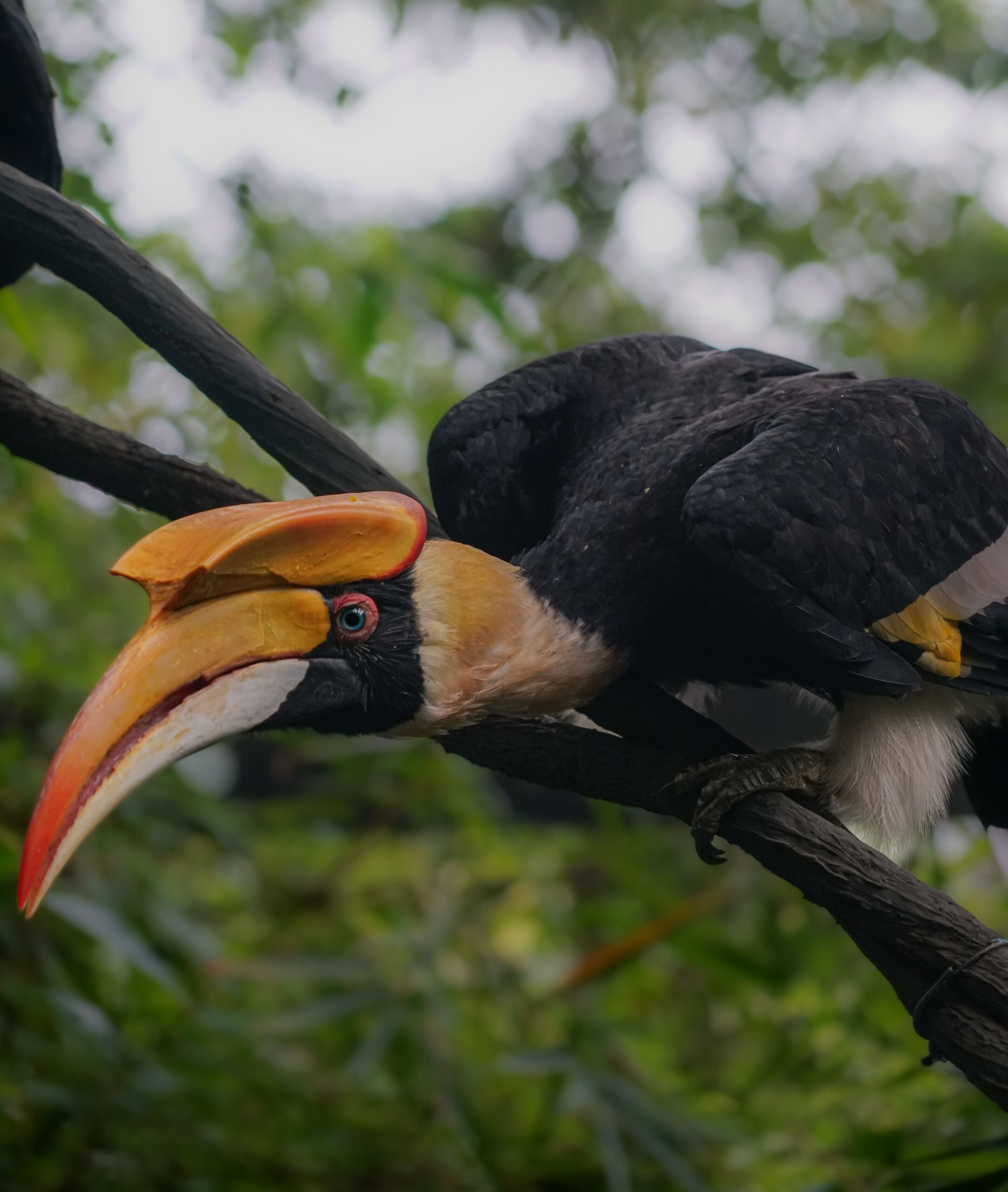
What kind of bird is the great hornbill? We will explain its characteristics, ecology, and habitat. The hornbill got its name because the large horn on its beak looks like a rhinoceros horn. Because of its unusual appearance, this bird can be easily identified.







- What is a great hornbill? About basic status
- What are the roots and origins of the Great Hornbill?
- About habitat
- feature is? What kind of creature is it?
- What is your personality like?
- What does the ecology look like?
- About Molting
- About Their Calls
- Seasonal Activities
- Flight Speed
- About Great Hornbill Chicks
- Is the great hornbill an endangered species?
- Can a great hornbill be kept as a pet?
- Zoos Housing Great Hornbills (Japan & Worldwide)
- Introducing other animals
What is a great hornbill? About basic status
The great hornbill is a bird classified in the genus Hornbill, in the order Carpenteridae and family Hornbillidae. The English name is Great Hornbill, and the scientific name is Buceros bicornis. The list of information is as follows. The body length is 90–125 cm and the weight is 3–4 kg.
| Japanese(和名) | オオサイチョウ |
| English(英名) | Great Hornbill |
| scientific name(学名) | Buceros bicornis |
| classification(分類) | Ave、 Coraciiformes、Bucerotidae、Buceros 鳥綱、ブッポウソウ目、サイチョウ科、サイチョウ属 |
| IUCN Status(保全状況) | VULNERABLE |
| Length(全長) | 90–125cm |
| Weight(体重) | 3-4kg |
What are the roots and origins of the Great Hornbill?
The roots (origins) of the Great Hornbill (Buceros bicornis) are ancient, tracing back to the evolutionary history of hornbills that began approximately 50 million years ago (during the Eocene epoch).
Ancestry: The emergence of the Bucerotidae family
The Great Hornbill belongs to the following evolutionary lineage:
Birds → Coraciiformes lineage → Hornbills → Genus Buceros → Great Hornbill
Hornbills as a whole are an ancient group of birds adapted to tropical regions; molecular phylogenetic studies suggest that the major lineages of frugivorous (fruit-eating) hornbills likely originated during the Eocene (around 48 million years ago).
Where did they originate?
While there is no definitive consensus on their origin, the leading theory is:
Leading theory: Origin in northern Eurasia (Laurasia)
Current research suggests that the ancestors of hornbills likely:
Originated in the ancient Eurasian continent (Laurasia)
↓
Migrated to Asia
↓
Diversified within tropical rainforests
However, a theory proposing an African origin has also long existed, sparking debate due to the fact that early hornbills were also distributed in Africa.
Where the Great Hornbill emerged
Today, the Great Hornbill inhabits tropical forests across South and Southeast Asia, including:
Northeastern India
Southern Himalayas
Myanmar
Thailand
The Malay Peninsula
Parts of Indonesia
A particularly important factor is the convergence and collision between the ancient Indian subcontinent and Southeast Asia (Sundaland).
Around 50 million years ago, as the Indian continent moved closer to Asia, the exchange of flora and fauna accelerated, and tropical rainforest environments developed. It is believed that hornbills evolved within this context as birds that “eat large fruits and disperse seeds.”
Why did that “horn” on their massive beak evolve? The most distinctive feature of the Great Hornbill is the casque atop its head.
This is not a horn, but rather a structure formed by the enlargement of the upper beak.
Possible evolutionary reasons for this feature include:
① Attracting a mate
An individual with a large, impressive casque may signal superior health.
② Male-male competition
They sometimes engage in “aerial battles,” ramming their heads against each other while in flight.
③ Acoustic effects
Its internal structure may serve to modify the resonance of their calls.
Taxonomy
- 界 (Kingdom): Animalia(動物界)
- 門 (Phylum): Chordata(脊索動物門)
- 綱 (Class): Aves(鳥綱)
- 目 (Order): Bucerotiformes(サイチョウ目)
- 科 (Family): Bucerotidae(サイチョウ科)
- 属 (Genus): Buceros(オオサイチョウ属)
- 種 (Species): Buceros bicornis(オオサイチョウ)
About habitat
Its habitat ranges from China to Southeast Asia.
- Natural Distribution (Origin)
Indian Subcontinent
Northern India, Nepal, Bhutan
Southeast Asia
Thailand, Malaysia, Singapore, Indonesia (Sumatra, Borneo)
Living in wooded tropical and subtropical rainforests
- Habitat
Prefers tropical rainforests and evergreen forests
Arboreal, living in trees with high canopies
Altitude
Flat to mountainous areas (up to approximately 1,500 m)
Population Density
More common in mature forests
- Range
Primarily sedentary
May move locally for food and breeding
As a large arboreal bird, it is rarely seen in open grasslands or urban areas
- Distinctive Habitat Conditions
Requires forests with large fruit trees and tree cavities
Uses cavities in large trees for breeding and nesting
May prefer to live near water sources
feature is? What kind of creature is it?
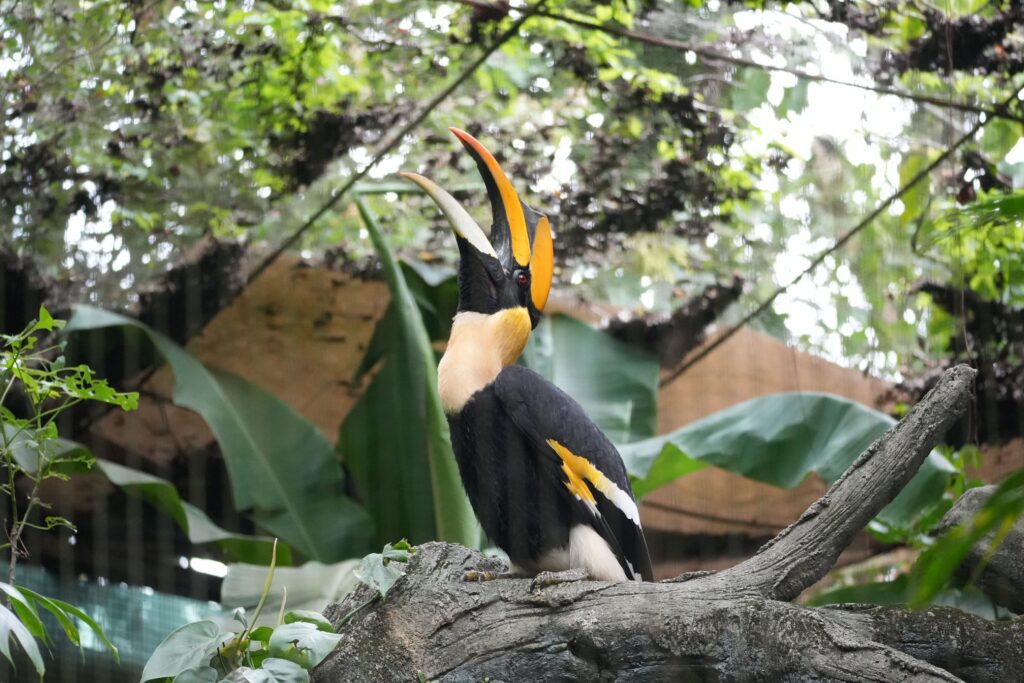
The great hornbill is a large hornbill that lives in the tropical rainforests of Southeast Asia. It is called the great hornbill because of the rhino horn-like thing on its beak that makes it look like a rhinoceros horn. Like other hornbills, this hornbill builds its nest in the hollow of a large tree, and when the female leaves the nest, the male coats the entrance to the nest with feces.
- Appearance and Physical Characteristics
Body Size
Body Length: 95-130 cm
Wingspan: Approximately 1.2-1.5 m
Weight: Approximately 2-4 kg
Beak
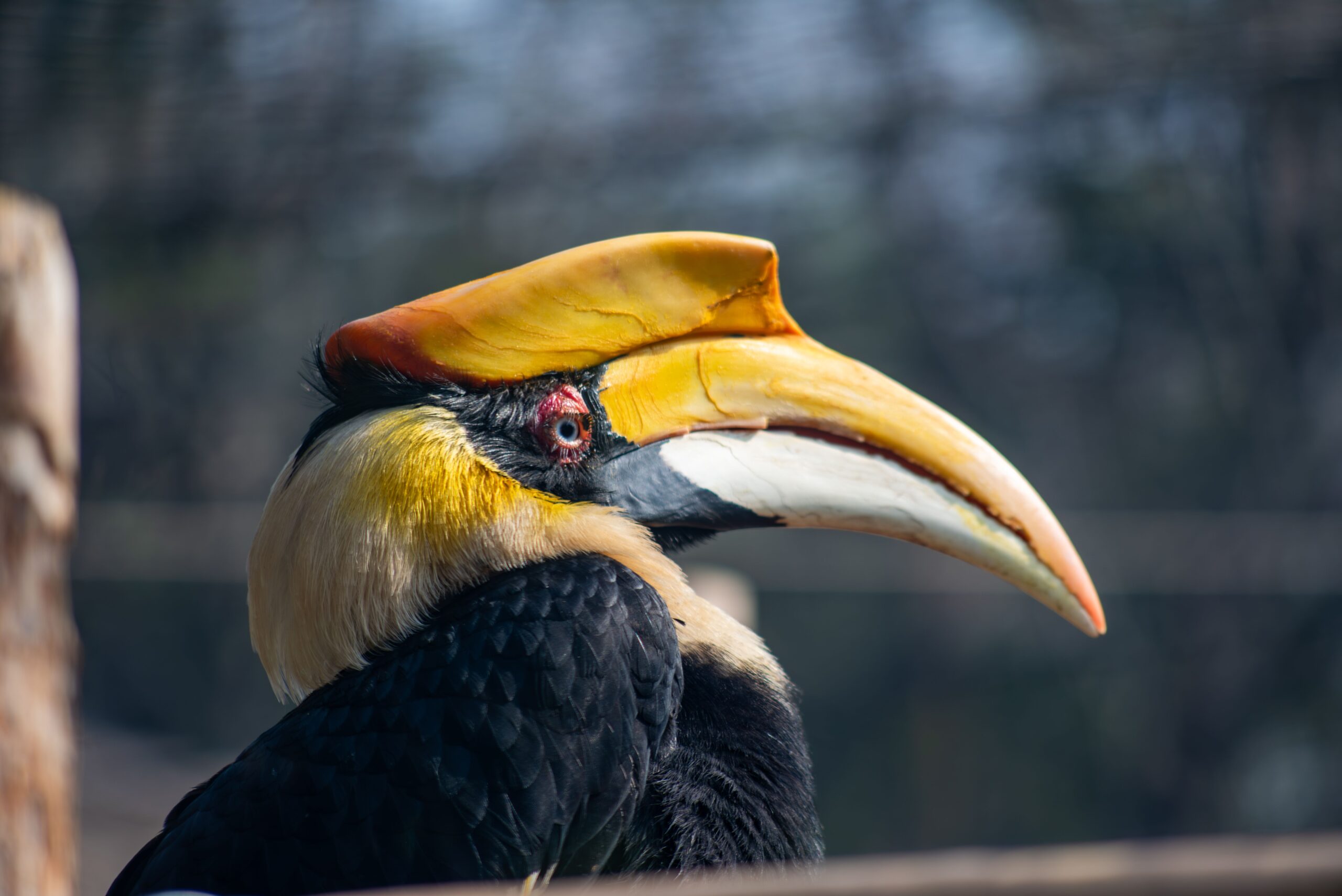
Large, yellow to orange
A horn-like bony structure called a “casque” is located above the upper beak.
Body Color
Back and Wings: Black
Belly and Tail: White
Head and Chest: Yellowish
Eyes and Face
Clear skin around the eyes gives the bird an expressive appearance.
Appearance: Majestic and flashy, its large beak stands out in the forest, making it a striking bird.
- Flight and Behavior
Flight Ability
Flight style suited to flying through forest canopies
Long-distance flight is possible, but they primarily live in trees
Do not swim
Not a waterfowl, but entirely arboreal
- Diet
Primarily frugivorous (mainly fruit)
Fruits such as bananas, mangoes, and papayas
Occasionally eats animals
May also eat small reptiles and insects
- Reproduction and Sociality
Nesting in tree holes
Females stay in the nest hole, while males bring food
Parent Role
Both parents care for their chicks
Calling
Loud, low-pitched “caw, caw” call
Can be heard far in the forest
- Personality and Characteristics
Generally timid but dignified
Highly adapted to life in the trees
Uses its large beak to crack open fruit and for intimidation
What is your personality like?
Great hornbills are said to be wary and timid, but there seems to be considerable individual variation. Some birds are wayward.
- Basic Personality
Timid and cautious
Easily wary of humans and predators
Very aggressive when defending their nests and chicks
Majestic
Due to their large size and presence, they behave as “dignified birds” in the forest.
- Sociality
Solo or small flocks
Often found in pairs
Sometimes flock in areas with abundant fruit
During the breeding season, cooperation between parents is evident
The male brings food while the female stays secluded in the nest
Both parents care for their chicks until they are fully grown
- Intimidation/Aggression
Uses its large beak and wings to intimidate others
When threatened, it makes a loud noise and either flies away or engages in threatening behavior
Very defensive of its nests and chicks
- Environmental Adaptation
Highly adapted to arboreal forest life
Moves cautiously in tall trees
Intelligent and strategic in securing food and nests
What does the ecology look like?
The great hornbill is omnivorous, but its favorite food is figs. It takes approximately 40 days for the eggs to hatch. The form of tying is oviparous. The lifespan is 30 to 40 years.
- Living Environment
Highly arboreal, living primarily in tall trees in mature tropical and subtropical rainforests.
Move, rest, and forage in the treetops.
Use tree hollows and hollows in large trees as nests.
- Diet
Mainly frugivorous (mainly fruit).
Bananas, mangoes, papayas, figs, etc.
Occasionally consumes animal matter.
Supplementary diet includes small reptiles and insects.
Uses long necks and large beaks to aid in fruit digestion.
- Breeding Behavior
Nest Construction: Nests are built in tree hollows.
Nest Behavior:
Females remain confined to the nest, with the male bringing food from outside.
Females remain in the nest until the chicks leave the nest.
Breeding Season: Varies by region, but primarily spring to summer.
Number of Eggs: Usually 1-2.
Parental Roles: Both parents protect and feed the chicks.
- Movement and Behavior Patterns
Primarily sedentary
May move locally to find food or nests
Spread their wings and fly gracefully between tree canopies
- Sociality
Single or paired
May form small flocks in areas with abundant fruit
Their calls carry far and wide, signaling their territory and presence
- Distinctive Ecology
Cavity-Dependent: Reproduction is highly dependent on hollows in large trees
Important as Fruit Dispersers: Contributes to forest regeneration by excreting seeds from eaten fruit
Few natural predators, allowing adult birds to live relatively safe in the forest
Are there any natural enemies?
Natural enemies include birds of prey. Your enemies will mainly be birds flying in the sky.
About Molting
Molting in the Great Hornbill is a vital physiological process linked to flight capability, reproduction, and physical maintenance. As large birds, they exhibit characteristics that differ somewhat from those of smaller birds like sparrows.
What is molting?
Molting is the process of replacing old, worn-out feathers with new ones.
Bird feathers are keratinous structures growing from the skin; once fully grown, they cannot be repaired. Therefore, feathers that have lost functionality due to—
wear and tear from flight
degradation caused by ultraviolet (UV) rays
friction between feathers
—are gradually replaced with new ones.
Molting period for Great Hornbills
Great Hornbills are generally believed to undergo molting—
after the breeding season concludes (during the rainy season or post-breeding period).
Like many tropical bird species, the sequence typically follows this pattern:
Breeding
↓
Completion of chick-rearing
↓
Physical recovery
↓
Molting
Do they lose all their feathers at once?
No.
Great Hornbills undergo a gradual (sequential) molt.
Losing all their wing feathers at once would render them unable to fly, so they replace—
flight feathers (large wing feathers)
tail feathers
body feathers
in a specific order.
Large birds, in particular, require a careful replacement system to ensure they maintain their ability to fly.
About Their Calls
True to its massive body and enormous beak, the Great Hornbill possesses a distinctive call that resonates powerfully through the forest. Its voice, much like its appearance, is a defining characteristic that embodies the spirit of the rainforest.
Basic Calls
Its signature vocalizations include sounds like:
“Kok, kok, kok… kakakakak!”
“Gwah, gwah, gwah!”
These are rapid, repetitive sounds that resemble a low, raucous laugh.
In English, the Great Hornbill’s call is often described as a
“laughing call.”
When heard from a distance, it can sound like:
human laughter
the sound of wood being struck
the croaking of a large frog
Why is the call so loud?
It is not simply a matter of body size.
The Great Hornbill possesses:
large lungs
a well-developed syrinx (the bird’s vocal organ)
a large, resonant beak and casque
The casque (the horn-like structure atop the head) is particularly notable; it is not merely ornamental but likely plays an acoustic role.
Its hollow structure is believed to modify the resonance of the voice, helping to project the sound over long distances.
Purpose of Calling
① Communication with the flock
Rainforests are densely wooded, resulting in poor visibility.
Consequently, they use loud calls to communicate messages such as:
“I am here”
“I’ve found a feeding ground”
“We are moving”
② Territorial defense
Great Hornbills maintain large home ranges.
When males compete with one another, factors such as:
vocal volume
flight capability
casque development
…all play a role in the rivalry.
③ Communication with a mate
During the breeding season, males and females engage in vocal exchanges with one another. Especially in a lifestyle where the male carries food to the female—who remains confined within the burrow—
vocal confirmation and communication
become crucial.
Seasonal Activities
The activities of the Great Hornbill vary significantly depending on the shift between the wet and dry seasons, fruit availability, and the breeding cycle. Although they inhabit the tropics, their rhythm of life is dictated not by temperature fluctuations like Japan’s four seasons, but rather by the alternation between periods of heavy rain and dry spells.
🌱 Dry Season (Generally November–March)
Activities: Foraging, movement, and territory maintenance
The dry season serves as a preparatory period before breeding.
Key behaviors:
Flying through the upper canopy
Patrolling the area around large trees
Searching for fruit
Moving in flocks or pairs
Great Hornbills are primarily frugivores, feeding on:
Figs (Ficus)
Wild fruits
Tree nuts/seeds
Figs are particularly important, serving as a “forest food hub” that remains available even when other fruits are scarce.
Male activities
In the period leading up to the breeding season, males engage in increased activity, such as:
Vocalizing to mark territory
Strengthening bonds with females
Searching for suitable nesting hollows
Their large casques and vibrant colors become especially important during this time.
🌸 Pre-wet Season to Early Wet Season (Around March–June)
Activities: Breeding season
This is the most critical time of year for the Great Hornbill.
① Searching for a nesting hollow
Great Hornbills do not build their own nests.
They utilize:
Massive old trees
Hollows within tree trunks
Large trees in the tropical forest
Breeding becomes difficult in environments where large trees are scarce.
② Female’s “confinement breeding”
This is their most distinctive characteristic.
The female enters the tree hollow and seals the entrance almost completely using:
Her own droppings
Mud
Wood fibers
Food scraps
Only a small slit remains visible from the outside.
During this time:
The female incubates the eggs inside the hollow
The male brings food from the outside
☔ Wet Season (Around June–September)
Activities: Chick-rearing period
Forest fruits become abundant during the wet season. The male becomes extremely busy.
The male’s tasks:
Gathering fruit
Carrying it to the female
Feeding the chicks
Keeping watch around the nest
He makes numerous trips to the nest throughout the day.
Changes in diet
While their diet usually consists mainly of fruit, during the breeding season they also consume animal-based foods to ensure proper nutrition, such as:
Small reptiles
Insects
Small animals
Bird eggs
Protein is particularly important for growing chicks.
🍂 Late rainy season through autumn (around September–November)
Activities: Fledging, recovery, and molting
As the chicks grow:
The female leaves the nest cavity
Parent and offspring move about together
They practice flying
Afterward, to recover from the physical toll of breeding,
Molting
begins.
Feathers replaced include:
Wing feathers (remiges)
Tail feathers (rectrices)
Body feathers
…and others.
Growing a fresh set of feathers prepares them for the next breeding season.
Flight Speed
Although there is limited precise field data on the flight speed of the Great Hornbill, estimates based on their body size and wing structure suggest a typical flight speed of around 30–50 km/h.
Typical Flight
🪽 Approximately 30–50 km/h
They are believed to fly at this speed when:
Moving over the forest canopy
Foraging for fruit
Patrolling their territory
Rapid Acceleration and Pursuit
During competition between males in the breeding season or when evading danger,
🪽 They can reach speeds exceeding 50 km/h.
However, they do not possess the high-speed flight capabilities of birds like the peregrine falcon.
Why don’t they fly faster?
The Great Hornbill is a heavy bird.
Adults can reach:
Body length: Approx. 90–120 cm
Wingspan: Approx. 150 cm or more
Weight: Approx. 2–4 kg
Consequently, they are not adept at the rapid, tight turns seen in smaller birds.
Instead, they have evolved:
“Efficient flight using large wings.”
About Great Hornbill Chicks
This article provides a detailed summary of Great Hornbill (Buceros bicornis) chicks. Great Hornbills are characterized by parental cooperation and hollow tree nest building, and their chick development is also unique.
- Birth and Hatching
Number of Eggs: 1-2 eggs are common
Incubation Period: Approximately 38-40 days
Characteristics Immediately After Hatching:
Fluffy feathers of pale gray or whitish color
Small, yellowish beak
Completely flightless
- Life in the Nest
Nests are built in hollow tree cavities
Female Behavior Within the Nest:
Warms eggs and remains confined to the nest until the chicks leave the nest
Sometimes blocks the nest entrance with mud or feces to protect it from predators
Male Role:
Brings food to the female and chicks who remain confined to the nest
Feeds fruit and insects by mouth
- Developmental Stage
Early Stage (from hatching to a few weeks):
Feathers are still soft and they cannot fly.
Parents provide food and keep them warm.
Middle Stage (a few weeks to 2 months):
Feathers gradually become more like those of an adult, and their bodies become stronger.
They begin practicing feeding in the nest using their necks and beaks.
Late Stage (2-4 months):
Feathers are fully grown and ready for flight.
Both males and females begin practicing leaving the nest.
- Flight and Fledging
Time to fly: Approximately 3-4 months old.
Fledging:
Chicks initially fly close to their parents, but gradually become independent.
Even after fledging, their parents continue to provide them with fruit and provide temporary care.
- Characteristics and Biology
Feathers are paler than those of adults, ranging in color from gray to whitish.
They have a habit of being fed by mouth.
Chicks stay confined to tree hollows and rely on their parents for safety and warmth.
Is the great hornbill an endangered species?
The great hornbill is listed as an endangered species. It is also listed in Appendix I of the Washington Convention, and international trade is restricted. Because the number of birds in captivity has increased so much, it has become a target for protection.
- IUCN Red List Assessment
Classification: Vulnerable (VU: Critically Endangered)
Reason: Population decline due to habitat destruction and hunting
- Causes of Endangerment
Deforestation and Habitat Destruction
Decrease in large trees with hollows due to deforestation in tropical rainforests
Habitat shrinkage due to development and agricultural land
Hunting and Poaching
Capture for feathers and ornaments
In some areas, they are also captured for food
Low Reproduction Rate
Only one or two eggs are laid, and the eggs must be protected in the nest until they grow
Chick survival rate is low
- Conservation Status
Conservation efforts are being carried out within protected areas in India, Nepal, Bhutan, and other countries.
Deforestation restrictions and breeding protection are important.
Breeding programs are also being implemented in zoos and conservation facilities.
Can a great hornbill be kept as a pet?
The great hornbill is also listed on CITES Appendix I, which restricts international trade. Therefore, it is difficult to breed them.
- Difficulty of Raising
Very Large
Adults have a body length of approximately 95-130 cm and a wingspan of 1.2-1.5 m
They cannot fit into a home cage
Strongly arboreal
Prefers high places and requires space to fly
They do not require a special environment like a waterside, but a large, high open space is essential
Loud call
Their “cawing, cawing” calls can be heard far away
They can be noisy in residential areas
- Personality and Behavior
Timid but dignified
They can become aggressive during breeding season and when they are very territorial
They are a flock-living bird
They can easily become stressed when alone
- Laws and Permits
In Japan, the Hornbill family in general is subject to the Wildlife Protection Act, although it is different from eagles, hawks, and designated invasive species.
Keeping and breeding require a zoo or special permit
Private breeding and sales are almost impossible
- Examples of care
Typically, they are kept in zoos, parks, and conservation facilities.
The following are required for care:
A large, tall cage or treetop space
Fruit-based diet
Breeding season management and chick protection
Veterinary health care
Zoos Housing Great Hornbills (Japan & Worldwide)
The Great Hornbill (Buceros bicornis) is a large bird rarely kept in captivity worldwide.
Reasons for this include not only their large size but also the extreme difficulty of breeding them, their need for spacious arboreal environments, and the delicate nature of their pair-bonding. Successful captive breeding cases are limited.
🇯🇵 Zoos in Japan where Great Hornbills can be seen
🦜 Saitama Children’s Zoo
Saitama Children’s Zoo keeps and exhibits Great Hornbills.
They can be observed in the “Hill of Flowers and Birds” area of the park.
Features:
Visitors can see their massive casques (horn-like growths on the head).
They can be observed eating fruit.
The loud sound of their wings flapping during flight is impressive.
🦜 Ehime Prefectural Tobe Zoo
Great Hornbills are also exhibited at Ehime Prefectural Tobe Zoo.
Events and educational talks introducing hornbills are held there.
🦜 Ouchiyama Zoo
Ouchiyama Zoo also keeps Great Hornbills.
Features:
A facility where they can be observed from a relatively close distance.
It is easy to appreciate the size of their bodies and beaks.
🌏 Notable facilities worldwide
🇸🇬 Singapore Zoo (Singapore)
A facility that focuses on exhibiting tropical birds; hornbills can be seen here.
Features:
Recreates the forest environment of Southeast Asia.
Conducts educational programs on hornbill conservation.
🇲🇾 Zoos and conservation facilities in Malaysia
In Southeast Asia, which is close to the Great Hornbill’s natural range,
Zoo Negara Malaysia
Wildlife conservation facilities
…are among the places where they are kept.
Due to the proximity to their natural habitat, they are also kept for conservation and research purposes.
🇮🇳 Zoos and conservation facilities in India
Northeast India is a crucial habitat for the Great Hornbill.
Key regions:
Assam
Arunachal Pradesh
Western Ghats
…are areas where conservation activities are being conducted.
Introducing other animals

コメント