What kind of bird is the kakapo? We will explain its characteristics, ecology, and habitat. New Zealand is home to many flightless birds. It is known to be the only flightless parrot in the world and a very rare animal. It’s a very interesting animal, so I’ll explain it to you.




- What is a kakapo? About basic status
- What are the roots and origins of the Kākāpō?
- About the Kakapo habitat
- feature is? What kind of creature is it?
- What is your personality like?
- What is the ecology of the kakapo?
- Kakapo Molting
- Vocalizations
- Seasonal Activities
- Walking Speed
- About Kakapo Chicks
- Is the kakapo an endangered species?
- Can you keep a kakapo?
- Zoos Housing the Species (Japan and Worldwide)
- Introducing other animals
What is a kakapo? About basic status
The Kakapo is a bird that belongs to the Owl-parrot subfamily, the Owl-parrot subfamily. The scientific name is Strigops habroptilus. It is the only flightless parrot in the world and is a type of nocturnal parrot that is endemic to New Zealand. The total length is about 60cm and the weight is 3-4kg. The list below provides basic information. There are often special features such as videos and news. Since it is a popular animal, you can often find pictures of it online.
| Japanese(和名) | カカポ |
| English(英名) | Kakapo |
| scientific name(学名) | Strigops habroptilus |
| classification(分類) | Ave、 Psittaciformes、Strigopidae、Strigops 鳥綱、オウム目、フクロウオウム科、フクロウオウム属 |
| IUCN Status(保全状況) | CRITICALLY ENDANGERED |
| Length(全長) | 60cm |
| Weight(体重) | 3-4kg |
What are the roots and origins of the Kākāpō?
The Kākāpō is the world’s only flightless parrot, having evolved uniquely in New Zealand.
Origins
Japanese name: Fukurō-ōmu (Owl-parrot)
Scientific name: Strigops habroptilus
Classification: Order Psittaciformes, Family Strigopidae (only one extant species)
The Kākāpō belongs to a very ancient lineage that evolved independently in the region after New Zealand separated from the supercontinent Gondwana approximately 80 million years ago. While its closest living relatives are the Kea and Kākā—also native to New Zealand—it is believed to have diverged from their common ancestor about 28 million years ago.
Why it lost the ability to fly
The ancestors of the Kākāpō were parrots capable of flight.
However, for a long period, New Zealand was largely devoid of terrestrial mammals such as cats or weasels.
There was little need to fly away to escape danger.
It was safe to forage for plants on the ground.
A larger body size offered advantages.
Adapting to this environment led to the following evolutionary changes:
Wings became shorter and vestigial.
A lifestyle involving walking and climbing trees using strong legs.
Becoming the world’s largest and heaviest parrot.
Origin of the name
“Kākāpō” is a Māori word:
kākā = parrot
pō = night
It translates to “night parrot.”
True to its name, the Kākāpō is nocturnal.
History following human arrival
Before humans arrived in New Zealand, the Kākāpō inhabited a wide range of areas across the country.
However, following the arrival of humans about 700 years ago,
hunting,
deforestation,
and the introduction of invasive mammals such as rats, cats, and weasels
caused their population to plummet, bringing them to the brink of extinction by the end of the 20th century. Today, all remaining individuals are strictly protected and managed on predator-free islands.
Even though it’s an owl parrot, it can’t fly.
The kakapo is a member of the parrot family, but cannot fly. The ancestors of the kakapo could fly, but since there were no carnivores in New Zealand, it is thought that they lost the need to escape, adapted to life on land, and stopped flying. “Kakapo” is a word spoken by Maori, the indigenous people of New Zealand. “Kakapo” means “night parrot”.
classification class
- ドメイン:真核生物(Eukaryota)
- 界:動物界(Animalia)
- 門:脊索動物門(Chordata)
- 亜門:脊椎動物亜門(Vertebrata)
- 綱:鳥綱(Aves)
- 目:オウム目(Psittaciformes)
- 科:オウム科(Psittacidae)
※分類によっては Strigopidae(カカポ科) として独立 - 亜科:カカポ亜科(Strigopinae)
- 属:カカポ属(Strigops)
- 種:カカポ(Strigops habroptilus)
About the Kakapo habitat
The Kakapo is endemic to New Zealand and cannot be found anywhere else.
■ Conclusion
Endemic to New Zealand
Currently found only on artificially selected remote islands
Its original wild habitat has been almost completely lost
① Original Habitat (Historical Distribution)
■ Former Distribution
All over the New Zealand mainland
North Island
South Island
From coastal areas to mountainous regions
■ Main Environments
Primitive forests (beech forests and mixed forests)
Temperate rainforests
Shrub forests and subalpine zones
Humid forests with abundant undergrowth
An environment suited to terrestrial and nocturnal habitats.
② Current Habitat (2020s)
■ Current Distribution
Only on protected islands where predators have been completely eliminated
Codfish Island (Whenua Hou)
Anchor Island
Little Barrier Island, etc.
*The exact locations are only disclosed to prevent poaching and disturbance.
③ Why did their habitat become limited?
Main Causes
Human Migration (Maori, Europeans)
Introduction of Cats, Rats, and Weasels
Deforestation
Flightless, ground-nesting kakapos were extremely vulnerable to predation.
④ Habitat Characteristics (Current)
Protected Islands have the following conditions:
Zero mammalian predators
Artificially managed forests
Sufficient food (fruit, leaves, seeds)
Artificial nesting holes
GPS and health monitoring for each individual
Natural + Thoroughly Managed Environment
⑤ Elevation and Climate
Elevation: Coastal to Subalpine
Climate: Cool to Temperate, Rainy
Quiet Environment Suitable for Nocturnal Activity
⑥ Habitat and Reproduction Relationship
Reproduction is highly dependent on the abundance of rimu nuts (a New Zealand native tree)
Breeding is active only in good years
Habitat vegetation management is directly linked to breeding success
feature is? What kind of creature is it?
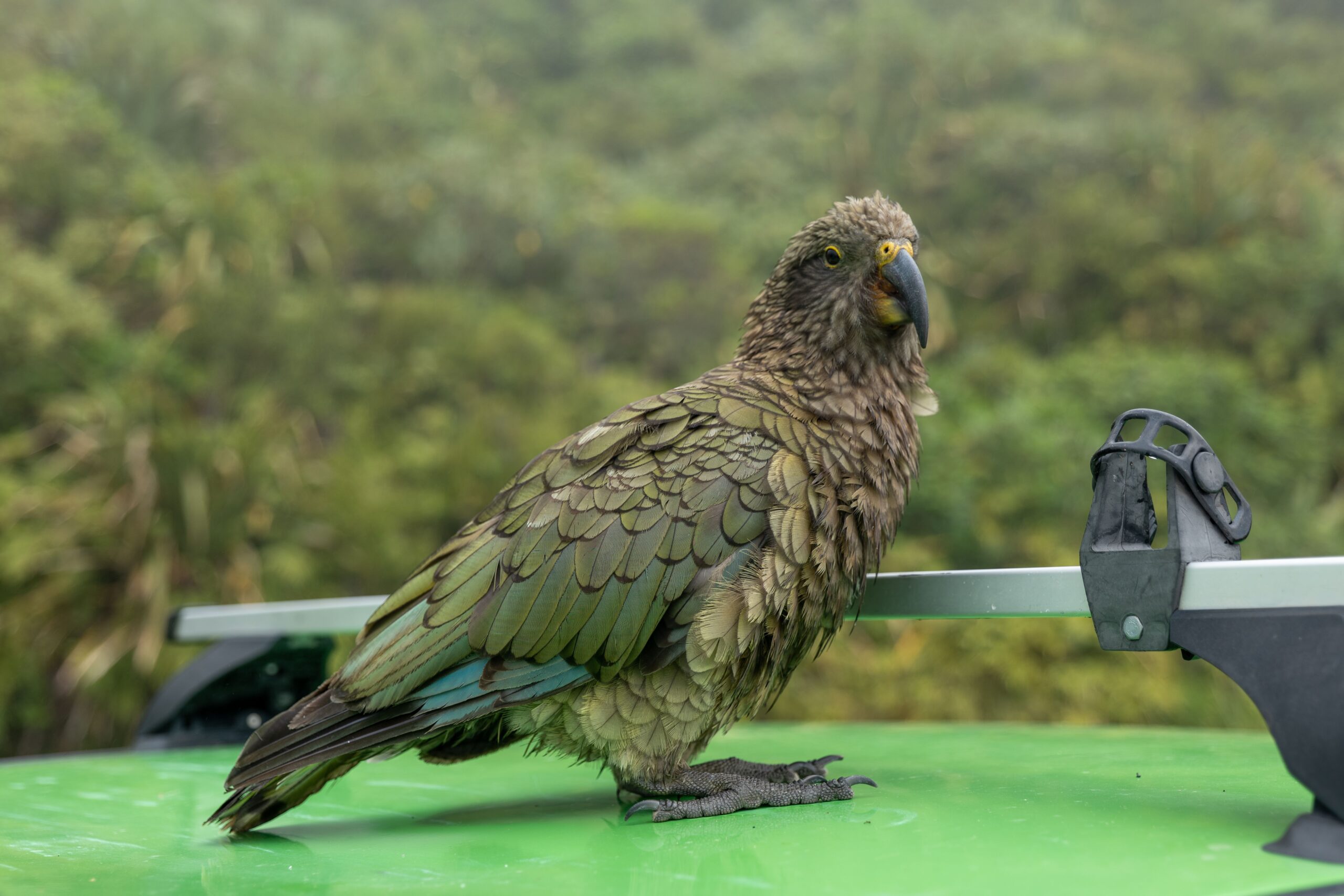
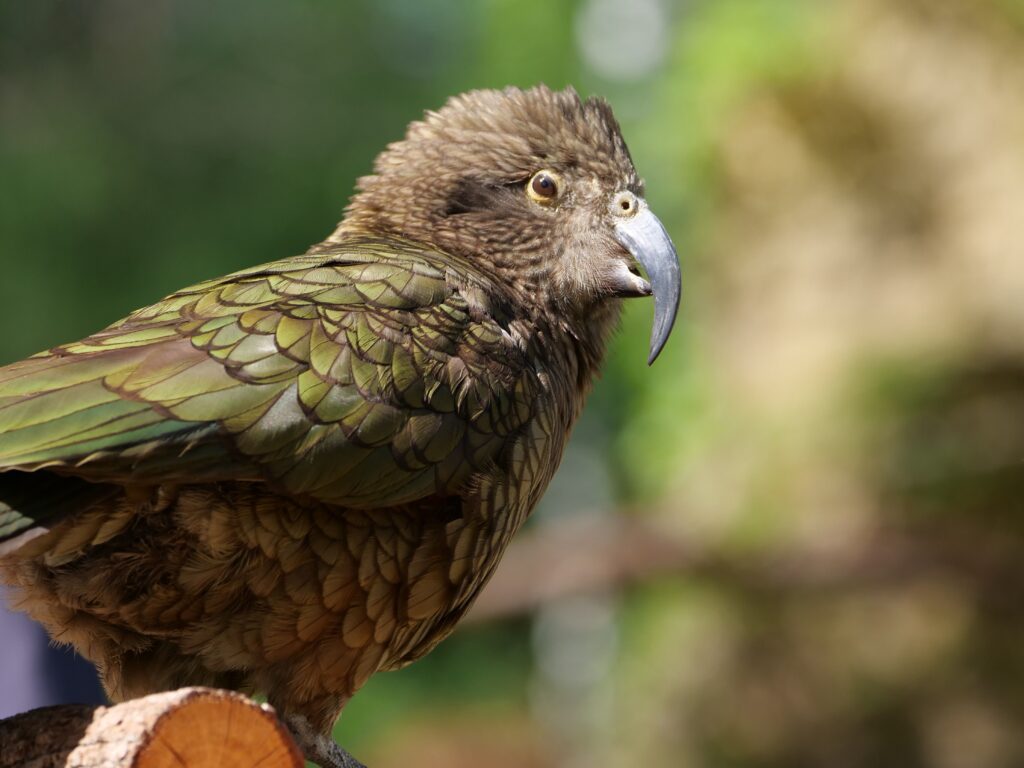
The Kakapo has a very fat appearance. Wings can only be used to balance and support the body when jumping. Its whole body is green with moss-green wings with black stripes on its back, which blend in with the vegetation and provide camouflage. It has a flat face that resembles that of an owl, which is why it is called the owl parrot.
① Physical Characteristics
Body Length: Approximately 60cm
Weight: 2-4kg (One of the heaviest parrots in the world)
Body Color: Yellow-green to Moss Green (moss-like camouflage)
Face: Round, owl-like face
Feathers: Fluffy and soft
Looks like a forest plush toy
② Flightless Parrot
Has wings, but cannot fly
Limits flight to climbing trees and gliding
Walks and runs on the ground
Despite being a parrot, it is “almost a terrestrial animal.”
③ Nocturnal
Day: Rests motionless in the shade or on the ground
Night: Moves slowly and feeds
Sense of smell is more developed than sense of sight
④ Herbivorous
Eats leaves, buds, fruits, and seeds
Distinct feeding patterns created by grinding food and leaving only fibers
Dietary habits deeply connected to forest vegetation
What is your personality like?
The Kakapo has a gentle personality and will run away or crouch down if it senses danger, which makes it very cute. Some people keep them because they are not wary and have a friendly personality.
① Very calm and non-aggressive.
Almost never threatening.
Almost never bites, pecks, or engages in other aggressive behaviors.
Relatively few conflicts with other individuals.
Unusually peaceful for a wild bird.
② Extremely low vigilance.
Doesn’t flee when humans approach.
Stays still in place.
In some cases, will approach on their own.
As a result of evolving in an environment without natural predators,
the instinct to flee has almost completely regressed.
③ Highly curious.
Intrigued by new objects and sounds.
Pecks at people’s clothes and tools.
May approach cameras and shoes.
Not being scared does not equal indifference; rather, they are genuinely curious.
④ Slow and extremely clumsy.
Walks slowly.
Stumbles and falls.
Sometimes climbs but can’t get down.
Goes beyond leisurely, becoming sluggish.
⑤ Generally solitary, but comfortable in solitude
Does not form flocks
Usually travels alone
Does not force interaction with other individuals
Less sociable, but tolerates loneliness well.
⑥ Personality changes dramatically during breeding season (male)
Normally: Quiet and inconspicuous
Breeding season:
Suddenly vocalizes frequently
Makes a low-pitched noise throughout the night
Expands range of activity
Transforms into a new personality mode once a year.
What is the ecology of the kakapo?
Kakapo live on large plants, leaves and fruits. Among them, his favorite food is the red fruit of a tree called rimu''. Kakapo are the only species in the world to use a breeding method called lek. Males slowly gather in an arena called alek” to court and charm females, competing to mate with them. Females choose a male to mate with based on the male’s display performance. Females lay one to four eggs at a time. The lifespan is about 60 years. Adult birds live almost a long time.
■ Basic Information
Activity Period: Nocturnal
Lifestyle: Terrestrial, solitary
Flight Ability: None (Flightless)
Lifespan: 50-90 years (one of the longest among birds)
Diet: Herbivorous
① Daily Rhythm
Day
Rests on the forest floor or at the base of trees
Moving little, it blends in with its surroundings using its body color
A “quiet, patient” lifestyle with no natural predators
Night
Starts activity
Wanders slowly around to feed
Often climbs trees
A herbivorous bird that walks the forest at night.
② Locomotion and Behavior
Mainly walking
Excellent at climbing trees
Can glide short distances from high places
Range of activity is relatively narrow
③ Diet (What do they eat?)
Main foods
Leaves
Buds
Fruits
Seeds
Flowers
Characteristic Eating Method
Gritten with their beak, they crush food and leave only the fibers, leaving “chewing marks”
Efficiently absorb nutrients
Their ecology is closely linked to forest vegetation.
④ Breeding Habits (Very Unique)
Breeding Frequency
Not annually
Only once every few years
Why?
Depends on the abundance of rimu (a tree endemic to New Zealand), their staple food
Breeds only in good years
Male Reproduction Behavior
Drills into bowl-shaped holes (leks) in the ground
Emits a low-frequency “buzzing” sound throughout the night
The sound can be heard several kilometers away
Females choose mates based solely on their calls (visiting).
Females raise their young
Nests are on the ground
2-4 eggs per nest
Only females incubate and raise their young
Males are not involved in child rearing
⑤ Sociality and Communication
Basically completely solitary
Does not form groups
Almost never vocalizes except during breeding season
Scent recognition is also important
⑥ Natural enemies and defensive strategies
Natural natural enemies
Almost none
Defensive methods
Does not run away
Does not move
Mimicry (camouflage)
A strategy completely ineffective against mammalian predators
⑦ Role in the ecosystem
Seed dispersal
Maintains forest vegetation
An iconic presence in New Zealand’s unique ecosystem
What is the kakapo’s natural enemy?
Kakapo originally lived in a world without carnivores. However, Europeans introduced animals such as dogs and cats, and carnivores became a threat. The abundant kakapo were preyed on due to their small size.
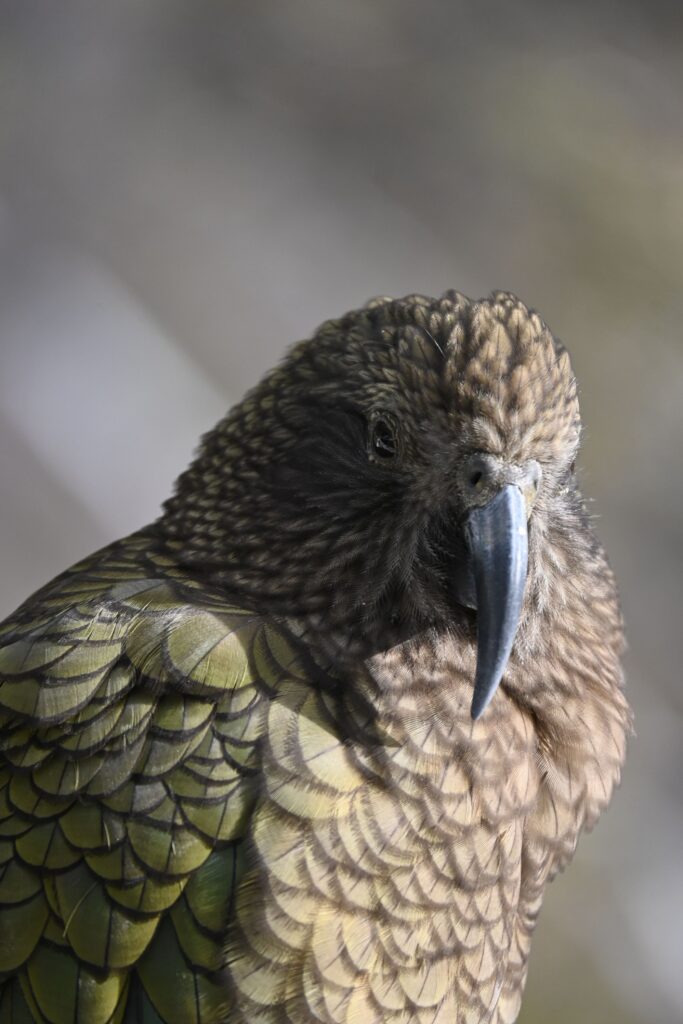
Kakapo Molting
Molting (the replacement of feathers) in the kakapo is a physiological process similar to that of other parrots, involving the replacement of old feathers with new ones; however, due to the species’ unique ecology, the process has several distinctive characteristics.
Timing of Molting
It is a gradual molt that occurs little by little each year.
Feathers do not fall out in large quantities all at once; instead, they are replaced gradually over the course of several months.
Because energy expenditure is high during the breeding and chick-rearing seasons, the molting process proceeds relatively slowly. Generally, many birds molt after the breeding season, and the kakapo follows this pattern.
Characteristics of Molting
Flight feathers (on the wings), tail feathers, and body feathers are replaced in sequence.
Molting occurs symmetrically on the left and right sides, allowing the bird to maintain its balance.
Since kakapo are flightless, molting does not affect flight ability, but it is crucial for maintaining insulation and waterproofing.
New Feathers
New feathers emerge encased in a keratinous sheath known as a “pin feather.”
Initially, they look like thin needles.
The sheath gradually falls away.
Vibrant green coloration and a mottled pattern of black and yellow are revealed.
Vocalizations
The kakapo is often described as the parrot with the most unusual calls in the world, utilizing a variety of sounds depending on the situation.
Booming (The signature call of the breeding season)
This is the most famous call produced by males during the breeding season.
“Bwooooon… bwooooon…”
A low-pitched sound that resonates through the body like a drumbeat.
Lasts about 1–2 seconds per call.
Repeated every few seconds for hours on end.
This low-frequency sound can travel several kilometers, signaling the male’s presence to females.
Characteristics:
Amplifies the sound by inflating an air sac in the chest.
Calls from a depression in the ground known as a “bowl.”
Can be repeated thousands of times throughout the night.
Chinging
A high-pitched, metallic sound produced after booming.
It sounds like:
“Chin, chin, cheen…”
A clear sound resembling a bell or metallic chime; it is believed to signal the male’s location to nearby females.
When alarmed
When startled, they emit short, sharp cries such as:
“Gya!”
“Kee!”
Everyday vocalizations
They are generally very quiet birds.
Sounds heard include:
“Kuk-kuk”
“Grrr…”
Soft, muttering sounds (like talking to oneself).
Chick vocalizations
Chicks call out to their parents with high-pitched, cute sounds such as:
“Pee-pee”
“Chi-chi-chi”
Seasonal Activities
The kākāpō is a flightless, nocturnal parrot native to New Zealand, and its activities vary significantly by season.
🌱 Spring (September–November)
Activity Characteristics
Activity levels begin to rise
Foraging becomes more active
Males begin preparing breeding sites
Main Foods
New shoots
Young leaves
Flower buds
Herbaceous plants
As spring is a season of plant growth, they consume large amounts of nutrient-rich new shoots.
☀️ Summer (December–February)
Activity Characteristics
The most active season
Courtship peaks during breeding years
Males perform “booming” calls throughout the night
Breeding Years
Kākāpō do not breed every year; breeding primarily occurs during years of abundant fruiting for the rimu tree (a native New Zealand tree).
Males:
Create “bowls” (depressions in the ground)
Continue booming for hours
Females:
Select a mate
Build nests
Incubate eggs
Rear chicks
🍂 Autumn (March–May)
Activity Characteristics
Breeding concludes
Period for physical recovery
Some individuals undergo molting
Behaviors
Extended foraging
Fat accumulation
Increased preening
They store nutrients in preparation for winter.
❄️ Winter (June–August)
Activity Characteristics
Reduced activity levels
No breeding activity
Energy conservation
Behaviors
Resting in thickets or at the base of trees
Shorter foraging times
Reduced travel distances
However, they do not hibernate.
Walking Speed
Although the kākāpō is a flightless parrot, it is highly adapted for walking and climbing. However, few studies have measured its actual walking speed, and no official data regarding average speed (km/h or m/s) has been published.
Normal Walking Speed
They typically walk at a slow pace.
They often move while foraging on the ground, and their speed is generally considered to be significantly slower than a human’s leisurely walking pace.
As they move quietly through the forest at night, they prioritize caution over speed.
Moving Quickly
When sensing danger or traveling long distances, they adopt a faster, trotting-like gait.
They may spread their wings slightly to maintain balance.
For short periods, they can move much faster than their usual pace.
Climbing Ability
In addition to walking, the kākāpō is adept at climbing trees.
Using sharp claws and strong legs, they may climb trees reaching heights of 10 to 20 meters.
After feeding on fruit or leaves, they spread their wings and glide down to the ground. While they cannot fly, they use their wings to descend safely from trees.
Distance Traveled Overnight
During their active hours at night, they may travel anywhere from several hundred meters to a few kilometers. Males, in particular, may walk relatively long distances as they head to breeding sites (leks) or patrol their territories.
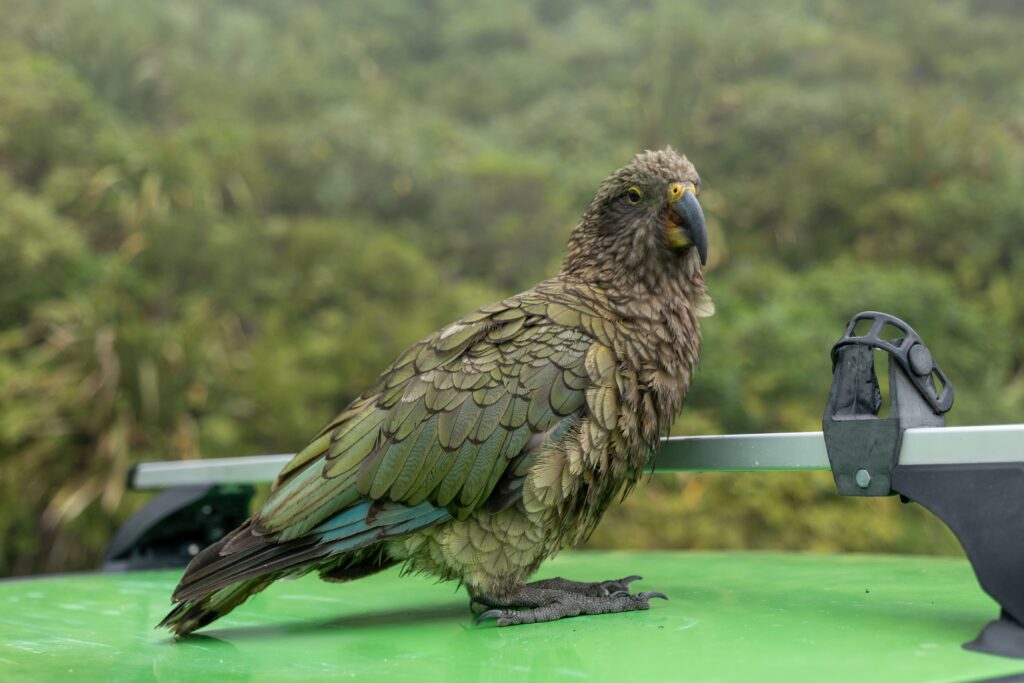
About Kakapo Chicks
Kakapo chicks may look cute, but in reality, they thrive in extremely harsh environments, a unique feature of this endangered species. We’ll explain their developmental stages.
What are Kakapo chicks?
Born and raised on the ground
Raising entirely dependent on their mother
Grows very slowly
Survival rate is low (especially under natural conditions)
① Immediately after birth (from hatching to a few days later)
Condition
Eyes closed
Almost no feathers (thin down)
Cannot regulate body temperature
Immobile
Extremely vulnerable.
② Life in the nest (0-3 months old)
Nest characteristics
Hollow in the ground
Base of a tree or under a fallen log
Simple nest with only a hiding place
Raising method
Solely raised by the mother
Food brought at night
Chicks wait patiently in the nest
Completely vulnerable while the mother is out foraging
③ Growth Characteristics
Very slow growth rate
Takes several months for feathers to grow in
Takes longer to fledge than other parrots
④ Fledge (after 3-4 months of age)
Finally begins to leave the nest
Cannot fly immediately
Move by walking
Learns tree climbing
⑤ Young bird stage (6 months to several years old)
Live near mother
Learns how to find food
May take more than a year to become fully independent
Is the kakapo an endangered species?
The kakapo is currently listed as an endangered species. In New Zealand, its conservation status remains at risk, as ranked by the Department of Conservation as ‘nationally critical’. The reasons may be as follows. The kakapo population has been reduced to 252 individuals. New conservation programs are now being implemented successfully throughout society.
hunting by humans
Hunting by humans is a problem. The Maori hunted the kakapo for food and used its skin and feathers as cloaks. Modern Europeans cleared vast tracts of land, reducing the kakapo’s habitat. As a result, their population has decreased significantly.
carnivores are introduced
Foxes, dogs, cats, and other animals were introduced by Europeans. Due to these presences, many native species, including the kakapo, were heavily predated and declined dramatically. Most of the Kakapo in mainland New Zealand have become extinct, including in Auckland.
Conservation efforts
In 1894, the New Zealand government planned and established Resolution Island in Fiordland as a nature reserve. They began capturing kakapo and kiwi and moving them from the mainland to Resolution Island, where they have no natural predators. Over 200 kakapo were relocated to Resolution Island. By protecting them on the island, they can be kept from becoming extinct. Reports of wild animals being predated have decreased considerably.
Can you keep a kakapo?
Because the kakapo population has decreased dramatically, they are strictly managed and extremely difficult for the general public to keep.
① Can they be kept as pets legally?
■ New Zealand
Kakapos are protected species of national treasures.
Under the Wildlife Act, capture, rearing, movement, and contact are strictly controlled.
Kakapos can only be kept in designated conservation facilities.
Private ownership and pet keeping are strictly prohibited.
■ Japan and overseas
Listed in Appendix I of the Convention on International Trade in Endangered Species of Wild Fauna and Flora (CITES).
International trade is prohibited in principle.
Import and rearing are illegal.
They are not even exhibited in zoos.
② Ecologically unsuitable for captivity.
Flightless and terrestrial.
Nocturnal.
Very long-lived (several decades).
Irregular breeding.
Unusual diet (dependent on forest vegetation).
Conditions that cannot be reproduced in a home environment.
③ Personality Issues (Reasons Why They’re Unsuitable)
Not Fearful of People → High Risk of Accidents
Vulnerable to Stimuli
Low Stress Tolerance
Extremely Sensitive to Environmental Changes
“Friendly” Doesn’t Mean “Keepable”
④ Exceptional Ways for Human Interaction
Donating to Conservation Projects
Online Adoption Program (Adopt a Kākāpō)
Official Communications (Individual Names and Growth Records) Tracking
Documentary and Research Support
Zoos Housing the Species (Japan and Worldwide)
To put it briefly, there are currently no zoos in Japan that keep or exhibit the kākāpō. Globally, too, it is virtually impossible to see one in a zoo open to the general public.
Worldwide
There are effectively no kākāpō currently on display in public zoos.
Each individual kākāpō is managed under a conservation program run by the New Zealand government.
The primary facilities for their care and conservation are as follows:
Offshore conservation islands
Whenua Hou (Codfish Island)
Anchor Island
Hauturu (Little Barrier Island)
Other conservation areas
These locations are off-limits to anyone other than researchers and conservation personnel.
Introducing other animals
コメント