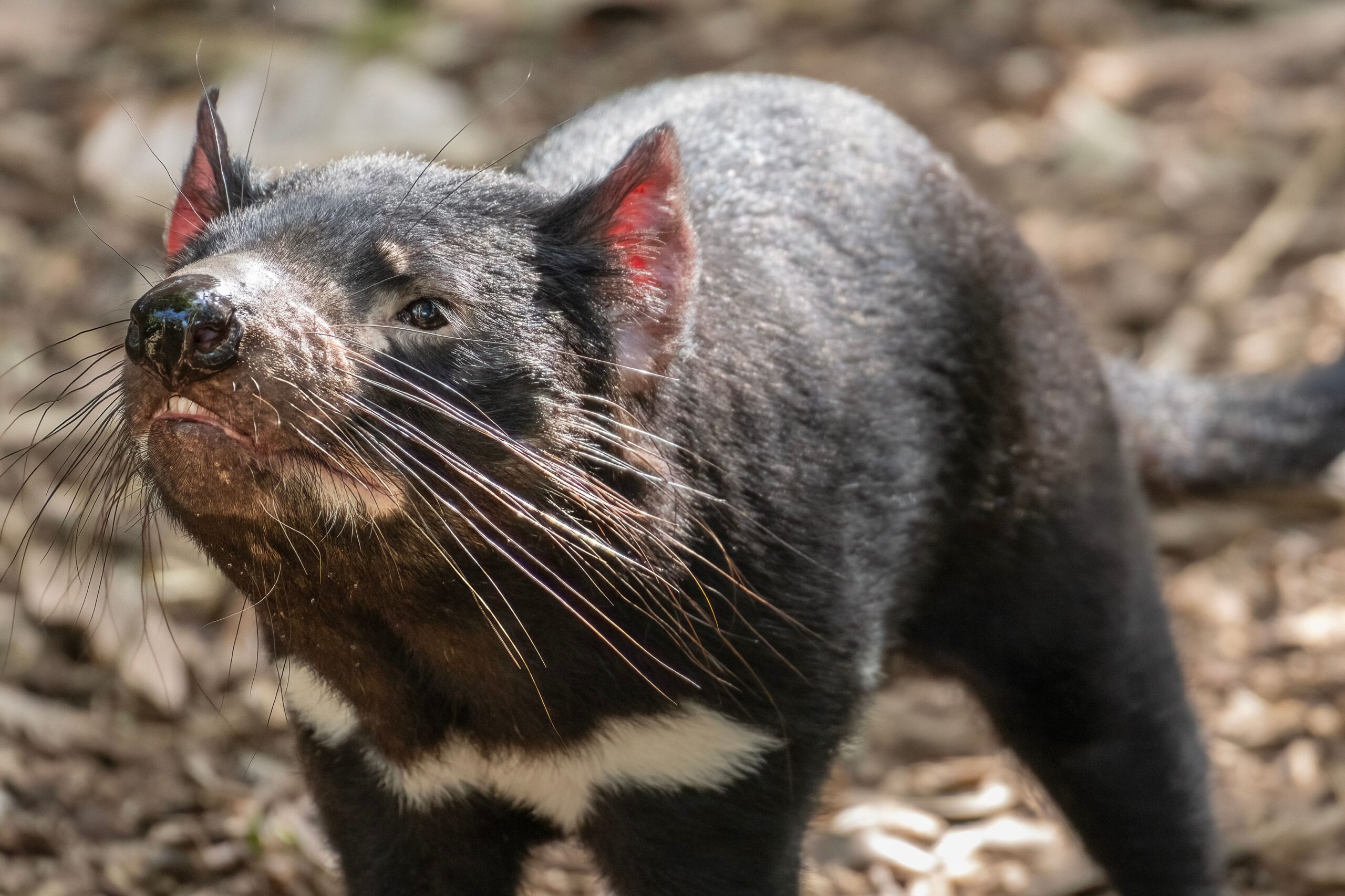
What kind of animal is the Tasmanian devil? We will explain their characteristics, sounds, lifespan, ecology, and habitat. It is said to be the world’s largest marsupial carnivore, and is said to have been given the name “devil” by European settlers who feared it because its growling sound sounded like a devil’s roar. .



- What is a Tasmanian devil? About basic status
- What are the roots and origins of the Tasmanian devil?
- About the habitat of the Tasmanian devil
- feature is? What kind of creature is it?
- What is your personality like?
- What is the ecology of the Tasmanian devil?
- Tasmanian Devil Vocalizations
- Seasonal Activities
- Locomotion Speed
- About Tasmanian Devil Juveniles
- Is the Tasmanian devil an endangered species?
- Can Tasmanian devils be kept in captivity?
- Zoos Housing Tasmanian Devils (Japan & Worldwide)
- Introducing other animals
What is a Tasmanian devil? About basic status
The Tasmanian devil is a marsupial classified in the Mammalia class, Dyscoidea order, Dyscoidea family, and Tasmanian genus. It is said to grow to 50-60 cm in length and weigh 10-12 kg. Its scientific name is Sarcophilus harrisii. It is said that the name “devil” was given to it by European settlers who were afraid of its growling sound, which sounded like the roar of a devil. It has a scary image because it is black from head to tail. It has been introduced to zoos in various parts of Japan.
| Japanese(和名) | タスマニアデビル |
| English(英名) | Tasmanian Devils |
| scientific name(学名) | Sarcophilus harrisii |
| classification(分類) | Mammalia、 Dasyuromorphia、Dasyurinae、Sarcophilus 哺乳綱、フクロネコ形目、フクロネコ科、タスマニアデビル属 |
| IUCN Status(保全状況) | ENDANGERED |
| Length(体長) | 50-60 cm |
| Weight(体重) | 10-12kg |
What are the roots and origins of the Tasmanian devil?
The roots of the Tasmanian devil trace back to carnivorous marsupials that evolved in Australia approximately 25 to 30 million years ago. The modern Tasmanian devil is one of the largest species of carnivorous marsupials.
Origins
Classification
Class: Mammalia
Order: Dasyuromorphia
Family: Dasyuridae
Genus: Sarcophilus
Species: Sarcophilus harrisii
The name “Sarcophilus” is derived from Greek and means “flesh-lover.”
Ancestors
The ancestors of the modern Tasmanian devil are believed to have been small carnivorous marsupials that inhabited the Australian continent.
Fossil records reveal the existence of extinct species—such as †Sarcophilus laniarius—that were larger than the modern species, indicating that multiple Sarcophilus species existed during the Pleistocene epoch.
Why did they survive only on the island of Tasmania?
At the end of the last ice age, roughly 12,000 to 14,000 years ago, rising sea levels separated the island of Tasmania from the Australian mainland.
Subsequently, the Tasmanian devil disappeared from the mainland due to factors such as:
human activity and environmental changes on the mainland
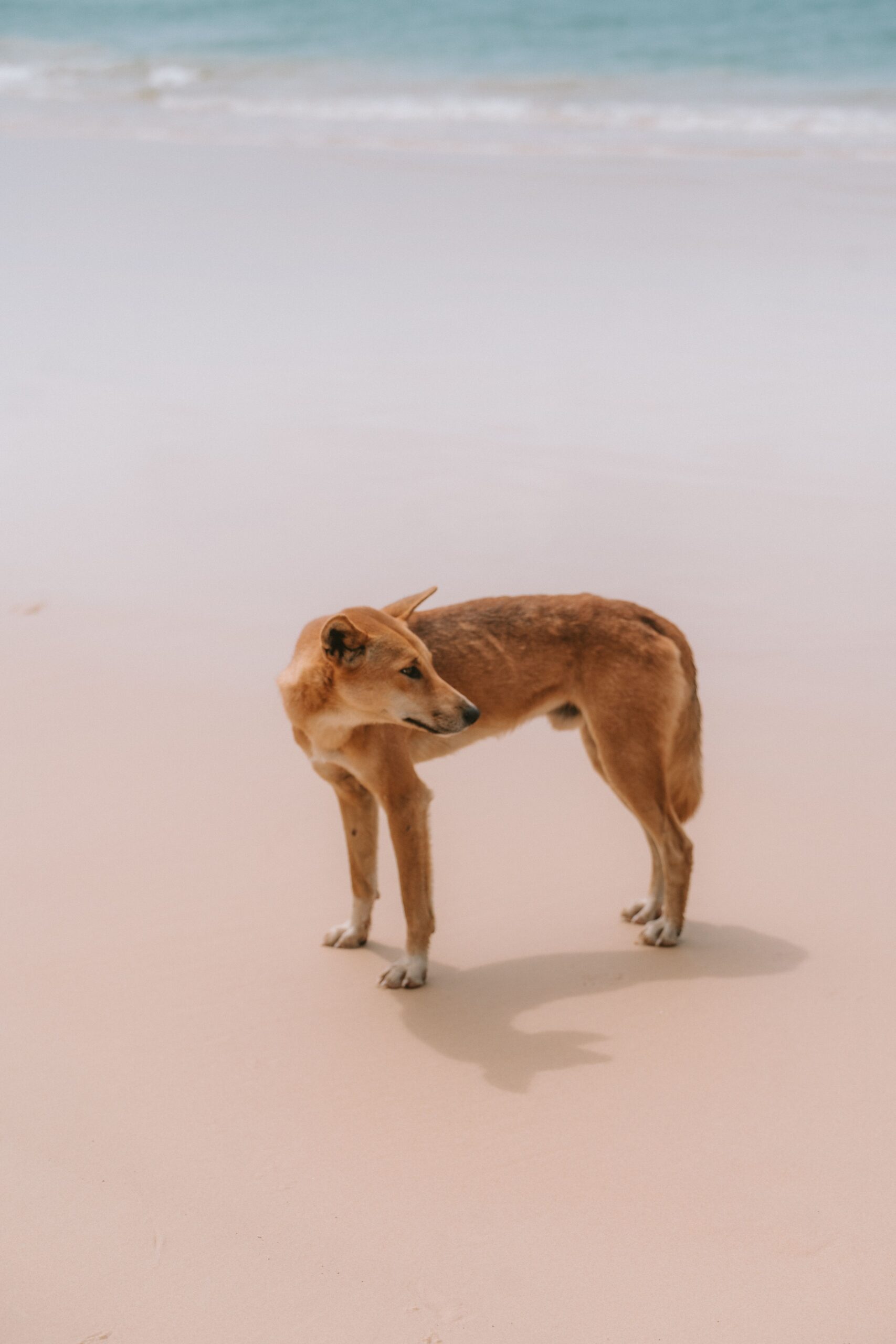
the arrival of the dingo (estimated to have occurred 3,000 to 4,000 years ago)
However, they survived on the island of Tasmania—where dingoes were absent—resulting in their current distribution.
About classification
The genus name Sarcophilus comes from the Greek sarx, which means “meat,” and philus, which means “to love.” In an 1807 paper, it was classified as a member of the opossum genus and named Didelphis ursina. In 1987, he changed the species to Sarcophilus laniarius.
classification class
- ドメイン:真核生物(Eukaryota)
- 界:動物界(Animalia)
- 門:脊索動物門(Chordata)
- 亜門:脊椎動物亜門(Vertebrata)
- 綱:哺乳綱(Mammalia)
- 亜綱:獣亜綱(Theria)
- 下綱:有袋下綱(Metatheria)
- 目:フクロネコ目(Dasyuromorphia)
- 科:フクロネコ科(Dasyuridae)
- 属:タスマニアデビル属(Sarcophilus)
- 種:タスマニアデビル(Sarcophilus harrisii)
About the habitat of the Tasmanian devil
Tasmanian devils were once found throughout Australia, but can now only be found in Tasmania. Nowhere outside Tasmania.
■ Geographic Distribution
Endemic to Tasmania, Australia
Currently, wild populations are found only on the island of Tasmania.
Once inhabited mainland Australia, but became extinct approximately 3,000 years ago.
Characteristics of their habitat
Tasmanian devils are highly adaptable animals that are not strongly dependent on any particular environment.
Main habitats
Eucalyptus forests
Forest-grassland interface
Shrub forests and scrub
Around agricultural land
Coastal forests
They particularly prefer environments that combine forest and open areas.
Nests and hiding places
Rock crevices
Under fallen trees
Underground burrows
Burrows dug by other animals
They rest in these areas during the day and are nocturnal.
Altitude and Climate
Widely distributed from coastal areas to mountainous regions
Altitudes from 0 to 1,500 m
Cool to temperate climate
Can live in both high-rainfall and dry areas
Population Density and Home Range
Generally solitary
Home range:
Males: Maximum 20 km² or more
Females: Slightly smaller
Varies depending on the availability of food resources (carrion)
Relationship with Humans
They are found around agricultural fields, but rarely actively attack humans
They often come to feed on roadkill (animals hit by cars), and traffic accidents are a threat
feature is? What kind of creature is it?
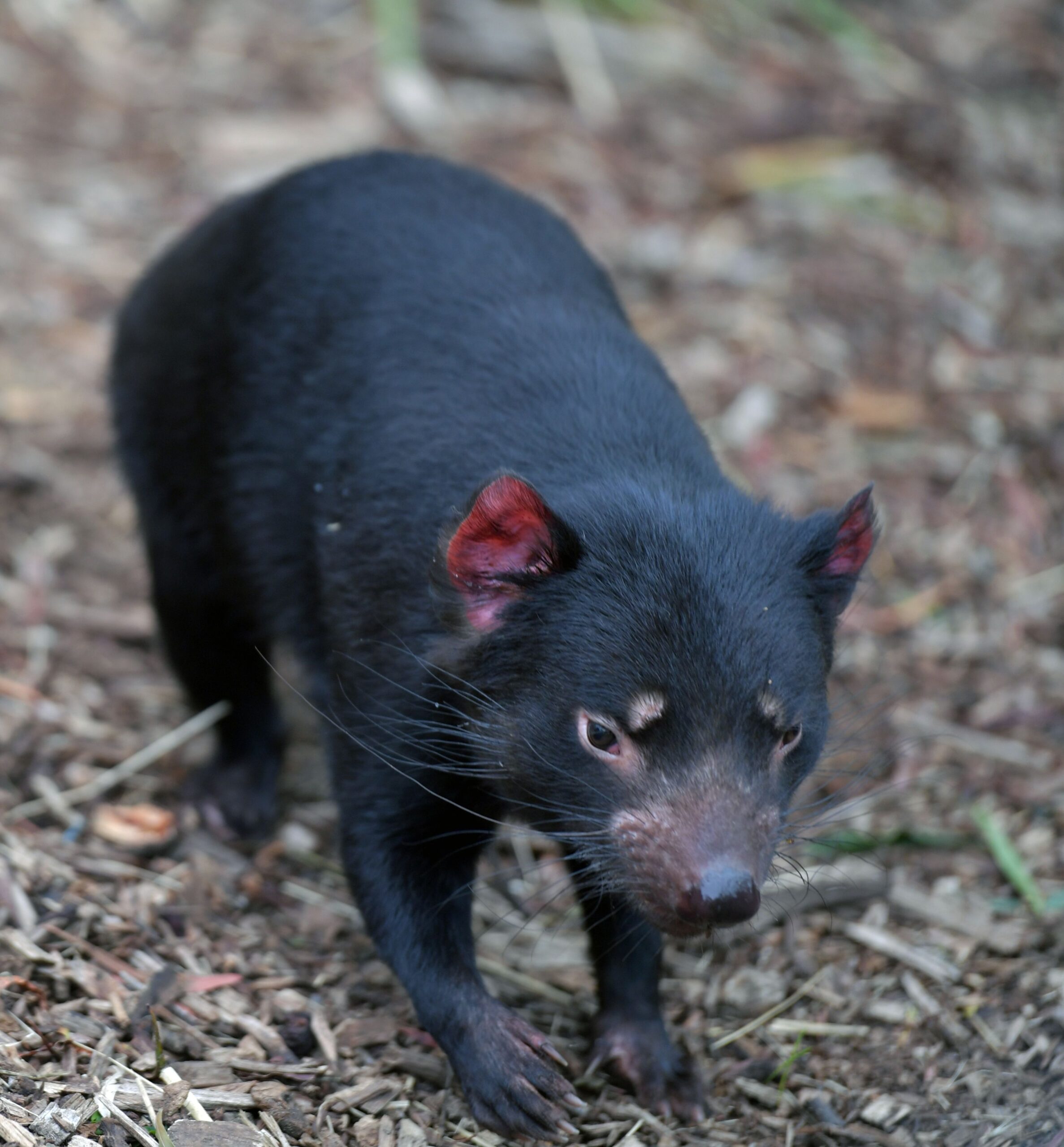
The Tasmanian devil has two sharp fangs in its mouth that grow throughout its life. Its jaw bones are powerful and it is the largest living carnivorous marsupial, with its head covered in black (or blackish brown) hair. It has sharp claws on its limbs, which it uses to dig holes. When young, it is light and agile, and can climb shrubs. It has a very distinctive cry, and is said to be a very scary animal. It captures its prey while moving around. It also eats the carrion of large animals. It is nocturnal, and its voice is very loud and devilish.
① Physical Characteristics
Body Length: Approximately 50-80cm (including tail)
Weight: 6-12kg (Males are larger)
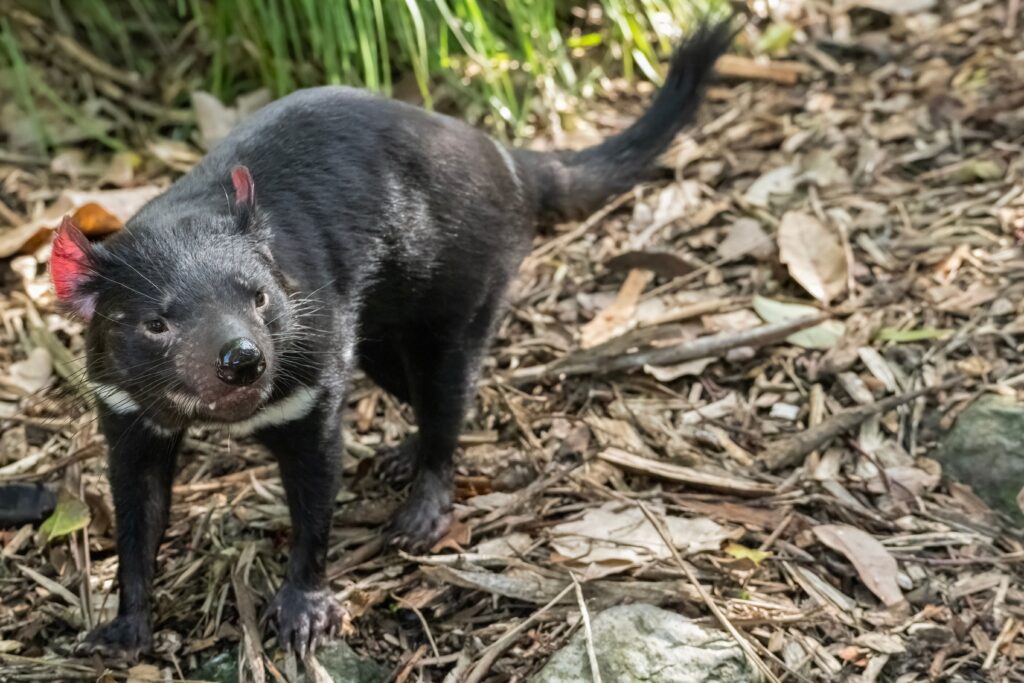
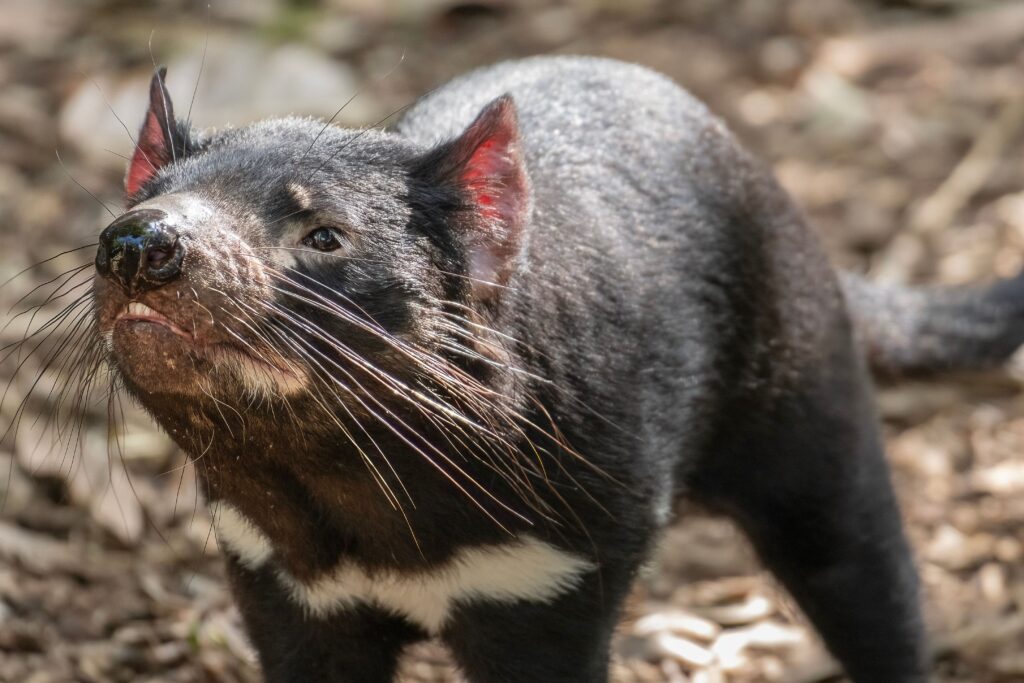
Body Color: Generally black, with white spots on the chest and lower back
Body Type: Stocky and muscular, with a thick neck and jaw
Ears: Turn red when excited
Its body shape resembles a small bear, and its jaws are particularly strong.
② Incredible Jaws and Teeth
Their bite force is among the strongest of any mammal relative to their body size.
They eat everything, including bones, hair, and internal organs.
Their teeth are specialized for tearing apart flesh.
They are excellent scavenger animals.
③ Calls and Threatening Behavior
At night:
Gyal
Rattling
Squeaking
A metallic-sounding sound.
They open their mouths wide and show their teeth.
The reason for the “devil” in their name.
What is your personality like?
Tasmanian devils have a rough temper even among wild animals, and individuals fight with each other over food. Fighting and some injuries are common in Tasmanian devils, so they are not suitable as pets. Their cry is very distinctive and can be threatening.
① They are generally timid and cautious.
They flee when they see people or large animals.
They behave cautiously, hiding in shadows and stopping to move.
They only attack when they have nowhere to escape.
They are more self-defensive than “violent.”
② They are flashy in their threats, but rarely engage in actual fights.
They open their mouths wide.
They bare their teeth.
They make metallic-sounding noises.
But…
They rarely engage in serious fights.
They usually engage in staring matches, pushing, and vocal battles.
They are loud-voiced pacifists.
③ They have a strong obsession with food.
Their personality changes completely while eating.
They become extremely threatening when other individuals approach.
They are relentless, even eating bones.
They become “demonic” only when eating.
④ They prefer to be solitary and go at their own pace.
They are usually completely solitary.
They have a sense of territory, but not strictly.
They do not live in groups.
They are not very sociable.
⑤ They are surprisingly intelligent.
They have a good memory for where food is.
They have the ability to learn to avoid the same dangerous places.
Some rescued individuals can recognize people.
What is the ecology of the Tasmanian devil?
The Tasmanian devil is a carnivore, eating creatures up to the size of a small kangaroo. Breeding begins in March, when females accumulate fat around their necks and begin building nests. Males fight over females. The gestation period is about 3 weeks, and 20-40 babies can be born at a time, but there are only 4 nipples in the pouch, so only a few survive. The lifespan is about 5 years.
■ Basic Information
Activity Period: Nocturnal
Behavior: Solitary
Lifespan: Approximately 5-6 years in the wild (approximately 8 years in captivity)
Sociality: Low (does not form groups)
① Daily Rhythm
Day
Rests in the shade of rocks, burrows, or under fallen trees
Mostly stays motionless to conserve energy
Night
Active
Travels several kilometers or more to search for food
Detects carrion using their sense of smell
② Diet (What do they eat?)
Main Food
Mainly Carrion (scavenger)
Wallabies, possums, small mammals
Birds, reptiles, insects
Characteristics
Eats bones, hair, skin, and internal organs
Scavengers of the food chain
Has no problem eating rotten meat
③ Home Range and Territory
Few clear territorial disputes
Large home range (up to 20 km² or more)
Flexibly adapts depending on food availability
④ Communication
Threatening and assertive vocalizations
Facial expressions (teeth showing, ears erect)
Scent marking
Actual fighting is minimal.
⑤ Breeding and rearing
Breeding season
Once a year (mainly March-May)
Birthing
20-40 immature pups are born at a time
Only four pups survive
Because the pouch only has four nipples
Rearing
Grows in the pouch for approximately four months
Then reared in the den
Independent at 8-9 months
⑥ Natural enemies and threats
Natural enemies
Adults have almost no natural enemies
Major threats
Devil facial tumor disease (DFTD)
Road accidents
Habitat fragmentation
⑦ Role in the ecosystem
Quick disposal of carcasses
Prevention of the spread of pathogens
Suppression of the population of other small predators
An important species whose disappearance would disrupt the ecosystem
What is the natural enemy of the Tasmanian devil?
The Tasmanian devil’s natural enemy is the dingo.
Tasmanian Devil Vocalizations
Tasmanian devils are known for having a particularly diverse and powerful range of vocalizations in the animal kingdom. Their eerie sounds were one of the reasons European settlers gave them the name “devil.”
Growl
The most frequently heard vocalization.
Sound profile
“Grrrrr…”
When guarding food
When asserting territory
To intimidate other individuals
A low, rumbling sound used to keep others at bay.
Scream
Their most famous vocalization.
Sound profile
“Gyaaaaa!”
“Keeeeee!”
Often heard at night
Can carry for hundreds of meters
Emitted during disputes or intimidation
To human ears, it can sound like a crying baby or a human scream.
Cough-like sound
Sound profile
“Kuh, kuh, kuh”
A warning to others
During minor scuffles at feeding sites
A series of relatively short sounds.
Hiss
Sound profile
“Shhhhh”
High alert
Just before attacking
When startled
Resembles the warning hiss of a snake.
Snort
Sound profile
“Pfft”
During contact with others
When investigating scents
Mild alertness
When do they vocalize?
Tasmanian devils are nocturnal.
Vocalizations are most frequently heard:
🌙 Just after sunset
🌃 Late at night
🍖 While feeding
💥 When gathering with others
💕 During mating season
Seasonal Activities
Tasmanian devils are nocturnal year-round, but their breeding, rearing, and foraging behaviors vary significantly by season. The following outlines their annual cycle based on the seasons in the Southern Hemisphere (Tasmania).
🌸 Spring (September–November)
Key Activities
Mothers raise their young in the pouch.
Young devils begin to emerge from the den.
Foraging increases, allowing both mother and young to build up physical strength.
Young individuals expand their home ranges.
Diet
Carrion (e.g., wallabies, possums)
Small mammals
Birds
Insects
☀️ Summer (December–February)
Key Activities
Young devils become independent of their mothers.
Young individuals search for new territories.
Nighttime foraging becomes more active.
They may use water sources to escape the heat.
Characteristics
Due to high temperatures, they rest in dens or thickets during the day.
Activity is concentrated between sunset and dawn.
🍂 Autumn (March–May)
Key Activities
Breeding season (mainly March–April)
Competition between males intensifies.
Males attract females using vocalizations and scent.
They return to a solitary lifestyle after mating.
Behavior
Home ranges expand.
Multiple individuals are more likely to gather at feeding sites.
Threat displays and growling increase.
❄️ Winter (June–August)
Key Activities
Females give birth in the den (gestation period is approximately 3 weeks).
About 20–30 young are born at once, but since there are usually only four teats in the pouch, at most four survive and grow.
The young grow inside the pouch for several months.
Mothers frequently go out to forage and return to nurse their young.
Locomotion Speed
Although the Tasmanian devil has a stocky appearance, it is capable of running surprisingly fast over short distances.
Normal Walking Speed
They typically walk at speeds of around 2–5 km/h, often moving slowly while sniffing the ground.
They move at a leisurely pace through forests and grasslands when foraging or patrolling their territory.
Running Speed (Top Speed)
Top speed: Reported to reach approximately 13 km/h.
This speed is achieved over short distances, such as when competing for food or fleeing from danger.
Locomotion Characteristics
They move on all fours.
Both their forelimbs and hindlimbs are powerful, allowing them to walk steadily even on uneven terrain.
Their tail not only stores fat but also plays a role in maintaining balance and making sharp turns.
Distance Traveled Overnight
During their nocturnal activity,
they may travel anywhere from a few kilometers to over 10 kilometers.
In areas where food is scarce, they may roam over an even wider range.
About Tasmanian Devil Juveniles
Tasmanian devil juveniles (babies to young) undergo a very distinctive developmental process typical of marsupials. Let’s explain it step by step.
What is a Tasmanian devil juvenile?
Immediately after birth, they are extremely immature.
They grow in their mother’s pouch.
The competition for survival is extremely fierce.
① Immediately after birth (immediately after birth)
Birth condition
Body length: Approximately 1 cm
Weight: Approximately 0.2 g
Eyes and ears are underdeveloped.
Almost no hair.
Only limbs developed.
Immediately after birth, they move to their mother’s pouch on their own.
② The competition for survival (first hurdle)
20-40 pups are born per litter.
However…
Only four nipples remain in the pouch.
Only a maximum of four pups that latch onto the nipples survive.
Most are culled at this stage.
③ Development in the pouch (0-4 months old)
Their mouths become attached to the nipple and cannot separate
They grow rapidly on breast milk
They grow hair, and their eyes and ears develop
They do not venture out into the outside world during this period.
④ Living in the den (4-6 months old)
They leave the pouch and live in the den
Their mother brings them food
They look like a “small Tasmanian devil”
⑤ Around independence (8-9 months old)
They leave their mother and begin living alone
They learn to hunt and scavenge
They do not yet have the jaw strength of an adult animal
Is the Tasmanian devil an endangered species?
Tasmanian devils are an endangered species. Due to the effects of their natural enemies, dingoes, Tasmanian devils became extinct on the Australian mainland 400 years ago. Even in Tasmania, most of their habitat is now farmland and pastureland, and they are in danger of extinction. Their population has declined by 60% in the past 10 years, due to the following reasons: According to domestic information, there are efforts to protect the wild, and the Australian government has started a program. They are more aggressive than other wombats.
Attacking livestock
They usually attack livestock, so they have been exterminated and their population has decreased. They are also listed on the Red List. There are organizations that cooperate with conservation efforts. Research is also led by the government. They often appear at events such as zoos, so it’s a good idea to visit them.
get hit by a car
The most common occurrence is being run over by a car. Tasmanian devils are frequently seen sitting on roads, and there have been many incidents where passing cars run over them without noticing. Especially at night, their black fur is a problem and they often go unnoticed.
Devil Facial Tumor Disease (DFTD)
Devil Facial Tumor Disease (DFTD) is a contagious disease that only affects Tasmanian devils. It has a huge impact on your health, and if you get infected, you are 100% sure to die. The situation is quite severe as Tasmanian devils are infected by biting each other’s faces when competing for food, as they are sure to die.
Can Tasmanian devils be kept in captivity?
Tasmanian devils are designated as an endangered species. Therefore, it is difficult to keep them as pets. Furthermore, they have a ferocious personality, so ordinary people will not be able to handle them. Although they are called endangered, they are one of the strongest mammals in the wild, and adult individuals often attack with their teeth, making them good news. It is recommended to see the exhibits at zoos with a guide. You can see detailed photos and videos of their appearance on the Internet.
① Can they be kept as pets legally?
■ In Japan
Tasmanian devils are not permitted for private ownership under the Animal Welfare Act and the handling of invasive and rare species.
Importing them is extremely difficult.
Permission is granted only to
zoos
research institutions
public conservation facilities
■ In Australia
Strictly protected species
Private ownership is prohibited
Keeping is permitted only in
state-certified zoos
conservation and breeding program facilities
② Personality and Safety Issues
Very strong jaws
Can easily crush fingers and bones
Particularly aggressive while eating
Nocturnal and very loud
It is not realistic to tame them and keep them safely.
③ The breeding environment is not realistic.
Requirements
Large exercise space
Digging ground and burrows
Special diet including raw meat and bones
Nighttime supervision
Strong escape prevention measures
Completely impossible in an average household.
- Exceptional locations where they are kept
Zoos around the world
Conservation centers in Tasmania
Breeding facilities for preventing extinction
*All under the supervision of government or academic institutions
Zoos Housing Tasmanian Devils (Japan & Worldwide)
Tasmanian devils are kept and exhibited at several zoos in Japan. In Australia, they can be seen at many zoos and wildlife parks as part of conservation efforts.
Zoos in Japan
The following are major facilities that currently house them or have done so in recent years:
Himeji Central Park
A prominent facility in Japan for viewing Tasmanian devils
Has a track record of successful breeding
As they are nocturnal animals, they are often seen resting depending on the time of day
Tobu Zoo
Has exhibited Tasmanian devils in the past
Has collaborated on breeding and conservation activities
Exhibition status may change due to factors such as animal transfers, so it is recommended to check before visiting
Major facilities in Australia
Bonorong Wildlife Sanctuary
World-renowned for Tasmanian devil conservation
Conducts rescue, breeding, and rehabilitation
Healesville Sanctuary
Specializes in exhibiting animals native to Australia
Participates in conservation breeding programs
Taronga Zoo Sydney
Exhibits Tasmanian devils
Engaged in conservation research
Tasmania Zoo
Features an extensive collection of species native to Tasmania
Offers close-up views of Tasmanian devils
Devils@Cradle
A conservation facility specializing in Tasmanian devils
Known for night tours and conservation programs
Introducing other animals
コメント