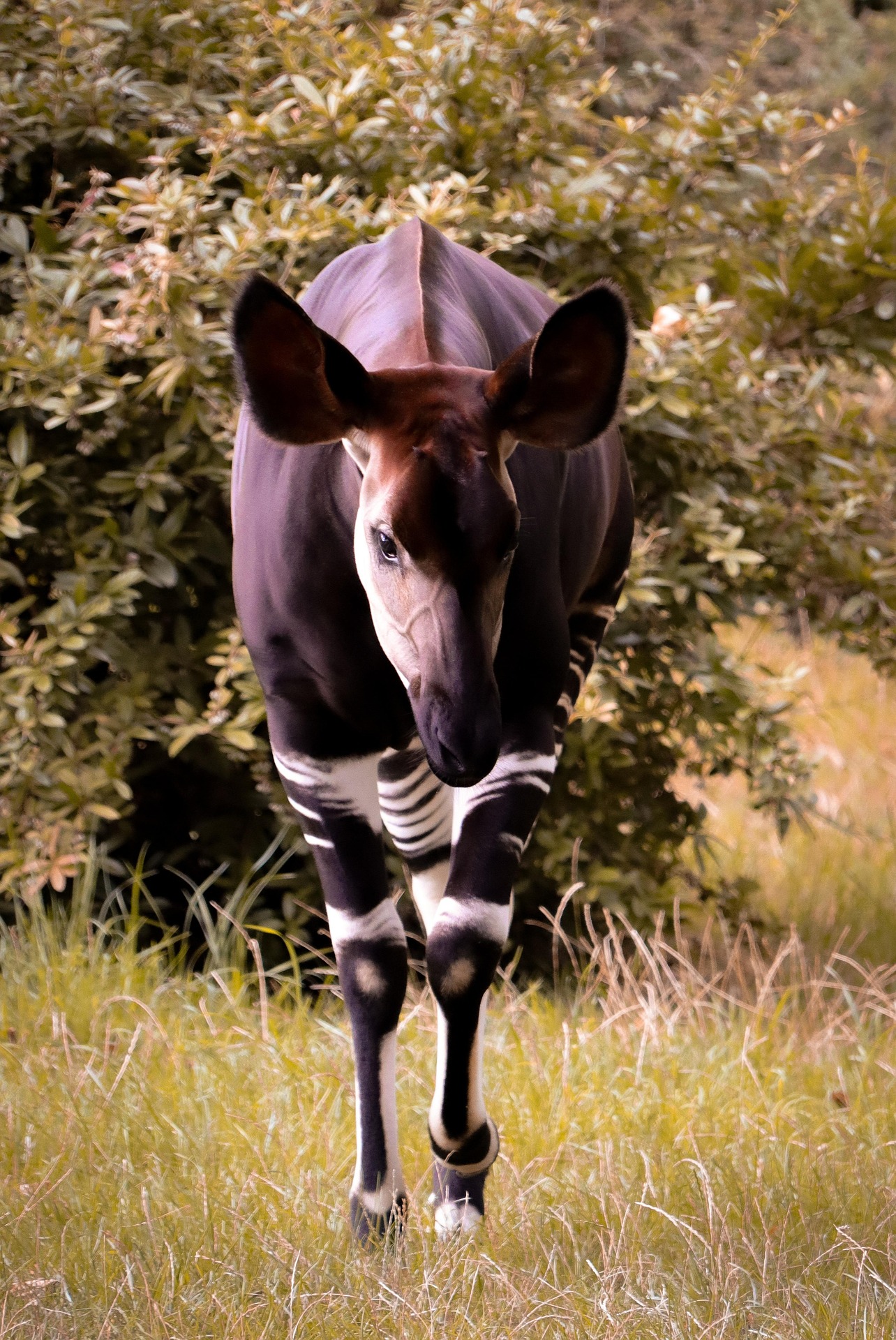
What kind of animal is the okapi, also known as the “forest giraffe”? We will explain its characteristics, ecology, and habitat. Although they are famous mammals that can always be seen at zoos, they are also endangered animals. The okapi looks like a cross between a deer and a zebra.



- What is okapi? About basic status
- What are the roots and origins of the okapi?
- Where is its habitat?
- feature is? What kind of creature is it?
- What is your personality like?
- What is the ecology like?
- Okapi Vocalizations
- Seasonal Activity Patterns
- Walking Speed
- About Okapi Baby
- Is the okapi an endangered species?
- Can okapi be kept?
- Zoos Housing Okapis (Japan & Worldwide)
- Introducing other animals
What is okapi? About basic status
The okapi, also known as the “giraffe of the forest,” looks like a cross between a deer and a zebra, and its scientific name is Okapia johnstoni. It is an animal belonging to the genus Okapi, in the order Mammalia and order Artiodactyla. It weighs 200-300 kg, is 1.9-2.5 m long, and 1.5-2.0 m high at the shoulder, and has a horse-like appearance. It is characterized by its giraffe-like horns. Like giraffes, it also has two horns covered with skin on its head. However, males have horns, but females do not.
| Japanese(和名) | オカピ |
| English(英名) | Okapi |
| scientific name(学名) | Okapia johnstoni |
| classification(分類) | Mammalia、 Artiodactyl、Giraffidae、Okapia 哺乳綱、偶蹄目、キリン科、オカピ属 |
| IUCN Status(保全状況) | ENDANGERED |
| Length(体長) | 1.9-2.5m |
| Weight(体重) | 200 – 300kg |
What are the roots and origins of the okapi?
Contrary to the common misconception that they are a cross between a zebra and a giraffe, okapis actually belong to an ancient lineage that evolved from the same group as giraffes. While their unusual appearance often leads to misunderstanding, taxonomically, they belong to the family Giraffidae.
Evolutionary Roots
More than 10 million years ago, the lineage leading to modern giraffes and okapis diverged from primitive giraffid animals found in Africa and elsewhere. Genetic studies estimate that the common ancestor of the giraffe and the okapi existed approximately 11.5 million years ago.
A simplified evolutionary timeline:
Ancient giraffid animals
│
├── Modern giraffes
│ (Evolved long necks to feed on leaves from tall trees)
│
└── Okapis
(Adapted to forest life; retained short necks)
Why do they have short necks despite being related to giraffes?
Giraffes evolved to feed on the leaves of tall trees in the savanna.
In contrast, okapis remained in the rainforests of Central Africa.
They adapted to an environment where:
Maneuverability was more important than a long neck in dense forests
Feeding on plants near the ground was necessary
Hiding within the undergrowth was essential
Consequently, they retained a body shape closer to that of their ancestors.
Why are they called “living fossils”?
Because they retain many characteristics of ancient giraffid animals, okapis are often referred to as “living fossils.”
Characteristics:
Possess a long tongue, just like the giraffe
Males have small horns
Body structure is similar to that of the giraffe
Striped markings on the legs are thought to aid in camouflage within the forest
History of Discovery
While the local people of the Congo had long known about the okapi, it was not introduced to the European scientific community until the early 20th century. It was scientifically reported in 1901 by the British explorer Harry Johnston.
About classification
The okapi alone forms the genus Okapi. This animal was discovered in Africa in the 1800s and was classified into the family Giraffidae. It is said to be one of the three most rare animals in nature, and there are many photos, images, and videos of okapi species available online. Giraffe and Okapi separated.
■ Basic classification
- 界:動物界(Animalia)
- 門:脊索動物門(Chordata)
- 綱:哺乳綱(Mammalia)
- 目:偶蹄目(Artiodactyla)
- 科:キリン科(Giraffidae)
- 属:オカピ属(Okapia)
- 種:オカピ(Okapia johnstoni)
The only closely related species to the giraffe.
Where is its habitat?
Okapis live in the Democratic Republic of the Congo. They used to live in Uganda too, but they have become extinct. There are no wild ones in Japan now, so if you want to find one, you can see them at the Yokohama Zoo Zoorasia in Kanagawa Prefecture.
① Geographic Distribution
Country: Democratic Republic of the Congo
Region:
Northeastern region, centered on Ituri Forest
Not naturally distributed in other countries
② Specific Environmental Conditions
Okapis live in the following areas:
Lowland to mid-lowland tropical rainforest
Altitude: Approximately 500-1,500m
High temperatures and humidity throughout the year
Dense jungle and abundant undergrowth
Dim forest interiors
Cannot survive in the savanna; fully adapted to forests.
③ Why are they only found deep in the forest?
Body color blends into the shadows of the forest
Excellent hearing and smell
Adapted to environments with poor visibility
Easily avoids predators and humans
“Hiding” is their survival strategy.
feature is? What kind of creature is it?
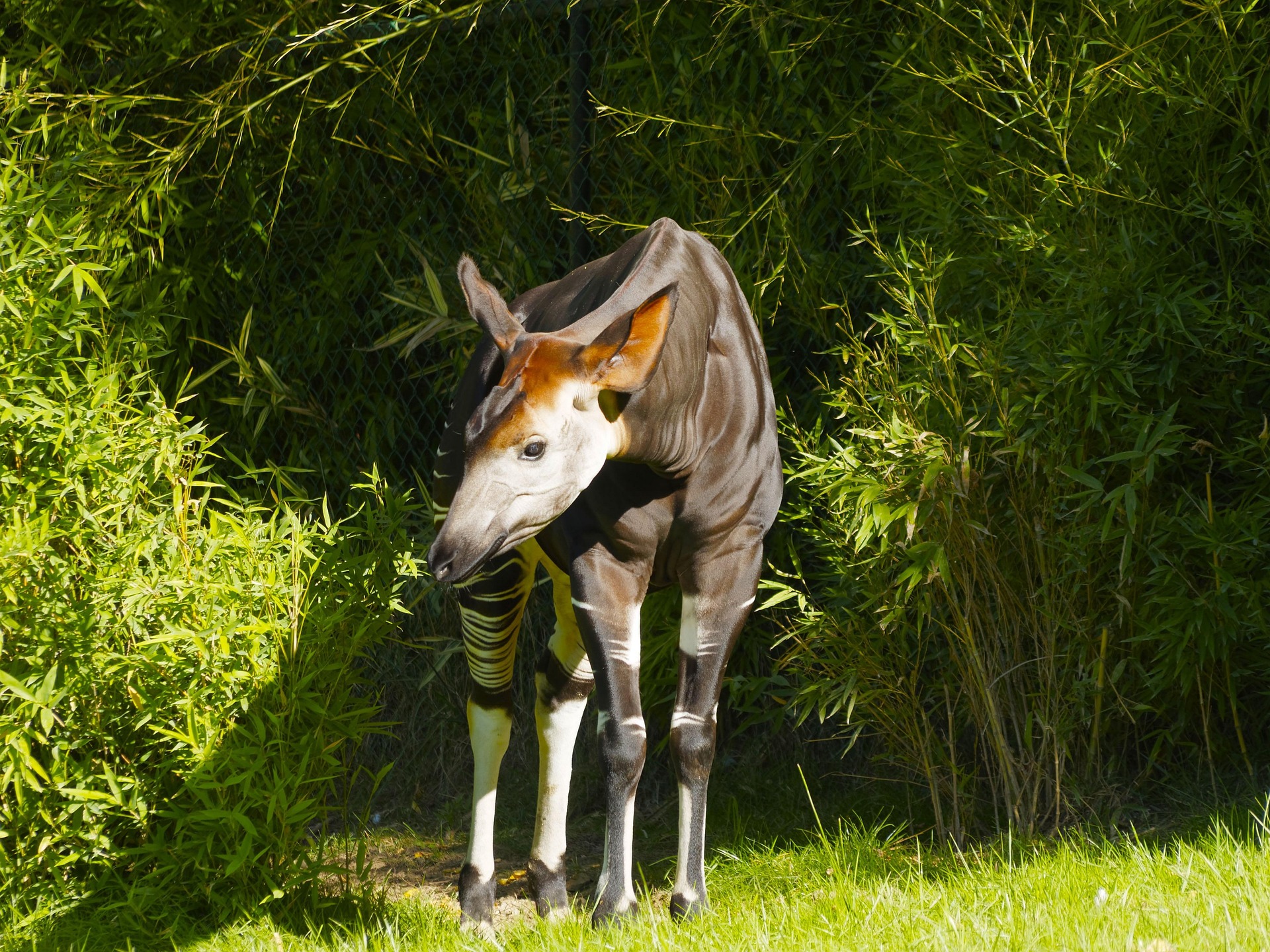
Okapi lives in grasslands and rainforests and has brown and white stripes on its rump and limbs. It is a large, diurnal animal that prefers to be solitary. Males advertise their territory by scattering urine on their territory. They also form small groups and eat together. It has been suggested that it is a member of the giraffe family, and its appearance resembles a cross between a giraffe and a horse. It is known that the okapi is an animal close to the ancestor of the giraffe.
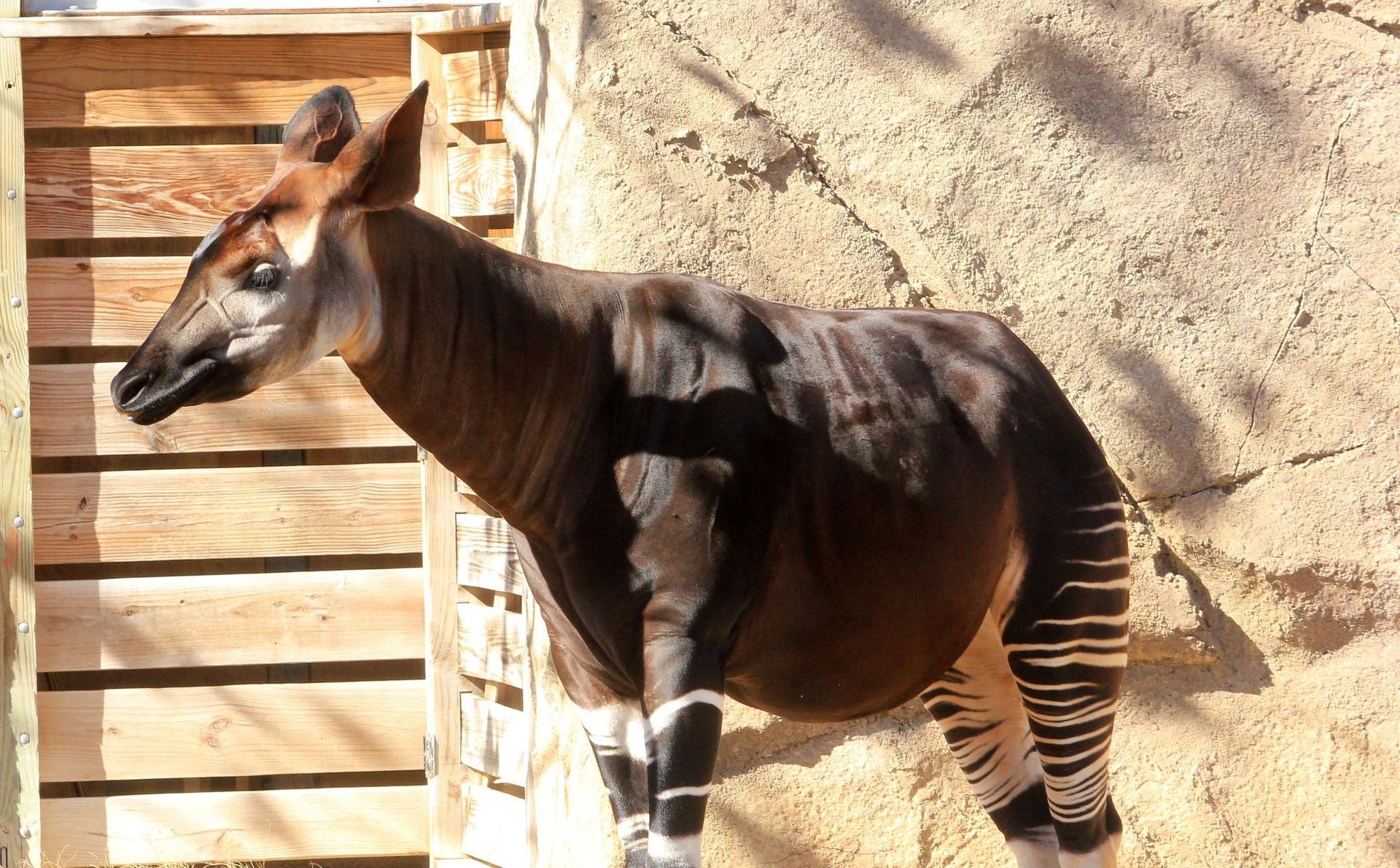
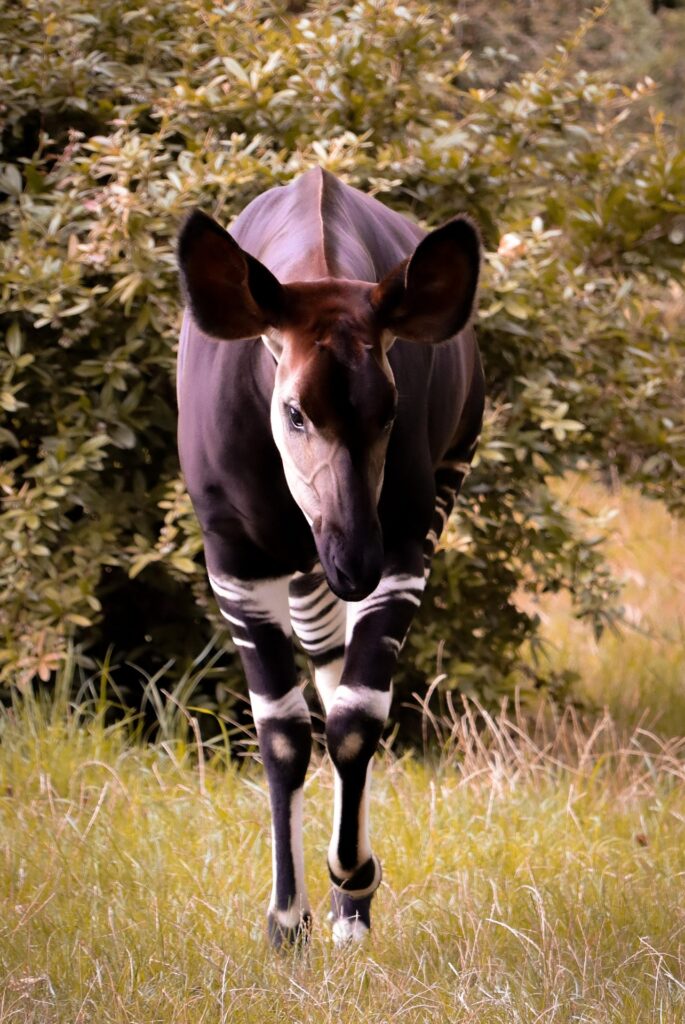
① Strange Appearance (Horse + Zebra + Giraffe)
Body: Dark Brown to Reddish Brown
Legs: Black and White Stripes (Mainly on the Hind Legs)
Neck: Not as Long as a Giraffe, but Slightly Long
Face: Slender and Gentle
The Contrast in Appearance Is Its Most Distinguishing Feature.
② Giraffidae-like Body Structure
Very Long Tongue (Over 30cm)
Used to Grab Leaves
Also Used to Clean Ears and Eyes
Herbivore with Ruminant Stomach
Males Have Small Skin Horns (Ossicones)
③ Body Color and Senses Specialized for the Forest
Dark Body: Blends Into the Shade
Stripes: May Help Distinguish Between Youngsters and Deter Predators
Highly Acute Hearing and Smell
④ Body Size
Body Length: Approximately 2.0-2.5m
Height (Shoulder): Approximately 1.5-1.7m
Weight: 200-350kg
Larger and Heavier Than They Look
What is your personality like?
Okapis are animals with a great deal of individual variation, with some being cautious, some timid, and some very friendly. They are said to have evolved independently, with hooves similar to those of giraffes.
① Very timid and cautious
Reacts to even the slightest noise
Avoids people and large animals
Disappears before they are seen
“Not being seen” is their best defense
② Generally solitary
Does not form groups
Home ranges overlap, but maintain distance
Minimizes social contact
Prefers solitude
③ Gentle and low-aggression
Does not engage in unnecessary fights
Will not attack unless cornered
Gentle herbivores
④ Moves silently
Very quiet footsteps
Moves quietly through the jungle
Almost never vocalizes
⑤ Sensitive and susceptible to stress
Sensitive to environmental changes
Artificial noise and human proximity are a burden
Difficult to manage in captivity
Personality traits observed in parent-child relationships
Mothers are very cautious
Hides their young in the jungle
Calls only using low-frequency sounds
Quiet and affectionate.
What is the ecology like?
Okapi lives by eating plants such as fruits, leaves, buds, leaves, and twigs. They eat leaves by gathering them with their long tongues. Regarding reproduction, the gestation period is long. It is possible to give birth to one calf at a time in 414 – 493 days. Babies breastfeed for about 6 months and reach sexual maturity in 3 years. Their lifespan is 15-20 years, with some living as long as 33 years.
① Daily rhythm
Morning–afternoon
Move slowly through the forest
Forage for leaves and young shoots
Ruminate in a secluded spot
Evening
Continue foraging
Slightly increased activity
Night
Rest in a safe place
Rarely moves far
Low-energy lifestyle with minimal movement.
② Diet (What do they eat?)
Leaves
Young shoots
Fruit
Ferns
Lichens (replenishes minerals)
Characteristic feeding habits
They entangle leaves with their long tongues
Mainly use leaves 1-3m tall
They rarely eat grass on the ground
③ Home range and sociality
Solo life
Fixed home range
Loosely mark territory with scent
Males do not fight directly with each other
④ Breeding ecology
Breeding
Breeding year-round
Breeding season is unclear
Gestation and birth
Gestation period: Approximately 14-15 months
Little child: 1
Rearing
Baby hides in the forest
Mother breastfeeds regularly
Baby does not defecate for several weeks (scent protection)
Thorough predator protection.
Are there any natural enemies?
The okapi has a natural enemy called the leopard. Parents and children should take good care of each other and escape from danger.
Okapi Vocalizations
An okapi’s vocalizations are not the “horse-like calls” or “zebra-like neighs” one might imagine based on their appearance. They are rather quiet animals that use sounds that are difficult for humans to hear.
Low, rumbling, or growling sounds
Okapis produce low-pitched sounds to communicate with one another.
Calls from a mother to her calf
Low-pitched sounds when alert
Signals to others
These are some of the contexts in which these sounds are used.
Infrasonic-range sounds (difficult for humans to hear)
Of particular interest is the possibility that okapis use low-frequency sounds (in the range of infrasound).
In the rainforest,
trees grow densely,
visibility is poor, and
sound does not travel far,
making low-frequency sounds advantageous for communicating with others.
“Whistle” calls to summon the calf
When looking for its mother, a calf produces a high-pitched, whistle-like sound.
Snorting and exhalation sounds
At close range, they also communicate through:
snorting,
muffled sounds, and
low growls.
Seasonal Activity Patterns
Since okapis inhabit Central Africa (primarily the rainforests of the Democratic Republic of the Congo), their activity patterns are dictated mainly by the alternation between the rainy and dry seasons, rather than the four distinct seasons (spring, summer, autumn, winter) found in Japan.
Rainy Season (Generally March–May and September–November)
Activity Level: High
A period of abundant rainfall and lush vegetation.
🌿 Increased foraging activity
Consumes large amounts of:
Young leaves
Fruit
Tree buds
Herbaceous plants
🐾 Expanded home range
Easier to move around due to plentiful food
Forages while walking slowly through the forest
🍼 Increased reproductive behavior
More frequent contact between males and females
Females have a gestation period of approximately 14–15 months, so birth timing depends on environmental conditions
Dry Season (Generally June–August and December–February)
Activity Level: Slightly lower
Reduced rainfall leads to a decrease in available vegetation.
🌱 More time spent searching for food
Moves around in search of preferred leaves
May frequent areas near water sources
🌳 Tendency to stay deep within the forest
Avoids heat and dryness
Utilizes tree shade and dense forest cover
🐾 Primarily solitary behavior
Okapis are fundamentally solitary animals
Rarely form herds, even during the dry season
Daily Activity Patterns (Morning, Day, and Night)
🌅 Morning
A period of heightened activity.
Foraging
Moving through the forest
Gathering information via scent
☀️ Daytime
Increased time spent resting.
Resting in the shade
Rumination (regurgitating and re-chewing consumed plant matter)
Staying alert to surroundings
🌙 Night
Becomes active again.
Foraging
Moving through the forest
Contact with other individuals
※ Okapis are considered to be strongly crepuscular (active primarily at dawn and dusk).
Walking Speed
Although there is little precise data on okapi walking speeds in the wild, it is estimated that their normal travel speed is around a few kilometers per hour (comparable to a human’s slow to average walking pace).
Approximate Movement Speeds
- Walking slowly (while foraging): Approx. 2–4 km/h
- Moving through the forest: Approx. 4–8 km/h
- Fleeing in alarm: Potentially over 10–20 km/h
- Short-distance sprints: Can be even faster
Why “Walk Quietly” Instead of Running Fast?
The okapi is an animal adapted to the dense forests of the Congo.
🌳 The forest is full of obstacles
- Few places to run at high speeds over long distances
- The ability to navigate around trees and plants is crucial
👂 Moving silently is essential
- To avoid predators (such as leopards)
- They are prey animals that need to protect themselves, not hunters seeking prey
🦵 Short neck and sturdy legs
- Skilled at making agile turns
- Well-suited for maneuvering in tight spaces within the dense forest
Characteristics of Their Gait
As members of the giraffe family, okapis share a similar gait to giraffes.
- They sometimes use a “lateral gait” (moving the legs on the same side of the body simultaneously)
- They make very little noise when walking
- They eat leaves while moving slowly through the forest
In short, the okapi is not a “speed animal” like the cheetah, but rather…
“An animal evolved to move silently through dense forests.”
About Okapi Baby
Okapi baby cubs are “hidden in the forest and raised in silence.”
Their most distinctive feature is their extremely secretive parenting.
① They can stand immediately.
Stand up within 30 minutes of birth.
Able to walk within an hour.
Long, strong legs.
They are quick to act, typical of large herbivores.
② Appearance
Body color is a slightly lighter brown.
The stripes on their legs are more pronounced than in adults.
Their faces are round and young.
A special behavior known as “hidden parenting.”
Mother’s behavior
Leaves their baby in the jungle and leaves.
Returns only a few times a day to nurse.
Moves when danger is near.
Baby characteristics
They barely defecate for several weeks.
They don’t emit any odor.
They wait motionlessly.
They have thorough predator protection.
Is the okapi an endangered species?
Unfortunately, the okapi is designated as an endangered species. According to the information provided, it is legally protected in the Democratic Republic of the Congo and is strictly protected. The population is declining due to the following reasons. Some protected areas have been built, making it difficult to manage.
Impact of civil war in the Democratic Republic of the Congo
You can die from the effects of the civil war in the Democratic Republic of Congo. Okapi are often victims of attacks by armed groups, and many are killed.
habitat destruction
The okapi’s biggest concern is habitat destruction. As more and more areas where okapi can live are developed by humans, their habitats are becoming fragmented and isolated.
Hunting for food and leather
Illegal hunting is also a problem. Many zebras are killed by businesses for their meat and leather, and their meat is used commercially. Because they were used for food and died, the zoo protects and breeds these zebras.
Can okapi be kept?
Unfortunately, it is difficult to keep okapis as they are designated as an endangered species. The best you can do is see them in zoos and national parks. Zoos in the United States and Japan have a wide range of exhibits and other content, so we recommend that you go and see them first. They have beautiful stripes. They are often featured in the news, and there are a certain number of places where you can see them, so do your research. In Japan, you can see them at Zoorasia and other places.
① Strictly restricted by law
IUCN Red List: Endangered
CITES Appendix I
International trade is generally prohibited
Nationally protected species in its country of origin (Democratic Republic of the Congo)
There is no way for individuals to acquire or keep them.
② Extremely unique environmental requirements
Okapis require the following environment:
Hot and humid tropical rainforest environment
Quiet, dark spaces
Large home range
Stable vegetation (mainly foliage)
Difficult to reproduce in standard captivity facilities.
③ Highly sensitive to stress
Sensitive to noise and human presence
Easily affected by environmental changes
Stress leads to a weakened immune system
Captivity is likely to pose a survival risk.
④ Breeding is difficult
Highly solitary
Breeding timing is difficult to determine
Long gestation period (approximately 15 months)
Advanced knowledge is required for successful breeding.
Zoos Housing Okapis (Japan & Worldwide)
In the wild, the okapi is an extremely rare animal found only in the Ituri rainforest of the Democratic Republic of the Congo; consequently, few are kept in zoos globally. Currently, they are housed in only a few dozen zoos worldwide.
🇯🇵 Zoos in Japan where you can see okapis
Yokohama Zoological Gardens “Zoorasia”
The most famous facility for keeping okapis in Japan.
Features:
🇯🇵 First zoo in Japan to introduce okapis
Exhibited in the “African Tropical Rainforest” zone
Successful breeding record
Many visitors come specifically to see the okapis
Zoorasia is renowned for exhibiting rare animals, including okapis.
Yokohama Municipal Kanazawa Zoo
Has a history of keeping okapis. As current exhibition status varies by season, it is recommended to check before visiting.
Ueno Zoological Gardens (Tokyo)
Known as one of the zoos in Japan that keeps okapis.
🌍 Major zoos worldwide where you can see okapis
🇺🇸 USA
San Diego Zoo
Participates in okapi conservation and breeding efforts
Has a record of successful breeding
A key facility for the protection of rare species
Bronx Zoo
Has strong ties to global wildlife conservation organizations
A central player in okapi conservation activities
Disney’s Animal Kingdom
A facility famous for its okapi exhibit
🇪🇺 Europe
Antwerp Zoo
A global hub for okapi breeding management
A key facility involved in international pedigree management (studbook)
Chester Zoo
Famous for the conservation of rare animals
Has a history of keeping okapis
ZSL London Zoo
One of the UK’s leading zoos
Rotterdam Zoo
Known as a European facility that keeps okapis
Introducing other animals
コメント