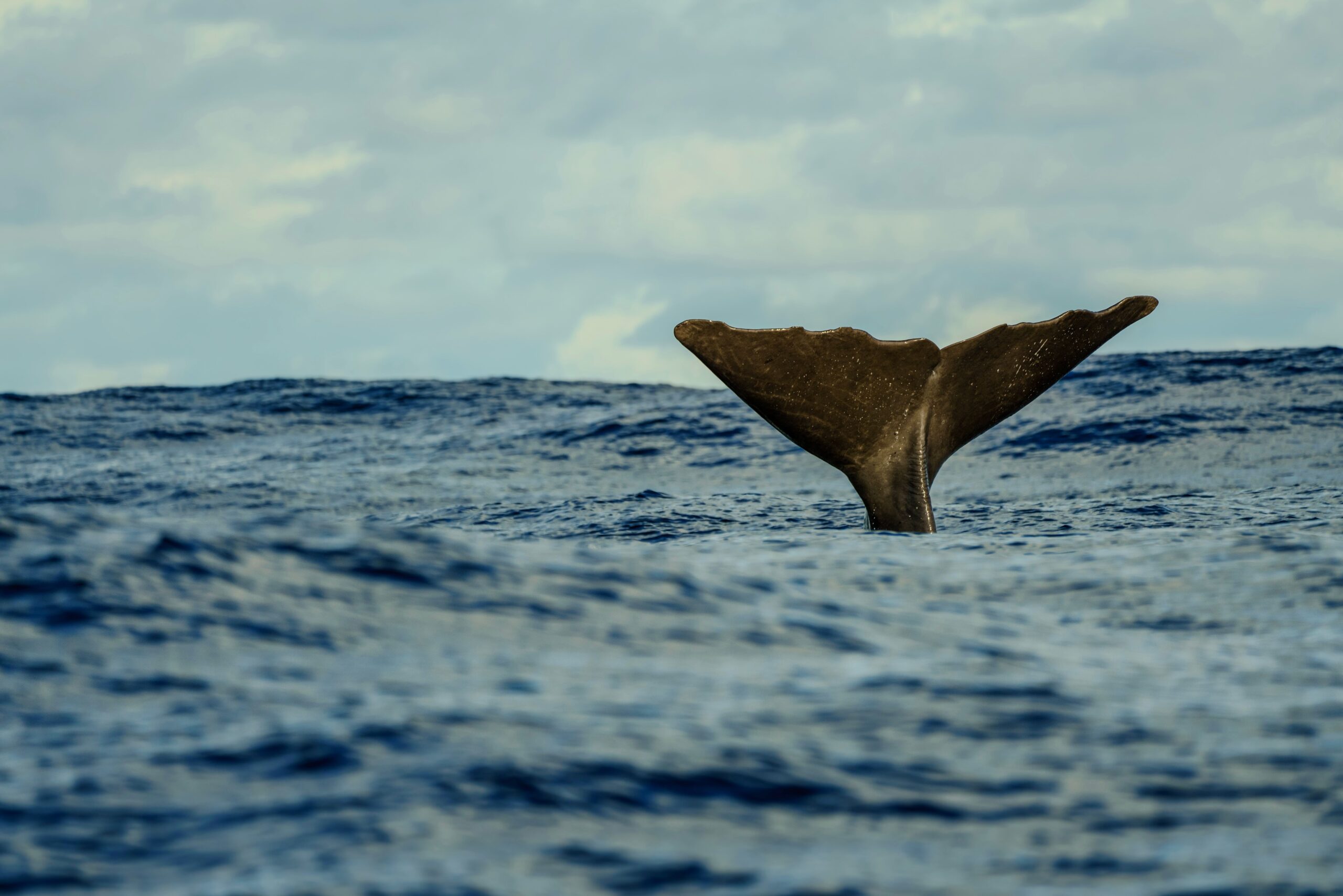
What kind of whale is a sperm whale? We will explain its characteristics, ecology, and habitat. This whale is distributed all over the world from the North Pole to the Antarctic, and is a member of the whale family that can be seen in any ocean, but despite this, it is designated as an endangered species.










- What is a sperm whale? About basic status
- What are the roots and origins of the sperm whale?
- About habitat
- feature is? What kind of creature is it?
- What is your personality like?
- What is the ecology like?
- About Diving
- About Their Vocalizations
- Seasonal Activities
- On Swimming Speed
- About Sperm Whale Calves
- Is the sperm whale an endangered species?
- Can sperm whales be kept as pets?
- Zoos and Aquariums Keeping Them (Japan and Worldwide)
- Introducing other animals
What is a sperm whale? About basic status
Sperm whales are classified into the Spermaceae family and Spermaceae genus. The scientific name is Physeter macrocephalus. It can reach 16-18m in size and weigh up to 50t. A list of basic information is below. In the ocean, some of the giant whales have sharp teeth and specialize in diving. There are many mysteries and research is still needed.
| Japanese(和名) | マッコウクジラ |
| English(英名) | Sperm whale |
| scientific name(学名) | Physeter macrocephalus |
| classification(分類) | Mammalia、Artiodactyla/Cetartiodactyla、 Physeteroidea、Physeter 哺乳綱、偶蹄目、マッコウクジラ科、マッコウクジラ属 |
| IUCN Status(保全状況) | VULNERABLE |
| Length(体長) | 16-18m |
| Weight(体重) | 20-50t |
What are the roots and origins of the sperm whale?
The sperm whale (scientific name: Physeter macrocephalus) belongs to a very ancient evolutionary lineage among extant toothed whales. Tracing back its ancestry leads to mammals that lived on land approximately 50 million years ago.
Ancestors were “land-dwelling mammals”
The ancestors of whales were land mammals belonging to the artiodactyl (even-toed ungulate) lineage—specifically the group known as Cetartiodactyla—which is closely related to modern hippopotamuses.
The general evolutionary progression is as follows:
Land mammals
↓ Approx. 50 million years ago
Pakicetus
↓
Ambulocetus
↓
Rodhocetus
↓
Primitive marine whales
↓
Toothed whales (Odontocetes) (from approx. 35 million years ago onwards)
↓
Sperm whale lineage
Early whales were roughly the size of dogs or wolves and lived by walking on land while catching fish in shallow waters.
Direct ancestors of the sperm whale
The group to which sperm whales belong (the superfamily Physeteroidea) first appeared during the late Oligocene epoch, approximately 25 million years ago.
One of the oldest known fossils is:
Ferecetotherium
Characteristics:
Skull structure resembling that of modern sperm whales
Asymmetrical nostril placement
In the process of evolving a massive head
It already possessed features characteristic of sperm whales.
How did the massive head evolve?
The most distinctive features of the sperm whale are:
A total body length of 15–18 meters
A head that accounts for approximately one-third of its body length
Possession of a massive “spermaceti organ” (often referred to as the “junk”) The ancestors of sperm whales did not possess massive heads from the very beginning.
Evolutionary process:
Small toothed whales
↓
Enlargement of the head
↓
Hunting large prey in the deep sea
↓
Modern sperm whale
…is how they evolved.
Why did they become deep-sea hunters?
Sperm whales underwent a unique evolutionary path among cetaceans.
Main prey:
Giant squid
Large squid species
Deep-sea fish
Consequently,
Evolved capabilities:
✅ Diving to depths of up to 3,000 meters
✅ Echolocation using ultrasonic sounds (clicks)
✅ An acoustic system utilizing their massive heads
✅ Muscles capable of storing vast amounts of oxygen
…are the traits they acquired.
About classification
Sperm whales belong to the whale family. This species alone constitutes the genus Sperm Whale.
Biological Classification (Taxonomy)
| 階級 | 分類 |
|---|---|
| 界 | 動物界(Animalia) |
| 門 | 脊索動物門(Chordata) |
| 亜門 | 脊椎動物亜門(Vertebrata) |
| 綱 | 哺乳綱(Mammalia) |
| 目 | クジラ目(Cetacea) |
| 亜目 | ハクジラ亜目(Odontoceti) |
| 上科 | マッコウクジラ上科(Physeteroidea) |
| 科 | マッコウクジラ科(Physeteridae) |
| 属 | マッコウクジラ属(Physeter) |
| 種 | マッコウクジラ(P. macrocephalus) |
About habitat
Sperm whales are distributed throughout the world’s oceans, from the North Pole to the South Pole.
① Global Distribution
Distributed in almost all oceans around the world
Pacific Ocean
Atlantic Ocean
Indian Ocean
Found widely from the equator to the polar regions
This species has one of the widest distributions among whales.
② Characteristics of Commonly Found Oceans
Sperm whales prefer the following locations:
Deep ocean depths of over 1,000 meters
Outside the continental shelf (continental slope)
Areas where the seafloor suddenly deepens
Areas where deep-sea squid are abundant
Oceans with prey (such as giant squid) are important.
③ Latitude Differences (Males and Females)
Habitats differ by sex.
Females and young
Sedentary habitats range from warm to tropical waters
Living in schools (family units)
Mature males
Migratory alone or in small groups
To high latitudes (cold waters)
Also found in the cold waters of the Antarctic and North Pacific Oceans
Males have a wider range of activity.
④ Habitat around Japan
Can also be found in waters near Japan.
Pacific coast (especially areas close to deep waters)
Around the Ogasawara Islands
Off the coast of Boso
Off the coast of Sanriku
Rarely spotted along the Sea of Japan coast
Japan is part of an important migration route.
⑤ Distinguishing between surface and deep sea habitat
Usually rests and breathes at the surface
When feeding, dives to depths of 1,000-2,000m
Dive time: 30 minutes to over an hour
The important thing about habitat is not the surface, but the vertical direction (depth) of the ocean.
feature is? What kind of creature is it?
Sperm whales are basically deep-sea creatures. The fumaroles (breathing holes, nostrils) are concentrated in the front of the head. The tail is triangular and very thick. It is the largest living toothed whale, second only to fin whales and right whales. Its most notable feature is its extremely enlarged head, and it has the largest and heaviest brain of all animals. Therefore, it can be said that it is a whale with very high intelligence. They can spend two-thirds of their lives in the deep sea, diving over 2,000 meters.
① Stunning Appearance
Body Length:
Males: Approximately 15-18m, Females: Approximately 10-12m
Weight:
Males: Over 50 tons
Abnormally Large Head
→ Approximately one-third of the body is head
Square, Sculpted Head
One Blowhole on the Front Left (Very Unique)
At First Sight, It Doesn’t Look Like a Whale
② Enormous Head Interior (Biggest Distinctive Feature)
Their heads contain
Sperm Oil Organs.
Their Functions:
Powerful Echolocation (Sound Detection)
Prey Detection in the Deep Sea
Sound Amplification and Directional Control
Sperm whales
Produce the most powerful sounds on Earth.
③ Deep-Sea Diver
Diving Depth: 1,000-2,000m+
Diving Time: 30 minutes to over an hour
Main Prey:
Giant Squid
Large deep-sea squid and fish
Ability comparable to a human submarine.
④ Diet/Hunting Style
Completely carnivorous
Sharp teeth only in the lower jaw
Searches for prey using sound waves and swallows them nearly whole.
“Catches and swallows” rather than chewing.
What is your personality like?
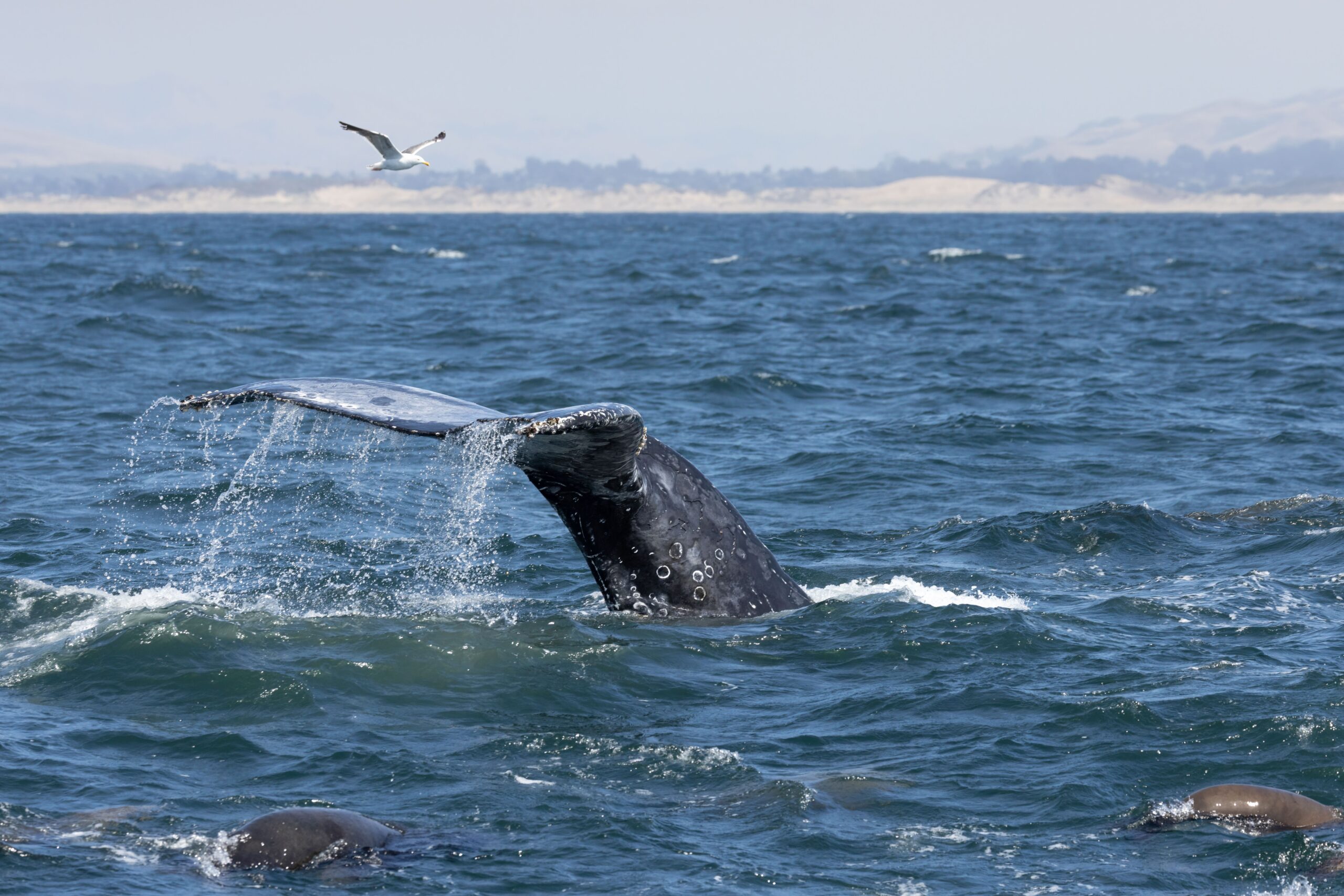
Sperm whales tend to be solitary or form groups. A large mature sperm whale has many scars on its body surface. This often occurs after males fight over females during the breeding season.
① Generally calm and at their own pace.
They usually swim slowly and quietly.
They are not aggressive toward people or boats.
They do not engage in unnecessary conflicts.
They are like the silent giants of the sea.
② They are highly intelligent and caring towards their companions.
They communicate with each other through clicking sounds.
Females and their young form strong bonds.
They have been reported to protect injured companions and their young.
They have a strong sense of family loyalty.
③ They respond calmly in times of danger.
When threatened,
They form a rosette with their group.
They protect their young in the center.
They do not run around recklessly.
They do not panic.
④ Males tend to be solitary.
Mature males have a lone wolf temperament.
However, they return to their group during breeding season.
They are more solitary than aggressive.
⑤ Their attitude toward humans.
They generally do not attack humans.
They may approach ships out of curiosity.
Even during the whaling era,
they were not indiscriminate attackers.
What is the ecology like?
Sperm whales feed on squid and fish such as giant squid. Female gestation period is at least 12 months. Parenting lasts several years. Sperm whales can live for about 70 to 80 years.
① Deep-sea hunting lifestyle
Mainly lives in the deep sea, at depths of 1,000-2,000m
Prey:
Giant squid
Large deep-sea squid
Deep-sea fish
Searches for prey using echolocation
Hunters rely more on sound than sight.
② Exceptional diving ability
Dive time: 30 minutes to over an hour
Dive depths: Recorded depths of over 2,000m
Dive → hunt → surface to rest, repeating the cycle
One of the strongest diving abilities among mammals.
③ Group structure (varying by sex)
Females and young
Family groups of 10-20 individuals
Cooperative parenting (parenting behavior)
Typically spend their entire lives in warm waters
Mature males
Generally solitary
Long-distance migrations to high latitudes (cold waters)
Join groups only during breeding season
Clear social structure.
④ Daily rhythm
Breathing and resting at the surface
Diving deep to feed
Resting again at the surface
This cycle is repeated multiple times per day.
⑤ Breeding and rearing
Gestation period: Approximately 15-16 months
Birth: One young
Lactation period: Several years
Young young are protected by their mother and the group for long periods of time.
Growth is very slow.
⑥ Lifespan and Growth
Lifespan: 60–70 years (possibly longer)
Takes more than 10 years to reach maturity
Long-lived, slow generational succession
Ecology that makes it difficult for populations to recover.
Are there any natural enemies?
Natural enemies are killer whales and sharks. Others include humans.
About Diving
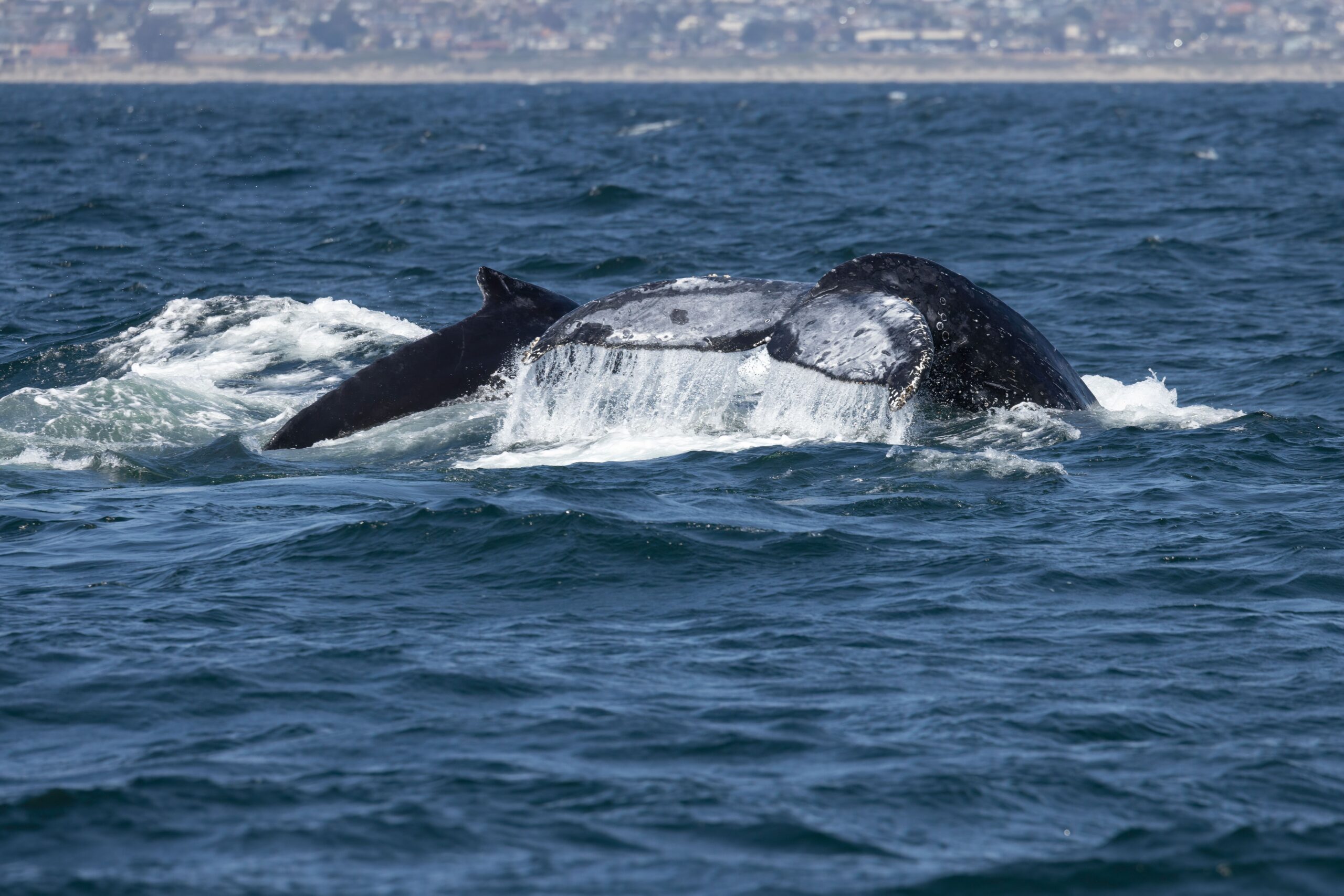
Sperm whales are among the mammals with the most exceptional deep-sea diving capabilities on Earth. To pursue prey such as giant squid, they can dive to depths of several thousand meters.
Diving Depth
Average dives
Approx. 400–1,000 m
Deep dives
1,500–2,000 m range
Record-breaking dives
Over 2,250 m
…have been recorded.
This is an astonishing capability for a diving mammal of this size.
Dive Duration
Sperm whales can hold their breath for remarkably long periods.
| Type | Dive Duration |
|---|---|
| Typical foraging dive | 30–45 minutes |
| Deep-sea hunting | 45–60 minutes |
| Maximum duration | Over 90 minutes |
Considering that human freediving records range from a few minutes to just over ten minutes, this is on a completely different scale.
How can they dive for so long?
① Storing large amounts of oxygen in the muscles
Sperm whale muscles contain high levels of
myoglobin,
an oxygen-storing protein.
The quantity is far greater than in land mammals,
with concentrations so high that the muscles appear dark in color,
enabling a continuous supply of oxygen to the muscles even while diving.
② Lowering the heart rate
Upon diving,
the “diving reflex”
is triggered.
Changes:
Normal state
↓
Heart rate drops
↓
Blood is preferentially distributed to the brain and heart
↓
Oxygen consumption is conserved
③ Collapsing the lungs to prevent nitrogen toxicity
Water pressure becomes extremely high in the deep sea.
At 1,000 meters, the pressure is approximately 100 atmospheres.
However, sperm whales withstand this by:
having flexible ribs,
allowing their lungs to compress in response to the pressure,
and closing off their alveoli.
This allows them to avoid the risk of decompression sickness (the “bends”) that affects human divers.
About Their Vocalizations
Sperm whales are among the loudest animals on Earth.
However, rather than producing the low-frequency “whale songs” typical of other species, they communicate and hunt using rapid-fire clicking sounds.
Their Primary Vocalization: “Clicks”
Characteristic sounds of the sperm whale:
● Clicks
Sound characteristics:
A rapid series of “click-click” sounds
Extremely short pulses
Travels long distances underwater
Uses:
✅ Echolocation (detecting prey)
✅ Communication with other whales
✅ Assessing the surrounding environment
Among the Loudest Sounds in the World
Sperm whale clicks are incredibly powerful.
Sound pressure: Estimated to reach over 230 decibels
A level louder than a jet engine
A massive organ in the head:
The spermaceti organ (specifically the “junk”)
Plays the role of generating and focusing the sound.
“Detection Sounds” Used for Deep-Sea Hunting
The deep ocean is in total darkness.
Sperm whales do not rely on their eyes;
Instead, they use the ability to
“see with sound.”
The process:
Emit a click
↓
Sound waves strike squid or fish
↓
Receive the reflected sound (echo)
↓
Determine the prey’s distance, size, and location
They are believed capable of detecting targets hundreds of meters away.
Signals to Others Known as “Codas”
Sperm whales have a unique form of communication.
Codas
These are patterns of clicks produced in a specific rhythm.
Example:
Regular clicks such as
“Click-click-click-click”
Roles:
Identifying individuals
Maintaining pod cohesion
Communication between mother and calf
Social interaction
Seasonal Activities
Unlike species such as the blue whale, sperm whales do not follow a clear seasonal migration pattern of feeding in high latitudes during summer and breeding in low latitudes during winter.
However, they do exhibit seasonal changes in behavior depending on sex, age, and location.
Spring (March–May)
Activities
Recovery following the winter breeding season
Increased foraging activity in the deep sea
Movement of pods begins
Females and Calves
Live in matrilineal pods
Continue rearing calves in warmer waters
Often rest in shallower waters
Males
Travel alone or in small groups
Some individuals head toward higher-latitude feeding grounds
Summer (June–August)
Period of peak activity
Summer brings an abundance of deep-sea prey in many regions; large males, in particular, may:
Migrate to high-latitude waters near the Arctic or Antarctic
Consume large quantities of deep-sea squid
Eat hundreds of kilograms of food per day
Diving Activity
Summer foraging season:
Diving dozens of times a day
Diving to depths of 700–1,500 meters
Searching for prey such as giant squid
…repeating these actions.
Autumn (September–November)
Season of preparation for breeding
In autumn, males increasingly:
Migrate to warmer waters
Approach female pods
Mature males, in particular:
Travel distances of several thousand kilometers
Migrate to breeding grounds
Compete with other males
Winter (December–February)
Breeding season
Breeding activity intensifies in warm tropical to subtropical waters.
Males
Large males:
Visit female pods
Compete for breeding opportunities
Engage in displays of intimidation or social interaction using click sounds
Females
Live in pods
Rear calves
Engage in social interaction
On Swimming Speed
Due to their massive size, sperm whales are not animals capable of the high-speed swimming seen in dolphins. However, they have evolved an efficient swimming style suited for long-distance travel, deep-sea diving, and pursuing prey.
Normal Swimming Speed
Cruising speed
Approximately 5–10 km/h
They can maintain this speed for extended periods.
Uses:
Traveling between ocean regions
Moving as a pod
Searching for feeding grounds
Swimming while resting
Maximum Speed
The top speed of a sperm whale is estimated to be
around 20–25 km/h.
However, this applies only to short bursts of acceleration.
Uses:
Escaping danger
Pursuing prey
Competition between males
Reacting to vessels, etc.
Speed During Deep-Sea Diving
When diving deep, they prioritize energy conservation over high speed.
During descent
Approximately 3–5 km/h
During deep-sea exploration
Swimming slowly while emitting click sounds
Searching for prey
During ascent
Rising by powerfully moving the tail fluke
This is the typical pattern.
How do they move their massive bodies?
A distinctive feature of sperm whales is that, unlike fish which move their tails from side to side,
they move their tail flukes up and down.
Evolutionary difference:
Fish
→ Move the spine from side to side
Cetaceans (whales)
→ Move the spine up and down
This movement of the spine is similar to that of land mammals when running.
About Sperm Whale Calves
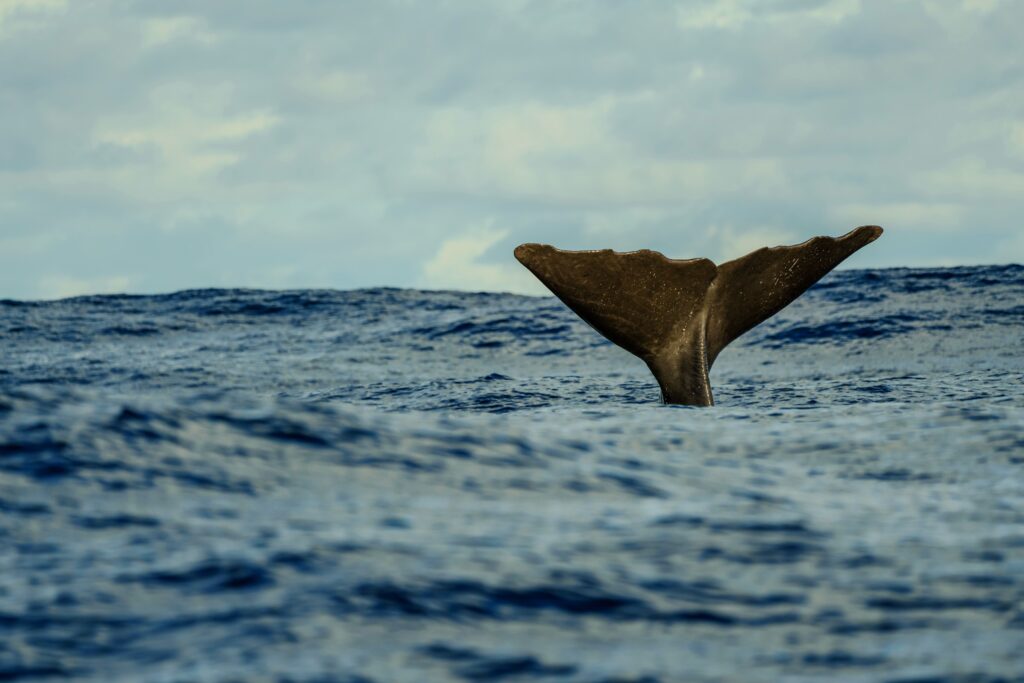
Sperm whale calves are “cuddly, intelligent baby whales that grow up protected by their mothers and pods for a very long time.”
In contrast to the gigantic adult whales, they go through a social and sensitive developmental stage.
① Immediately after birth
Body length: Approximately 3.5-4m
Weight: Approximately 1 ton
Able to swim immediately after birth (unusual among mammals)
Swim alongside or under their mother’s belly
Babies are already much larger than humans.
② Nursing and Growth
Breast milk is very high in fat.
Lactation period: More than 2 years (sometimes several years).
Growth is slow but steady.
Extended lactation develops the brain and diving ability.
③ Raising in a group
Live in a family group centered around a female and her young
Females other than the mother
Take turns watching over the young (nurturing behavior)
In times of danger, they focus on protecting the young
“Cooperative parenting” in the sea.
④ Behavioral Characteristics
Often play near the surface
Practice swimming and diving through play
Learn communication by making clicking sounds
Play = learning.
⑤ Development of diving ability
Young animals start with shallow dives
Gradually develop deeper and longer dives
It takes more than 10 years to reach adult level
A long training period before becoming a deep-sea hunter.
⑥ Danger and Protection
Young animals’ natural predator: Killer whales
They form a circle with their young, protecting them in the center
Getting lost reduces their survival rate
⑦ After adulthood
Females: Often remain in the group for their entire lives
Males: Leave the group at around 10-15 years of age and become independent
It takes more than 20 years to become a mature male
Is the sperm whale an endangered species?
Sperm whales are listed as an endangered species. It is also listed in Appendix I of the Washington Convention, and international trade is restricted. The reason for the large decline in population is probably the whaling problem and ocean pollution. Although they are now restricted to some extent, in the past they could do whatever they wanted, so their numbers have decreased dramatically.
✅ IUCN (International Union for Conservation of Nature) Red List
Category: Vulnerable (Vulnerable/Endangered)
→ This species is considered to be at high risk of future extinction (a level less than endangered).
IUCN is the world’s most authoritative species assessment organization, and sperm whales are classified as “vulnerable.”
Other conservation assessments
Under U.S. law (the Endangered Species Act), sperm whales are classified as “endangered.”
They are also listed in the Convention on International Trade in Endangered Species (CITES),
which strictly restricts international trade.
Major reasons
Former large-scale whaling
During a long history of mass hunting by humans, populations have declined.
Fishery entanglement/accidents
Fish can die from entanglement in nets or collisions with ships.
Marine pollution/noise
Chemical pollution and ship noise are thought to affect even deep-sea species.
What about the population?
The exact global population is unknown, but some estimates put it at hundreds of thousands to millions (high compared to other whales).
However, because they mature and reproduce slowly, their populations are small.
Can sperm whales be kept as pets?
Sperm whales cannot be kept in captivity. In the first place, it is not an animal that can be kept as it is too large.
① Completely illegal
Sperm whales are internationally protected (IWC, CITES)
Private captivity, ownership, and trade are prohibited in almost all countries, including Japan.
Capturing and transporting them is illegal.
Buying or keeping them is not an option.
② Ecologically impossible to keep.
Sperm whales are:
15-18m in length and weigh over 50 tons.
Deep-sea creatures that dive to depths of 1,000-2,000m.
Migratory animals that travel dozens of kilometers per day.
❌ Aquarium tanks.
❌ Ocean fish ponds.
❌ Private swimming pools.
None of these environments are viable.
③ Extremely advanced intelligence and sociality.
Highly intelligent.
They communicate through sound and live in family groups.
Long-term care and training are required.
Keeping them alone or in an artificial environment can cause severe psychological distress (an animal welfare issue).
④ Safety Danger
A single flick of their tail fin is enough to destroy a ship.
The risk of unintended accidents is extremely high.
Friendliness does not necessarily mean safety.
Even “gentle” giant animals are uncontrollable.
Zoos and Aquariums Keeping Them (Japan and Worldwide)
To put it briefly, there are currently no zoos or aquariums in the world that keep sperm whales in captivity.
There have been no instances—either in Japan or elsewhere—of a live sperm whale being kept in captivity for an extended period.
There have been cases where sperm whales were temporarily placed under human care.
Examples include:
Individuals that wandered near the shore
Stranded individuals
Whales requiring rescue
And so on.
However, these instances represent temporary rescue operations rather than captivity in a zoo setting.
Introducing other animals




コメント