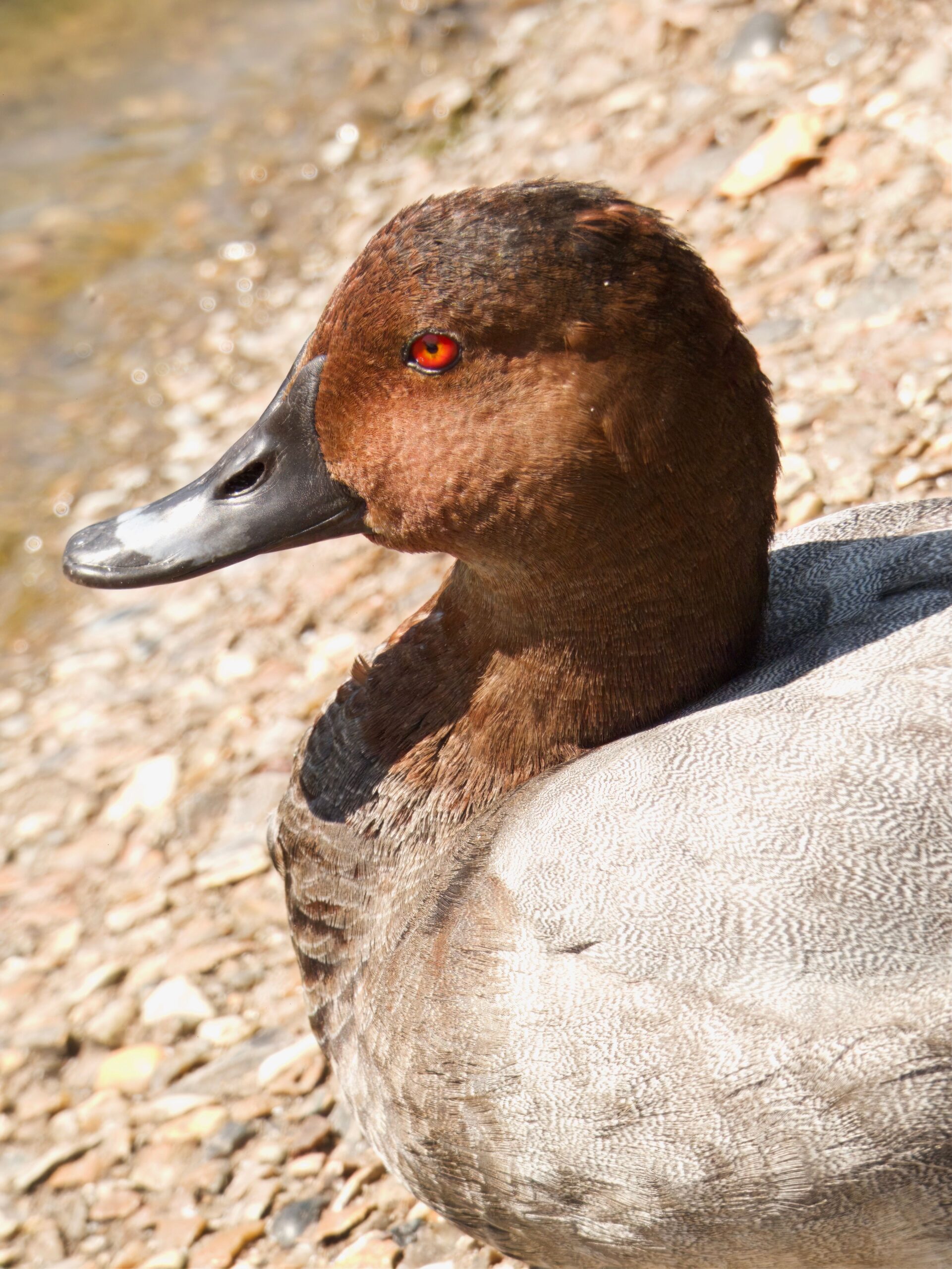
What kind of bird is the starfish? We will explain its characteristics, ecology, and habitat. The white-crowned nighttail has a very distinctive red head and is a bird that can mainly be seen in Europe. In winter, this bird appears in northern Africa and the Middle East, but it is actually an endangered species.



- What is a starfish? About basic status
- What are the roots and origins of the Common Pochard?
- About habitat
- feature is? What kind of creature is it?
- What does the ecology look like?
- About Diving
- About Vocalizations
- Seasonal Activities
- Regarding Walking Speed
- About Common Pochard Chicks
- Is the white-crowned nighttail designated as an endangered species?
- Can starfish be kept as pets?
- Zoos Housing the Species (Japan & Worldwide)
- Introducing other animals
What is a starfish? About basic status
The white-crowned nighttail is a bird classified in the Anseriformes order, Anseriformes family, and the Anseriformes genus. The kanji is Hoshiba Shiro, and the scientific name is Aythya ferina. The total length is 42-49cm, the wingspan is 72-82cm, and the weight is 0.5-1kg. The list of information is as follows.
| Japanese(和名) | ホシハジロ |
| English(英名) | Common pochard Eurasian pochard European pochard |
| scientific name(学名) | Aythya ferina |
| classification(分類) | Ave、 Anseriformes、Anatidae、Aythya 鳥綱、カモ目、カモ科、ハジロ属 |
| IUCN Status(保全状況) | VULNERABLE |
| Length(全長) | 42-49cm |
| Weight(体重) | 0.5-1kg |
What are the roots and origins of the Common Pochard?
The Common Pochard (scientific name: Aythya ferina) is a diving duck belonging to the genus Aythya within the family Anatidae (ducks, geese, and swans). Currently, it is widely distributed from Europe through Central Asia to southern Siberia; in Japan, it primarily arrives as a winter visitor.
Ancestors: “Ancient Diving Ducks”
The ancestors of the Common Pochard belong to an ancient lineage of the genus Aythya that emerged several million years ago or earlier.
In the evolutionary history of the Anatidae family, the progression is believed to have followed this path:
Primitive ducks
↓
A group that developed underwater diving capabilities
↓
Aythya species (diving ducks)
↓
Common Pochard
The Aythya group diverged from ducks that fed on aquatic plants in shallow water, evolving into a group with enhanced capabilities for diving underwater to forage.
Origins of the Genus Aythya
The genus Aythya, to which the Common Pochard belongs, includes species such as:
Common Pochard
Tufted Duck
Greater Scaup
Baer’s Pochard
Ferruginous Duck
This group evolved in the lake and wetland environments of the Northern Hemisphere.
Environmental changes caused by the Ice Ages played a particularly important role.
During the Quaternary period (starting approximately 2.6 million years ago),
the expansion of ice sheets,
changes in lake environments, and
fluctuations in sea levels
occurred repeatedly, causing duck populations to become fragmented.
As a result, it is believed that they diverged into lineages such as:
Northwest Eurasian
East Asian
North American
Unique Evolution of the Common Pochard
The Common Pochard specifically developed the following capabilities:
Diving ability
Evolving from ancestral surface-feeding ducks, it acquired:
strong leg muscles
legs positioned further back on the body
dense plumage
a body structure capable of adjusting buoyancy As a result,
diving to depths of several meters,
feeding on the roots of aquatic plants and other vegetation,
and consuming shellfish and aquatic insects
became possible.
Origin of the Name
The name “Hoshihajiro” is derived from:
“Hajiro” (meaning “white-wing”): referring to a duck with white patches on its wings;
“Hoshi” (meaning “star”): referring to the fine black-and-white pattern on the male’s back, which resembles stars.
The male has a distinctive appearance, featuring:
a reddish-brown head,
a black breast,
and a gray back.
Taxonomy of the Common Pochard
The Common Pochard is a bird and a type of freshwater duck belonging to the Anseriformes order.
| 分類階層 | 名称 |
|---|---|
| 界 (Kingdom) | Animalia(動物界) |
| 門 (Phylum) | Chordata(脊索動物門) |
| 綱 (Class) | Aves(鳥綱) |
| 目 (Order) | Anseriformes(カモ目) |
| 科 (Family) | Anatidae(カモ科) |
| 属 (Genus) | Aythya(アカハジロ属) |
| 種 (Species) | Aythya ferina(ホシハジロ) |
About habitat
The white-crowned nighttail is distributed mainly in Europe.
- Global Distribution
The Common Pochard is a migratory bird found widely distributed mainly in Eurasia.
Breeding Grounds (Summer):
Northern Europe, northwestern Russia to southern Siberia
Breeds in wetlands, freshwater lakes, and around rivers.
Wintering Grounds (Winter):
Western Europe (UK, France, the Netherlands, etc.)
Middle East, India, East Asia (China, Japan, the Korean Peninsula)
Also winters in shallow coastal lakes, estuaries, and bays.
- Habitat in Japan
Migratory Period: Mainly October to March
Main Wintering Grounds:
Lakes and marshes in Hokkaido and the Tohoku region
Large ponds and rivers in the Kanto, Chubu, and Kinki regions
Also observed in tidal estuaries and bays.
Behavior:
Often lives in groups.
Dives to feed on aquatic plants and aquatic organisms.
- Habitat Characteristics
Water Type:
Freshwater lakes, rivers, ponds, and wetlands
Can also be found in shallow bays and brackish waters in winter
Water Quality and Depth:
Prefers relatively calm, shallow waters
Vegetation:
Areas with abundant aquatic plants and algae
Environments with an abundance of aquatic insects and small fish to feed on
feature is? What kind of creature is it?
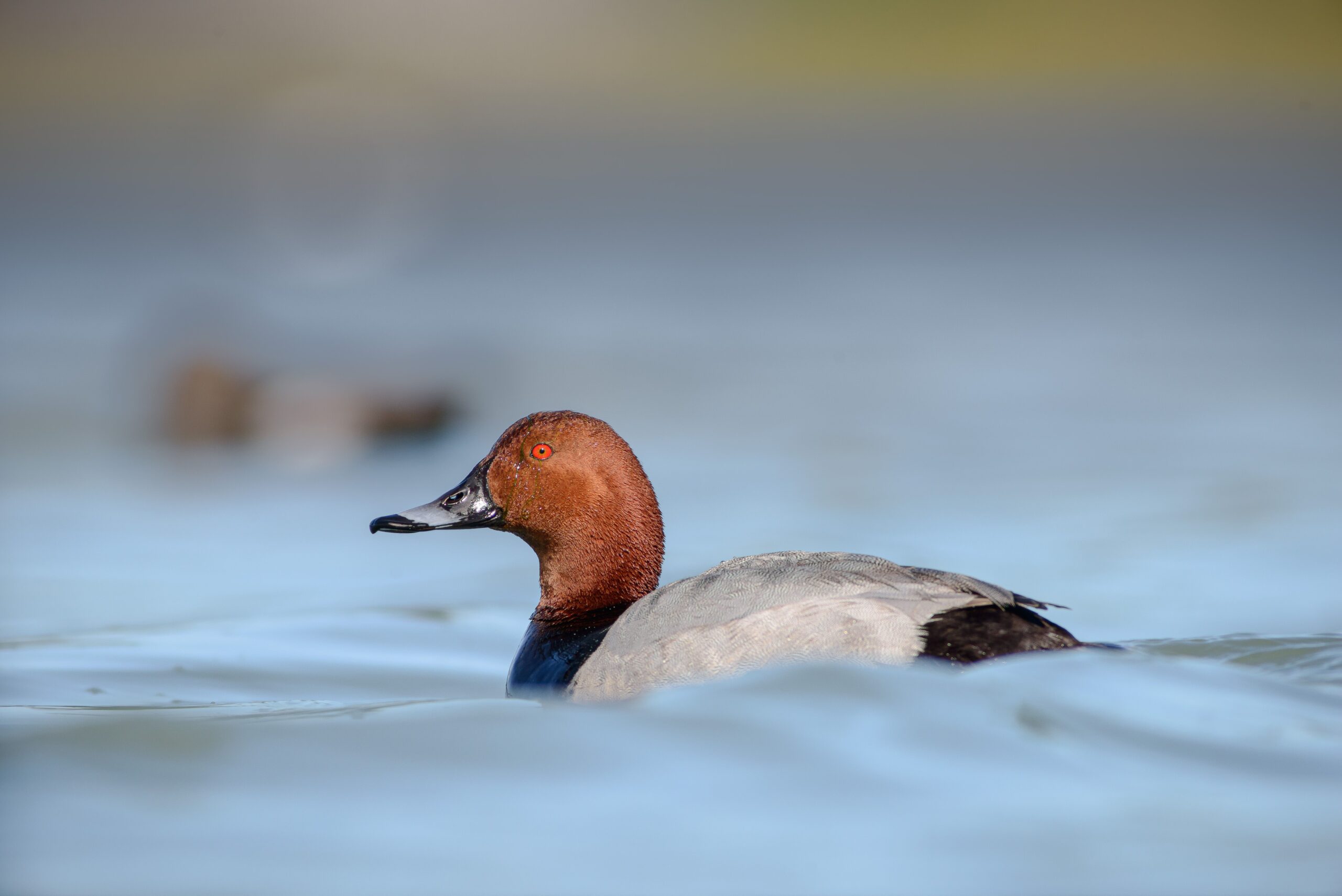
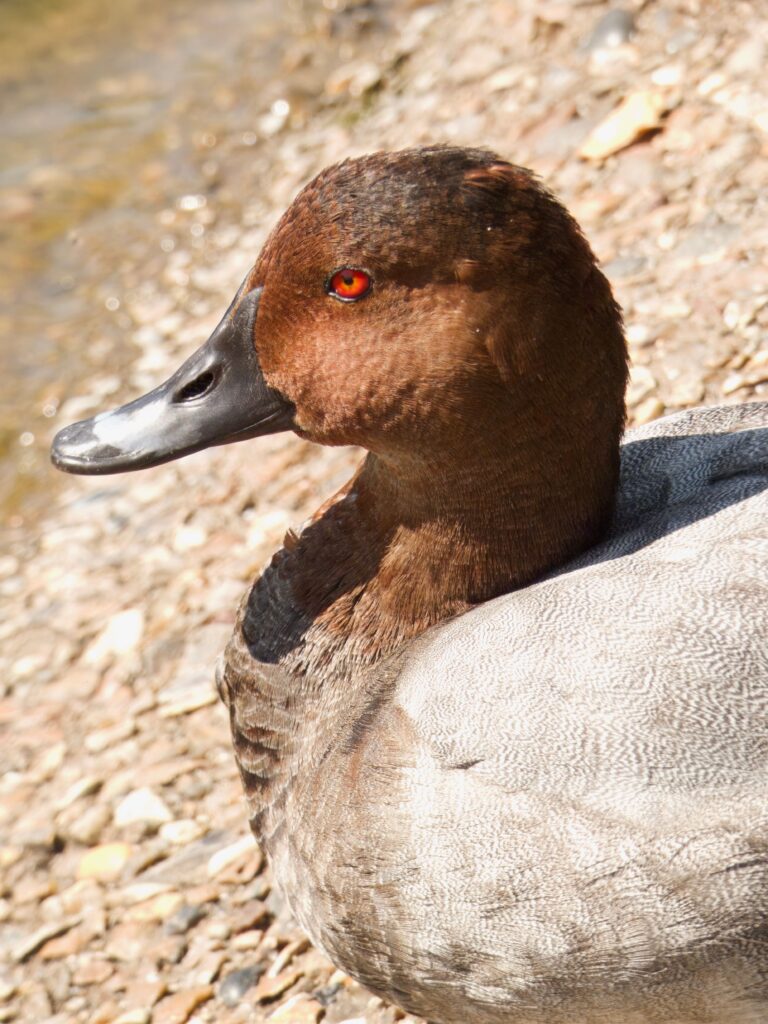
The male white-tailed flycatcher has reddish-brown plumage from the head to the neck, and the feathers covering the chest plumage and the base of the tail feathers are black. Female irises are brown. The white-crowned nighttail is quite widespread in Europe, and in winter it spends the winter in northern Africa, the Middle East, and India. White-crowned nighttails live in lakes, rivers, estuaries, and inner bays.
- Appearance
Male
Head: Reddish-brown and shiny
Chest: Black
Back and Wings: Gray
Eyes: Yellow
Bright, eye-catching coloring throughout
Relatively vivid even in winter plumage
Female
Overall: Subdued brown coloring
Chest and back: Shades of brown
Eyes are slightly darker than those of the male
From a distance, it appears to be an ordinary brown duck
Common
Body Length: Approximately 45-50 cm (medium-sized duck)
Wingspan: Approximately 70-80 cm
A diving duck with a rounded body that excels at floating in water
- Ecology & Behavior
Diet
Mainly forages by diving
Aquatic plants, algae, small fish, crustaceans, aquatic insects, etc.
Diet changes depending on the season and location
Habitat
Lakes, ponds, estuaries, wetlands, shallow inland bays
In winter, they form flocks, with groups of dozens to hundreds of birds
Breeding
Breeding season (spring-summer) takes place in northern wetlands and lakes
Nests are built in grassy patches or floating islands near the water’s edge
Lays 8-12 eggs per breeding
Flight & Migration
Excellent migratory birds, traveling long distances
Flying in a straight, fast flight, often near the water’s surface
- Personality & Characteristic Behavior
Generally timid, but calm when in a flock
They are characterized by their diving to search for food at the surface in winter
During the breeding season, the male’s reddish-brown head becomes brighter, attracting females
What does the ecology look like?
The starfish is a herbivorous diet, subsisting on seeds, leaves, buds, underground stems, fish, and amphibians. The reproductive form is oviparous. They build nests made of reeds piled up in bushes near water or on top of aquatic plants floating on the water’s surface. The female lays 8-10 eggs and incubates them. The lifespan is about 20 years.
- Diet/Foraging Behavior
Diving Ducks
They dive underwater to feed on aquatic plants, algae, small fish, crustaceans, shellfish, and insects.
Foraging Method
They submerge their bodies and dive to grab plants and animals from the bottom.
Time of Day
They also forage during the day, but often move in groups, ensuring safety.
- Breeding
Breeding Season: Spring to Summer (Northern Breeding Grounds)
Nests:
They build nests on the water’s edge of lakes and marshes, floating islands, and grassy areas.
They prefer locations slightly above the water surface.
Eggs: Approximately 8-12 per clutch
Rearing:
Females are responsible for incubation and raising the eggs.
Chicks begin swimming immediately after hatching and grow by feeding on small aquatic animals and plants.
- Migration/Migration
They are migratory birds, traveling between breeding and wintering grounds.
Migration Distances: Can be thousands of kilometers.
Wintering areas: Japan, western Europe, India, East Asia, etc.
They often travel in flocks, ensuring safety while flying.
- Sociality/Flocking
They often form flocks in winter.
They can form large flocks of dozens to hundreds of birds.
They dive to feed while checking each other’s positions within the flock.
Both males and females mingle with the flock outside of the breeding season.
- Habitat and Adaptation
They prefer shallow waters such as freshwater lakes, ponds, estuaries, and marshes.
They can adapt to tidal estuaries and inland bays.
They have the flexibility to change their feeding locations depending on water quality and the presence of aquatic plants.
Are there any natural enemies?
The nests of white-tailed hawks are often raided by eagles and hawks.
About Diving
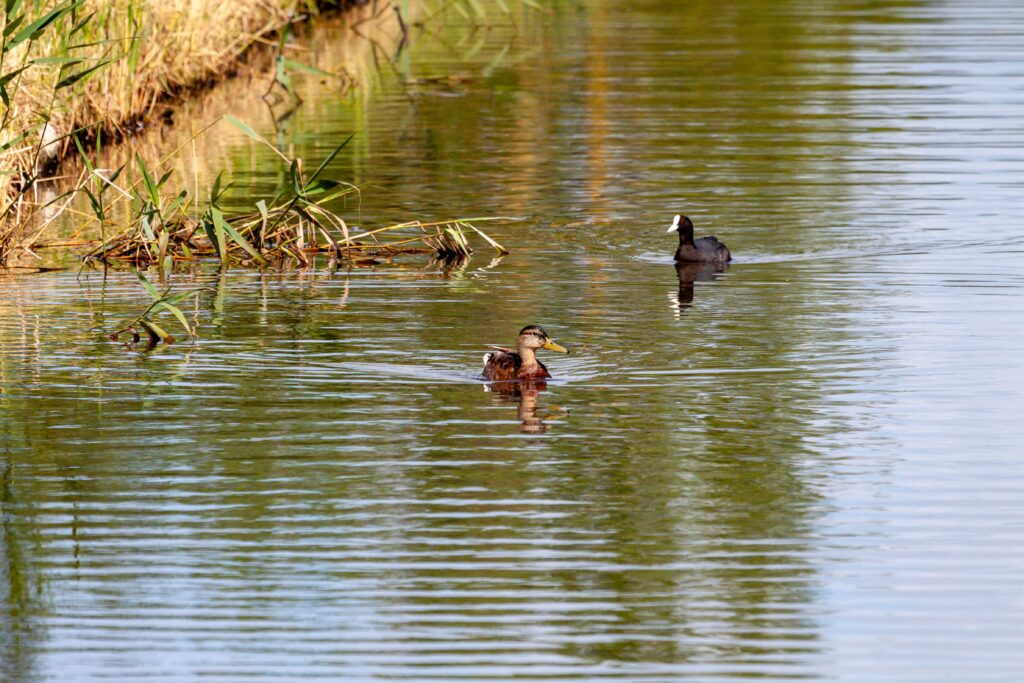
The Common Pochard (Aythya ferina) belongs to the group of ducks known as “diving ducks,” which are specialized for underwater foraging. Unlike ducks that merely float on the surface, they are adapted to dive underwater to search for food.
Diving Duration
A typical dive by a Common Pochard lasts:
Approximately 10 to 30 seconds
In some situations, they may stay submerged for around 40 seconds
While they are not birds that remain submerged for long periods, they excel at efficiently searching the lakebed during short dives.
Diving Depth
They typically dive to depths of:
1 to 3 meters
Up to around 5 meters in deeper areas
In lakes and ponds, they are most active in shallower areas where aquatic plants grow.
Diving Method
The Common Pochard’s diving technique is distinctive:
① Adjust posture on the water surface
↓
② Tilt the head forward
↓
③ Kick the water strongly with the feet
↓
④ Submerge with the body in a vertical position
↓
⑤ Forage on the lakebed
Unlike other ducks that perform “dabbling” (tipping up to feed with only their tails in the air), the Common Pochard submerges its entire body underwater.
About Vocalizations
The Common Pochard (Aythya ferina) is a diving duck that produces relatively quiet, low-pitched sounds, rather than the loud “quack-quack” calls typical of Mallards. Males, in particular, make distinctive sounds.
Male Calls
Typical calls made by the male include:
“Wee-wee”
“Pui-pui”
“Kururu-kururu”
These are soft sounds resembling a whistle.
Characteristics:
Low volume
Low-pitched, nasal quality
Resonates across the water surface
Sounds like a whistle when heard from a distance
These calls become especially frequent during the breeding season.
Female Calls
Females have a louder voice than males, producing short calls such as:
“Quack-quack” (or “Kwah-kwah”)
“Ga-ga”
Functions:
Responding to males
Checking the location of flock mates
Signaling danger
Breeding Season Calls
During the spring breeding season (mainly April to June), males call as part of courtship.
Behavior:
They perform displays such as:
Stretching the neck
Bobbing the head slightly up and down
Making soft calls on the water surface
However, pochards are not ducks known for flamboyant courtship displays, and their vocalizations are relatively subdued.
Calls in Winter Flocks
During the winter season, when they are commonly seen in Japan, their vocal activity is limited to:
Floating in large flocks on the water
Communicating with each other using soft calls
Calling back and forth before taking flight
On lakes, one might hear soft sounds like:
“Pui…”
“Kururu…”
Seasonal Activities
The Common Pochard (Aythya ferina) is a migratory bird whose habitat, diet, flocking patterns, and behavior change significantly depending on the season. In Japan, they primarily arrive in autumn, overwinter, and return north in the spring.
Spring (March–May)
Migration North and Preparation for Breeding
Key Activities
Migrating from wintering grounds to breeding grounds
Males performing courtship displays
Forming breeding pairs
Behavioral Characteristics
Resting in lakes, marshes, and wetlands
Eating aquatic plants to regain physical strength
Males stretching their necks and calling
Diet
Aquatic plants
Plant seeds
Shellfish
Aquatic insects
In spring, they spend more time foraging in preparation for long-distance migration.
Summer (May–August)
Breeding and Rearing Season
Primary Habitats
Europe
Western Russia
Siberia
Lakes and marshes in Central Asia
Breeding Behavior
Nesting occurs in areas such as:
Shallow lakes
Wetlands
Areas surrounding reed beds
Rearing Young
The female takes the lead in:
Incubating eggs
Guiding chicks to the water’s edge
Protecting them from predators
Chicks are able to swim immediately after hatching.
Autumn (September–November)
Migration and Preparing for Winter
Key Activities
Migrating south from northern breeding grounds
Increasing numbers of individuals arriving in Japan
During migration, they rest in locations such as:
Large lakes
River estuaries
Bays
Ponds
Flocking Behavior
In autumn, one can observe:
Flocks ranging from dozens to hundreds of birds
Resting in groups on the water surface
Diving in unison
Winter (December–February)
Peak Period of Activity in Japan
This is the season when they are most easily observed in Japan as winter visitors.
Primary Locations
Lakes
Ponds
Reservoirs (dam lakes)
Rivers
Inner bays
Daily Routine
Early Morning
Resting in flocks
Slowly beginning activity
↓
Daytime
Diving to forage
Searching for aquatic plants and shellfish
↓
Evening
Resting in flocks
Preening
Regarding Walking Speed
The Common Pochard (Aythya ferina) is a bird not particularly adept at walking. This is because its evolution has specialized for underwater diving rather than a terrestrial lifestyle.
Typical Walking Speed
While there is little precise field data on the Common Pochard’s walking speed, estimates based on the general body shape of diving ducks suggest:
Approximately 0.3–0.8 m/s
(approx. 1–3 km/h)
This is significantly slower than human walking speed (approx. 4–5 km/h), and they generally only move short distances on land.
Why Are They Poor Walkers?
① Legs Positioned Toward the Rear of the Body
The Common Pochard’s legs are:
Located toward the rear rather than the center of the body
Positioned to generate strong propulsion underwater
Advantages:
✅ Fast diving
✅ Easy to change direction underwater
Disadvantages:
❌ Difficult to support the body on land
❌ Difficult to maintain an upright posture
② Feet Adapted for Water
The feet feature:
Large webs
Long toes
Strong muscles
While ideal for swimming, on land, this results in:
A gait where the feet drag
A waddling movement
Behavior on Land
Common Pochards rarely come ashore; they do so mainly to:
Rest on the shore
Preen their feathers
Move short distances to avoid danger
Move around the nesting area
Foraging is also primarily conducted by:
Diving underwater
Taking food from the water’s surface
About Common Pochard Chicks
This article provides detailed information on the characteristics and ecology of Common Pochard (Aythya ferina) chicks (young birds).
- Birth and Early Life
Hatching Period: Spring to Early Summer (at breeding grounds)
Number of Eggs: Approximately 8-12 per clutch
Incubation Period: Approximately 23-25 days (female incubates)
- Appearance
Plumage: Newly hatched chicks have fluffy, soft down feathers with mottled yellow and brown patterns.
Inconspicuous Coloration: Their overall coloring is dull to protect them from predators.
Body Shape: Small and round, but adapted for swimming and diving.
- Behavior and Abilities
Swimming: Able to swim immediately after birth.
Diving: Diving ability develops gradually.
Foraging: Initially guided by the female, they peck at small animals and aquatic plants in the water.
Alert Behavior: They maintain safety within the flock while being protected by their mother.
- Growth
Flight Ability: They become capable of flight at approximately 50-60 days of age.
Molt: Their newborn down is replaced by adult feathers.
Independence: Once they are able to fly, they can forage independently from their parents.
- Biological Characteristics
Chicks quickly adapt to aquatic life.
They gradually learn the skill of diving forage from an early stage of development.
The mother and her flock defend against predators (crows, raptors, small terrestrial predators).
Is the white-crowned nighttail designated as an endangered species?
The white-crowned nighttail is designated as an endangered species. Their population has declined dramatically due to changes in their natural habitat and overhunting. In Europe, this decline rate is 30-49% over 20 years, which is a very serious situation.
- International Status (IUCN)
IUCN Red List: Least Concern (LC)
Reason:
Relatively large population and widespread distribution.
Population declines have been reported in some areas, but overall the species is stable.
- Status in Japan
Not designated as a specially endangered species in Japan.
The number of migratory winter birds is stable, but attention must be paid to habitat loss due to lake reclamation and development.
- Precautions and Need for Protection
Habitat Conservation:
Deterioration of lake and wetland environments will reduce the number of wintering flocks.
Capture/Hunting:
No significant impact if properly managed.
Impact as a Migratory Bird:
Environmental changes in wintering and stopover areas may affect populations in the long term.
Can starfish be kept as pets?
It would be difficult to raise a starfish. It is designated as an endangered species, and its population is declining rapidly.
- Basic Pet Ownership
The Common Pochard is a wild migratory bird and is generally not sold as a pet.
Capturing and selling it in Japan may be restricted by law.
While not subject to regulation under the Convention on International Trade in Endangered Species of Wild Fauna and Flora (CITES), capturing wild specimens is generally prohibited under the Wildlife Protection Act.
Keeping them as pets is limited to breeding specimens or those bred in specialized facilities.
- Difficulty of Keeping
Requires a large water area
Because they dive, they require a deep pond or large aquarium with a large water surface.
Prefers to live in groups.
They are prone to stress when kept alone.
Diet
They require aquatic plants, small fish, and crustaceans, making food preparation difficult.
Winter Care
As they are migratory birds, they are sensitive to temperature and sunlight.
They have excellent flying ability.
They require large measures to prevent them from jumping out (such as a large enclosure or net).
- Overall Evaluation
Sea Pochards are not suitable as pets.
Keeping them is extremely difficult, requiring specialized knowledge and equipment.
Keeping them in the home is not practical, and observing them in the wild is the best way to interact with them.
Zoos Housing the Species (Japan & Worldwide)
While the Common Pochard (Aythya ferina) is not as commonly exhibited as the Mallard or the Eastern Spot-billed Duck, it can be found in zoos and bird parks that maintain waterfowl collections. However, because large numbers of wild individuals migrate to Japan during the winter, only a limited number of facilities keep and exhibit them specifically.
🇯🇵 Facilities in Japan
Inokashira Park Zoo
The Inokashira Park Zoo in Tokyo exhibits the Common Pochard.
Features:
Can be observed in the waterside bird exhibit area
Offers a chance to learn about the characteristics of diving ducks
Key highlights include the male’s red eyes and reddish-brown head
The zoo’s online animal encyclopedia also features the Common Pochard, explaining its habit of diving underwater to feed on aquatic plants and shellfish.
🌍 Facilities Worldwide
Overseas, the species can be seen relatively often in facilities specializing in waterfowl exhibits. Global zoo records indicate that the Common Pochard is kept at the following facilities:
🇩🇪 Germany
Zoologischer Garten Halle
A zoo with a waterfowl collection that keeps Common Pochards.
Zoologischer Garten Augsburg
Known for exhibits featuring European waterfowl; this zoo also keeps Common Pochards.
🇫🇷 France
Parc des Oiseaux
A large-scale bird facility housing a wide variety of species; records show they keep Common Pochards.
Introducing other animals
コメント