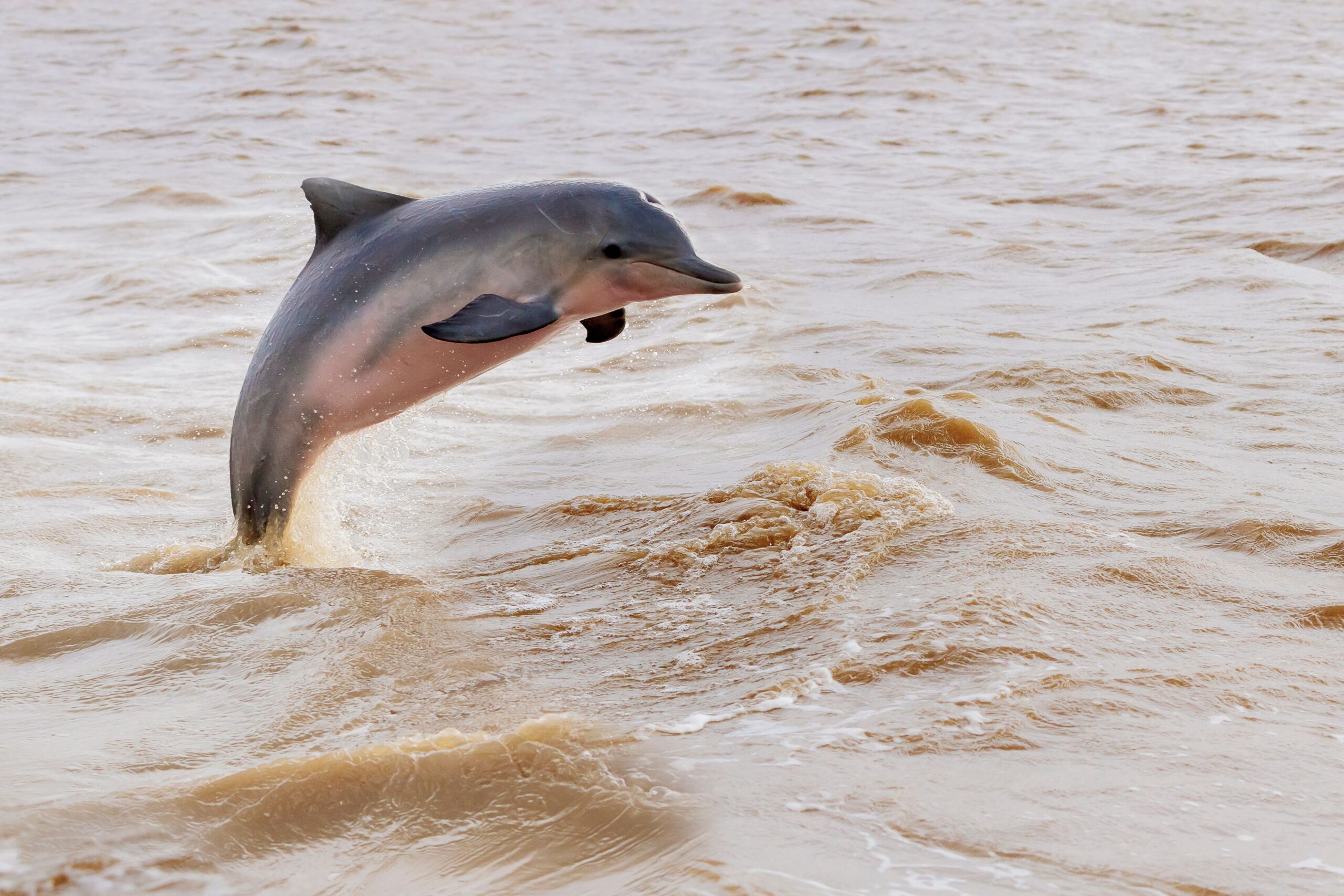
We will explain the characteristics, ecology, and habitat of the Amazon river dolphin. It is the largest living dolphin species and lives primarily in South America. Unfortunately, it is listed as an endangered species. We will explain the detailed ecology and characteristics.








- What is the Amazon river dolphin? About basic status
- What are the roots and origins of the Amazon river dolphin?
- About habitat
- feature is? What kind of creature is it?
- What is the ecology like?
- Diving Behavior of the Amazon River Dolphin
- Vocalizations
- Seasonal Activities
- About Baby Amazon River Dolphins
- Is the Amazon river dolphin an endangered species?
- Can Amazon river dolphins be kept in captivity?
- Facilities Housing the Species (Japan and Worldwide)
- Introducing other animals
What is the Amazon river dolphin? About basic status
The Amazon river dolphin is a cetacean classified in the mammalian class Artiodactyla (Cetacean artiodactyla) and the Amazonian river dolphin family Amazon River dolphin genus. The scientific name is Inia geoffrensis. The body length is 2.8m and the weight is 100-160kg.
| Japanese(和名) | アマゾンカワイルカ |
| English(英名) | Amazon river dolphin |
| scientific name(学名) | Inia geoffrensis |
| classification(分類) | Mammalia、 Artiodactyla/Cetartiodactyla、Iniidae、Inia 哺乳綱、偶蹄目/鯨偶蹄目、アマゾンカワイルカ科、アマゾンカワイルカ属 |
| IUCN Status(保全状況) | ENDANGERED |
| Length(体長) | 2.8m |
| Weight(体重) | 100 – 160kg |
What are the roots and origins of the Amazon river dolphin?
The Amazon river dolphin (also known as the pink river dolphin; scientific name Inia geoffrensis) traces its ancestry back to dolphins that lived in the ocean. Although they inhabit only freshwater today, they originally evolved from marine toothed whales.
Origins dating back 15–20 million years (Miocene epoch)
The prevailing theory suggests that during the Miocene epoch (approximately 15–20 million years ago)—a time when global sea levels were higher than they are today—vast shallow seas and wetlands covered northern South America.
The most widely supported scenario is as follows:
Ancestral dolphins living in the ocean moved inland.
Eventually, geological changes such as the uplift of the Andes Mountains cut off their connection to the sea.
Populations stranded in rivers and lakes adapted to the freshwater environment.
Over millions of years, they evolved into the modern Amazon river dolphin.
How did they come to live in rivers instead of the ocean?
The Amazon River presents a complex environment where forests are frequently submerged. Consequently, they evolved specific characteristics to thrive there:
Long, slender snouts that make it easier to catch fish.
Unfused neck vertebrae, allowing the head to move widely from side to side.
Highly developed echolocation capabilities, compensating for small eyes.
Flexible bodies that allow them to swim between submerged trees.
Recent research
In 2024, a fossil of a massive freshwater dolphin named Pebanista yacuruna, dating back approximately 16.5 million years, was discovered in Peru.
Interestingly, this fossil species was found not to be a direct ancestor of the modern Amazon river dolphin, but rather closely related to the South Asian Ganges river dolphin. This indicates that multiple dolphin lineages independently migrated from the ocean into freshwater environments in ancient times.
About classification
The Amazon river dolphin was originally classified as a member of the family Pelfinidae, but it has now been divided into the Amazonidae family. We have compiled a list of similar types below.
| Name (名前) | Scientific Name (学名) | Habit (生息地) |
| Amazon river dolphin | Inia geoffrensis geoffrensis | Ecuador, Brazil, and Peru エクアドル、ブラジル、ペルー |
| Bolivian river dolphin | Inia geoffrensis boliviensis d’Orbigny | Bolivia ボリビア |
| Orinoco river dolphin | Inia geoffrensis humboldtiana Pilleri & Gihr | Colombia and Venezuela コロンビア、ベネズエラ |
| Araguaian boto | Inia araguaiaensis Hrbek | Tocantins-Araguaia River Basin in the Amazon River Basin アマゾン川水域のトカンチンス・アラグアイア川流域 |
About habitat
As mentioned above, Amazon river dolphins live throughout South America.
- Main Habitat
Amazon River Basin: The Amazon River and its tributaries flow through countries such as Brazil, Peru, Colombia, Bolivia, Ecuador, and Venezuela.
Orinoco River Basin: Small populations exist in the Orinoco River, particularly in Colombia and Venezuela.
Freshwater Rivers and Lakes: They migrate seasonally as river water levels fluctuate, and during flood season, they may enter surrounding wetlands or temporary lakes.
- Habitat Characteristics
They specialize in freshwater and do not inhabit saltwater.
They prefer rivers with relatively calm depths and currents and abundant fish.
They can survive in relatively warm waters (approximately 25-30°C), even in murky waters.
- Distribution
Amazon river dolphins are widely distributed throughout rivers, from upstream to downstream, but populations are declining in some areas due to human activity and water pollution.
Due to their widespread migration during flood season, accurate population counts can be difficult to ascertain.
feature is? What kind of creature is it?
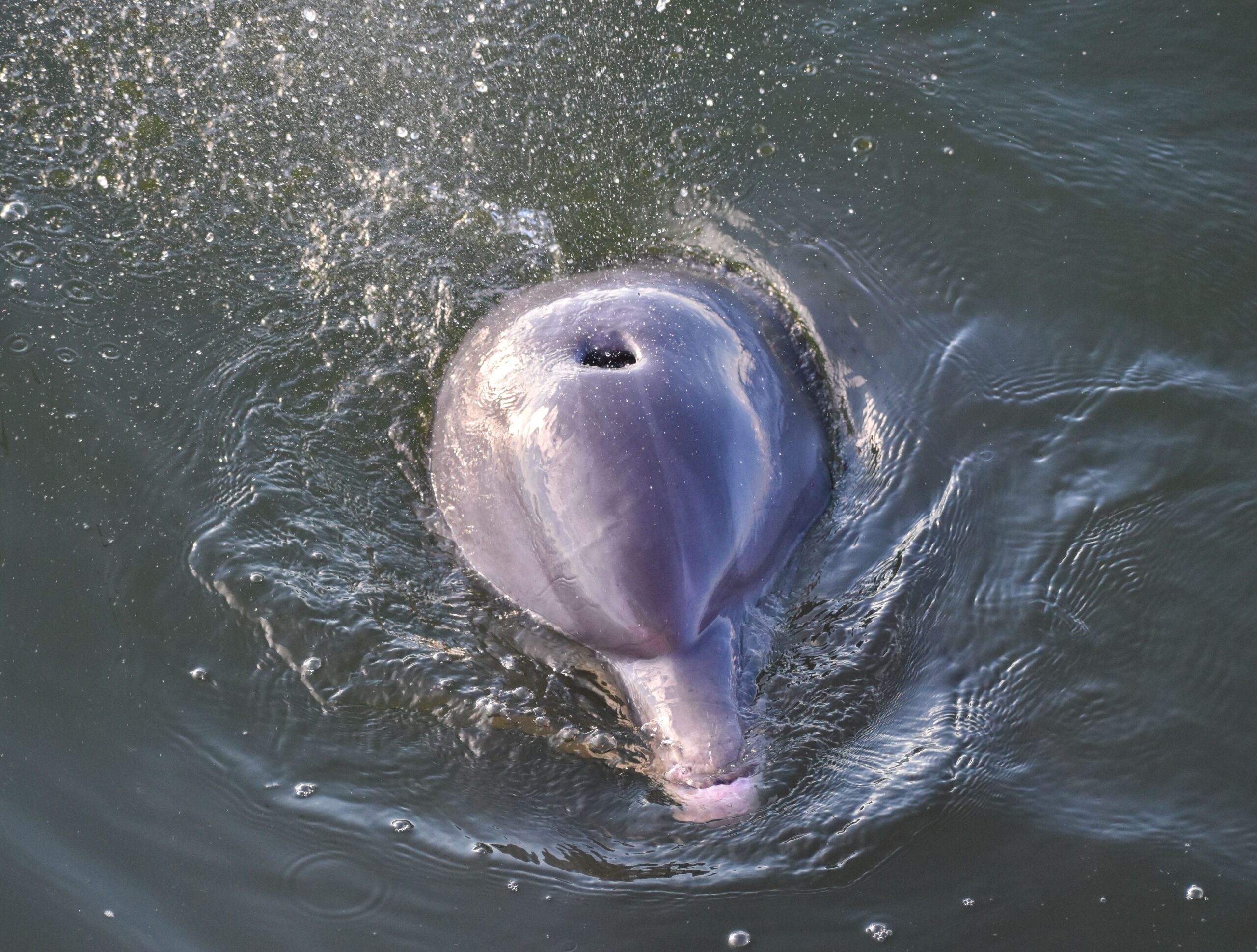
The Amazon river dolphin is the largest species of river dolphin. Its most distinctive feature is its snout and pink body color. Mainly bright pink, but also dark brown, cream, etc. The front teeth are sharp and pointed, and are used for catching fish rather than chewing food. Although their eyes are extremely small, their eyesight is very high. The pectoral fins are large relative to the body length and curve backwards. They usually travel alone or in pairs.
- Appearance and Physical Characteristics
Body Color: Adults range from pale pink to deep pink, with the color intensity varying between individuals. Young individuals are grayish, becoming more pink as they grow.
Body Length and Weight:
Body Length: Males approximately 2.5-2.8m, females approximately 2.3-2.5m
Weight: Males approximately 150kg, females approximately 100kg
Head: The forehead is rounded and the mouth is elongated and “beak-like,” making it easy to catch fish.
Dorsal Fin: There is only one small, rounded dorsal fin, not as large as that of an oceanic dolphin.
Fins and Tail: The pectoral fins are large and broad compared to the width of the body, and the tail fin is horizontally spread.
- Behavior and Ecology
Diet: Carnivorous, primarily eating fish, but also eating shrimp and crustaceans.
Intelligence: Even among dolphins, they are highly intelligent, exhibiting curious and playful behavior.
Sociality: They tend to live alone or in small groups. They rarely form large schools.
Aquatic Behavior: They often breathe near the surface and sometimes jump or slap the water with their tail fins.
- Special Characteristics
Color Change: When excited or active, their color may become a deeper pink due to increased blood flow.
Flexible Neck: Their neck bones (cervical vertebrae) move freely, allowing them to shake their heads from side to side. This is a characteristic not commonly seen in sea dolphins.
What is the ecology like?
Amazon river dolphins live by eating fish and squid that live in rivers. Breeding is seasonal, with birth occurring from May to June. The gestation period is estimated to be about 11 months, and lactation takes about a year. Dolphins become independent within two to three years. The average lifespan of Amazon river dolphins in the wild is unknown. Their lifespan in captivity is 10 to 30 years.
- Diet (What they eat)
They are freshwater carnivores, primarily feeding on fish.
They use their beaks to search for fish on the riverbed or among aquatic plants.
They occasionally eat shrimp, crustaceans, and small frogs.
They are nocturnal, with many individuals actively hunting at night or in the evening.
- Reproduction and Growth
Reproduction: Viviparous (they carry their young inside the womb)
Gestation Period: Approximately 11-12 months
Birth: Usually one pup
Child Development: They stay with their mother immediately after birth, and nursing continues for several months.
Sexual Maturity: Females reach maturity at 5-6 years, males at 7-10 years
Lifespan: Approximately 30-35 years in the wild
- Behavior and Sociality
They live alone or in small groups. They typically live in groups of a few to 10 individuals.
They are highly intelligent and curious, and may approach boats.
Communication: They communicate with each other through clicking and calls.
- Movement/Habitat Use
Seasonal Movement: Their range changes between the rainy and dry seasons.
Rainy Season: When rivers flood, they move to nearby wetlands or temporary lakes.
Dry Season: As water levels drop, they return to the main river or deeper waters.
Territory: While some individuals stay in a particular location for long periods of time, many individuals also move in search of food.
- Natural Enemies/Threats
They have few natural predators, with large fish and jaguars occasionally attacking young ones.
Human Impacts: The main threats are water pollution, dam construction, and bycatch in fishing.
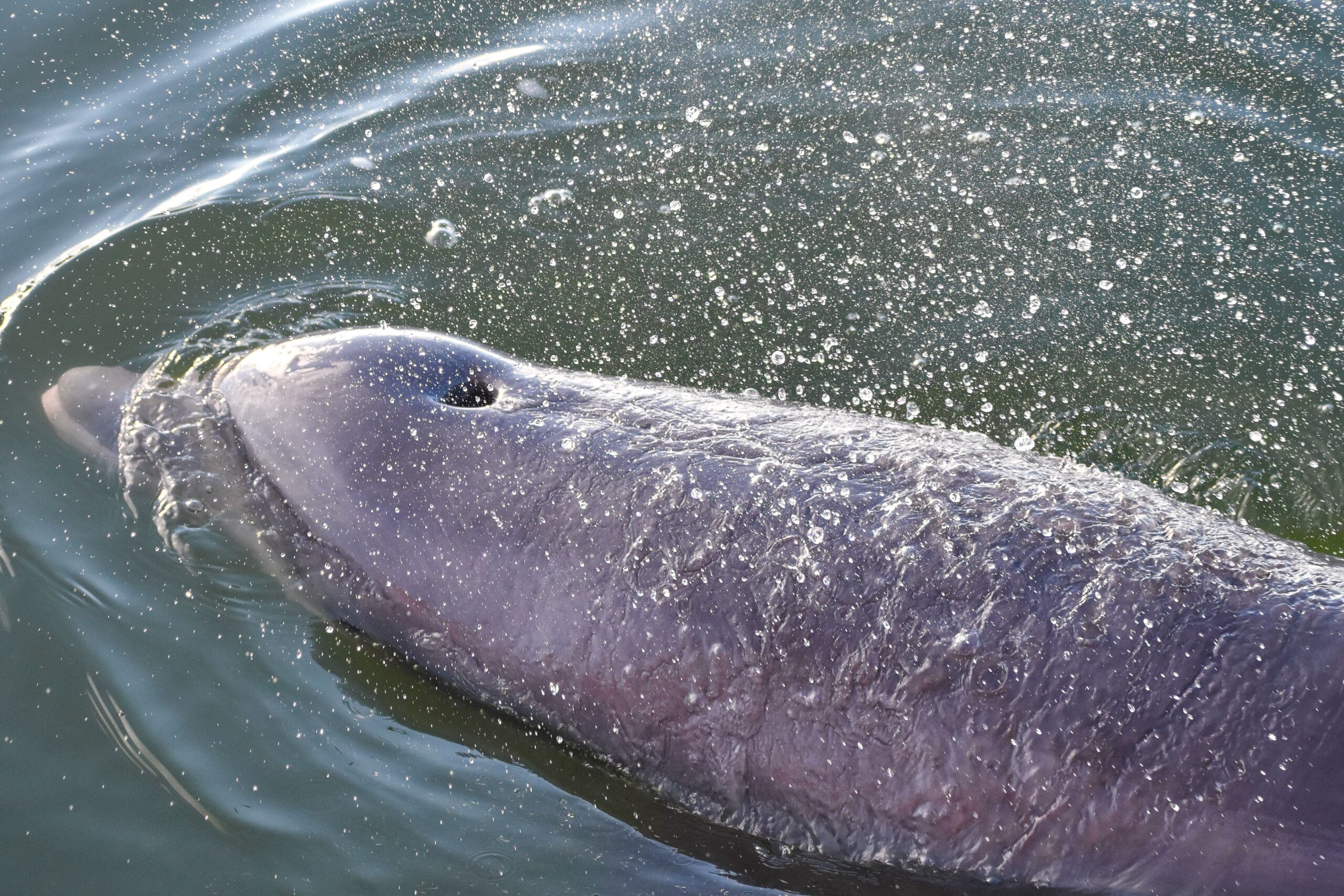
Diving Behavior of the Amazon River Dolphin
Although Amazon river dolphins (pink dolphins) do not dive as deeply or for as long as oceanic dolphins, they possess diving capabilities suited to their river environment.
Dive Duration
They typically remain submerged for about 30 to 90 seconds.
In some cases, they may stay underwater for around two minutes.
Unlike oceanic dolphins, they do not dive for tens of minutes at a time; instead, they surface frequently to breathe.
Dive Depth
They dive to depths corresponding to the water level of the Amazon River.
Depths usually range from a few meters to just over ten meters.
In deeper sections of the river, they are known to dive to depths of around 20 to 30 meters.
Because the Amazon River’s waters are murky, their activity focuses more on searching for fish along the riverbed or around submerged logs than on deep-water diving.
Hunting While Diving
They rely primarily on echolocation rather than vision.
By emitting ultrasonic sounds,
they locate and prey on
catfish,
piranhas,
small fish,
and crustaceans such as shrimp and crabs.
Vocalizations
The Amazon river dolphin (pink dolphin) is known for having a highly diverse vocal repertoire. While it was previously thought that they rarely vocalized, recent research has revealed that they engage in far more extensive vocal communication than anticipated.
What kind of sounds do they make?
They primarily produce the following sounds:
Clicks: “Click-click” or “Tsk-tsk”
These are ultrasonic sounds used for echolocation to detect prey and obstacles.
Whistles (flute-like sounds)
These are believed to be used for communication with other dolphins.
Pulsed sounds (short, rapid-fire sounds)
These appear to be associated with social interactions, such as when the dolphins are excited or approaching one another.
When do they vocalize?
Communication between mother and calf
Checking the distance between individuals
Courtship and mating behavior
Searching for prey (clicks)
Can humans hear them?
Since many of the clicks are ultrasonic, they are largely inaudible to humans.
Some whistles and lower-frequency sounds can be heard by humans if recorded using an underwater microphone (hydrophone).
Seasonal Activities
The activity of the Amazon river dolphin (pink dolphin) is heavily influenced by fluctuations in the Amazon River’s water level. Unlike Japan, the Amazon does not have four distinct seasons; instead, it has a “wet season” and a “dry season,” with water levels varying by as much as 10 to 15 meters annually in some areas.
Wet Season (High-Water Period: Generally December–May)
Activity Characteristics
Water overflowing from the river floods the forest, creating vast areas of “flooded forest” (igapó and várzea).
The dolphins swim deep into the forest, hunting for fish among the branches and roots.
Their range of movement is at its widest during this time of year.
Food is relatively abundant, as they can prey on a wide variety of fish.
During this period, their flexible bodies—which allow them to navigate the submerged forest—and their neck structure—which enables significant head movement—prove particularly useful.
Water-Receding Period (Around May–July)
Activity Characteristics
They gradually move back from the forest to the river.
Fish also begin to congregate in the main river channels and tributaries.
The dolphins shift their range in tandem with the movement of the fish.
Dry Season (Low-Water Period: Around June–November)
Activity Characteristics
Water levels drop significantly.
Fish concentrate in deep areas and the main river channels.
The dolphins also tend to gather in the main channels and deep pools.
While food is easier to locate, their living space becomes more restricted.
Individual dolphins are relatively easy to observe during this period, making tours to see wild Amazon river dolphins popular.
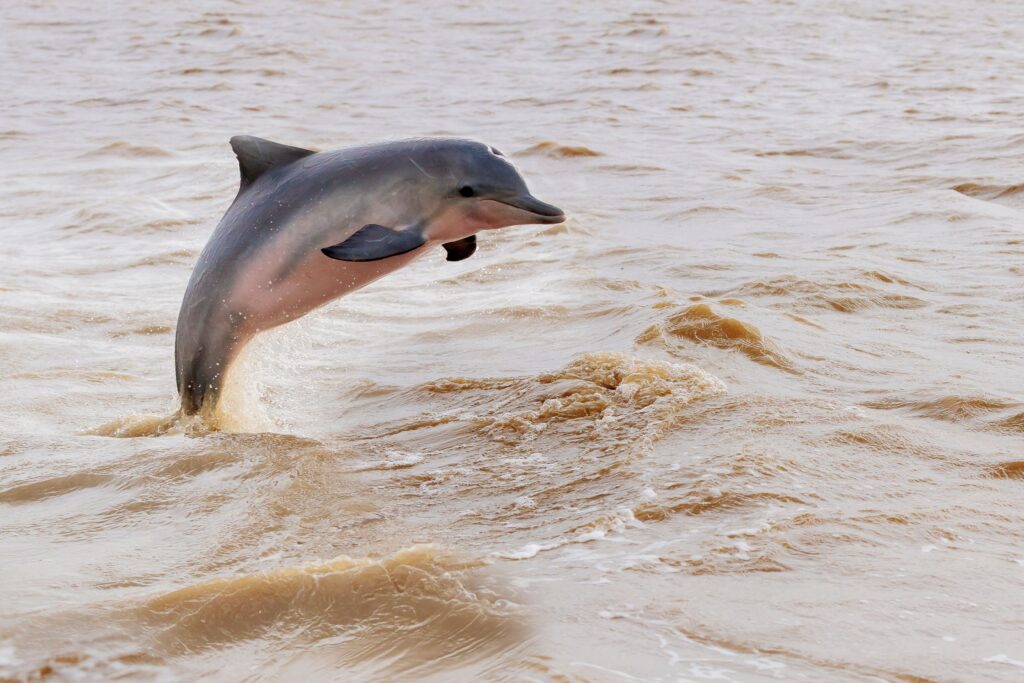
About Baby Amazon River Dolphins
This article provides a detailed explanation of baby Amazon river dolphins, covering their appearance, growth, behavior, and mother-offspring relationships.
- Appearance and Physical Characteristics
Body Color: Immediately after birth, they are gray or light gray, with pink not yet noticeable.
Body Length and Weight:
Body Length: Approximately 80-100cm
Weight: Approximately 10kg
Beak: Short, lengthens as they grow.
Fins and Tail: Small and soft, but gradually acquire the same shape as their mother.
- Growth and Development
Nursing Period: Nursing continues for several months. Breast milk is highly nutritious and provides the energy needed for growth.
Weaning: Weaning usually begins practicing fishing between 6 months and 1 year, but becomes fully independent around 2-3 years of age.
Sexual Maturity: Males reach sexual maturity between 7-10 years of age, and females between 5-6 years of age.
- Behavior and Mother-Child Relationship
Cubs always accompany their mothers, often clinging to their backs or sides in the water.
Mothers protect their young while teaching them how to catch food and swim.
Cubs also play with each other, making this an important time for them to learn social skills and motor skills.
- Threats and Survival
Cubs are more vulnerable to predators than adults, and can be attacked by jaguars, large fish, and anacondas.
Cubs are vulnerable to predators if isolated due to changes in water levels or the environment, making survival difficult. Therefore, maternal protection is extremely important.
Is the Amazon river dolphin an endangered species?
Unfortunately, the Amazon river dolphin is listed as an endangered species (Red List) according to information. It is also listed in Appendix II of the Convention on International Trade in Endangered Species of Wild Fauna and Flora (CITES), and international trade is strictly restricted. Due to their pink color and larger body size than humans, both males and females are easy targets in daily life. Many dolphin species are in a critical situation. Dam construction is also a nuisance.
Overfishing by local fishermen
Amazon river dolphins are overfished by local fishermen, and are removed for consumption as meat or because they interfere with fishing operations. Despite Brazil banning the killing of Amazon river dolphins, killings continue.
Tropical rainforest pollution and destruction
The biggest problem is due to water pollution and environmental destruction. As a result, the dolphins’ health is compromised and they live in extremely dangerous conditions. Dumping of mercury and other powerful chemicals into watersheds from industrial mining is harmful to life.
River dolphin world declaration
In 2024, the Global River Dolphin Declaration was adopted. We aim to reverse the decline in river dolphin populations around the world. As of early 2024, 11 of the 14 countries that keep river dolphins have signed the declaration.
Can Amazon river dolphins be kept in captivity?
Unfortunately, it is listed as an endangered species. Furthermore, international trade is severely restricted by CITES, making it extremely difficult to keep Amazon river dolphins in captivity.
- Ecological Reasons
Requires a Wide Range of Movement: Their range changes between the rainy and dry seasons, and in the wild, they can travel more than tens of kilometers. Small aquariums can be very stressful for them.
Special Diet: They primarily eat freshwater fish, but it is difficult to secure wild fish. It is also difficult to provide sufficient nutrition with artificial feed.
Sociality: Because they value mother-child relationships and small group behavior, they experience psychological stress when kept alone or in unnatural environments.
- Laws and Regulations
Amazon river dolphins are listed in Appendix II of the Convention on International Trade in Endangered Species of Wild Fauna and Flora (CITES), and international trade is restricted.
In many South American countries, wild capture and captivity are generally prohibited.
Even in Japan, due to environmental conservation and invasive species regulations, it is impossible for individuals to keep them as pets.
- Conditions in Captivity
Freshwater dolphins are extremely rare worldwide. They are occasionally kept in captivity at some research facilities and zoos in Brazil for research and conservation purposes.
Keeping them requires large aquariums, a supply of freshwater, fish stocking, specialized veterinarians and staff, making them very expensive.
Facilities Housing the Species (Japan and Worldwide)
The Amazon river dolphin (or pink river dolphin) is an animal rarely kept in captivity worldwide. Because maintaining a freshwater environment is difficult and the species is highly susceptible to stress, very few facilities have succeeded in keeping them long-term. Furthermore, they are an endangered species, and international trade is strictly regulated.
Japan
Currently, there are no zoos or aquariums in Japan that house or exhibit Amazon river dolphins.
Worldwide
Facilities where live Amazon river dolphins can be seen are currently very limited.
Duisburg Zoo
One of the most famous facilities housing the species in the world.
It has kept Amazon river dolphins for many years and is sometimes cited as the only facility housing them outside of South America.
In parts of South America—such as Brazil, Peru, and Colombia—
conservation centers,
research facilities,
and rehabilitation centers
may temporarily house and care for them; however, these are often not open to the public and are not intended for exhibition purposes.
Introducing other animals



コメント