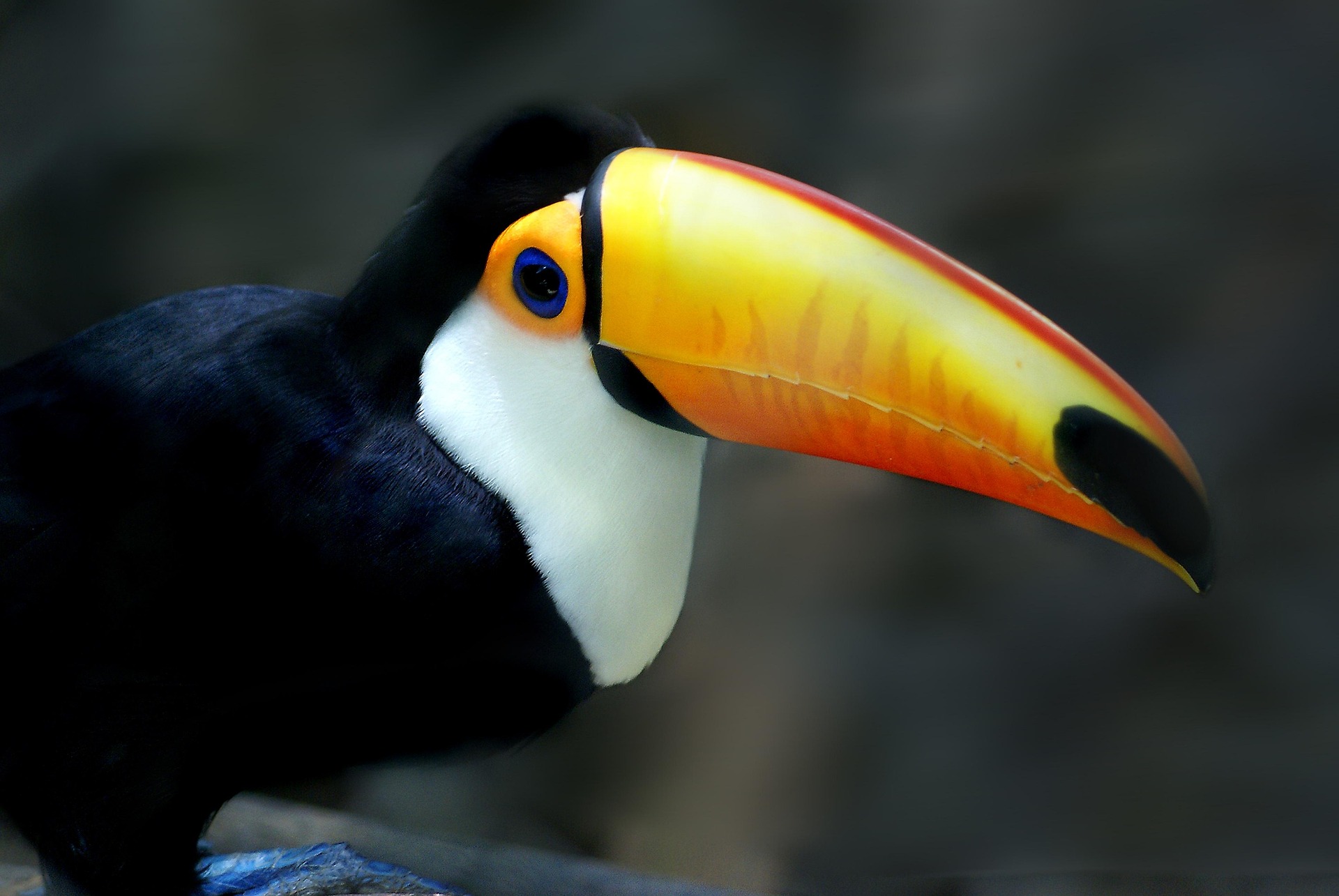
What kind of bird is a toucan? We will explain its characteristics, ecology, and habitat. The most distinctive feature of this bird is its extremely large beak. They live in the tropical rainforests from the Caribbean Sea to the central and southern parts of South America, so I will explain their characteristics for your reference.






- What is a toucan? About basic status
- What are the roots and origins of the toucan?
- Where will the habitat be?
- feature is? What kind of creature is it?
- What is your personality like?
- What is the ecology like?
- Toucans and Molting
- Vocalizations
- Seasonal Activities
- Flight Speed
- About Toucan Chicks
- Is the toucan an endangered species?
- Can you keep toucans?
- Zoos Housing Toucans (Japan & Worldwide)
- Introducing other animals
What is a toucan? About basic status
Toucans are birds of the order Woodpeckers. The scientific name is Ramphastidae. It is a small bird with a total length of 30–60 cm and a weight of about 300–500 g. In kanji, it is written as “big beak.”
| Japanese(和名) | オオハシ |
| English(英名) | Toucan |
| scientific name(学名) | Ramphastidae |
| classification(分類) | Ave、 Piciformes、 Ramphastidae 鳥綱、キツツキ目、オオハシ科 |
| IUCN Status(保全状況) | ENDANGERED |
| Length(体長) | 30–60cm |
| Weight(体重) | 300 – 500kg |
What are the roots and origins of the toucan?
Toucans are iconic birds of the South American rainforests; they are believed to have evolved in South America approximately 20 to 25 million years ago. There are currently about 40 known species of toucans, all of which inhabit the Americas exclusively.
Origins
Based on fossil evidence and DNA analysis, the ancestors of the toucan family (Ramphastidae) are thought to have originated in the forests of South America.
Their evolutionary path unfolded as follows:
Approx. 25 million years ago
│
Diverged from the ancestors of woodpeckers
│
Toucan family emerged in South America
│
Adapted to the rainforest environment
│
Diversified into the approximately 40 species known today
Their long, large beaks evolved as an adaptation to life in the rainforest.
Why did they develop such large beaks?
A toucan’s beak can account for up to one-third of its total body length, yet it is remarkably lightweight due to its internal sponge-like structure.
These large beaks serve several functions:
Reaching fruit on high branches
Foraging at the tips of slender branches without putting weight on them
Swallowing fruit whole
Regulating body temperature (dissipating heat)
Displaying during courtship or for intimidation
Did you know?
After eating fruit, toucans transport the seeds to distant locations before excreting them, earning them the nickname “gardeners of the forest.” This behavior contributes significantly to the distribution and regeneration of rainforest plants, making them vital to the ecosystem.
About classification
Toucans are classified in the Toucanidae family. The following variants exist: There are so many subspecies. The infraorder Toucan was traditionally divided into Toucanidae and Barbetidae. There is a theory that the family Barbetidae and the family Barbetidae are not separate families, but are included in the family Toucanidae. The following is a quote from Wikipedia.
- Aulacorhynchus ミドリチュウハシ属
- Aulacorhynchus wagleri, Wagler’s Toucanet (P. prasinus から分離)
- Aulacorhynchus prasinus, Emerald Toucanet, キバシミドリチュウハシ
- Aulacorhynchus caeruleogularis, Blue‐throated Toucanet (P. prasinus から分離)
- Aulacorhynchus cognatus, Violet‐throated Toucanet (P. prasinus から分離)
- Aulacorhynchus lautus, Santa Marta Toucanet (P. prasinus から分離)
- Aulacorhynchus griseigularis, Grey‐throated Toucanet (P. prasinus から分離)
- Aulacorhynchus albivitta, White‐throated Toucanet, ミナミキバシミドリチュウハシ (P. prasinus から分離)
- Aulacorhynchus atrogularis, Black‐throated Toucanet (P. prasinus から分離)
- Aulacorhynchus sulcatus, Groove‐billed Toucanet, ミネアカミドリチュウハシ
- Aulacorhynchus calorhynchus, Yellow‐billed Toucanet (↑から分離)
- Aulacorhynchus derbianus, Chestnut‐tipped Toucanet, クロアカミドリチュウハシ
- Aulacorhynchus whitelianus, Tepui toucanet, テプイミドリチュウハシ (A. derbianus から分離) LC IUCN
- Aulacorhynchus haematopygus, Crimson‐rumped Toucanet, コシアカミドリチュウハシ
- Aulacorhynchus huallagae, Yellow‐browed Toucanet, キマユミドリチュウハシ
- Aulacorhynchus coeruleicinctis, Blue‐banded Toucanet, アオオビミドリチュウハシ
- Pteroglossus チュウハシ属
- Pteroglossus viridis, Green Aracari, キムネチュウハシ
- Pteroglossus inscriptus, Lettered Aracari, スジキムネチュウハシ
- Pteroglossus bitorquatus, Red‐necked Aracari, アオハシチュウハシ
- Pteroglossus azara, Ivory‐billed Aracari, ハシジロチュウハシ
- Pteroglossus mariae, Brown‐mandibled Aracari, チャハシチュウハシ (↑から分離)
- Pteroglossus aracari, Black‐necked Aracari, アカオビチュウハシ
- Pteroglossus castanotis, Chestnut‐eared Aracari, チャミミチュウハシ
- Pteroglossus pluricinctus, Many‐banded Aracari, フタオビチュウハシ
- Pteroglossus torquatus, Collared Aracari, ムナフチュウハシ
- Pteroglossus sanguineus, Stripe‐billed Aracari, ホシハシムナフチュウハシ (P. torquatus から分離)
- Pteroglossus erythropygius, Pale‐mandibled Aracari, ハイハシムナフチュウハシ (P. torquatus から分離)
- Pteroglossus frantzii, Fiery‐billed Aracari, アカハシムナフチュウハシ
- Pteroglossus beauharnaisii, Curl‐crested Aracari, ニジチュウハシ
- Pteroglossus bailloni, Saffron Toucanet, オウゴンチュウハシ (Baillonius bailloni)
- Selenidera コチュウハシ属
- Selenidera spectabilis, Yellow‐eared Toucanet, アオハシコチュウハシ
- Selenidera piperivora, Guianan Toucanet, ニショクコチュウハシ
- Selenidera reinwardtii, Golden‐collared Toucanet, アカハシコチュウハシ
- Selenidera nattereri, Tawny‐tufted Toucanet, サンショクコチュウハシ
- Selenidera gouldii, Gould’s Toucanet, クロフイリコチュウハシ
- Selenidera maculirostris, Spot‐billed Toucanet, フイリコチュウハシ
- Andigena ヤマオオハシ属
- Andigena hypoglauca, Grey‐breasted Mountain Toucan, サンショクヤマオオハシ
- Andigena laminirostris, Plate‐billed Mountain Toucan, イタハシヤマオオハシ
- Andigena cucullata, Hooded Mountain Toucan, キバシヤマオオハシ
- Andigena nigrirostris, Black‐billed Mountain Toucan, ハシグロヤマオオハシ
- Ramphastos オオハシ属
- Ramphastos dicolorus, Green‐billed Toucan, アオハシヒムネオオハシ
- Ramphastos vitellinus, Channel‐billed Toucan, ヒムネオオハシ (R. culminatus を含む)
- Ramphastos citreolaemus, Citron‐throated Toucan, キノドオオハシ (↑から分離)
- Ramphastos brevis, Choco Toucan, チョコキムネオオハシ
- Ramphastos sulfuratus, Keel‐billed Toucan, サンショクキムネオオハシ
- Ramphastos toco, Toco Toucan, オニオオハシ
- Ramphastos tucanus, White‐throated Toucan, シロムネオオハシ (R. cuvieri を含む)
- Ramphastos swainsonii, Chestnut‐mandibled Toucan, クリハシオオハシ (↓から分離)
- Ramphastos ambiguus, Black‐mandibled Toucan, ニショクキムネオオハシ
Source Wikipedia
Where will the habitat be?
Toucan birds live throughout Central and South America. Their habitat is extremely wide, including Mexico, Argentina, Belize, Peru, Bolivia, Guiana, Brazil, Panama, and Nicaragua.
- Geographic Distribution
Origin: Central and South America
Mainly found in tropical rainforests
Widely distributed in countries including Brazil, Colombia, Venezuela, Peru, and Ecuador
- Habitat
Tropical rainforest: Living in the canopy (above tall trees)
Prefers areas rich in nuts and fruit
Builds nests in tree cavities or among the branches of tall trees
Includes riversides and forest edges in its range
- Environmental Characteristics
Hot, humid, and high-rainfall areas
Forests with a multi-layered structure (tall trees, medium-sized trees, and shrubs) provide abundant food and hiding places
Habitat reduction due to development and deforestation also affects populations
feature is? What kind of creature is it?
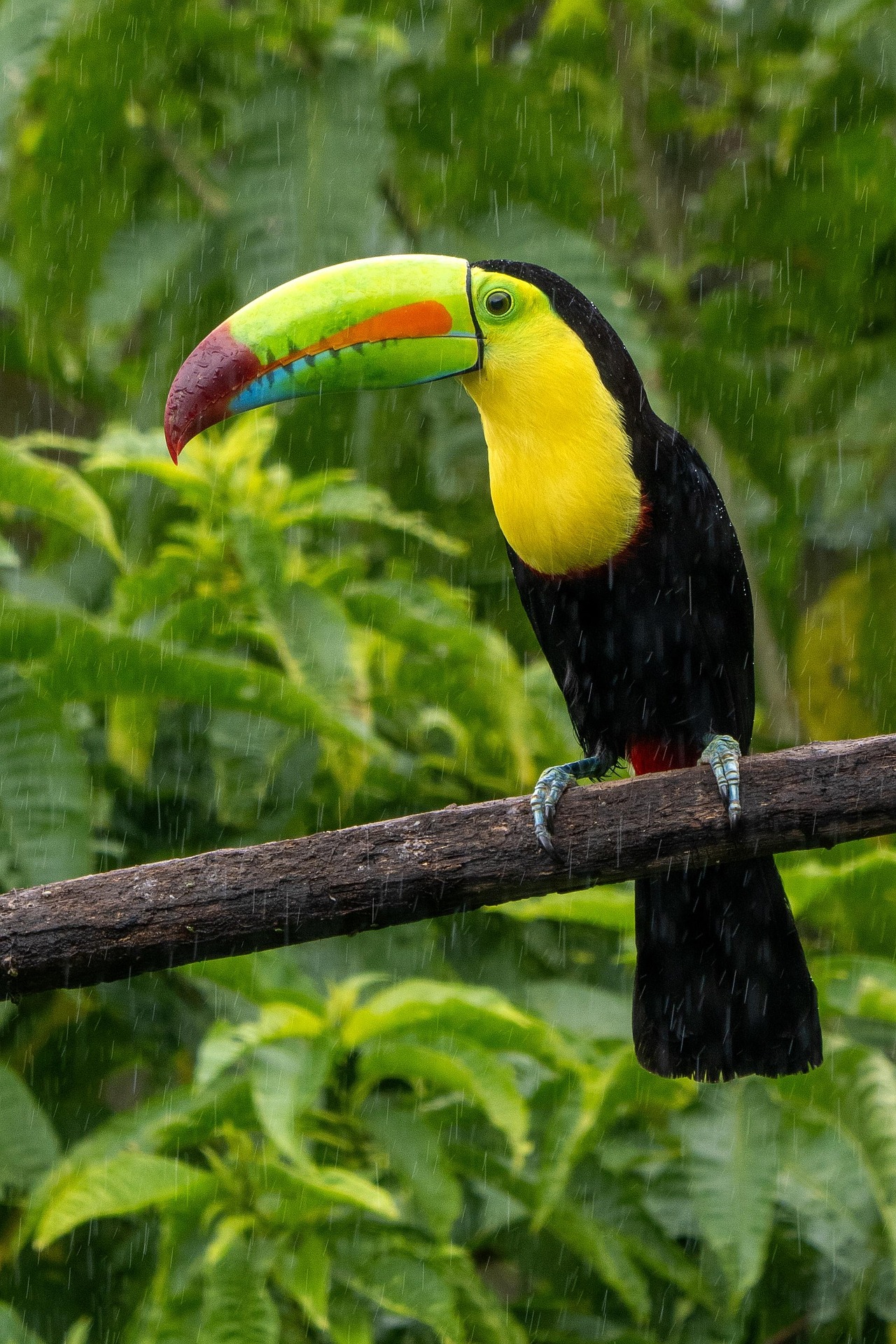
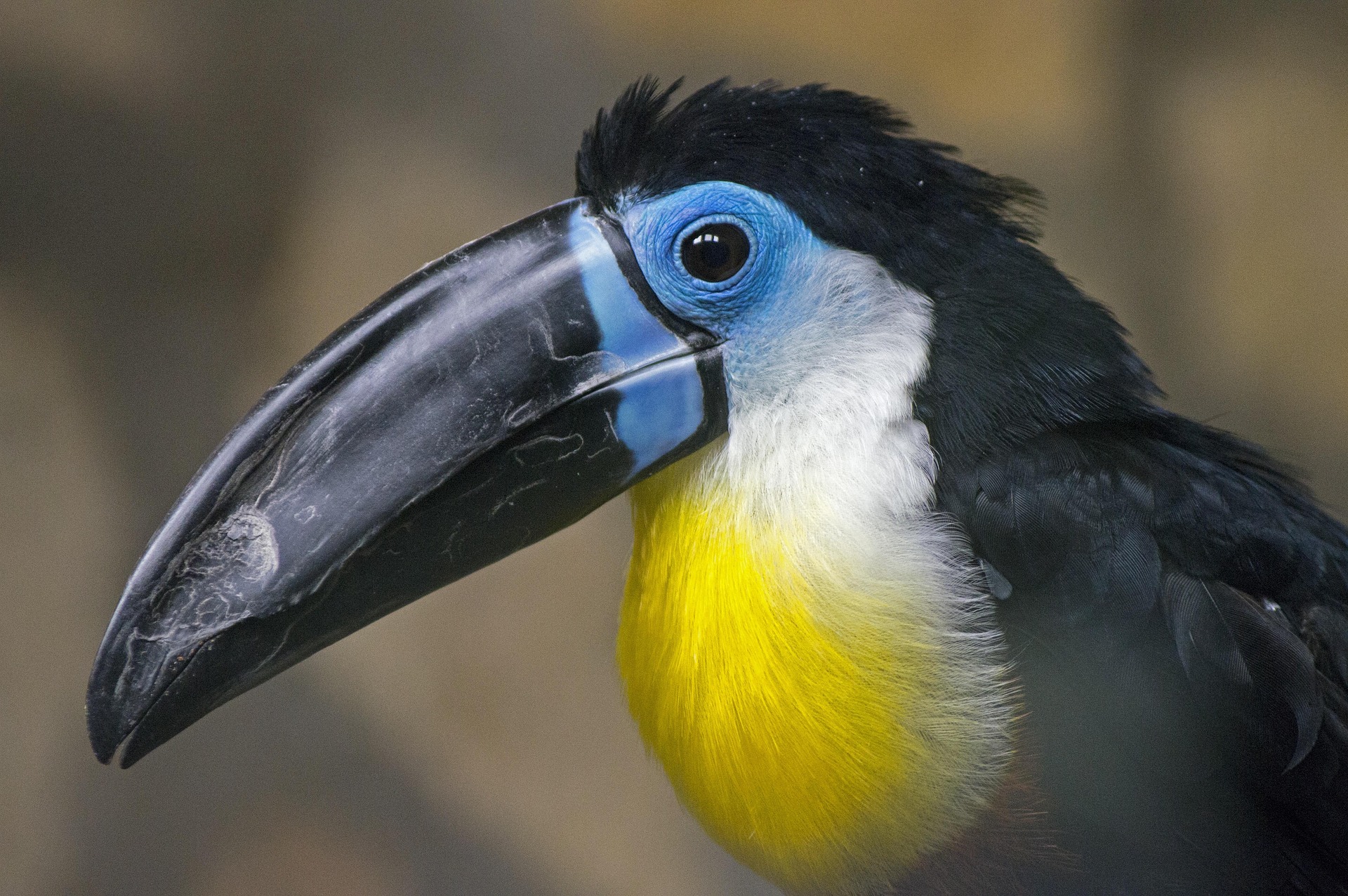
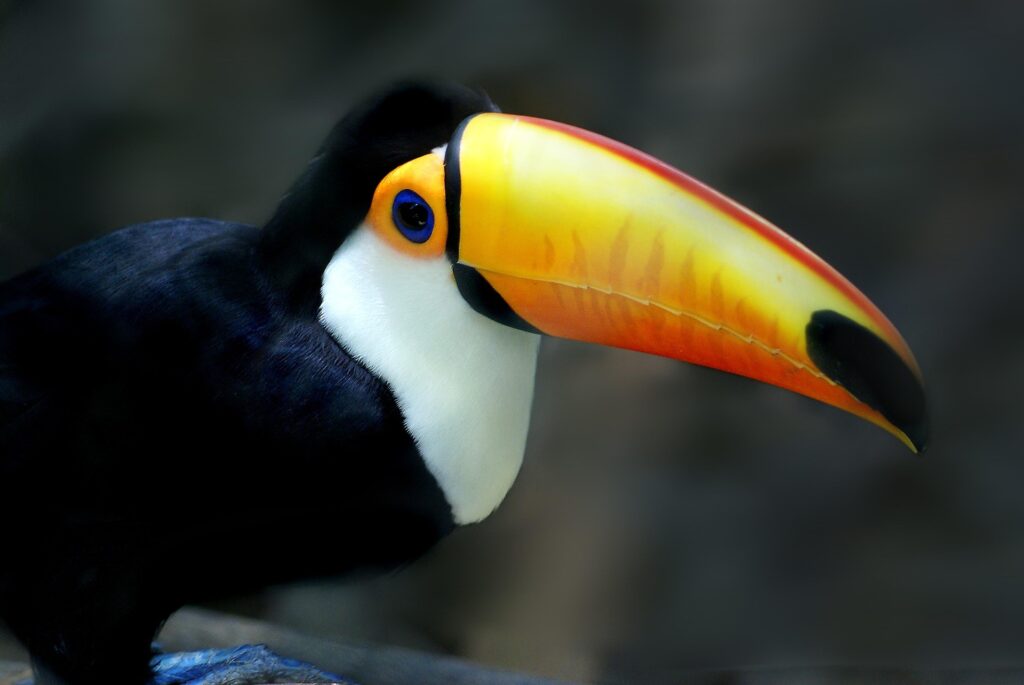
The toucan’s name comes from its large beak, which is its most distinctive feature. There is also a small species called chuuhashi (small beak). The reason for the enlarged beak is unknown. One theory is that they were made larger to make it easier to pick the fruits at the tips of the branches. They can release heat from their bodies through the tiny blood vessels in their beaks. Most species live in tropical rainforests.
- Body Size and Appearance
Total Length: Approximately 50-65cm (varies by species)
Weight: Approximately 300-700g
Beak:
Very large, accounting for approximately 1/3-1/2 of the total length
Bright colors (red, yellow, orange, black, etc.)
Lightweight structure, long but not heavy
Feather Color:
Colorful, including black, white, red, and yellow
Body color combinations vary by species
Eyes: Relatively large, adapted to arboreal life
- Behavior and Personality
Arboreal birds that live in trees
Active and curious
Highly sociable, sometimes living in pairs or small flocks
Their calls have a distinctive cuckoo-like sound
- Diet
Primarily frugivorous (fruit) diet
Also eats insects, small reptiles, and bird eggs
Uses its long beak to skillfully catch fruit and small animals between branches
- Ecological Characteristics
Their long beaks are useful for reaching tree cavities and between branches to retrieve fruit and seeds.
They contribute to forest ecosystems by dispersing fruit seeds.
Flight is primarily short distances, adapted for moving between branches.
What is your personality like?
Toucans are very attached to people. However, some subspecies are more wary, so there are considerable individual differences. Although they are friendly towards their families, they may feel very stressed. It also has the ability to communicate with people and can be played with in a variety of ways.
Toucan Personality and Behavior
Active and curious
Flying through trees, searching for food by searching among fruit and branches
Curious about new things and environments
Social
Often living in pairs or small groups
Communicating with others through vocalizations and posture
Timidity and wariness
Sensitive to predators and humans, they quickly flee when they sense danger
Often hiding among the branches of trees
Playful
They have a habit of playing by nibbling on branches and pecking at fruit
They have been observed using their long beaks to perform skillful movements
What is the ecology like?
Toucans may live alone or in groups of several birds. They build nests in holes in banks and lay eggs in the spring. Their diet is omnivorous, with a diet that leans toward herbivores, subsisting on fruits, nuts, insects, and small reptiles. Toucans are long-lived birds in the wild, and can actually live for over 50 years, with considerable variation depending on the subspecies.
- Life Rhythm
Diurnal: Active during the day and forage for food.
Rests in trees at night.
Flying between branches in the canopy, mainly for short distances.
- Diet
Mainly frugivorous (fruit) diet.
Other diets include insects, small reptiles, and bird eggs.
Uses its long beak to skillfully catch fruit and small animals between branches.
Eating fruit also contributes to seed dispersal.
- Breeding
Breeding Season: Varies by region and species, but breeding is common during the rainy season.
Nest Building:
Builds nests in tree cavities or among high branches.
Nests are constructed from natural materials (tree branches, leaves, moss, etc.).
Egg Laying: Approximately 1-4 eggs.
Brooding:
Both parents take turns incubating and feeding the eggs.
Chicks remain dependent on their parents until they leave the nest.
- Sociality
Often live in pairs.
May travel in small flocks.
Communicates through vocalizations and posture.
- Habitat
Dependent on tropical rainforests
Live in the canopy and mid-story
Prefers fruit-rich, densely wooded environments
Affected by habitat loss due to deforestation and development
Are there any natural enemies?
Toucans basically have few natural enemies. Natural enemies include monkeys.
Toucans and Molting
Like other birds, toucans undergo molting, a process where old feathers are replaced by new ones. Molting is a vital physiological process for maintaining flight capability and body heat retention.
Timing of Molting
While it varies by species and habitat in the wild, many toucans tend to begin molting after the breeding season ends.
Wild: Typically once a year
In captivity: Timing may shift depending on the environment and individual differences
Because they inhabit tropical regions, the process often proceeds relatively gradually, rather than involving a synchronized “autumn molt” like that seen in many wild birds in Japan.
How Molting Progresses
To ensure they do not lose the ability to fly, toucans shed and replace their feathers gradually and symmetrically.
Flight feathers (wing feathers)
Tail feathers
Body feathers
Feathers are usually replaced in this order, and they rarely lose large amounts of feathers all at once.
Characteristics During Molting
The following behaviors and signs may be observed during molting:
Increased frequency of preening
More feathers found on the floor
Growth of new feathers (pin feathers)
Temporary slight reduction in flight ability
Increased energy consumption, leading some individuals to rest for longer periods
Vocalizations
In contrast to their flashy appearance, toucans have very loud, resonant calls. Because the trees in the rainforest grow close together, they produce calls that travel long distances to communicate with their flock.
- “Gwa! Gwa!”
Most frequently heard call
Checking the location of flock members
A signal before taking flight
A low, deep call often likened to the croaking of a frog or the barking of a dog.
- “Raa! Raa!”
Asserting territory
Calling out to flock members
A loud, far-reaching call that can travel hundreds of meters through the forest.
- “Ka-ka-ka”
Mild alarm
Communication within the flock
Often a series of short, repeated sounds used for interaction between flock members.
- “Gyaa!”
When startled
Upon spotting a predator
State of high agitation
A sharp, loud alarm call.
- “Koro-koro” / “Goro-goro”
Close-range interaction between a pair
When relaxed
Depending on the species, they may produce soft, throat-vibrating sounds.
Seasonal Activities
Since toucans inhabit tropical and subtropical regions, they do not experience distinct four seasons like those in Japan. Instead, their activities shift based on the wet and dry seasons and the fruiting cycles of plants rather than temperature fluctuations.
However, as they are often described in terms of seasons in Japan, the following overview is organized according to the Japanese four-season calendar.
🌸 Spring (Breeding Season)
For many species, breeding begins during this period (though the exact timing varies by region and the wet/dry season).
Pairs spend more time together
Courtship behavior, such as the male passing fruit to the female, is observed
Tree hollows (cavities) previously used by birds like woodpeckers are utilized as nests
Nest building and preparations for egg-laying take place
☀️ Summer (Rearing Season)
This is the busiest time for raising chicks.
Parents carry fruit, insects, and small vertebrates to the chicks
Parent birds take turns guarding the nest
Chicks’ beaks grow larger as they mature
Foraging activity becomes particularly intense
🍂 Autumn (Foraging Season)
During times when fruit is abundant, they spend much of their time foraging.
They consume large quantities of fruits such as figs and palm fruits
They disperse seeds over wide areas, contributing to forest regeneration
They often move in family units or small flocks
❄️ Winter (Active Season)
As temperature fluctuations are minimal in tropical regions, their activity levels remain largely unchanged during winter.
Active during the day throughout the year
The proportion of insects and small animals in their diet increases when fruit is scarce
They do not hibernate or enter long periods of dormancy
They may move between feeding grounds in flocks
Daily Activity
Toucans are diurnal (active during the day).
Sunrise to morning: Peak foraging activity
Around midday: Resting and preening in the shade
Afternoon: Foraging resumes
Evening: Returning to the roost
Night: Resting in tree hollows or on branches
Flight Speed
While toucans are capable of flight, they are not birds that fly at high speeds over long distances like eagles or falcons. Their flight style is adapted for moving short distances between trees within the forest.
Flight Speed
Approximate flight speeds: Normal flight: ~20–30 km/h; Rapid movement: ~30–40 km/h; Short-burst top speed: ~40–50 km/h.
*Note: As there are limited studies directly measuring flight speeds in the wild, these figures are estimates based on observational records, body size, and flight patterns.
Flight Characteristics
Toucans have a distinctive flight style that involves repeating the following pattern:
Several powerful wingbeats
Folding the wings to glide
Flapping again
This undulating flight pattern—alternating between flapping and gliding—is characteristic of the species and closely resembles the flight style of woodpeckers.
Do They Fly Long Distances?
Toucans are not adept at long-distance flight.
They typically move only tens to hundreds of meters from tree to tree.
Even when traveling between feeding grounds and roosting sites, they mostly move in short hops through the forest.
They are not migratory birds.
About Toucan Chicks
By analyzing toucan chicks (such as those of the Ramphastos genus), we can understand their developmental process from hatching to fledging and their relationship with their parents.
- Hatching/Nest
Nest Construction: Nests are built in hollows or between branches of tall trees.
Egg Number: 1-4
Egg Size: Approximately 3-5cm depending on the species.
Incubation Period: Approximately 16-18 days (varies by species).
- Chick Characteristics
Weight: Approximately 20-30g at hatching (varies by species).
Feathers: Initially soft, whitish down.
Eyes: Closed immediately after hatching, but open within a few days.
Behavior:
Remains motionless in the nest.
Parents take turns incubating and feeding.
- Development Stages
Weeks: Development/Behavior: 0-2 weeks: Spends time in the nest with down. Parents feed. 2-3 weeks: Feathers begin to form. Plays with siblings. 3-4 weeks: Practices flapping. By the 4th to 5th week, they begin moving between branches, improving their flight ability. They prepare to leave the nest at around 5 weeks. They become independent with the support of their parents.
- Survival Considerations
There is a risk of predation from natural enemies (large birds of prey and snakes).
Survival rates decrease due to food shortages and environmental changes.
Is the toucan an endangered species?
Overall, toucans have a very stable population and are unlikely to go extinct. However, some of the subspecies are already listed as endangered species, as the loss of forest areas due to habitat destruction by humans has created a considerable problem.
- IUCN Red List Assessment
There are several species in the Toucan genus, but some representative examples include:
Toucan (Ramphastos toco): Least Concern
Wide distribution and relatively stable populations
Species with limited distribution or habitat loss may be classified as Near Threatened or Vulnerable.
- Habitat Impact
Deforestation and agricultural development can cause local population declines.
The decline of tropical rainforests, in particular, has a significant impact on the survival of some rare species.
- Conservation Status in Japan
Toucans are not naturally distributed in Japan, so they are not included in the national conservation list.
Can you keep toucans?
Toucans are actually one of the few birds that can be kept in captivity. Please pay attention to the following points when raising your pet. The big key is whether you can secure a veterinarian. They are also very long-lived birds, so please take good care of them.
How much will it cost?
There are very few pet stores that carry toucans. Therefore, it becomes very expensive. There is information that it costs about 500,000 yen to 1 million yen in Japanese yen. It will be a considerable expense. If you don’t like that, you have no choice but to ask a zoo to give it to you.
What do you eat?
The foods given at the zoo include melons, tomatoes, apples, bananas, papaya, grapes, and pellets. Toucans tend to accumulate iron in their bodies, so special pellets are recommended. My favorite food is tropical fruits, so I also enjoy eating mangoes and papayas.
need a cage
The toucan is a bird that requires a large area because it has a large amount of exercise and a large area of activity. They live in trees and rarely come down to the ground during their lifetime, so a perch and a large cage are essential. Also, try to exercise moderately in your daily life. Stress can also lead to illness.
Zoos Housing Toucans (Japan & Worldwide)
Although toucans are native to South America, their vibrant colors and distinctive beaks make them popular attractions at zoos and bird parks around the world. In Japan, species such as the Toco Toucan (Ramphastos toco) and the Keel-billed Toucan are commonly kept in captivity.
🇯🇵 Major Facilities in Japan Where You Can See Toucans
Ueno Zoo
A prominent zoo with a track record of exhibiting toucans.
Known for its tropical bird exhibits.
One of the facilities where you can observe South American bird species.
Kobe Animal Kingdom
Famous for allowing close-up observation of toucans.
Features an open-style exhibit where you can see them flying overhead.
Feeding experiences are sometimes available.
Kakegawa Kachoen (Kakegawa Bird and Flower Garden)
Boasts extensive tropical bird exhibits.
Allows close-up observation of large birds, including toucans.
Features interactive exhibits where visitors can get up close with the birds.
Matsue Vogel Park
A large bird park showcasing species from around the world.
Houses tropical birds, including toucans.
Nasu Animal Kingdom
Offers a wide variety of bird exhibits.
Includes exhibits featuring tropical birds.
Nagasaki Bio Park
A facility with many exhibits dedicated to South American animals.
Visitors can view tropical bird species.
🌎 Major Facilities Worldwide Where You Can See Toucans
🇺🇸 United States
San Diego Zoo
One of the world’s largest zoos.
Features extensive tropical bird exhibits.
Has a history of keeping toucans.
Bronx Zoo
Showcases South American birds within its rainforest exhibits.
🇧🇷 Brazil (Native Region)
São Paulo Zoo
One of the largest zoos in South America.
Located near the toucan’s natural habitat; features a rich collection of South American birds.
Rio de Janeiro Zoo
Exhibits species native to Brazil as well as tropical birds.
🇬🇧 UK / Europe
Chester Zoo
A large zoo known for its tropical bird exhibits. We keep South American birds.
Berlin Zoo
A zoo with a long, world-renowned history.
It houses a diverse collection of birds.
Introducing other animals

コメント