We will explain the characteristics, ecology, and habitat of rockhopper penguins. Rockhopper penguins actually have subspecies and are divided into other types. It has a wider range of habitat than any other species in the Macaroni penguin genus, which is why subspecies have emerged.



- Basic information about rockhopper penguins
- What are the roots and origins of the Rockhopper penguin?
- What will happen to the classification?
- About the habitat of rockhopper penguins
- feature is? What kind of creature is it?
- What will your personality look like?
- What is the ecology of rockhopper penguins?
- Rockhopper Penguin Molting
- Rockhopper Penguin Diving
- Rockhopper Penguin Calls
- Seasonal Activities of Rockhopper Penguins
- About Rockhopper Penguin Chicks
- Is the rockhopper penguin an endangered species?
- Is it possible to keep rockhopper penguins?
- Zoos and Aquariums Housing Rockhopper Penguins (Japan & Worldwide)
- Fellow members of the same group
Basic information about rockhopper penguins
Rockhopper penguins are birds belonging to the Macaroni penguin genus. The scientific name is Eudyptes chrysocome. This penguin is 50-60cm long and lives near Antarctica. This penguin has a fairly wide range of habitats, and it gets its name because it jumps up and down rocks.
| Japanese(和名) | イワトビペンギン |
| English(英名) | Rockhopper Penguin |
| scientific name(学名) | Eudyptes chrysocome |
| classification(分類) | Sphenisciformes, Spheniscidae, Eudyptes ペンギン目ペンギン科マカロニペンギン属 |
| IUCN Status(保全状況) | VULNERABLE |
| Height(身長) | 50-60cm |
| Weight(体重) | 2-5kg |
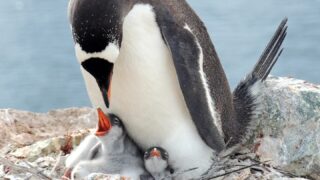
What are the roots and origins of the Rockhopper penguin?
The Rockhopper penguin is characterized by its yellow crest feathers and the way it moves by hopping across rocky terrain. Its lineage dates back tens of millions of years.
Roots (Evolutionary Origins)
Penguin ancestors are believed to have been flying seabirds that lived in the Southern Hemisphere approximately 60 to 65 million years ago. Following the mass extinction of the dinosaurs, as they adapted to a life of catching fish in the ocean, their wings evolved into “flippers” (fin-like wings) for swimming rather than flying.
Subsequently, between 20 and 15 million years ago, the group of “crested penguins”—characterized by yellow ornamental feathers (crests) on their heads—emerged. The Rockhopper penguin belongs to this group.
Origin of the Name
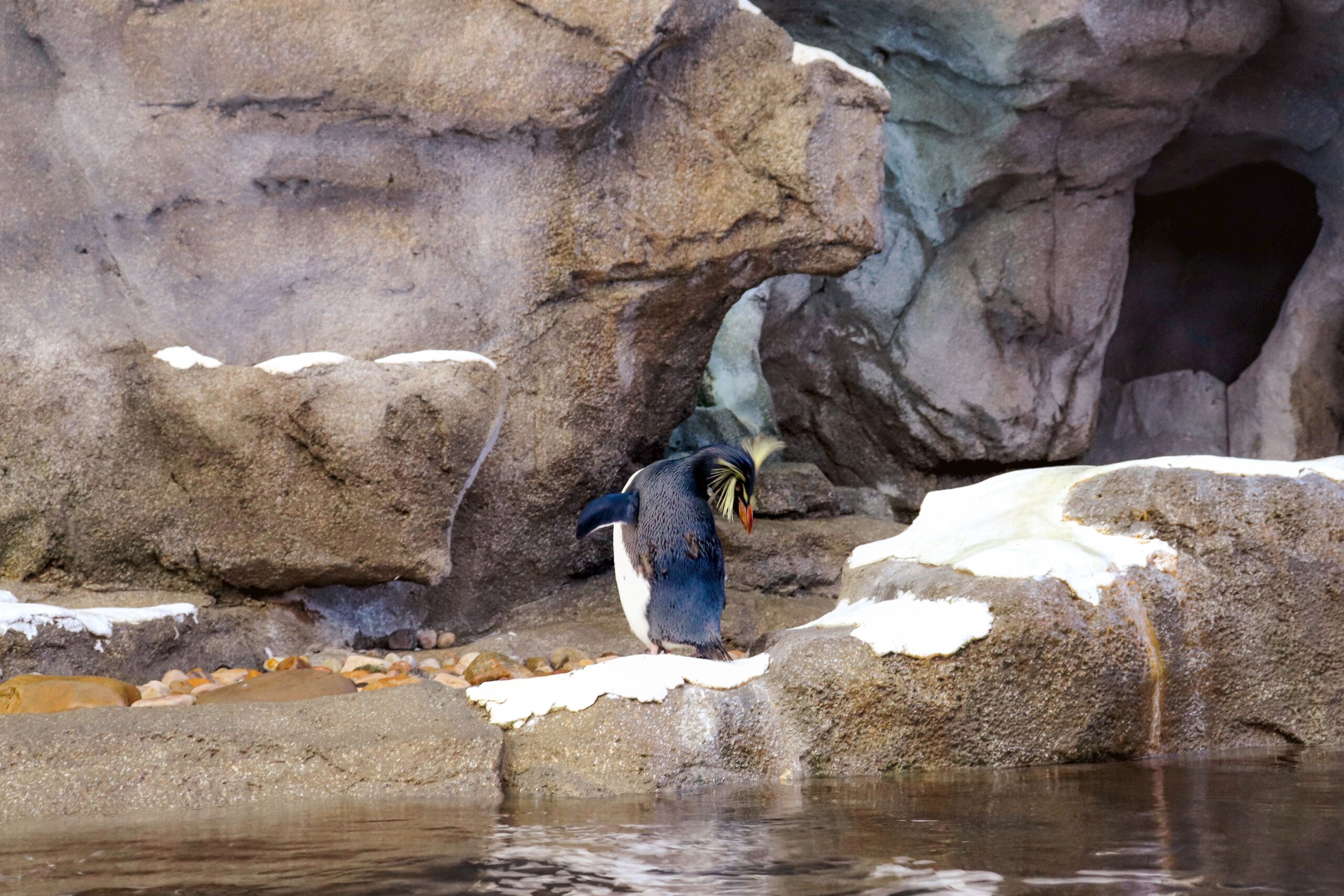
The name “Rockhopper penguin” was derived from the bird’s behavior of moving across steep, rocky terrain by hopping.
The English name “Rockhopper Penguin” is also a combination of “Rock” and “Hopper” (one that hops).
Closely Related Species
The Rockhopper penguin is closely related to the following crested penguin species:
Royal penguin
Macaroni penguin
Snares penguin
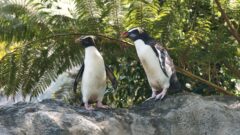
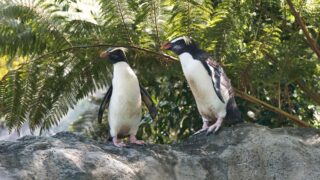
Fiordland penguin
Genetic analysis indicates that these species diverged from a common ancestor.
Current Classification
In recent years, a classification system dividing Rockhopper penguins into three distinct species has become widely adopted:
Southern rockhopper penguin
Northern rockhopper penguin
Eastern rockhopper penguin
While they were previously sometimes treated as a single species, the prevailing view today recognizes them as three separate species based on differences in DNA, morphology, and vocalizations.
What will happen to the classification?
Rockhopper penguins belong to the Macaroni penguin genus. The genus name is derived from the ancient Greek eu “good” and dyptes “diver”. “Macaroni” is an 18th century British word that refers to “date man.”
| 名前:Name | Gropu:属名 | 生息地: habit |
| フィヨルドランドペンギン(Fiordland penguin) | Eudyptes マカロニペンギン属 | New Zealand ニュージーランド |
| シュレーターペンギン(Erect-Crested Penguin) | Eudyptes マカロニペンギン属 | New Zealand ニュージーランド |
| スネアーズペンギン(Snares Islands Penguin) | Eudyptes マカロニペンギン属 | New Zealand ニュージーランド |
| マカロニペンギン(Macaroni Penguin) | Eudyptes マカロニペンギン属 | Antarctica 南極大陸 |
| ロイヤルペンギン(Royal Penguin) | Eudyptes マカロニペンギン属 | Antarctica 南極大陸 |
| イワトビペンギン(Rockhopper Penguin) | Eudyptes マカロニペンギン属 | South Atlantic, Indian Ocean, Falkland Islands 南大西洋、インド洋、フォークランド諸島 |
Rockhopper penguin taxonomy
| 階級 | 分類 |
|---|---|
| 界 (Kingdom) | 動物界 (Animalia) |
| 門 (Phylum) | 脊索動物門 (Chordata) |
| 綱 (Class) | 鳥綱 (Aves) |
| 目 (Order) | ペンギン目 (Sphenisciformes) |
| 科 (Family) | ペンギン科 (Spheniscidae) |
| 属 (Genus) | Eudyptes |
| 種 (Species) | Eudyptes chrysocome |
About the habitat of rockhopper penguins
The rockhopper penguin’s habitat is islands near Antarctica.
- Distribution
Distributed around Antarctica and sub-Antarctic islands
Main breeding areas:
Falkland Islands
South Georgia
South Shetland Islands
Coast of the southern tip of South America (parts of the Argentine and Chilean coasts)
- Habitat
Breeds on rocky, cliffy, and sandy coasts
Forages in the sea except during winter and breeding season, rarely on land
Prefers isolated environments with little human disturbance
- Behavior and Movement
Feeds on fish, krill, and crustaceans in the sea
Always returns to breeding grounds during breeding season
Swims around the surrounding waters to feed
feature is? What kind of creature is it?
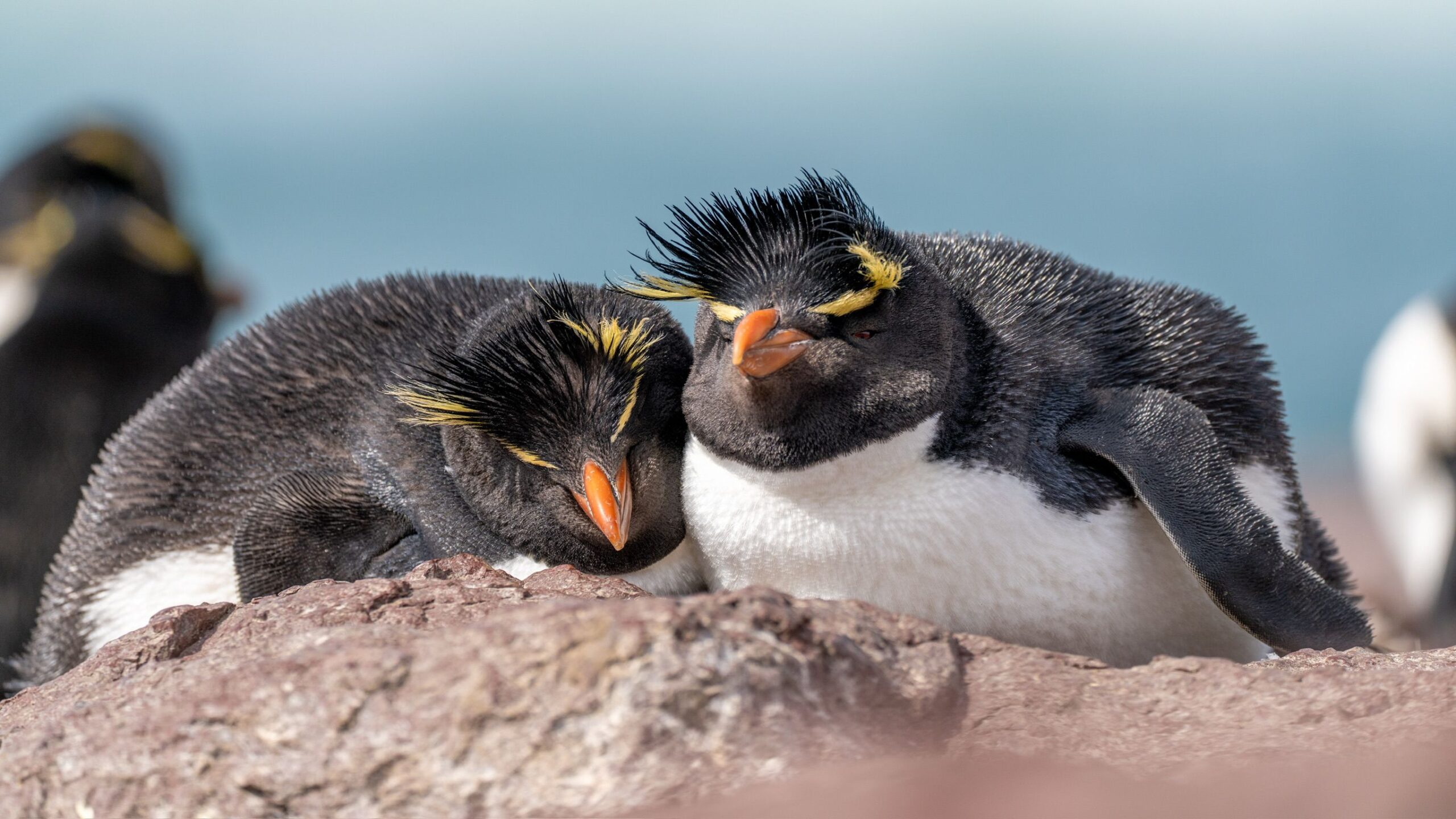
Rockhopper penguins are the smallest of any species in the Macaroni penguin genus. Rockhopper penguins have decorative feathers that spread out behind their eyes. Their most distinctive feature is that they do not waddle like other penguins, but move by hopping with both feet together. The average dive time is 53-193 seconds and the depth is 10.4-44.2 m. Rockhopper penguins live in colonies.
variants exist
There are subspecies of rockhopper penguins. There are three species: Eastern Rockhopper Penguin, Northern Rockhopper Penguin, and Southern Rockhopper Penguin. Each has a different habitat.
| Northern Rockhopper Penguin キタイワトビペンギン | Mid-South Atlantic Ocean, South Indian Ocean 南大西洋中部、南インド洋 |
| Eastern Rockhopper Penguin ヒガシイワトビペンギン | Prince Edward Islands, Kerguelen Island, Antipas Islands プリンスエドワード諸島、ケルゲレン島、アンティポーズ諸島 |
| Southern Rockhopper Penguin ミナミイワトビペンギン | Falkland Islands、Argentina、 Chile フォークランド諸島からアルゼンチン、チリ |
- Physical Characteristics
Size: Approximately 60 cm in length, weighing 3-4 kg (medium-sized penguin)
Body Type: Stocky, streamlined for underwater swimming
Feather Color:
Back: Black
Belly: White
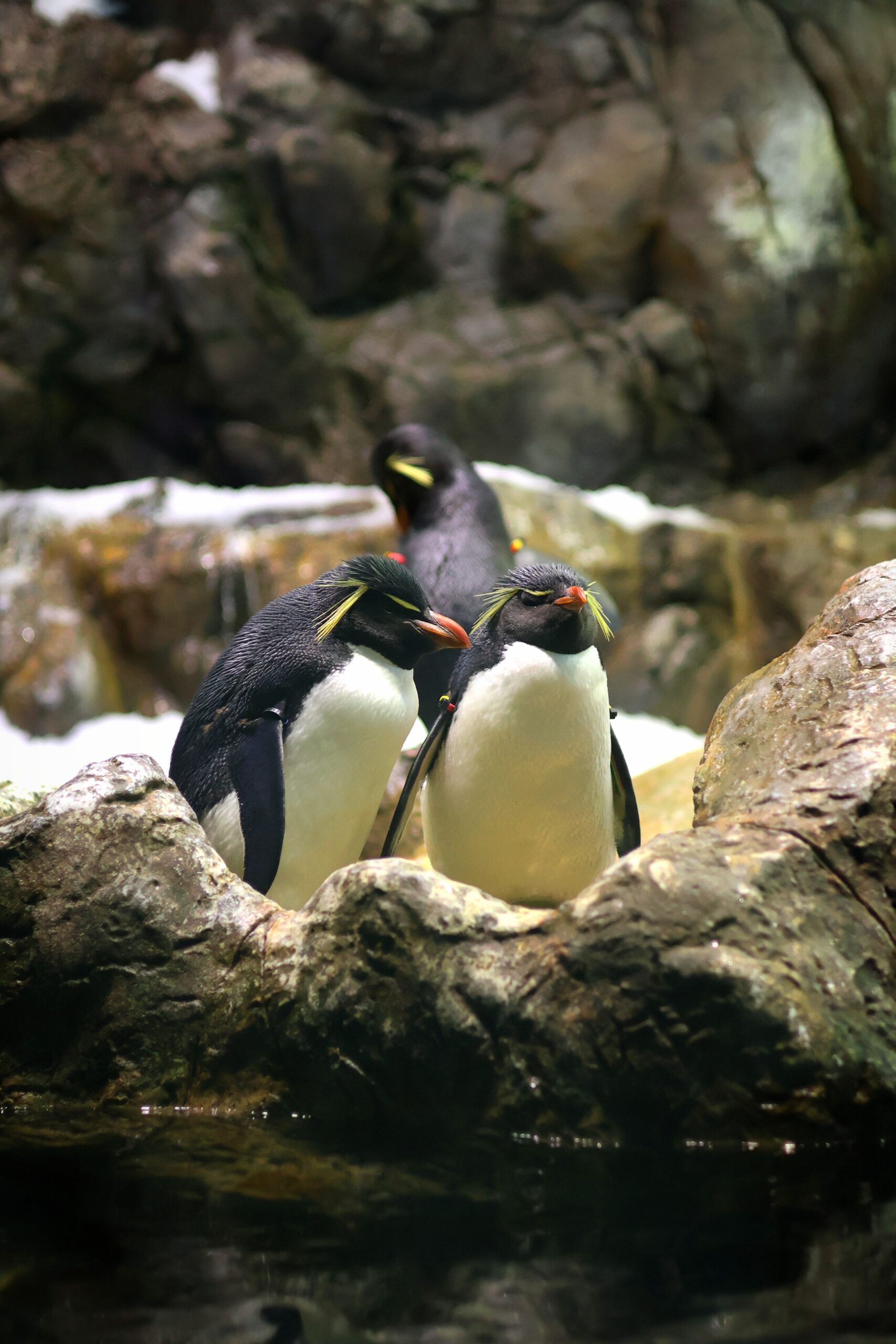
Head: Yellow crest (from above the eyes to the back of the head)
Face: Black, with a thinner crest than that of the Macaroni Penguin and Royal Penguin
Beak: Orange-red, feeds on fish and krill
Legs: Short and sturdy, allowing for steady walking on rocky or sandy beaches
- Ecology and Behavior
Excellent Swimmer: Pursues fish and krill in the sea for prey
Diet: Fish, small squid, krill, crustaceans
Reproduction:
Breeds in colonies on rocky areas, cliffs, or sandy beaches
Eggs are laid by pairs, with males and females taking turns incubating them
Sociality: Lives in groups and cooperates to raise chicks
- Personality and Characteristics
Sociable and cooperative: They form groups within colonies during the breeding season.
Curious: They are sometimes interested in their surroundings and people.
Tenacious and loyal: They are loyal to their mates and breeding grounds, and tenaciously raise their young during the breeding season.
- Appearance
Their trademark is the yellow feather crest on their head.
They are agile swimmers in the ocean and adorable walkers on land.
They resemble “little adventurers with yellow feather crests.”

What will your personality look like?
This is a very aggressive and quarrelsome penguin. This animal will attack even if it is a larger animal than itself, so you need to be careful.
Rockhopper Penguin Personality (Behavioral Characteristics)
Social and cooperative
During the breeding season, they form large colonies and live in groups.
Pairs work together to care for eggs and chicks.
Curious
Early alert to movements around them, other animals, and humans.
Shows boldness when pursuing prey at sea.
Bold and tenacious
Breeds in harsh environments such as rocky areas, cliffs, and sandy beaches.
Tenacious in protecting chicks and eggs.
Loyal
Strongly loyal to their mates and breeding sites.
Typically returns to the same breeding sites year after year and breeds with the same pair.
What is the ecology of rockhopper penguins?
Rockhopper penguins subsist on fish and crustaceans. The breeding season is from October to November, and nests are built with twigs and stones, but fights often occur over nest-building materials. Two eggs are laid and the incubation period is 30-40 days. The chicks form a kleish and live there. Lifespan is around 20 years.
- Habitat and Environment
Distributed around Antarctica, sub-Antarctic islands, and the southern coast of South America
Forms breeding colonies on rocky, cliffy, or sandy coasts
Forages in the sea outside of the breeding season and is rarely seen on land
Prefers isolated environments with little human influence
- Diet (Prey)
Preys mainly on fish, krill, small squid, and crustaceans
Dives underwater to pursue prey
Rarely feeds on land
- Breeding and Rearing
Breeding season is during the Southern Hemisphere summer (November to February)
Forms colonies on rocky or sandy coasts
Each pair takes turns incubating eggs
Chicks grow while being fed by their parents, and once they have fully developed feathers, they become independent in the sea
- Behavior
Highly social, living in groups
Living in groups to protect themselves from predators (such as seals and seagulls)
Swimming quickly in the ocean, they pursue prey
On land, they roam rocky areas and sandy beaches, focusing on breeding and protecting their chicks
- Adaptability
Feathers and blubber allow them to withstand the cold temperatures of the harsh sub-Antarctic waters
Streamlined body shapes suitable for diving
Social cooperation allows for successful reproduction
What are the natural enemies of rockhopper penguins?
Rockhopper penguins’ natural enemies include great skuas, giant petrels, fur seals, and sea lions.

Rockhopper Penguin Molting
Molting in Rockhopper penguins is the process of shedding old feathers and growing new ones all at once. It is an essential part of their annual life cycle, crucial for maintaining the waterproofing and heat-retention properties of their plumage.
When Molting Occurs
After finishing their breeding and chick-rearing season (around February to April in the Southern Hemisphere), Rockhopper penguins return to their breeding grounds to molt.
Before molting, they feed extensively at sea to build up fat reserves in their bodies before coming ashore.
What Happens During Molting
The molting process takes about two to three weeks.
During this time:
Feathers across their entire body are gradually replaced.
Waterproofing is compromised until the new feathers fully grow in.
They cannot enter the water.
They do not eat, surviving solely on their stored fat.
Consequently, they are often seen resting quietly on rocky terrain.
Why Can’t They Enter the Water?
Penguin feathers overlap in multiple layers, serving to repel water and retain body heat.
However, during molting, old feathers fall out while new ones have not yet fully grown in, resulting in:
Reduced waterproofing capabilities.
An inability to maintain body temperature in the cold ocean.
Impaired swimming ability.
For these reasons, they cannot enter the sea.
Rockhopper Penguin Diving
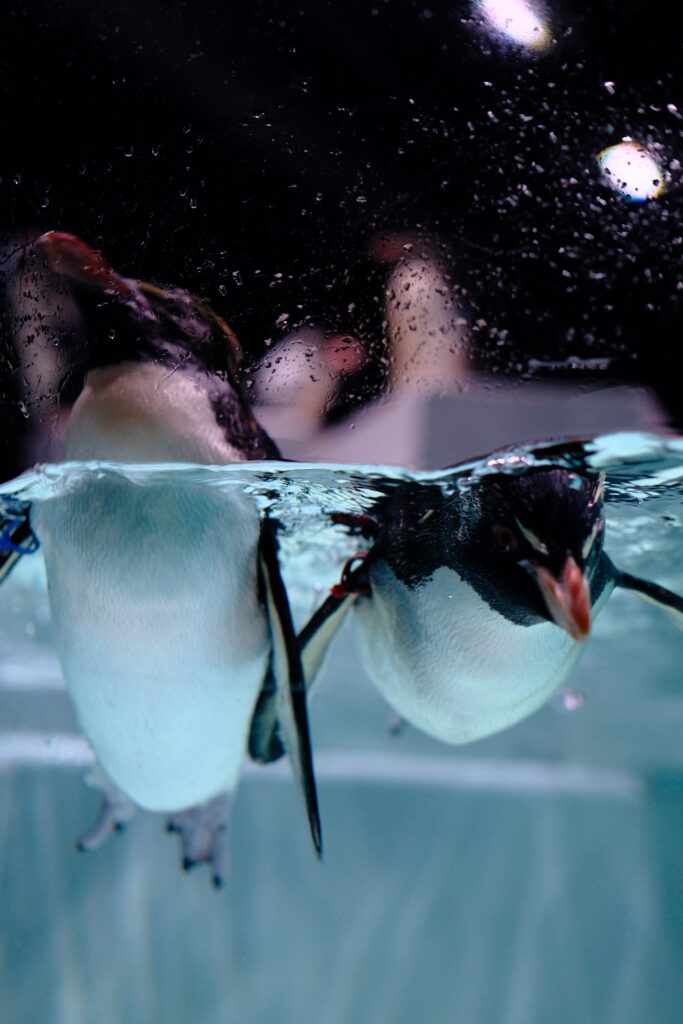
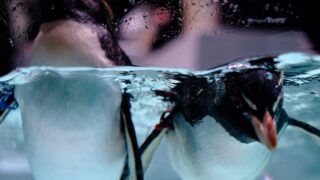
Although small in size, Rockhopper penguins possess excellent diving abilities, feeding on prey such as krill and small fish in the ocean. During the breeding season, they dive repeatedly—often many times a day—to gather food for their chicks.
Diving Capabilities
While Rockhopper penguins primarily dive in relatively shallow waters, they can dive to greater depths depending on the situation.
Typical diving depth: Approx. 10–60 m
Deep dives: Can reach depths of over 100 m
Dive duration: Usually around 1–2 minutes; up to 2–3 minutes for longer dives
Diving depth and duration vary depending on the type of prey and marine conditions.
Physical Adaptations for Diving
Rockhopper penguins possess the following characteristics that enable them to swim efficiently in the ocean:
Flipper-like wings that allow them to “fly” underwater
Streamlined bodies that reduce water resistance
Dense plumage that maintains waterproofing and heat retention
Subcutaneous fat that preserves body heat in cold waters
Muscles capable of storing high levels of oxygen, allowing for continued activity while submerged
Swimming Speed
They typically swim at speeds of 6–8 km/h but can swim faster when chasing prey or escaping predators.
Near the water’s surface, they sometimes engage in a behavior known as “porpoising,” where they leap in and out of the water. This behavior reduces water resistance and allows for efficient travel over long distances.
Rockhopper Penguin Calls
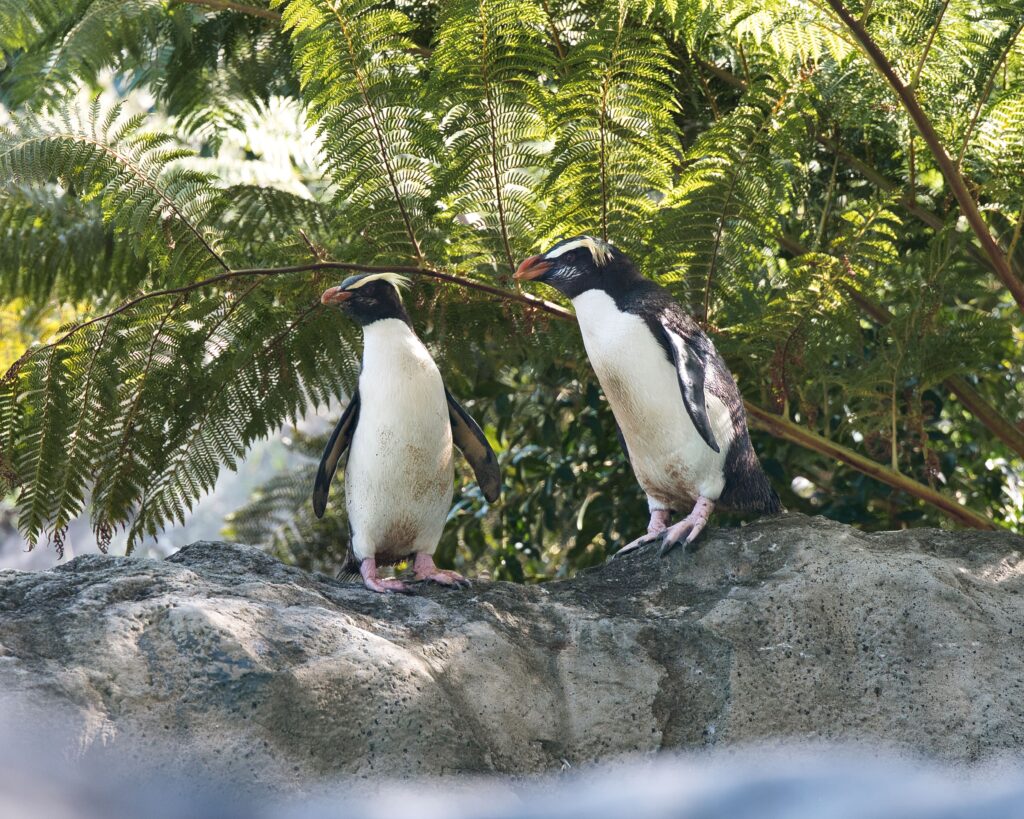
Rockhopper penguins are a very vocal species. During the breeding season, their rocky colonies fill with noise, becoming lively enough that their presence can be detected from a distance.
What do they sound like?
Rockhopper penguin calls are sometimes described as follows:
“Gaa, gaa”
“Kwaa, kwaa”
“Brrr-rr-rr”
“Ehh, ehh”
Their voices are relatively loud and vary from low, raspy sounds to high-pitched, sharp cries.
Why do they call?
① Communication with a partner
During the breeding season, males and females exchange calls to identify one another. They often pair up with the same mate as the previous year, and vocalizations play a crucial role in this process.
② Parent-chick recognition
As the chicks grow, they spend time in a “crèche” (a nursery group) alongside many other chicks.
When parents return from the sea, they locate their own chick by its call, and the chick recognizes its parent’s voice and approaches them.
③ Territory and intimidation
If another individual gets too close to the nest, they will vocalize loudly to intimidate the intruder. During the breeding season, these calls are often accompanied by behaviors such as thrusting their beaks forward or spreading their wings (flippers).
Seasonal Activities of Rockhopper Penguins
Since Rockhopper penguins inhabit the Southern Hemisphere, their seasons are the reverse of those in Japan. Throughout the year, they cycle through breeding, rearing chicks, molting, and living at sea.
Spring (September–November): The Start of Breeding Season
As spring arrives in the Southern Hemisphere, Rockhopper penguins return from the open ocean to their breeding islands.
During this period:
Males arrive at the breeding grounds first
They build nests on rocky terrain
Courtship displays and vocal exchanges become active
They form new pairs or reunite with partners from the previous year
Females typically lay two eggs
Although Rockhopper penguins lay two eggs, a common characteristic is that the chick hatching from the second, larger egg is more likely to survive than the one from the first, smaller egg.
Summer (December–February): Incubation and Chick Rearing
Summer is the season of peak activity.
Parents take turns incubating the eggs and cooperate to raise the chicks once they hatch.
During this period:
Males and females take turns incubating the eggs
They head out to sea daily to bring food back to the chicks
They catch prey such as krill, small fish, and squid
Growing chicks form “crèches” (nursery groups) and spend time together
Once the chicks have grown sufficiently, they become independent of their parents and begin life at sea.
Autumn (February–April): Molting
After finishing chick rearing, the parents return to the breeding grounds to undergo molting (shedding and replacing feathers).
During molting:
They spend about two to three weeks on land
Old feathers are shed and new ones grow in
They cannot enter the water because they lose their waterproofing
They do not eat, surviving solely on stored fat
Molting is one of the most energy-intensive periods of the year.
Winter (May–August): Life at Sea
Once molting is complete, Rockhopper penguins leave the breeding grounds and live in the open ocean. Key activities during the winter include:
Foraging across a wide area of the ocean
Feeding on krill, fish, and squid
Regaining physical strength for the upcoming breeding season
During this period, they spend almost all their time at sea and rarely come ashore.
About Rockhopper Penguin Chicks
Here is some information about rockhopper penguin (Eudyptes chrysocome) chicks.
- Hatching
Two eggs are usually laid, but the first one to hatch often takes priority.
The incubation period is approximately 32-34 days.
The parents take turns incubating the eggs and protecting the chicks.
- Appearance and Physical Characteristics
Immediately after hatching, they are covered in gray to pale down.
Their feathers are not yet waterproof, and they cannot swim.
They have a small, round body, and their limbs are underdeveloped.
- Growth and Development
Early Stage (1-2 weeks after hatching): They are warmed and protected by their parents.
Middle Stage (2-4 weeks): They are fed by their parents and gain strength.
Late Stage (4-7 weeks): Their feathers are replaced and become waterproof.
Chicks may form groups called “kreich” (chickling schools).
- Diet
The parents feed their young fish and krill by mouth.
The parents take turns foraging for food.
- Independence
Once their feathers have grown in and become waterproof, they begin foraging at sea.
They leave the sea and become independent at about 2-3 months of age.
They live cooperatively in flocks until they reach adulthood.
Is the rockhopper penguin an endangered species?
The estimated population of rockhopper penguins is 3.68 million. Currently, it is on the decline, due to the following reasons:
Competition with fishing industry
Human populations are also increasing, and we are now catching more fish through fishing. This makes it difficult for macaroni penguins to secure food. Furthermore, due to global warming, it is no longer possible to catch fish that used to be nearby.
Effects of marine pollution
There is also the impact of marine pollution. Chemicals are flowing into the ocean from oil tankers, causing further pollution. It is also believed that female penguins’ reproductive ability is declining.
Is it possible to keep rockhopper penguins?
Rockhopper penguins are listed as an endangered species. Furthermore, since the animals live near Antarctica, equipment that can reproduce that environment at room temperature is required, which can be quite a hurdle.
- Constraints as a Wild Species
A wild species that inhabits sub-Antarctic rocky and coastal areas.
Because they are adapted to low-temperature waters, captivity in an artificial environment is extremely difficult.
Rockhopper penguins are rarely kept in captivity in zoos around the world, and home captivity is impossible.
- Difficulties of Captivity
Temperature Control: A low-temperature environment is essential (near-freezing is preferable).
Aquarium Size: A large saltwater pool is required for swimming.
Dietary Management: A large and stable supply of fish and krill is required.
Health Management: Wild species are susceptible to stress and disease, making it difficult for them to survive in an artificial environment.
Legal Restrictions: Import, export, and captivity are strictly restricted by the Convention on International Trade in Endangered Species of Wild Fauna and Flora (CITES).
- Summary
Rockhopper penguins are virtually impossible to keep in homes or small facilities.
Captivity is only possible in specialized facilities or research institutes under specially controlled conditions.
There are few examples of actual captivity, and conservation and observation are primarily conducted in the wild.
Zoos and Aquariums Housing Rockhopper Penguins (Japan & Worldwide)
Rockhopper penguins are kept in zoos and aquariums across Japan and around the world. However, the specific types housed are primarily Southern Rockhopper penguins or Eastern Rockhopper penguins, and some facilities do not specify the exact subspecies.
Major Facilities in Japan
Rockhopper penguins can be seen at a relatively large number of facilities in Japan.
Asahiyama Zoo
Keeps and exhibits Rockhopper penguins
A popular zoo known for its ecological penguin exhibits
Aqua World Oarai (Ibaraki Prefecture)
Keeps multiple penguin species
Exhibits Rockhopper penguins
Port of Nagoya Public Aquarium
Keeps Rockhopper penguins in its penguin exhibit area
Kobe Suma Sea World
Rockhopper penguins can be observed in the penguin exhibit area
Nagasaki Penguin Aquarium
One of the world’s leading penguin facilities
Exhibits multiple penguin species, including Rockhopper penguins
Major Facilities Worldwide
Rockhopper penguins are also relatively commonly kept in facilities overseas.
Australia
SEA LIFE Melbourne Aquarium
Taronga Zoo Sydney
USA
SeaWorld San Diego
Saint Louis Zoo
UK
Edinburgh Zoo
Germany
Tierpark Hagenbeck
Fellow members of the same group
コメント