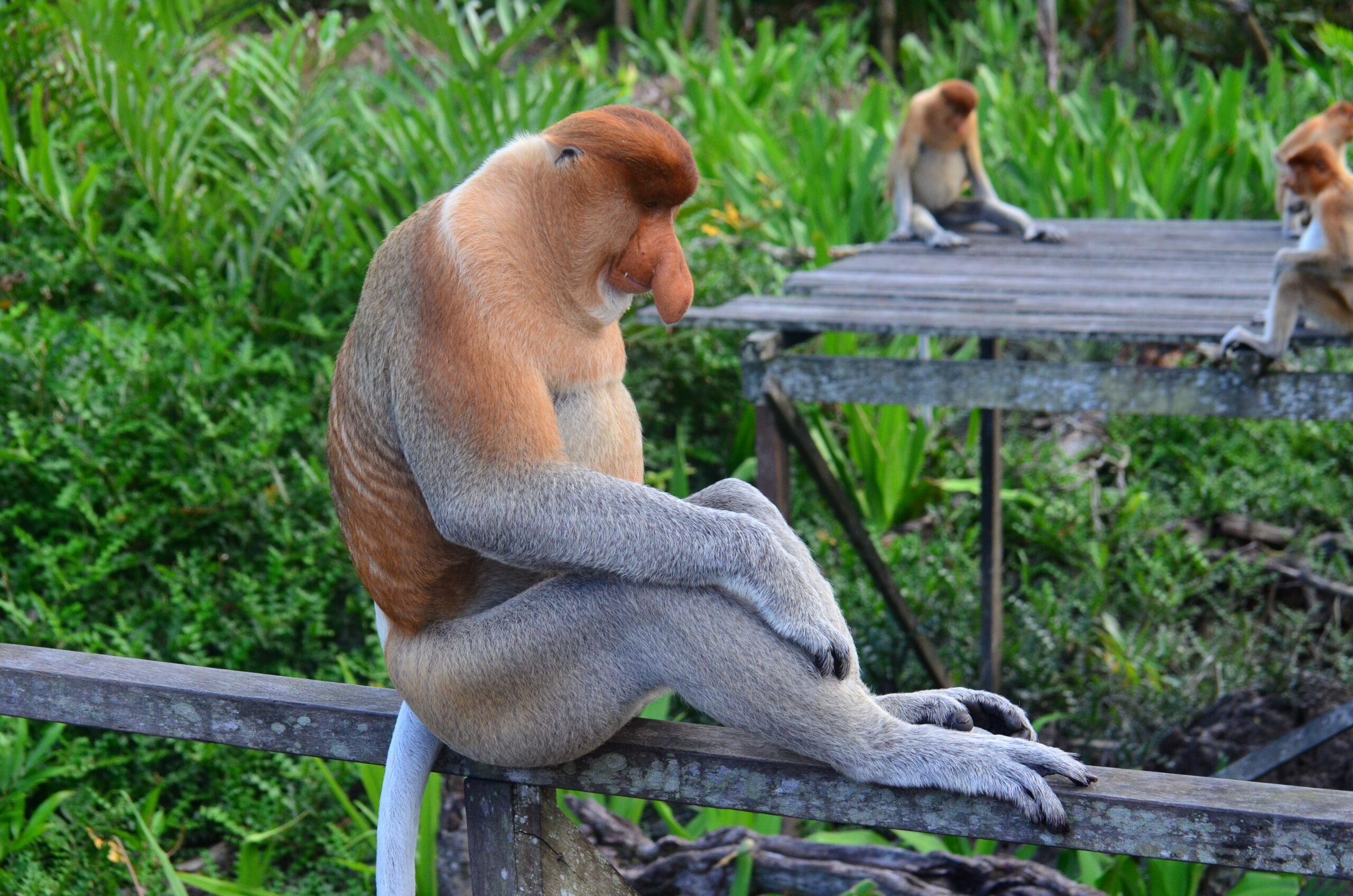
What kind of animal is a proboscis monkey? We will explain its characteristics, ecology, and habitat. As you can probably guess from its name, it is a member of the monkey family with a very long nose, reminiscent of a tengu. They are actually designated as an endangered species. We are in a critical situation.









- What is a proboscis monkey? About basic status
- What are the roots and origins of the proboscis monkey?
- About habitat
- feature is? What kind of creature is it?
- What is your personality like?
- What does the ecology look like?
- About Molting
- About Their Vocalizations
- Seasonal Activities
- Regarding Walking Speed
- About Baby Proboscis Monkeys
- Is the proboscis monkey an endangered species?
- Can proboscis monkeys be kept as pets?
- Zoos Housing the Species (Japan & Worldwide)
- Introducing other animals
What is a proboscis monkey? About basic status
The proboscis monkey is a monkey classified in the genus Proboscis in the order Primates and the family Cercopitheinae. The scientific name is Nasalis larvatus, and the kanji is Tenguzaru. The list of information is as follows. The total length is 60-70cm and the weight is 10-20kg.
| Japanese(和名) | テングザル |
| English(英名) | Long-nosed monkey Proboscis monkey |
| scientific name(学名) | Nasalis larvatus |
| classification(分類) | Mammalia、Primates、 Cercopithecidae、Nasalis 哺乳綱、霊長目、オナガザル科、テングザル属 |
| IUCN Status(保全状況) | VULNERABLE |
| Length(体長) | 60-70cm |
| Weight(体重) | 10-20kg |
What are the roots and origins of the proboscis monkey?
The proboscis monkey (scientific name: Nasalis larvatus) is a species endemic to the island of Borneo that evolved from the ancient Cercopithecidae (Old World monkey) family found in Southeast Asia. It possesses an evolutionary history spanning millions of years to reach its current form, characterized by its massive nose.
Origin: Ancestors were “Colobines” (Colobinae)
Taxonomically, the proboscis monkey belongs to:
Order: Primates
Family: Cercopithecidae
Subfamily: Colobinae
In other words, it belongs to the same “Old World monkey” group as Japanese macaques and other macaques.
It is believed that the ancestral Colobines diverged in Asia approximately 7 to 10 million years ago, giving rise to the lineage that eventually led to the proboscis monkey.
Where did they come from? → Borneo
Currently, the proboscis monkey is a species endemic to Borneo, meaning it is found nowhere else.
Habitat:
Indonesian Kalimantan
Malaysian Sabah and Sarawak
Brunei
They particularly favor:
Mangrove forests
Riverine forests
Wetlands
It is thought that after the ancestral Colobines spread into Southeast Asia, they became isolated on Borneo and underwent unique evolution.
Why did they develop such a nose?
Their most distinctive feature—the massive nose—is not merely a deformity but the result of evolution.
Especially in males, the nose likely developed through “sexual selection,” as:
A larger nose allows for the production of a deeper, resonant voice
It serves to attract females
It provides an advantage in reproductive competition
The nose also functions as a resonator to amplify their vocalizations.
Why are they called “Tengu”?
In Japan, they are called Tengu-zaru (Tengu monkey) because the shape of their nose resembles that of the Tengu, a creature from Japanese folklore. Overseas, it is known by names such as:
Proboscis monkey
Long-nosed monkey
scientific classification
- 界:動物界 (Animalia)
- 門:脊索動物門 (Chordata)
- 綱:哺乳綱 (Mammalia)
- 目:霊長目 (Primates)
- 亜目:真猿亜目 (Haplorhini)
- 科:オナガザル科 (Cercopithecidae)
- 属:テングザル属 (Nasalis)
- 種:Nasalis larvatus(テングザル)
About habitat
Proboscis monkeys are distributed on the island of Borneo (Malaysia).
- Geographical Distribution
Distribution: Southeast Asia, endemic to Borneo (Indonesia, Malaysia, Brunei)
Country Distribution:
Indonesia (Kalimantan)
Malaysia (Sabah, Sarawak)
Brunei
- Forest Environment
Prefers tropical rainforest swamps and lowland forests along rivers
Also found in mangroves, estuarine forests, and swamp forests
Selects areas with an abundance of large trees suitable for arboreal life
- Behavioral Environment
Live in tall trees, moving, eating, and resting
Rarely descends to the ground, but may cross rivers and swamps
Vulnerable to deforestation, and habitat fragmentation affects populations
- Food Relationships
Eating fruits, leaves, flowers, and bark, they live mainly in the canopy layer, where food resources are abundant
Riverside and swamp forests are rich in fruit and leaves, making them ideal habitats
feature is? What kind of creature is it?
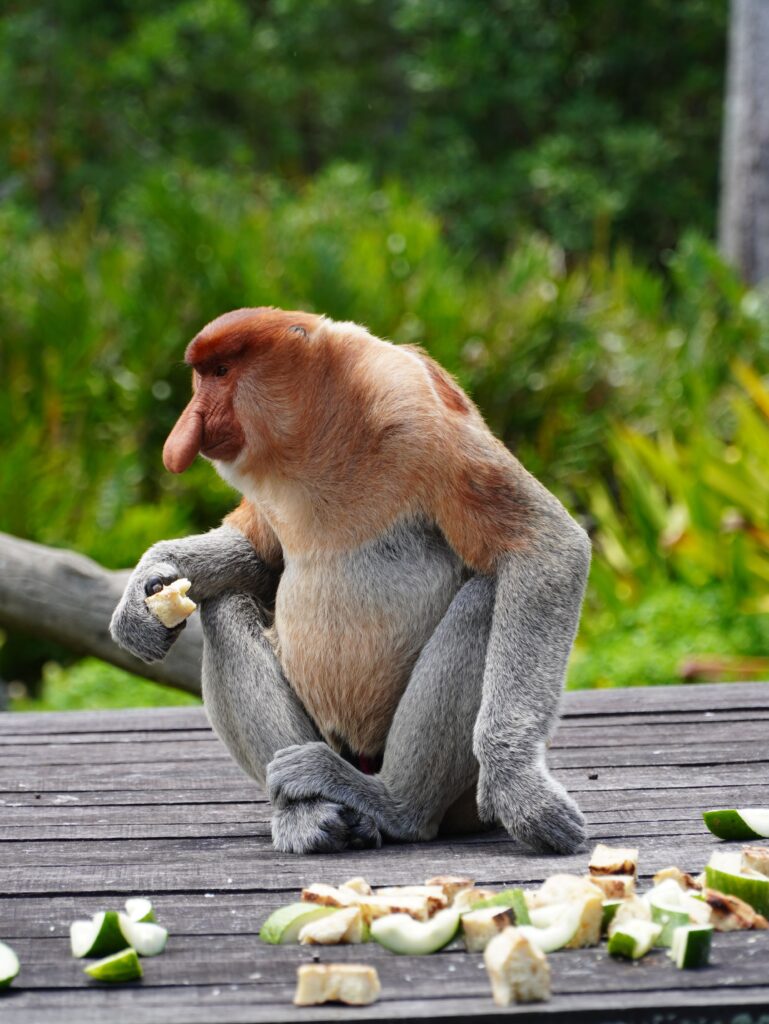
The most distinctive feature of proboscis monkeys is their distinctive large nose. The male’s nose is particularly large, measuring 10 cm. The coat color is chestnut or reddish brown from the head to the shoulders and back. The limbs and ventral side are pale gray. The face is red and the base of the tail is black. Proboscis monkeys live near rivers, such as mangroves, forests, and wetlands. They are active during the day and live mostly in trees. They are agile on the tree and can move from branch to branch.
- Physical Characteristics
Body Type: Large Cercopithecus monkey, with long limbs adapted to arboreal life
Body Length: Males approximately 65-75 cm, Females approximately 55-65 cm (Tail approximately 75-85 cm)
Weight: Males approximately 16-24 kg, Females approximately 7-12 kg
Tail: Long, helps maintain balance in the trees
Fur Color: Reddish-brown to brown long hair, slightly thinner on the abdomen and limbs
Face: Males have a distinctive large, protruding snout
Females have a smaller, less prominent snout
- Movement/Behavior
Completely arboreal: Moves skillfully from branch to branch
Moves by hanging and jumping using their long limbs and tail
Rarely descends to the ground
- Diet
Omnivorous, almost herbivorous
Fruit, leaves, flowers, bark, seeds, etc.
Occasionally eats insects
Moves through fruit- and leafy tree canopies to feed
- Sociality
Live in large groups (several dozen to over a hundred individuals)
While there are hierarchical and territorial differences within the group, they are relatively peaceful.
Communicate through vocalizations and gestures.
- Appearance
Males are characterized by their large noses and reddish-brown fur.
These monkeys have a striking appearance and are adept at moving about in the trees using their long tails and limbs.
What is your personality like?
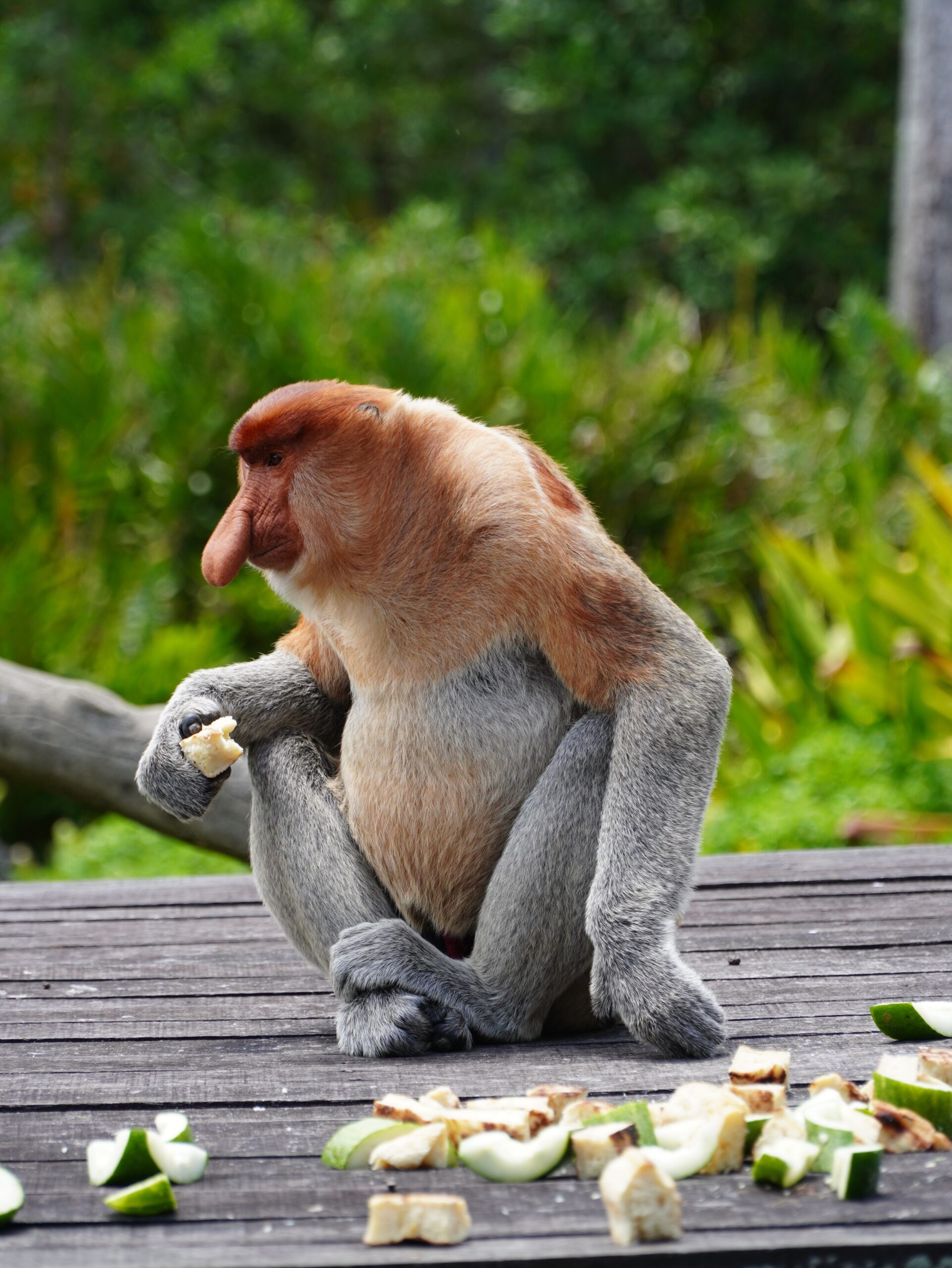
Proboscis monkeys, like many monkeys, are highly social. Therefore, they place great importance on discipline, and will also warn other members of danger.
- Gentle and Sociable
They often live cooperatively in groups and are relatively peaceful.
Living in large groups means cooperation between individuals is important.
While conflicts do occur between males and within the group, they are not violent and are resolved primarily through threats or vocalizations.
- Vigilance and Timidity
They are highly alert and sensitive to humans and predators.
When they sense danger, they quickly move up the treetops to avoid it.
They rarely descend to the ground and live in the safety of the trees.
- Intelligence and Curiosity
Highly intelligent and able to adapt to their environment.
They have the judgment to select and eat fruits and leaves.
They are cautious about new environments and changes, but are also curious.
- Social Communication
They communicate with their peers through vocalizations and gestures.
Males sometimes use their noses to emphasize their calls.
They have developed vocalizations and body movements to indicate rank and territory within the group.
What does the ecology look like?
Proboscis monkeys are herbivorous and feed on plants, young mangrove leaves, and other tree leaves. The breeding season is from February to November, and the gestation period is over 200 days. Births take place in trees, and it is possible to give birth to one to two calves at a time. It has a lifespan of 20 to 30 years.
- Living Environment
Habitat: Tropical rainforests of Borneo, especially riverside, swampy forests, and mangroves.
Arboreal: Moves, rests, and feeds in the trees, rarely descending to the ground.
Range of Activity: Each group has a territory and moves through the treetops in search of food resources.
- Diet
Omnivorous, leaning towards herbivorous.
Eats fruits, leaves, flowers, bark, and seeds.
Occasionally preys on insects.
Forages mainly in the fruit-rich canopy of trees, changing diet with the seasons.
- Sociality and Group Structure
Live in large groups (tens to over a hundred individuals).
Coordinates within the group for feeding, movement, and resting.
Dominance and territory within the group are primarily determined by vocalizations and threatening behavior.
Males use nasal calls to mark their territory and signal their presence.
- Behavior Pattern
Diurnal, active during the day
Jumping and hanging from branch to branch (adapted for arboreal life)
Swiftly evade danger by standing on a branch
May also swim along rivers or in wetlands
- Reproduction
Sexual maturity: Males reach approximately 6-7 years of age, females reach approximately 4-5 years of age
Gestation period: Approximately 166 days (5-6 months)
Litter size: Usually one pup
Rearing: The mother carries the pups, and the pack cooperates to protect them
Cubs grow up dependent on their mother for several months, learning how to live in the trees and forage.
Are there any natural enemies?
Proboscis monkeys are safe because they usually live in trees, but on the ground their natural enemies include tigers and leopards.
About Molting
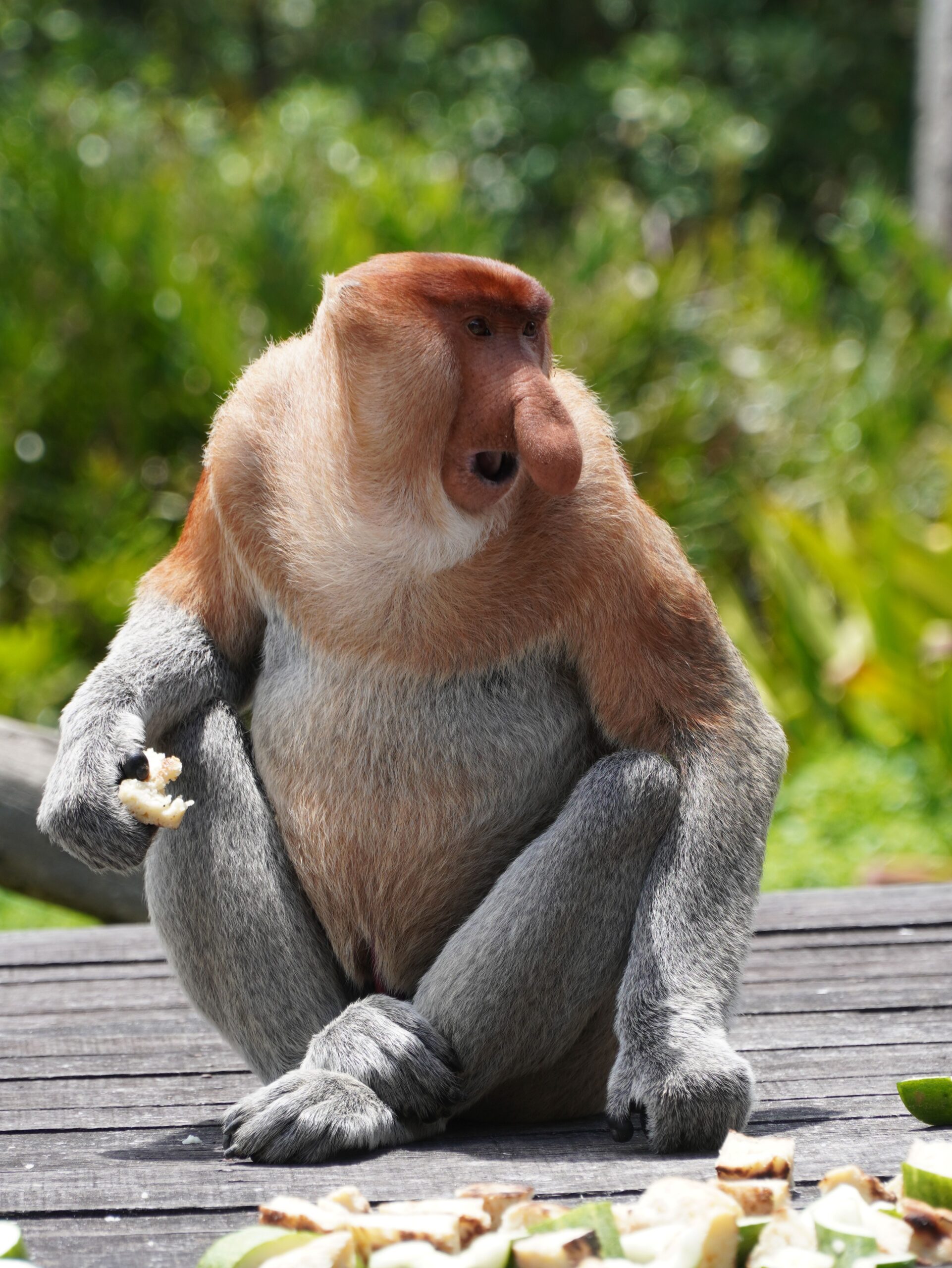
Proboscis monkeys do not have a distinct “molting season” like dogs or cats, where they shed large amounts of fur at specific times of the year. However, their fur quality and color do change depending on their growth stage and environment.
Fur Changes from Juvenile to Adult (Growth-Related Change)
Proboscis monkeys undergo particularly significant changes.
Juvenile
Immediately after birth: Dark-colored fur
Dark facial and body coloration
Small nose
↓
Young Individual
Gradual shift to reddish-brown or orange fur
Thickening of body fur
Males begin to develop their characteristic noses
↓
Adult
Back: Reddish-brown to yellowish-brown
Belly: Whitish
Head: Orange
Males: Huge nose and long body fur
These changes are not “molting” in the traditional sense, but rather a replacement of fur associated with growth and a change in body color driven by hormones.
Seasonal Molting
Because Borneo has a tropical environment that is hot and humid year-round,
Winter coat
Summer coat
…there is no distinct seasonal molting pattern like this.
However, the condition of their fur can change due to:
The rainy and dry seasons
Food availability
Health status
Stress
Why Do They Need Fur?
A proboscis monkey’s fur serves not only an aesthetic purpose but is also an adaptation to its living environment.
Adaptation to Life Near Water
Proboscis monkeys are frequent swimmers.
Their fur plays roles such as:
Preventing a drop in body temperature
Retaining heat after emerging from the water
Protecting the skin from ultraviolet rays
Camouflage in Wetlands
Their reddish-brown body color helps them blend in with:
Forests along rivers
Mangroves
Tree branches and dead leaves
About Their Vocalizations
The vocalizations of the proboscis monkey are quite distinctive among primates. The deep, resounding calls of the males—who possess notably large noses—play a crucial role in communicating with their troop and in competition for mating opportunities.
The Male’s Signature Call: The “Honk”
Adult males produce loud, deep, and nasal-sounding calls, such as:
“Honk, honk”
“Ngooo, ngooo”
These calls carry over long distances, signaling the male’s presence to others along the riverbanks or within the forest.
Why Do They Make Deep Calls?
The large nose of the male proboscis monkey acts as a resonator that amplifies their voice.
A larger nasal cavity and throat space offer several advantages:
The ability to produce lower-frequency sounds
Increased volume
The appearance of being a larger individual
In short, the evolutionary progression is:
Large nose → Deep voice → A display of male strength
Types of Vocalizations
① Male “Territorial and Threat” Calls
Purpose:
Warning other males
Asserting the troop’s territory
Attracting females
Characteristics:
Deep pitch
Long, resounding tone
Slow rhythm
② Alarm Calls (Warning of Danger)
When sensing danger—such as eagles, snakes, or crocodiles—they emit:
Short calls
Rapid, continuous cries
Warnings to the entire troop
Upon hearing these calls, the troop responds by:
Fleeing into the trees
Moving away from the water’s edge
Gathering together to stay alert
③ Juvenile Calls
Young monkeys produce:
High-pitched sounds
“Kee-kee” sounds
Calls to summon their mothers
These are used for communication between mother and offspring.
Seasonal Activities
Since proboscis monkeys (Nasalis larvatus) inhabit the tropical regions of Borneo, they do not exhibit the distinct seasonal activity changes (spring, summer, autumn, winter) seen in animals from Japan. However, their feeding, movement, reproduction, and group behaviors do shift according to Borneo’s wet and dry seasons.
Wet Season (Generally November–March)
Activity Characteristics
River water levels rise
Mangrove and wetland vegetation becomes abundant
Food sources increase
Behaviors
More time spent eating leaves
Extensive use of riverside forests
Group home ranges may expand
Physical Effects
Due to frequent rain and stable temperatures:
Fur gets wet
Basking in the sun to maintain body temperature
Increased activity after the rain stops
…are among the behaviors observed.
Dry Season (Generally April–October)
Activity Characteristics
Low rainfall
Easier movement along rivers
Focus on specific food trees
Behaviors
Increased activity during morning and evening hours
Resting during the hottest part of the day
Spending time in the shade near the water
On particularly hot days, the rhythm becomes:
Foraging → Resting → Resuming activity in the evening
Regarding Walking Speed
Proboscis monkeys are not built for rapid running on land; instead, they are “slow-moving” animals adapted to arboreal (tree-dwelling) and riparian (waterside) environments.
Typical Walking Speed
While the exact average walking speed in the wild varies by individual and environment, the general estimates are:
Normal walking: Approx. 1–2 km/h
Moving hurriedly: Approx. 3–5 km/h
This is slower than the average human walking speed (approx. 4–5 km/h).
Why Are They Slow Walkers?
Proboscis monkeys did not evolve specifically for walking on the ground.
Their primary habitats include:
Tree canopies
Riverine forests
Mangrove forests
Consequently, what matters most is not the ability to run fast, but rather:
The ability to move without falling
The ability to grip branches securely
The ability to navigate waterside areas safely
Movement Speed in Trees
When moving through the trees, they engage in:
Quadrupedal movement (walking on all fours)
Swinging between branches
Slow lateral movement
Key characteristics include:
Using their long tails for balance
Firmly gripping branches with their hands and feet
Prioritizing safety over speed or distance
Surprisingly Agile on the Ground
Proboscis monkeys are capable of walking on the ground.
They increase their speed particularly when:
Crossing rivers
Moving between trees
Evading danger
However, due to their physical build—specifically their large bellies (an adaptation for digesting fermented plant matter), long limbs, and bodies designed for arboreal life—they are incapable of high-speed running like that of a cheetah or a deer.
About Baby Proboscis Monkeys
This article provides information about baby proboscis monkeys (Nasalis larvatus). They are perfectly adapted to arboreal life and social groups, and grow up under the protection of their mother and her group.
- Birth and Physical Characteristics
Birth Weight: Approximately 1-2 kg
Body Length: Approximately 35-45 cm (Tail is even longer)
Appearance:
Fur is soft and light brown to reddish brown.
Males have small noses at birth that become more prominent as they grow.
Long limbs allow them to cling tightly to their mothers in trees.
- Dependence on Mother
They cling to their mothers for the first few months of life.
Nursing lasts approximately 6-8 months.
They cling to their mothers’ backs and bellies, learning how to navigate and avoid danger in trees.
- Growth and Acquisition
Movement:
Early acquire the ability to grasp branches.
Trained to follow their mother through the tree canopy.
Foraging:
Learns about fruit and leaves by observing their mothers.
Begins to eat small amounts on their own within the first few months.
Social Learning:
Observes and understands relationships and rank with other individuals in the group.
Learns to communicate through vocalizations and gestures.
- Behavioral Characteristics
They hone their motor skills while playing alongside their mothers.
They are highly curious and practice crossing branches and playing small games.
They also learn danger detection from their mothers.
- Protection from Predators
Since young animals are vulnerable to predators on their own, the protection of their mother and herd is essential.
Living in trees, moving quickly, and keeping watch over the herd increases their survival rate.
Is the proboscis monkey an endangered species?
Proboscis monkeys are designated as an endangered species. The reason for this is land development in Southeast Asia. Deforestation is so advanced that there is no land left for them to live on, and as a result they are increasingly attacked by natural enemies. Furthermore, hunting for food and medicine is also a problem. It has been listed since CITES came into effect in 1975, and international trade is severely restricted. It is strictly controlled.
- IUCN Assessment
Classification: EN (Endangered/Critically Endangered)
Reason for Assessment:
Habitat is restricted to parts of Borneo
Habitat loss due to deforestation and wetland destruction
Population decline due to hunting and human activities
- Threat of Extinction
Deforestation and Wetland Development
Habitat loss due to agricultural land conversion, palm oil plantations, and urban development
Depending on specific habitats such as riversides and swamp forests, the impact is significant
Hunting and Trapped
Traditional hunting and limited hunting have affected the population
Habitat Fragmentation
Forest fragmentation has limited the migration range of herds and reduced genetic diversity
- Conservation Status
Found in national parks and protected areas
Internationally, trade is prohibited under Appendix I of the Convention on International Trade in Endangered Species of Wild Fauna and Flora (CITES)
Habitat protection and prevention of illegal hunting are essential to reduce the risk of extinction
Can proboscis monkeys be kept as pets?
Proboscis monkeys are an endangered species and cannot be kept by the general public. We recommend viewing them at zoos and other locations, and asking them to show you around at events. Let’s observe the males and females exhibited in the park.
- Difficulty in Raising
① Unique Habitat
Depending on specific arboreal environments, such as the tropical rainforests of Borneo, riverside areas, and swamp forests
Their long tails and limbs have adapted them to arboreal life, making it impossible to reproduce this lifestyle at home.
② Highly Social
They are highly social, living in groups of several dozen to over a hundred individuals.
Solo keeping is prone to stress and health problems and behavioral abnormalities.
③ Difficulty in Dietary Management
They require a balanced diet of fruits, leaves, flowers, and bark.
It is practically impossible to provide them with the proper nutrition they need at home.
④ Difficulty in Health Management
They require arboreal living, large spaces, and specific environmental conditions.
Risk of diseases and parasites specific to wild animals.
- Legal Restrictions
Subject to the Wildlife Protection Act and CITES (Convention on International Trade in Endangered Species of Wild Animals) Appendix I.
Capturing, importing, and raising them is illegal in most countries.
Keeping them in Japan is prohibited without special permission.
- Safety Issues
Wild animals are not accustomed to humans and are prone to aggression and stress.
Crowded captive environments can lead to health problems and behavioral abnormalities.
Zoos Housing the Species (Japan & Worldwide)
The proboscis monkey (Nasalis larvatus) is a rare primate, with very few examples of them being kept in captivity worldwide. This is because long-term husbandry and breeding in zoos are difficult due to factors such as their specialized diet (folivorous/leaf-eating), unique digestive system, and high susceptibility to stress.
🇯🇵 Zoos in Japan
Yokohama Zoological Gardens “Zoorasia”
This is the primary zoo in Japan where proboscis monkeys can currently be seen.
They are housed in an exhibit that recreates the tropical environment of Southeast Asia.
They are extremely rare exhibit animals within Japan.
*While there have been instances of them being kept in Japan in the past, the number of facilities currently housing them is limited.
🌏 Major Facilities Worldwide
🇸🇬 Singapore
Singapore Zoo
One of the world’s most successful facilities for keeping proboscis monkeys.
They have achieved success in breeding the species over a long period.
Known for exhibits that incorporate vegetation closely resembling their natural habitat.
🇳🇱 Netherlands
Apenheul Primate Park
There have been past instances where individuals were transferred here from Singapore.
One of the few facilities in Europe that houses proboscis monkeys.
🇺🇸 United States
Bronx Zoo
A prominent zoo that has kept proboscis monkeys in the past.
They housed multiple individuals during the latter half of the 20th century, though current ongoing husbandry is limited.
Introducing other animals




コメント