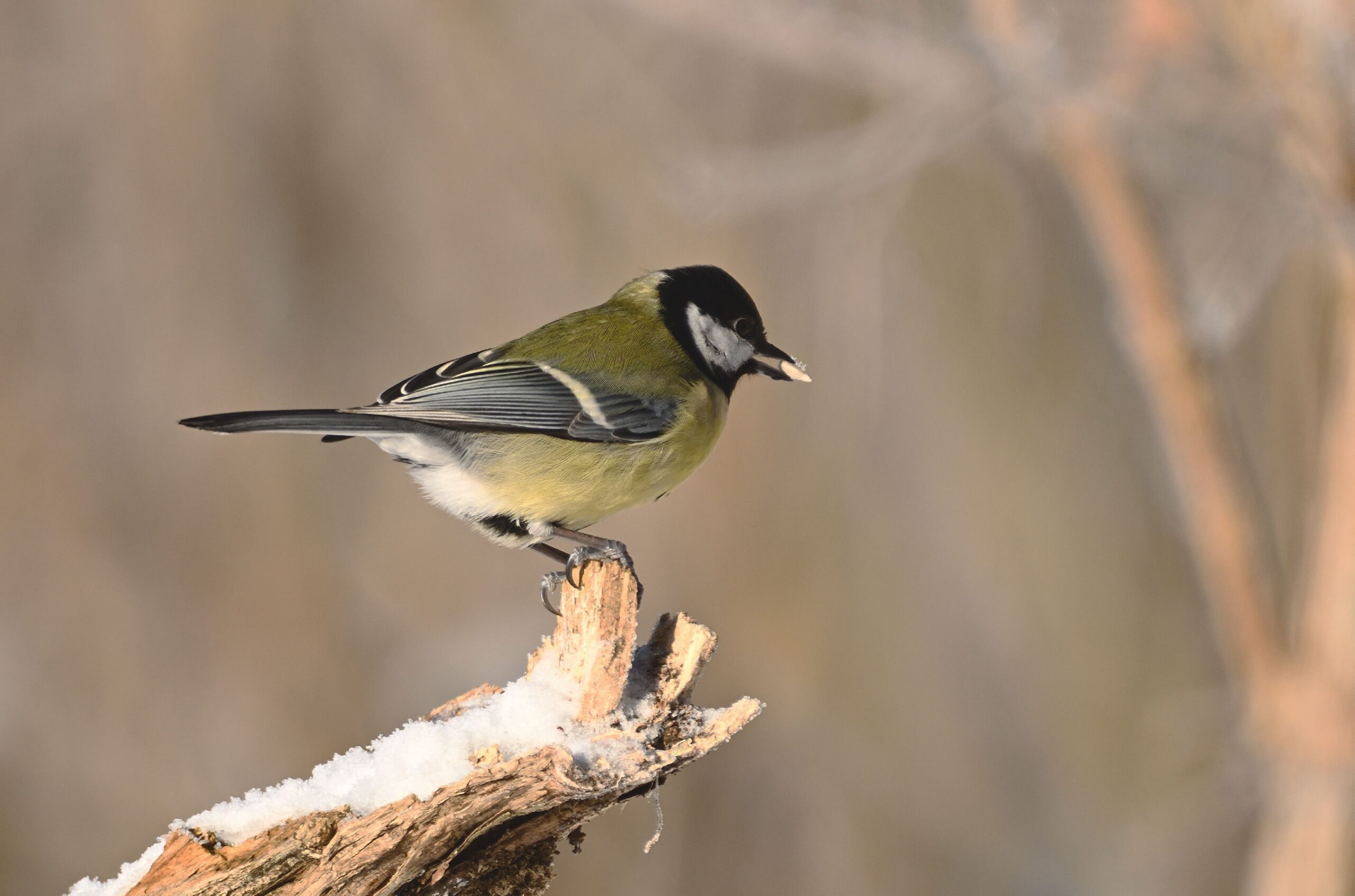
What kind of bird is the great tit? We will explain its characteristics, ecology, and habitat. Great tits live mainly in Japan and are widely distributed in East Asia and other areas. There are many subspecies, so we will introduce them all together.










- What is titmouse? About basic status
- What are the roots and origins of the Japanese Tit?
- About habitat
- feature is? What kind of creature is it?
- What does the ecology look like?
- About Molting
- About Their Calls
- Seasonal Activities
- About Flight Speed
- About Great Tit Chicks
- Is the great tit an endangered species?
- Can tits be kept as pets?
- Zoos Keeping the Species (Japan & Worldwide)
- Introducing other animals
What is titmouse? About basic status
The titmouse is a bird that belongs to the genus Tittidae in the family Tittidae. The total length is only 14-20cm and the weight is 11-20g. The scientific name is Parus minor and the Japanese name is Chickadee.
| Japanese(和名) | シジュウカラ |
| English(英名) | Japanese tit Eastern Great Tit Oriental Tit |
| scientific name(学名) | Parus minor |
| classification(分類) | Ave、 Passeriformes、Paridae、Parus 鳥綱、スズメ目、シジュウカラ科、シジュウカラ属 |
| IUCN Status(保全状況) | LEAST CONCERN |
| Length(全長) | 14cm |
| Weight(体重) | 20g |
What are the roots and origins of the Japanese Tit?
The Japanese Tit (scientific name: Parus minor) is a small bird belonging to the family Paridae (tits and chickadees) within the order Passeriformes. The Japanese population is considered to have diverged from a lineage of tits that evolved on the Eurasian continent.
Ancestors: The “Tit” group from tens of millions of years ago
The ancestors of the Paridae family evolved from the lineage of the Passeriformes (perching birds), a group that is relatively recent in the history of birds.
The general evolutionary progression is as follows:
Dinosaurs (Theropods)
↓
Primitive birds
↓
Ancestors of Passeriformes (diversified after approx. 50 million years ago)
↓
Paridae family
↓
Parus genus
↓
Modern Japanese Tit
Origins on the Eurasian continent
Modern tits are widely distributed across Eurasia, including:
Europe
Russia
China
The Korean Peninsula
Japan
Ancestral tits evolved in temperate forest environments, developing:
Small bodies
Strong legs
The ability to move freely among tree branches
Slender beaks for catching insects
Japanese Tits diverged from the continental lineage
The Japanese Tit (Parus minor) was formerly classified as the same species as the Great Tit (Parus major) found in Europe and other regions.
However, genetic research revealed that populations in:
Japan
The Korean Peninsula
Eastern China
…belong to a distinct lineage, and they are now classified separately as Parus minor.
Why did they evolve independently in Japan?
The reason lies in the geographical characteristics of the Japanese archipelago.
Starting several million years ago, factors such as:
Isolation by the sea
Climate change
Changes in forest environments
…caused them to separate from the ancestral populations on the continent and adapt to the environment of the Japanese archipelago. As a result, it has evolved into the Japanese tit we see today—a bird capable of breeding in sync with Japan’s four seasons, possessing the stamina to remain active even in winter, and able to adapt to urban environments.
About classification
There are the following subspecies of titmouse: The following is a quote from Wikipedia.
- Parus minor minor Temminck & Schlegel, 1848 シジュウカラ
- Parus minor amamiensis Kleinschmidt, 1848 アマミシジュウカラ
- Parus minor commixtus Swinhoe, 1868
- Parus minor dageletensis Kuroda & Mori, 1920
- Parus minor nigriloris Hellmayr, 1900 イシガキシジュウカラ
- Parus minor nubicolus Meyer de Schauensee, 1946
- Parus minor okinawae Hartert, 1905 オキナワシジュウカラ
- Parus minor tibetanus Hartert, 1905
classification
| 階級 | 分類 |
|---|---|
| 界 | 動物界(Animalia) |
| 門 | 脊索動物門(Chordata) |
| 綱 | 鳥綱(Aves) |
| 目 | スズメ目(Passeriformes) |
| 科 | シジュウカラ科(Paridae) |
| 属 | シジュウカラ属(Parus) |
| 種 | シジュウカラ(Parus major) |
About habitat
Great tits are active in Japan, China, the Korean Peninsula, southern Russia, and even Southeast Asia.
- Distribution Range
Worldwide Distribution
Widely distributed throughout Europe and Asia (Middle East, Siberia, India, East Asia)
Also found in parts of North Africa
Within Japan
Distributed nationwide from Hokkaido, Honshu, Shikoku, and Kyushu
Distribution ranges vary slightly depending on the subspecies (e.g., P. m. major in Hokkaido, P. m. minor south of Honshu).
- Habitat
The great tit is highly adaptable and can live in a variety of environments.
Forests
Deciduous broadleaf forests, mixed forests, coniferous forests, etc.
Urban and rural environments
Also found in parks, gardens, and around farmland.
Nesting Sites
Uses tree hollows and nest boxes.
If no tree hollows are available, they can breed in crevices in buildings or artificial nest boxes.
- Altitude and Climate Adaptation
Widely distributed from plains to mountains
Can survive winter in cold regions (can tolerate the cold if food is available)
feature is? What kind of creature is it?
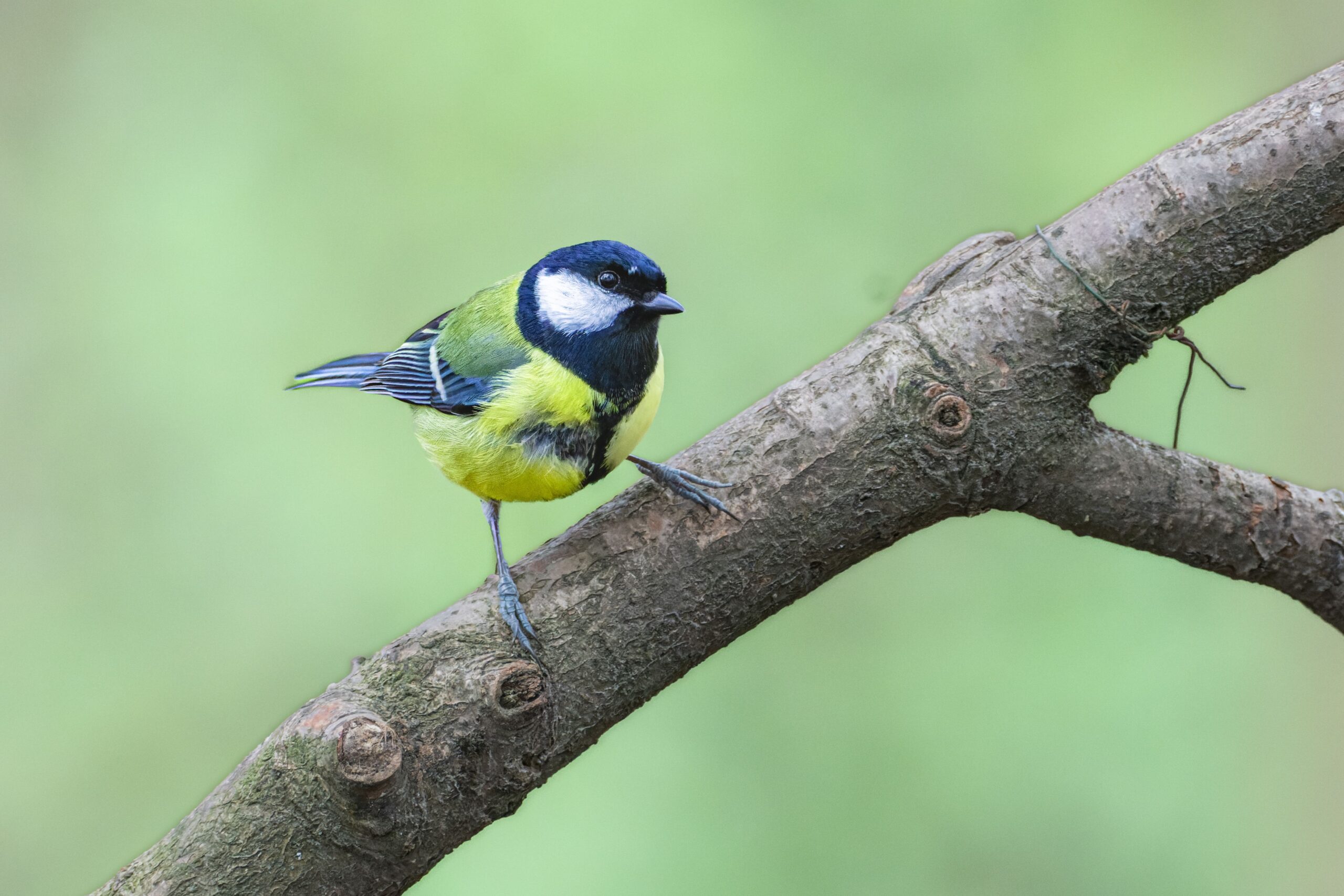
Great tits live in forests from the plains to mountains, but they are often seen in urban and residential areas, and are often seen by humans. The feathers are bluish gray or blackish brown on the upper side and light brown on the underside. The top of the head is covered with black feathers, and there are white markings on the cheeks and back of the neck. Males can be distinguished from females because of their many markings and the black vertical line that runs from the throat to the lower tail tube. They are resident birds and tend to flock in large numbers.
- Appearance (External Characteristics)
Total Length: Approximately 14-16cm
Weight: Approximately 18-21g
Head: Characteristic black “tie pattern”
Back: Olive green
Belly: Yellow with a black vertical line down the middle
Wings: Gray with white edges
Tail: Gray with a white tip
Beak: Small, pointed, suitable for pecking at insects and seeds
*Sex and males look almost identical, but males tend to have a thicker black line on their chest and darker black on their face.
- Behavior and Habits
Omnivorous
Eats insects, spiders, nuts, seeds, etc.
In winter, they also use sunflower seeds and garden feeders.
Social
Usually travels in small flocks.
In winter, they may form mixed flocks with other birds (such as great tits and long-tailed tits).
Nesting
Nests in tree holes (tree cavities).
Artificial nest boxes are also readily available.
Voice and Calls
They often make the “chutsupi” or “chupitupi” sound.
They use their calls to mark their territory and communicate with others.
- Ecological Characteristics
Activity: Daytime (diurnal)
Breeding Season: April–July
Lifespan: Average of 2–3 years in the wild, ideally 5 years.
Flight: Quick, short, and bounds from branch to branch.
What does the ecology look like?
Great tits are omnivorous, subsisting on fruits, seeds, insects and spiders. Among other things, they sometimes eat moss. The nest is built inside a narrow hole. The reproductive form is oviparous. They lay approximately 7-10 eggs from April to July. The incubation period is about 2 weeks. The chicks then hatch. The lifespan of a great tit is about 1 to 3 years.
- Diet and Foraging Behavior
Omnivorous
Mainly feeds on insects (caterpillars, aphids, wasp larvae, etc.)
Also eats nuts, seeds, and fruit
In winter, they also use sunflower seeds and peanuts from garden feeders
Foraging Methods
Perches on tree branches and leaves and pecks with its beak
May also catch insects in the air
Food Storage
Sometimes hides food in crevices in tree bark or under fallen leaves
- Breeding
Breeding Season: April to July
Nest Building
Uses tree cavities and old nests
Often uses artificial nest boxes
Eggs
Approximately 6-12 eggs per breeding
Eggs are whitish in color with brown spots
Raising
Females primarily incubate the eggs
Males provide support by bringing food
After hatching, both parents feed the young, and they leave the nest in about two weeks
- Sociality/Flocking
Usually lives in small flocks
In winter, they may form mixed flocks with other titmice or long-tailed tits
Territoriality
During the breeding season, males use vocalizations to mark their territory
They identify allies and predators through vocalizations
- Behavior/Activity Patterns
Diurnal: Active from morning to evening
Flight: Moves from branch to branch in short, hopping movements
Wintering Behavior: Can survive winter in cold regions if food is available
Are there any natural enemies?
Snakes are the greatest natural enemy of great tits. When a natural predator approaches, they make a special call to alert their friends. The sound is very special and you can hear it even from the hive.
About Molting
The Japanese Tit undergoes a “complete molt” once a year. It replaces almost all of its old feathers with new ones to prepare for the coming season.
■ Adults
Mainly late summer to autumn (around July–October)
Molting begins after the breeding season ends.
Process:
May–July
Rearing of young concludes
Recovery of physical strength
↓
July–September
Transition from summer plumage to new plumage
Feathers are replaced gradually while maintaining flight capability
↓
Autumn
New plumage for winter is fully grown
■ Juveniles (born that year)
Molting from juvenile plumage to immature plumage occurs around June–August
Fledglings have:
A faint black “tie” pattern on the chest
Overall paler feather colors
A strong yellowish tint
However, after their first molt, they take on an appearance close to that of an adult.
Which feathers are replaced?
In the Japanese Tit’s complete molt:
① Flight feathers (wing feathers)
Crucial feathers for flight
Replaced while maintaining left-right balance
② Tail feathers
Important for steering
Replaced over the course of several weeks
③ Body feathers
Chest
Back
Neck
Head
Feathers across the entire body are replaced.
About Their Calls
The Japanese Tit (Parus minor) is known for having an exceptionally wide variety of calls and for engaging in communication that conveys a significant amount of information. Rather than just simple “singing,” they use distinct sounds to convey specific meanings to one another.
■ “Tsupee-tsupee” / “Tsupin, tsupin”
(Song)
Season: Approximately February to July (breeding season)
Primarily produced by males.
Purpose:
Attracting females
Declaring territory
Warning other males
Characteristics:
Bright, high-pitched sound
Repeated at a steady rhythm
Slight variations between individuals
Commonly heard in forests and residential areas during spring.
■ “Pii-tsupi” / “Chi-chi-chi”
(Contact call)
Used year-round
Purpose:
Communicating with others
Maintaining the flock
Confirming locations while moving
Often heard when multiple birds are active together in winter.
■ “Ji-ji-ji” / “Dji-dji-dji”
(Alarm call)
Produced when the bird senses danger.
Targets:
Cats
Crows
Birds of prey
Humans
Etc.
Serves to alert others to danger.
Seasonal Activities
The Japanese Tit (Shijūkara) is a resident bird found in Japan year-round, and its lifestyle changes significantly with the seasons. Its activities center on breeding in spring, raising young in summer, molting in autumn, and flocking in winter.
🌸 Spring (March–May)
Season for breeding preparations and territorial disputes
This is the period of peak activity.
Key behaviors
Males sing vigorously
Securing territory
Forming pairs
Searching for nesting cavities
Calls
“Tsu-pi, tsu-pi”
“Tsu-pin, tsu-pin”
Beautiful songs like these become more frequent.
Food
Caterpillars
Moth larvae
Spiders
Insects
They actively seek high-protein food in preparation for breeding.
☀️ Summer (June–August)
Season for raising young and fledgling development
This is the busiest time of year for the Japanese Tit.
Nest building
Locations used:
Tree hollows
Nest boxes
Gaps in buildings
Holes in utility poles
Etc.
Raising young
Parent birds carry food dozens to hundreds of times a day.
Chicks’ staple diet:
Green caterpillars
Spiders
Insect larvae
Larvae are particularly important for growth.
Late summer (July–August)
After rearing ends:
Fledglings become independent
They move in family flocks
Adults begin molting
Activity levels drop slightly during molting, as damaged feathers reduce flight capability.
🍂 Autumn (September–November)
Molting and preparation for winter
A season for renewing their plumage and body condition.
Key activities
Complete molt
Replacing old feathers with new ones
Scouting winter feeding grounds
Flock formation
Territorial instincts weaken, and they may form mixed-species flocks.
Birds they flock with:
Varied Tit (Yamagara)
Japanese Pygmy Woodpecker (Kogera)
Japanese White-eye (Mejiro)
Long-tailed Tit (Enaga)
Etc.
Food
As insects decrease, they also consume:
Tree nuts/berries
Seeds
Tree buds
Fruit
❄️ Winter (December–February)
A season of flocking and energy conservation
To withstand the cold, they move in flocks rather than acting alone.
Behavior
Forming mixed-species flocks
Sharing feeding grounds
Constantly remaining alert to their surroundings
In the winter forest,
“Chi-chi-chi…”
…you can often hear the calls they use to communicate with one another.
About Flight Speed
Although the Japanese tit is a small bird, it excels at quick, short-distance flight. Unlike pigeons or ducks, which fly long distances at a steady pace, the Japanese tit is adapted for agile flight, moving from branch to branch within the forest.
Flight Speed
The Japanese tit’s normal flight speed is estimated to be:
Approximately 20–30 km/h
However, this varies depending on the flight style.
| Flight Style | Estimated Speed |
|---|---|
| Moving between branches / Normal flight | Around 20 km/h |
| Fleeing from danger | Approx. 30–40 km/h |
| Short-distance rapid acceleration | Can exceed the above |
*Note: Small birds experience significant speed fluctuations during flight, making it difficult to measure an exact average speed.
Flight Characteristics
Japanese tits engage in typical flapping flight.
Characteristics:
They often exhibit an “undulating flight” pattern:
Flap a few times
Close wings and glide
Flap again
This offers several advantages:
✅ Conserves energy
✅ Makes it easier to navigate narrow spaces in the forest
✅ Allows for quick escape from predators
Body Size and Flight Ability
Japanese tit physique:
Body length: Approx. 14 cm
Weight: Around 14 g
Wingspan: Approx. 22–25 cm
Their very lightweight bodies allow them to excel at:
Making sharp turns
Stopping suddenly
Landing on slender branches
Flight Distance
Typical movements usually cover:
A few meters to several tens of meters
In the forest, they repeat the cycle of:
“Fly → Perch on a branch → Forage for food”
However, during seasonal migrations or dispersal, they may travel several kilometers or more.
About Great Tit Chicks
This article provides a detailed summary of the characteristics and developmental stages of great tit (Parus major) chicks.
- Eggs and Hatching
Egg Laying: Approximately 6-12 eggs per breeding
Egg Size: Approximately 18 x 14 mm
Egg Color: White with brown spots
Incubation Period: Approximately 13-14 days (mainly female)
Hatching: Chicks emerge from eggs
- Chick Characteristics
Immediately After Hatching
Hairless, eyes closed
Low body temperature, requiring warmth from parents
Several Days After Hatching
Skin Pink
Uses small beak to receive food provided by parents
Growth Rate
Weight Gains Daily
Feathers Begin to Grow in About a Week
- Feeding and Growth
Parental Roles
Both parents (especially the male) bring food to the chicks.
They provide them with insects and small bugs for nutrition.
Growth Stages
Hatching to 1 week: Eyes remain closed, with almost no feathers.
1-2 weeks: Feathers begin to grow, and they can maintain their body temperature on their own.
2 weeks and beyond: Fledglings: They begin practicing flight and prepare to leave the nest.
- Fledgling
Fledgling Period: Approximately 14-18 days after hatching.
After Fledgling
Flying is unsteady at first.
They learn by being fed by their parents.
They become independent within a few weeks.
- Caution
Chicks are very sensitive and easily affected by humans and predators around the nest.
They can die from cold or lack of food.
Is the great tit an endangered species?
Great tits as a whole are not an endangered species.
- Conservation Status
IUCN (International Union for Conservation of Nature) Red List:
Rating: Least Concern (LC)
Reason: Wide distribution and stable population
Status in Japan:
A common wild bird found nationwide
Seen in urban parks and gardens
No special conservation measures necessary
- Reasons for Stability
Highly Adaptable
Can live not only in forests but also in urban areas and farmland
Omnivorous
Rich in food, including insects, nuts, and seeds
Adapts to artificial nest boxes
Can breed using nest boxes set up by humans
- Caution
Deforestation and environmental pollution have caused local declines
However, overall, populations are stable and the risk of extinction is low
Can tits be kept as pets?
It would be difficult to keep wild tits in captivity. They don’t feel attached to humans. Also, keeping wild birds is prohibited under Japanese law. This bird can also be seen in manga, dramas, and images. There are many photos in the encyclopedia, so take a look.
- Legal Issues
In Japan, wild tits are protected under the Wildlife Protection Act, and capturing or raising them without permission is prohibited.
This means that it is illegal to keep a wild-caught specimen at home.
If you wish to keep one, you will need special permission or it must be kept for research purposes.
- Ecology and Difficulties
Strong Wildness
Difficult to Domesticate
Difficult to Domesticate
Unique Diet
Requires a balanced diet of insects and fruit, making feeding in an average household difficult
Requires ample space for exercise
Due to their flying habits, they are prone to stress and health problems in small cages
Calls and Behavior
Because they are not habituated to people, they fly around actively and are often difficult to keep quiet in captivity.
- Alternatives
If you want to keep a small bird, we recommend captive species such as canaries, budgerigars, and Java sparrows.
In Japan, these birds are easy to raise, available at pet shops, and do not pose any conservation issues.
Zoos Keeping the Species (Japan & Worldwide)
Although the Japanese tit (Parus minor) is a very familiar wild bird in Japan, it is rarely exhibited in zoos. This is because the species is abundant and easily observed in the wild, and because exhibiting and managing the breeding of small birds presents significant challenges.
🇯🇵 Facilities in Japan with confirmed records of keeping/exhibiting the species
Ueno Zoological Gardens
Records of keeping the Japanese tit (Parus minor) exist.
A facility dedicated to the exhibition, conservation, and research of Japanese bird species.
Features exhibits that help visitors understand wild birds found in urban areas.
Inokashira Park Zoo
Records of keeping the Japanese tit exist.
Features exhibits themed around the natural environment of the Musashino region.
Also known as a site for wild bird observation.
Kyoto City Zoo
Records of keeping the Japanese tit exist.
Exhibits animals and birds familiar to Japan.
Toyohashi Comprehensive Zoo and Botanical Park (Nonhoi Park)
Records of keeping the Japanese tit exist.
🌏 Status of captivity worldwide
The Japanese tit (Parus minor) is native to Japan and East Asia. Zoos outside of this region more commonly exhibit the Great tit (Parus major), a related European species; consequently, exhibitions of Parus minor itself are extremely rare overseas.
Internationally, the species is primarily found in:
Avian research facilities
Conservation centers
Wildlife rehabilitation facilities
Introducing other animals




コメント