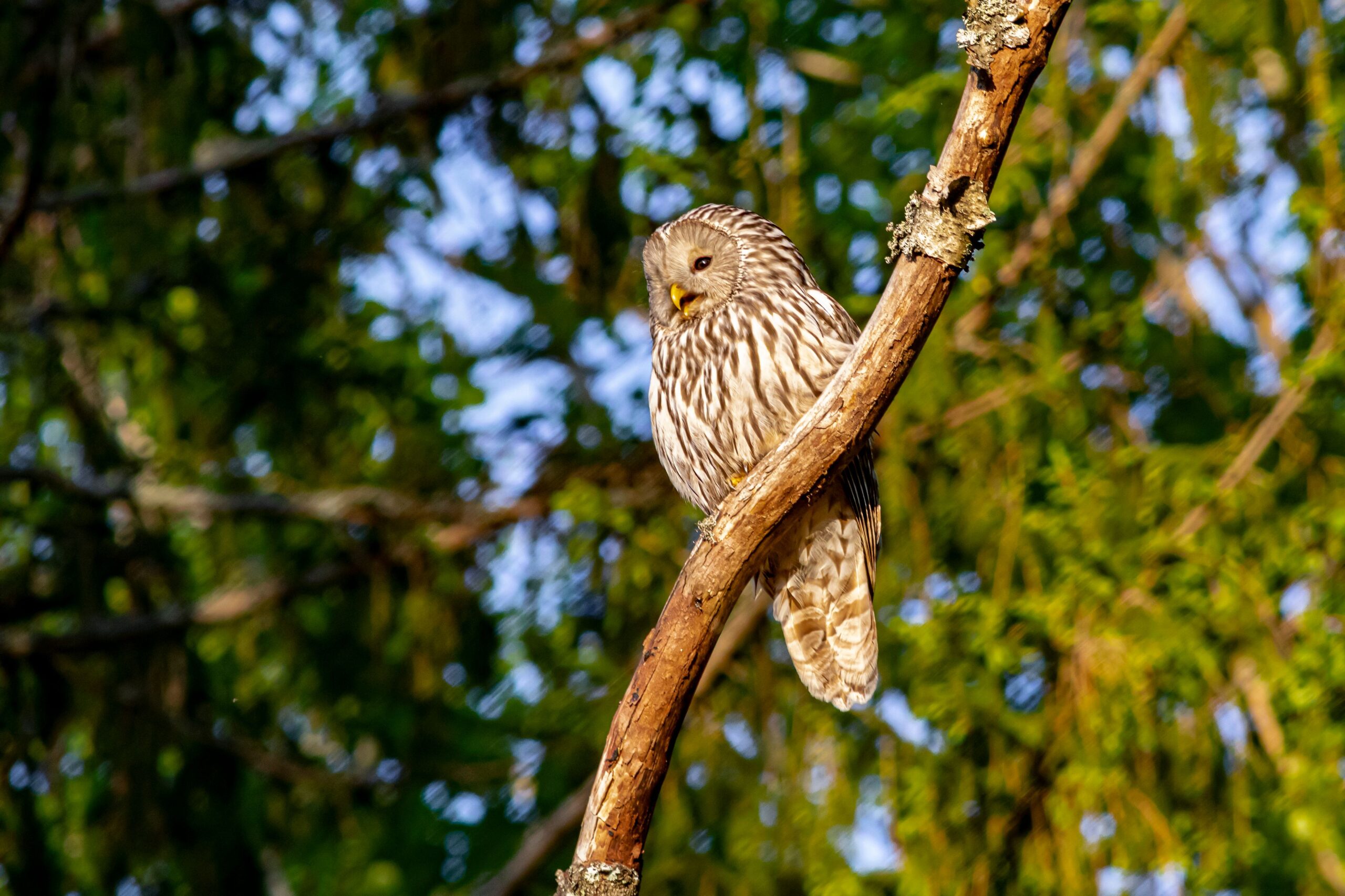
What kind of bird is Blakiston’s Fish Owl? We will explain its characteristics, ecology, and habitat. This bird is a member of the owl family that lives mainly in Japan, but can also be seen in parts of China and the Korean Peninsula. However, this species is actually designated as an endangered species, suggesting the possibility of extinction.







- What is Blakiston’s Fish Owl? About basic status
- What are the roots and origins of the Blakiston’s fish owl?
- Where is its habitat?
- feature is? What kind of creature is it?
- What is the ecology like?
- Blakiston’s Fish Owl Molting
- Vocalizations
- Seasonal Activities
- Flight Speed
- About Blakiston’s Fish Owl Chicks
- Is the fish owl an endangered species?
- Can Blakiston’s Fish Owl be bred?
- Zoos Housing the Species (Japan & Worldwide)
- Introducing other animals
What is Blakiston’s Fish Owl? About basic status
The cheetah is a bird that belongs to the genus Bubo and the family Strigidae. It is one of the largest owls in Japan, with a total length of 66-69cm and a wingspan of 180cm. Its Japanese name is Shima-fukuro (island owl), and its scientific name is Bubo blakistoni. The information is as follows. Its body is more distinctive than its feathers. Its plump body is its characteristic.
| Japanese(和名) | シマフクロウ |
| English(英名) | Blakiston’s Fish-owl |
| scientific name(学名) | Bubo blakistoni |
| classification(分類) | Ave、 Strigiformes、 Strigidae、Buho 鳥綱、フクロウ目、フクロウ科、ワシミミズク属 |
| IUCN Status(保全状況) | ENDANGERED |
| Length(体長) | 66 – 69cm |
| Weight(体重) | 3 – 4kg |
What are the roots and origins of the Blakiston’s fish owl?
The Blakiston’s fish owl (Ketupa blakistoni) originated from a lineage of large owls adapted to the forests of East Asia.
Today, it is one of the largest owl species in the world, inhabiting the cool forests of regions such as Hokkaido and the Russian Far East.
Ancestors: Asian fish-eating owls
Unlike typical forest owls, the Blakiston’s fish owl belongs to a group of “fish-eating owls” that rely primarily on fish for sustenance.
The general evolutionary trajectory is as follows:
Ancient owls
↓
Large owl lineage of East Asia
↓
Divergence into a group with fish-catching habits
↓
Blakiston’s fish owl (Ketupa blakistoni)
Where did they originate?
The ancestors of the Blakiston’s fish owl are believed to have evolved in the forest zones of northern East Asia—an area spanning the present-day
Russian Far East
Northeastern China
Korean Peninsula region
Northern Japanese archipelago
Environments characterized by the presence of
large rivers
freshwater bodies
and primeval forests
were particularly important.
Although the Blakiston’s fish owl is a “forest bird,” its life centered around rivers.
Why did they evolve to eat fish?
Many owls target prey such as
mice
small birds
and insects.
However, as the ancestors of the Blakiston’s fish owl lived in the forests of cold regions, they evolved to utilize resources such as
fish active at night
salmon abundant in rivers
and prey found along the water’s edge.
Consequently, they became specialists in catching fish, possessing
large feet
sharp talons
soles adapted to prevent slipping on wet surfaces
and a robust physique.
When did the Blakiston’s fish owl arrive in Hokkaido?
It is believed that the Blakiston’s fish owl entered Hokkaido from the north during a geological era when the island was connected to the Asian mainland. Tens of thousands of years ago (or earlier):
Eurasian continent
↓
Direction of Sakhalin
↓
Hokkaido
↓
Settled in the forests of Hokkaido
Hokkaido was more accessible to species from northern regions than Honshu was, making it an ideal environment for the Blakiston’s fish owl (shima-fukuro).
Origin of the name
The “Shima” in Shima-fukuro…
…means “owl that lives on the island” (referring to Hokkaido).
In Hokkaido, the bird has long been deeply connected to Ainu culture.
In the Ainu language, it was revered as…
“Kotankorokamuy”
(a god that protects the village).
About classification
The Blakiston’s Fish Owl is a type of owl. There are the following subspecies. We will investigate and introduce the major representative species. In the wild, both males and females are animals that behave individually.
Bubo blakistoni blakistoni
Bubo blakistoni blakistoni is an owl that lives from Hokkaido in Japan to the Kuril Islands. There have been no records of this species on Sakhalin since 1974, suggesting that it may already be extinct.
Bubo blakistoni doerriesi
Bubo blakistoni doerriesi is a member of the owl family that can be seen from China to Mongolia and even the Korean Peninsula. It may also live in southeastern Russia.
Where is its habitat?
As explained above, Blakiston’s Blakiston’s Fish Owl can be seen mainly in Hokkaido, Japan, but also in the Korean Peninsula, China, and Russia. It is distributed in natural places such as forests.
- Habitat in Japan
Main Area: Eastern Hokkaido, especially the Kushiro Wetlands and the Shiretoko Peninsula
Habitat:
Requires virgin forests and large natural forests
A rich habitat for nesting and hunting, with many standing trees.
Hunting grounds are often along rivers and around wetlands.
- Distribution in Russia and Northeast Asia
Also found in the Russian Far East (Sakhalin and Primorsky Krai)
Breeds in broadleaf and mixed forests, preferring deep forests.
- Habitat Characteristics
Since it cannot survive when forests are cleared, it is severely affected by deforestation and development.
It primarily hunts small mammals (such as mice and rabbits) and small birds, so biodiversity in hunting grounds is also essential.
- Conservation Status
Designated as a Special Natural Monument and Endangered Species (EN) in Japan.
Very small populations exist, with isolated populations in each region.
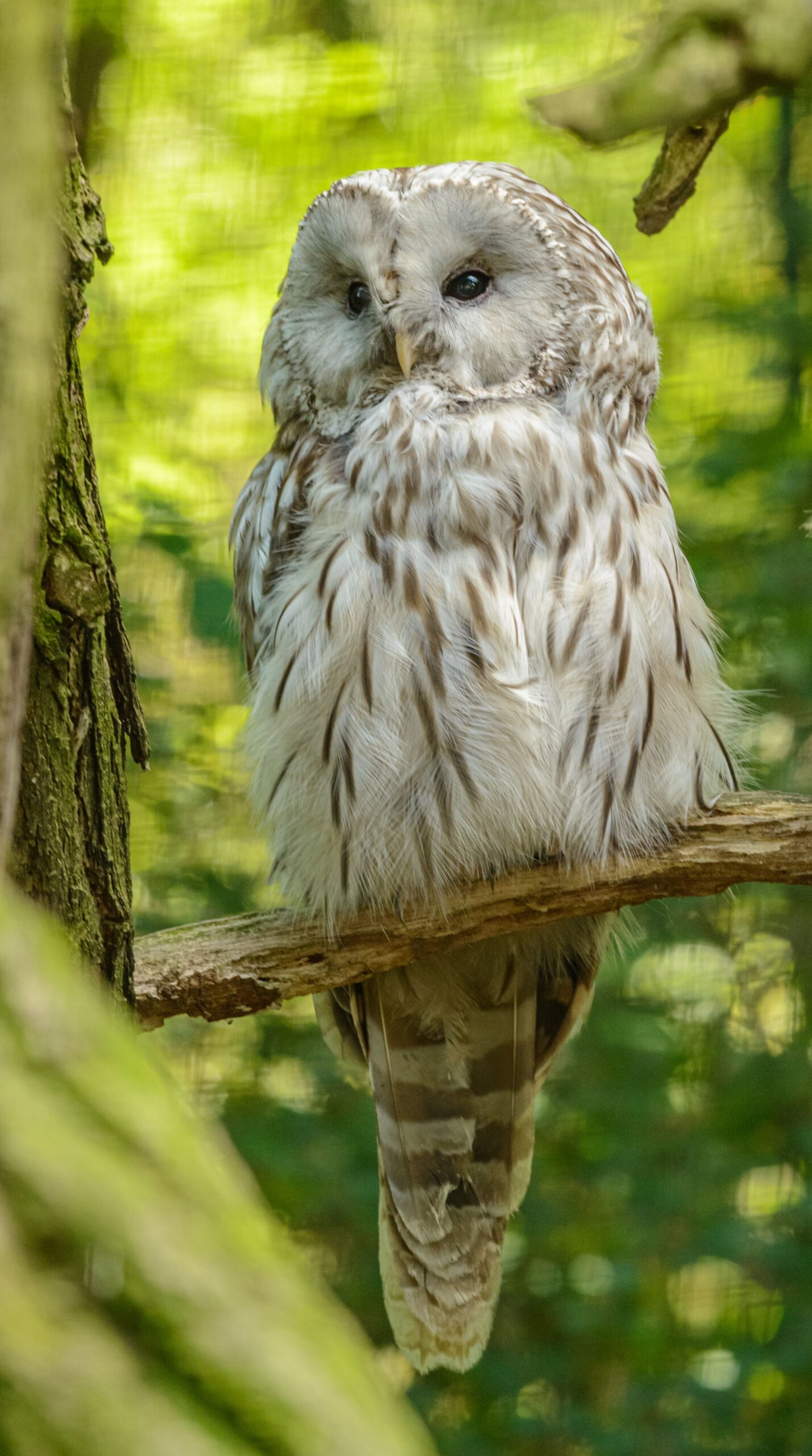
feature is? What kind of creature is it?
The Blakiston’s Blakiston’s fish owl is characterized by its long, wide, ear-shaped feathers on its head. It is also easily recognizable as it is one of the largest owls that can be seen in Japan. The plumage of the whole body is gray-brown, with black-brown vertical stripes and thin horizontal stripes, making it relatively easy to identify. Its main habitat is deciduous forests and it is nocturnal. They also tend to be sedentary rather than migratory birds.
- Body Size and Appearance
Total Length: Approximately 60-72cm
Wingspan: Approximately 150-178cm
Weight: Males approximately 2.2-2.5kg; females are slightly larger at 2.5-3kg
Plumage:
Back and wings are dark brown
Chest and belly are light brown with dark spots
Facial disc is rounded, with dark edges around the eyes
Eyes: Large, dark pupils allow them to easily see prey even in the dark
- Behavior and Personality
Nocturnal rather than diurnal (primarily active at night)
Shy and cautious, they are sensitive to human presence
Perches high in forest trees and closely monitors the movements of their prey
Call is a low, resonant “hoot” used to mark territory and during breeding season
- Diet/Hunting
Main Prey: Mice, rabbits, squirrels, small birds
Hunts at night, approaching prey silently by flying silently.
As a large owl, it can prey on relatively large prey.
- Other Characteristics
The largest owl species living in Japan.
Nests in large trees deep in forests and cannot breed without natural forests.
A very rare and endangered species with a small population.
What is the ecology like?
Blakiston’s Blakiston’s fish owl mainly eats small animals as its staple food. Other fish are often found feeding mainly in shallow waters. They nest and live mainly in tree cavities, large trees, and rock ledges on cliffs. They lay one or two eggs in February or March, and the female takes care of them. Their lifespan is said to be around 30 to 40 years.
- Life Rhythm
Nocturnal: They are primarily active and hunt at night.
During the day, they quietly perch on trees or branches to rest.
They are highly territorial, with each individual having its own range of activity.
- Diet/Hunting
Main Prey:
Small to medium-sized mammals (mice, rabbits, squirrels)
Small birds
Hunting Method:
Study prey from high up in trees or branches.
Quietly jump down to capture prey.
Large individuals can also capture relatively large prey.
- Breeding
Breeding Season: Winter to Spring (usually December to April)
Nest Building:
Nests are built in hollows or on branches of large trees.
Prefer areas with deep forests and old trees.
Egg Laying: Usually 2-3 eggs.
Brooding:
Females are responsible for incubation and raising the eggs.
They begin preparing to leave the nest at about one month old.
Both parents hunt and feed the chicks.
- Sociality
Generally solitary
Rarely interacts with other individuals outside of breeding season
Highly territorial, they mark their territory through vocalizations and markings
- Habitat Relationship
Requires deep areas in virgin forests or natural forests
Large, old trees provide nesting and resting spaces
Habitat destruction makes hunting and breeding difficult
Are there any natural enemies?
Crows are the natural enemies of fish owls. In others, they are still human. Environmental destruction is the biggest risk.
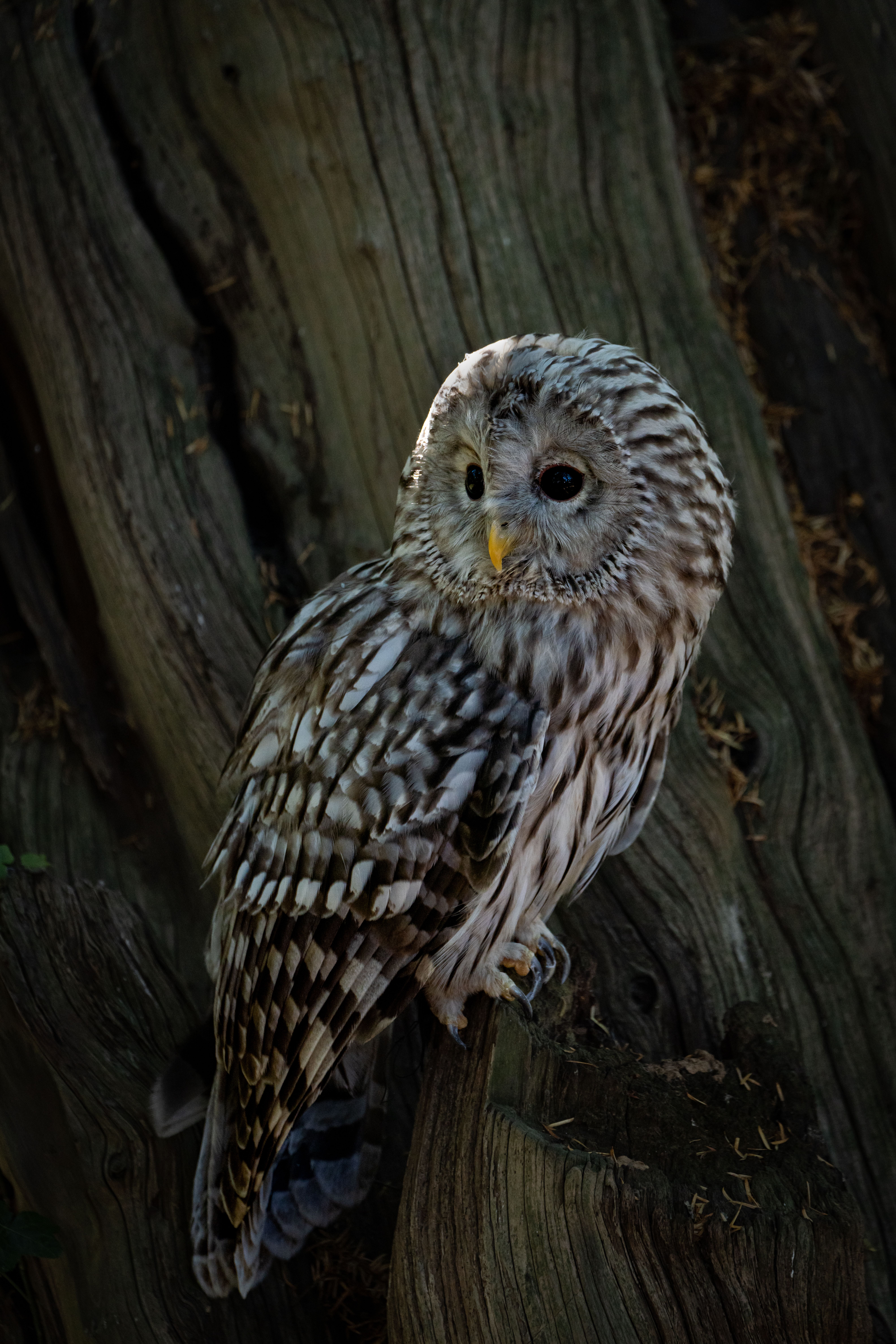
Blakiston’s Fish Owl Molting
Blakiston’s Fish Owls replace their feathers in accordance with their growth and seasonal changes.
As large owls, they do not shed and replace all their feathers at once over a short period like smaller birds; instead, they molt gradually to maintain their ability to fly.
☀️ Summer (June–September) | Peak Molting Season
This is the most critical molting season for Blakiston’s Fish Owls.
Feathers primarily replaced include:
Flight feathers (large wing feathers)
Tail feathers
Body feathers
Feathers around the face
…and others.
The wing flight feathers are particularly important, as they are directly linked to flight performance.
Why don’t they lose all their feathers at once?
Blakiston’s Fish Owls are large predators.
If they were to lose their wing feathers all at once, they would face dangers such as:
Being unable to fly
Being unable to catch fish
Being unable to escape from natural predators
Therefore, in the wild, they have a mechanism to replace feathers on the left and right wings little by little, ensuring they remain capable of hunting.
Molting in Young Owls
Blakiston’s Fish Owls undergo multiple molts before reaching adulthood.
Immediately after hatching
White downy feathers
Unable to fly
↓
Juvenile stage
Brownish feathers
Prominent striped pattern
↓
Adult
Yellow eyes
White eyebrow markings
Brown body
Large ear tufts
They eventually take on this appearance.
Vocalizations
The Blakiston’s fish owl is characterized by deep, resonant calls that sound like “boo-boo” or “voh-voh.”
As befits a large owl, their voices are incredibly powerful, carrying long distances through the night forest and along riverbanks.
Typical Calls
🌙 “Boo-boo”
This is their most well-known call.
Functions:
Territory assertion
Communication between mates
Locating one another
The low-pitched calls are repeated at regular intervals; in the night forest, they sound like the beating of a “forest drum.”
Duetting
Blakiston’s fish owls live in mated pairs, so the male and female often call back and forth to each other.
Characteristics:
Male: Low, deep voice
Female: Slightly higher-pitched voice
The two birds may call alternately:
“Boo… boo…”
“Kwoh… kwoh…”
This exchange serves to confirm territory boundaries and strengthen the bond between the pair.
Breeding Season Calls (Winter to Spring)
The breeding season for Blakiston’s fish owls is primarily from January to May.
Vocal activity increases significantly during this period.
Purposes:
Pair formation
Declaring territory around the nest
Attracting a mate
Their calls can often be heard at night coming from forests along rivers.
Alarm and Threat Calls
When sensing danger, they emit short, sharp sounds such as:
“Gya”
“Gwah”
“Kururu”
These serve as warnings to:
Other Blakiston’s fish owls
Predators
Humans, etc.
Chick Calls
Young birds call out to their parents for food, making high-pitched sounds like:
“Pee-pee”
“Kee-kee”
These differ greatly from the low voices of adults, making the chicks’ presence audible even from a distance.
Seasonal Activities
The Blakiston’s fish owl is a large, nocturnal owl that makes its home in the primeval forests and rivers of Hokkaido.
Its activities—including breeding, raising young, hunting, and territorial behavior—shift significantly with the seasons.
🌸 Spring (March–May) | Breeding and Rearing Season
Key Activities
Strengthening pair bonds
Breeding in nesting cavities
Raising chicks
This is the most critical season for the Blakiston’s fish owl.
Breeding Behavior
From winter through spring, the following activities intensify:
Duetting (calling back and forth between male and female)
Territory verification
Nest site inspection
Nests are typically located in:
Tree hollows in large trees
Nest boxes
Cliffs or rocky areas
Raising Young
Chicks hatched in the spring grow by being fed by their parents.
At night, the parent birds:
Catch prey such as fish, frogs, and small mammals
Carry the food back to the nest
☀️ Summer (June–August) | Chick Growth and Hunting Skill Acquisition
Key Activities
Fledging (leaving the nest)
Hunting practice
Molting
Summer is the time when the young birds grow.
Growth of Young Birds
Young birds that have left the nest cannot hunt proficiently right away.
They learn the following from their parents:
How to fly
How to catch fish
How to ambush prey in the river
Period of Increased Food Intake
Parent birds hunt actively to feed their growing chicks.
Main prey:
Salmon and trout
Freshwater fish
Frogs
Snakes
Small mammals
🍂 Autumn (September–November) | Independence and Territory Formation
Key Activities
Independence of young birds
Seeking a territory
Preparing for winter
Young birds raised during the summer leave their parents to find a new place to live.
Importance of River Environments
Autumn is a season of abundant fish resources.
In particular, the following serve as vital food sources for the owls:
Salmon runs (upstream migration)
Increased river fish populations
❄️ Winter (December–February) | Territory Maintenance and Breeding Preparation
Key Activities
Territory maintenance by the mated pair
Nighttime hunting
Courtship behavior
Winter is a season when Blakiston’s Fish Owls are particularly active.
Reasons:
The breeding season is approaching
Vocalizations increase
They hunt along rivers
Flight Speed
There is no precise figure for the Blakiston’s fish owl’s maximum flight speed, as there is little data measured in detail in the wild.
However, based on its physique, wing structure, and flight characteristics, its normal flight speed is estimated to be around 30–50 km/h.
① Large wings suited for “slow, stable flight”
The Blakiston’s fish owl is one of the world’s largest owls, with:
A body length of approximately 70 cm
A wingspan of approximately 175–190 cm
A weight of approximately 3–5 kg
Consequently, rather than:
High-speed flight like small birds
Diving at high speeds like hawks
It is better suited for:
Silent gliding flight using its large wings
② Virtually silent flight
A major characteristic of owls, including the Blakiston’s fish owl, is silent flight.
Their wings feature:
A serrated structure along the edges of the feathers
Soft plumage
These features reduce the noise caused by airflow.
As a result,
They can approach prey (such as fish or small animals) without being easily detected.
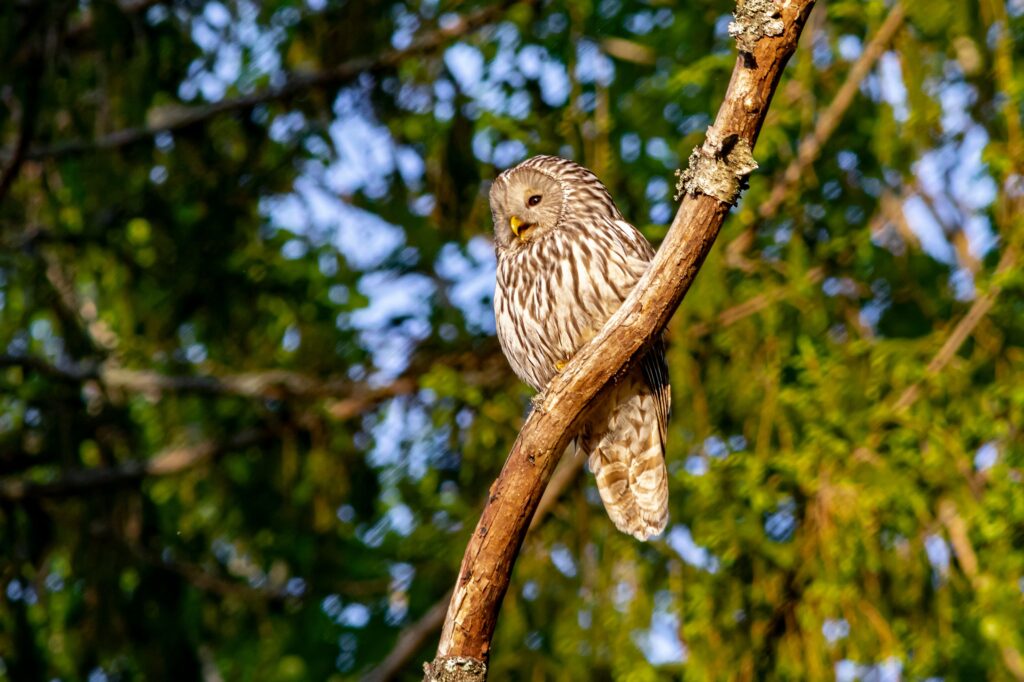
About Blakiston’s Fish Owl Chicks
By analyzing Blakiston’s Fish Owl (Bubo blakistoni) chicks, we can understand their developmental stages, behavior, and relationship with their parents from hatching to fledging.
- Birth and Nest
Nesting Location: Tree hollows or on the branches of tall trees
Number of Eggs Laid: Usually 2-3
Egg Size: Approximately 6-7cm
Incubation Period: Chicks hatch in approximately 30 days
- Young Bird Characteristics
Weight: Approximately 70-100g at hatching
Feathers: Soft, grayish-white to light brown down
Vision and Hearing: Sensitive from birth, responding to their parents’ calls and movements
Behavior:
Initially, they stay still in the nest
They wait safely in the nest while the mother hunts
- Growth Stages
Months: Behavior and Growth: 0-1 month: Eggs hatch. The mother incubates and feeds them. They barely move yet, and their feathers are downy. 1-2 months: The feathers become firmer. They play with their siblings and begin to practice movement and flight. 2-3 months: They practice flying around the nest with their parents. They get food and pretend to hunt. 3-4 months: They start to leave the nest. Their flying ability improves, and they continue to practice in preparation for independence. 4-5 months: They have fully left the nest. They gradually become independent from their parents and begin to act.
Is the fish owl an endangered species?
Unfortunately, Blakiston’s Fish Owl is an endangered species and is listed on the Red List. Furthermore, it is listed in Appendix II of the Washington Convention, and international trade is strictly restricted. Of course, the biggest threat is humans, and their population is decreasing due to the following reasons: It is estimated that there are only a few thousand individuals.
habitat destruction
Habitat destruction by humans is the biggest threat. Due to a wide variety of causes of death, including water pollution, competition with fishing industries, and traffic accidents, owls are losing their homes year after year. Furthermore, there are areas where they are consumed as food, and hunting is also a problem. It was designated as a national natural monument by the Japanese government’s Ministry of the Environment in 1971, and as a rare wild animal species in 1993. Currently, conservation activities and support have begun as a business. Research business plans are also progressing.
Can Blakiston’s Fish Owl be bred?
Unfortunately, the Blakiston’s Blakiston’s fish owl is designated as an endangered species, so it cannot be kept in captivity due to its small population. Let’s enjoy it at the zoo.
- Legal Issues
In Japan, Blakiston’s Fish Owls are designated as a Special Natural Monument/Endangered Species, and capture and breeding without permission is prohibited.
Special permission from the Ministry of the Environment is required for breeding and research.
Violations are subject to penalties and criminal prosecution.
- Difficulties in Breeding
Requires ample flight space: Blakiston’s Fish Owls are nocturnal and hunt for food, so they experience significant stress in small cages or huts.
Difficulty in securing food: Natural prey, such as small mammals and birds, must be secured daily.
Nocturnal and timid:
Sensitive to humans and noise, they are prone to becoming ill from excessive stress.
Difficulty in breeding: They require tree hollows and tall trees for nesting, making it extremely difficult to recreate their natural environment.
- Where Breeding is Possible
Breeding is permitted only in specialized facilities such as zoos and research facilities.
Facilities provide ample flight cages, nesting environments similar to their natural habitat, and specialized breeding and management systems.
Zoos Housing the Species (Japan & Worldwide)
As the Blakiston’s fish owl is a rare and endangered species, it is not commonly found in typical zoos.
Currently, they are primarily kept in facilities dedicated to conservation breeding and species preservation.
🇯🇵 Major Facilities in Japan
🦉 Sapporo Maruyama Zoo
A leading zoo in Hokkaido that is actively involved in the care and breeding of Blakiston’s fish owls.
Features:
Exhibits Blakiston’s fish owls
Participates in conservation and propagation projects
Manages captive-bred individuals
Maruyama Zoo presents the Blakiston’s fish owl as a rare wild animal native to Hokkaido.
🦉 Kushiro Zoo
A key facility for the conservation and breeding of Blakiston’s fish owls.
Activities:
Pair formation
Breeding research
Captive breeding
Management of rescued/protected individuals
Kushiro Zoo has conducted breeding research since the 1980s, making a significant contribution to the conservation of the species in Japan.
🦉 Asahiyama Zoo
Another prominent zoo in Hokkaido that participates in the network for Blakiston’s fish owl care and breeding.
It plays a role in supporting species preservation through distributed housing (keeping individuals at multiple locations).
🌏 Facilities Worldwide
Russian Far East
Blakiston’s fish owls also inhabit:
Primorsky Krai (Russia)
The area around Sakhalin
Northeastern China
While there are instances of them being kept in select research facilities and zoos overseas, the total number of individuals in captivity worldwide is very low.
Primary reasons:
Difficult to replicate their natural habitat
Requires large flight spaces
Nocturnal and sensitive to stress
Requires a specialized diet centered on fish
Difficult to breed
Introducing other animals
コメント